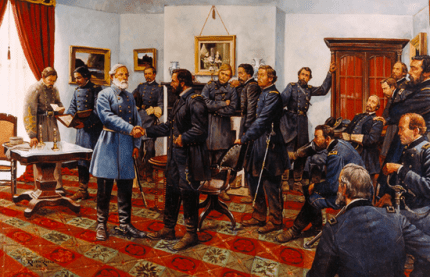
But of course, we studied the Civil War in our U.S. history classes last fall, in the first six weeks, as a review of what the students were supposed to get in 8th grade.
In your classroom, how do you deal with anniversaries when they are out of the current course of study? How have you seen it done well?
The Surrender, by Keith Rocco – image from National Park Service, via Pillar to Post
The frequently quotable Oliver Wendell Holmes, Jr., circa 1930. Edited photograph from the Library of Congress Prints and Photographs Division. Original photo by Harris & Ewing. LC-USZ62-47817. Copyright expired.
I like paying taxes. With them I buy civilization.
Justice Oliver Wendell Holmes, Jr., attributed. (see Felix Frankfurter, Mr. Justice Holmes and the Supreme Court, Harvard University Press, 1961, page 71.)
I found reference to the quote in a book about eminent economists, through Google Scholar:
Eminent Economists: Their Life Philosophies
By Michael Szenberg
Published by Cambridge University Press, 1993
320 pages
On page 201, Szenberg refers Holmes’s view of “taxation as the price of liberty.” In a footnote, he points to Justice Frankfurter’s book. The quote is dolled up a little. According to Szenberg’s footnote:
More precisely, he rebuked a secretary’s query of “Don’t you hate to pay taxes?” with “No, young fellow, I like paying taxes, with them I buy civilization.”
Frankfurter is a reliable source. It’s likely Holmes said something very close to the words Friedman used.
April 13 should be a holiday, don’t you think? Religious Freedom Day, or Public Education Day, or Self-evident Truths Day — something to honor Thomas Jefferson.
Tomorrow, April 14, Mission Specialists Dottie Metcalf-Lindenburger is scheduled to talk with students at Eastern Guilford High School in North Carolina, and all of the 71,000 students in Eastern Guilford School District.
Caption from NASA: STS-131 Mission Specialist Dorothy Metcalf-Lindenburger, attired in a training version of her shuttle launch and entry suit, poses for a photo prior to the start of an ingress/egress training session in the Space Vehicle Mock-up Facility at NASA's Johnson Space Center. Photo Credit: NASA
Metcalf-Lindenburger is one of three teachers selected in 2004 as astronauts. NASA is committed to help education out. After the Challenger disaster, and the death of “teacher in space” Christa McAuliffe, NASA finally determined to make teachers into astronauts rather than fly “civilians.”
Haley Miller
Guilford Public Schools, Guilford, N.C.
336-370-3200 millerh3@gcsnc.com
April 12, 2010
MEDIA ADVISORY : M10-048
Orbiting Space Shuttle Astronauts — Including Former Teacher — Call North Carolina Students
WASHINGTON — Astronauts orbiting 220 miles above Earth will speak with students in Gibsonville, N.C., on Wednesday, April 14. The call with the students and space shuttle Commander Alan Poindexter and Mission Specialists Dottie Metcalf-Lindenburger, Stephanie Wilson and Clay Anderson will take place at 1:06 p.m. EDT at Eastern Guilford High School in Gibsonville.
Eastern Guilford High School is hosting students from Eastern Guilford Middle School, Gibsonville Elementary, McLeansville Elementary, Rankin Elementary and Sedalia Elementary for the downlink. The school also will broadcast the event to the entire Guilford County Schools district, which serves more than 71,000 students.
The astronauts launched Monday, April 5, aboard space shuttle Discovery from NASA’s Kennedy Space Center in Florida. During the 13-day mission to the International Space Station, the crew will deliver science experiments and supplies; take three spacewalks to switch out a gyroscope on the station’s truss, or backbone; install a spare ammonia storage tank and return a used one; and retrieve a Japanese experiment from the station’s exterior.
Metcalf-Lindenburger is one of three teachers selected to fly as shuttle mission specialists in the 2004 Educator Astronaut Class. She operates the shuttle’s robotic arm. Without robotics, major accomplishments like building the station, repairing satellites in space and exploring other worlds would not be possible.
Students have been preparing for the downlink by conducting NASA engineering design challenges and implementing agency robotics resources and activities into K-12 classrooms. A science, technology, engineering and math, or STEM, club was organized to increase participation and interest, particularly by female students.
The school’s guidance department also is collaborating with local universities to help students investigate and explore STEM opportunities beyond graduation. During follow up in-district workshops in April and May, a NASA Aerospace Education Services Program specialist will demonstrate how to access and use NASA resources in K-12 curricula.
Eastern Guilford High School employee Michael Woods, a former Aerospace Education Services Project specialist at NASA’s Goddard Space Flight Center in Greenbelt, Md., and the agency’s Langley Research Center in Hampton, Va., is leading the downlink effort. In December 2009, NASA awarded Guilford County Schools a two-year grant of nearly $1 million to help middle and high school teachers develop science lessons using the space agency’s content.
The event is part of a series with educational organizations in the U.S. and abroad to improve teaching and learning in science, technology, engineering and mathematics. The in-orbit call is part of Teaching From Space, a NASA project that uses the unique environment of human spaceflight to promote learning opportunities and build partnerships with the kindergarten through 12th grade education community.
NASA Television will air video of the astronauts during the downlink. For NASA TV downlink, schedule and streaming video information, visit:
Here’s another opportunity to put real, cutting edge technology in your classroom. In fact, your kids could probably invent all sorts of new uses for it.
Have you even heard of this stuff? Can you use it, live, with the equipment you’ve got?
Blaise Aguera y Arcas of MicroSoft demonstrated augmented-reality maps using the power of Bing maps, Flickr, Worldwide Telescope, Video overlays and Photosynth, to an appreciative and wowed audience at TEDS:
My prediction: One more advance in computer technology that classrooms will not see in a timely or useful manner.
But have you figured out how to use this stuff in your geography, history, economics or government classes? Please tell us about it in comments. Give examples and links, please.
It’s not exactly family safe, so I’ll link. For a college class, I’d ask students to determine if the piece is accurate, and if not, what really happened.
Pulitzer Prize-winner Tom Toles in the Washington Post, March 19, 2010
It’s pretty embarrassing when the State Board of Education’s actions leave Texas open to jokes about whether Texans remember the Alamo. Remembering the Alamo is as much a Texas monument or icon as anything else — maybe moreso.
Tom Toles demonstrates why Texas should be embarrassed by the Texas State Board of Education’s work on social studies standards.
Spread the word; friends don't allow friends to repeat history.
Clay Bennett, Chattanooga Times-Free Press, March 16, 2010
Bennett remains one of my favorite cartoonists today. His work is incisive, intelligent, and persuasive to the side of reason and light almost all of the time. Why hasn’t he won a Pulitzer yet?
Bennett is generally a powerful supporter of U.S. education; see the two other recent cartoons, below the fold.
The first one featured pure crankery, often, from Christopher Monckton and Steven Milloy, two people who have made careers out of pissing in the soup of science. The second conference pretended warming isn’t happening (the title of the conference was). The theme of the third conference is “Reconsidering the Science and the Economics,” but you’d have to be complete fool to think the Heartland Institute would allow a reconsideration of their misplaced sniping at science and bizarre claims that we cannot afford a healthy planet (we can’t afford an unhealthy planet!).
Watts’s topic will be “Is the U.S. Surface Temperature Record Reliable?” It should be a remarkable presentation.
If the surface temperature record isn’t reliable, what’s he doing using it every day in his weather forecasts? If it is reliable, what’s he doing attacking scientists for using it, and where does he propose to get better, more reliable data?
You can rely on this: There will be lots of press releases, but precious little science that has gone through any peer review process to provide reliability.
In fact, now would be a great time to brush up on Jeremy Bernstein’s methods for telling crank science from genius, and Bob Parks’s “Seven Warning Signs of Bogus Science.”
I’d love to have the concession to sell the “Bogus Science Bingo” cards at the meeting.
Chicago in May can be delightful. Cooler days do not get so cool. Spring flowers still erupt. Warmer days will invite outdoor dining downtown and at Chicago’s great neighborhood restaurants.
But these guys will stay indoors and carp about science, about imagined conspiracies to keep their words of wisdom out of publication. Most of them will have some corporate or PAC group paying their way, but a few people will pay to see this parade of voodoo science. They will be had by all.
Spread the word; friends don't allow friends to repeat history.
In a discussion of the Cold War, the Space Race, and the Race to the Moon, we get to a photo about Apollo 11’s landing on the Moon.
Like clockwork, a hand goes up: “Mr. Darrell, wasn’t that landing a hoax? They didn’t really go to the Moon then, did they?”
There are a lot of ways to know that Apollo 11 landed on the Moon. Among other things, students could talk to people alive at the time who have the slightest bit of technological savvy: With lots of other people, I tracked part of the trip with my 6-inch reflecting telescope. Ham radio operators listened in on the radio broadcasts. And so on.
But I really like this chunk of evidence: How about a photograph of the landing site?
Holy cow! You can see the tracksof Neil Armstrong’s footprints to the lip of Little West crater (see arrow below).
Tranquility Base, shot from the Lunar Reconnaissance Orbiter Camera (LROC), showing the traces left by Apollo 11's landing on the Moon. It really happened. Credit: NASA/GSFC/Arizona State University
The astronaut path to the TV camera is visible, and you may even be able to see the camera stand (arrow). You can identify two parts of the Early Apollo Science Experiments Package (EASEP) – the Lunar Ranging Retro Reflector (LRRR) and the Passive Seismic Experiment (PSE). Neil Armstrong’s tracks to Little West crater (33 m diameter) are also discernable (unlabeled arrow). His quick jaunt provided scientists with their first view into a lunar crater.
Ben Sargent, Austin American-Statesman (GoComics) March 17, 2010
(I first saw a Ben Sargent cartoon published in the Daily Utah Chronicle in about 1974. 35 years of great stuff from that guy. He officially retired from the Austin American-Statesman in 2009, running one cartoon a week now.)
Or, until that account is unsuspended by the forces supporting Donald Trump: Follow @FillmoreWhite, the account of the Millard Fillmore White House Library
We've been soaking in the Bathtub for several months, long enough that some of the links we've used have gone to the Great Internet in the Sky.
If you find a dead link, please leave a comment to that post, and tell us what link has expired.
Thanks!
Retired teacher of law, economics, history, AP government, psychology and science. Former speechwriter, press guy and legislative aide in U.S. Senate. Former Department of Education. Former airline real estate, telecom towers, Big 6 (that old!) consultant. Lab and field research in air pollution control.
My blog, Millard Fillmore's Bathtub, is a continuing experiment to test how to use blogs to improve and speed up learning processes for students, perhaps by making some of the courses actually interesting. It is a blog for teachers, to see if we can use blogs. It is for people interested in social studies and social studies education, to see if we can learn to get it right. It's a blog for science fans, to promote good science and good science policy. It's a blog for people interested in good government and how to achieve it.
BS in Mass Communication, University of Utah
Graduate study in Rhetoric and Speech Communication, University of Arizona
JD from the National Law Center, George Washington University


 Posted by Ed Darrell





 Millard Fillmore's Bathtub