Let’s do lunch: February 1, 1960, non-violence, human rights, and a grilled cheese sandwich

February 2, 2009

Four young men turned a page of history on February 1, 1960, at a lunch counter in a Woolworth’s store in Greensboro, North Carolina.

Ezell A. Blair, Jr. (now Jibreel Khazan), Franklin E. McCain, Joseph A. McNeil, and David L. Richmond, sat down at the counter to order lunch.  Because they were African Americans, they were refused service.  Patiently, they stayed in their seats, awaiting justice.

On July 25, nearly six months later, Woolworth’s agreed to desegregate the lunch counter.

Ezell A. Blair, Jr. (now Jibreel Khazan), Franklin E. McCain, Joseph A. McNeil, and David L. Richmond leave the Woolworth store after the first sit-in on February 1, 1960. (Courtesy of Greensboro News and Record)

From the Smithsonian Institution: "Ezell A. Blair, Jr. (now Jibreel Khazan), Franklin E. McCain, Joseph A. McNeil, and David L. Richmond leave the Woolworth store after the first sit-in on February 1, 1960. (Courtesy of Greensboro News and Record)"

News of the “sit-in” demonstration spread.  Others joined in the non-violent protests from time to time, 28 students the second day, 300 the third day, and some days up to 1,000.   The protests spread geographically, too, to 15 cities in 9 states.

On the second day of the Greensboro sit-in, Joseph A. McNeil and Franklin E. McCain are joined by William Smith and Clarence Henderson at the Woolworth lunch counter in Greensboro, North Carolina. (Courtesy of Greensboro News and Record)

Smithsonian Institution: "On the second day of the Greensboro sit-in, Joseph A. McNeil and Franklin E. McCain are joined by William Smith and Clarence Henderson at the Woolworth lunch counter in Greensboro, North Carolina. (Courtesy of Greensboro News and Record)"

Part of the old lunch counter was salvaged, and today is on display at the Smithsonian Institution’s Museum of American History.  The museum display was the site of celebratory parties during the week of the inauguration as president of Barack Obama.

Part of the lunchcounter from the Woolworths store in Greensboro, North Carolina, is now displayed at the Smithsonians Museum of American History, in Washington, D.C.

Part of the lunchcounter from the Woolworth's store in Greensboro, North Carolina, is now displayed at the Smithsonian's Museum of American History, in Washington, D.C.

Notes and resources:


Misquoting Jefferson?

February 1, 2009

Statue of Thomas Jefferson in the Jefferson Memorial - Mr. Lant's HIstory page

Statue of Thomas Jefferson in the Jefferson Memorial, Rudulph Evans, sculptor – Library of Congress photo by Carol Highsmith, who graciously puts her photos in the public domain

A commentary from Cal Thomas caught my eye — little more than a few quotes from Thomas Jefferson strung together.  Jefferson seems oddly prescient in these quotes, and, also oddly, rather endorsing the views of the right wing.

From the way the text is laid out, and the brevity of the piece, I’m guessing it’s a radio commentary.

I read Jefferson often.  I’ve read Jefferson a lot.  I don’t recognize any of the quotes.

So I plugged them into the Jefferson collection at Liberty Fund’s Online Library of Liberty, which has a lot of Jefferson ready for full-text searching.

Oops.  None of the quotes scored a hit.

Couldn’t find them in the Library of Congress’s on-line list of quotes, either.

It looks as though Jefferson didn’t say these things that are being attributed to him.

Cal, is that you?

Cal, can you give us citations on these quotes?

How about you, Dear Reader?  Can you save Cal Thomas’s bacon by providing a citation for any of the quotes below, alleged to be from Thomas Jefferson?

AS WE LISTEN TO TALK OF BAILOUTS AND ENDLESS DEBT, THINK ON THESE THOUGHTS FROM THOMAS JEFFERSON:

“THE DEMOCRACY WILL CEASE TO EXIST WHEN YOU TAKE AWAY FROM THOSE WHO ARE WILLING TO WORK AND GIVE TO THOSE WHO WOULD NOT.”

HERE’S ANOTHER: “IT IS INCUMBENT ON EVERY GENERATION TO PAY ITS OWN DEBTS AS IT GOES. A PRINCIPLE WHICH IF ACTED ON WOULD SAVE ONE-HALF THE WARS OF THE WORLD.”

AND ANOTHER: “I PREDICT FUTURE HAPPINESS FOR AMERICANS IF THEY CAN PREVENT THE GOVERNMENT FROM WASTING THE LABORS OF THE PEOPLE UNDER THE PRETENSE OF TAKING CARE OF THEM.”

AND ONE MORE:  “MY READING OF HISTORY CONVINCES ME THAT MOST BAD GOVERNMENT RESULTS FROM TOO MUCH GOVERNMENT.”

There you have ’em, Dear Readers.  Did somebody hoodwink Cal Thomas into thinking these are Jefferson’s bon mots, when they are not?

Shake of the wet scrub brush to Truthseeker.

Below the fold, the complete Cal Thomas commentary.
Read the rest of this entry »

Box of surprises

January 29, 2009

HistoryBox.com?

Check it out — there be good stuff.

For example, abundant sources of information and especially images on the history of New York City can be found here.  It’s in directory form, so you may need to click once more to get what you need — but so far, everything I’ve clicked works, and it always seems to go to a good site.

New York state resources, here.

The U.S. history portion is not working yet.


Let there be light: January 27, anniversary of bright idea

January 29, 2009

Oops, missed this anniversary date!

First page of patent granted to Thomas Edison on January 27, 1880 -- for light bulb

First page of patent granted to Thomas Edison on January 27, 1880 -- for light bulb

Thomas Alva Edison got a patent for “electric-lamp” on January 27, 1880.

According to the Our Documents site:

In 1878 the creation of a practical long-burning electric light had eluded scientists for decades. With dreams of lighting up entire cites, Edison lined up financial backing, assembled a group of brilliant scientists and technicians, and applied his genius to the challenge of creating an effective and affordable electric lamp. With unflagging determination, Edison and his team tried out thousands of theories, convinced that every failure brought them one step closer to success. On January 27, 1880, Edison received the historic patent embodying the principles of his incandescent lamp that paved the way for the universal domestic use of electric light.

(Information excerpted from American Originals by Stacey Bredhoff; [Seattle and London; The University of Washington Press, 2001] p. 62–63.

Our Documents grew out of the National Archives list of 100 milestone documents important to American history — Edison’s patent application was voted one of the top 100.  Our Documents is now a joint exercise combining the efforts of the National Archives, National History Day, and USA Freedom Corps.

Page from Edisons application for patent for an electric lamp - National Archives

Page from Edison's application for patent for an "electric lamp" - National Archives


President Grant’s papers moving – to Mississippi

January 28, 2009

It’s either a sign of how old wounds have healed, or it’s another step in the cryptic and slow, cold war in which the South works to overcome the victory of the Union in the Civil War.

Ulysses S Grant as a Lt. General, Library of Congress image

Ulysses S Grant as a Lt. General; photo by Alexander Gardner, Library of Congress image

Associated Press reports (via Federal News Radio) the papers of President Ulysses S Grant will move from the University of Southern Illinois at Carbondale,  to Mississippi State University, in Starkville, Mississippi.

The fact that a collection about a Union hero who helped topple the Confederacy has wound up in Dixie is not lost on [John Marszalek, a Civil War scholar and Mississippi State history professor emeritus who’s now shepherding the collection].

“There’s an irony in it,” he said with a laugh. “People recognize this for its scholarly worth, and I think what has happened over time is that people have come to realize that the Civil War is over and we’re a united nation again.”

Still, Grant’s return to the South doesn’t thrill Cecil Fayard Jr., the Mississippi-based leader of the Sons of Confederate Veterans.

“U.S. Grant is not beloved in the state of Mississippi. Southern folks remember well his brutal and bloody tactics of war, and the South will never forget the siege of Vicksburg,” he said.

The Ulysses S. Grant Association, which owns the papers, decided to move them at the request of Marzsalek, who was named conservator after the death of John Y. Simon, the historian who had curated the collection during the publication of more than 30 volumes of Grants papers, beginning in 1962.  Simon lost his professorship at SIU last year, and died in July 2008.

The modern concept of a presidential library did not exist until 1939.  The first such library was the Franklin D. Roosevelt Library in Hyde Par, New York, established with papers donated in 1939.  There are now official libraries, parts of the U.S. National Archives system, for Herbert Hoover (who preceded FDR) in West Branch, Iowa, Harry Truman, in Independence, Missouri, Dwight Eisenhower, in Abilene, Kansas, John Kennedy, at Harvard University near Boston, Lyndon Johnson at the University of Texas, Austin, Richard Nixon at Yorba Linda, California, Gerald Ford library at Ann Arbor and museum (still under construction) in Grand Rapids, Michigan, Jimmy Carter in Atlanta, Ronald Reagan at Simi Valley, California, George H. W. Bush at Texas A&M University, College Station, Texas, and Bill Clinton in Little Rock.  George W. Bush is working to establish a library and institute at Southern Methodist University in Dallas, the library an extension of the National Archives, and the institute modeled roughly after the Herbert Hoover Institution affiliated with Stanford University in Palo Alto, California.

George Washington and Abraham Lincoln are honored with institutions, too.  Washington’s home at Mount Vernon, Virginia, is held by the Ladies of Mount Vernon Association, which originally saved the mansion; the Abraham Lincoln Presidential Library and Museum is in Springfield, Illinois.  Neither of those institutions has much formal tie to the federal library system.

Because of their places in history, even at the risk of enlarging the institutionalness and management problems of these libraries, I would like to see libraries established for Theodore Roosevelt, perhaps in South Dakota; for Woodrow Wilson; For Andrew Jackson, probably near his home in Tennessee; and for John Adams and/or John Quincy Adams, outside of Boston.  These institutions could bolster the spread of knowledge and preservation of history of our freedoms and liberties; if we were rich, it would be useful and productive to put libraries in Ohio — for William Howard Taft, or for Taft and Garfield and Buchanan — and far upstate New York for Millard Fillmore, perhaps at the University of Buffalo.  Libraries honoring James Madison and James Monroe could be useful, too, but would put a great concentration of such institutions close to Charlottesville, Virginia.

Resources:

Under the fold:  Quotations from U. S. Grant, from the Grant papers collection.

Read the rest of this entry »


Reading for government classes: Obama’s shift in governing philosophy

January 28, 2009

No, Obama didn’t change his mind.  He’s changing the way government does business — putting government on a more solidly-based, business-like model for performance, according to at least one observer.  That’s the shift discussed.

And it’s about time, I say.

Max Stier’s commentary on the Fed Page of the Washington Post quickly lays out the case that Obama’s making big changes.  Copy it for students in your government classes (or history classes, if you’re studying the presidency in any depth).  Stier wrote:

There are some fundamental reasons why our federal government’s operational health has been allowed to steadily deteriorate. It’s hard to change what you don’t measure, and our government operates in an environment with very few meaningful and useful measurements for performance. Perhaps more significantly, it is run by short-term political leadership that has little incentive to focus on long-term issues.

A typical presidential appointee stays in government for roughly two years and is rewarded for crisis management and scoring policy wins. These individuals are highly unlikely to spend significant energy on management issues, when the benefits of such an investment won’t be seen until after they are long gone.

(According to the Post, “Max Stier is president and CEO of Partnership for Public Service, a group that seeks to revitalize the federal government.”  I don’t know of him otherwise.)

Political appointees can be good, but too many have not been over the past 25 years.  A bad enough political appointee can frustrate even the most adept, dedicated-to-the-people’s-business career federal service employees, and frustrate the law and good management of agencies.

Let’s wish them all good luck.

Potential questions to follow-up this article in discussions:

  • Constitution: Under the Constitution, who specifically is charged with managing the federal agencies, the “federal bureaucracy?  What is that charge, in the Constitution?
  • Constitution, politics: What is the role of Congress in managing the federal bureaucracy?
  • Evaluating information sources: Do some research on the internet.  Is Max Stier a credible source of information on managing federal agencies?  Why, or why not?  Who provides an opposing view to Stier’s?  Are they credible?  Why or why not?
  • Evaluating information sources: Is the Fed Page of the Washington Post a good source of information about the federal bureaucracy?  (Students may want to investigate columnists and features at this site; the Fed Page was started as a one-page feature of the newspaper in the early 1980s, covering for the public issues that tended to slip through the cracks of other news coverage, but which were very important to the vast army of federal employees and federal policy wonks in Washington.)  What other sources might be expected?  What other sources are there?  (Federal News Radio is another site that focuses on the functions of the federal agencies — Mike Causey started out writing the column on the bureaucracy in the Washington Post; this is an AM radio station dedicated to covering federal functions in the federal city.  Other sources should include National Journal, and Congressional Quarterly, especially if you have those publications in your school library).
  • History, maybe a compare and contrast question: How has the federal bureaucracy changed over time?  Compare the size, scope and people employed by the federal government under the administrations of George Washington, Andrew Jackson, Ulysses Grant, James Garfield, William McKinley, Dwight Eisenhower, and Bill Clinton.  What trends become clear?  What major changes have occurred (civil service protection, for example)?
  • Analysis: How does the transition process from one president to the next affect federal employees and the operation of government?
  • Analysis: How does the transition of President Barack Obama compare with past transitions — especially that of President Franklin Roosevelt, who also faced a tough economic crisis, or Ronald Reagan, whose transition signalled a major shift in government emphasis and operation?

What other questions did your students find in this article?  Comments are open.


Bill of Rights Institute teacher training in Austin, Texas, February 6 & 7

January 27, 2009

For you Austinites, or someone close enough to make this training:

Bill of Rights Institute logo

The Bill of Rights Institute at the
Texas Law-Related Education Conference
February 6-7, 2009

Event Website

Date: February 6-7

Where:
Hilton Austin Airport 9515 Hotel Drive Austin, TX 78719

The Bill of Rights Institute is pleased and honored to be exhibiting and presenting at the 2009 Texas Law-Related Education conference on Friday and Saturday, February 6 & 7. We hope while you are attending the conference, you will stop by our booth in the exhibits area and see our wide range of materials and programs that can enrich as well as bring new excitement to your lessons. Also, on Friday at 10:00 AM, we will be presenting a session at the conference on Lincoln’s Leadership: Secession and Emancipation (with free lesson plans distributed at the end of the session!).

Have a terrific time at the conference and we hope to see you at our booth or our session!

Bill of Rights Institute
200 North Glebe RD
Suite 200
Arlington, Virginia 22203
703-894-1776


Bush’s presidency in photographs – stunning

January 26, 2009

Blogging for the New York Times, filmmaker Errol Morris interviewed the top photographers from some of the world’s top photographic journalism agencies about their picks of photos that capture George Bush through his presidency. Yeah, some are goofy; most are not.

It’s interesting to read the photographers’ takes on their photos, sometimes different views on different photos taken at the same time and place.  Morris asks good questions, the photographers give great answers.

And the photographs are, in total, stunning.

You could capture these photos for a bell-ringer of some sort, if you don’t take them beyond your classroom.  If you don’t capture these photos, especially for history classes, you’ll regret that you didn’t.

Go see, and marvel, and learn.

Tears run from the eyes of President George W. Bush during a ceremony in honor of Medal of Honor winner Marine Cpl. Jason Dunham in the East room of the White House in Washington, January 11, 2007. Cpl. Dunham was killed when he jumped on a grenade to save fellow members of his Marine patrol while serving in Iraq. REUTERS/Jim Bourg

Here's one photo you probably didn't see in the U.S.: "Tears run from the eyes of President George W. Bush during a ceremony in honor of Medal of Honor winner Marine Cpl. Jason Dunham in the East room of the White House in Washington, January 11, 2007. Cpl. Dunham was killed when he jumped on a grenade to save fellow members of his Marine patrol while serving in Iraq. REUTERS/Jim Bourg"

Tip of the old scrub brush to Earthaid3.


Forgotten anniversaries: Microwave oven patent

January 26, 2009

Some history really does need to be rewarmed.

January 24 marks the anniversary of the granting of the patent for the microwave oven, “Method of treating foodstuffs.” Do your texts even refer to this by-product of World War II?  What benefits of microwave ovens can your students come up with?  Will they offer the apocryphal question about how Native Americans could possibly have invented popcorn with their wood-fired microwave ovens?

Dr. Percy L. Spencer noted that a chocolate bar in his shirt pocket had melted when he was working around an operating radar tube, at Raytheon Corp., during World War II (the patent application for microwave cooking was filed on October 8, 1945).  With a little experimentation, he determined the microwaves from the radar tube were rapidly cooking things — think exploding egg, think popping corn.

Drawing from the patent of the microwave oven, granted to Percy L. Spencer on January 24, 1950; courtesy the Southwest Museum of Engineering, Communications and Computation

Drawing from the patent of the microwave oven, granted to Percy L. Spencer on January 24, 1950; courtesy the Southwest Museum of Engineering, Communications and Computation

One of the problems Spencer had to overcome was that radar tubes cooked foods way too fast.  He had to tune the magnetron tubes to produce wavelengths with less energy, to heat food more slowly so the cooking could be controlled.  Spencer explained this process of invention in the first page of text on the patent itself.

Perhaps one could create an interesting DBQ with only patents, tracing radio and radar through the microwave oven.

This is one device you probably can demonstrate  safely  in any history classroom.

Resources:

Tip of the old scrub brush to Rhapsody in Book’s Weblog.


Dick Neavel’s Testimony on evolution, to Texas Education Board

January 22, 2009

Testimony of Richard Neavel, PhD, to the Texas State Board of Education January 21, 2009

I oppose the inclusion of strengths and weaknesses in the TEKS and I’m going to do a show and tell about why.

At the last public hearing, Board member Gail Lowe asked me whether I was familiar with “polystrate fossils.” I had to admit that I wasn’t.

I Googled the term, and found creationist Paul Ackerman writing: “Polystrate fossils in numerous places around the world are one dramatic piece of evidence that the [young earth] creationists may be right [about earth’s history].” (Footnote [1])

Now I know why I wasn’t familiar with them. Geologists don’t refer to polystrate fossils – creationists do.

Ms. Lowe questioned me about the Lompoc whale fossil that was supposed to be “standing up” within many strata, that is layers of rock. How could this happen, she asked if the strata accumulated over millions of years. (See Figure 1 – next page and Footnote [2].)

That’s the kind of question a student might  ask to demonstrate weaknesses of  geologic theories.

I didn’t have an answer, so I researched it and here’s what I found.

The fossil is found in Miocene-age rocks about 10 million years old near Lompoc, California.

Creationists have cited it as an anomaly ever since it was uncovered.

Creationists explain it by saying a catastrophe, such as Noah’s flood, buried the whale very quickly.

Here’s what really happened.

Lompy, the whale, is eating plankton in a lagoon off the California coast 10 million years ago.

The ones he doesn’t eat die and their shells drift down to make a silica-rich, oozy sediment.

OH!. OH!    Heart attack. Lompy dies, rolls over and sinks to the bottom of the lagoon. (Figure 2)

He rots away, and his skeleton gets covered with more sediment.  (Figure 3)

The sediments harden to rock. Along comes a mountain-building force and the rocks are tilted up.

A company mines the rock, called diatomaceous earth, and uncovers Lompy’s skeleton.   (Figure 4)

Creationists go wild – it’s a miracle – a whale on its tail.

I’m a PhD geologist and I didn’t have a ready answer to Ms. Lowe’s questions about polystrate fossils.

Do you think a high school science teacher would be able to answer a student’s questions about Lompy?

Members of the Board: Do you really want students to waste time discussing this kind of creationist nonsense in science class? Not weaknesses – just nonsense.

Every other creationist so-called “scientific weakness” can be explained just like this by real scientists — but not necessarily by high school teachers.

PLEASE! PLEASE! DON’T MESS WITH TEXAS EDUCATION.  IT’S TOO IMPORTANT TO AMERICA’S FUTURE.

PLEASE BE PATRIOTIC.        THANK YOU.

ANY QUESTIONS, CLASS?

[Pictures coming when I can get them to stick in the file!  — E.D.]


Creationism outburst in Texas

January 22, 2009

Obama promised to put science in its proper place, in federal policy.

In Texas, however, evolution and science education are under assault today as the State Board of Education (SBOE) looks at revising science standards for public schools.  Creationists have been sharpening their knives for months, with a stiff-necked creationist heading SBOE as a fifth columnist.

SBOE votes today (perhaps already, but I can’t find the story of a vote).  At issue is the recommendations by scientists, educators and parents to teach evolution without creationist language that misleads students.  SBOE Chairman Don McLeroy has vowed to insert more religion into science classes.  The board is nearly evenly split between creationists and backers of science, so the vote could go either way.

Here at the Bathtub we’ll feature testimony from science supporters in a few posts, as we can snag them from witnesses.

McLeroy and his supporters at SBOE worked hard to stack the witness list, to prevent testimony from parents, teachers, scientists and educators who all favor new standards that eliminate a decade-old statement about “strengths and weaknesses” of evolution theory, hoary old creationist propaganda that has no place in a curriculum for the 21st century.  Several science witnesses were bumped from testifying, and the board was quite rude to some of America’s best scientists, appearing to fear what the scientists had to say.

It’s an ugly situation.  Say a prayer for Texas.

Resources:i


Quote of the moment: Richard Halverson, chaplain of the U.S. Senate, religion in America becomes enterprise

January 20, 2009

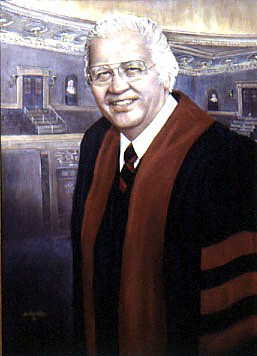
Rev. Richard C. Halverson, 1916-1995, Chaplain of the U.S. Senate; painting for the North Dakota Capitol by Ann Linton Hodge

Rev. Richard C. Halverson, 1916-1995, Chaplain of the U.S. Senate; painting for the North Dakota Capitol by Ann Linton Hodge

“In the beginning the church was a fellowship of men and women centering on the living Christ. Then the church moved to Greece, where it became a philosophy. Then it moved to Rome, where it became an institution. Next, it moved to Europe, where it became a culture. And, finally, it moved to America, where it became an enterprise.”

Richard Halverson, former Chaplain of the United States Senate

At least, P. M. Summer claims Halverson said it, and I trust himTip of the old scrub brush to P. M. Summer, at Una Perla, Por Favor.


Obama said it

January 20, 2009

“We will restore science to its rightful place.”

Wow.


Hallucinating George Washington, the Birth Certificate Obsessed

January 20, 2009

Some of the Birth Certificate Obsessed (BCOs) are seeing things (that’s Obama’s birth certificate that they are obsessed with).  They claim to see a vision that is attributed to George Washington in a hoax. It’s voodoo history, stuff that never was.

Hallucinations would be bad enough, but what do you have to smoke to see hallucinations other people were supposed to have had, but didn’t?

Looking at the docket of the Supreme Court, I don’t see that any of the anti-Obama suits got an order for certiorari. Will the dismissal of the wingnut lawsuits make the wingnuts go away?


Fly your flag today, for the inauguration of President Obama

January 20, 2009

The United States Armed Forces Color Guard presents the American flag and the different U.S. military service flags at the opening ceremony for the 55th Presidential Inauguration, A Celebration of Freedom, near the Ellipse in Washington, D.C., Jan. 19, 2005. More than 5,000 service members will take part in the 55th Presidential Inauguration. Defense Dept. photo by U.S. Air Force Tech. Sgt. Tracy DeMarco

The United States Armed Forces Color Guard presents the American flag and the different U.S. military service flags at the opening ceremony for the 55th Presidential Inauguration, "A Celebration of Freedom," near the Ellipse in Washington, D.C., Jan. 19, 2005. More than 5,000 service members will take part in the 55th Presidential Inauguration. Defense Dept. photo by U.S. Air Force Tech. Sgt. Tracy DeMarco

The law asks us to do it, but we only get the chance every four years.

Fly your flag today for the inauguration of the president, Barack Obama.

The flag flying today bears 50 stars, the 50th in honor of Obama’s birth state, Hawaii.

Today is one of those days we get to see the flag displayed with scrupulous attention paid to the proper methods of display.  If you see a flag attached to an automobile, for example, it will probably be on a special attachment on the right front fender of the vehicle, as the Flag Code suggests.  The free-for-all flag display methods of small town Fourth of July parades will be reined in.  At least, we hope so.

Fly your flag today — you’ll be glad you did.

Resources: