That kid’s at it again

April 17, 2008

The kid in Kearny, New Jersey, who caught his U.S. history teacher peddling religion instead, is at it again.

This time he’s targeting a textbook on government — and it happens to be one written by the most right wing of the semi-mainstream government text writers.

Education Gadfly has the story here, with the Official Fordham Foundation cynicism at anyone who professes to be the the left of Ayn Rand (it’s an endearing cynicism, really — it makes the stuff much more readable, and it indicates that there is gray matter in action behind the comments).   CNBC  has the Associated Press story here.

Matthew LaClair complains about the book’s slant on climate change and church-state relations — two hot-button issues, to be sure.  One wonders why a government text has any view on climate change, and one wonders how anyone could get the church-state thing wrong without criminal intent — but go see for yourself.  LaClair, you recall, recorded his U.S. history teacher going on about the glories of Christianity, and blew the whistle.  For that Matthew got slapped around unjustly in the local media.  He was correct, before, about church state relations, so we might cut him some slack on this complaint. 

Read it all; and remember to trust your textbooks no farther than you can throw them.  The Bathtub tends to agree with the Gadfly that texts should be accurate, and that the selection processes for texts is out of hand (as defined by Diane Ravitch).  But on the other hand, it appears to me that James Q. Wilson and John Dilulio, the authors of the text in question, got some things wrong.  They can fix it, and do so with a smile.

Will they?

See also the other bias on the issue, from the Center for Inquiry — with a detailed critique.

http://www.centerforinquiry.net/


First Amendment: Engraved in stone

April 15, 2008

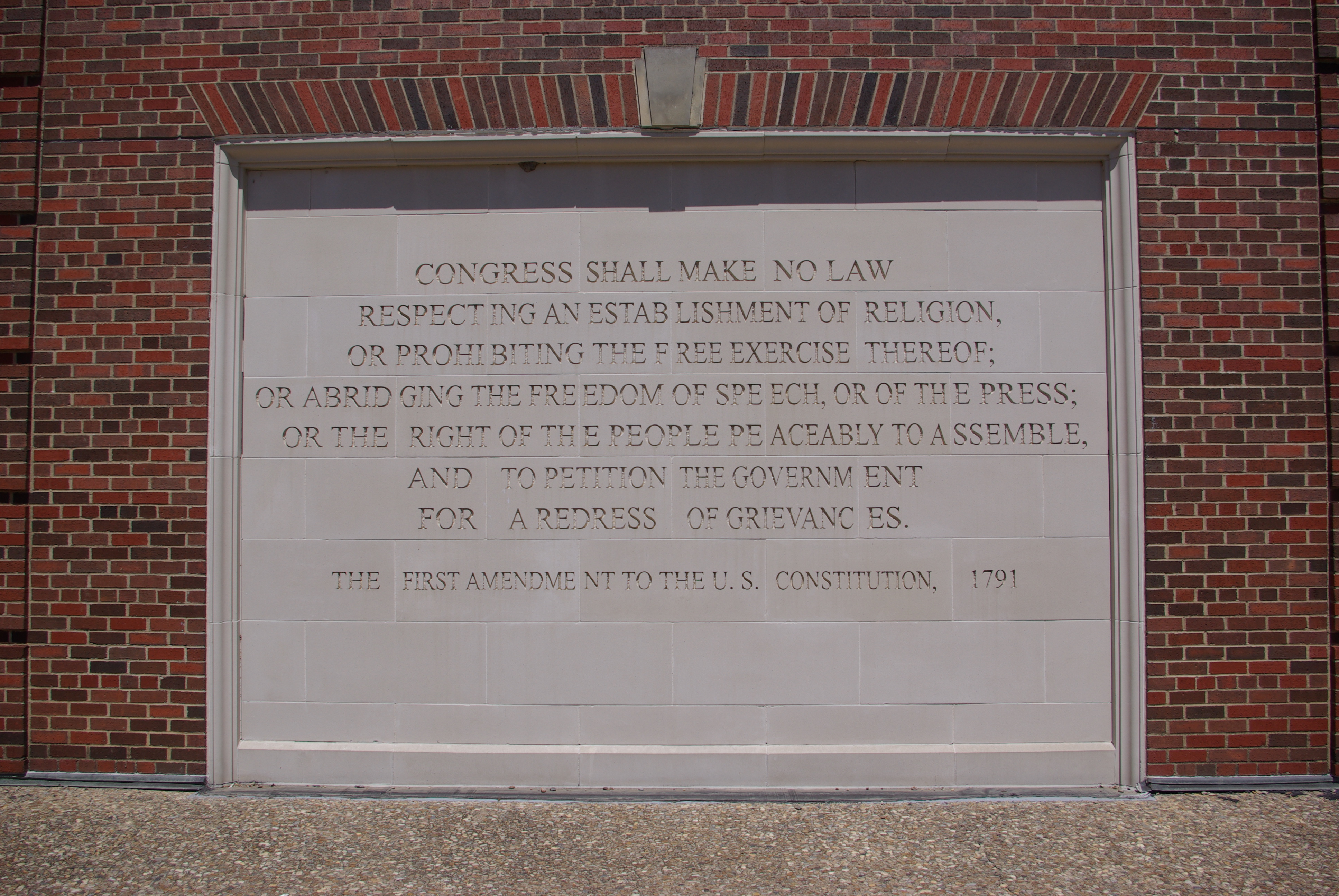
In a discussion about teaching evolution in biology classes a few years ago, I had carefully explained how and why the First Amendment does not require creationism to be taught in biology classes, and in fact is the reason that creationism isn’t taught, in the Establishment Clause. My explanation irritated the tarnation out of a creationist woman who exclaimed, “Well, it’s not like the First Amendment is engraved in stone!”

Heh. Guess what I found at Southern Methodist University Saturday. There, outside the main door of the Umphrey Lee Center, which houses the Department of Economics and the Division of Journalism of the Meadows School for the Arts:

The First Amendment, at SMU


Desert Rock power plant controversy heats up

April 14, 2008

A dozen scholars from a half dozen universities presented papers at SMU Saturday, at a symposium titled “Indians and Energy: Exploitation and Opportunity in the American Southwest.” Papers detailed the history, economics, cultural and social effects of the development of energy resources on Indian lands, concentrating on development of the massive Navajo Reservation that straddles four western states.

The seminar was cosponsored by the William P. Clements Center for Southwest Studies at SMU, and the distinguished School for Advanced Research of the Human Experience, at Santa Fe.

Energy development does not paint a pretty picture. Since 1800, development of Indian resources generally means value is extracted from Indian lands, but the Indians themselves make no profit, and often bear the burdens of development, especially in health damage, pollution, and hammering of social structures.

One presenter, Colleen O’Neill of Utah State, had a photograph that hit me hard. It showed two Navajos aboard an ore car from a uranium mine on the Reservation, in 1952. Neither man had any breathing protection of any kind. I worked for a decade to get compensation for victims of atomic fallout and mine radiation, on the U.S. Senate staff. And I know that the death rate from lung cancer for the uranium miners was nearly 95% when I worked the issue, 30 years ago. Those smiling men had been given a death sentence, and no one told them.

Especially after the final presentation, specifically aimed at a new proposal for another massive coal-fired electrical generating plant in an area that hosts two already, concern about the effects of energy development was clear from the symposium participants and audience.

Stakes got a lot higher Sunday morning. The Arizona Republic published a story on Desert Rock about as glowing as the proponents could hope for, pitting high unemployment rates and a lack of electricity on the Navajo Reservation against environmentalists who oppose the plant.

This post is a marker. I hope I’ll get time to write more about the seminar and the extensive findings (the School for Advanced Research will publish the papers, but that will be several months in the future). But until then, let me urge you to read the newspaper’s story, “For Navajos, Coal means survival.”

When you read the story, remember this: The employment numbers cited in the story are considerably more optimistic than any touted before; past construction on the Reservation has been difficult for Navajos to break into the work force, and imported workers generally do much of the work; it’s taken more than 50 years for Navajos to get the number of jobs they now hold at the Four Corners Plant, a fight that continues; and the sad story of the woman who died during a cold snap will tug at your heart and conscience, but you need to remember that there is no way her cold hogan will get electricity from Desert Rock; her children will still be cold if the plant is built.

More, later, I hope.

Sherry Smith and Brian Frehner did a whale of a job organizing the thing, by the way. You shoulda been there.

Resources:


Typewriter of the moment: Heart Mountain Japanese internment camp

April 14, 2008

A remarkable device, in sad, remarkable circumstances.

The photos below show a typewriter that produces Japanese characters, an invention of no small achievement.

The photos also show American citizens, arrested for being Japanese, in the Heart Mountain internment camp in Wyoming, during World War II. They’re getting the machine in operation to produce a camp newspaper.

Newspaper volunteers reassemble a Japanese typewriter, for the Heart Mountain Sentinel

The official caption:

Members of the staff and volunteer helpers reassemble a privately owned Japanese typewriter to be used for the Japanese language edition of the Heart Mountain Sentinel, Center newspaper. The paper is wrapped around the rubber cylinder, the typist pushes the roller riding platen over the bed of type. After picking the next character, a lever is operated which picks up the type, presses it against the paper and replaces it in its niche. Complicated in appearance and operation, due to the shorthand characteristics of Japanese writing, the advance of thought is nearly equal in speed to a standard English typewriter. — Photographer: Parker, Tom — Heart Mountain, Wyoming. 1/13/43

Heart Mountain Relocation Center, workers assemble Japanese character typewriter for the newspaper, 1943

Official caption:

This complicated looking gadget is a standard Japanese typewriter, the private property of a resident of Japanese ancestry at the Heart Mountain Relocation Center. The machine, loaned to the center newspaper for its Japanese section which is printed for for the purpose of informing those residents unable to read English, is here being assembled by Sentinel staff members. The paper is wound on the round drum, which operates on rollers over the type bed, spotted over the required character, an arm picks the metal slug from the bed, presses it against the paper and returns it to its niche. Due to the shorthand character of Japanese printing, the typewriter is nearly equal in speed in conveying thoughts as a standard English typewriter. — Photographer: Parker, Tom — Heart Mountain, Wyoming. 1/13/43

These photos are available from several sites. The best quality is probably from UC Berkeley’s Bancroft Library’s contribution to the California Digital Library. Office Museum.com also carries the photos, with attribution to the Department of Interior, War Relocation Authority, National Archives, Still Picture Branch, NWDNS-210-G-E691 and E728.

From the Office Museum:

The first typewriter with Chinese characters was produced about 1911-14. Nippon Typewriter Co. began producing typewriters with Chinese and Japanese characters in 1917. “The Nippon has a flat bed of 3,000 Japanese characters. This is considered a shorthand version since the Japanese language contains in excess of 30,000 characters.” (Thomas A. Russo, Office Collectibles: 100 Years of Business Technology, Schiffer, 2000, p. 161.) A successor company, Nippon Remington Rand Kaisha, was producing similar machines in the 1970s.

To use the typewriter, paper is wrapped around the cylindrical rubber platen, which moves on rollers over the bed of type. The operator uses a level to control an arm that picks up a piece of metal type from the bed, presses it against the paper, and returns it to its niche. While the machine is complicated, because of the shorthand character of Japanese writing, the Japanese language typewriter is nearly equal to an English language typewriter in speed for recording thoughts.

Other posts on typewriters, here. Other posts on Japanese internment, here.


Bedbugs, DDT

April 13, 2008

Bedbugs came back.

Common bedbug, Cimex lectularius, University of Minnesota image

Common bedbug, Cimex lectularius, University of Minnesota image

Once a scourge, bedbugs seemed to have gone away, largely, during most of the past 30 years, in most of the western world. International travel and other conducive conditions joined in the perfect storm, however, and bedbug infestation reports are rising in places like New York City.

A significant number of news stories on the topic mention DDT, which was briefly the pesticide of choice against bedbugs. Probably a majority of the blog posts on the topic call for a return of DDT for general use.

This blog is a refreshing exception: New York vs. Bed Bugs, “No DDT, thanks, we’re good.”

Update: In comments, Bug Girl suggests we look at the blog of Bedbugger, and especially this interview with an entomologist.  Take a look — the expert, Dr. James W. Austin of Texas A&M, says bedbugs are about 100% resistant to DDT.


Renaissance shadow over contemporary art: Penultimate suppers

April 11, 2008

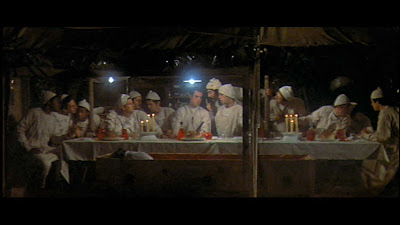
Jeremy Barker at Popped Culture assembled more than 30 versions of contemporary recastings of DaVinci’s painting of “The Last Supper.” There’s the Simpsons version, the cartoon version with Disney and Warner Bros. characters. There’s the Sopranos version, and the Battlestar Galactica version.

For example, the Robert Altman version, from M*A*S*H:

If you need a 20 minute lesson on the influence of Renaissance art on contemporary art, this is one many high school kids may find interesting, if not amazingly historically informative. I suspect there is a great lesson plan hiding in there about 20th century history as reflected in parody art.

It’s a brilliant and subtle demonstration of the power of DaVinci’s art that there are so many copy cat pictures, don’t you think?

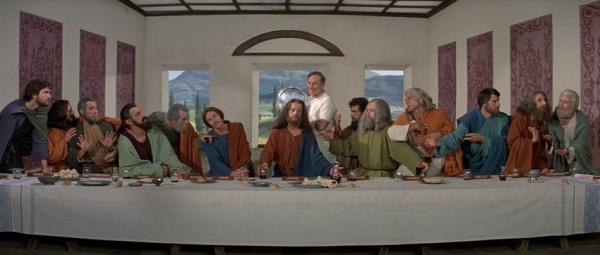
I did notice, however, that Barker left out the Mel Brooks version, from “History of the World, Part I.” It may not fit the meme.

Mel Brooks'

Resources:


Why Rats, Lice and History is a great book

April 7, 2008

Gerald Weissman wrote a solid review of Hans Zinsser’s Rats, Lice and History in the journal Emerging Infectious Diseases. The review appeared two years ago, but I just found it.

It’s hard nowadays to reread the work of de Kruif or Sinclair Lewis without a chuckle or two over their quaint locution, but Zinsser’s raffiné account of lice and men remains a delight. Written in 1935 as a latter-day variation on Laurence Sterne’s The Life and Opinions of Tristam Shandy, Zinsser’s book gives a picaresque account of how the history of the world has been shaped by epidemics of louseborne typhus. He sounded a tocsin against microbes in the days before antibiotics, and his challenge remains meaningful today: “Infectious disease is one of the few genuine adventures left in the world. The dragons are all dead and the lance grows rusty in the chimney corner. . . . About the only sporting proposition that remains unimpaired by the relentless domestication of a once free-living human species is the war against those ferocious little fellow creatures, which lurk in dark corners and stalk us in the bodies of rats, mice and all kinds of domestic animals; which fly and crawl with the insects, and waylay us in our food and drink and even in our love”

If you’ve not read Zinsser’s book, this review will give you lots of reasons why you should.  They don’t write history like this for high schools, though they should:

Despite the unwieldy subtitle “Being a study in biography, which, after twelve preliminary chapters indispensable for the preparation of the lay reader, deals with the life history of TYPHUS FEVER,” Rats, Lice and History became an international critical and commercial success. Zinsser’s romp through the ancient and modern worlds describes how epidemics devastated the Byzantines under Justinian, put Charles V atop the Holy Roman Empire, stopped the Turks at the Carpathians, and turned Napoleon’s Grand Armée back from Moscow. He explains how the louse, the ubiquitous vector of typhus, was for most of human history an inevitable part of existence, “like baptism, or smallpox”; its habitat extended from hovel to throne. And after that Murder in the Cathedral, the vectors deserted Thomas à Becket: “The archbishop was murdered in Canterbury Cathedral on the evening of the twenty-ninth of December [1170]. The body lay in the Cathedral all night, and was prepared for burial on the following day…. He had on a large brown mantle; under it, a white surplice; below that, a lamb’s-wool coat; then another woolen coat; and a third woolen coat below this; under this, there was the black, cowled robe of the Benedictine Order; under this, a shirt; and next to the body a curious hair-cloth, covered with linen. As the body grew cold, the vermin that were living in this multiple covering started to crawl out, and, as … the chronicler quoted, ‘The vermin boiled over like water in a simmering cauldron, and the onlookers burst into alternate weeping and laughter …'”

Add to FacebookAdd to NewsvineAdd to DiggAdd to Del.icio.usAdd to StumbleuponAdd to RedditAdd to BlinklistAdd to TwitterAdd to TechnoratiAdd to Furl


Top 25 guitar riffs of all time? This school needs a history class

April 6, 2008

Guitar-X students — from London Tech Music School — picked what they consider to be the top 25 guitar riffs of all time.

You can listen to the top 25 in The Sun’s video below linked to below [I can’t get the video to embed correctly, alas]. The entire list is below that.

The Beeb’s report:

Here’s the full 25 on the list, courtesy of Reuters’ wire:

1. Smoke On The Water – Deep Purple (1973)
2. Smells Like Teen Spirit – Nirvana (1991)
3. Walk This Way – Aerosmith (1975)
4. Purple Haze – Jimi Hendrix (1967)
5. Sweet Child O Mine – Guns N Roses (1987)
6. Paradise City – Guns N Roses (1987)
7. Ace Of Spades – Motorhead (1980)
8. Enter Sandman – Metallica (1991)
9. Under The Bridge – Red Hot Chilli Peppers (1992)
10. Welcome To The Jungle – Guns N Roses (1987)
11. Run To The Hills – Iron Maiden (1982)
12. Walk – Pantera (1992)
13. Johnny Be Goode – Chuck Berry (1958)
14. Back In Black – AC/DC (1980)
15. Immigrant Song – Led Zeppelin (1970)
16. Wake Up – Rage Against The Machine (1992)
17. Highway to Hell – AC/DC (1979)
18. My Generation – The Who (1965)
19. 7 Nation Army – The White Stripes (2003)
20. Born To Be Wild – Steppenwolf (1968)
21. Give It Away – Red Hot Chilli Peppers (1991)
22. Paranoid – Black Sabbath (1970)
23. Voodoo Chile (Slight Return) – Jimi Hendrix (1967)
24. Eye Of The Tiger – Survivor (1982)
25. Money For Nothing – Dire Straits (1984)
(Editing by Paul Casciato)

A spokesman for the school seemed quite proud that a lot of the top 25 are 20 years old; no one who ever listened to rock and roll between 1957 and 2008 will think this list to be perfect, though. There is too much good guitar riffing absent. The Idolator, obviously more current than I, complains:

As you’d expect from a list based on the opinions of young guitar students, you’ve got some Hendrix, some Angus, three from Slash in the Top 10. But two Frusciantes? A Dimebag? A Knopfler?

. . . Duuuuuuude, no “Stone Cold Crazy?” And if you’re going to bother with Jack White, you have to go with “Icky Thump.” Maybe it’s just my patriotism talking, I think an American school would have made a much fiercer list. One with some Kerry King! Some John Petrucci! Some John Mayer!

John Mayer? Things that pass for value these days! (No Steely Dan licks made the list.)

How about the Beatles? No “Ticket to Ride?” How about the Stones, for the love of blues roots: No “Satisfaction?” This can’t be the list ’cause it doesn’t list the same guitar riffs as me!

No Santana? Nothing from Clapton, not even Cream? “Sunshine of Your Love” doesn’t rate over something on that list? “Layla” isn’t mentioned!? What sort of time warp list warping is that! Where is one of the three dozen great riffs from Motown? Duane Allman? How about the Beach Boys and “Surfin’ USA?”

The list seems limited by genre, too. Surely Wes Montgomery or George Benson, or both of them, should be in there. Somebody’s version of “Malagena” ought to be in there.

Comments are wide open, Dear Readers: What guitar riff ought to be in the top 25, that is not included on that list?

Resources:


Rape in the Congo: When is “never again?”

April 5, 2008

An epidemic of brutal, and constant, rapes in Congo made me wonder when the world will stand up against such mass, directed violence.

A new movie asks the same question: The Greatest Silence – Rape in the Congo.  The movie premieres on HBO on Tuesday, April 8, 2008.

Poster for movie, The Greatest Silence

War in the Congo is not about liberty, it’s not really about the politics of a nation, at least, not a nation as any book defines it. At this point, the conflict is over who controls deposits of ores, some fo them rare, from which today’s modern technological devices are manufactured. The world needs to worry about blood diamonds, but also blood cell phones, blood iPods and blood computers.

Seriously, when does “never again” begin?


Typewriter of the moment: Linowriter

April 4, 2008

Linowriter, in the collection of International Printing Museum, Carson, CA

This curious machine is in the collection of the International Museum of Printing in Carson, California. I’ve never been to the museum myself.

The museum’s website describes the machine:

Linowriter, Circa 1920

This typewriter with a linotype keyboard arrangement was sold by the Empire Typefoundry, Buffalo. Very few of these machines were made and today their exact purpose is obscure. Possibly this kind of typewriter was intended for the small newspaper office where the editorial staff also operated the linotype.
(9.5 inches high)

The Linotype machine was the device that mechanically set the type to print the newspaper, generally a very large, noisy machine that mechanically assembled lead slugs of letters, and then cast a lead plate that could be used to print the page.

I wonder:  Do you know of any linotype machines still in use?


Monument to brevity: William Henry Harrison

April 4, 2008

William Henry Harrison died on April 4, 1841, 31 days after his inauguration as president of the United States.

Perhaps during the cold and rainy inauguration, perhaps from a well-wisher, Harrison caught a cold. The cold developed into pneumonia. The pneumonia killed him.

William Henry Harrison, White House portrait Harrison, a Whig, was the first president to die in office. His vice president, John Tyler, was a converted Democrat who abandoned the Whig platform as president.

Harrison won fame pushing Indians off of lands coveted by white settlers in the Northwest Territories. Harrison defeated Tecumseh’s Shawnee tribe without Tecumseh at the Battle of Tippecanoe, then beat Tecumseh in a battle with the English in which Tecumseh died in the War of 1812.

Schoolchildren of my era learned Harrison’s election slogan: “Tippecanoe, and Tyler, too!”

Congress voted Harrison’s widow a payment of $25,000 since he had died nearly penniless. This may be the first example of a president or his survivors getting a payment from the government after leaving office.

In the annals of brief presidencies, there is likely to be none shorter than Harrison’s for a long time. As you toast him today, you can honestly say he did not overstay his White House tenure. Others could have learned from his example.


Best April Fool’s

April 1, 2008

Steaming into the final days of law school. Papers due. Finals coming. The job demanded extra hours, too.

I had been up well before dawn for some fool reason — job interview? We were closing down the President’s Commission on Americans Outdoors, and I didn’t have a job lined up. Full day at the office, the race through D.C. traffic at rush hour to get to class, three hours of lecture (probably punctuated with that dark, French roast coffee from Au Bon Pain), the train ride and late night walk home, writing the paper and fighting the printer of the crude computer we rented just for the month. It had been more than 20 hours since I’d seen bed.

It was all I could do to stay awake to get up the stairs and into bed. “1:30 a.m.” the clock radio glowed. Three and a half hours to sleep, maybe. I remembered it was April 1, and I smiled as I wondered what odd stories might pop up on the news wires in the morning.

“Get up. We have to go to the hospital!” Kathryn said. I looked at the clock again. 1:31 a.m.

I was concerned, but I was sleepy, too. I asked why.

“My water broke. We have to go.” I felt her side of the bed, and it was wet. I thought it was pretty sneaky of her to go so far as to keep a pan of water close by to make the joke. Just as I got to bed, she had to get up. Riiight!

I kept waiting for the “April Fool!” She’d planned this one well, but I didn’t think it was very funny. I wanted rest.

I turned over to go back to sleep.

“Do I have to drive myself?” Kathryn yelled from the bathroom. We were in Cheverly, Maryland, and the George Washington University Hospital was across town. I jolted awake, and smiled that there would be no significant traffic on the trip. It wasn’t a joke. I hoped I could stay awake for the drive.

kenny_s_new_guitar.jpg

Just about 13 hours of terrifying (for a first-time dad, not to mention a first-time mom) labor later, Kenny was born. Give him credit: He was born so that we got him cleaned up, got Kathryn comfortable, and unshaven and unshowered I could make it to my next class across the street from the hospital (to turn in work and say why I was missing the class).

21 years ago today, I well remember what I was doing. Happy birthday, Kenny!

Notice, Dear Reader, the great attention and homage to history demonstrated in the snapshot above (from last year, really): The Rock and Roll Hall of Fame t-shirt, the denims, the Gibson Les Paul, the “Abbey Road” cover poster on the wall, the topographic map of a favorite hike (near Woodstock, New York, with the Camp Rising Sun crew), the guitar strap his father used in the late 1960s, and the vintage light fixture with just one bulb burning.

Best April Fool’s ever.


85 years old, counting the last days

March 30, 2008

I’m talking about Yankee Stadium, of course.

Great behind-the-scences, usually-not-seen tour in still photos and narration,from the New York Times, here.

In New York this summer? You rather owe it to your grandchildren to go see the stadium, don’t you?  Note this is the last year for Shea Stadium, too — better plan an extra day on that trip to the home office in Manhattan.

Confession:  I’ve never been inside the stadium.  Once, on a road trip to New York City, visiting a friend, Mark Wade, we parked in the shadow of the stadium.  Oops — somebody didn’t lock one door.  Two days in the City, parked in a tough neighborhood, with a door wide open, nothing happened to the car.  There’s some magic in that ballpark.

Yankee Stadium, from high above home plate

Yankee Stadium from high in back of home plate; photo from MLB Road Trip.com

Resources:


March 27, 1912: Cherry trees for Washington, D.C.

March 27, 2008

From the Library of Congress:

Potomac Blossoms

Japanese cherry blossoms
View of Washington Monument, Cherry Blossoms and Tidal Basin
Theodor Horydczak, photographer, circa 1920-1950.
Washington as It Was, 1923-1959

On March 27, 1912, First Lady Helen Herron Taft and the Viscountess Chinda, wife of the Japanese ambassador, planted two Yoshino cherry trees on the northern bank of the Potomac River Tidal Basin in Washington, D.C. The event celebrated the Japanese government’s gift of 3,000 trees to the United States. Trees were planted along the Potomac Tidal Basin near the site of the future Jefferson Memorial, in East Potomac Park, and on the White House grounds.

The text of First Lady Taft’s letter, along with the story of the cherry trees, is available from the National Park Service’s official Cherry Blossom Festival Web site. From the opening screen, scroll down to the paragraph beginning, “The history of the cherry trees.”

A lot more, with good links, at the Library of Congress “Today in History” site.


Carnival of historic proportions

March 27, 2008

Lent’s over, Easter’s done — time to carnival once again.

Very good stuff in several different carnivals on history and other subjects we like to peruse and ponder while soaking in Millard Fillmore’s Bathtub.

The passings of those who saw history, commemorated at the 12th Carnival of Military History, at Thoughts on Military History:

Next we have a series of posts commemorating the deaths of veterans who have recently passed away. First, at UKNIWM we have a post about the passing away of the last Scottish veteran of the Spanish Civil War. Second, again at UKNIWM, we have a post on the death of the last French veteran of the First World War. Finally, we have a post at Rantings of a Civil War Historian about the anniversary of the death of Sir Henry Shrapnel, the inventor of the shrapnel artillery shell. [Link on Shrapnel not working]

There’s a whole lesson plan in that paragraph, all of it important and fascinating, and none of it important in your state’s history standards, probably.

A Hot Cup of Joe, appropriately, hosts the Four Stone Hearth #37, the carnival of archaeology — in a strangely futuristic Pulp Science Fiction fashion. Go see the thing just for the pulp sci-fi images, if you must — but as usual there are great gems there. This week our youngest son expressed some exasperation at the short shrift given Angkor Wat in high school texts, which led to a discussion about cultures and histories generally not part of the U.S. canon. Four Stone Hearth features a post at Wanna Be An Anthropologist that digs through Angkor Wat in some depth. I love timely posts.

These things lead off into all sorts of rabbit trails. Wanna Be An Anthropologist also has this post on “Mogollon Snowbirds,” a wry title twist on a very good, deep post on archaeology and anthropology study in the Mogollon Rim area of Arizona. No bit conclusion, but sources you can use, and a great look at what real scientists really do.

We’re all back from spring break in our household, but still appreciative of the Teachers Gone Wild edition of the Carnival of Education (#165), at Bellringers.

New school in Toronto, Kohn Schnier Architects New elementary school in Toronto, Ontario; architecture by Kohn Schnier Architects.

One feature on the Education Carnival midway was this post, “Luddite Lite,” at Teacher in a Strange Land. It’s sharp little spur under my seat, about actually using technology to promote learning for the students, rather than as a crutch for the teacher. But in that blog’s archives, right next door to that post, is this evocative post from a 30-year, in-the-trenches veteran teacher, to my old boss at Education, Checker Finn — a response to one of his posts (which we’ve commented on before). What makes education work? Are you delivering it? Check out both posts.

Oops. Gotta scoot. Lesson plans to tweak.