President Warren Harding, a voice for the ages

December 29, 2017

In 1922, President Warren G. Harding made a sound recording of his voice, for archival purposes. He died in 1923, succeeded by Calvin Coolidge. National Archives image.

In 1922, President Warren G. Harding made a sound recording of his voice, for archival purposes. He died in 1923, succeeded by Calvin Coolidge. National Archives image.

President Warren G. Harding made a recording of his voice in 1922, for archival purposes. From the photograph it appears the recording was made to a wax or plastic disk. Hypothetically, the recording exists somewhere in the bowels of the National Archives and Records Administration (NARA).


Dallas history, tonight! Bob Reitz at Half Price Books

December 28, 2017

History teachers, and parents of students — and students (why shouldn’t you direct your own learning?) — note this event TONIGHT.

Dallas historian Bob Reitz presents “Collectible Conversations: The History of Dallas in the 50s and 60s,” at Half Price Books’ mothership at 5803 E Northwest Hwy (just off the Dallas Parkway).

Reitz is an old friend, curator of Circle 10 Council, BSA’s Harbin Scout Museum, housed at Camp Wisdom on Redbird Lane — a greater resource since the National Scout Museum decamped from Irving in September. He’s a homegrown Dallas boy, loaded with history of the tumultuous two decades from 1950 to 1970

Half Price Books’s blog featured an interview with Bob, which I crib here for your convenience (and to preserve it!):

For the December presentation in our monthly Collectible Conversations series at the HPB Flagship in Dallas, we welcome Dallas historian Bob Reitz. Reitz will discuss his growing up in Dallas in the 50s and 60s using books as his reference points. Bob gave an earlier Collectible Conversations talk specifically about his life in bookstores and his 37 books about bookstores from his collection.

Coll Conv 8 31 3

We asked Bob to give us a little preview of his upcoming talk.

When did you first feel that Dallas in the 50s and 60s was a special place and time?
In January of 1954, my father’s insurance company transferred him to Dallas from upstate New York. We had a new house built in the Casa View section of northeast Dallas. Cotton fields were being plowed under to create homes for newly returned servicemen beginning to start families after World War II. I started first grade and finished high school living in the same house. I still have a small group of friends from these times. Growing up, it seemed normal to have new movie houses, drive-ins, libraries, swimming pools and a thriving downtown. I never realized as a kid what we had in these unique and special times.

I’ve always thought that besides your family, your neighborhood makes the biggest difference in your life. I didn’t grow up smelling salt water from the ocean or seeing snow-covered mountains on the horizon. I grew up on the rolling blackland prairies in a large urban city straddling the Trinity River.

I know you own many books on the subject. Is there one that may best encapsulate the era for, say, a 20-year-old reader from Milwaukee?
Probably the most thoughtful book about this era in Dallas is by Pulitzer Prize-winning author Lawrence Wright (who graduated from Dallas’s Woodrow Wilson High School). The cover of his book In the New World:  Growing Up with America from the Sixties to the Eighties (1989) reads: “It’s both a story of one man’s coming of age in 1960s Dallas and a provocative account of the end of American innocence, the assassination of John F. Kennedy, the Vietnam War, and the Civil Rights era.”

Were there any particular events of the 50s or 60s that made the biggest impression on you?
One significant event took place in August of 1960 to celebrate the 50th anniversary of the Boy Scouts of America. Five thousand Scouts camped on a hill overlooking White Rock Lake. I had never seen so many Scouts in one place at one time—lines of tents covered the sloping hill in the middle of the city. Today, there is a sign on the slope designating the location as Scout Hill.

The rest of the world probably thinks of President Kennedy’s assassination as the most important event that occurred in Dallas in the 60s. Are many of your books primarily or partially about that event?
I was a junior in high school on that fateful November 22, 1963. I was finishing lunch when a student ran in and said, “The president has been shot, the president has been shot!” They moved us into the auditorium and by 2 p.m. they dismissed classes for the day.

We stayed glued to the television for the next week, witnessing the supposed ineptness of the Dallas Police play out on national TV, including the on-air killing of Lee Harvey Oswald by night club operator Jack Ruby. In the end, the police did pretty well. They caught Oswald within two hours, but Dallas became the laughing stock of the whole nation.

The Kennedy assassination spawned a couple of excellent novels of the era: Libra by Don DeLillo (1998) and November 22 by Bryan Woolley (2013). Author Norman Mailer wrote a telling non-fiction book, Oswald’s Tale: An American Mystery (1995), covering the early life of Lee Harvey Oswald.

Also in my collection is the book Reclaiming History: The Assassination of President John F. Kennedy by Vincent Bugliosi (2007). He concludes that Oswald was the lone gunman and destroys every one of the conspiracy theories.

Another book that agrees Oswald was the lone gunman also asserts that the darkest days of Dallas were caused by local ultraconservatives, such as oilman H.L. Hunt, former Army general Edwin Walker and national congressman, Bruce Alger. That book is Nut Country: Right Wing Dallas and the Birth of the Southern Strategy, by Edward H. Miller (2015).

In your previous Collectibles Conversation presentation, you referred to many Dallas bookstores in whose aisles you lost yourself. How big a role did its bookstores play in your understanding of Dallas history?
Dallas bookstores and libraries have been important throughout all my life. When I was small my dad drove my sister and me to the Lakewood Theater on Saturdays to watch a double feature movie and the cartoons. Afterwards we walked across the street to the Lakewood Library, which allowed us to call home (in the pre-cell phone era). While waiting for dad to come, we checked out lots of books.

Closer to home, I was part of the opening of the Casa View Library, which in 1964 set a national record of checking out over 9,000 books in a single day! In appreciation of the library’s influence in my life, I have put together twenty exhibits at the downtown Dallas Library on a wide variety of subjects, all from my personal book collection.

As a young teenager, I could visit Harper’s Used Books in the Deep Ellum section of downtown Dallas. My primary goal was to collect old Boy Scout Handbooks. What I found was so much more. A college student visited the same bookstore a couple of years before me. He became a Pulitzer Prize-winning author, Larry McMurtry, of Lonesome Dove fame. McMurtry wrote about the changes that occurred as Texas changed from a rural to a mostly urban economy.

My experiences in bookstores have enriched my life and broadened my perspective on how I grew up in Dallas and what I can give back to the cultural life of the city.

Want to hear more from Bob about life in Dallas in the 50s and 60s?  Join us at the HPB Flagship in Dallas for Collectible Conversations: 1950s and 60s Dallas Through Books on Thursday December 28 at 6 p.m.!

Steve is the”Buy Guy” at Half Price Books Corporate.

via Collectible Conversations: The History of Dallas in the 50s & 60s Through Books


Iowans, fly your flags today for statehood, December 28, 1846

December 28, 2017

The 2004 commemorative Iowa quarter-dollar pays homage to Iowa's great artist son, Grant Wood, and the prairie school house, with a motto for Iowa,

The 2004 commemorative Iowa quarter-dollar pays homage to Iowa’s great artist son, Grant Wood, and the prairie school house, with a motto for Iowa, “Foundation in Education.” Wood’s painting is “Arbor Day,” showing students and a teacher planting a tree outside a one-room schoolhouse. Image from the Littleton Coin Company.

Iowans fly their flags today in celebration of the anniversary of Iowa statehood.  Iowa’s admission to the Union came on December 28, 1846; Iowa is the 29th state admitted.

The Flag Code, 4 USC §6 (d), notes that the U.S. flag may be flown on “the birthdays of States (date of admission),” in addition to the other score of dates specifically written into law.

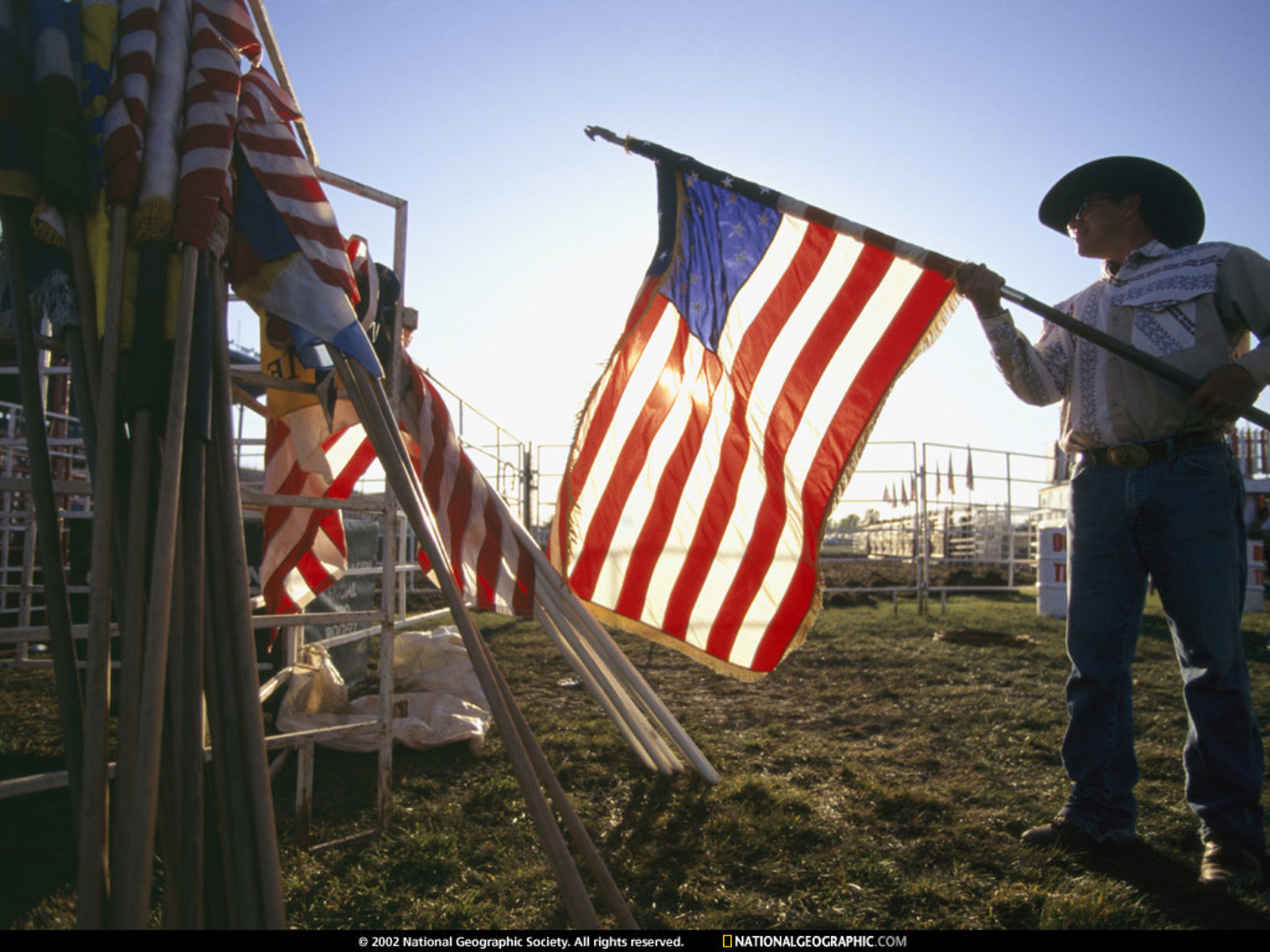
American Flag, Spencer, Iowa, 1996 – caption from the National Geographic Society: A man rolls up U.S. flags at the end of the Clay County Fair in Spencer, Iowa. “Although the population of Spencer is only about 12,000, the fair draws some 300,000 visitors. Once a year, rising from the endless flatness of the Iowa countryside, a crowd forms—to stroll, to hear big country music acts like the Statler Brothers, to sell a grand champion boar, to buy a new silo.” (Photographed on assignment for, but not published in, “County Fairs,” October 1997, National Geographic magazine) Photograph by Randy Olson; copyright National Geographic Society

American Flag, Spencer, Iowa, 1996 – caption from the National Geographic Society: A man rolls up U.S. flags at the end of the Clay County Fair in Spencer, Iowa. “Although the population of Spencer is only about 12,000, the fair draws some 300,000 visitors. Once a year, rising from the endless flatness of the Iowa countryside, a crowd forms—to stroll, to hear big country music acts like the Statler Brothers, to sell a grand champion boar, to buy a new silo.” (Photographed on assignment for, but not published in, “County Fairs,” October 1997, National Geographic magazine) Photograph by Randy Olson; copyright National Geographic Society. Just a great photo.

More:


100th anniversary of the “neglected anniversary” of Mencken and Millard Fillmore’s Bathtub – National Bathtub and Presidential Obscurity Day

December 28, 2017

THIS IS IT!

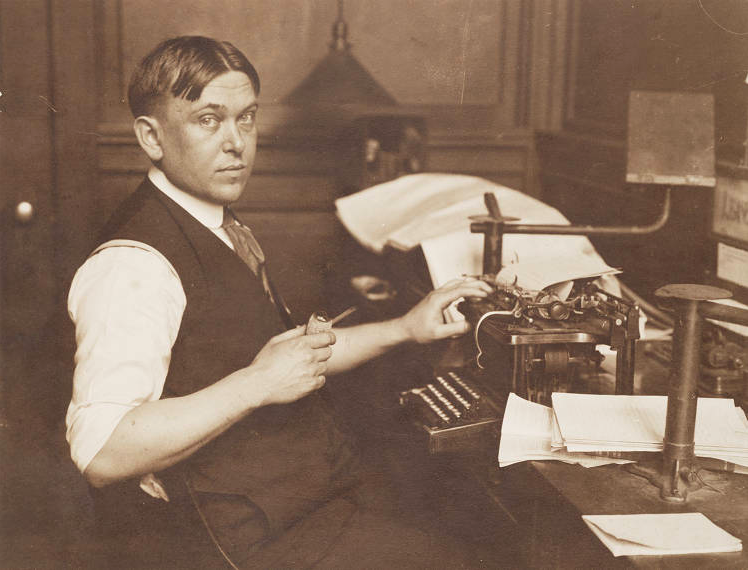
Writer Henry Louis Mencken. This photo, in the archives of the Maryland Historical Society, may have been taken in 1917, the year of Mencken's not-famous-enough hoax on poor old Millard Fillmore.

Writer Henry Louis Mencken. This photo, in the archives of the Maryland Historical Society, may have been taken in 1917, the year of Mencken’s not-famous-enough hoax on poor old Millard Fillmore. Image here via Paris Review.

December 28, 2017, is the 100th anniversary of the false news item, the hoax column written by curmudgeonly newspaperman H. L. Mencken, that lamented the unmarked passing of the anniversary of Millard Fillmore’s “greatest accomplishment,” the placing of a plumbed bathtub in the White House!

Contrary to Woodrow Wilson’s 1916 campaign slogan, “He Kept Us Out of War,” Wilson had just led the U.S. into World War I, on the side of the Allies, the British and French. Mencken was opposed to entering the war, but had thought that if the U.S. got involved it should be on the side of Germany.

So Mencken was quite tuned in to false reports which, he lamented, got picked up by newspapers and spread across the nation. Partly to make a point that news organizations needed to be more careful, and partly because he was on deadline and didn’t have another idea, Mencken created out of thin air a story of the “first” bathtub in the White House, placed by Millard Fillmore (Mencken said) over the objections of experts like the American Medical Association (Mencken claimed).

All hoax.

But that’s where this blog steals its name, and it’s the inspiration for many of us who think false news is bad news and should be stopped, with accurate reports. Be sure to read through to the comments at the end.

And remember: Don’t trust everything you read; read more so you cannot be hoaxed like this.

A Millard Fillmore’s Bathtub December 28 tradition; mostly encore post, but worthy of note on National Bathtub and Presidential Obscurity Day

100 years ago today, on December 28, 1917, this column by H. L. Mencken was published in The New York Evening Mail:

Portrait of H. L. Mencken

1927 Portrait of H. L. Mencken by Nikol Schattenstein; Enoch Pratt Free Library, Baltimore

A Neglected Anniversary

On December 20 there flitted past us, absolutely without public notice, one of the most important profane anniversaries in American history, to wit, the seventy-fifth anniversary of the introduction of the bathtub into These States. Not a plumber fired a salute or hung out a flag. Not a governor proclaimed a day of prayer. Not a newspaper called attention to the day.

True enough, it was not entirely forgotten. Eight or nine months ago one of the younger surgeons connected with the Public Health Service in Washington happened upon the facts while looking into the early history of public hygiene, and at his suggestion a committee was formed to celebrate the anniversary with a banquet. But before the plan was perfected Washington went dry (This was war-time Prohibition, preliminary to the main catastrophe. — HLM), and so the banquet had to be abandoned. As it was, the day passed wholly unmarked, even in the capital of the nation.

Bathtubs are so common today that it is almost impossible to imagine a world without them. They are familiar to nearly everyone in all incorporated towns; in most of the large cities it is unlawful to build a dwelling house without putting them in; even on the farm they have begun to come into use. And yet the first American bathtub was installed and dedicated so recently as December 20, 1842, and, for all I know to the contrary, it may still be in existence and in use.

Curiously enough, the scene of its setting up was Cincinnati, then a squalid frontier town, and even today surely no leader in culture. But Cincinnati, in those days as in these, contained many enterprising merchants, and one of them was a man named Adam Thompson, a dealer in cotton and grain. Thompson shipped his grain by steamboat down the Ohio and Mississippi to New Orleans, and from there sent it to England in sailing vessels. This trade frequently took him to England, and in that country, during the ’30s, he acquired the habit of bathing.

The bathtub was then still a novelty in England. It had been introduced in 1828 by Lord John Russell and its use was yet confined to a small class of enthusiasts. Moreover, the English bathtub, then as now, was a puny and inconvenient contrivance — little more, in fact, than a glorified dishpan — and filling and emptying it required the attendance of a servant. Taking a bath, indeed, was a rather heavy ceremony, and Lord John in 1835 was said to be the only man in England who had yet come to doing it every day.

Thompson, who was of inventive fancy — he later devised the machine that is still used for bagging hams and bacon — conceived the notion that the English bathtub would be much improved if it were made large enough to admit the whole body of an adult man, and if its supply of water, instead of being hauled to the scene by a maid, were admitted by pipes from a central reservoir and run off by the same means. Accordingly, early in 1842 he set about building the first modern bathroom in his Cincinnati home — a large house with Doric pillars, standing near what is now the corner of Monastery and Orleans streets.

There was then, of course, no city water supply, at least in that part of the city, but Thompson had a large well in his garden, and he installed a pump to lift its water to the house. This pump, which was operated by six Negroes, much like an old-time fire engine, was connected by a pipe with a cypress tank in the garret of the house, and here the water was stored until needed. From the tank two other pipes ran to the bathroom. One, carrying cold water, was a direct line. The other, designed to provide warm water, ran down the great chimney of the kitchen, and was coiled inside it like a giant spring.

The tub itself was of new design, and became the grandfather of all the bathtubs of today. Thompson had it made by James Cullness, the leading Cincinnati cabinetmaker of those days, and its material was Nicaragua mahogany. It was nearly seven feet long and fully four feet wide. To make it water-tight, the interior was lined with sheet lead, carefully soldered at the joints. The whole contraption weighed about 1,750 pounds, and the floor of the room in which it was placed had to be reinforced to support it. The exterior was elaborately polished.

In this luxurious tub Thompson took two baths on December 20, 1842 — a cold one at 8 a.m. and a warm one some time during the afternoon. The warm water, heated by the kitchen fire, reached a temperature of 105 degrees. On Christmas day, having a party of gentlemen to dinner, he exhibited the new marvel to them and gave an exhibition of its use, and four of them, including a French visitor, Col. Duchanel, risked plunges into it. The next day all Cincinnati — then a town of about 100,000 people — had heard of it, and the local newspapers described it at length and opened their columns to violent discussions of it.

The thing, in fact, became a public matter, and before long there was bitter and double- headed opposition to the new invention, which had been promptly imitated by several other wealthy Cincinnatians. On the one hand it was denounced as an epicurean and obnoxious toy from England, designed to corrupt the democratic simplicity of the Republic, and on the other hand it was attacked by the medical faculty as dangerous to health and a certain inviter of “phthisic, rheumatic fevers, inflammation of the lungs and the whole category of zymotic diseases.” (I quote from the Western Medical Repository of April 23, 1843.)

The noise of the controversy soon reached other cities, and in more than one place medical opposition reached such strength that it was reflected in legislation. Late in 1843, for example, the Philadelphia Common Council considered an ordinance prohibiting bathing between November 1 and March 15, and it failed of passage by but two votes. During the same year the legislature of Virginia laid a tax of $30 a year on all bathtubs that might be set up, and in Hartford, Providence, Charleston and Wilmington (Del.) special and very heavy water rates were levied upon those who had them. Boston, very early in 1845, made bathing unlawful except upon medical advice, but the ordinance was never enforced and in 1862 it was repealed.

This legislation, I suspect, had some class feeling in it, for the Thompson bathtub was plainly too expensive to be owned by any save the wealthy; indeed, the common price for installing one in New York in 1845 was $500. Thus the low caste politicians of the time made capital by fulminating against it, and there is even some suspicion of political bias in many of the early medical denunciations. But the invention of the common pine bathtub, lined with zinc, in 1847, cut off this line of attack, and thereafter the bathtub made steady progress.

The zinc tub was devised by John F. Simpson, a Brooklyn plumber, and his efforts to protect it by a patent occupied the courts until 1855. But the decisions were steadily against him, and after 1848 all the plumbers of New York were equipped for putting in bathtubs. According to a writer in the Christian Register for July 17, 1857, the first one in New York was opened for traffic on September 12, 1847, and by the beginning of 1850 there were already nearly 1,000 in use in the big town.

After this medical opposition began to collapse, and among other eminent physicians Dr. Oliver Wendell Holmes declared for the bathtub, and vigorously opposed the lingering movement against it in Boston. The American Medical Association held its annual meeting in Boston in 1849, and a poll of the members in attendance showed that nearly 55 per cent of them now regarded bathing as harmless, and that more than 20 per cent advocated it as beneficial. At its meeting in 1850 a resolution was formally passed giving the imprimatur of the faculty to the bathtub. The homeopaths followed with a like resolution in 1853.

But it was the example of President Millard Fillmore that, even more than the grudging medical approval, gave the bathtub recognition and respectability in the United States. While he was still Vice-President, in March, 1850, he visited Cincinnati on a stumping tour, and inspected the original Thompson tub. Thompson himself was now dead, but his bathroom was preserved by the gentlemen who had bought his house from the estate. Fillmore was entertained in this house and, according to Chamberlain, his biographer, took a bath in the tub. Experiencing no ill effects, he became an ardent advocate of the new invention, and on succeeding to the Presidency at Taylor’s death, July 9, 1850, he instructed his secretary of war, Gen. Charles M. Conrad, to invite tenders for the construction of a bathtub in the White House.

This action, for a moment, revived the old controversy, and its opponents made much of the fact that there was no bathtub at Mount Vernon, or at Monticello, and that all the Presidents and other magnificoes of the past had got along without any such monarchical luxuries. The elder Bennett, in the New York Herald, charged that Fillmore really aspired to buy and install in the White House a porphyry and alabaster bath that had been used by Louis Philippe at Versailles. But Conrad, disregarding all this clamor, duly called for bids, and the contract was presently awarded to Harper & Gillespie, a firm of Philadelphia engineers, who proposed to furnish a tub of thin cast iron, capable of floating the largest man.

This was installed early in 1851, and remained in service in the White House until the first Cleveland administration, when the present enameled tub was substituted. The example of the President soon broke down all that remained of the old opposition, and by 1860, according to the newspaper advertisements of the time, every hotel in New York had a bathtub, and some had two and even three. In 1862 bathing was introduced into the Army by Gen. McClellan, and in 1870 the first prison bathtub was set up at Moyamensing Prison, in Philadelphia.

So much for the history of the bathtub in America. One is astonished, on looking into it, to find that so little of it has been recorded. The literature, in fact, is almost nil. But perhaps this brief sketch will encourage other inquirers and so lay the foundation for an adequate celebration of the centennial in 1942.

(Text courtesy of Poor Mojo’s Almanac(k))

The entire history was a hoax composed by Mencken.

Even conservative wackoes appreciate the column.

Content with his private joke, Mencken remained silent about the hoax until a follow-up article, “Melancholy Reflections,” appeared in the Chicago Tribune on May 23, 1926, some eight years later. This was Mencken’s confession. It was also an appeal for reason to the American public.

His hoax was a joke gone bad. “A Neglected Anniversary” had been printed and reprinted hundreds of times in the intervening years. Mencken had been receiving letters of corroboration from some readers and requests for more details from others. His history of the bathtub had been cited repeatedly by other writers and was starting to find its way into reference works. As Mencken noted in “Melancholy Reflections,” his “facts” “began to be used by chiropractors and other such quacks as evidence of the stupidity of medical men. They began to be cited by medical men as proof of the progress of public hygiene.” And, because Fillmore’s presidency had been so uneventful, on the date of his birthday calendars often included the only interesting tidbit of information they could find: Fillmore had introduced the bathtub into the White House. (Even the later scholarly disclosure that Andrew Jackson had a bathtub installed there in 1834—years before Mencken claimed it was even invented—did not diminish America’s conviction that Fillmore was responsible.)

(No, dear reader, probably not correct; surely John Adams brought a bathtub with him when he moved into the White House, then called the President’s Mansion.  Plumbing, hot water, and finally hot water to a bathtub in the president’s residence, were installed between 1830 and 1853, as best I can determine.)

Mencken wrote an introduction to the piece in a later bookA Mencken Chrestomathy (Alfred A. Knopf, 1949):

The success of this idle hoax, done in time of war, when more serious writing was impossible, vastly astonished me. It was taken gravely by a great many other newspapers, and presently made its way into medical literature and into standard reference books. It had, of course, no truth in it whatsoever, and I more than once confessed publicly that it was only a jocosity… Scarcely a month goes by that I do not find the substance of it reprinted, not as foolishness but as fact, and not only in newspapers but in official documents and other works of the highest pretensions.

There’s a moral to the story:  Strive for accuracy!

So, Dear Reader, check for accuracy, and question authority.

Fact checks — what else might need to be corrected in this story?

Resources:

Finally, Dear Readers — have you noticed someone falling victim to the hoax of Millard Fillmore’s Bathtub recently?  Give us details in comments, please.


December 27, Great Beginnings Day 2017: Darwin, Apollo, and more

December 27, 2017

December 27 is one of those days — many of us are off work, but it’s after Boxing Day, and it’s not yet on to New Year’s Eve or Day. We should have celebrated, maybe.

It’s the end of the year, and yet it is also a day of great beginnings.

We should celebrate December 27 as a day of portent: A good embarkation, and a good, safe end to a nation-encouraging trip to almost touch the Moon.

HMS Beagle, Darwin's ship

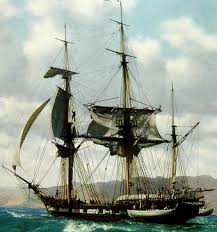
HMS Beagle, on a voyage of discovery; painting of the Beagle in the Galapagos by John Chancellor

On December 27, 1831, Charles Darwin and H.M.S. Beagle set sail on an around-the-world voyage of discovery that would change all of science, and especially biology, forever.

December 27 1831
After a few delays, H.M.S. Beagle headed out from Plymouth with a crew of 73 under clear skies and a good wind. Darwin became sea-sick almost immediately.

Darwin never fully overcame his seasickness, but he fought it well enough to become the single greatest collector of specimens in history for the British Museum and British science, a distinction that won him election to science societies even before his return from the trip — and cemented his life in science, instead of in the church.

Darwin’s discoveries would have revolutionized biology in any case. But, in analyzing what he had found, a few years later and with the aid of experts at the British Museum, Darwin realized he had disproved much of William Paley’s hypotheses about life and its diversity, and that another, more basic explanation was possible. This led to his discovery of evolution by natural and sexual selection.

Mini-sheet from the Royal Mail honoring Darwin's discoveries in the Galapagos Islands

Mini-sheet from the Royal Mail in 2009 honoring Darwin’s discoveries in the Galapagos Islands

On December 27, 1968, Apollo 8 splashed down after a successful and heartening trip to orbit the Moon. The three crewmen, Commander Frank Borman, James A. Lovell, Jr., and William A. Anders, had orbited the Moon, a very important milestone in the methodological race to put humans on the Moon (which would be accomplished seven months later).

1968 was a terrible year for the U.S., with the North Korean capture of the U.S.S. Pueblo, assassinations of Rev. Martin Luther King, Jr., and Sen. Robert F. Kennedy during the presidential campaign, riots in dozens of American cities, nasty political conventions with riots at the Democratic Convention in Chicago, a contentious and bitter election making sore the nation’s divide over Vietnam policy, and other problems. On Christmas Eve, Borman, Lovell and Anders broadcast from orbit around the Moon, a triumphant and touching moment for the Apollo Program and Americans around the world. Their safe return on December 27 raised hopes for a better year in 1969.

Motherboard.tv has a great write up from Alex Pasternack, especially concerning the famous photo taken a few days prior to splashdown:

In 1968, NASA engineers were scrambling to meet President Kennedy’s challenge to land a man on the moon by decade’s end. Because delays with the lunar module were threatening to slow the Apollo program, NASA chose to change mission plans and send the crew of Apollo 8 all the way to the moon without a lunar module.

Exactly 43 [49] years ago, the three astronauts of Apollo 8 became the first humans to orbit another celestial object. As they came around the dark side of the Moon for the third time, Frank Borman, the commander, finally turned their capsule around. And then they saw the Earth.

Borman: Oh my God! Look at that picture over there! Here’s the Earth coming up. Wow, is that pretty.
Anders: Hey, don’t take that, it’s not scheduled.
Borman: (laughing) You got a color film, Jim?
Anders: Hand me that roll of color quick, will you…

One of the resulting photos taken by Anders on a Hasselblad camera became one of the world’s most iconic images.

As Bill Anders recalls it:

I just happened to have one with color film in it and a long lens. All I did was to keep snapping… It’s not a very good photo as photos go, but it’s a special one. It was the first statement of our planet Earth and it was particularly impressive because it’s contrasted against this startling horizon . . . After all the training and studying we’d done as pilots and engineers to get to the moon safely and get back, [and] as human beings to explore moon orbit, what we really discovered was the planet Earth.

Plan to raise a glass today, December 27, 2012, to Great Beginnings Day for the human race. December 27 is a day we should remember, for these achievements. (But if you’re raising a glass, consider Carrie Nation, too!)

Also on December 27:

More:

This is an encore post.

Yes, this is an encore post. Defeating ignorance takes patience and perseverance.


Rare, Alternative and New Christmas music: Pogues, “Fairytale of New York”

December 19, 2017

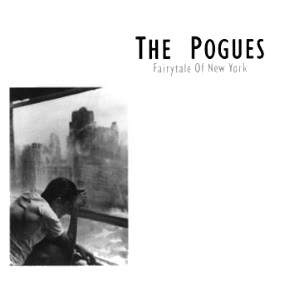
Cover for a version of The Pogues,

Cover for a version of The Pogues, “Fairytale of New York. Wikipedia image

If you think Joni Mitchell’s “River” represents a turn to blue for Christmas songs, what does “Fairytale of New York” show?

I must admit, this is one I was not familiar with — I’d heard it before, but not paid much attention. Surprised to learn it was written and rewritten 1985 to 1987, with a first recording by the Pogues in 1987. Judging by its popularity in the UK, it’s a song we all should be familiar with.

Fairytale of New York” is a song written by Jem Finer and Shane MacGowan and first released as a single on 23 November 1987[1] by their band The Pogues, featuring singer-songwriter Kirsty MacColl on vocals. The song was written as a duet, with the Pogues’ singer MacGowan taking the role of the male character and MacColl the female character. It is an Irish folk-style ballad, and featured on The Pogues’ 1988 album If I Should Fall from Grace with God.

Originally begun in 1985, the song had a troubled two year development history, undergoing rewrites and aborted attempts at recording, and losing its original female vocalist along the way, before finally being completed in summer 1987. Although the single never reached the coveted UK Christmas number one, being kept at number two on its original release in 1987 by the Pet Shop Boyscover version of “Always on My Mind“, it has proved enduringly popular with both music critics and the public: to date the song has reached the UK Top 20 on fourteen separate occasions since its original release in 1987, including every year since 2005, and was certified platinum in the UK in 2013.[2] The song has sold 1.18 million copies in the UK as of November 2015.[3] In the UK it is the most-played Christmas song of the 21st century.[4] “Fairytale of New York” has been cited as the best Christmas song of all time in various television, radio and magazine related polls in the UK and Ireland.[5]

Is it a downer of a song? Voices in the lyric do not appear happy, but rather angry with each other for imagined slights that put each of them where they did not wish to be, when they met years ago.

But still the bells ring out on Christmas Day. (Remember that, if I get around to posting the Chieftans’ recording I have in mind for this series.)

I found the song this year on Twitter, improbably, in something called the World Cup of Christmas Songs, sponsored by UK radio guy Richard Osman (@RichardOsman). It’s not a serious competition, and it excluded most Christmas music we all know, which tips the scales a bit, it seems to me. But here it is, and the vox populi rings out.

More:


Scrooge’s 2017 Christmas gift: Trump policy reduced to three words

December 18, 2017

Oh, why bother with this BEFORE Christmas? It’s more salient now, looking at the new year, and wondering what is the fate of man and men, in the new year.

Roberto Innocenti, Scrooge on a dark staircase

Ebenezer Scrooge, up a dark staircase; “Darkness was cheap, and Scrooge liked it.” Illustration by Roberto Innocenti, via Pinterest.

It’s a Quote of the Moment (an encore post for the season, with a bit of context thrown in later), Trump’s platform, and life, edited down to just three words, in green:

Darkness is cheap,
and Scrooge liked it.

– Charles Dickens, A Christmas Carol, Stave 1

Isn’t that the entire GOP platform in three words? “Darkness is cheap.” Substitute “Trump” for “Scrooge,” you’ve got the picture.

I think of that line of Dickens’s often when  I read of the celebrations of calumny that pass as discourse in Republican politics these days. Although, with the 2008 renewing of Limbaugh’s contract, it may no longer be true that his particular brand of darkness is cheap. With the advent of Donald Trump’s insult politics, offending America’s allies and all American ethnic groups possible, with un-ironic calls to drop nuclear weapons, GOP politics is even darker than ever.

Cheap or not, darkness remains dark.

John Leach, Scrooge meets Ignorance and Want

Scrooge meets Ignorance and Want, the products of his stinginess (drawing by John Leech, 1809-1870)


Here is the sentence Dickens put before the quote, to add a little context; Scrooge was climbing a very large, very dark staircase.

Half-a-dozen gas-lamps out of the street wouldn’t have lighted the entry too well, so you may suppose that it was pretty dark with Scrooge’s dip.

Up Scrooge went, not caring a button for that. Darkness is cheap, and Scrooge liked it.

Speaking of darkness, a longer excerpt from a bit later in Dickens’s story, when the Ghost of Christmas Present ushers Scrooge to glimpse what is in the present, but what will be the future if Scrooge does not repent:

‘Forgive me if I am not justified in what I ask,’ said Scrooge, looking intently at the Spirit’s robe, ‘but I see something strange, and not belonging to yourself, protruding from your skirts. Is it a foot or a claw?’

‘It might be a claw, for the flesh there is upon it,’ was the Spirit’s sorrowful reply. ‘Look here.’

From the foldings of its robe, it brought two children; wretched, abject, frightful, hideous, miserable. They knelt down at its feet, and clung upon the outside of its garment.

‘Oh, Man! look here. Look, look, down here!’ exclaimed the Ghost.

They were a boy and girl. Yellow, meagre, ragged, scowling, wolfish; but prostrate, too, in their humility. Where graceful youth should have filled their features out, and touched them with its freshest tints, a stale and shrivelled hand, like that of age, had pinched, and twisted them, and pulled them into shreds. Where angels might have sat enthroned, devils lurked, and glared out menacing. No change, no degradation, no perversion of humanity, in any grade, through all the mysteries of wonderful creation, has monsters half so horrible and dread.

Scrooge started back, appalled. Having them shown to him in this way, he tried to say they were fine children, but the words choked themselves, rather than be parties to a lie of such enormous magnitude.

‘Spirit! are they yours?’ Scrooge could say no more.

‘They are Man’s,’ said the Spirit, looking down upon them. ‘And they cling to me, appealing from their fathers. This boy is Ignorance. This girl is Want. Beware them both, and all of their degree, but most of all beware this boy, for on his brow I see that written which is Doom, unless the writing be erased. Deny it!’ cried the Spirit, stretching out its hand towards the city. ‘Slander those who tell it ye! Admit it for your factious purposes, and make it worse. And bide the end!’

‘Have they no refuge or resource?’ cried Scrooge.

‘Are there no prisons?’ said the Spirit, turning on him for the last time with his own words. ‘Are there no workhouses?’ The bell struck twelve.

Scrooge looked about him for the Ghost, and saw it not. As the last stroke ceased to vibrate, he remembered the prediction of old Jacob Marley, and lifting up his eyes, beheld a solemn Phantom, draped and hooded, coming, like a mist along the ground, towards him.

A Christmas Carol, Stave 3

Think of 2014, 2015, and 2016, children abused in Central America and in the Middle East, fleeing as best they can, only to die, off the shores of Greece, on the southern deserts of the U.S., or be cast into incarceration after having achieved a nation whose very name promised them refuge, the United States. “Two children; wretched, abject, frightful, hideous, miserable,” Dickens described. Whose children? “Man’s.” Yours, and mine.

Christmas is a festival to celebrate light, what many Christians call “the light of the world?” If so, let us work to stamp out the darkness which the unrepentant Scrooge so dearly loved.

Darkness may be cheap, but it is not good.  Light a candle, and run into the darkness, spreading light. We need more light.

Hope you had a merry Christmas in 2016. Let us remember, as Tom and the late Ray Magliozzi always reminded us, the cheapskate pays more in the end, and usually along the way. Is Darkness cheap? Let us then eschew it as too costly for a moral nation, too costly for a moral people.

Is Donald Trump as smart as Ebenezer Scrooge? Is his heart as good as Scrooge’s heart?

More:

Yes, this is an encore post, mostly. Fighting ignorance is taking a lot longer than anyone thought.

Yes, this is an encore post, mostly. Fighting ignorance is taking a lot longer than anyone thought.

Save


How can we not allow undeveloped nations and the poor to use fossil fuel energy?

December 18, 2017

Greenpeace and Tcktcktck volunteers raise a wind turbine on the beach at dawn in Durban, South Africa. Microgrid News image

Greenpeace and Tcktcktck volunteers raise a wind turbine on the beach at dawn in Durban, South Africa. Microgrid News image

How can we not allow undeveloped nations to catch the first world with fossil fuel energy? Katharine Hayhoe explains at Global Weirding.

More: 


Rare and alternative Christmas songs: “It’s Beginning to Snow,” Thisbe Vos

December 13, 2017

Cover to

Cover to “A Jazzy Christmas,” by Thisbe Vos. Image from ThisbeVos.com

This week’s episode of “Bull” on CBS ended with this one, “It’s Beginning to Snow,” performed by Thisbe Vos.

I think I have four other albums, collections, called “A Jazzy Christmas.” Thisbe Vos’s album dropped in 2015, I think. She wrote “It’s Beginning to Snow,” and (ironically) recorded it in Pasadena.

More:

Thisbe Vos, publicity photo from AllAboutJazz.com

Thisbe Vos, publicity photo from AllAboutJazz.com


December 7, 2017: Fly flags for Pearl Harbor Remembrance, and for Delaware statehood — and at half staff

December 7, 2017

From Dayton Daily News: Jeff Duford, curator for the National Museum of the U.S. Air Force, with a flag that flew on the U.S.S. St. Louis in Hawaii during the attack on Pearl Harbor on Dec. 7, 1941. The same flag flew aboard the U.S.S. Iowa in Tokyo Bay on September 16, 1944, as Japan signed instruments of surrender aboard the U.S.S. Missouri.

From Dayton Daily News: Jeff Duford, curator for the National Museum of the U.S. Air Force, with a flag that flew on the U.S.S. St. Louis in Hawaii during the attack on Pearl Harbor on Dec. 7, 1941. The same flag flew aboard the U.S.S. Iowa in Tokyo Bay on September 16, 1944, as Japan signed instruments of surrender aboard the U.S.S. Missouri. [This flag was displayed for one day at the museum, on Pearl Harbor Remembrance Day 2016.]

December 7 is a two-fer flag-flying day.

By public law, December 7 is Pearl Harbor Remembrance Day, and Americans fly the U.S. flag in memory of those who lost their lives at Pearl Harbor on December 7, 1941. U.S. flags should be flown at half-staff.

As for Delaware, under the U.S. Flag Code, residents of the relevant state should fly their U.S. flag on the date the state joined the union.

In 1787 Delaware quickly and promptly elected delegates to the former colony’s convention to ratify the Constitution proposed at the Philadelphia convention just over three months earlier. The ratification of the Constitution won opposition from strong factions in almost every state. Pols anticipated tough fights in New York, Virginia, and other states with large populations. They also expected other states would wait to see what the bigger states did.

Delaware didn’t wait.  On December 7 Delaware became the first of the former British colonies to ratify the Constitution. Perhaps by doing so, it guaranteed other states would act more favorably on ratification.

Because Delaware was first, it is traditionally granted first position in certain ceremonies, such as the parades honoring newly-inaugurated presidents. Delaware’s nickname is “The First State.”

In Delaware and the rest of the nation, fly your flags on December 7, 2016. If you can, fly your flag at half-staff to honor the dead at Pearl Harbor; if you have a flag on a pole that cannot be adjusted, just fly the flag normally.

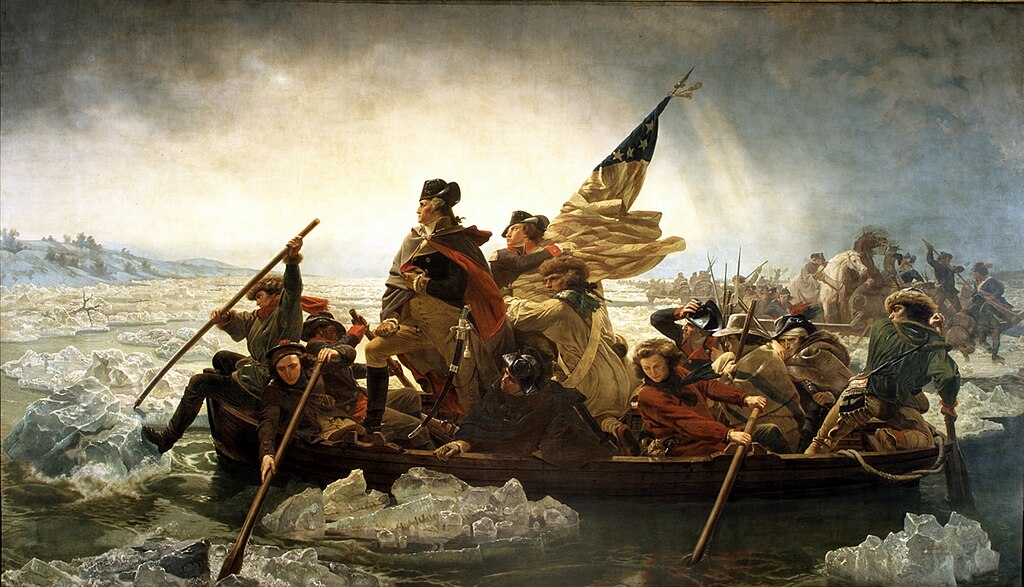
The most famous portrayal of a U.S. flag flying in Delaware is in the painting by Emanuel Leutze (American, 1816–1868).

The most famous portrayal of a U.S. flag flying in Delaware is in the painting by Emanuel Leutze (American, 1816–1868). “Washington Crossing the Delaware,” 1851. The Metropolitan Museum of Art, New York, Gift of John Stewart Kennedy, 1897 (97.34) Among other problems with this portrayal: The flag depicted had not been designated on the date of the crossing, Christmas 1776.

Yes, this is mostly an encore post. Fighting ignorance requires patience.

Yes, this is mostly an encore post. Fighting ignorance requires patience.


It’s Martin van Buren’s birthday, December 5

December 5, 2017

Former President Martin van Buren, circa 1855-1888. Matthew Brady photograph (Imperial print of Martin Van Buren. Salted paper print from glass negative. Provenance from W.H. Lowdermilk & Co., Rare Books, 1418 F Street, Washington, DC) Metropolitan Museum image, via Wikimedia

Former President Martin van Buren, circa 1855-1888. Matthew Brady photograph (Imperial print of Martin Van Buren. Salted paper print from glass negative. Provenance from W.H. Lowdermilk & Co., Rare Books, 1418 F Street, Washington, DC) Metropolitan Museum image, via Wikimedia

Martin van Buren was our nation’s 8th president, serving one term, 1837-1841.

This photo is roughly  15 years after van Buren left office, taken in the Washington, D.C., studio of Matthew Brady, whose photography gained fame from his work photographing battle sites during the American Civil War.

Martin van Buren was born December 5, 1782, in Kinderhook, New York. He is the only president to have the first name Martin. He’d be 235 years old today, and still king of the mutton chop sideburns among presidents.

Van Buren died on July 24, 1862.

More:

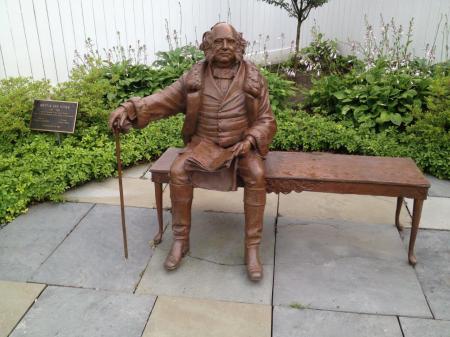
At Broad and Hudson Streets in Kinderhook, New York, one can sit with a statue of Martin Van Buren, and see if one can decipher the newspaper he is reading. PresidentsUSA image

At Broad and Hudson Streets in Kinderhook, New York, one can sit with a statue of Martin Van Buren, and see if one can decipher the newspaper he is reading. PresidentsUSA image


December 2: Millard Fillmore’s Guano Day! 2017 edition

December 2, 2017

Why December 2?

(You couldn’t make this stuff up if you were Monty Python.)

English: Millard Fillmore White House portrait

Millard Fillmore’s White House portrait, via Wikipedia

President Millard Fillmore, in the State of the Union Address, December 2, 1850

Peruvian guano has become so desirable an article to the agricultural interest of the United States that it is the duty of the Government to employ all the means properly in its power for the purpose of causing that article to be imported into the country at a reasonable price. Nothing will be omitted on my part toward accomplishing this desirable end. I am persuaded that in removing any restraints on this traffic the Peruvian Government will promote its own best interests, while it will afford a proof of a friendly disposition toward this country, which will be duly appreciated.

Did any other U.S. President spend so much time thinking about guano?  Did any president ever mention it in a State of the Union Address?  The curious case of Millard Fillmore, Seer, just grows.

Guano, or bird poop (and its relative, bat poop), contains phosphorus, which is an essential element for life.  Consequently, it turns out to be a key ingredient in effective agricultural fertilizers.  In international competition for supremacy in farming and farm exports, guano became a key resource to fight over, in the 19th century.

It’s almost safe to say the fights were economic; but guano did play a key role in wars in South America (see Andrew Leonard’s article, noted below).

Fillmore figured out that the substance had great importance, coupled that with the rather esoteric knowledge that sea birds tended to deposit guano in great abundance on certain islands, often unoccupied, and ordered the U.S. Navy to claim islands found to contain guano deposits that were not claimed by other nations.

By the American Civil War, the importance of phosphorus to the production of gun powder became an issue for the armies of the North and South.  Millard Fillmore had set the stage for the North to win an important advantage in gun powder production, just one of many that led to the defeat of the South.

It’s one more thing we should thank Millard Fillmore for doing. Our study of history should inform us that it is, indeed, important for politicians to understand the importance of guano.

Fillmore knew his guano.

Take a moment on December 2 to toast Millard Fillmore’s prescience, on Guano Day!

More:  

You can purchase Peruvian guano today, from Amazon, GrowOrganic.com, and other sources. It's roughly $15 per pound in the U.S.

You can purchase Peruvian guano today, from Amazon, GrowOrganic.com, and other sources. It’s roughly $15 per pound in the U.S.

This is an encore post.

Yes, this is an edited encore post. Defeating ignorance takes patience and perseverance.


Carl Sagan’s song of the open road; can you spare a penny?

November 29, 2017

NASA image of a launch of one of the Space Shuttles.

NASA image of a launch of one of the Space Shuttles. “The open road still softly calls,” Carl Sagan said.

“The open road still softly calls,” Carl Sagan said, optimistically, in this film.

Can you spare a penny to keep the road open? To answer the call?

More:


December’s dates to fly Old Glory, 2017

November 28, 2017

U.S. flag flies at the U.S. Capitol in a snow storm. Photo by Victoria Pickering, Creative Commons license, from Flickr

U.S. flag flies at the U.S. Capitol in a snow storm. Photo by Victoria Pickering, Creative Commons license, from Flickr. (This photo was actually taken in March.) 

November offers several flag flying days, especially in years when there is an election.

But December may be the month with the most flag-flying dates, when we include statehood days.

December 7 is Pearl Harbor Remembrance Day.  It’s not in the Flag Code, but public law (P.L. 103-308) urges that the president should issue a proclamation asking Americans to fly flags.

December 25 is Christmas Day, a federal holiday, and one of the score of dates designated in the Flag Code. If you watch your neighborhood closely, you’ll note even some of the most ardent flag wavers miss posting the colors on this day, as they do on Thanksgiving and New Years.

Other dates?

Nine states attained statehood in December, so people in those states should fly their flags (and you may join them).  Included in this group is Delaware, traditionally the “First State,” as it was the first colony to ratify the U.S. Constitution:

  • Illinois, December 3 (1818, 21st state)
  • Delaware, December 7 (1787, 1st state)
  • Mississippi, December 10 (1817, 20th state)
  • Indiana, December 11 (1816, 19th state)
  • Pennsylvania, December 12 (1787, 2nd state)
  • Alabama, December 14 (1819, 22nd state)
  • New Jersey, December 18 (1787, 3rd state)
  • Iowa, December 28 (1846, 29th state)
  • Texas, December 29 (1845, 28th state)

December 15 is Bill of Rights Day, marking the day in 1791 when the Bill of Rights was declared ratified; but though this event generally gets a presidential proclamation, there is no law or executive action that requires flags to fly on that date, for that occasion.

Eleven flag-flying dates in December.  Does any other month have as many flag flying opportunities?

Have I missed any December flag-flying dates?  11 events on 10 days (Delaware’s statehood falls on the anniversary of the Pearl Harbor attack).

Here’s a list of the days to fly the flag, under national law, in chronological order:

  1. Illinois, December 3 (1818, 21st state)
  2. Pearl Harbor Remembrance Day, December 7
  3. Delaware, December 7 (1787, 1st state) (shared with Pearl Harbor Remembrance Day)
  4. Mississippi, December 10 (1817, 20th state)
  5. Indiana, December 11 (1816, 19th state)
  6. Pennsylvania, December 12 (1787, 2nd state)
  7. Alabama, December 14 (1819, 22nd state)
  8. New Jersey, December 18 (1787, 3rd state)
  9. Christmas Day, December 25
  10. Iowa, December 28 (1846, 29th state)
  11. Texas, December 29 (1845, 28th state)

Fly your flag with respect to the flag, for the republic it represents, and for all those who sacrificed that it may wave on your residence.

And if you travel for the holidays? You’re away from home?

Astronauts Eugene Cernan and Harrison Schmitt took a flag with them when they visited the Moon in December 1972. Maybe you could carry a small travel flag, too.

NASA caption: Apollo 17 commander Eugene A. Cernan is holding the lower corner of the American flag during the mission's first EVA, December 12, 1972. Photograph by Harrison J.

NASA caption: Apollo 17 commander Eugene A. Cernan is holding the lower corner of the American flag during the mission’s first EVA, December 12, 1972. Photograph by Harrison J. “Jack” Schmitt. Image Credit: NASA


Glorious thread on typewriters and their masters

November 22, 2017

From Dean Frey, posting on Twitter as “Deny Fear @dean_frey.”

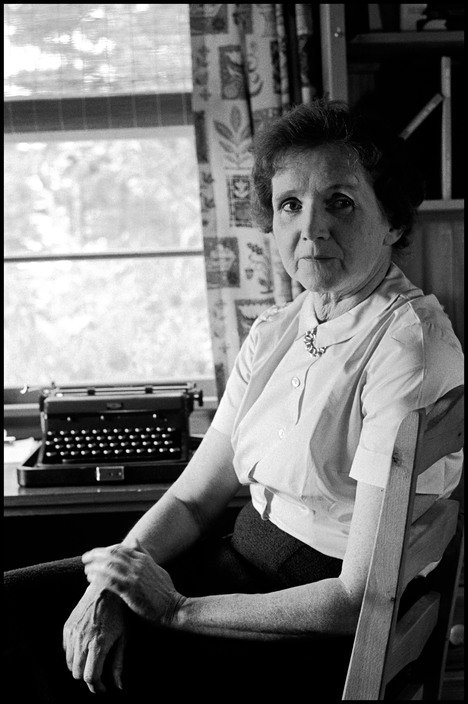
Frey posted this wonderful picture of Rachel Carson, taken by Erich Hartmann in 1962 (after publication of Silent Spring?)

Rachel Carson and her typewriter, by Erich Hartmann, 1962.

Rachel Carson and her typewriter, by Erich Hartmann, 1962.

But hold your horses. Frey posted a raft of other artists with their machines. What a glorious little thread!

https://twitter.com/dean_frey/status/933033391447875585

The entire glorious thread.

You have seen some of those photos, some of those artists, and some of those typewriters in other posts at Millard Fillmore’s Bathtub. There are some sparkling photos there I had not seen before.

Thank you, Dean Frey.