A Gospel About Millard Fillmore – a Unitarian paean to our 13th president, born January 7, 1800

January 7, 2016

This sermon was delivered at the First Unitarian Universalist Society of San Francisco, by the Rev. John Robinson, on September 18, 2005.

Choir practice at First Unitarian Universalist Church of San Francisco.

Choir practice at First Unitarian Universalist Church of San Francisco.

That church used to keep this text in its sermon archives, but I recently discovered the archive had gone away.  I was happy to find I could get a historic version of the page, from which I got this text below.

I offer this here for scholars of the history of the presidency, and for scholars and fans of Millard Fillmore.  Oh, and to update the link in my list of sources on Millard Fillmore.

The Gospel About Millard Fillmore

This sermon began many years ago, over 30. Elliot Richardson had been invited to speak at the Annual Meeting of our Association of Free churches. He was then the martyred hero who had resigned as Attorney General of these United States rather than obey Richard Nixon’s order to fire Archibald Cox as Special Watergate Prosecutor. He was a Unitarian from an old Unitarian family.

Not all Unitarians were happy to have him as speaker. There was much agitation about the choice. Protesters tried to interrupt his speech, but were finally prevailed upon to let him make it.

In the question and answer period that followed, one of the dissenters demanded to know how Elliot Richardson, when Nixon’s Secretary of Defense, could have authorized the infamous December bombings of Hanoi and Haiphong.

Elliot Richardson pointed out to the questioner that he had not been appointed to Secretary of Defense until after the bombings, indeed until after the Vietnam Truce had been declared. He could have stopped there. Gotten off, as so many of us are apt to do, looking good. But he did not. He told the truth. He continued saying: “But, I think the decision to bomb was right.” It was the sort of candor that impresses.

Later that evening a young minister, this was years ago, was on a hotel elevator on to which Elliot Richardson stepped, unsuspectingly. Emboldened by spirits if not spirit. The young minister thanked Mr. Richardson for his speech and apologized for the rude behavior of some self-righteous Unitarians who treat those others of this tradition with whom they disagree so intolerantly. And then, as an illustration he launched into an impromptu sermon on Millard Fillmore. Ever polite, Elliot Richardson said he would like to see a full text. The young minister sent it to him, at the Court of St. James, where Mr. Richardson was at the time United States Ambassador to Great Britain. The Ambassador sent back a letter thanking the young minister for his sermon, saying that he had enjoyed it immensely. As a not so young minister, I still treasure that letter. Here for you this morning is the text of that sermon.

History has been unkind to Millard Fillmore, often referred to as “Millard Who?” forgetting that he was 13th president of the United States. One of the few accomplishments for which he is given credit is installing the first bath tub in the White House. There is serious doubt about that. [MFB note: No longer is there doubt; Fillmore was not the first.]

One historian said of Fillmore: “He came to the Presidency by the only road available to a man of limited ability, the death of his predecessor.” He was accused of being both pro-slavery and abolitionist. It was said he did “not have courage” “but was just inflexible.” They accused him of having “no position except equivocation,” that he was “without personal earnest conviction, personal force, or capacity for strong personal leadership.” His general rating as a president has been, until recently, below average, way below. He is judged bad or poor in his religiousness by those who judge such things. He was rejected by the religious community of which he was a member. He was a Unitarian.

There are three reasons to tell the story of Millard Fillmore: First, he illustrates the on-going tension in our free religious community, between the prophetic and the practical – the privilege of moral purity and the necessity to make real world decisions. Second, he illustrates well how difficult it is to judge our contemporaries. And third, to help restore Millard Fillmore to his rightful place in history.

The list of reasons for Fillmore’s lack of fame or infamy is long. His presidency was very short, only 2 years 236 days. His presidency is greatly overshadowed by the momentous events of the Civil War, eight years later. He was not liked by either the abolitionist historians or those historians who were apologists for the south. His association with the Know-Nothings tarnished his memory. And perhaps most important, the principal source of information about him came from the writings of his arch rival and enemy, the New York political boss Thurlow Weed, who called Fillmore derisively, “That incorruptible man from Buffalo.” Weed was very corruptible.

Millard Fillmore was born in a log cabin January 1, 1800, in upstate New York on his father’s poor, unproductive, isolated, farm. Millard was his mother’s maiden name. His education was sparse, no more than three months a year. He said that in the nine months working on his father’s farm, he forgot more than he learned the other three months. But his ambitious father apprenticed Millard to a cloth cutter, and then later got him a job in a law office. Millard’s Education was mostly self-learning, though by 20 he had a position as a schoolteacher. And then he became a lawyer. At 26 he married Abigail Powers who had taught him as he tried to catch up on his education. At 28 he was elected to the New York State Assembly.

At age 31 he joined a group of like-minded citizens in Buffalo New York where he now made his home. These were the founding and charter members of the First Unitarian Church of Buffalo New York.

Millard fought many good fights in the New York State Assembly. He fought for repeal of a law that required anyone testifying in court to swear that they believed in God and the hereafter. He pushed for an end to imprisonment for debt, and bankruptcy laws to protect small business interests. He fought for separation of church and state.

Millard was a party switcher right from the beginning. He was elected to the assembly as a National Republican, the party of Jefferson. Then He was elected as an Anti-Mason, a party he had helped to form. The Anti-Masons held that the Masonic Order with its lodges, secret rites and oaths, loyalties to something other than the Constitution, constituted an invisible Empire, a dangerous intrusion in a democracy. He wanted to get Masons out of government.

Fillmore was elected to Congress as a National Republican in 1832. His first term saw the formation of the Whig Party, an event he supported, as he wanted to see a party of National Union.

Unfortunately for those who look for titillation in sermons there were no publish rumors of moral turpitude. He served but one term in Congress, (perhaps an early supporter of term limits) and then went home to Buffalo and devoted himself to cultural and intellectual enrichment of Buffalo. (I know, you may think that an oxymoron.) He supported good causes like free public education and free public libraries.

In 1836 he was again elected to the House of Representatives. There he was made chair of the powerful House Ways and Means Committee. He also was chair of a Select Committee charged with investigation of election fraud in New Jersey (yes, I know, no change there). Incredibly Fillmore’s committee found 5 congressmen of his own party guilty, threw them out of congress, and thus handed control of The House to the opposition party! (IMAGINE!)

In 1842 he again left Congress, this time as a prominent Whig. The next year Horace Greely, editor of the NEW YORK TRIBUNE (also an alleged Unitarian), urged Fillmore’s candidacy for Vice-President. (Years later Fillmore repaid the favor by getting Greely out of debtors’ prison in Paris.)

1844 was not the year for Millard to get the nomination. He was held to be anti-slave and anti-Southern. He opposed the annexation of Texas as an attempt to swell slavery forces.

Later Millard opposed the Mexican War, which he believed would spread slavery and weaken the North’s industrial economy.

1848 was the year when Fillmore was tapped as the Whigs vice-presidential candidate. He balanced the ticket, with General Zachary Taylor, a Southerner, and slave owner, who was a hero of the Mexican War (ironically). Taylor ran on a rough and ready image. Leading abolitionists bolted the party, particularly New Englanders, notably the leading Unitarian, Charles Francis Adams.

The Taylor-Fillmore ticket had no platform because whatever was said would alienate part of the country. Abe Lincoln supported this ticket. On November 7, they won.

On July 9, 1850, rough and ready Zachary Taylor died from illness. Fillmore became President, the third President to be Unitarian. (In October of that same year this church was founded.) Within a month Fillmore had aroused the ire of the North by signing the Compromise of 1850. He did it, knowing that he had ruined any hope he had to run for the Presidency on his own. He also earned the animosity of many Unitarians.

The Compromise of 1850 preserved the balance between the North and South that dated from the Missouri Compromise and earlier. By it: California was admitted as a free state; New Mexico and Utah became Territories with no restriction on slavery; Texas was paid 10 million dollars to accept the Texas-New Mexico boundaries; slavery was to be decided by the people of Texas. The balance of concessions was further kept by prohibiting the slave trade in Washington, D.C. but continuing the right (better said the wrong) of slave ownership in the capital. The provision that enraged the abolitionists most was the strengthening of the fugitive slave laws. It empowered federal agents to enforce the act. The Whig Party split over Fillmore’s signing of the law.

Ralph Waldo Emerson (Unitarian) said of the fugitive slave law, “I will not obey it, by God.” Theodore Parker (author of the opening words this morning), a Boston Unitarian minister, led an armed band of vigilantes that confronted slave hunters up from the South; intimidated them into leaving; and saved a slave couple who had escaped to Boston. Parker had acted in direct defiance of the Fugitive Slave Law. With loaded pistol and sword ready on his writing desk Unitarian Parker wrote the Unitarian President, Fillmore, telling what he had done and challenging Fillmore to enforce his “damned law.”

History has judged Fillmore harshly for that one law – a Unitarian President perpetuating slavery – the scandal! Why did he do it? Talk of secession! Remember the times. Even before Taylor’s inauguration, Virginia had passed legislation that threatened secession if the federal government interfered with “Southern Institutions”. John C. Calhoun (also a Unitarian and charter member of the Unitarian Church in Washington D.C.) and other Southern leaders were making ominous warnings. Tension between the States in the House of Representatives kept them from selecting a Speaker for over three weeks. By the time Fillmore took office, the South was ringing with calls for secession, not only if slavery were interfered with but if its expansion were checked.

Fillmore’s predecessor, Taylor, a Southerner, a slave owner and war hero, might have held the country together had he lived to veto the compromise of 1850 as he had said he would. Fillmore knew he could not hold the Union if he vetoed it. He set one goal, to preserve the Union and the Constitution. To give up the great compromise forged in 1787-1788 would, he knew, lead to the rupture of the Union. He thought the North was at that time not yet strong enough to win a civil war. Modern historians agree.

By the end of October 1850, Fillmore had angered abolitionists by sending federal troops to assist U.S. Marshal’s in the arrest of fugitive slaves. His determination for the compromise was also felt in the South. He sent reinforcements for Charleston, South Carolina where Southerners, angry over the North’s resistance to the fugitive slave laws, were threatening to seize federal property.

Fillmore has been most severely criticized for not fighting slavery with determination. However, there is another side. John F. Kennedy in Profiles of Courage chose to profile Daniel Webster. Webster was also a Whig and a Unitarian. Kennedy praises Webster for his courage in supporting The Compromise of 1850 with its Fugitive Slave Law. Fillmore had presided as Vice-President over the debates on the Compromise. He had heard Webster’s famous speech that cost Webster the support of his Massachusetts constituents. Emerson said of Webster at this time “The word ‘liberty’ in the mouth of Mr. Webster sounds like the word ‘love’ in the mouth of a courtesan.”

Webster and Fillmore thought slavery would die a natural death in the industrial revolution (Why invest capital in slave ownership when an Irishman could be rented for next to nothing in wages.) They saw the tension, not so much as slave vs. free, as agriculture vs. industry.

Webster was but one vote for the bill. Fillmore alone shouldered the final responsibility to veto or sign the bill. Fillmore bore the blame for the Compromise of 1850. Do not forget that Lincoln, the Great Emancipator, said that if he could preserve the Union by keeping slavery, he would.

When the Compromise of 1850 fell apart, the Civil War began. The Whigs were terribly weakened by abolitionist outrage.

Perhaps Fillmore’s next most far-reaching act was to send Commodore Perry to Japan. But Fillmore was done. The Whigs were done.

In the election of 1852 Fillmore and Webster fought over the nomination for President at the next Whig Convention, for 47 ballots to a deadlock. In the end, a man neither of them could support was nominated and lost the election. A saddened Fillmore attended, with his wife, the cold rainy inauguration of Franklin Pierce. Three weeks later Fillmore’s wife died of pneumonia contracted that inauguration day. Fillmore’s 22 year old daughter died the year after he left office.

After he had stepped down from office, the Officers of the American Unitarian Association invited Millard Fillmore to preside over the Annual Meeting. But abolitionists refused to allow him to be seated after he got there. They would have no part of this man who would not follow their conscience. One hopes that this free religion might be gentler today but I am not sure. After the Civil War, Fillmore stung by their action resigned from the Buffalo Church when its minister and his friend died.

By 1856 the Whig party had disintegrated. The lines grew harder: Democrats to the South, Republicans to the North. Millard Fillmore wanted a party for the Union. He then made the second mistake for which he has been charged harshly. He offered himself to the American Party, the Know-Nothings, anti-foreign and anti-Catholic, as candidate — a devil of a thing for a free religionist to do. He hoped to gather there the remnants of the Whigs. He then went off to Europe on a 12-month vacation.

Ironically he was on foreign soil, after just completing an audience with the Pope when he was notified that he had received the Know-Nothing’s nomination for President. He was chosen because he was the only person of stature that they could get.

But many Know-Nothings were unhappy with him and bolted the party. Fillmore is not known to have ever expressed any anti-Catholic sentiments. This though he had lost a bid for Governor of New York because Catholics were angry that his militancy for separation of church and state made him oppose state funding they sought for various Catholic institutions.

Fillmore expressed no support for the Know-Nothing goal of removing all Catholics from office alleging they would be loyal to the Pope rather than the U.S.A. He did, however, believe that foreigners should be fully Americanized in their views before becoming citizens. He was also concerned that immigrants, who joined our diplomatic service, were sent to the countries from which they had come. He thought it a potential conflict of interest.

In 1856, he ran for President as the American Party candidate with a Southern slaveholder as his running mate. They emphasized in the campaign regional compromise and preservation of the Union. They carried only the State of Maryland. However they also were the spoilers that kept the Republicans from winning and thus put the Civil war off four more years. It is important remember that the changes happening in this nation, at this time, were more dramatic and far reaching in many ways than the computer revolution in our own. These were the years of the industrial revolution. The dramatic growth of railroads and factories, was changing the North for a subsistence farm economy to market agriculture and industrial growth. These changes radically altered the balance between North and South, increasing the might of the North disproportionately.

It is difficult to know whether Millard was in any sense a believer in Know-Nothingism, or if he knew of the violence in which some of its members engaged, or if he merely compromised himself to win his objective of continued Union of the States. He wouldn’t be the first prejudice Unitarian. He was not a radical Abolitionist. He said, however, that he thought the fugitive slave law odious but constitutional.

Slavery was a despicable practice. There is no apology for it. It is easy to condemn compromisers. But it is harder to make the difficult decisions that the real world demands. If it had not been for the courage of Fillmore the Civil war would have come sooner. And if the South had succeeded in becoming independent, how long and how entrenched by bitterness would slavery have lasted? Until today? And if cooler heads had prevailed, compromise succeeded, would slavery possibly have collapsed anyway without the blood shed and bitterness engendered by that fratricidal war?

The tension between the ideal and the real, the promise and what is practical, between moral purity and the sin of every day life, is very real. It is a tension that we humans are both burdened and blessed with. I leave you to struggle with these hard dilemmas. You do each time you vote. I believe that we are at our best when we walk with each other talk with each other, even in our differences, rather than separating.

Millard Fillmore lived out the balance of his days quietly in private life. He supported Lincoln, met Lincoln in Buffalo when Lincoln was on his way from Illinois to his First Inaugural. He took Lincoln to services at the First Unitarian Church of Buffalo. He thought that the Republicans had provoked the Civil War but gave it his support at rallies. He thought Lincoln too harsh – he strongly supported Andrew Johnson’s efforts at conciliation.

Fillmore was no Saint if you look for moral purity, nor was he our most brilliant President. He refused an Honorary Degree from Oxford, because he had no earned degree of any kind. He said he was “not entitled to it.” (Give him high marks on humility). But he was more than most have given him credit for. He risked and lost his reputation to keep the vision of a United States, even as others risked much to purify that vision. In looking up Eliot Richardson on the Internet, I find that he is listed as an Episcopalian/Anglican. Perhaps he too felt the sting of our righteousness at the General Assembly.

May we, O God, be people who understand that the course of truth and good is never so easy, and that the tread of evil runs through each of us, most surely when we are convinced of our own righteousness.

Amen and Amen.

Mostly accurate, so far as I can tell.  No, I haven’t figured out how you cite this under MLA standards.

Yes, this is mostly an encore post. Fighting ignorance requires patience.

Yes, this is mostly an encore post. Fighting ignorance requires patience.


Happy birthday, Millard Fillmore! Mo Rocca’s profile, from our archives to yours

January 7, 2016

Millard Fillmore as a younger man? Several sites claim this is a painting of Fillmore, but as with much about our mysterious 13th president, it's difficult to confirm, partly because images of Fillmore really are rather rare.

Millard Fillmore as a younger man? Several sites claim this is a painting of Fillmore, but as with much about our mysterious 13th president, it’s difficult to confirm, partly because images of Fillmore really are rather rare.

Our 13th president, Millard Fillmore, was born January 7, 1800. He’s 216 years old today, though he’s been dead most of that time.

After commemorating Fillmore’s birthday each year for the past several years, I’m running out of ideas to write about him that seem novel, at least to me. Several years I’ve called the University of Buffalo to try to get copies of the remarks officials make at Fillmore’s gravesite, but those remarks rarely come through — so we don’t get enlightenment from them.

Reality? Few people remember anything about Fillmore even after we feature it here. For Fillmore’s 216th, let’s review what little we really know about him, with some encore posts.

Raconteur Mo Rocca profiled Fillmore for CBS’s Sunday Morning, a while back. That may be as good a place as any to review the highlights of Fillmore’s life, and meaning and place in U.S. history.

Most historians give Fillmore bad marks as a president, despite his having opened Japan for trade, and despite his having procured a steady supply of bird poop for U.S. industry.

I get this eerie feeling Fillmore would fit right in today in the GOP presidential scraps, and would be a serious challenge to fellow New Yorker Donald Trump. Do you agree?

You may view Mo Rocca’s “profile” of President Millard Fillmore for CBS Sunday Morning, on YouTube:

“CBS Sunday Morning” correspondent Mo Rocca, far left, poses with Kathy Frost, curator of the Millard Fillmore Presidential Site, and Robert Lowell Goller, town historian and director of the Aurora Historical Society, during his recent visit to East Aurora. Photo by Robert Lowell Goller

East Aurora Advertiser caption: CBS Visits East Aurora “CBS Sunday Morning” correspondent Mo Rocca, far left, poses with Kathy Frost, curator of the Millard Fillmore Presidential Site, and Robert Lowell Goller, town historian and director of the Aurora Historical Society, during his recent visit to East Aurora. Photo by Robert Lowell Goller

CBS broadcast this piece on February 16, 2014.

 974

More:


New Mexico flies U.S. flags January 6 for Statehood Day

January 6, 2016

President William Howard Taft signing the bill that made New Mexico a state, in 1912. (Other people in the photo, I have not yet identified). Image from OldPicture.com

President William Howard Taft signing the bill that made New Mexico a state, in 1912. (Other people in the photo, I have not yet identified). Image from OldPicture.com

New Mexico became the 47th member of the Union on January 6, 1912.  New Mexicans should fly their U.S. flags today in honor of statehood, the U.S. Flag Code urges.

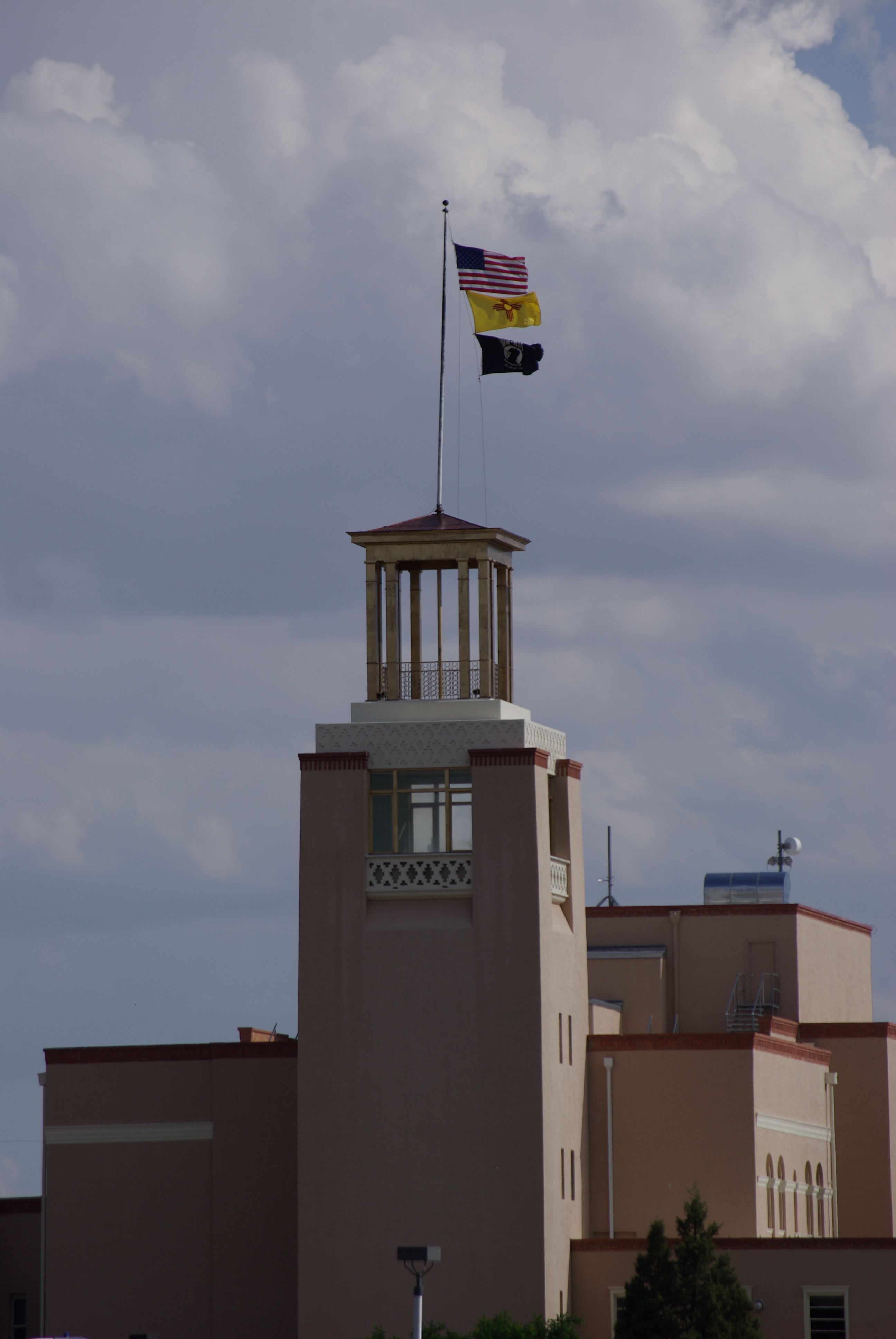
U.S. and New Mexico flags fly from the state education administration building in Santa Fe, 2014

U.S. and New Mexico flags fly from the state education administration building in Santa Fe, 2014. The third flag is the U.S. POW/MIA flag.

I don’t think Statehood Day is a big deal in New Mexico.  New Mexicans love art, though, and statehood and history of the land and the peoples who live there are celebrated throughout Santa Fe and New Mexico.  The New Mexico Art Museum features a lot about history.

The New Mexico State Capitol is one of the more unique in the U.S. There is no grand dome. Instead, the building is a large, circular structure, a giant kiva, honoring New Mexico’s ancient residents and ancestors.

We toured the Capitol in July 2014. It features a massive collection of art by and about New Mexico, and is worth a stop as one would intend to visit any great art museum.

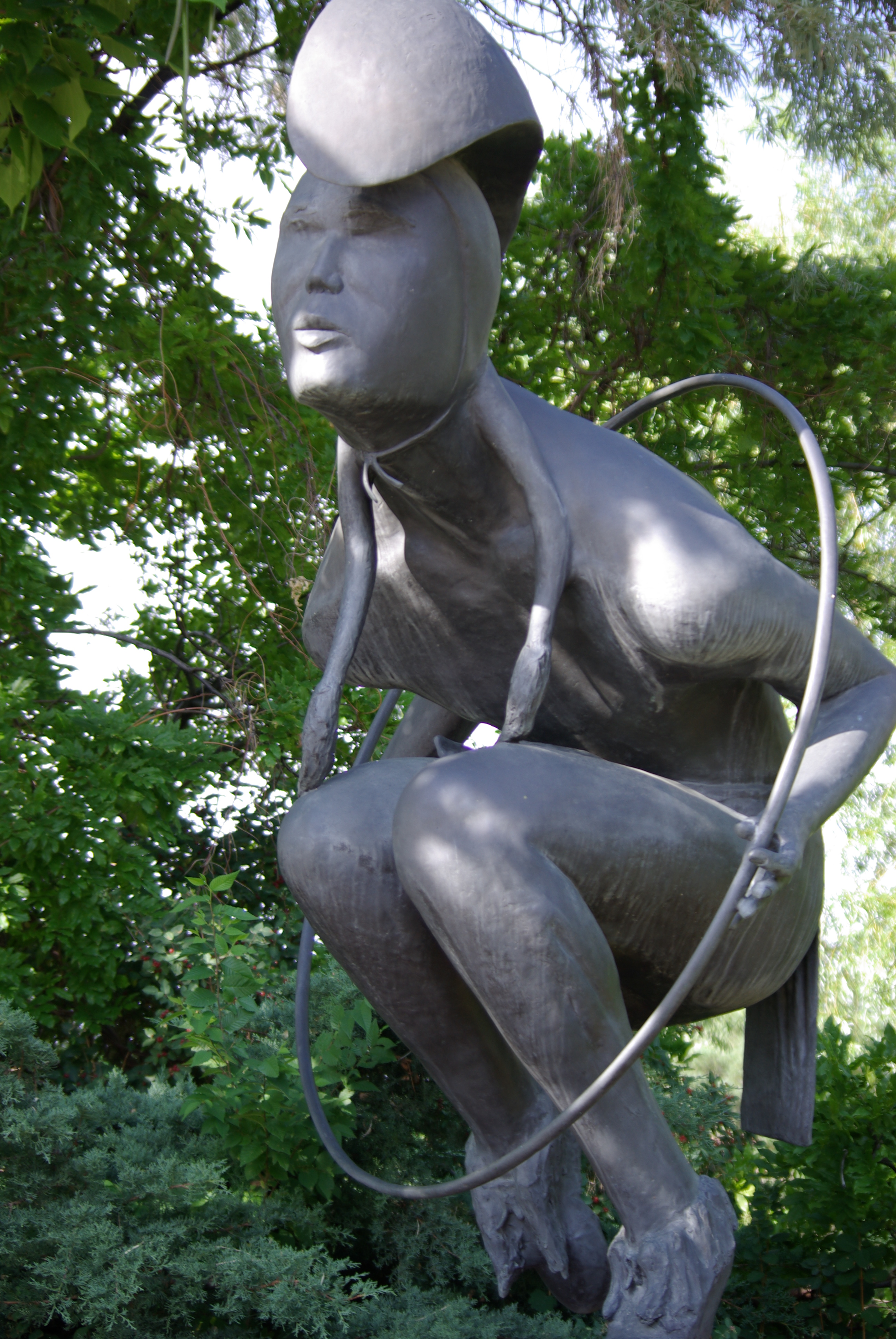
"Emergence," a representation of the creation of the present Earth and people, by Michael A. Naranjo, 2000. Part of the massive collection of New Mexico Art at the State Capitol -- this one outside the building itself.

“Emergence,” a representation of the creation of the present Earth and people, by Michael A. Naranjo, 2000. Part of the massive collection of New Mexico Art at the State Capitol — this one outside the building itself.

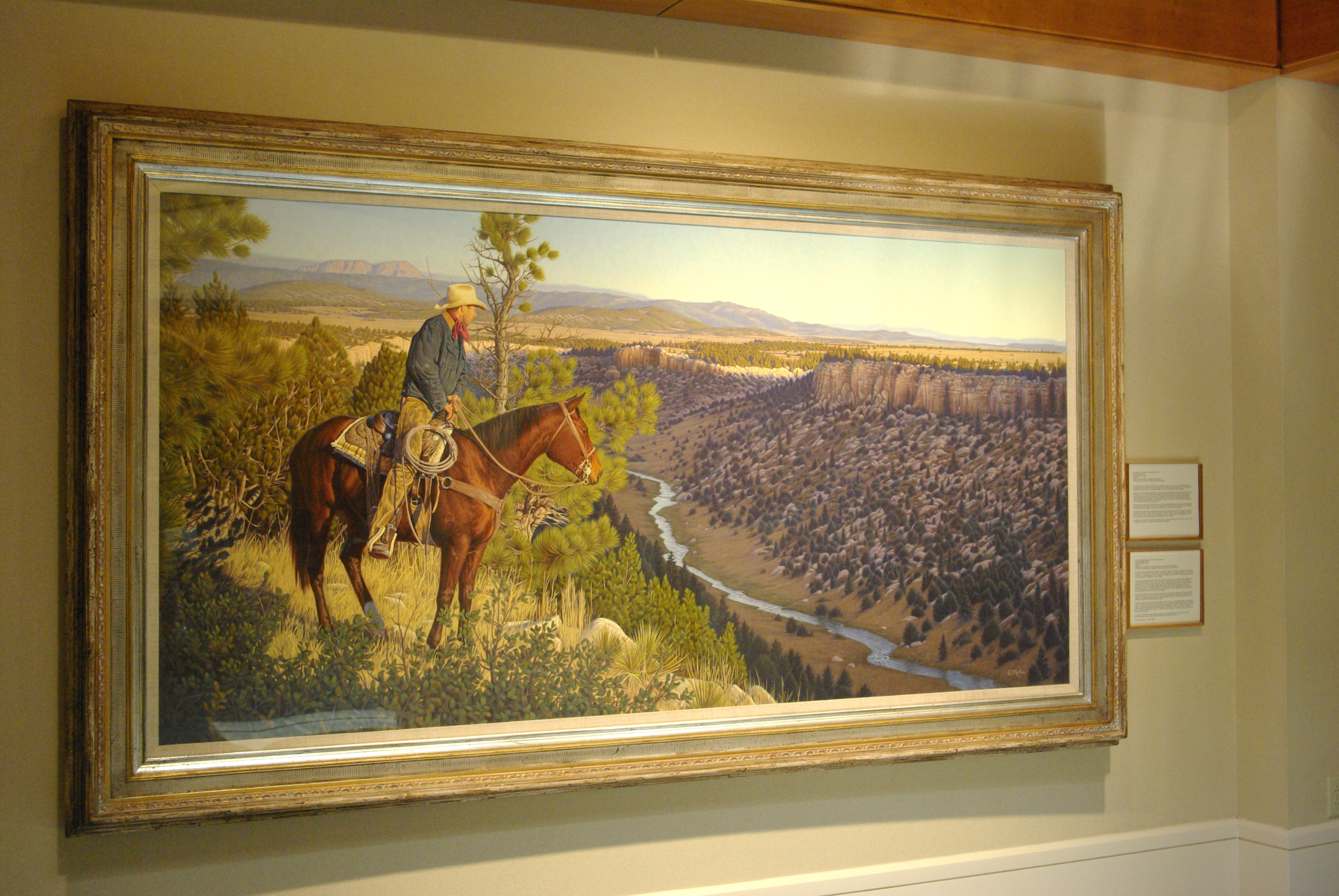
Simple Pleasures of New Mexico, acrylic by Gary Morton, 1992

Simple Pleasures of New Mexico,  stunning painting in acrylic by Gary Morton, 1992

If you’re in Santa Fe, plan to spend a half of a day, at least, looking at the Capitol and its art collections.  There are more than 400 pieces on display, sculpture, paintings, mixed media, and more.  It’s a world class gallery, free for the browsing.  Much of the art packs a powerful emotional punch, too, such as the sculpture outside the building honoring the vanished native tribes of North America.

Happy statehood, New Mexico.

More: 

USPS stamp honoring the centennial of New Mexico's statehood, in 2012. The stamp features a representation of the beauty of the state found in its desert hills and mountains. VirtualStampClub.com

USPS stamp honoring the centennial of New Mexico’s statehood, in 2012. The stamp features a representation of the beauty of the state found in its desert hills and mountains. VirtualStampClub.com


Wildlife refuge photos, early January 2016

January 5, 2016

National Wildlife Refuges. Four days ago, most people were very fuzzy on what they are, except for members of Ducks Unlimited, and conservationists.

Here are a few Tweets to help the rest along.

Moose at the National Elk Refuge, outside Jackson Hole, Wyoming:

Wisdom is a 64-year old albatross who remarkably returns to the Midway National Wildlife Refuge every year, and has raised chicks most of those years. Midway NWR is northwest of Hawaii:

Sparky the lightning catching bull bison, at the Midwest NWR:

Every Kid in a Park shares a photo of an unnamed wild area (threw it in just for the heck of it):

Yellow-rumped warbler at the Sacramento NWR:

USFWS workers conduct a controlled burn at the Okefenokee NWR in Florida:

Hamden Slough NWR, Minnesota, is 26 years old today, January 5:

Great blue heron at Sacramento NWR:

Pied-billed grebe at Sacramento NWR:

Conservatives keep misattributing a famous quote to Thomas Paine, but it was Ed Abbey who said it. Rumor is you can find Abbey at the Caza Prieta NWR in Arizona:

Buenos Aires NWR, Arizona:

Wichita Mountains NWR, Oklahoma:

Bosque del Apache NWR, New Mexico (near Las Vegas, New Mexico, home of the first Owl Cafe and the wonderful Owl Burger):

https//twitter.com/CherylRofer/status/683725871123791872

Back to the Midway Atoll NWR:

1908 photo from Oregon’s Malheur NWR:

Working against extinction of monarch butterflies, at St. Marks NWR:

Lake Klamath NWR in Oregon, critical habitat for ducks along the Pacific flyway:

Loxahatchee NWR:

“Conservatives” want to sell these lands off, or drill for oil or gas, or mine for minerals, on many of these lands. Will these places be preserved for your great grandchildren and America’s future?


January 5, 1502: A deal is a deal, with Columbus’s most prized possession

January 5, 2016

Who can you trust, if not the king and queen?

Columbus feared that King Ferdinand and Queen Isabella would not honor pledges they had made to him as recompense and honor for his great work of discovery on their behalf.  Before his final voyage, he assembled a legal document showing those promises made to him, and his work for Spain.

This illustrates, once again, the human dimension of the great drama of the age of exploration, of Columbus’s stumbling on to the America’s in his efforts to get to China.

The Library of Congress and the History Channel team up again to show off these grand snippets of history:

On January 5, 1502, prior to his fourth and final voyage to America, Columbus gathered several judges and notaries in his home in Seville. The purpose? To have them authorize copies of his archival collection of original documents through which Isabel and Fernando had granted titles, revenues, powers and privileges to Columbus and his descendants. These 36 documents are popularly called “Columbus’ Book of Privileges.” Four copies of his “Book” existed in 1502, three written on vellum and one on paper. The Library’s copy, one of the three on vellum, has a unique paper copy of the Papal Bull Dudum siquidem of September 26, 1493, which extended the Spanish claim for future explorations.

513 years ago today.

Parts of Christopher Columbus’s journals parked for a visit to Dallas, through January 3, at the Meadows Museum on the campus of Southern Methodist University. When we visited, the exhibits were not crowded. Who cares about ancient history today? Not enough.

Borrowed with permission from Mr. Darrell’s Wayback Machine. This has also appeared at Millard Fillmore’s Bathtub before.


January 5, 1949: Truman launches the “Fair Deal”

January 5, 2016

Front page of the New York Times on January 6, 1949, with news of President Truman's State of the Union message. Oddly, via Conservapedia

Front page of the New York Times on January 6, 1949, with news of President Truman’s State of the Union message. Oddly, via Conservapedia

President Harry Truman delivered his State of the Union address to Congress on January 5, 1949, the first after he’d won election to the presidency in his own right (he succeeded to the presidency on the death of Franklin Roosevelt on April 12, 1945, remember).

Campaign button from the 1948 presidential campaign; on January 5, 1949, Truman presented a more detailed program backing the slogan, in his State of the Union Address

Campaign button from the 1948 presidential campaign; on January 5, 1949, Truman presented a more detailed program backing the slogan, in his State of the Union Address

Not a barn-burner of a speech, but an important one.  He appealed to history and the Square Deal of Teddy Roosevelt and the New Deal of Franklin Roosevelt; he appealed to Americans’ innate patriotism, and he appealed to a nation grateful to the soldiers who had defended freedom and democracy in World War II.  Truman called for a Fair Deal for all Americans, because they’d earned it, and it was the American thing to do.

This was barely eight weeks since Truman pulled out a stunning re-election win against the “do-nothing Congress.”  In many, many ways, the problems of 1949 look stunningly familiar to us today.  He spoke of the successes of the country in World War II, and the successes in business and finance since the war.  Truman said:

Reinforced by these policies, our private enterprise system has reached new heights of production. Since the boom year of 1929, while our population has increased by only 20 percent, our agricultural production has increased by 45 percent, and our industrial production has increased by 75 percent. We are turning out far more goods and more wealth per worker than we have ever done before.

This progress has confounded the gloomy prophets–at home and abroad who predicted the downfall of American capitalism. The people of the United States, going their own way, confident in their own powers, have achieved the greatest prosperity the world has even seen.

But, great as our progress has been, we still have a long way to go.

As we look around the country, many of our shortcomings stand out in bold relief.

We are suffering from excessively high prices.

Our production is still not large enough to satisfy our demands.

Our minimum wages are far too low.

Small business is losing ground to growing monopoly.

Our farmers still face an uncertain future. And too many of them lack the benefits of our modern civilization.

Some of our natural resources are still being wasted.

We are acutely short of electric power, although the means for developing such power are abundant.

Five million families are still living in slums and firetraps. Three million families share their homes with others.

Our health is far behind the progress of medical science. Proper medical care is so expensive that it is out of the reach of the great majority of our citizens.

Our schools, in many localities, are utterly inadequate.

Our democratic ideals are often thwarted by prejudice and intolerance.

Each of these shortcomings is also an opportunity-an opportunity for the Congress and the President to work for the good of the people.

Hello, boy howdy!  Prices aren’t so stifling as they were considered to be, then, and inflation is far from the plate of problems we face.

But the rest?

Perhaps we should look back to see what Congress, and the nation, did in 1949, as instructive to us in 2014.  Did Americans get a Fair Deal then?  Do they deserve one now?

From “Today in History” at American Memory, the Library of Congress:

On January 5, 1949, President Harry Truman used his State of the Union address to recommend measures including national health insurance, raising the minimum wage, strengthening the position of organized labor, and guaranteeing the civil rights of all Americans. Referencing the popular “New Deal” programs of his predecessor, Franklin Delano Roosevelt, Truman styled his reform package the “Fair Deal.”

A few months earlier the president’s career seemed over.  Political pundits of the time agreed that Truman needed a miracle to win his 1948 bid for reelection against the popular Republican governor from New York, Thomas E. Dewey. Adding to the incumbent’s troubles, a revived Progressive Party attempted to attract left-leaning Democrats, while segregationist “Dixiecrats” broke with the Democrats to run South Carolina Governor Strom Thurmond for president. Responding to the competition, Truman embarked on a campaign tour by train, delivering “whistle-stop” speeches to thousands of voters in small communities throughout the United States. This tactic proved effective, and President Truman was reelected by a slim margin. Still, the Chicago Daily Tribune was so confident of the president’s defeat it went to press with the November 3, 1948 headline “DEWEY DEFEATS TRUMAN.”

Truman had begun to push for Fair Deal-type legislation following the end of World War II in 1945. However, Congress resisted his plans for the extension of federal social and economic programs. Concerned about the transition from a wartime to a peacetime economy, lawmakers ultimately accepted the role of government in maintaining full employment and stabilizing the economy, but rejected Truman’s proposals for national health insurance, educational aid, and federally-supported housing programs. Even after Truman’s successful 1948 campaign, the mandate for expanded social programs remained weak. The minimum wage rose and social security coverage broadened, but few Fair Deal programs were enacted.

On July 26, 1948, President Harry Truman issued two executive orders. One instituted fair employment practices in the civilian agencies of the federal government; the other provided for “equality of treatment and opportunity in the armed services without regard to race, color, religion, or national origin.”

Gib Crockett cartoon on Truman's Fair Deal, 1949. May still be under copyright

Gib Crockett cartoon on Truman’s Fair Deal, 1949. May still be under copyright

We could use a Fair Deal for America today, in 2016. GOP wouldn’t stand for it, though.

More:

Yes, this is mostly an encore post. Fighting ignorance requires patience.

Yes, this is mostly an encore post. Fighting ignorance requires patience. Heaven knows this nation needs good news of great turnarounds in history.


Remember the day they flew the U.S. flag backwards from the Mormon Temple in Salt Lake City?

January 4, 2016

Holly Munson at the Constitution Center wrote up a piece about Utah’s perhaps odd path to statehood, certainly complementary to my reminder that you could fly your flags on January 4, to honor Utah’s statehood, under the U.S. Flag Code.  Munson’s piece was distributed on Yahoo! News.

Her report is very solid, even though brief.  Utah history is nothing if not a convoluted path to statehood through what amounted to a civil war, the Mexican War, the discovery of gold in California, the transcontinental railroads, mining and immigration, Indian wars, old west shootouts, rampant environmental destruction with sheep grazing and mineral extraction and smelting, union strife, astonishing agricultural applications, and a lot of books written from tens of thousands of Mormon pioneer journals — Mormonism appears to be impossible without ink and paper and time to write.

Go read her story.

What caught my eye was the George W. Reed photograph of the Salt Lake City Temple of the Church of Jesus Christ of Latter-day Saints — the LDS, or Mormon church.  The Temple and the Tabernacle, also in the photo, both have their own unique architectural histories, and quirks that make them noteworthy purely from architecture.  (This George W. Reed should not be confused with the Civil War Medal of Honor winner, George W. Reed)

Reed was an early photographer for newspapers in Salt Lake City, and he took some wonderful photos for posterity.  He was also a founder of the leading non-Mormon paper in the state, The Salt Lake Tribune.  At points in its history, it’s been known as an anti-Mormon paper.  The University of Utah’s library holds about five dozen of his photos in their collection, indexed electronically if not quite available yet; there Reed is described:

A pioneer in the development of Utah newspapers, George Reed was originally employed by the Deseret News and in 1871 helped in establishing the Salt Lake Tribune. His photographs include nineteenth century views of Salt Lake City, individuals at Reed’s Avenue home, Wasatch Resort in Little Cottonwood Canyon, and a photograph of the American flag hung on the Salt Lake Temple in 1896 to commemorate Utah’s statehood.

In the collection of Utah State University, in Logan, Reed has yet more papers.  There we get a bit more of his history:

A pioneer in Utah journalism, George W. Reed was born in London, England, on April 7, 1833. He emigrated to Utah in 1862 and became manager of the Deseret News, a position he held until 1871 when he founded the Salt Lake Tribune. In 1882, after a decade at the Tribune, Reed sold his interest in the paper to P. H. Lannan. He married Elizabeth Tuddenham in 1866 and passed away December 1, 1909.

U.S. flag on the Mormon Temple, at Utah statehood in 1896

The Mormon Temple in Salt Lake City, Utah, draped with a U.S. flag in 1896, commemorating the completion of Utah’s statehood campaign when President Grover Cleveland declared Utah a member of the Union. Photo by George W. Reed; Reed worked for the Deseret News, and helped found the Salt Lake Tribune. I do not know whether this photo was published in either paper.  From the George W. Reed Collection, University of Utah Libraries.

Yes, you’re right!  That flag is backwards.  Well, it’s backwards according to the modern U.S. Flag Code, which specifies that when hung from a building, the flag’s union should always be in the viewer’s upper left corner (“northwest” corner were it a standard map).  In the photograph, the union is in the opposite corner.  No, we know the photo is not reversed, because it accurately portrays the location of the Tabernacle, to the west and slightly south of the Temple.

But we hear the protests:  The U.S. Flag Code did not exist in 1896!  How can that be a violation of a code that did not exist?

That’s right, too.

That is an indication that the traditions of flag display that some people get riled up about, that many people think we should amend the Constitution to protect, are new inventions more than old traditions.  Flag code violations are legion by well-meaning citizens celebrating the flag and patriotism, and rare by anyone with any malignant motives.

After a 49-year fight for statehood, through wars with the U.S., fighting with the U.S. forces in Mexico, the administrations of several presidents and 25 different U.S. Congresses, and pledges to change the rules of the church to ban polygamy and put that ban in the state constitution,  the people of Utah, especially the Mormon officials, were not trying to insult America by displaying the flag incorrectly.  Somebody said ‘fly the flag from the Temple,’ and some engineer or custodian got it done.  By 1896, most of the First Amendment litigation done in the U.S. had involved whether Mormons could keep their marriage policies (Mormons lost).  There was no intent to violate any rule of separation of church and state — nor would that be considered a violation today.  Churches may fly the nation’s flag with all the approval that suggests; it’s the government which may not fly a church’s flag.

Finally, there is no grand story in the flag’s being flown backwards.  It’s just one of those historical footnotes that mark the changing mores of the times, in this case, for standards of how to fly the U.S. flag.

Perhaps Utah history textbooks should make note of the day the U.S. flag was flown, backwards, to honor statehood.

More, and related resources:

Yes, this is mostly an encore post. Fighting ignorance requires patience.

Of course this is an encore post. Fighting ignorance requires patience. No one has changed the Utah history textbooks yet.


Utah at 120: Fly colors for Utah statehood, January 4, 1896

January 4, 2016

Utah Capitol, with flags

South entrance (main) to the Utah State Capitol, with U.S. and Utah flags flying on the single flag poll, and the snow-dusted Wasatch Mountains in the background. Utah State Law Library photo.

Utah joined the Union on January 4, 1896.  It had been a 49-year slog to statehood for Deseret, the Mormon settlement in the Desert.  The size had been pared down, so it would not be the biggest state, incorporating parts of what is now Nevada, Arizona, Oregon, Idaho, Colorado and New Mexico.  New capitals had been tried and cast aside (Fillmore, Utah).  Democratic Party rule was broken when LDS church authorities went door-to-door, calling every other family to the Republican Party, and party parity.  The Mormon Church abandoned polygamy, and adopted a state constitution that gave the vote to women.

Finally, Utah became the 45th state.

You may fly your U.S. flag today for Utah statehood, especially if you’re in Utah.

Happy birthday, Utah!  120 years old today.

Next federal flag-flying date: January 6, in honor of New Mexico’s statehood.

More:

U.S. flag in Capitol Reef NP

U.S. flag flying at Capitol Reef National Park, in Utah. Photo by longyang0369, via Flickr

Much of this material appeared here before; this is an annual event, after all.


Georgians fly flags on January 2, celebrating statehood

January 2, 2016

Or not.

I haven’t found any commemoration in Georgia of Georgia Statehood Day.

Which rather moots Luther McKinnon’s question about which Georgia flag to fly on the date. (Head over there anyway, just to see the photos.)

In any case, January 2 is Georgia Statehood day. U.S. law urges residents of states to fly the U.S. flag on the anniversary of statehood.  Georgia was the fourth state to ratify the U.S. Constitution, in a unanimous vote in a convention called solely to consider the document, on January 2, 1788.  Georgia is considered the fourth state.

U.S. and Georgia flags fly at the Georgia Capitol. (Flags pictured flew half-staff on December 8, 2012.)

U.S. and Georgia flags fly at the Georgia Capitol. (Flags pictured flew half-staff on December 8, 2012.)

While patriots urge flying the flag often, and “with gusto,” one should be careful to avoid errors in etiquette, or other oopsies, like this one in April 2014:

Via Buzzfeed: Braves Spokesperson Beth Marshall told 11Alive News it happened because of new pyrotechnics. For the first time, they put pyrotechnics on Braves Vision (that’s the large HD screen). One of the pyrotechnics flew at the flag and lit it on fire. Marshall said the material of the flag is flame retardant, so it went out on its own.

Via Buzzfeed: Braves Spokesperson Beth Marshall told 11Alive News it happened because of new pyrotechnics. For the first time, they put pyrotechnics on Braves Vision (that’s the large HD screen). One of the pyrotechnics flew at the flag and lit it on fire. Marshall said the material of the flag is flame retardant, so it went out on its own.

Happy birthday, Georgia!  Fly your flags today.


Will you fly your U.S. flags in January 2016?

January 2, 2016

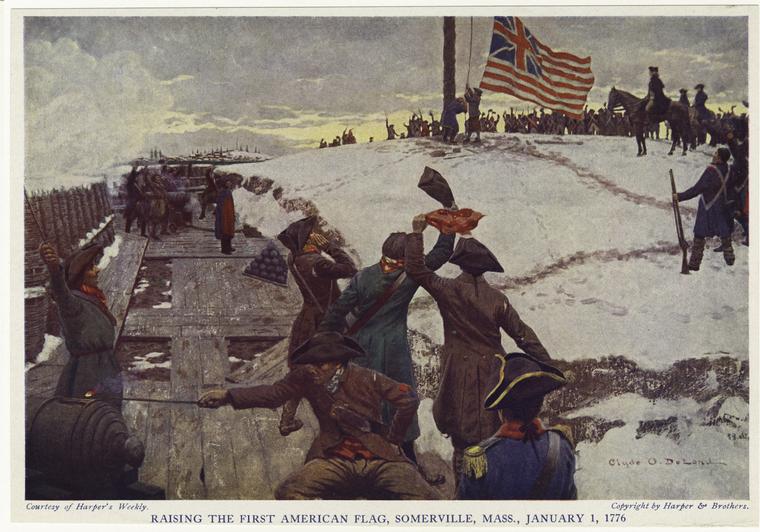
“Raising the first American flag, Somerville, Mass., January 1, 1776.” Harper’s Weekly painting by Clyde Osmer DeLand, 1897. From the digital collections of the New York Public Library

January is loaded with flag flying dates, when we add in statehood days, dates those states are invited to fly their U.S. flags.

In January 2016, the U.S. Flag Code urges citizens to fly flags on these dates, listed chronologically:

  • New Year’s Day, January 1, a federal holiday
  • January 2, Georgia Statehood Day
  • January 3, Alaska Statehood Day
  • January 4, Utah Statehood Day
  • January 6, New Mexico Statehood Day
  • January 9, Connecticut Statehood Day
  • Martin Luther King’s Birthday, a federal holiday on the third Monday of January; that date is January 18, in 2016; King’s actual birthday is January 15, and you may fly your flag then, too
  • Inauguration Day, January 20, the year after election years (next one in 2017)
  • January 26, Michigan Statehood Day
  • January 29, Kansas Statehood Day

You may fly your flag any other day you wish, too; flags should not be flown after sundown unless they are specially lighted, or at one of the few places designated by Congress or Presidential Proclamation for 24-hour flag flying.  According to Wikipedia’s listing, those sites include:

  • Fort McHenry, Baltimore, Maryland (Presidential Proclamation No. 2795, July 2, 1948).
  • Flag House Square, Albemarle and Pratt Streets, Baltimore, Maryland (Public Law 83-319, approved March 26, 1954).
  • Marine Corps War Memorial (Iwo Jima Memorial), Arlington, Virginia (Presidential Proclamation No. 3418, June 12, 1961).
  • Lexington Battle Green, Lexington, Massachusetts (Public Law 89-335, approved November 8, 1965).
  • White House, Washington, D.C. (Presidential Proclamation No. 4000, September 4, 1970).
  • Washington Monument, Washington, D.C. (Presidential Proclamation No. 4064, July 6, 1971, effective July 4, 1971).
  • Any port of entry to the United States which is continuously open (Presidential Proclamation No. 413 1, May 5, 1972).
  • Grounds of the National Memorial Arch in Valley Forge State Park, Valley Forge, Pennsylvania (Public Law 94-53, approved July 4, 1975).
Flag House in 1936, 844 East Pratt & Albemarle Streets (Baltimore, Independent City, Maryland) (cropped). Image courtesy of the federal HABS—Historic American Buildings Survey of Maryland.

Flag House in 1936, where Mary Pickersgill sewed the garrison-sized, 15-star flag that flew over Fort McHenry at the Battle of Baltimore in 1814; one of the sites where the U.S. flag may be flown 24 hours. The house is at 844 East Pratt & Albemarle Streets (Baltimore, Independent City, Maryland). Cropped image courtesy of the federal HABS—Historic American Buildings Survey of Maryland.


How USA spends so much money to fight malaria in other nations

January 2, 2016

Fighting malaria is difficult, and complex, and expensive. No magic bullet can slow or stop malaria.

Reasonable people understand the stakes, not only for Africa, where $12 billion is lost every year to malaria illness and death, according to WHO records; but also for all nations who trade with Africa and other malaria endemic nations in the world.

What should we do about malaria?

Before we leap to solutions, let us look to see what the United States is already doing, according to USAID, the agency which has led U.S. malaria-fighting since the 1950s.

USAID explains on their website:

Fighting Malaria

A mother and child sit under the protection of malaria nets

A mother and child sit under the protection of malaria nets. Learn more about PMI’s contributions to the global fight against malaria. Maggie Hallahan Photography

Each year, malaria causes about 214 million cases and an estimated 438,000 deaths worldwide

While malaria mortality rates have dropped by 60 percent over the period 2000–2015, malaria remains a major cause of death among children. Although the disease is preventable and curable, it is estimated that a child dies every minute from malaria. In Asia and the Americas, malaria causes fewer severe illnesses and deaths, but antimalarial drug resistance is a serious and growing problem.

The U.S. Agency for International Development (USAID) has been committed to fighting malaria since the 1950s. Malaria prevention and control remains a major U.S. foreign assistance objective and supports the U.S. Government’s vision of ending preventable child and maternal deaths and ending extreme poverty. USAID works closely with national governments to build their capacity to prevent and treat the disease. USAID also invests in the discovery and development of new antimalarial drugs and malaria vaccines. USAID-supported malaria control activities are based on country-level assessments, and a combination of interventions are implemented to achieve the greatest public health impact – most importantly the reduction of maternal and child mortality. These interventions include:

  • Indoor residual spraying (IRS): IRS is the organized, timely spraying of an insecticide on the inside walls of houses or dwellings. It kills adult mosquitoes before they can transmit malaria parasites to another person.
  • Insecticide-treated mosquito nets (ITNs): An insecticide-treated mosquito net hung over sleeping areas protects those sleeping under it by repelling mosquitoes and killing those that land on it.
  • Intermittent preventive treatment for pregnant women (IPTp): Approximately 125 million pregnant women annually are at risk of contracting malaria. IPTp involves the administration of at least two doses of an antimalarial drug to a pregnant woman, which protects her against maternal anemia and reduces the likelihood of low birth weight and perinatal death.
  • Diagnosis and treatment with lifesaving drugs: Effective case management entails diagnostic testing for malaria to ensure that all patients with malaria are properly identified and receive a quality-assured artemisinin-based combination therapy (ACT).

The President’s Malaria Initiative (PMI) works in 19 focus countries in sub-Saharan Africa and the Greater Mekong Subregion in Asia. PMI is an interagency initiative led by USAID and implemented together with the U.S. Centers for Disease Control and Prevention. In 2015, PMI launched its next 6-year strategy for 2015–2020, which takes into account the progress over the past decade and the new challenges that have arisen. It is also in line with the goals articulated in the Roll Back Malaria (RBM) Partnership’s second generation global malaria action plan, Action and Investment to Defeat Malaria (AIM) 2016–2030: for a Malaria-Free World [PDF, 18.6MB] and The World Health Organization’s (WHO’s) updated Global Technical Strategy: 2016–2030 [PDF, 1.0MB]. The U.S. Government’s goal under the PMI Strategy 2015-2020 [PDF, 8.9MB] is to work with PMI-supported countries and partners to further reduce malaria deaths and substantially decrease malaria morbidity, toward the long-term goal of elimination. USAID also provides support to malaria control efforts in other countries in Africa, including Burkina Faso, Burundi and South Sudan, and one regional program in the Amazon Basin of South America. The latter program focuses primarily on identifying and containing antimalarial drug resistance.

Do you think the U.S. spends too much on foreign aid, even good aid to fight malaria? How much do you think is spent? Put your estimate in comments, please — and by all means, look for sources to see what the actual amount is.


December 31, 2015: Bright Idea Day, anniversary of the Day the Lights Went On

December 31, 2015

Between Christmas and New Year’s Day, here at Millard Fillmore’s Bathtub we celebrate a variety of historically holy days.  December 31, by tradition, is Bright Idea Day, the anniversary of the day Thomas Edison demonstrated for the public a working light bulb, in 1879.

100,000 people gather in Times Square, New York City (surely not the 1 million predicted by NBC!) tonight, and millions more around the world, in festivities for the new year made possible by the work of Thomas Alva Edison.

Here it is, the invention that stole sleep from our grasp, made clubbing possible, and launched 50,000 cartoons about ideas:

The light bulb Thomas Edison demonstrated on December 31, 1879, at Menlo Park, New Jersey - Wikimedia image

The light bulb Thomas Edison demonstrated on December 31, 1879, at Menlo Park, New Jersey – Wikimedia image (GFDL)

The light bulb. It’s an incandescent bulb.

It wasn’t the first bulb. Edison a few months earlier devised a bulb that worked with a platinum filament. Platinum was too expensive for mass production, though — and Edison wanted mass production. So, with the cadre of great assistants at his Menlo Park laboratories, he struggled to find a good, inexpensive filament that would provide adequate life for the bulb. By late December 1879 they had settled on carbon filament.

Edison invited investors and the public to see the bulb demonstrated, on December 31, 1879.

Thomas Edison in 1878, the year before he demonstrated a workable electric light bulb. Library of Congress image

Thomas Edison in 1878, the year before he demonstrated a workable electric light bulb. CREDIT: Thomas Edison, head-and-shoulders portrait, facing left, 1880. Prints and Photographs Division, Library of Congress. Reproduction number LC-USZ62-98067

Edison’s successful bulb indicated changes in science, technology, invention, intellectual property and finance well beyond its use of electricity. For example:

  • Edison’s Menlo Park, New Jersey, offices and laboratory were financed with earlier successful inventions. It was a hive of inventive activity aimed to make practical inventions from advances in science. Edison was all about selling inventions and rights to manufacture devices. He always had an eye on the profit potential. His improvements on the telegraph would found his laboratory he thought, and he expected to sell the device to Western Union for $5,000 to $7,000. Instead of offering it to them at a price, however, he asked Western Union to bid on it. They bid $10,000, which Edison gratefully accepted, along with the lesson that he might do better letting the marketplace establish the price for his inventions. Other inventive labs followed Edison’s example, such as the famous Bell Labs, but few equalled his success, or had as much fun doing it.  (Economics teachers:  Need an example of the marketplace in action?)
  • While Edison had some financial weight to invest in the quest for a workable electric light, he also got financial support, $30,000 worth, from some of the finance giants of the day, including J. P. Morgan and the Vanderbilts who established the Edison Light Company.
  • Edison didn’t invent the light bulb — but his improvements on it made it commercial. “In addressing the question ‘Who invented the incandescent lamp?’ historians Robert Friedel and Paul Israel list 22 inventors of incandescent lamps prior to Joseph Wilson Swan and Thomas Edison. They conclude that Edison’s version was able to outstrip the others because of a combination of three factors: an effective incandescent material, a higher vacuum than others were able to achieve (by use of the Sprengel pump) and a high resistance lamp that made power distribution from a centralized source economically viable.”
  • Edison’s financial and business leadership acumen is partly attested to by the continuance of his organizations, today — General Electric, one of the world’s most successful companies over the past 40 years, traces its origins to Edison.

Look around yourself this evening, and you can find a score of ways that Edison’s invention and its descendants affect your life. One of the more musing effects is in cartooning, however. Today a glowing lightbulb is universally accepted as a nonverbal symbol for ideas and inventions. (See Mark Parisi’s series of lightbulb cartoons, “Off the Mark.”)

Even with modern, electricity-saving bulbs, the cartoon shorthand hangs on, as in this Mitra Farmand cartoon.

Fusilli has an idea, Mitra Farmand, Fuffernutter

Brilliant cartoon from Mitra Farmand, Fuffernutter (regrettably, we note this site is no longer there; but with some hope, we find a new site here)

Or see this wonderful animation, a video advertisement for United Airlines, by Joanna Quinn for Fallon — almost every frame has the symbolic lightbulb in it.

Electrification of America, and the consequent spread of electric lighting and electrical machines to make domestic and industrial life more productive, and the spread of great public works to enable these and other inventions to spread, were made possible by a people roughly united in advancing progress, what historians now call “the progressive agenda” and the great advances of the Progressive Era.

Could we get such agreement among workers, corporate bosses and many levels of government today? When we celebrate anniversaries, like the demonstration of the light bulb, we celebrate the united polity that made such things possible, too.

Other resources:

Patent drawing for Thomas Edison's successful electric lamp. Library of Congress

Thomas Edison’s electric lamp patent drawing and claim for the incandescent light bulb CREDIT: “New Jersey–The Wizard of Electricity–Thomas A. Edison’s System of Electric Illumination,” 1880. Prints and Photographs Division, Library of Congress. Reproduction Number LC-USZ62-97960.

Yeah, this is mostly an encore post. ‘Tis the season for tradition, especially good, wise tradition.

Even More, in 2012 and 2013:


December 30, 2015, Hubble Day! Look to the stars for our future

December 30, 2015

[Today is actually the day!  You may fly your flag if you choose.  This is the traditional Millard Fillmore’s Bathtub Hubble Day post.]

Lift a glass of champagne today in tribute to Edwin Hubble and his great discovery. Not sure what to call it — Hubble Day, Looking Up Day, Endless Possibilities Day — whatever, this is the anniversary of Edwin Hubble’s announcement that he had discovered the universe is much, much larger than anyone had imagined, containing far more stars than anyone had dared guess.

It’s a big universe out there.

Ultraviolet image of the Andromeda Galaxy. Wired caption: Photo: Edwin Hubble’s 1920s observations of Andromeda (whose ultraviolet spectrum is rendered here) expanded our notions of the size and nature of a universe that is itself expanding. Galaxy Evolution Explorer image courtesy NASA.

Ultraviolet image of the Andromeda Galaxy. Wired caption: “Photo: Edwin Hubble’s 1920s observations of Andromeda (whose ultraviolet spectrum is rendered here) expanded our notions of the size and nature of a universe that is itself expanding. Galaxy Evolution Explorer image courtesy NASA.”

So, today is a good day to celebrate the universe in all it’s glory – December 30.

On December 30, 1924, Edwin Hubble announced he’d discovered other galaxies in distant space. Though it may not have been so clear at the time, it meant that, as a galaxy, we are not alone in the universe (whether we are alone as intelligent life is a separate question). It also meant that the universe is much, much bigger than most people had dared to imagine.

91 years ago today.

I keep trying to get people to celebrate.

In 2008 for Hubble Day, Wired picked up on the story (with a gracious link to 2007’s post here at the Bathtub). Wired includes several links to even more information, a good source of information. See Wired’s 2009 post here.

Hubble was the guy who showed us the universe is not only bigger than we imagined, it’s probably much bigger and much more fantastic than we can imagine. (See J. B. S. Haldane’s “queerer” quote.) Hubble is the guy who opened our imaginations to the vastness of all creation.

Hubble’s work would have been impossible without the earlier work of one of the great, unsung women of science, Henrietta Leavitt, as Wired explained:

He trained the powerful new 100-inch telescope at Mount Wilson in Southern California on spiral nebulae. These fuzzy patches of light in the sky were generally thought to be clouds of gas or dust within our galaxy, which was presumed to include everything in the universe except the Magellanic Clouds. Some nebulae seemed to contain a few stars, but nothing like the multitudes of the Milky Way.

Hubble not only found a number of stars in Andromeda, he found Cepheid variable stars. These stars vary from bright to dim, and a very smart Harvard computationist named Henrietta Leavitt had discovered in 1912 that you could measure distance with them. Given the brightness of the star and its period — the length of time it takes to go from bright to dim and back again — you could determine how far away it is.

Hubble used Leavitt’s formula to calculate that Andromeda was approximately 860,000 light years away. That’s more than eight times the distance to the farthest stars in the Milky Way. This conclusively proved that the nebulae are separate star systems and that our galaxy is not the universe.

How does one celebrate Hubble Day? Here are some suggestions:

  • Easier than Christmas cards: Send a thank-you note to your junior high school science teacher, or whoever it was who inspired your interest in science. Mrs. Hedburg, Mrs. Andrews, Elizabeth K. Driggs, Herbert Gilbert, Mr. Willis, and Stephen McNeal, thank you.
  • Rearrange your Christmas/Hanukkah/Eid/KWANZAA lights in the shape of the Andromeda Galaxy — or in the shape of any of the great photos from the Hubble Telescope (Andromeda Galaxy pictured above; Hubble images here)

    A few of the images from the Hubble Telescope

    A few of the images from the Hubble Telescope

  • Go visit your local science museum; take your kids along – borrow somebody else’s kids if you have to (take them along, too); this year, in Dallas, you can visit the Perot Museum of Nature and Science — it’s a doozy
  • Spend two hours in your local library, just looking through the books on astronomy and the universe
  • Write a letter to your senators and congressman; tell them space exploration takes a minuscule portion of our federal budget, but it makes us dream big; tell them we need to dream big, and so they’d better make sure NASA is funded well.  While you’re at it, put in a plug for funding Big Bird and the rest of public broadcasting, too.  Science education in this nation more and more becomes the science shows on NPR and PBS, watched by kids who learned to read and think by watching Big Bird.
  • Anybody got a good recipe for a cocktail called “The Hubble?” “The Andromeda?” Put it in the comments, please.  “The Hubble” should have bubbles in it, don’t you think?  What was it the good monk said?  He was working to make great wine, but goofed somewhere, and charged the wine with another dose of yeast.  When he uncorked the very first bottle of what would come to be called champagne, Benedictine Monk Dom Pierre Perignon said “I am drinking stars!”  Except, he said it in French.  In any case, a Hubble cocktail should have bubbles, some of Perignon’s stars.

The encore post, from 2007:

December 30, 1924, Edwin Hubble announced the results of his observations of distant objects in space.

PBS

Edwin Hubble

In 1924, he announced the discovery of a Cepheid, or variable star, in the Andromeda Nebulae. Since the work of Henrietta Leavitt had made it possible to calculate the distance to Cepheids, he calculated that this Cepheid was much further away than anyone had thought and that therefore the nebulae was not a gaseous cloud inside our galaxy, like so many nebulae, but in fact, a galaxy of stars just like the Milky Way. Only much further away. Until now, people believed that the only thing existing outside the Milky Way were the Magellanic Clouds. The Universe was much bigger than had been previously presumed.

Later Hubble noted that the universe demonstrates a “red-shift phenomenon.” The universe is expanding. This led to the idea of an initial expansion event, and the theory eventually known as Big Bang.

Hubble’s life offered several surprises, and firsts:

Hubble was a tall, elegant, athletic, man who at age 30 had an undergraduate degree in astronomy and mathematics, a legal degree as a Rhodes scholar, followed by a PhD in astronomy. He was an attorney in Kentucky (joined its bar in 1913), and had served in WWI, rising to the rank of major. He was bored with law and decided to go back to his studies in astronomy.

In 1919 he began to work at Mt. Wilson Observatory in California, where he would work for the rest of his life. . . .
Hubble wanted to classify the galaxies according to their content, distance, shape, and brightness patterns, and in his observations he made another momentous discovery: By observing redshifts in the light wavelengths emitted by the galaxies, he saw that galaxies were moving away from each other at a rate constant to the distance between them (Hubble’s Law). The further away they were, the faster they receded. This led to the calculation of the point where the expansion began, and confirmation of the big bang theory. Hubble calculated it to be about 2 billion years ago, but more recent estimates have revised that to 20 billion years ago.

An active anti-fascist, Hubble wanted to joined the armed forces again during World War II, but was convinced he could contribute more as a scientist on the homefront. When the 200-inch telescope was completed on Mt. Palomar, Hubble was given the honor of first use. He died in 1953.

“Equipped with his five senses, man explores the universe around him and calls the adventure Science.”

That news on December 30, 1924, didn’t make the first page of the New York Times. The Times carried a small note on February 25, 1925, that Hubble won a $1,000 prize from the American Academy for the Advancement of Science.

(Does anyone have a suitable citation for that video? Where did it come from? Who produced it? Is there more somewhere?)

Happy Hubble Day! Look up!

Resources:

Hubble Space Telescope - NASA image

Hubble Space Telescope, working homage to Edwin Hubble – NASA image

Even More Resources:

Andromeda as we can see it today. Wikimedia image: The Andromeda Galaxy is a spiral galaxy approximately 2.5 million light-years away in the constellation Andromeda. The image also shows Messier Objects 32 and 110, as well as NGC 206 (a bright star cloud in the Andromeda Galaxy) and the star Nu Andromedae. This image was taken using a hydrogen-alpha filter.

Andromeda as we can see it today. Wikimedia image: The Andromeda Galaxy is a spiral galaxy approximately 2.5 million light-years away in the constellation Andromeda. The image also shows Messier Objects 32 and 110, as well as NGC 206 (a bright star cloud in the Andromeda Galaxy) and the star Nu Andromedae. This image was taken using a hydrogen-alpha filter.

Yes, this is mostly an encore post. Fighting ignorance requires patience.

Yes, this is mostly an encore post. Fighting ignorance requires patience.


December 30 is Hubble Day; are you ready to celebrate?

December 29, 2015

Get ready to look up!

Edwin Hubble.

Edwin Hubble. (Photo credit: snaphappygeek)

At Millard Fillmore’s Bathtub, for several years we’ve celebrated Hubble Day on December 30.

On December 30, 1924, Edwin Hubble announced he’d discovered other galaxies in distant space. Though it may not have been so clear at the time, it meant that, as a galaxy, we are not alone in the universe (whether we are alone as intelligent life is a separate question). It also meant that the universe is much, much bigger than most people had dared to imagine.

December 30, 2015 is the 91st anniversary of the announcement.  When dealing with general science illiteracy, it’s difficult to believe we’ve been so well informed for more than nine decades.  In some quarters, news travels more slowly than sound in the vacuum of space.

I find hope in many places.  Just three years ago the Perot Museum of Nature and Science opened in downtown Dallas.  It’s the old Dallas Museum of Science and Natural History, once cramped into a bursting building in historic Fair Park, now expanded into a beautiful new building downtown, and keeping the Fair Park building, too.  Considering the strength of creationism in Texas, it’s great news that private parties would put up $185 million for a museum dedicated to hard science.

Displays in the Perot border on brilliance at almost every stop.  Stuffy museum this is not — it’s designed to spark interest in science and engineering in kids, and I judge that it succeeds, though we need to wait 20 years or so to see just exactly what and who it inspires.

We visited the Perot regularly through 2014.  On one visit in 2012, as I was admiring a large map of the Moon, a family strolled by, and a little girl I estimated to be 8 or 9 pointed to the Moon and asked her maybe-30-something father where humans landed.  I had been working to see whether the very large photo showed any signs of activity — but the father didn’t hesitate, and pointed to the Sea of Tranquility.  “There,” he said.  The man was not old enough to have been alive at the time; I’d wager most of my contemporaries would hesitate, and maybe have to look it up.  Not that guy.

Visitors to the Perot Museum of Nature and Science, Dallas

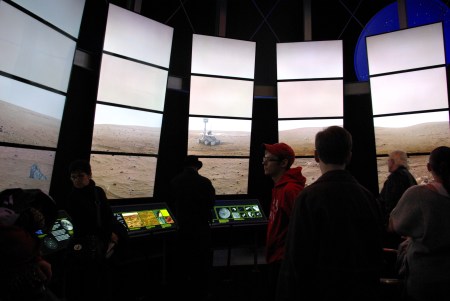
On 32 flat-panel video displays hooked together to make one massive display, visitors to the Perot Museum of Nature and Science view Mars as our new Mars Rover’s friend might see it, in a section of the museum devoted to astronomy, physics, astronomy and planetary exploration. Photo by Ed Darrell; use encouraged with attribution.

Still, kids today need this museum and the knowledge and excitement it imparts.  One recent July I accompanied a group of Scouts from Troop 355 to summer camp in Colorado, to Camp Chris Dobbins in the foothills just east of Colorado Springs.  Near lights out one night I hiked the half-mile to our campsite admiring the Milky Way and other bright displays of stars that we simply do not get in light-polluted Dallas County.  I expected that our older Scouts would have already started on the Astronomy merit badge, but the younger ones may not have been introduced.  So I asked how many of them could find the Milky Way.  Not a hand went up.

“Dowse the lights, let’s have a five minute star lesson,” I said.  we trekked out to a slight opening in the trees, and started looking up.  I had just enough time to point out the milky fog of stars we see of our own galaxy, when one of the Scouts asked how to tell the difference between an airplane and a satellite.  Sure enough, he’d spotted a satellite quietly passing overhead — and just to put emphasis on the difference, a transcontinental jet passed over flying west towards Los Angeles or San Francisco.

Then, when we were all looking up, a meteoroid streaked from the south across almost the whole length of the visible Milky Way.  Teenage kids don’t often go quiet all at once, but after the oohs and aahs we had a few moments of silence.  They were hooked already.  Less than five minutes in, they’d seen the Milky Way, found the Big Dipper, seen a satellite, a jet, and a shooting star.

Perfection!

Edwin Hubble’s discovery can now be the stuff of elementary school science, that the blobs in the sky astronomers had pondered for a century were really galaxies like our own, which we see only through a faint fuzz we call the Milky Way.

Do kids get that kind of stuff in elementary school?  Not enough, I fear.

We named a great telescope after the guy; shouldn’t we do a bit more to celebrate his discovery?

More:

Yes, this is mostly an encore post. Fighting ignorance requires patience.

Yes, this is mostly an encore post. Fighting ignorance requires patience.


Happy birthday as a state, Texas! – 170 years old

December 29, 2015

It’s Texas Statehood day, the 170th anniversary of Texas joining the Union — or as some Texans prefer, the anniversary of Texas’s making America great.

According to the U.S. flag code, people should fly their U.S. flags on their state’s statehood day.

Not many Texans are, if any. Can you find someone honoring statehood day?

texas our texas

U.S. and Texas flags at the Texas Capitol – photo: jmtimages

170 years ago today: Rub your pet armadillo’s belly, slaughter the fatted longhorn, crank up the barbecue pit with the mesquite wood, put Willie Nelson and Bob Wills on the mp3 player, put the “Giant” DVD on the television, and raise your glass of Big Red, Dr. Pepper, or Lone Star Beer (or Pearl, or Shiner Bock, Sir Williams English Brown Ale, or Llano Wine).

U.S. Flag Code rules urge flying the U.S. flag on the anniversary of a state’s joining the Union — even as much as that will frost the tiny band of desperate Texas secessionists.  (Will the secessionists fly the Texas flag at half-staff?)

Texas was admitted to the union of the United States of America on December 29, 1845.

President Polk's authorization to affix Great Seal of the U.S. to Texas Statehood documents

President Polk’s Authorization to affix the Great Seal to Texas Statehood documents – Texas Memorial Museum, University of Texas at Austin

The text of Polk’s message:

I hereby authorize and direct the Secretary of State to affix the Seal of the United States to an authenticated copy of “an act to extend the laws of the United States over the State of Texas and for other purposes” approved Dec. 29, 1845 dated this day, and signed by me and for so doing this shall be his warrant.

James K. Polk
Washington, Dec. 29, 1845

Seal of the U.S. affixed to Texas Statehood Proclamation

Great Seal of the United States of America, affixed to the Texas Statehood Proclamation – image from State Archives Division, Texas State Library

Resources:

More:

The Texas Ranger Museum took note of the day (no, not the baseball Rangers):

Yes, this is mostly an encore post. Fighting ignorance requires patience.

Yes, this is mostly an encore post. It is an annual event, after all. And, fighting ignorance requires patience and persistence.