(Okay, you may fly your flag all weekend — especially if you’re a union member. We get the whole weekend, but Labor Day itself is Monday.)
Labor Day 2015 in the United States is a federal holiday, and one of those days Americans are urged to fly the U.S. flag.
“Free Labor Will Win,” the poster said, encouraging a theme important during World War II, when unions were encouraged to avoid strikes or any action that might interrupt work to build the “arsenal of democracy” believed necessary to win the war. Labor complied, the war was won, and organized labor was the stronger for it. In 2015, some have difficulty remembering when all Americans knew that our future rides on the backs of organized labor.
In war, America turned to organized labor to get the jobs done. Not only do we owe a debt to labor that deserves remembering, we have many jobs that need to be done now, for which organized labor is the best group to turn to.
The poster was issued by the Office of War Information in 1942, in full color. A black-and-white version at the Library of Congress provides a few details for the time:
Labor Day poster. Labor Day poster distributed to war plants and labor organizations. The original is twenty-eight and one-half inches by forty inches and is printed in full color. It was designed by the Office of War Information (OWI) from a photograph especially arranged by Anton Bruehl, well-known photographer. Copies may be obtained by writing the Distribution Section, Office of War Information [alas, you can’t get a copy from the Office of War Information in 2012]
Even down here in deepest, darkest-right-to-work Texas, patriots fly their flags to honor Labor today. It’s heartening.
Flags fly all around in 1882 at the first Labor Day Parade in New York City’s Union Square; lithograph from USC’s Dornsife History Center, via Wikipedia, artist unidentified
Business Insider photo of a giant flag suspended at the George Washington Bridge between New York City and New Jersey, on September 2, 2013, to celebrate Labor Day; Collins Flags said: “This flag isn’t just any flag, it is the largest free-flying American flag in the entire world. It measures a total of 90 feet (27 meters) long and 60 feet (18 meters) wide. In order to preserve the quality of the flag, the Port Authority took the flag down Monday evening after letting it fly all day.”
Five days designated by law to fly the U.S. flag in September — only one statehood day, though, for California. In chronological order:
Labor Day, the first Monday in September — September 8, in 2015
California Statehood, September 9 (1850, the 31st state)
Patriot Day, September 11
Constitution Day and Citizenship Day, September 17; September 17-23 is also designated Constitution Week, though flag flying is not mentioned as a recommended activity (you may feel free to fly your flag anyway)
Gold Star Mothers Day, last Sunday in September — September 27 in 2015
This occurred during a Revolutionary War skirmish at Cooch’s Bridge, Delaware. Gen. William Maxwell, commanding a Patriot force of infantry and cavalry, ordered the new flag raised in a clash with an advance guard of British and Hessian troops.
The rebels were defeated and forced to retreat to the encampment housing Gen. George Washington’s main force near Brandywine Creek in Pennsylvania.
Three months beforehand, on June 14, the Continental Congress resolved that “the flag of the United States be 13 alternate stripes red and white” and that “the Union be 13 stars, white in a blue field, representing a new constellation.”
The new national flag, which quickly became known as the “Stars and Stripes,” was based on the “Grand Union” flag – a banner carried by the Continental Army in 1776 that consisted of 13 red and white stripes.
September features several other commemorations that usually involve no flag flying:
Still photo captured from the film, “Christmas Bird Count,” by Chan Robbins; photo shows a group counting birds, probably in the 1940s or 1950s. Audubon’s Christmas Bird Count got its start in 1900.
69. After 15 years of heavy and widespread usage of DDT, Audubon Society ornithologists counted 25 percent more eagles per observer in 1960 than during the pre-DDT 1941 bird census. [Marvin, PH. 1964 Birds on the rise. Bull Entomol Soc Amer 10(3):184-186; Wurster, CF. 1969 Congressional Record S4599, May 5, 1969; Anon. 1942. The 42nd Annual Christmas Bird Census. Audubon Magazine 44:1-75 (Jan/Feb 1942; Cruickshank, AD (Editor). 1961. The 61st Annual Christmas Bird Census. Audubon Field Notes 15(2):84-300; White-Stevens, R.. 1972. Statistical analyses of Audubon Christmas Bird censuses. Letter to New York Times, August 15, 1972]
99. The Audubon Society’s annual bird census in 1960 reported that at least 26 kinds of birds became more numerous during 1941 – 1960. [See Anon. 1942. The 42nd annual Christmas bird census.” Audubon Magazine 44;1-75 (Jan/Feb 1942), and Cruicjshank, AD (editor) 1961. The 61st annual Christmas bird census. Audubon Field Notes 15(2); 84-300]
100. Statistical analysis of the Audubon data bore out the perceived increases. [White-Stevens, R. 1972. Statistical analyses of Audubon Christmas bird censuses. Letter to New York Times, August 15, 1972]
Those claims are false with regard to bald eagles.
The careful citations offered by Milloy and Edwards simply do not exist; if the source exists, the source does not say what is claimed by these guys. (Don’t take my word for it; go see for yourself.)
Audubon never suggested, in any forum, that their famous Christmas Bird Count had shown increases in eagles. Most other species showed no increases, either. I spent a couple of days at the library of Southern Methodist University reviewing every issue of Audubon Magazine from 1941 through 1974, and found not a single article suggesting anything other than declining eagle populations in the lower 48 states (Alaska eagles were not untouched by DDT, but were not so seriously affected; and as you will see below, the first counts of Alaska’s eagles did not occur until after 1950, so the addition of numbers from Alaska counts do not indicate an increase in U.S. population of eagles.)
I also reviewed each bird count, usually published in a separate booklet with the March issue of Audubon in that time. While raw numbers increased, that was clearly due to increases in people observing. At no point did any ornithologist or Audubon member suggest eagles were in recovery, from 1941 through 1972.
That’s a long explanation, unsuitable for quick discussion on blogs, and wholly too much for a 140-character Tweet. My experience with Milloy and his followers is that they will say my analysis somehow errs, though they cannot offer any real analysis from any other source that isn’t just a misreading of the raw bird count.
I wrote the Audubon Society, and asked them to respond to the claim. At first the press office thought the claims so bizarre that they didn’t think a reply necessary. I sent them a half-dozen links to other documents that cited Milloy and Edwards. Delta Willis at Audubon took the claims to officials of the bird count.
Geoff LeBaron, Director of Audubon’s Christmas Bird Count sent the following reply (posted without correction).
See also the footnote from Audubon Chief Scientist Gary Langham appended to the end of the e-mail.
LeBaron, Geoff
Sent:Friday, May 10, 2013 10:21 AM
To:Willis, Delta; Langham, Gary; Dale, Kathy
Subject:RE: DDT and effects on birds, and Audubon Christmas bird count
Hello Delta,
From the 1930s through 1970s there was a tremendous growth in the number of Christmas Bird Counts, from 203 total counts in the 30thCBC to 1320 counts in 80thCBC. The number of observers on those counts rose from 679 in 30thto 32,322 in the 80thCount. That is a tremendous increase in effort as well as geographic coverage, and more people in more areas are going to count more Bald Eagles, even if the populationsare[were]declining.
A second major factor is that during that period many CBCs were started with the specific goal of censusing wintering Bald Eagles. Thus we were targeting the areas where eagles were wintering, and thus tallying a much greater percentage of the total population.
Thirdly, there were only two individual CBCs conducted in Alaska prior to the late 1950s. Bald Eagle populations never suffered dramatically in Alaska[from DDT?], and their numbers were always much higher there. Since the late 1950s there has been a tremendous growth in the number of counts in Alaska—again, with some of these counts targeting areas where wintering eagles congregate even in the thousands. These counts added in Alaska can contribute greatly to the total number of Bald Eagles in each season’s CBC.
Thus even while Bald Eagle populations were plummeting in the lower 48 states (outside of Florida) CBC[Citizen Science] efforts were greatly increasing, and in fact targeting monitoring Bald Eagles. That is why both the raw number of eagles and the numbers when weighted for observer effort went up when you pull CBC data for Bald Eagle during the decades of heavy DDT use.
It’s still educational to look at raptor numbers in CBC data in the years following the banning of the use of DDT in the US. Many species of raptors show a rapid rebound in numbers after the mid-1970s…and Bald Eagles also dramatically increased.
Per Dr. Gary Langham, Audubon Chief Scientist: Audubon scientists are careful to include levels of participation and geographic coverage in all analyses. Fortunately, we have tracked both of these aspects since the CBC was started and so it is straightforward to adjust for their impacts.
Bird counts do not show that eagles were out of trouble during DDT years, roughly 1946 through 1972; especially they do not show that bald eagle populations increased.
Explanation of the Christmas Bird Count in four minutes, by Chan Robbins.
Chandler Robbins, founder of the Audubon Christimas Bird Count, screen capture from Audubon film “Christmas Bird Count.”
Nota bene: Yes, this has sat in my “to be published” box for too long. It was scheduled for publication, but it appears I had not hit the “publish at scheduled time” button. My apologies to readers, and especially to Audubon’s scientists and press people.
Spread the word; friends don't allow friends to repeat history.
Front page of the New York Times on August 26, 1944, noting the liberation of Paris after Allied troops reached there, following D-Day.
On August 26, 1944, on a front page filled with other news from the war in Europe and the Pacific, the New York Times carried the story from the Associated Press:
Allied Forces Help French to Rid Capital of Nazis
By THE ASSOCIATED PRESS
SUPREME HEADQUARTERS, Allied Expeditionary Force, Aug. 25 — The Paris radio announced late tonight that the French capital had been liberated and that the German commander had signed a document ordering his troops to cease fire immediately.
The announcement followed entry of American and French troops into the capital during the day. There was no immediate confirmation here.
The latest word at headquarters was that American and French troops had joined Fighting French patriots on the Ile de la Cite in the heart of the capital after bitter fighting with Germans and French collaborationist militiamen.
Gen. Charles de Gaulle, President of the French Committee of National Liberation, said in a speech broadcast from Paris:
“France will take her place among the great nations which will organize the peace. We well not rest until we march, as we must, into enemy territory as conquerors.”
Allies invaded Europe at Normandy the previous June.
August, 1944: American soldiers watch as the Tricolor flies from the Eiffel Tower again. (Image: National Archives), via Brain Pickings
Wikipedia gives the unadorned, but detail-rich version of the story; note the vast array of national forces who joined to oust the Germans, including Spanish Republicans-in-exile:
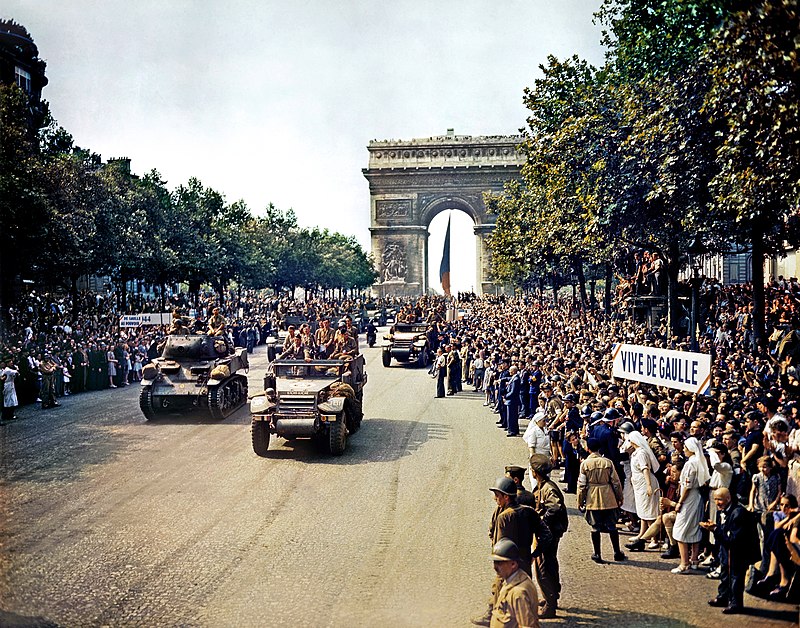
Victory parades followed on August 26 and August 29. Paris was spared destruction ordered by German Chancellor Adolf Hitler when his commander simply failed to carry out the destruction, perhaps because his forces had been overrun more quickly than he’d imagined, perhaps because French underground and other resistance fighters simply prevented it.
From Wikipedia, a rare color photograph: “Crowds of French patriots line the Champs Elysees to view Free French tanks and half tracks of General Leclerc’s 2nd Armored Division passes through the Arc du Triomphe, after Paris was liberated on August 26, 1944. Among the crowd can be seen banners in support of Charles de Gaulle.” Jack Downey, U.S. Office of War Information – This image is available from the United States Library of Congress’s Prints and Photographs division under the digital ID fsac.1a55001.
It’s been 56 years since the youngest state entered the union — the longest stretch in which the U.S. has not added another state.
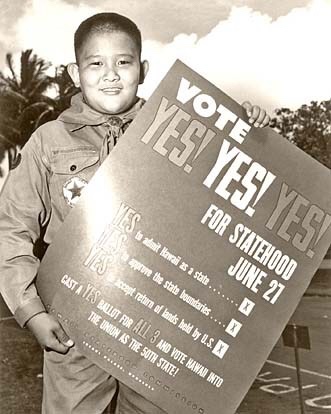
“On June 14, 1959, Boy Scout Milton Motooka helped get the word out for Hawaii’s statehood plebiscite to be held 13 days later. A new documentary will focus on Hawaii’s statehood.” Hawaiians voted yes in the plebiscite, and statehood was declared two months later. (Whatever became of Scout Motooka?)
“On June 14, 1959, Boy Scout Milton Motooka helped get the word out for Hawaii’s statehood plebiscite to be held 13 days later. A new documentary will focus on Hawaii’s statehood.” Hawaiians voted yes in the plebiscite, and statehood was declared two months later. (Whatever became of Scout Motooka?)
June’s plebiscite smoothed the path for statehood, declared two months later.
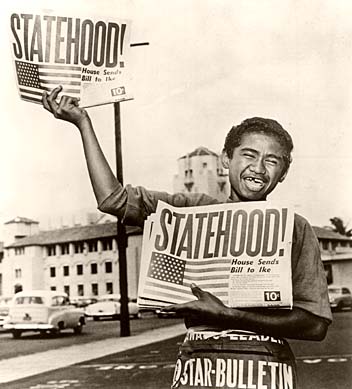
13-year-old paperboy Chester Kahapea happily hawks a commemorative edition of the Honolulu Star-Bulletin with the headline showing the state had achieved statehood after the U.S. House of Representatives passed the law authorizing Hawaii as a state. Star-Bulletin photo by Murray Befeler.
Hawaii formally celebrates the day on the third Friday in August, this year coincidentally on the 21st. I hope you joined in the festivities (it’s a holiday in Hawaii) — but under the U.S. Flag Code, you may certainly fly your flags on August 21, regardless which day of the week that is.
Specimen copy of the ballot used by Hawaiians in a June 27, 1959, plebiscite to approve conditions of statehood. Image from Hawaii Magazine, 2009
After the U.S. annexed Hawaii in 1898 (in action separate from the Spanish-American War) attempts at getting Hawaii admitted as a state got rolling. After World War II, with the strategic importance of the islands firmly implanted in Americans’ minds, the project picked up some steam. Still, it was 14 years after the end of the war that agreements were worked out between the people of Hawaii, the Hawaiian royal family, Congress and the executive branch. The deal passed into law had to be ratified by a plebiscite among Hawaiian citizens. The proposition won approval with 94% of votes in favor.
Other than the tiny handful of loudmouth birthers, most Americans today are happy to have Hawaii as a state, the fifth richest in the U.S. by personal income. The nation has a lot of good and great beaches, but the idea of catching sun and surf in Hawaii on vacation might be considered an idealized part of the American dream.
From Prologue, the blog of the National Archives: This petition, rolled onto a wooden spool, was signed by 116,000 supporters of Hawaii statehood and presented to the U.S. Senate on February 26, 1954. (RG 46, Records of the U.S. Senate)
U.S. postage stamp issued in 2009 commemorating the 50th anniversary of Hawaii’s admission to the union.
Contrast the first class postage price above with the airmail postage price of this stamp issued in 1959 — August 21, 1959 7¢ Rose Hawaii Statehood stamp. Wikipedia image
Caption from Tropas de Ulramar: Re-enactors dressed as participants in the Battle of Medina fire a musket volley during a ceremony on Saturday, Aug. 20, 2011, commemorating the 198th anniversary of the Battle of Medina. The event was sponsored by the Texas Society – Sons of the American Revolution. The Battle of Medina was fought on Aug. 18, 1813, when a Spanish army, attempting to win Texas from the Republican Army of the North, which was supported by the United States and included veterans of the American Revolution, won a battle fought south of San Antonio near Espey. It is thought that about 800 Republicans died in the battle. [Other estimates put the death toll on the Texas side at 1,500] Photo: BILLY CALZADA
Two years after the bicentennial, does anyone remember it yet?
The long drive for Texas independence from Mexico may be more clearly seen in the light of the continents-long struggles for independence that included not only the American Revolution, but also revolutions in the nations of Haiti, Mexico, Chiapas, and others across Central America and South America. The Battle of Medina was a part of that earlier history. Fought on August 18, 1813, it was more deadly than any other battle in the wars for Texas independence, it is linked to Mexico’s long history of struggle. It occurred in the same year that Haiti got independence, and in the middle of the War of 1812, which helps to obscure the history of the battle.
Chapman’s report said:
“Contrary to popular belief, the struggle for democracy in Texas did not begin with the Anglo-led revolution of 1835-36,” author and historian James Haley wrote in a recent Austin American-Statesman article. “In fact, the yearning for liberty had its own ongoing legacy in Latin America.
“As early as 1810, movements for independence began simultaneously in Venezuela and Argentina. It was also in 1810, on Sept. 16, that the Mexican priest Father Miguel Hidalgo y Costilla raised his famous grito, the cry for social justice that opened the Mexican campaign for independence, a date now celebrated as Diez y Seis.”
America was drawn into that campaign when it funded a small force under the control of Bernardo Gutierrez de Lara, one of Father Hidalgo’s emissaries. A former Army officer, Augustus Magee, went along with the expedition to offer military advice. The Gutierrez-Magee Expedition, also called the Green Flag Rebellion because of its banner, soon captured Nacogdoches. All went well for the expedition — too well — and Texas independence was quickly claimed. Spain took immediate measures to quell the insurrection.
It ended at the Battle of Medina, “the biggest, bloodiest battle ever fought on Texas soil,” a South Texas historian says.
Spanish forces slaughtered more than 1,000 of the rebels, perhaps as many as 1,500. The battle methods, and total extirpation of the losing forces, would recur in the Texas Revolution.
Fewer than 100 republic troops survived the battle, Thonhoff said. Those not killed in the battle were later chased down and executed. Retaliation went on for days. Royalist forces swept into San Antonio and took revenge on anyone they suspected of aiding the rebel forces. One of the royalist officers was a young Lt. Antonio Lopez de Santa Anna.
The bodies of soldiers killed in battle were left where they fell. It would be nine years before their bones were gathered and buried in a communal grave.
This story should translate well to the Texas-required 7th-grade history course. Here is a cause — the archaeological excavation and historical marking of the battlefield itself — which lends itself well to getting students to write letters to state legislators and state education authorities. Here is news of an archaeological site that could provide work for a generation of diggers, and experience for countless school kids taken on tour. And the story of the battle is one of those relatively unknown gems that excite students who realize, after they discover it, that they know something that most others do not know.
Medina Battle -State of Texas historic marker Near Leming, Texas. Wikipedia image
As well, this should be supplement to world history courses, which in my experience too often overlook the independence wars and successes in Central and South America. The article mentions independence movements in Argentina and Venezuela. The United States fought Britain in the War of 1812, which was the western fallout of England’s simultaneous war with Napoleon (who was on the road to getting his comeuppance in Russia). Haiti’s drive for independence from France racked that Caribbean nation. A mapping exercise showing the various independence movements occurring between 1800 and 1826 provides links to parts of the narrative of American nations’ independence that often gets overlooked.
The battle also ties together several otherwise loose threads in the Texas history curriculum.
The Gutierrez-McGee Expedition falls into that time period and that type of movement to steal Texas known as the filibusters.
The treachery of the Green Flag Rebels in executing the Spanish officers in San Antonio after the Spanish had surrendered raises issues of ethics in battle that are rich for discussion.
Incompetence with which the Texian forces were led into the battle, missing completely the feint the Spanish troops made until they were already into a classic battle trap, is another place to emphasize the importance of having good leaders especially in rebellion (this will become clear to students, perhaps, when they study the events of 1775 and 1776 and Washington’s leadership, in the 8th grade curriculum in Texas).
Santa Anna’s presence as a young officer at the Battle of Medina suggests that he got the idea of “no quarter” early in his career; see how the tactic plays out 23 years later at the Battle of the Alamo, the Battle of Coleto, Goliad, and the Battle of San Jacinto, with an older Santa Anna in command.
In the context of Texas’ becoming a “majority-minority” state with a very large population with historical ties to Mexico, the Battle of Medina deserves greater consideration in Texas history curricula.
Partly due to the brutality of the Spanish victors to the survivors, wounded and dead, the battlefield itself was not cleaned up for years — bodies lay across a wide area. Medina was a touchy point, a point of embarrassment perhaps to local Mexicans and Texians, a loyalty test for the Spanish rulers. So the battle site was ignored and hushed up. 200 years later, we don’t know the exact site of the battle. A lot of work remains to be done, exploration of archives in Spain, Mexico and Texas, exploration of map collections, archaeological and paleontological work on the suspected sites of the battle. But every year this work remains undone, the story becomes that much more difficult to find. It is unlikely we’ll ever know all that we probably should about the Battle of Medina.
For teachers and parents, Patrick M. Reynolds cartoons of Texas history were staples in the Dallas Morning News for years. His treatment of the Green Flag Republic, the Gutierrez-McGee Expedition, and the Battle of Medina are really among the best available for the junior high/middle school audience. You can buy the books directly from Reynolds’ Red Rose Studios; alas, I don’t have handy a key to which volumes of these graphic history books hold which stories. Reynolds has a compilation of all of the stories, however, in a slightly smaller format than the others, such as shown at Amazon.com.
Do not confuse this Texas battle with the Battle of Medina Rioseco, an 1808 battle between Napoleon’s forces and the Spanish Guerrillas, in the Peninsular Campaign; different continent
Photo from the Pleasanton Express: “A Color Guard representing the U.S.A., Spain, Texas and Mexico, plus descendants of the men who fought and died in [The Battle of Medina] will be presented at the Battle of Medina ceremony.
Screen capture of the Wellcome Trust HTML presentation on the life cycle of malaria parasites. Malaria fighters know all this almost instinctively; too often policy makers fail to understand it, and so they recommend policies that do not make medical or economic sense in fighting the disease. Click image to go to Wellcome Trust site for full presentation.
Britain’s Wellcome Trust takes as one of its key missions the fight against malaria. The Trust is a charitable foundation created from profits of pharmaceutical development and sales.
Recently I found this HTML animation presentation on the life cycle of the malaria parasite, something all malaria fighters must know to be effective.
It’s also something that DDT advocates seem unable to comprehend. Malaria is not a virus, nor is it a venom mosquitoes manufacture, but it is a parasite that infects (and disables) both mosquitoes and humans. Mosquitoes catch the parasite from an infected human host. After the malaria parasite completes a couple of cycles in the gut of the mosquito, the parasite can be transmitted back to humans by a mosquito bite. And the cycle continues.
Since complete eradication of malaria-carrying mosquitoes is practically impossible in almost all cases, beating malaria requires an interruption in the cycle of transmission of the parasite, plus the curing of the disease in infected human hosts.
For example, the old World Health Organization (WHO) malaria eradication campaign, which operated from 1955 to 1963, DDT was used to temporarily knock down a population of mosquitoes, with hopes human hosts would be ridded of malaria parasites so that, in six months or so, when the mosquito populations roared back, there would be no malaria in local humans to infect mosquitoes. Consequently, mosquitoes can’t transmit a parasite they don’t have.
Lost on far too many people: Humans must be cured of malaria to prevent transmission. Beating malaria takes a lot more than just killing mosquitoes.
Does Missouri celebrate this event at all? I’m not finding much on celebrations in 2015. Perhaps the state is preoccupied with other events.
Missouri and U.S. flags adorn the Missouri House of Representatives on opening day 2015. St. Louis Post-Dispatch caption: “The opening day of the Missouri House of Representatives 98th General Assembly at the Missouri State Capitol on Wednesday, Jan. 7, 2015. Photo by Cristina Fletes-Boutte, cfletes-boutte@post-dispatch.com”
Just try to find someone who can tell you who first said it, and what the circumstances were. It’s a sign that history instruction is not what it should be on some matters.
August 5 marks the 151st anniversary of the Battle of Mobile Bay in 1864, when the Union Navy under the command of Admiral David Farragut took Mobile from Confederate forces.
U.S. Heritage Protection Services — a division of the National Park Service — gives a straight up, unemotional description of the fight, which was a key victory for the Union, shutting down much of the Confederacy’s ability to trade with foreign nations and supply its army:
Photograph from circa 1855-1865 of then-Rear Admiral David Glasgow Farragut, the commander of the Union forces at the Battle of Mobile Bay, and the man to who is attributed the famous line, “Damn the Torpedoes!”
Forces Engaged: Farragut’s Fleet (14 wooden ships and 4 monitors) and U.S. army forces near Mobile [US]; Buchanan’s Flotilla (3 gunboats and an ironclad), Fort Morgan Garrison, Fort Gaines Garrison, and Fort Powell Garrison [CS]
Estimated Casualties: 1,822 (US 322; CS 1,500)
Description: A combined Union force initiated operations to close Mobile Bay to blockade running. Some Union forces landed on Dauphin Island and laid siege to Fort Gaines. On August 5, Farragut’s Union fleet of eighteen ships entered Mobile Bay and received a devastating fire from Forts Gaines and Morgan and other points. After passing the forts, Farragut forced the Confederate naval forces, under Adm. Franklin Buchanan, to surrender, which effectively closed Mobile Bay. By August 23, Fort Morgan, the last big holdout, fell, shutting down the port. The city, however, remained uncaptured.
Results(s): Union victory
World War I recruiting poster showing Admiral David Farragut lashed to the mast of his ship, and offering the quote for which Farragut is famous. Image from the collection of the Library of Congress, via Wikipedia
Nota bene:
Was Farragut lashed to the rigging?Wikipedia’s listing:An anecdote of the battle that has some dramatic interest has it that Farragut was lashed to the mast during the passage of Fort Morgan. The image it brings to mind is of absolute resolve: if his ship were to be sunk in the battle, he would go down with her. The truth is more prosaic; while he was indeed lashed to the rigging of the mainmast, it was a precautionary move rather than an act of defiance. It came about after the battle had opened and smoke from the guns had clouded the air. In order to get a better view of the action, Farragut climbed into Hartford‘s rigging, and soon was high enough that a fall would certainly incapacitate him and could have killed him. Seeing this, Captain Drayton sent a seaman aloft with a piece of line to secure the admiral. He demurred, saying, “Never mind, I am all right,” but the sailor obeyed his captain’s orders, tying one end of the line to a forward shroud, then around the admiral and to the after shroud.[50]Later, when CSS Tennessee made her unsupported attack on the Federal fleet, Farragut climbed into the mizzen rigging. Still concerned for his safety, Captain Drayton had Flag-Lieutenant J. Crittenden Watson tie him to the rigging again.[51] Thus, the admiral had been tied to the rigging twice in the course of the battle.
Did Farragut actually say, “Damn the torpedoes, full speed ahead? Mobile Bay had been mined by the Confederates, to hold off exactly the sort of Union attack Farragut mounted. Mines, in that time, were known as “torpedoes,” not the underwater-missiles made famous by World War II movies. Farragut had an iron-clad ship, Tecumseh, under his command leading the attack; legend holds that other ships slowed to allow Tecumseh to cross them and move ahead. Farragut asked why the attack was slowing, and upon hearing that they feared torpedoes (mines), he later was reputed to have said “Damn the torpedoes,” and urged moving at all speed. Did he say, “full speed ahead?” Accounts differ on that, even in legend. In one version he shouted to the ship Brooklyn, “Go ahead!” That’s unlikely in the din of sailing, coupled with the din of battle. Another account has him shouting (vainly) to the Hartford, “Four bells, Captain Drayton.” Yet another version, that almost makes sense, has him shouting to the Metacomet, which was lashed to the Hartford’s side, “Go ahead, Jouett, full speed.” The entire quote must be listed as attributed, and the only part most versions agree on is “Damn the torpedoes.” A World War I recruiting poster probably inscribed the quote into history (see the poster in this post). Alas, Tecumseh hit a torpedo early in the battle, and sank, killing most of its crew.
Political importance: Coupled with Gen. William Tecumseh Sherman‘s March Across Georgia, and the Fall of Atlanta, the Battle of Mobile Bay gave credence to the idea that the fortunes of the Civil War had turned in the Union’s favor. This victory probably contributed greatly to the re-election of President Abraham Lincoln against opponents who urged simply ending the war without victory.
Mobile Bay was an important port? Mobile Bay stands as a monument to poor soil conservation practices, today. Maps of the battle show a much larger bay than exists today; since 1864, silting from the river has filled in the bay, making it much less useful, and much less important to shipping.
1861 map of Mobile Bay: “H.H. Lloyd & Co’s Campaign Military Charts Showing The Principal Strategic Places Of Interest. Engraved Expressly To Meet A Public Want During The Present War. Compiled From Official Data By Egbert L. Viele, Military and Civil Engineer; and Charles Haskins. Published Under The Auspices Of The American Geographical And Statistical Society. Entered … 1861 by H.H. Lloyd & Co. H.H. Lloyd & Co’s Military Charts. Sixteen Maps On One Sheet.”
LandSat image of Mobile Bay, from NASA, 2003 (via Wikipedia). The Northern Bay is almost completely silted in by the Mobile River and others.
Whether Admiral David G. Farragut actually said, “Damn the torpedoes!” the phrase remains an often-used quotation to urge action in the face of uncertainty, hopefully, to victory. Farragut’s forces won the Battle of Mobile Bay on August 5, 1864, a key maritime battle of the Civil War. Whatever he said, it must have been inspiring.
1. There was such a small population in the area, Johnson felt Colorado would fare better as a territory without the added taxation of statehood.
2. Also due to the small population, Colorado would have only one representative to speak for the people in Congress. (New York, on the other hand, had thirty-one).
3. Johnson felt the citizens of Colorado were not prepared for, and not all wanted, statehood. Johnson wanted to hold a census or an election there first. This would ascertain the number of people in the area, as well as find out what their strongest desire was.
Second veto:
1. Johnson didn’t agree with the Edmunds Amendment which said that Nebraska and Colorado had to give equal suffrage to blacks and whites as a statehood condition. Johnson felt this was unconstitutional because Congress couldn’t regulate a state’s franchise, and the people had not been allowed to vote on it.
2. After holding a census, Johnson felt the population was still too small for statehood.
NOTE: In addition, Johnson did not feel right about adding new states to the Union when the Confederate States had not yet been readmitted to the Union and were still unrepresented.
Congress sustained the veto.
Jerome B. Chaffee, one of Colorado’s first U.S. Senators, and the man who earlier pushed through Congress the law admitting Colorado into the Union. Library of Congress description: “Chaffee, Hon. J.B. of Colorado” (Photo credit: Wikipedia)
Colorado Republican and millionaire Jerome Chaffee, serving as the Colorado Territory delegate to Congress, managed to get a statehood bill passed in 1875, in the second term of President Ulysses S Grant; Grant signed the law. Colorado drafted a state constitution that passed muster, Coloradans approved it, and President Grant declared Colorado the 38th state on August 1, 1876. Chaffee was elected one of the first U.S. Senators from Colorado by the new state legislature. In an odd footnote, President Grant’s son, Ulysses S Grant, Jr., married Chaffee’s daughter Fannie in 1881.
In 1875, Chaffee claimed 150,000 people lived in the state, but most historians think that figure was inflated; the 1880 census counted 194,000 people. Some historians doubt that count was accurate.
No doubt there are at least that many people in Colorado today. Several counties in the northeast corner of the state got together in 2013 to explore the possibility of separating from Colorado to form their own state. Does the political cauldron in Colorado ever cool? (Did those secessionists ever cool?)
One of the more dramatic images from Colorado in recent years, courtesy the U.S. Air Force. Captioned in the Las Vegas Review-Journal, June 15, 2013: “An American flag hangs in front of a burning structure in the Black Forest, a thickly wooded rural region north of Colorado Springs, Colo. Authorities reported early Saturday that 473 houses had been incinerated.”
PRCA Rodeo in Steamboat Springs, Colorado; photo from SeaSweetie’s Pages
National anthem at opening day 2011 at the Ballpark in Arlington, where the Texas Rangers play. Many Americans salute the flag several times during August at U.S. major league ballparks. Photo: Texas Rangers/Examiner/Ben Werz. (How many displays in contravention of the U.S. Flag Code can you spot?)
August in the U.S. is a lazy, often hot, summer month. It’s a month for vacation, picnicking, local baseball games, camping, cookouts and beach vacations. It’s not a big month for events to fly the U.S. flag.
Only one event calls for nation-wide flag-flying in August, National Aviation Day on August 19. This event is not specified in the Flag Code, but in a separate provision in the same chapter U.S. Code. Three states celebrate statehood, Colorado, Hawaii and Missouri.
Put these dates on your calendar to fly the flag in August:
US flag at site of a bitter siege in August, 1777; National Parks Service Caption: The American Flag, as it is known today, flies over [Fort Stanwix] National Monument. It is flown following the U.S. flag code regulations. At all times of the year it is a quite a site to see. National Park Service VIP Mike Hucko
Bloom County, July 17, 2015. Yes, Opus and the crew are back.
How much of our current fascination with penguins can be traced back to this old strip?
This strip also reminds me of that old pro-Reagan story that circulated in 1980, about the senator stopping off at Roosevelt Island on the way home, and Teddy Roosevelt’s statue coming to life to ask how things were. Anybody got a good copy of that story?
101 years ago today. Let us remember, and never forget.
Wikipedia photo and caption: Austro-Hungarian troops executing captured Serbians, 1917. Serbia lost about 850,000 people during the war, a quarter of its pre-war population.
According to the Associated Press, today is the anniversary of the declaration of war that really got World War I started: Austria declared war on Serbia on July 28, 1914.
SerbianSouth slav nationalists assassinated Austrian Crown Prince Franz Ferdinand and his wife Sofie in Sarajevo, the traditional a Serbian capital then held by Austria, the previous June. After a summer of demands on Serbia by Austria, which Serbia could not or would not meet, Austria declared war.
As more nations declared war on each other through August and the rest of 1914, most people expected it to be a “short” war.
Peace is difficult. It must be worked on every day. But war is disaster.
Commemoration in 2013: President Barack Obama delivers remarks to commemorate the 60th anniversary of the signing of the Armistice that ended the Korean War, at the Korean War Veterans Memorial in Washington, D.C., Saturday, July 27, 2013. (Official White House Photo by Amanda Lucidon)
President Obama issued a proclamation for National Korean War Veterans Armistice Day in 2015, though the law Congress passed specified it should run only until 2003. There was no proclamation to urge flag flying, however.
Presidential Proclamation — National Korean War Veterans Armistice Day, 2015
NATIONAL KOREAN WAR VETERANS ARMISTICE DAY, 2015
– – – – – – –
BY THE PRESIDENT OF THE UNITED STATES OF AMERICA A PROCLAMATION
Throughout history, the United States has stood as a powerful force for freedom and democracy around the world. In the face of tyranny and oppression, generations of patriots have fought to secure peace and prosperity far from home. And in 1950, as Communist armies crossed the 38th parallel just 5 years after the end of World War II, courageous Americans deployed overseas once again to stand with a people they had never met in defense of a cause in which they both believed. On National Korean War Veterans Armistice Day, we honor all those who sacrificed for freedom’s cause throughout 3 long years of war, and we reaffirm our commitment to the security of the Republic of Korea and the values that unite our nations.
Often outnumbered and outgunned, nearly 1.8 million Americans fought through searing heat and piercing cold to roll back the tide of Communism. The members of our Armed Forces endured some of the most brutal combat in modern history; many experienced unimaginable torment in POW camps, and nearly 37,000 gave their last full measure of devotion. Their sacrifice pushed invading armies back across the line they had dared to cross and secured a hard-earned victory.
The Korean War reminds us that when we send our troops into battle, they deserve the support and gratitude of the American people — especially once they come home. We must make it our mission to serve all our veterans as well as they have served us, always giving them the respect, care, and opportunities they have earned. And we will never stop working to fulfill our obligations to our fallen heroes and their families. To this day, more than 7,800 Americans are still missing from the Korean War, and the United States will not rest until we give these families a full accounting of their loved ones.
Today, the Republic of Korea enjoys a thriving democracy and a bustling economy, and the legacy of our Korean War veterans continues on in the 50 million South Koreans who live with liberty and opportunity. The United States is proud to stand with our partner in Asian security and stability, and our commitment to our friend and ally will never waver — a promise embodied by our servicemen and women who fought from the Chosin Reservoir to Heartbreak Ridge and Pork Chop Hill, and by every American since who has stood sentinel on freedom’s frontier.
No war should ever be forgotten, and no veteran should ever be overlooked. Today, on the anniversary of the Military Armistice Agreement that ended the Korean War, let us remember how liberty held its ground in the face of tyranny and how free peoples refused to yield. And most of all, let us give thanks to all those whose service and sacrifice helped to secure the blessings of freedom.
NOW, THEREFORE, I, BARACK OBAMA, President of the United States of America, by virtue of the authority vested in me by the Constitution and the laws of the United States, do hereby proclaim July 27, 2015, as National Korean War Veterans Armistice Day. I call upon all Americans to observe this day with appropriate ceremonies and activities that honor our distinguished Korean War veterans.
IN WITNESS WHEREOF, I have hereunto set my hand this twenty-fourth day of July, in the year of our Lord two thousand fifteen, and of the Independence of the United States of America the two hundred and fortieth.
BARACK OBAMA
At this blog, we urge you to remember what is often called “the forgotten war,” and the veterans of the war, and the sacrifices of those veterans and those who did not return. You may fly your flag if you wish.
Save
Save
Spread the word; friends don't allow friends to repeat history.
There’s a lot of encore material here — I think about this in the middle of the summer, and July 24 is a good day to commemorate arrivals: It’s Arrival Day. It’s Touchdown Day.
July 24 – almost the end of the month, but not quite.
July 24, 1847: A larger contingent of Mormons, refugees from a literal religious war in Illinois and Missouri, entered into the Salt Lake Valley under the leadership of Brigham Young, who famously said from his wagon sick-bed, “This is the place; drive on!”
In Utah, July 24 is a state holiday, to celebrate the date in 1847 that the Mormon refugees arrived in Salt Lake Valley and began to set up their agriculture and schools. In Salt Lake City, bands from across the state and floats from many entities form the Days of ’47 Parade. When I marched with the Pleasant Grove High School Viking Band, the route was 5 miles. We had only one band uniform, for winter — I lost nearly 10 pounds carrying a Sousaphone.
When the Mormons got to Salt Lake, after a couple of months’ trekking across the plains (then known as “The Great American Desert,” the Great Basin and the Mojave being little known), and after being on the run for well over a year, they got right down to priorities. Summer was nearly gone, and crops had to be planted quick. Within a couple of weeks, the Mormons dammed local streams to create irrigation systems to grow what they could before fall (this is, popularly, the first major crop irrigation set up in America); they’d started to lay out plans for settlements, with straight streets based on Cartesian-plane grids: The first serious community planning? And they began construction of schools, knowing education to be one of the most important attributes in the foundation of free societies, a position Mormons have reneged on recently in Utah. Water, communities, schools.
Heck, that’s a good campaign platform today. It’s with sadness I note few people run on such a platform, instead begging voters to be afraid of others who are different in some fashion. Fear quenches no thirst, makes no place for families, nor educates any curious child. Utah’s Mormon pioneers were on the right track. We’ve run out of the ruts, and we are not there yet.
Utahns will be flying their U.S. flags today. (Remember, President Obama proclaimed this a period of mourning, through July 25; flags should fly half-staff where possible.)
Maybe spending a few weeks struggling across a prairie and risking your life focuses you on the important stuff. How would it improve America if we put more people on a bus to Omaha, put them out there, and said, “Hike to Salt Lake City from here.”
They’d focus. Can we start with Paul Ryan, John Boehner and Mitch McConnell? Ted Cruz couldn’t make the journey. Donald Trump would die of sunburn. Wisconsin Gov. Ahab Walker would find no one to swindle, and talking down teachers and community builders wouldn’t be popular among fellow trekkers.
Ah, the good old days!
July 24 features a number 0f other arrivals, too.
From various “Today in History” features, AP, New York Times, and others, not in chronological order:
Buzz Aldrin walks on the moon, July 20, 1969 (Photo credit: Wikipedia)
July 24, 1969: Apollo 11 returned to the Earth, and splashed down in the Pacific Ocean, Michael Collins, Buzz Aldrin and Neil Armstrong — Aldrin and Armstrong having landed on the Moon. In our celebrations of Apollo 11, and in our remembrances of President Kennedy, we may forget, though young kids rarely miss it, that Kennedy didn’t just say ‘Let’s put a guy on the Moon by 1970.’ Getting back safely was a key part of the challenge.
First, I believe that this nation should commit itself to achieving the goal, before this decade is out, of landing a man on the moon and returning him safely to the earth. No single space project in this period will be more impressive to mankind, or more important for the long-range exploration of space; and none will be so difficult or expensive to accomplish.
On July 24, 1969, the crew of Apollo 11 returned, safely.
Would there be a Mormon Tabernacle Choir, and organ, had the Mormons settled somewhere other than Utah? Wikipedia photo
July 24, 1866: Tennessee became the first of the Confederate States, the former “state in rebellion,” to be readmitted fully to the Union, following the end of the American Civil War. (Does Tennessee celebrate this anniversary in any way?)
July 24, 1911: On July 24, 1911, American archeologist Hiram Bingham arrived at Machu Picchu in Peru. We still don’t know all the reaons the Incas built that city on the top of very high mountains. Cell service was not a factor.
July 24, 2005: Lance Armstrong won his seventh consecutive Tour de France bicycle race. Little did we know then, the journey wasn’t over. (Lance Armstrong is no relation to Neil Armstrong. Did I need to point that out?)
Nixon advance man William Safire claimed later than he’d set up the famous “debate” between Eisenhower’s Vice President Richard Nixon and Soviet Communist Party Premier Nikita Khrushchev, at the American National Exhibition in Moscow, 1959. Nixon argued that the technology on display made better the lives of average Americans, not just the wealthiest. (Photo credit: Wikipedia)
July 24, 1959: Visiting Moscow, USSR, to support an exhibit of U.S. technology and know-how, Vice President Richard Nixon engaged Soviet Communist Party Secretary and Premier Nikita Khrushchev in a volley of points about which nation was doing better, at a display of the “typical” American kitchen, featuring an electric stove, a refrigerator, and a dishwasher. Khrushchev said the Soviet Union produced similar products; Nixon barbed back that even Communist Party leaders didn’t have such things in their homes, typically, but such appliances were within the reach of every American family. It was the “Kitchen Debate.”Try explaining this to high school U.S. history students. The textbooks tend to avoid this story, because it stops the class. That’s a sign it should be used more, I think. Does the Common Core even touch it?Nixon’s arrival as a major political force in the Cold War grew clear from this event. The pragmatic stakes of the Cold War were drawn in stark contrast, too. It’s interesting to ponder that microwave ovens were not part of the exhibit.
Cover of Time Magazine, July 22, 1974, explaining the showdown between President Richard Nixon and the Special Prosecutor, playing out in the U.S. Supreme Court. Image copyright by Time Magazine.
July 24, 1974:In U.S. vs. Nixon, The U.S. Supreme Court ruled unanimously that President Richard Nixon had to turn over previously-secret recordings made of conversations in the White House between Nixon and his aides, to the special prosecutor appointed to investigate the Watergate affair and cover-up. Nixon would resign the presidency within two weeks, the only president to leave office by resignation.
July 24, 1975: An Apollo spacecraft splashed down after a mission that included the first link-up of American and Soviet spacecraft. (The Apollo mission was not officially numbered, but is sometimes called “Apollo 18″ — after Apollo 17, the last trip to the Moon.)
Library of Congress image caption: Mormon Temple Grounds, Salt Lake City, Utah, L. Hollard, photographer, 1912. Taking the Long View: Panoramic Photographs, 1851-1991 [The building on the far right? That’s the old Hotel Utah, where Kathryn and I had a great wedding reception with plenty of champagne considering our many Mormon family and friends — some of whom may have sampled a little to see what they usually missed. It was such a great reception that the owners of the hotel, the LDS Church, stopped holding wedding receptions there and shortly closed it as a hotel; now it’s an office building with a fantastic lobby that makes any sensible person wistful for what used to be.]
Bareback rider Jerad Schlegel of Burns, Colorado, clings to his horse as it falls to the dirt during a re-ride at the Ogden Pioneer Days Rodeo Friday, July 19, 2013. Photo by Brian Nicholson (go see his blog)
Or, until that account is unsuspended by the forces supporting Donald Trump: Follow @FillmoreWhite, the account of the Millard Fillmore White House Library
We've been soaking in the Bathtub for several months, long enough that some of the links we've used have gone to the Great Internet in the Sky.
If you find a dead link, please leave a comment to that post, and tell us what link has expired.
Thanks!
Retired teacher of law, economics, history, AP government, psychology and science. Former speechwriter, press guy and legislative aide in U.S. Senate. Former Department of Education. Former airline real estate, telecom towers, Big 6 (that old!) consultant. Lab and field research in air pollution control.
My blog, Millard Fillmore's Bathtub, is a continuing experiment to test how to use blogs to improve and speed up learning processes for students, perhaps by making some of the courses actually interesting. It is a blog for teachers, to see if we can use blogs. It is for people interested in social studies and social studies education, to see if we can learn to get it right. It's a blog for science fans, to promote good science and good science policy. It's a blog for people interested in good government and how to achieve it.
BS in Mass Communication, University of Utah
Graduate study in Rhetoric and Speech Communication, University of Arizona
JD from the National Law Center, George Washington University


 Posted by Ed Darrell







 Millard Fillmore's Bathtub
