August 30, 2014
Still important in 2014: Fly your flag for American labor, Monday.
(Okay, you may fly your flag all weekend — especially if you’re a union member. We get the whole weekend, but Labor Day itself is Monday.)
Labor Day 2014 in the United States is a federal holiday, and one of those days Americans are urged to fly the U.S. flag.
“Free Labor Will Win,” the poster said, encouraging a theme important during World War II, when unions were encouraged to avoid strikes or any action that might interrupt work to build the “arsenal of democracy” believed necessary to win the war. Labor complied, the war was won, and organized labor was the stronger for it. In 2012, some have difficulty remembering when all Americans knew that our future rides on the backs of organized labor.
The poster was issued by the Office of War Information in 1942, in full color. A black-and-white version at the Library of Congress provides a few details for the time:
Labor Day poster. Labor Day poster distributed to war plants and labor organizations. The original is twenty-eight and one-half inches by forty inches and is printed in full color. It was designed by the Office of War Information (OWI) from a photograph especially arranged by Anton Bruehl, well-known photographer. Copies may be obtained by writing the Distribution Section, Office of War Information [alas, you can’t get a copy from the Office of War Information in 2012]
Even down here in deepest, darkest-right-to-work Texas, patriots fly their flags to honor Labor today. It’s heartening.

Flags fly all around in 1882 at the first Labor Day Parade in New York City’s Union Square; lithograph from USC’s Dornsife History Center, via Wikipedia, artist unidentified
This is partly an encore post, a Labor Day tradition.
More, Other Resources:
Spread the word; friends don't allow friends to repeat history.
 1 Comment |
  Flag etiquette, Fly your flag today, Freedom - Economic, Freedom - Political, History, Holidays, Labor and unions, Posters, Primary Source Documents | Tagged: Flag etiquette, Fly your flag today, History, Labor Day, Library of Congress, Office of War Information, Patriotism, Posters, Trade union |
  Permalink
 Posted by Ed Darrell
August 28, 2014
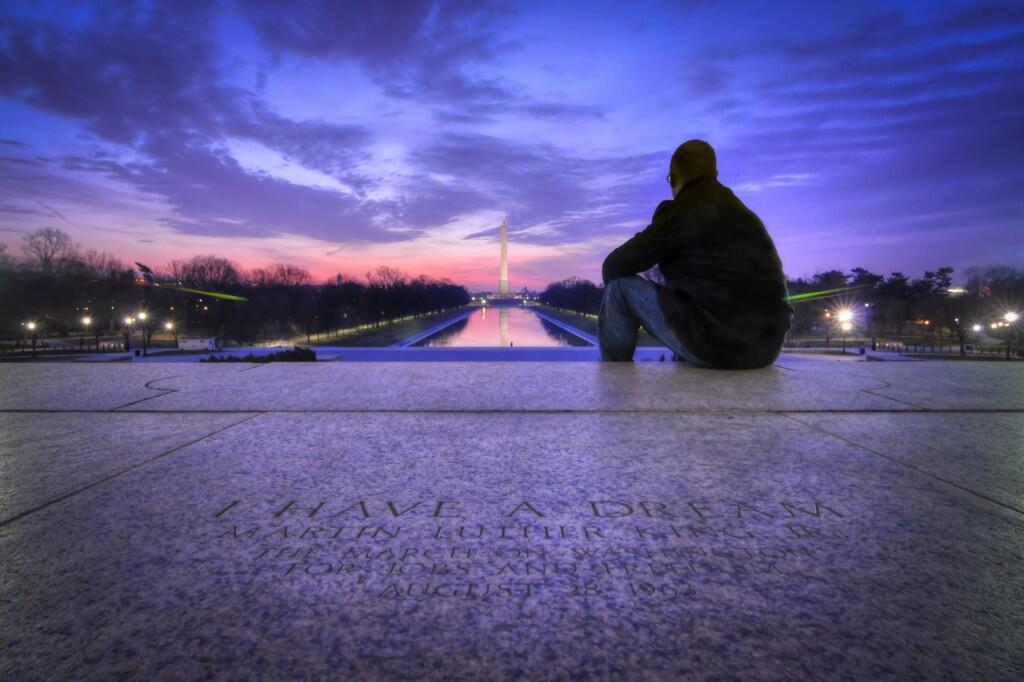
Pic Tweet from the National Park Service: Beautiful photo of the exact spot Dr. King delivered his “I Have a Dream speech” 50 years ago today. #MLKdream50 pic.twitter.com/MHwWsY7Hwp
Nice photo from the Lincoln Memorial looking toward the Washington Monument across the length of the Reflecting Pool.
The photo is a couple of years old, having been taken before the scaffolding went up on the Washington Monument for repairs for damage from the 2011 earthquake — scaffolding which has since been removed. It’s a winter or fall picture, I’m guessing from the bare trees, and taken early in the morning, as the sun rises in the east over the Capitol and Washington Monument. That is one of the best times to be at the Lincoln Memorial, in my experience. The man in the photo has the historic spot very much to himself at that time.
Engraving on the stone says:
I HAVE A DREAM
MARTIN LUTHER KING, JR.
THE MARCH ON WASHINGTON
FOR JOBS AND FREEDOM
AUGUST 28, 1963
Assuming you’re older than 51, where were you that day in August? Do you remember the event in the news?
King’s speech got very little press that day, or the next. It was in the time when television news operations used film. The film came late in the afternoon, and would have to be developed — it missed evening broadcasts on that Saturday. The text did not get much mention, either — reports for the Washington Post and New York Times, had to be filed early. Most reporters wrote before the event. Even those who wrote after the speech often were unaware of how it had moved the crowd. It’s one of those historic events that, had you been there, you’d have known something happened. but not necessarily what.
News reports tended to be dominated by coverage of the size of the crowd, and the fact that violence didn’t break out.
It was a different time.
More:

This is an edited encore post
Spread the word; friends don't allow friends to repeat history.
2 Comments | Famous quotes, History, Landmarks, Martin Luther King | Tagged: 1963, Civil Rights, famous speeches, History, I Have a Dream, Lincoln Memorial, March on Washington, Martin Luther King Jr. | Permalink
Posted by Ed Darrell
August 26, 2014
August 26 is the anniversary of the first television broadcast of professional baseball, in 1939; the future-legendary Red Barber called a doubleheader between his Brooklyn Dodgers and the Cincinnati Reds from Ebbets field.
Both games were carried on experimental television station W2XBS, which evolved into New York’s NBC affiliate Channel 2, WNBC. Two stationary cameras were used, in contrast to the several used in modern broadcasts — and it was in black and white. About 3,000 people are estimated to have watched.
The Reds won the opener, 5-2, but the Dodgers roared back in game 2, 6-1.
In 1939, the broadcast was inspired by the New York World’s Fair, which showcased television, though there were perhaps only 400 television sets in the New York area. Baseball on television didn’t really take off until after World War II, with many games scheduled in 1946. Today, all 30 major league teams are scheduled to play on TV.
Ebbets field is gone. The Dodgers absconded to Los Angeles in the 1950s. Baseball games are in color.
Red Barber is gone, too. We have great play-by-play guys, and wonderful color commentators. There will never be another Red Barber though. Below is an old post noting Barber’s ways with typewriters.
The great Red Barber, when his hair was still red, working at his typewriter, with a volume of Roget’s Thesaurus close by.
Many of us knew Red chiefly through his weekly chats with Bob Edwards at NPR’s Morning Edition. The biographies say Red died in 1992. That was 19 years ago — it seems more recent than that. (Edwards left Morning Edition in 2004.)
It may be ironic to show Barber at his typewriter. He would be more accurately portrayed, perhaps, behind a microphone at a baseball park.
From 1939 through 1953 Barber served as the voice of the Brooklyn Dodgers. He was working for the New York Yankees when he retired in 1966. Barber had the distinction of broadcasting baseball’s first night game on May 24, 1935 in Cincinnati and the sport’s first televised contest on August 26, 1939 in Brooklyn.
During his 33-year career Barber became the recognized master of baseball play-by-play, impressing listeners as a down-to-earth man who not only informed but also entertained with folksy colloquialisms such as “in the catbird seat,” “pea patch,” and “rhubarb” which gave his broadcasts a distinctive flavor. (Radio Hall of Fame)
More:
Some of this post, probably the best stuff on Red Barber, is an encore presentation.
Spread the word; friends don't allow friends to repeat history.
1 Comment | Baseball, History, Radio, Technology, Typewriters | Tagged: August 26 1939, Baseball, Bob Edwards, Broadcasting, Brookly Dodgers, Florida Memory, History, Radio, Red Barber, State Archives of Florida, Technology, Typewriters | Permalink
Posted by Ed Darrell
August 25, 2014
Cartoonist Randall Munroe at XKCD demonstrates ice age issues.
Of course it was a cartoonist. Where else does one go to find the truth these days, but the cartoons?

XKCD dramatically shows differences in North American cities and their relationship with their local ice sheets, 21,000 years ago. Cartoon by Randall Munroe.
Enric Sala wrote about our disappearing ice for the World Economic Forum — a post worth reading.
Twenty kilometres in 20 years. That’s how much the Ilulissat glacier has retreated as this mighty, flowing river of ice crumbles into the ocean. It sounds like a lot. But I did not fully realize what this meant until we flew over the Ilulissat icefjord. It takes 10 minutes for the helicopter to fly over the amount of ice that has been lost because of global warming – in this glacier alone.
The speed at which the glacier moves has doubled relative to that in 1998. My scientist brain, accustomed to working with numbers and large scales, had a hard time absorbing this information. If I was rationally aware of the consequences of global warming from scientific reports before, now I felt it emotionally. This is what my trip to Greenland with a group of World Economic Forum Young Global Leaders did to us. It made us move from knowing and caring to be desperate to do something about it.
The experience also made us realize that all the international negotiations and agreements to date are not going to help avert the imminent catastrophe. Not even the boldest targets to reduce carbon pollution put forward by the smartest nations are going to move the dial. It’s all an illusion of movement, kind of like Alice in Wonderland’s Red Queen, running and running but not going anywhere.
Truth on ice.
There is a difference, though. Ice thins, gets weaker, and covers less area. As that happens, as the planet warms, the density of denialists does not appear to decrease, at least not fast, and not toward greater understanding and less insanity.
Spread the word; friends don't allow friends to repeat history.
22 Comments | Cartoons, Climate change, climate_change, Economics, Global warming, History | Tagged: Cartoons, Climate change, Economics, Global warming, Greenland, Ice Sheets, World Economic Forum, XKCD | Permalink
Posted by Ed Darrell
August 21, 2014

13-year-old paperboy Chester Kahapea happily hawks a commemorative edition of the Honolulu Star-Bulletin with the headline showing the state had achieved statehood after the U.S. House of Representatives passed the law authorizing Hawaii as a state. Star-Bulletin photo by Murray Befeler.
Hawaii’s official statehood day is August 21, commemorating the day in 1959 when Hawaii was recognized as a member of the union of the United States of America. Hawaiians should fly their flags to day in honor of the date (you may, too).
Hawaii formally celebrates the day on the third Friday in August (last Friday, for 2013). I hope you joined in the festivities (it’s a holiday in Hawaii) — but under the U.S. Flag Code, you may certainly fly your flags on August 21, regardless which day of the week that is.

Specimen copy of the ballot used by Hawaiians in a June 27, 1959, plebiscite to approve conditions of statehood. Image from Hawaii Magazine, 2009
After the U.S. annexed Hawaii in 1898 (in action separate from the Spanish-American War) attempts at getting Hawaii admitted as a state got rolling. After World War II, with the strategic importance of the islands firmly implanted in Americans’ minds, the project picked up some steam. Still, it was 14 years after the end of the war that agreements were worked out between the people of Hawaii, the Hawaiian royal family, Congress and the executive branch. The deal passed into law had to be ratified by a plebiscite among Hawaiian citizens. The proposition won approval with 94% of votes in favor.
Some native Hawaiian opposition to statehood arose later, and deference to those complaints has muted statehood celebrations in the 21st century.
Other than the tiny handful of loudmouth birthers, most Americans today are happy to have Hawaii as a state, the fifth richest in the U.S. by personal income. The nation has a lot of good and great beaches, but the idea of catching sun and surf in Hawaii on vacation might be considered an idealized part of the American dream.

U.S. and Hawaii flags flying together.
More:

From Prologue, the blog of the National Archives: This petition, rolled onto a wooden spool, was signed by 116,000 supporters of Hawaii statehood and presented to the U.S. Senate on February 26, 1954. (RG 46, Records of the U.S. Senate)

U.S. postage stamp issued in 2009 commemorating the 50th anniversary of Hawaii’s admission to the union.

Contrast the first class postage price above with the airmail postage price of this stamp issued in 1959 — August 21, 1959 7¢ Rose Hawaii Statehood stamp. Wikipedia image
Spread the word; friends don't allow friends to repeat history.
6 Comments | Flag etiquette, Fly your flag today, Geography - Physical, Geography - Political, History, Statehood, World War II | Tagged: Flag Etiquitte, Fly your flag today, geography, Hawaii, History, Kingdom of Hawaii, World War II | Permalink
Posted by Ed Darrell
August 21, 2014

Ho Chi Minh at his typewriter. Photo from EarthStation 1
The image looks to me to have been lifted off of a film or video; by the non-white color of his beard, this must have been taken sometime before 1955. I’ve found no other details on the photo, especially nothing on the typewriter. Anybody know the date of the photo, the occasion, the location, or the typewriter?
But there you go: Ho Chi Minh, the leader of the Vietnam freedom fighters against the Japanese in World War II, then against the French colonialists (his forces then called Viet Minh, and later Viet Cong), and then of North Vietnam against South Vietnam and the United States after 1954, until his death in 1969.
Ha! A second photo of Ho and a typewriter, from Greg Hocfell:

Ho Chi Minh at his typewriter. Photo via Greg Hocfell
Might those photos be from the same session? Ho looks about the same age, his hair and beard are about the same color, and he’s wearing a dark shirt with white buttons in each.
More:
Spread the word; friends don't allow friends to repeat history.
1 Comment | History, Technology, Typewriters, Vietnam | Tagged: History, Ho Chi Minh, Technology, Typewriters, Vietnam | Permalink
Posted by Ed Darrell
August 20, 2014
Found this wonderful page with a list of resources on Millard Fillmore, available on line from the Library of Congress. The list was compiled by Library of Congress’s Virtual Services, Digital Reference Section.
Completely cribbed from that site:
Millard Fillmore: A Resource Guide
American Memory Historical Collections
Abraham Lincoln Papers at the Library of Congress
The complete Abraham Lincoln Papers from the Manuscript Division at the Library of Congress consist of approximately 20,000 documents. The Lincoln Papers contain more than fifty items to, from, or referring to Millard Fillmore. To find these documents, go to the collection’s search page, and search on the phrase Millard Fillmore (do not put quotation marks around the words).
Among the collection’s Fillmore-related materials are:
An American Time Capsule: Three Centuries of Broadsides and Other Printed Ephemera
The Printed Ephemera collection comprises 28,000 primary source items dating from the seventeenth century to the present and encompasses key events and eras in American history. Search the bibliographic records and the full-text option to find items related to Millard Fillmore.
A Century of Lawmaking for a New Nation: U.S. Congressional Documents and Debates, 1774-1875
This collection contains a large selection of congressional material related to Millard Fillmore’s political career as a member of the House of Representatives, vice president, and president. Search this collection by date and type of publication to find materials related to Fillmore.
- The Congressional Globe provides the text of congressional debates from Fillmore’s service in the House of Representatives (1833-35 and 1837-43). It also contains the text of congressional debates and presidential messages from Fillmore’s presidency (1850-53), including Fillmore’s First, Second, and Third Annual Messages to Congress and his message to the Senate announcing the death of President Zachary Taylor on July 9, 1850.
- The United States Statutes at Large contain the full text of all the laws enacted and treaties ratified during Fillmore’s presidency, including the acts that made up the Compromise of 1850. As part of the Compromise of 1850, the Fugitive Slave Act was amended and the slave trade in Washington, D.C., was abolished. Furthermore, California entered the Union as a free state and a territorial government was created in Utah. In addition, an act was passed settling a boundary dispute between Texas and New Mexico that also established a territorial government in New Mexico.
From Slavery to Freedom: The African-American Pamphlet Collection, 1824-1909
The collection consists of 397 pamphlets, published from 1824 through 1909, by African-American authors and others who wrote about slavery, African colonization, Emancipation, Reconstruction, and related topics, including two items that reference Millard Fillmore.
“I Do Solemnly Swear…”: Presidential Inaugurations
This collection contains approximately 400 items relating to presidential inaugurations, including a lithograph of Millard Fillmore from 1850.
Map Collections
The focus of Map Collections is Americana and the cartographic treasures of the Library of Congress. These images were created from maps and atlases selected from the collections of the Geography and Map Division. Millard Fillmore’s personal collection of printed and manuscript maps is represented by sixteen maps.
Music for the Nation: American Sheet Music, 1820-1860 & 1870-1885
This collection contains more than 62,500 pieces of historical sheet music registered for copyright, including three songs related to Millard Fillmore.
The Nineteenth Century in Print: Periodicals
This collection presents twenty-three popular periodicals digitized by Cornell University Library and the Preservation Reformatting Division of the Library of Congress. Search the bibliographic records and the full-text options to find articles that discuss Millard Fillmore.
Among the collection’s Fillmore-related articles are:
Words and Deeds in American History: Selected Documents Celebrating the Manuscript Division’s First 100 Years
In honor of the Manuscript Division’s centennial, its staff selected approximately ninety representative documents spanning from the fifteenth to the mid-twentieth centuries. The following items reference Millard Fillmore:
|
Happy researching! Teachers, be sure to make your students aware of these sites (I presume other presidents are covered, too).
Spread the word; friends don't allow friends to repeat history.
Leave a Comment » | DBQ sources, DBQs, Historic documents, History, Library of Congress, Millard Fillmore, Research | Tagged: DBQ, History, Library of Congress, Millard Fillmore, Original Documents, Research | Permalink
Posted by Ed Darrell
August 20, 2014
PrintsOldandRare.com had a copy of an 1864 Illustrated News with Millard Fillmore on the cover.

Prints Old and Rare: “1853 Portrait of Millard Fillmore. Antique engraved portrait of Fillmore from the May 28, 1853 issue of the Illustrated News, surrounded by text discussing the history of his administration. 11×16 in. SOLD”
What was the contemporary judgment on the last Whig President, whose own party refused to nominate him for a term of his own?
One wonders if there isn’t another copy of that newspaper floating around out there, or whether it might be available at the Library of Congress.
Just about a decade later, some people thought Fillmore might be a good nominee for the Democrats, against Lincoln. In a look back in history in the Columbia (Missouri) Daily Tribune, we find this news report out of Fulton, Missouri, repeated by Rudi Keller:
FULTON — Former President Millard Fillmore was a tested leader who would preserve the Union and heal political divisions, Editor John Williams wrote, announcing his preference for the Democratic presidential nomination.
“We have tried him and we know that he will do us justice,” Williams wrote.
The Democratic National Convention was scheduled to begin Aug. 29 at Chicago. Fillmore, 64, was gaining some notice as a potential candidate, but most Democrats were focused on Maj. Gen. George McClellan. Nicknamed “The Young Napoleon,” McClellan was a meticulous officer who thoroughly organized the Army of the Potomac but was relieved of command because of his cautious approach to combat.
Missouri had 22 delegate seats at the convention, with U.S. Rep. William Hall of Randolph County, banker Weston Birch of Howard County and former U.S. Rep. Thomas Price of Cole County included in the delegation.
Williams wrote that while he preferred Fillmore, “McClellan will do — he is a Christian — a soldier and a patriot. Although a war man we believe he would favor peace at once, with the most liberal terms, and on the condition of the Union. If not McClellan, then some other good man…”
Democrats nominated McClellan. Lincoln won.
More:
Spread the word; friends don't allow friends to repeat history.
Leave a Comment » | Elections, History, Millard Fillmore, Presidents | Tagged: 1853, Elections, History, Illustrated News, Millard Fillmore | Permalink
Posted by Ed Darrell
August 20, 2014
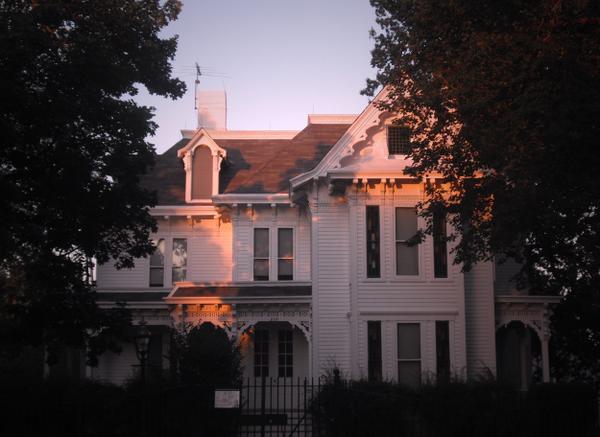
Sunset at the home of President Truman. @GoParks @Interior #POTUS
In the late afternoon light, one gets a better view of just why Harry Truman was so fond of this house. Who wouldn’t be?
Something to visit when you’re next in Independence, Missouri.
More:
Spread the word; friends don't allow friends to repeat history.
Leave a Comment » | Harry Truman, History, National Parks, photography, Presidents, Travel | Tagged: Harry Truman, History, Independence Missouri, National Parks, photography, Presidents, Travel | Permalink
Posted by Ed Darrell
August 18, 2014
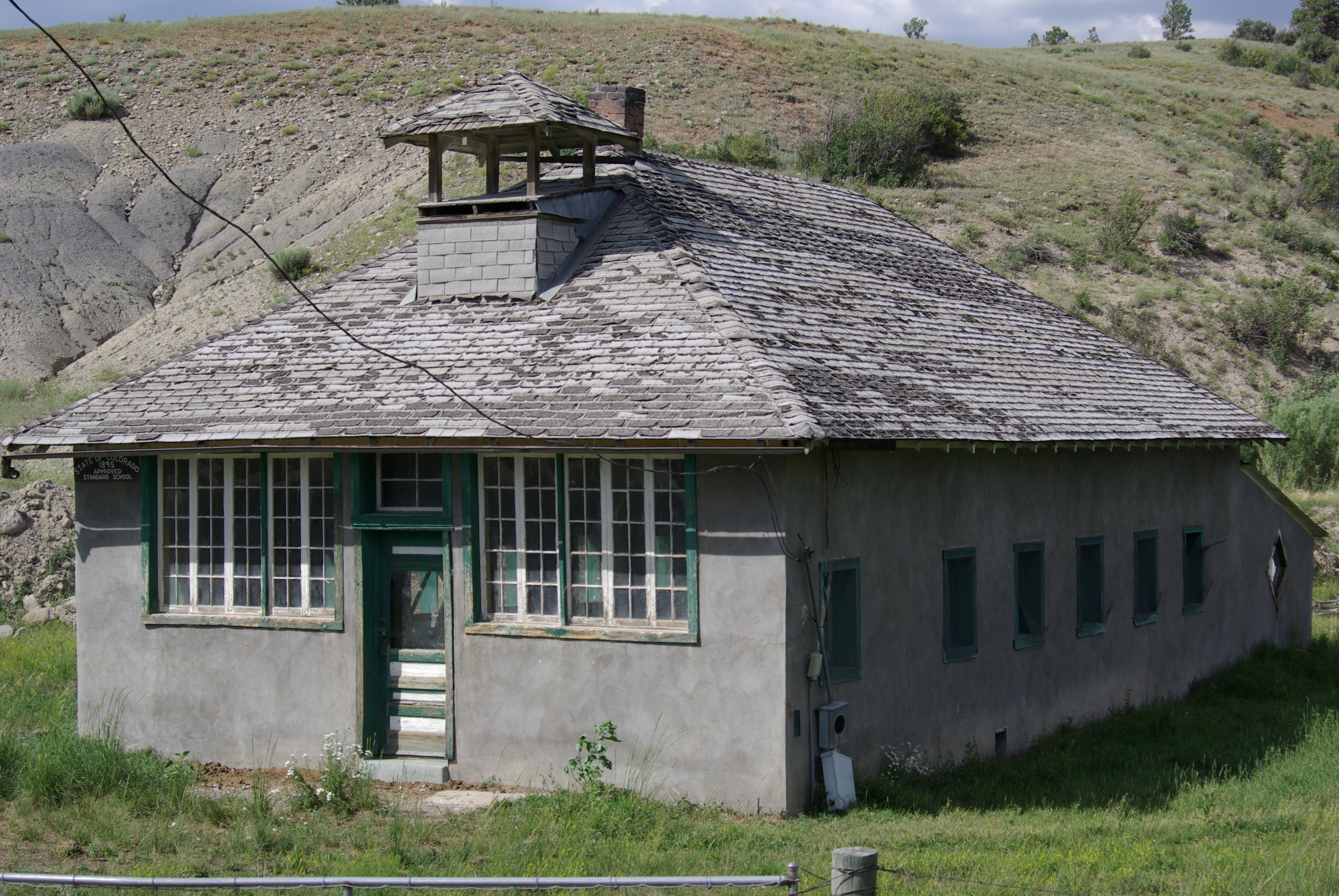
A few miles from the New Mexico border, in Chromo, Colorado:

East of Durango, along U.S. Highway 160 84, a school building with a sign suggesting it was built in 1895. The map said it was Chromo, Colorado. Photos by Ed Darrell; use with attribution is encouraged.
Difficult to tell how many rooms; it could have had up to four classrooms at one point, I reckon. The belfry is still there, but the bell is long gone — a prize for some scavenger if it was not removed for re-use, or for a museum.
Bigger windows that many modern schools, windows students could use to actually look outdoors. Modern school architects seem to want students to be unaffected by the outdoors, or light from outdoors, often.
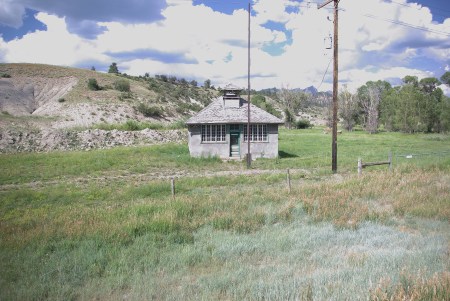
Off in a field by itself, there was plenty of room for kids to run around, at recess.
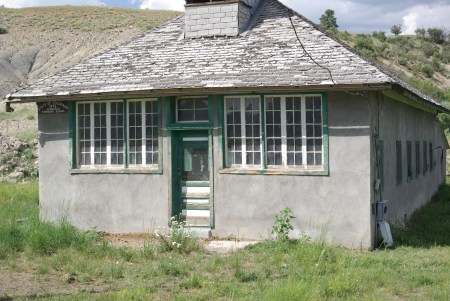
In this photo the sign is legible: “State of Colorado 1895 Approved Standard School.”
Was this a standard design, or does “standard school” refer to the program of instruction offered?
There were a few homes and farms close by. The community has always been small. How many students learned to read, learned how to handle numbers, read the greats of American history and literature in these walls? Who were they, and where did they go?
How big a mark can a school, or a teacher, actually make?
More:
- John Little taught 24 students in this building, in 1950; great stories; he writes that it is a one-room schoolhouse, then serving eight grades (don’t miss his photo of the teacher’s home, or cabin)
- Prairie Sagebrush Award 2011, at Sage to Meadow (featuring more photos of the school)
- Chromo School resides on the Colorado Registry of Historic Places, in Archuleta County; “Chromo School, US Hwy. 84, State Register 6/12/1996, 5AA.1907; The 1922 Chromo School served the area’s children from 1922 to 1954, and it continues to function as a community center. The concrete structure is a well preserved example of a rural school complex that also includes a teacherage and privy. Its design is reminiscent of local Hispanic architecture.” Teacherage?
- Nice photo with horses, at Desert Marmot
- Ghostroad Images has nice black and white photos for sale (see 3/32)
Spread the word; friends don't allow friends to repeat history.
5 Comments | Classroom technology, Education, History | Tagged: Chromo, Classroom technology, Colorado school building 1895, Education, History, John Little, One-room School | Permalink
Posted by Ed Darrell
August 18, 2014

Getty images. A young boy at the blackboard of a school in Gaza, August 2014. Via BBC.
Gaza got bombed 97 years ago when the British seized it, in World War I.
In the 21st century, things have not changed enough for the people who live in the area.
It’s even worse in Gaza than it was for the West Bank earlier.
Spread the word; friends don't allow friends to repeat history.
3 Comments | Civil Rights, Classroom technology, Education, History, History images, Human Rights, Israel | Tagged: Civil Rights, Classroom technology, Education, Gaza Strip, History, Human Rights, Israel | Permalink
Posted by Ed Darrell
August 11, 2014
These are quite creative. I wonder who invented them?
Other possibilities?
Maybe:

Edison’s logo?
Spread the word; friends don't allow friends to repeat history.
3 Comments | History, Humor, Science, Signs | Tagged: History, Humor, Science, Signs | Permalink
Posted by Ed Darrell
August 9, 2014
A roundup of thoughts on Twitter and elsewhere.
From The Bulletin of Atomic Scientists:
At the end of the day, it can be worthwhile on the Hiroshima and Nagasaki anniversaries to think about the personal and the emotional—while keeping such clinical data in mind and ready to hand when it is necessary to debate proponents of ideas such as “battlefield nuclear weapons,” “limited nuclear war,” and the use of select nuclear strikes as a form of “de-escalation.”
Therefore, perhaps the most compelling of the stories in the Bulletin archive is a first-person recollection, Hiroshima Memories, by Hideko Tamura Friedman, who was just a young girl back on August 6, 1945. After moving to the United States and becoming a therapist in private practice and a part-time social worker in the Radiation Oncology Department at the University of Chicago Hospitals, Hideko excerpted this 1995 article from a longer, unpublished manuscript she was working on.
Hideko describes how she was reading a book when “a huge band of white light fell from the sky down to the trees.” She jumped up and hid behind a large pillar as an explosion shook the earth and pieces of the roof fell about her.
Hideko survived; some members of her family did not. “My father,” she wrote in in a heart-rending statement of fact, “brought Mama’s ashes home in his army handkerchief.”
Editor’s note: The Bulletin’s archives from 1945 to 1998, complete with the original covers and artwork, can be found here. http://books.google.ca/books?id=-wsAAAAAMBAJ&source=gbs_all_issues_r&cad=1. Anything after 1998 can be found via the search engine on the Bulletin’s home page.
http://twitter.com/wellerstein/status/498124471979745280
Even the cross was bent by the blast.
Spread the word; friends don't allow friends to repeat history.
1 Comment | Atomic Bomb, History, Nagasaki, Nuclear Nonproliferation, Peace, World War II | Tagged: Atomic Bomb, History, Nagasaki, Nuclear Nonproliferation, Peace, World War II | Permalink
Posted by Ed Darrell
August 6, 2014
[Still true, from last year, with minor edits.]

A-Bomb Dome in Hiroshima, Japan Wikipedia image
As a Utah Downwinder, I fight depressing ideas every August 6, and August 9.
The first atomic bomb used in war was dropped by my nation on August 6, 1945. The second, on August 9. Hiroshima, then Nagasaki, were the targets.
I know the arguments, both ways. I feel certain my Uncle Leo B. Stewart’s life was saved by the bombs — and the lives of probably two or three million more Americans, and five or ten million Japanese. And still I am troubled.
I’m troubled that there seems to be so little attention paid to the anniversary in the U.S. Year by year, it gets tougher to get news out of remembrance ceremonies in Japan. Here are some Twitter notes on the day. I may be back with more, later.
http://twitter.com/TimHarford/status/364792998275448835
This comes from a pseudo-Truman, but it’s an accurate reflection of the angst Truman went through; once he made the decision, he did not have doubts that it was the right one.
Fortunately, in 68 years since, no other nuclear device has ever been used in war. May we have a planet that never sees their use in war, again.
More:
Spread the word; friends don't allow friends to repeat history.
43 Comments | 1941-1945, Atomic Bomb, Harry Truman, Hiroshima, History, Nagasaki, Nuclear weapons, World War II | Tagged: 1941-1945, Atomic Bomb, August 6, Harry Truman, Hiroshima, History, Nagasaki, Nuclear weapon, War, World War II | Permalink
Posted by Ed Darrell
August 5, 2014

Julius O. Davidson’s painting (published by Louis Prang) of the Battle of Mobile Bay, August 5, 1864.
It was 150 years ago today: Especially with the excellent help of Tom Petty, whose 1979 album “Damn the Torpedoes” propelled him to stardom, the phrase “Damn the torpedoes!” remains one of the most used phrases out of history.
Just try to find someone who can tell you who first said it, and what the circumstances were. It’s a sign that history instruction is not what it should be on some matters.
August 5 marks the 150th anniversary of the Battle of Mobile Bay in 1864, when the Union Navy under the command of Admiral David Farragut took Mobile from Confederate forces.
U.S. Heritage Protection Services — a division of the National Park Service — gives a straight up, unemotional description of the fight, which was a key victory for the Union, shutting down much of the Confederacy’s ability to trade with foreign nations and supply its army:

Photograph from circa 1855-1865 of then-Rear Admiral David Glasgow Farragut, the commander of the Union forces at the Battle of Mobile Bay, and the man to who is attributed the famous line, “Damn the Torpedoes!”
Other Names: Passing of Forts Morgan and Gaines
Location: Mobile County and Baldwin County
Campaign: Operations in Mobile Bay (1864)
Date(s): August 2-23, 1864
Principal Commanders: Adm. David G. Farragut and Maj. Gen. Gordon Granger [US]; Adm. Franklin Buchanan and Brig. Gen. Richard L. Page [CS]
Forces Engaged: Farragut’s Fleet (14 wooden ships and 4 monitors) and U.S. army forces near Mobile [US]; Buchanan’s Flotilla (3 gunboats and an ironclad), Fort Morgan Garrison, Fort Gaines Garrison, and Fort Powell Garrison [CS]
Estimated Casualties: 1,822 (US 322; CS 1,500)
Description: A combined Union force initiated operations to close Mobile Bay to blockade running. Some Union forces landed on Dauphin Island and laid siege to Fort Gaines. On August 5, Farragut’s Union fleet of eighteen ships entered Mobile Bay and received a devastating fire from Forts Gaines and Morgan and other points. After passing the forts, Farragut forced the Confederate naval forces, under Adm. Franklin Buchanan, to surrender, which effectively closed Mobile Bay. By August 23, Fort Morgan, the last big holdout, fell, shutting down the port. The city, however, remained uncaptured.
Results(s): Union victory

World War I recruiting poster showing Admiral David Farragut lashed to the mast of his ship, and offering the quote for which Farragut is famous. Image from the collection of the Library of Congress, via Wikipedia
Nota bene:
- Was Farragut lashed to the rigging? Wikipedia’s listing:An anecdote of the battle that has some dramatic interest has it that Farragut was lashed to the mast during the passage of Fort Morgan. The image it brings to mind is of absolute resolve: if his ship were to be sunk in the battle, he would go down with her. The truth is more prosaic; while he was indeed lashed to the rigging of the mainmast, it was a precautionary move rather than an act of defiance. It came about after the battle had opened and smoke from the guns had clouded the air. In order to get a better view of the action, Farragut climbed into Hartford‘s rigging, and soon was high enough that a fall would certainly incapacitate him and could have killed him. Seeing this, Captain Drayton sent a seaman aloft with a piece of line to secure the admiral. He demurred, saying, “Never mind, I am all right,” but the sailor obeyed his captain’s orders, tying one end of the line to a forward shroud, then around the admiral and to the after shroud.[50]Later, when CSS Tennessee made her unsupported attack on the Federal fleet, Farragut climbed into the mizzen rigging. Still concerned for his safety, Captain Drayton had Flag-Lieutenant J. Crittenden Watson tie him to the rigging again.[51] Thus, the admiral had been tied to the rigging twice in the course of the battle.
- Did Farragut actually say, “Damn the torpedoes, full speed ahead? Mobile Bay had been mined by the Confederates, to hold off exactly the sort of Union attack Farragut mounted. Mines, in that time, were known as “torpedoes,” not the underwater-missiles made famous by World War II movies. Farragut had an iron-clad ship, Tecumseh, under his command leading the attack; legend holds that other ships slowed to allow Tecumseh to cross them and move ahead. Farragut asked why the attack was slowing, and upon hearing that they feared torpedoes (mines), he later was reputed to have said “Damn the torpedoes,” and urged moving at all speed. Did he say, “full speed ahead?” Accounts differ on that, even in legend. In one version he shouted to the ship Brooklyn, “Go ahead!” That’s unlikely in the din of sailing, coupled with the din of battle. Another account has him shouting (vainly) to the Hartford, “Four bells, Captain Drayton.” Yet another version, that almost makes sense, has him shouting to the Metacomet, which was lashed to the Hartford’s side, “Go ahead, Jouett, full speed.” The entire quote must be listed as attributed, and the only part most versions agree on is “Damn the torpedoes.” A World War I recruiting poster probably inscribed the quote into history (see the poster in this post). Alas, Tecumseh hit a torpedo early in the battle, and sank, killing most of its crew.
- Political importance: Coupled with Gen. William Tecumseh Sherman‘s March Across Georgia, and the Fall of Atlanta, the Battle of Mobile Bay gave credence to the idea that the fortunes of the Civil War had turned in the Union’s favor. This victory probably contributed greatly to the re-election of President Abraham Lincoln against opponents who urged simply ending the war without victory.
- Mobile Bay was an important port? Mobile Bay stands as a monument to poor soil conservation practices, today. Maps of the battle show a much larger bay than exists today; since 1864, silting from the river has filled in the bay, making it much less useful, and much less important to shipping.

1861 map of Mobile Bay: “H.H. Lloyd & Co’s Campaign Military Charts Showing The Principal Strategic Places Of Interest. Engraved Expressly To Meet A Public Want During The Present War. Compiled From Official Data By Egbert L. Viele, Military and Civil Engineer; and Charles Haskins. Published Under The Auspices Of The American Geographical And Statistical Society. Entered … 1861 by H.H. Lloyd & Co. H.H. Lloyd & Co’s Military Charts. Sixteen Maps On One Sheet.”

LandSat image of Mobile Bay, from NASA, 2003 (via Wikipedia). The Northern Bay is almost completely silted in by the Mobile River and others.
Whether Admiral David G. Farragut actually said, “Damn the torpedoes!” the phrase remains an often-used quotation to urge action in the face of uncertainty, hopefully, to victory. Farragut’s forces won the Battle of Mobile Bay on August 5, 1864, a key maritime battle of the Civil War. Whatever he said, it must have been inspiring.
What torpedoes are you damning today?
More:
This is an annual event. Much of this is an encore post.
Spread the word; friends don't allow friends to repeat history.
Leave a Comment » | Civil War, Famous Battles, Famous quotes, History | Tagged: "Damn the torpedoes!", Battle of Mobile Bay, Civil War, David Farragut, Famous Battles, Famous quotes, Fort Morgan, History | Permalink
Posted by Ed Darrell







 Millard Fillmore's Bathtub
