June 23 is Typewriter Day

July 7, 2014

All these years I didn’t know.

Some wags designated June 23 as Typewriter Day — the anniversary of the date the typewriter was first patented by Christopher Sholes.  (And you know, I did have a post on that event, last year.)

Drawing for a Typewriter, 06/23/1868 (ARC Identifier: 595503); Patented Case Files, 1836 - 1956; Records of the Patent and Trademark Office; Record Group 241; National Archives.

From the U.S. National Archives Administration: Dated June 23, 1868, this is the printed patent drawing for a “Type-Writer” invented by Christopher L. Sholes, Carlos Glidden, and J. W. Soule. Drawing for a Typewriter, 06/23/1868 Drawing for a Typewriter, 06/23/1868 (ARC Identifier: 595503); Patented Case Files, 1836 – 1956; Records of the Patent and Trademark Office; Record Group 241; National Archives.

Will you remind me in 2015, a week or so in advance, so we can get appropriate celebratory posts up here at Millard Fillmore’s Bathtub?

Links below can get us into position to commemorate the day adequately, next year.

More:

April 30, 1808, first practical typewriter?

Historical dispute!


July 4, 1826: Astonishing coincidences on the 50th anniversary of the Declaration

July 4, 2014

You know the story, don’t you? If you don’t, you should commit this one to memory.  It’s not fiction, and if you proposed it for fiction, the editors would reject it as too improbable, or too sappy, a tug on your heartstrings and tear ducts.  It’s true, better than the faux patriot fiction we often get on July 4.

July 4, 2014, is the 238th anniversary of the announcement of the Declaration of Independence.  I hope you’re thinking about how you’ll fly the flag this weekend in honor of the Declaration of Independence.

The resolution proposed by Richard Henry Lee calling for independence of the 13 colonies passed the Continental Congress on July 2, 1776.  The Declaration would be Thomas Jefferson’s crowning achievement, outshining even his presidency and the Louisiana Purchase.   John Adams wrote to his wife, Abigail, that July 2 would forever be marked by patriotic displays.

But the Declaration itself, which gave teeth to the resolution, was adopted two days later on July 4.  That has come to be the day we celebrate.

Detail, John Trumbull's Signing of the Declaration of Independence - Theodor Horydczak photo, Library of Congress

Detail, John Trumbull’s Signing of the Declaration of Independence – The committee of five presents the Declaration of Independence to John Hancock, the President of the Second Continental Congress; from left, the committee is John Adams, Robert Livingston, Roger Sherman, Thomas Jefferson, and Ben Franklin.  Theodor Horydczak photo, Library of Congress

Adams didn’t miss a beat.  Who quibbles about a couple of days when the celebrating is so good?

Adams and Jefferson were two of the five-member committee the Congress had tasked to write a declaration.  Adams and Ben Franklin quickly determined to leave it up to Jefferson, who had a grand flair with words, and who had just written a couple of stirring documents for Virginia.  Roger Sherman and Robert Livingston, the other two members, went along.  And so it was that the Declaration of  Independence is almost completely the work of Thomas Jefferson.

Adams and Jefferson became friends only later, when they both served the nation at war as ambassadors to France, and then for Adams, to England.  A widower, Jefferson was taken in by Abigail Adams who worried about him.  After the war, Jefferson was in England when Adams was to meet King George III in a grand ceremony in which the king would accept the credentials of all the ambassadors of foreign nations to England.  As the king strode down the line, each ambassador or delegation would bow, the king would acknowledge them, the papers would be passed, and the king would move on.  Adams and Jefferson bowed.  King George moved on, ignoring them completely.

In such a case of such a snub, the snubbed foreigners usually made a quick exit.  Adams and Jefferson did not.  They stood at attention as if the king had treated them like all the rest, reversing the snub.  From the beginning, Americans and the United States pushed for more practical, reasonable, and compassionate government and relations.  Standing together, against the snub of the British King one more time, Adams and Jefferson formed a silent bond that held them the rest of their lives.

Back in America in peacetime, and both members of the administration of George Washington, Adams and Jefferson fell out.  Secretary of State Jefferson favored a more limited federal government; Vice President Adams favored a more powerful one.  By the end of Washington’s second term, party politics had been well developed.  Adams defeated Jefferson in the election of 1796.  As was the law then, Jefferson was vice president as the runner-up vote getter in the electoral college; but Adams kept Jefferson out of all government affairs.  Perhaps because he didn’t have Jefferson to help, Adams’s presidency did not go well.  In the rematch election in 1800, one of  the bitterest election fights ever, Jefferson’s party defeated Adams.  The gleeful Democratic-Republican electors all voted one ballot for Jefferson, the presidential candidate, and one ballot for Aaron Burr, the party’s vice presidential candidate.

Alas, that produced a tie vote in the electoral college.  Adams’s party, the Federalists, still held the House of Representatives before the new Congress came in.  A tie vote goes to the House for decision.  They could not bring themselves to vote for Jefferson, and the deadlock continued for 37 ballots.  Finally Jefferson’s former friend but now arch-enemy Alexander Hamilton intervened, explaining that Burr was clearly the greater scoundrel, and the House elected Jefferson.  Adams slunk out of town, avoiding the inauguration.

It wasn’t until after 1809 when Benjamin Rush hoodwinked Jefferson into writing to Adams, and Adams to Jefferson, that the two became friendly again.  For the next 17 years Jefferson and Adams carried on perhaps the greatest series of correspondence in history between two great minds.  Letters went out almost daily, from Monticello, Virginia,  to Braintree, Massachusetts, and from Braintree to Monticello.  They discussed the weather, their families, old times, farming — but especially the republic they had been most instrumental in creating, and how it might be preserved, and made to prosper.  Eventually the letters became harder to read, both because their eyesight was failing, and because their penmanship deteriorated, too.

The ideas, however, flowed like a great river of freedom.  Perhaps this correspondence was the river flowing justice the prophet Amos foretold.

Letter from Thomas Jefferson to John Adams, August 15th, 1820 - Library of Congress image

Letter from Thomas Jefferson to John Adams, August 15th, 1820. From The Thomas Jefferson Papers at the Library of Congress, Thomas Jefferson Papers Series 1. General Correspondence. 1651-1827. Library of Congress image

Both men took ill early in 1826.  This was a landmark year, 50 years since the Declaration of Independence.  In Massachusetts, a grand display of fireworks was planned to cap off a day of feasting and celebration.  Adams hoped he might attend.  In Virginia, a week before, it became clear Jefferson was too ill to venture even as close as Charlottesville for the celebration.  Jefferson sent his regrets to invitations from several celebrations.  Jefferson slept through most of July 3, but awoke about 9:00 p.m., and asked, “This is the fourth?”  It was not.  These are the last significant, recorded words of Jefferson.  He awoke at about 4:00 a.m. on the Fourth of July, 1826, but could not make a rally.  He died at 12:50 in the afternoon.

Adams, too, was too ill to attend the celebrations.  In the late afternoon or early evening of the Fourth, he awoke, and heard the celebration in the town.  Almost as if he had worked just to live to see that particular day, he checked the date.  Realizing he was near the end, happy that he’d seen 50 years after the Declaration, and unaware of the events a few hours earlier that day in Virginia, Adams said, “Thomas Jefferson still survives.”  Adams, too, died on July 4, 1826.

Fly your flag July 4th. Remember John Adams and Thomas Jefferson.  Remember their great work in creating the nation that protects our freedoms today.  Remember their great friendship.  Write a letter to a good friend you’ve not written to lately.

It is Independence Day, a day created and celebrated by great men like John Adams and Thomas Jefferson.  Their spirit survives in us, as we celebrate, and if we remember why we celebrate as friends.

More:


Fly your flag today! July 4, 2014, 238th anniversary of the public reading of the Declaration of Independence

July 4, 2014

It’s a day of tradition — oddly enough, since we are in reality a very new nation, and Lee’s resolution to declare independence from Britain came on July 2.

A soak in Millard Fillmore’s Bathtub is nothing if not a steeping in tradition.  Fly your flag today, to celebrate the independence of the American colonies of Britain.

Fourth of July: NPR has already read the Declaration of Independence (or will soon, if you’re up early), PBS is ready to broadcast the Capitol Fourth concert  (maybe a rebroadcast is available, if you’re off at your own town’s fireworks — check your local listings), your town has a parade somewhere this weekend, or a neighboring community does, and fireworks are everywhere.

At the White House, traditionally, new citizens are sworn in — often people who joined our armed forces and fought for our nation, before even getting the privileges of citizenship.  Fireworks on the Capital Mall will be grand, with the White House hosting a few thousand military people and their families from some of the best views.  Traditionally, five photographers, chosen by lottery, get to shoot photos of the fireworks from the windows of the Washington Monument; will that occur, with the Monument shut down from public view for repair from the earthquake?

There will be great fireworks also in Baltimore Harbor over Fort McHenry, the fort whose siege inspired Francis Scott Key to write the “Star-spangled Banner” from his boat in the harbor, in 1814. Firworks will frighten the bluebirds nesting at Yorktown National Battlefield.  I suspect there will be a grand display at Gettysburg, on the 150th anniversary of the end of that battle. July 4, 1863, also marked the end of the Siege of Vicksburg; tradition holds that Vicksburg did not celebrate the 4th of July for 83 years after that. I’ll wager there will be fireworks there tonight.  In Provo, Utah, the city poobahs will have done all they can to try to live up to their self-proclaimed reputation as having the biggest Independence Day celebration in the nation.  The celebration in Prescott, Arizona, is muted by the tragic deaths of 19 Hot Shot firefighters last week; will drought halt the fireworks, too?  There will be fireworks around the Golden Gate Bridge, in Anchorage, Alaska, reflecting on the waters of Pearl Harbor, and probably in Guam, American Samoa, and the Northern Marianas Islands.

Fireworks on the Fourth is a long tradition — a tradition that kept John Adams and Thomas Jefferson alive, until they both died on the 50th anniversary of the Declaration of Independence, in 1826, the sounds of the fireworks letting Adams know the celebration had begun (Adams erroneously celebrated that Jefferson, the Declaration’s author, still lived, unable to know Jefferson had passed just hours earlier).

Remember to put your flag up today.

Astronaut Eugene Cernan and the U.S. Flag -- Apollo 17 on the Moon (NASA photo)

Last flag on the Moon: Astronaut Eugene Cernan and the U.S. Flag — Apollo 17 on the Moon (NASA photo)

If you’re not on the Moon, here are some tips on flag etiquette, how to appropriately fly our national standard.

Also:

Lunar Reconnaissance Orbiter photo of the Apollo 17 landing site.

Lunar Reconnaissance Orbiter photo of the Apollo 17 landing site. NASA caption: Apollo 17 Lunar Module Challenger descent stage comes into focus from the new lower 50 km mapping orbit, image width 102 meters. Credit: NASA/GSFC/Arizona State University

This is mostly an encore post, but I so love that photo of the flag with the Earth in the distance.

Happy birthday, Kathryn!

Fireworks in Duncanville, Texas, for July 4

Fireworks in Duncanville, Texas, for July 4 — Kathryn Knowles’s birthday. We’re always happy the town chimes in with the celebratory spirit.

Tip of the old scrub brush to Thomas Jefferson, Richard Henry Lee, John Adams, Benjamin Franklin, Roger Sherman, Robert Livingston, and the cast of thousands of patriots including George Washington.


Reminder: How to fly the flag on July 4 in 2014

July 4, 2014

Every kid should learn this stuff by third grade, but it’s clear from what we see that they don’t.

Flag flying in front of U.S. Capitol (East side) LOC photo

Flag flying at the eastern front of the U.S. Capitol. Library of Congress photo

So here’s a quick review of dos and don’ts for display and behavior toward the U.S. flag on this most flag-worthy of days, the 4th of July. With a few comments.

1. Fly your flag, from sunup to sundown. If you’re lucky enough to have a flagpole, run the flag up quickly. Retire it slowly at sunset. Then go see fireworks.

2. Display flags appropriately, if not flown from a staff. If suspended from a building or a wall, remember the blue field of stars should always be on the flag’s right — the “northwest corner” or left as you look at it. Do not display a flag flat, parallel to the ground.

3. Salute the flag as it opens the 4th of July parade. In a better world, there would be just one U.S. flag at the opening of the parade, and the entire crowd would rise as it passes them in a great patriotic, emotional wave — civilians with their hands over their hearts, hats off; people in uniform saluting appropriately with hats on. It’s likely that your local parade will not be so crisp. Other entries in the parade will have flags, and many will be displayed inappropriately. A true patriot might rise and salute each one — but that would look silly, perhaps even sillier than those sunshine patriots who display the flag inappropriately. Send them a nice letter this year, correcting their behavior. But don’t be obnoxious about it.

4. Do not display the flag from a car antenna, attached to a window of a car, or attached in the back of a truck. That’s against the Flag Code, which says a flag can only be displayed attached to the right front fender of a car, usually with a special attachment. This means that a lot of the National Guard entries in local parades will be wrongly done, according to the flag code. They defend the flag, and we should not make pests of ourselves about it. Write them a letter commending their patriotism. Enclose the Flag Code, and ask them to stick to it next time. Innocent children are watching.

5. Do not dishonor the flag by abusing it or throwing it on the ground. It’s become popular for a local merchant to buy a lot of little plastic flags and pass them out to parade goers. If there is an advertisement on the flag, that is another violation of the Flag Code. The flag should not be used for commercial purposes. I have, several times, found piles of these flags on the ground, dumped by tired people who were passing them out, or dumped by parade goers who didn’t want to carry the things home. It doesn’t matter if it’s printed on cheap plastic, and made in China — it is our nation’s flag anyway. Honor it. If it is worn, dispose of it soberly, solemnly, and properly.

That’s probably enough for today. When the Flag Desecration Amendment passes — if it ever does — those parade float makers, National Guard soldiers, and merchants, can all be jailed, perhaps. Or punished in other ways.  And wouldn’t that be silly and unproductive?

Until that time, our best hope is to review the rules, obey them, and set examples for others.

Have a wonderful 4th of July! Fly the flag. Read the Declaration of Independence out loud. Love your family, hug them, and feed them well. That’s part of the Pursuit of Happiness that this day honors. It is your right, your unalienable right. Use it wisely, often and well.

Happy birthday, Kathryn!

More, and Additional Resources:


116 years ago, July 1, Teddy Roosevelt “rode” into history

July 2, 2014

American Experience makes a Facebook presence.  On July 1, they posted one of my favorite photos of Teddy Roosevelt (and one of the more famous):

On July 1, 1898 Theodore Roosevelt and his volunteer cavalry, the Rough Riders, stormed Kettle Hill and helped capture San Juan Hill. Learn more about Roosevelt and the Rough Riders: http://to.pbs.org/1x730Kv

Theodore Roosevelt and the Rough Riders, atop San Juan Hill in Cuba, ostensibly; circa July 1, 1898.

American Experience

On July 1, 1898 Theodore Roosevelt and his volunteer cavalry, the Rough Riders, stormed Kettle Hill and helped capture San Juan Hill.

Learn more about Roosevelt and the Rough Riders: http://to.pbs.org/1x730Kv

But, it’s Teddy Roosevelt!  There is always so much more!

On my Facebook timeline I answered:

And started the ball rolling that would make Teddy Roosevelt the only person ever to receive the Nobel Prize for Peace, and the Medal of Honor for war.

What an interesting character.

P.S. — TR resigned his job as Asst. Secretary of the Navy to enlist; told that there was no group for him to lead, he proceeded to recruit fellow Harvard Law classmates, and fellow South Dakota cowboys, to form the roughriders. Wouldn’t you love to have sat around a campfire with THAT group?

The horses of the Rough Riders were stuck on a ship in the harbor when they made this assault. Famous for riding horses, their reputation was earned on foot, with their horses on a boat.

You couldn’t make that stuff up for a fictional account.

It was a short war; by the end of the year TR was back in New York, wangling to get elected governor, which he did.  His do-good, reformer ways rubbed the corrupt GOP machine the wrong way, however, and when William McKinley’s Vice President Garret A. Hobart died, they seized the opportunity to bury Roosevelt forever; they got him nominated vice president for McKinley’s second term.  They probably remembered, and thought always true, that old Mark Twain story, about the poor widow who had two sons:  One went off to sea, and the other was elected vice president, and neither was ever heard from again.

Assassination struck for the third time in our presidential history.  By the end of 1901, Teddy Roosevelt was President of the United States.

Just like Teddy to ride into history, too impatient to wait for a horse to ride on.


John Adams’s greatest error

July 2, 2014

“The Second Day of July 1776 will be the most memorable Epocha, in the History of America. . . . It ought to be solemnized with Pomp and Parade, with Shews, Games, Sports, Guns, Bells, Bonfires, and Illuminations from one End of this Continent to the other from this Time forward forever more.”
John Adams to Abigail Adams, July 3, 1776

In writing to his wife Abigail on July 3, John Adams committed one of those grand errors even he would laugh at afterward.  We’ll forgive him when the fireworks start firing.

1776 filled the calendar with dates deserving of remembrance and even celebration. John Adams, delegate from Massachusetts to the Second Continental Congress, wrote home to his wife Abigail that future generations would celebrate July 2, the date the Congress voted to approve Richard Henry Lee’s resolution declaring independence from Britain for 13 of the British colonies in America.

Continental congress DSC_0607

Scene of the crime — Independence Hall in Philadelphia, where the Second Continental congress approved the resolution to declare the colonies independent from Britain – (Photo credit: diablodale)

Two days later, that same Congress approved the wording of the document Thomas Jefferson had drafted to announce Lee’s resolution to the world.

Today, we celebrate the date of the document Jefferson wrote, and Richard Henry Lee is often a reduced to a footnote, if not erased from history altogether.

Who can predict the future?

(You know, of course, that Adams and Jefferson both died 50 years to the day after the Declaration of Independence, on July 4, 1826. In the 50 intervening years, Adams and Jefferson were comrades in arms and diplomacy in Europe, officers of the new government in America, opposing candidates for the presidency, President and Vice President, ex-President and President, bitter enemies, then long-distance friends writing almost daily about how to make a great new nation. Read David McCullough‘s version of the story, if you can find it.)

(Yes, this is mostly an encore post.)

More, and Related articles:

The Lee Resolution.

The Lee Resolution, passed by the Second Continental Congress on July 2, 1776 – Wikipedia image (Wait a minute: Are those numbers added correctly? What are they?)


Unintentional bogus history: Archduke Ferdinand assassinated! British lead assault on Damascus!

June 30, 2014

Santayana said it:  Those who don’t remember history, yada, yada, yada.

It almost turned Dada-esque over the weekend, when a Syrian television editor mistook a “history-as-it-happened” Twitter feed for actual events.

One reason to learn history, I tell students, is so that you cannot be jived by politicians and others who wish to persuade you falsely.  Add to that:  So you won’t be suckered by false news reports when you’re at the editor’s desk.

I wonder how many hoaxes get started this way?

Is that today's newspaper? Toronto Daily Star, June 29, 1914. Not today's edition.

Is that today’s newspaper? Toronto Daily Star, June 29, 1914. Not today’s edition.


Remember Helen Keller on her birthday 2014

June 27, 2014

Helen Keller was born June 27, 1880.

More:


Quote of the Moment: John Kennedy, June 26, 1963 (51 years ago)

June 26, 2014

Rare color photograph of President John Kennedy addressing a crowd in the then-divided city of Berlin, June 26, 1963

Rare color photograph of President John Kennedy addressing a crowd in the then-divided city of Berlin, June 26, 1963

On the day the U.S. and Germany meet in Brazil in the World Cup, let us remember the ties that bind our nations together, including especially the memorable speech of  U.S. President John F. Kennedy on this day, in Berlin, in 1963.

From the Smithsonian Magazine site:

June 26, 1963: “Ich bin ein Berliner”

In West Berlin, President John F. Kennedy delivers the famous speech in which he declares, “Ich bin ein Berliner.” Meaning literally “I am a citizen of Berlin,” the statement shows U.S. solidarity with democratic West Berlin, surrounded by communist territory.

View a video of President Kennedy’s speech at American Rhetoric, Top 100 Speeches.

Kennedy’s entire speech was good. It was well drafted and well delivered, taking advantage of the dramatic setting and the dramatic moment. John Kennedy well understood how to give a speech, too.

Below is most of the speech, nearly five minutes’ worth, from a YouTube file — another indication that schools need to open up their filters to allow at least some of the best YouTube material through:

You may also want to note these posts:

German government photo and caption: The masses that greeted Kennedy in front of the West Berlin City Hall and throughout the city were jubilant. (© Press and Information Office of the Federal Government; Steiner)

German government photo and caption: The masses that greeted Kennedy in front of the West Berlin City Hall and throughout the city were jubilant. (© Press and Information Office of the Federal Government; Steiner)

This is an encore post.

This is an encore post.


Star-spangled Banner’s 200th – with the Steep Canyon Rangers

June 26, 2014

Published on Jun 19, 2014

Grammy Award winning bluegrass band the Steep Canyon Rangers, well known for their work with Steve Martin, perform a special version of “The Star-Spangled Banner” for the Smithsonian’s National Museum of American History in honor of the song’s 200th anniversary.

The museum will “Raise It Up!” and celebrate the 200th anniversary by uniting the original manuscript with the flag at the Museum from June 14-July 6, 2014 and holding a special event at the museum on Flag Day (Saturday, June 14, 2014). Join the party: http://anthemforamerica.smithsonian.com/

Special thanks to the team at Wool and Tusk for their hard work and creativity: Scott Mele, Roger Pistole, Derek West, Joe Pisapia, David Bartin, Michael Freeman, Alexis Kaback, Daniel Walker, Jeff Rosen, Harvey Moltz, and Greg and Erin Whiteley.

More:

The flag that flew over Fort McHenry at the Battle of Baltimore, 1814. Smithsonian image.

The flag that flew over Fort McHenry at the Battle of Baltimore, 1814. Smithsonian image.


1914 — photo of Flag Days past, present, and yet to come

June 14, 2014

A guy speaking on Flag Day. Unremarkable, except, look at the year, look at the audience.

Caption from the Library of Congress:  Flag Day exercises, State, War, and Navy Building. Wilson speaking; Bryan, Daniels, [Breckinridge Long], William Phillips, F.D. Roosevelt, etc. present

Caption from the Library of Congress: Flag Day exercises, State, War, and Navy Building. Wilson speaking; Bryan, Daniels, [Breckinridge Long], William Phillips, F.D. Roosevelt, etc. present

Flag Day was marked in 1877 by a few hundred Americans, fresh from celebrating the nation’s centennial, on the centennial date of the resolution from the Second Continental Congress that designated the flag, with stars and stripes.  Pushed by history teachers who used the celebration as a teaching tool, unofficial ceremonies continued across the nation.

President Woodrow Wilson — himself a professor of history and politics — issued a proclamation for a national celebration to continue each year, in 1916.

This photo was taken two years before that proclamation, in the centennial year of the “Star-spangled Banner.”

Professional photographers Harris & Ewing captured Wilson in mid-speech, in declamation form without a public address system or any other amplification.  (I wonder:  Who was the first president to use a microphone and amplification?)

Reporters for newspapers, and maybe an official scribe, work to capture Wilson’s speech in text form; Wilson was probably speaking extemporaneously, without a prepared text.  Whatever Wilson said, his remarks were not captured officially in Presidential Papers, though they may be available in other venues (behind a paywall for me)Wilson’s speech, delivered at 4:00 p.m., was titled “The Meaning of the Flag.”  A few snippets from the speech suggest that it was mostly a diatribe that whipped up sentiment against German immigrants in America, ultimately ending in violence against many U.S. citizens and residents.

The platform was the steps of the State, War and Navy Building, now the West Executive Office Building next door to the White House.  Then the building housed three departments; today State has its own complex in Foggy Bottom, a few blocks away; War was renamed Defense after World War II, and moved across the Potomac to Virginia, to the Pentagon, where the Navy’s chief offices also reside.

On the platform with Wilson were his Secretary of State, William Jennings Bryan, former Congressman from Nebraska who ran for the presidency six times, most famously capturing the nomination of the Democratic Party in 1896 with this “Cross of Gold” speech; and immediately to the left of Wilson in the photo is his young Assistant Secretary of the Navy, Franklin D. Roosevelt, who would go on to be crippled by polio, then elected Governor of New York and, in 1932, President of the U.S.

In the photo above, Bryan is almost wholly cut out, on the extreme left edge.

Others on the stand include William Phillips, sitting on Roosevelt’s right, though a chilly couple of feet away; Breckinridge Long, to Phillips’s right; and Secretary of the Navy Josephus Daniels, in a light colored suit, to Long’s right and Bryan’s left.

You won’t find William Phillips in most history books, but he played important roles in American state affairs for four decades.  Returning early from an assignment in London in 1912, he booked passage on the RMS Olympic, avoiding passage on the grander, RMS Titanic a week later.  An odd little history of the Olympic gives a great, brief description of Phillips’s career:

A career diplomat, he would shortly go on to work closely with Woodrow Wilson and to be involved in the latter’s 14-point peace plan following the Great European War.

Wilson made him an Assistant Secretary of State, and Phillips would later be Ambassador to Italy at the time of Mussolini. Later in the war he became London head of the Office of Strategic Services (OSS, forerunner of the CIA), and would come into contact with an operative named Walter Lord.

Breckinridge Long also held important posts over 40 years, but his legacy is much less happy.  As Assistant Secretary of State for Visas during World War II, Long set up obstacles to U.S. immigration by people who were threatened by Nazi governments in European nations, sometimes countermanding orders from President Franklin Roosevelt.

Josephus Daniels, son of a southern shipbuilder murdered for his Union sympathies during the Civil War, published newspapers in North Carolina most of his life.  President Wilson appointed him Secretary of the Navy, where he became close friends with his Assistant Secretary Franklin Roosevelt; FDR appointed Daniels Ambassador to Mexico.  Among Daniels’s newspaper holdings was the Raleigh News and Observer.  An opponent of the Ku Klux Klan, Daniels argues for white supremacy, and claimed that African Americans would block progressive reforms.

No, “cup of joe” is not a reference to Josephus Daniels and his order banning alcohol from Navy officers’ messes.

On that speaker’s stand, on Flag Day, 1914, were the president and a future president, experience dating back to the Civil War and future leadership through the end of World War II.  Interesting photo.

Your flag is already flying for Flag Day, right?

Absent in most photos of the dignitaries at Wilson's speech:  The U.S. flag.  This photo, from farther back, shows the U.S. Marine Band, which played for the occasion, and the U.S. flag on the main pole in front of the State, War and Navy Building.  Photo from the Lincoln Highway National Archives and Museum.

Absent in most photos of the dignitaries at Wilson’s speech: The U.S. flag. This photo, from farther back, shows the U.S. Marine Band, which played for the occasion, and the U.S. flag on the main pole in front of the State, War and Navy Building. William Jennings Bryan is more clearly shown, also, on the left of the row of seats behind Wilson. Photo from the Lincoln Highway National Archives and Museum.


Flag Day 2014 – Fly your flag June 14! Oh, and sing!

June 13, 2014

Of course, you’re ready to fly your Stars and Stripes on Saturday, June 14, right?

Again, I’m on the road.  But Flag Day 2014 is a biggie — 2014 also the bicentennial of the night (in September) the British invaded Baltimore — the Battle of Baltimore, and the Battle of Baltimore Harbor, during the War of 1812.  On that night, Georgetown, D.C., lawyer Francis Scott Key negotiated the release of a physician the British captured during their raid on Washington, D.C., and environs.  But, the British officers didn’t want Key to be able to reveal what he might have learned about their next target, Baltimore.  So they put Key on a boat to watch as they invaded Baltimore, trying to capture the fort that guarded the harbor, Fort McHenry.

Yes, THAT battle.  Key saw the flag at the fort flying, under extreme bombardment, at sunset.  The bombardment continued through night.  At dawn, on September 14, 1814, Key saw that the massive flag at Fort McHenry still flew, meaning the British invasion failed.

He was inspired to write poem, “The Defense of Fort McHenry.”  You know the opening line:

“O! Say can you see by the dawn’s early light, what so proudly we hailed at the twilight’s last gleaming?”

History by Zim has a more detailed account — and this photo, noted as probably the first photograph of that same flag.

From History by Zim:

From History by Zim: “This is the first known photograph of the American flag taken on June 21, 1873 by George Henry Preble. The flag was flown over Fort McHenry in Baltimore, Maryland during an infamous battle between the British and the United States during the War of 1812. Photo Credit: National Star-Spangled Banner Centennial, Baltimore, Maryland, September 6 to 13, 1914.”

Flag Day, June 14th, marks the anniversary of the resolution passed by the Second Continental Congress in 1777, adopting the Stars and Stripes as the national flag.

Fly your flag today. This is one of the score of dates upon which Congress suggests we fly our U.S. flags.

Flag Day 1916, parade in Washington, D.C. - employees of National Geographic Society march - photo by Gilbert Grosvenor

Flag Day 1916, parade in Washington, D.C. – employees of National Geographic Society march – photo by Gilbert Grosvenor

The photo above drips with history. Here’s the description from the National Geographic Society site:

One hundred and fifty National Geographic Society employees march in the Preparedness Parade on Flag Day, June 14, in 1916. With WWI underway in Europe and increasing tensions along the Mexican border, President Woodrow Wilson marched alongside 60,000 participants in the parade, just one event of many around the country intended to rededicate the American people to the ideals of the nation.

Not only the anniversary of the day the flag was adopted by Congress, Flag Day is also the anniversary of President Dwight Eisenhower’s controversial addition of the words “under God” to the Pledge of Allegiance in 1954.

(Text adapted from “:Culture: Allegiance to the Pledge?” June 2006, National Geographic magazine)

The first presidential declaration of Flag Day was 1916, by President Woodrow Wilson. Wilson won re-election the following November with his pledge to keep America out of World War I, but by April of 1917 he would ask for a declaration of war after Germany resumed torpedoing of U.S. ships. The photo shows an America dedicated to peace but closer to war than anyone imagined. Because the suffragettes supported Wilson so strongly, he returned the favor, supporting an amendment to the Constitution to grant women a Constitutional right to vote. The amendment passed Congress with Wilson’s support and was ratified by the states.

The flags of 1916 should have carried 48 stars. New Mexico and Arizona were the 47th and 48th states, Arizona joining the union in 1913. No new states would be added until Alaska and Hawaii in 1959. That 46-year period marked the longest time the U.S. had gone without adding states, until today. No new states have been added since Hawaii, more than 49 years ago. (U.S. history students: Have ever heard of an essay, “Manifest destiny fulfilled?”)

150 employees of the National Geographic Society marched, and as the proud CEO of any organization, Society founder Gilbert H. Grosvenor wanted a photo of his organization’s contribution to the parade. Notice that Grosvenor himself is the photographer.

I wonder if Woodrow Wilson took any photos that day, and where they might be hidden.

History of Flag Day from a larger perspective, from the Library of Congress:

Since 1916, when President Woodrow Wilson issued a presidential proclamation establishing a national Flag Day on June 14, Americans have commemorated the adoption of the Stars and Stripes by celebrating June 14 as Flag Day. Prior to 1916, many localities and a few states had been celebrating the day for years. Congressional legislation designating that date as the national Flag Day was signed into law by President Harry Truman in 1949; the legislation also called upon the president to issue a flag day proclamation every year.

According to legend, in 1776, George Washington commissioned Philadelphia seamstress Betsy Ross to create a flag for the new nation. Scholars debate this legend, but agree that Mrs. Ross most likely knew Washington and sewed flags. To date, there have been twenty-seven official versions of the flag, but the arrangement of the stars varied according to the flag-makers’ preferences until 1912 when President Taft standardized the then-new flag’s forty-eight stars into six rows of eight. The forty-nine-star flag (1959-60), as well as the fifty-star flag, also have standardized star patterns. The current version of the flag dates to July 4, 1960, after Hawaii became the fiftieth state on August 21, 1959.

Fly your flag with pride today.

Elmhurst Flag Day 1939, DuPage County Centennial - Posters From the WPA

Elmhurst flag day, June 18, 1939, Du Page County centennial / Beauparlant.
Chicago, Ill.: WPA Federal Art Project, 1939.
By the People, For the People: Posters from the WPA, 1936-1943

This is an encore post, from June 14, 2009, and other previous Flag Days.

More, and Other Voices:


Chester Nez tells his story, life as a Code Talker

June 4, 2014

From the Navajo Codetalkers website:

Published on Sep 25, 2012

This documentary film was researched, photographed, edited and produced by students of Winona State University (Winona, Minnesota) and Diné College (Tsaile, Arizona, Navajo Nation) during summer 2012. It contains stories Chester Nez of Chichiltah, New Mexico, told the students during several hours of interviews about his life. Chester is the last surviving member of The Original 29 Navajo Code Talkers who were recruited in 1942 to create a code using the Navajo language for use in the battlefield so the South Pacific. Chester and the rest of The Original 29 then took the code they created into battle. This documentary film is archived at the Navajo Nation Museum, Navajo Nation Library, Winona State University Library, and Diné College Library, and will be archived at the Smithsonian Institution’s National Museum of the American Indian. The film is part of the Navajo Oral History project, a multi-year collaboration between the Winona State University Mass Communication Department and Diné College– The official Tribal College of the Navajo Nation.


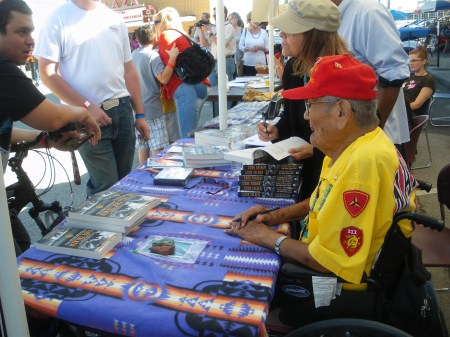
Chester Nez told his story, for all the Code Talkers, often.  I last met him in 2012, when he was in Carrollton, Texas, telling the story and selling his books.

Navajo Code Talker, Marine Chester Nez, signing copies of his book, Carrollton, Texas Oct 14 2012

Navajo Code Talker, Marine Cpl. Chester Nez, signing copies of his book Code Talkers, in  Carrollton, Texas, October 14, 2012


Does “Twitchy” really just mean “knee jerk?” Correcting the record, deflecting the hoaxes, propaganda and Mau-Mauing about Rachel Carson and DDT

June 1, 2014

Or is there any “knee” in that at all? Maybe it’s just jerk.

You know the drill. Someone says something nice about Rachel Carson’s great work. Someone on the right can’t stand that a scientist gets spoken of well, comes unglued, and spills every lie about Rachel Carson anyone can find, including the big lie, that “millions of kids died unnecessarily because DDT was banned because Rachel Carson lied about DDT, which is really a lot like sugar water to humans and all other living things.”

For the record, each of those claims is false; in reverse order:

  1. DDT is toxic to almost all living things, a long-lived and potent poison (which is why DDT was used to kill harmful insects and other vermin). While bed bugs and mosquitoes have evolved resistance and total immunity to the stuff, few other creatures have.
  2. Rachel Carson told all the truth about DDT that was known at the timeHer accuracy was confirmed by a panel of the nation’s top scientists, who reviewed her work for errors, and federal policy for usefulness and safety.  Since the 1962 publication of Silent Spring, and since Carson’s untimely death from cancer in 1964, we’ve learned that DDT is a carcinogen (though, we hope, a weak one); we’ve learned that DDT is an endocrine disruptor that fouls up sex organs and sexual maturity in more animals than anyone can count, including humans; and we’ve learned that  DDT causes birds to lay eggs with shells so thin the chicks cannot survive, even if the DDT doesn’t kill the chick outright.
  3. Carson didn’t urge a ban on DDT, nor did it happen until eight years after her death.  As I explain below, Carson fought to stop DDT abuses, to preserve DDT’s utility in the fight against disease.  She lost that fight, and as a resul tof DDT abuse by DDT advocates, the World Health Organization (WHO) had to scrap it’s ambitious program to eradicate malaria from the Earth — just as the campaign got to tropical areas of Africa.  DDT was banned for crops in the U.S. (health uses have never been banned here), after two different federal courts ordered EPA to do something because under the existing law they’d be required to ban DDT completely if EPA didn’t act, and after a rather adversary administrative law hearing that lasted nine months, featured testimony and document submissions from more than 30 DDT manufacturers, and compiled a record of DDT’s benefits and harms nearly 10,000 pages long.  It was science that got DDT banned, not Rachel Carson’s great writing.
  4. Almost every year since EPA banned DDT use on crops in the U.S., worldwide malaria deaths dropped, from peak-DDT use years (circa 1958-1963) levels of approximately 4 million deaths per year, to 2013’s approximately 627,000 deaths.  It’s unfair and grotesquely inaccurate to claim a reduction in deaths of about 84% is, instead, an increase.  Malaria was not close to eradication in 1965 when WHO stopped its campaign on the ground, nor in 1969 when WHO officially abandoned eradication as a goal, nor in 1972 when the U.S. banned DDT use in the U.S., and dedicated all U.S. production of DDT to export, mostly for fighting insects that cause disease.

In short, Rachel Carson is exactly as the history books present her, a very good scientist with a special gift for communicating science issues.

That’s exactly the stuff that galls the hell out of self-proclaimed conservatives, especially those who know they are the smartest person in any room, even an internet chat room with a few million people in it.  Say something good about a scientist, and they know that statement must be false, and what’s more  “. . .  let’s see, there should be something bad about this guy on Google . . . um, yeah . . . yessss! here, Lyndon Larouche’s magazine has some guy I’ve never heard of, but he’s smarter than any librul because he agrees with my bias! Take THAT you scurvy dog!”  And in short order they’ve scooped up all five or six nuts who said bad stuff about Rachel Carson and cross-cited each other, and they’ve copied the links to the three articles on the internet that obscure groups like CEI and AEI and Heritage have paid to raise in the Google searches, and . . .

Done deal.  “Good scientist!  Heh! No one will listen to old Rachel Carson any more!”

Unless good people stand up to the reputation lynch mobs, and stop them.  That’s why I’m telling you, so you’ll have the stuff you need to stand up.  I’m hoping you will stand up.

Shortly after dawn on May 27, Twitchy rose out of the mucky water and lobbed some mud balls at Google and especially Rachel Carson.  Twitchy is an interesting site.  It’s mostly composed of Tweets that support conservative causes and are snarky enough earn a snicker.  In short, there is no fact checking, and biases are preferred — whatever is the imagined conservative bias of the day (oddly enough, never is conservation of soil, water, nor human life ever a conservative-enough issue . . . but I digress).

It’s the nervous twitch of a knee-jerk mind and knee-jerk political mentality.

Twitchy opened up with a straightforward salvo from IowaHawk.

Note that, above, and again below, WHO records show that there were no “millions of malaria victims” of Rachel Carson.  IowaHawk, David Burge,  assumes — without a whit of real information — that DDT was the key to beating malaria, and so after the EPA ban on DDT, malaria must have risen, and so there must have been millions who died unnecessarily. Challenge the guy to put evidence to any part of that chain, and he’ll demur, probably suggest you’re mentally defective, and cast aspersions on what he assumes your political stand to be.  Or, he’ll ignore the challenge in hopes everybody will forget.   And another person will retweet Burge’s disinformative bit of propaganda — no facts, but what sounds like a nasty charge at someone who is presumed to be a liberal.  Burge’s erroneous Tweet had 504 retweets when I wrote this on June 1, great impact.

Eh. Truth wins in a fair fight, Ben Franklin said.  [I’m pretty sure it was Franklin; I’m still sourcing it, and if you have a correction, let me know!]

At length, more people chime in . . . and the level of misinformation in that discourse makes me crazy.

Occasionally I’ll drop in a correction, often a link to contrary information.  Then the abuse is astonishing. This conservative “hate information” machine is ugly.

CDC image of a child sleeping under an insecticide treated bednet (ITN) to prevent bites from malaria-carrying mosquitoes.

CDC image and caption: How do insecticide-treated nets work? People sleep under ITNs during the time when the mosquitoes that spread malaria like to feed. The insecticide on the nets helps reduce the numbers of mosquitoes that enter the house and works to kill the ones that do enter. In this way, the ITN protects the person or people sleeping under the net. If large numbers of people in the community sleep under an ITN, the numbers of mosquitoes, as well as their lifespan, will be reduced. When this happens, all members of the community receive some protection, whether or not they own or use an ITN.

From the Wellcome Trust malaria page, an explanation for why it's so important to stop bites in the home, at night, and why it's generally not necessary to kill mosquitoes out of doors, in daylight.

[Image link failed] From the Wellcome Trust malaria page, an explanation for why it’s so important to stop bites in the home, at night, and why it’s generally not necessary to kill mosquitoes out of doors, in daylight.

Sometimes I unload.  I was on hold for a more than an hour on a couple of phone calls that day.  Some guy working the handle OmaJohn took great exception to something I said — I think his complaint was that thought I knew what I was talking about — and of course, he knew better!  How dare I refer to facts!

Here’s my response.  I think OmaJohn may have gotten the message, or rethought the thing.

But others haven’t.

I list his statements, indented; my responses are not indented.  Links will be added as I can.  All images are added here.

Rachel Carson is still right, still a great scientist and an amazing writer.  DDT is still poisonous, still banned for agricultural use in the U.S., and still not the answer to “how do we beat malaria.”

OmaJohn said (double indent), and I responded (single indent):

Always with the crow’s lofty view to try and cherry-pick facts to paint a valid conclusion.

I wouldn’t know, Mr. Corvus. I’ve been looking at DDT professionally for science and policy, and as a hobby, and for law and history courses, for more than 30 years. I’m rather drowning in studies and statistics. A crow might be able to find some information that contradicts Rachel Carson’s writings and EPA’s rulings — but it’s not evident in this data ocean. You see some of those cherries? Do they outweigh the ocean they float in?

I do like how you use blogs to justify your condescension, though. [He complaining that I offered links to answers here, at this blog; how brazenly wrong of me to study an issue!]

I think your denigration of people who actually study a subject is ill-advised behavior. Research papers are printed on paper, just like comic books. It’s up to us to use the information to form cogent ideas about history, science, and make good policy as a result. The blogs I cite are often written by experts in the field — see especially Bug Girl, Tim Lambert and John Quiggen — and they most often provide links to the original sources.

(I gather you didn’t bother to read to see what was actually there. Your loss.)

I don’t like what appears to be your view that your non-informed opinion of something you really know little about is as valid as the work of people who devote their lives to getting the facts right. In the long run, your life depends on their winning that game, and always has.

Without having read a lot, I took a gander at a few of the folks ‘on the other side’ on this, and I was Jack’s complete lack of surprise to see you in here with your head high, throwing around blog references and talking down to people.

Much as you are talking down to me, from your position has head muckraker? I see.

I’m not sure what you mean by “folks on the other side.” If you mean on the other side of Rachel Carson, please note that in 52 years not a single science source she listed has ever been found to be in error, or fading as a result of changing science. Discover Magazine took a look at this issue in 2007, concluding Carson was right, and DDT use should be restricted as it was then and remains. The author wrote this, about claims that Carson erred on damage to birds from DDT:

In fact, Carson may have underestimated the impact of DDT on birds, says Michael Fry, an avian toxicologist and director of the American Bird Conservancy’s pesticides and birds program. She was not aware that DDT—or rather its metabolite, DDE—causes eggshell thinning because the data were not published until the late 1960s and early 1970s. It was eggshell thinning that devastated fish-eating birds and birds of prey, says Fry, and this effect is well documented in a report (pdf) on DDT published in 2002 by the Department of Health and Human Services’ Agency for Toxic Substances and Disease Registry (ATSDR). The report, which cites over 1,000 references, also describes how DDT and its breakdown products accumulate in the tissues of animals high up on terrestrial and aquatic food chains—a process that induced reproductive and neurological defects in birds and fish.

Don’t take my word for it. Go read for yourself. Check out PubMed, and read the first 50 citations you find on DDT and birds, the first 20 on DDT and human health, the first 50 on DDT and malaria. Check out the recent good books on the issue — William Souder’s great biography of Carson last year, On a Farther Shore, or Sonia Shah’s wonderful biography of malaria, [The Fever, How malaria has ruled humankind for 500,000 years].

Get real facts, in other words. Don’t talk down to people who might know what they’re talking about.

You wrote:

DDT use was officially stopped in most countries (perhaps all, I’ve not read anything I’d tout as even remotely conclusive, but I’ve not spent a substantial amount of time on this issue), but quickly (within a decade) was brought back to common use.

You should compost that, but it’s too green to do anything but foul things up indoors, here.

DDT was banned first in Sweden in 1971, then in the U.S. in 1972 — the U.S. ban was on crop use, only. About the only use that actually fell under that ban was cotton crops.

A few other European nations banned DDT.

DDT has never been banned in China, India, nor most of Asia, nor in any nation in Africa. Some African nations stopped using it when it stopped being effective; some African nations stopped using it when DDT runoff killed off food fishes and several thousands starved to death.

The World Health Organization never stopped using DDT, though its dramatic decline in effectiveness, especially in Africa, was key to the collapse and abandonment of WHO’s campaign to eradicate malaria. WHO stopped that campaign in 1965, and officially killed it off at the 1969 WHO meetings. You’ll note that was years before the 1972 ban in the U.S. — so the claims that the U.S. ban prompted a WHO to act is also false just on calendar terms.

If you check with the Wellcome Trust, they have several papers and PowerPoint presentations on the problems with malaria in Mexico, Central and South America — where DDT has been used constantly since 1948, with no ban. Unfortunately, malaria came back. Resistance to DDT in mosquitoes is real, and if malaria is not cured in the humans while the populations are temporarily knocked down, when the mosquitoes come back, they will find those humans with malaria, withdraw some of the parasites from that human, incubate them to the next part of the life cycle, and start a plague within a couple of weeks.

So, no, DDT was never banned in most places. There is a treaty, the Persistent Organic Pollutants Treaty (POPs), which names DDT as one of the dirtiest pollutants in the world. Though every other pollutant on the list is severely restricted or completely banned, DDT has a special carve out (Addenda D, if I recall correctly) which says DDT may be used by any nation to fight any vector-borne disease.

All a nation need do is send a letter to WHO explaining that it plans to use DDT, and when.

And, no, DDT was not brought back in haste to make up for a lack of the stuff.

Not sure where you’re getting your history, but it’s not exactly square with what’s happened.

That’s a pretty huge, expensive policy shift — twice.

Would have been, had it been done as you described. Not so.

There was a lot of pressure to make those changes.

So in the fight on Malaria, I think that scientists and bureaucrats generally agree that DDT plays an important role, particularly after seriously slowing or stopping use for a substantial amount of time.

Read the POPs treaty — go to the WHO site and you can still get some of the deliberative papers.

For almost all uses, DDT has much better alternatives available today.

Malaria is a special case because humans screwed up the eradication campaign, first, by abusing DDT and creating DDT resistance in the mosquitoes, and second, by completely abandoning most other parts of the program when DDT crapped out.

DDT doesn’t cure malaria. All it does is temporarily knock down the mosquitoes that carry the parasite through part of its life cycle. Better medical care is a very important part of beating the disease, and as in the U.S., improving housing cuts malaria rates dramatically, especially with windows that are screened roughly from sundown to early morning.

DDT is one of 12 chemicals WHO approves for use in Indoor Residual Spraying (IRS), in areas where there are outbreaks of the disease. If any one chemical were used alone, it would be ineffective within months, or weeks.

When tobacco farmers in Uganda sued to stop DDT spraying in the early years of the 21st century, WHO issued a press release saying it still believes in DDT. Well, WHO always did. But as of 2010, DDT’s effectiveness is even less, and many nations use only the other 11 chemicals for IRS against malaria.

DDT is still there, if it works, and if it helps; bednets alone are more than double the effectiveness of DDT in preventing malaria. We could probably phase out DDT completely without anyone noticing. DDT is not a panacea. There is no shortage of DDT anywhere today. No one dies for a lack of DDT — though many may die from a lack of bednets or appropriate medical care, problems DDT cannot touch

I believe that Rachel Carson championed her cause very successfully. I believe there was sizeable, if not perfectly tangible, fallout that would only be measurable in human livesand misery thanks to her efforts. And in the end, things were as they should have been, despite her best efforts to force them where they
shouldn’t be.

I see. You don’t know what Rachel Carson said about DDT.

Carson said that DDT was — in 1962 — a pesticide without a clear replacement. She said it was absolutely critical to the then-existing WHO campaign to fight malaria.

And because of that, she urged that use of DDT on crops, or to kill cockroaches, or to kill flies at picnic sites, be stopped — because unless it were stopped, the overuse could not fail to leak into the rest of the ecosystem. Mosquitoes would quickly develop resistance to DDT — that had been a key problem in Greece in 1948, and Carson cites several other places where anti-typhus and anti-malaria campaigns were scuttled when the insects started eating DDT — and once that resistance developed, Carson said, beating malaria would be set back decades at a minimum, and maybe centuries.

She wrote that in 1962.

Fred Soper was the super mosquito fighter in the employ of the Rockefeller Foundation who developed the DDT-based malaria eradication program. He was loaned to WHO to take the campaign worldwide. Soper thought Carson was too tough on DDT in her book, but he had already calculated that DDT resistance would develop by 1975. He had just more than a dozen years to eliminate malaria, he wrote. (This is chronicled in Malcom McDowell’s 2001 profile of Soper in The New Yorker; you can read it at McDowell’s website.)

WHO’s campaign had mopped up pockets of malaria left in temperate zone nations; he had massive successes in sub-tropical nations, and he was poised to strike at the heart of malaria country, in equatorial Africa, in 1963.

The first campaign launched there fizzled completely. When they captured some mosquitoes, they found the mosquitoes were highly resistant to DDT already. Turns out that farmers in Africa wanted spotless fruit, too, and were using tons of DDT to get it.

For the health workers, what that meant was they had no tool at all to knock down mosquitoes even temporarily, to then finish the medical care, housing improvement and education components of the malaria eradication campaign.

It is also true that many of those nations had unstable governments. Soper’s formula required that 80% of the homes in an affected area be treated. That required highly trained, very devoted workers, and a willing population. Those things were difficult to find in nations with unstable governments, or worse, civil war. So there were other complicating factors. But Soper had faced those, and beaten them, behind the Iron Curtain, in Asia, in the Pacific and in South America.

When DDT quit on him, as Carson predicted it would without official action to save its potency, Soper called it quits.

Soper ended his campaign without approaching most of equatorial Africa in 1965. WHO officially ended the program in 1969.

Carson died in 1964. She would have been saddened that DDT stopped working in the malaria fight so early. She had written about it occurring in some future year — she probably knew of Soper’s calculation in the 1970s.

The public relations smear campaign against Carson, costing the chemical companies $500,000, generated some doubt among the public, but the President’s Science Advisory Council published its report saying Carson was accurate on the science, and calling for immediate action against DDT — in 1963.

It was 7 years after her death that EPA was organized, and 8 years before EPA moved against DDT.

Carson pleaded for a dramatic reduction in unnecessary DDT use — to make spotless apples, for example — in order to save people from malaria.

What did you think she said? What things were back where they should have been — poor kids dying of malaria is as it should be?

We could have done better, had we listened to Rachel Carson in 1962.

You’ve offered nothing that logically refutes those conclusions.

You should have read those blogs.

More:

  • David Burge, Iowahawk, whose post started the Twitchy twitches, several years ago revealed that a young boy his family had been sponsoring in Africa through a private charity, had died from malaria.  Death from malaria is a tragic reality.  Burge urged people to speak out for more DDT, and to donate money to Africa Fighting Malaria.  Readers of my blog may recall that AFM is the astro-turf organization founded by Roger Bate years ago, from all appearance to pay Roger Bate to say nasty things about Rachel Carson.  We could find on their IRS 990 form no evidence that the organization does anything to fight malaria, anywhere.  One might wonder how much anti-malaria activity Roger Bate’s $100,000/year salary would have purchased, in any of the several years he headed the non-help group, or since.  Adding insult to tragedy, Burge noted at his blog that “environmental groups” opposed Indoor Residual Spraying in Africa, and especially the use of DDT.  But it turns out that the chief opposition at that time came from tobacco growers and tobacco organizations — the groups from whom Roger Bate solicited money to start up AFM.  Wouldn’t it be easier just to stick with the facts?
  • If you want to do something, to save a life from malaria, send $10 to Nothing But Nets.  In stark contrast to AFM, NbN sends almost all its money to buy bednets to give away to people in malaria-endemic areas of Africa.  While AFM ridicules nets, they are much more effective at preventing malaria than IRS, especially IRS with DDT alone.  Nets are much cheaper, too.  NbN acts in partnership with the NBA and the United Methodist Church in the United States, and is one of the most upstanding charities anywhere.  They do not say nasty things about Rachel Carson — probably wouldn’t if they thought to, because they are so busy fighting malaria.

Yes, malaria is still a plague; it’s not Rachel Carson’s fault, and your saying so probably kills kids

May 30, 2014

May 27’s Google Doodle honoring Rachel Carson brought out a lot of those people who have been duped by the anti-Rachel Carson hoaxers, people who are just sure their own biased views of science and the politics of medical care in the third world are right, and Carson, and the people who study those issues, are not.

So comes “The Federalist,” what appears to me to be a reactionary site, which yesterday got great readership for a story from Bethany Mandel.  Mandel tells a story of a child in Cambodia suffering from malaria.  The suffering is horrible and the child most likely died.  It’s a tragic story of poverty and lack of medical care in the third world.

Erroneously, Mandel up front blames the suffering all on Rachel Carson, in a carp about the Google Doodle.

Here was my quick response between bouts in the dentist’s chair yesterday [links added here]:

[Bethany Mandel wrote:] Using faulty science, Carson’s book argued that DDT could be deadly for birds and, thus, should be banned. Incredibly and tragically, her recommendations were taken at face value and soon the cheap and effective chemical was discontinued, not only in the United States but also abroad. Environmentalists were able to pressure USAID, foreign governments, and companies into using less effective means for their anti-malaria efforts. And so the world saw a rise in malaria deaths.

Don’t be evil?

Start by not telling false tales.

1.  Carson presented a plethora of evidence that DDT kills birds.  This science was solid, and still is.

2.  Carson did not argue DDT should be banned.  She said it was necessary to fight disease, and consequently uses in the wild, requiring broadcast spraying, should be halted immediately.

3.  Scientific evidence against DDT mounted up quickly; under US law, two federal courts determined DDT was illegal under the Federal Insecticide, Fungicide, and Rodenticide Act; they stayed orders to ban the chemical pending hearings under a new procedure at the new Environmental Protection Agency.

EPA held hearings, adversary proceedings, for nine months. More than 30 DDT manufacturers were party to the hearings, presenting evidence totaling nearly 10,000 pages.  EPA’s administrative law judge ruled that, though DDT was deadly to insects, arachnids, fish, amphibians, reptiles, birds and mammals, the labeled uses proposed in a new label (substituted at the last moment) were legal under FIFRA — indoor use only, and only where public health was concerned.  This labeling would allow DDT to remain on sale, over the counter, with few penalties for anyone who did not follow the label.  EPA took the label requirements, and issued them as a regulation, which would prevent sales for any off-label uses.  Understanding that this would be a severe blow to U.S. DDT makers, EPA ordered U.S. manufacture could continue, for the export markets — fighting mosquitoes and malaria being the largest export use.

This ruling was appealed to federal courts twice; in both cases the courts ruled EPA had ample scientific evidence for its rule.  Under U.S. law, federal agencies may not set rules without supporting evidence.

4.  DDT was banned ONLY for agriculture use in the U.S.  It was banned in a few European nations.  [Addition, December 30, 2014: In fact, the U.S. action against DDT by EPA specifically called for DDT use in any fight against a vector borne disease, like malaria.]

5.  DDT has never been banned in Africa or Asia.

6.  USAID’s policy encouraged other nations to use U.S.-made DDT, consistent with federal policy to allow manufacture for export, for the benefit of U.S. business.

7.  U.S. exports flooded markets with DDT, generally decreasing the price.

Fred Soper, super malaria fighter, whose ambitious campaign to erase malaria from the Earth had to be halted in 1965, before completion, when DDT abuse bred mosquitoes resistant and immune to DDT.

Fred Soper, super malaria fighter, whose ambitious campaign to erase malaria from the Earth had to be halted in 1965, before completion, when DDT abuse bred mosquitoes resistant and immune to DDT.

8.  Although WHO had been forced to end its malaria eradication operation in 1965, because DDT abuse had bred mosquitoes resistant to and immune to DDT, and though national and international campaigns against malaria largely languished without adequate government funding, malaria incidence and malaria deaths declined.  Especially after 1972, malaria continued a year-over-year decline with few exceptions.

Note that the WHO campaign ended in 1965 (officially abandoned by WHO officials in 1969), years before the U.S. ban on DDT.

Every statement about DDT in that paragraph of [Mandel’s] article, is wrong.

Most important, to the purpose of this essay, malaria did not increase.  Malaria infections decreased, and malaria deaths decreased.

I’m sure there are other parts of the story that are not false in every particular.  But this article tries to make a case against science, against environmental care — and the premise of the case is exactly wrong.  A good conclusion is unlikely to follow.

Mandel was hammered by the full force of the anti-Rachel Carson hoaxers.  I wonder how many children will die because people thought, “Hey, all we have to do is kill Rachel Carson to fix malaria,” and so went off searching for a gun and a bullet?

You are not among them, are you?

Update: This guy, a worshipper of the Breitbart, seems to be among those who’d rather rail against a good scientist than lift a finger to save a kid from malaria. If you go there, Dear Reader, be alert that he uses the Joe Stalin method of comment moderation:  Whatever you say, he won’t allow it to be posted.  Feel free to leave comments here, where we practice First Amendment-style ethics on discussion.