Rachel Carson, star of Google Doodle on her 107th birthday

May 27, 2014

Have you been to Google today for a general search?  Did you catch the Doodle?

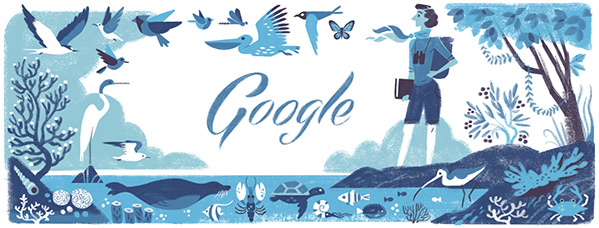
Google Doodle for May 27, 2014, honors scientist and writer Rachel Carson on what would have been her 107th birthday.

Google Doodle for May 27, 2014, honors scientist and writer Rachel Carson on what would have been her 107th birthday.

Perhaps even more remarkable, if you click the Doodle (any Doodle) it takes you to a Google search on that subject.  The search you get today is all positive about Carson.  Considering the money being spent to soil her reputation, 50 years after her death, one might wonder if Google adjusted the search or the algorithm for the results to do that.

If they monkeyed with it, give them bonus points for accuracy and thoroughness.

If they didn’t monkey with it, take great hope that Ben Franklin was right, and truth does indeed win in a fair fight.

Here’s page 1 of the search result I got (not an image, so the links stay hot for you):

Rachel Carson – Wikipedia, the free encyclopedia

en.wikipedia.org/wiki/Rachel_Carson

Wikipedia

Rachel Louise Carson (May 27, 1907 – April 14, 1964) was an American marine biologist and conservationist whose book Silent Spring and other writings are …


    1. The Independent ‎- by Linda Sharkey ‎- 3 hours ago
      Tomorrow marks the 107th anniversary of the birth of Rachel Louise Carson, the environmentalist whose research led to the banning of harmful …

    More news for Rachel Louise Carson


Rachel Carson left a great and powerful legacy.  52 years after the publication of her most important, most read, and most criticized book, not a single piece of science she cited has been disproven by subsequent research.  Discover Magazine did a literature search some years ago and found more than 1,000  research projects had been done on DDT’s harm to birds, and every one that was published came back to support the claims Carson had made.

Apart from her extreme care for the science and great accuracy, Carson’s words today can still inspire.  She was a helluva writer.  Carson made clear that biological research in the wild is really ecology.  Today more than ever before range botanists and zoologists, to take one example, work closely with each other, and with geneticists, molecular biologists, entomologists, chemists, physicists, climatologists, geologists and geographers, and anyone else who wants to chime in, to present clear understandings the ripple effects damage or benefit to one species may have on many others.

Before Rachel Carson, any graduate study programs in ecology were few and far between, often not even called ecology.

Those methods help to save birds, and also every other form of life on the planet.

Blinded, angry and malicious opposition to the facts Carson laid out, and later scientists still lay out, remains the bigger problem.

Chemical manufacturers spent more than $500,000 in 1962 to smear Carson and her work.  The smears largely did not work, instead forcing scientists to look at her work (which they found solid in science).  But since then, tobacco companies with the Tobacco Institute, perfected the techniques of raising doubts about good science among policymakers and the public.  Today companies spend billions to impugn scientific works in climate change, air and water pollution, and health care.  They are joined by an unpaid mob of internet-savvy malcontents to impugn the integrity of the U.S. space program, vaccinations, and even meteorologists who note that airplane exhaust creates condensation trails at high altitudes. (Yes, it’s water vapor.)

This blog’s seeming obsession with Carson was prompted by such an exquisite act of denialism in Congress, seven years ago, when I learned that Utah Congressman Rob Bishop was bragging about blocking the naming of a post office for Carson, based on false claims that Carson had written false or faulty science, that the U.S. ban on DDT use on crops had extended far outside the jurisdiction of the U.S., and that a shortage of DDT meant malaria had come roaring back from near extinction to unnecessarily kill millions. (The post office was eventually named for Carson, but Bishop and other deluded critics have never repented nor apologized.)

(The facts:  Malaria deaths and infection rates both continued to drop, worldwide, after the U.S. stopped spraying DDT on cotton. Many tens of millions fewer people died of malaria after the U.S. banned it.  The U.S. ban covered only the U.S., but let DDT makers keep cranking the stuff out for export, multiplying the amount of DDT available to fight malaria.  Unfortunately, as Carson feared, abuse of DDT in the third world quickly created DDT-resistant and immune mosquitoes; in 1965, the World Health Organization abandoned its malaria eradication campaign because of DDT’s declining effectiveness, a full seven years before the U.S. banned DDT.)

Truth wins in a fair fight, Ben; but as in colonial America, it is necessary for brave citizens to work hard to keep the fight fair.

Because of Rachel Carson, the bald eagle is off the endangered species list, and proliferating in the lower 48 states of the U.S. — as indeed are the peregrine falcon, osprey, and brown pelicans.  DDT continues to hammer many creatures in the wild, however, including the still-endangered  California condor.  Our national policies now require, by law, that significant federal projects consider the environmental effects of those actions, and mitigate the more severe effects or not proceed.  The U.S. now has an agency whose sole job is to consider the safety of chemicals and substances we use in the wild, with power to regulate air and water cleanups — and to clean up more than 400 DDT-contaminated sites on the EPA Priority List, or Superfund.  Among the great successes of this agency was the elimination of lead from gasoline in the U.S., reducing chronic lead poisoning in tens of millions of Americans, and literally raising the national average IQ with elimination of the brain-killing effects of lead.  Lake Erie is cleaner.  The Potomac River, though with its problems, is once again clean enough for humans to swim and boat, as are a hundred other waterways in America, from the Raritan River in New Jersey to the Willamette in Oregon.

Very powerful legacy indeed.

Happy birthday, Rachel Carson; Earth is lucky to have had you, even for such a brief period.

More: 


Memorial Day 2014: Fly your flag, with proper etiquette

May 26, 2014

Caption from Wikipedia:  Pearl Harbor, Hawaii (May 31, 2004) - Sailors assigned to ships based at Pearl Harbor bring the flag to half-mast over the USS Utah Memorial on Ford Island in honor of Memorial Day May 31, 2004. U.S. Navy photo

Caption from Wikipedia: Pearl Harbor, Hawaii (May 31, 2004) – Sailors assigned to ships based at Pearl Harbor bring the flag to half-mast over the USS Utah Memorial on Ford Island in honor of Memorial Day May 31, 2004. U.S. Navy photo

Monday, May 26, 2014, is Memorial Day in the U.S.  It’s the day we honor soldiers who died, either fighting to defend the nation, or after.

Because it honors the dead, the flag-flying rules differ slightly.

If you’re flying your flag from a staff that allows raising and lowering, the flag should be posted at half-staff in the morning at sunrise.  At noon, the flag goes to full-staff position.

Usual flag-raising rules apply: Going up the staff, the flag rises briskly.  Coming down, it sinks slowly.

Before going to the half-staff position to honor the dead, the flag should be raised briskly to the top of the pole, and then brought down slowly to half-staff. At noon, again, the flag rises briskly.  And at retreat, at sundown, the flag comes down slowly.

Most Americans have a flag that attaches to the wall of a residence, or in other ways is not capable of raising and lowering.  In that case, simply post the the flag.

More: 


U.S. spends $38 billion on foreign aid? (Not nearly enough)

May 22, 2014

Glenn Beck got all worked up over this chart, as if it revealed some great, cardinal sin:

Chart on foreign aid as a part of the U.S. budget, from http://www.financedegreecenter.com/foreign-aid/

Chart on foreign aid as a part of the U.S. budget, from http://www.financedegreecenter.com/foreign-aid/

FinanceDegreeCenter.com is a mysterious organization that does no-one-really-will-say what on the internet.  A few months ago I got a series of e-mails from the group, telling that they were changing their name from an earlier iteration and claiming my links to one of their charts jeopardized all the good work they did for people seeking higher education, merely by accurately citing where I got the chart.  That sounded fishy, so I asked them what they did, really, and I got a barrage of e-mails . . .

I think they get paid to steer people to for-profit, on-line schools.  That doesn’t mean their charts are inaccurate, though it does mean I don’t post them without a lot of checking first (this is the first one I’ve posted since then).

Which is a long way of saying, Beck sure has crumby sources.

Bad as the source may be, the information isn’t far off.  But there’s the problem.

Beck’s audience probably believes, as Beck has told them, that the U.S. pays way too much in foreign aid.  Polls repeatedly show most people think we spend anywhere from ten times to a hundred times what we do.  A great little article with charts at the Washington Post explained:

The poll result that seems to most frustrate budget analysts is the apparent belief among Americans that foreign aid is a huge cost to the federal government. The latest poll that my colleague Ezra Klein cites finds that the average American thinks the United States spends 28 percent of the federal budget on aid to foreign governments — more than the country spends on Social Security or Medicare or defense.

In reality, we spend only 1 percent on foreign aid.

This gap between perception and reality is ridiculously large. That’s depressing, but it also presents an opportunity. The case that 28 percent of the budget should go to foreign aid is very strong. And if Americans already think we give that much — well, the least we could do is accommodate them!

We don’t spend enough.  Yes, we spend $38 billion.  That’s less than 1% of total U.S. outlays, and it’s been declining as a share of our Gross National Income and Gross Domestic Product since 1960.

Glenn Beck gets outraged, and shouts away, “$38 billion,” hoping that his shouting will make the number appear larger than it is.  He thinks, and says, it’s too much.

$38 billion?  Less than 1% of the budget.  Less than one penny of every dollar.

As a nation, the U.S. does not spend enough on foreign aid.  We should spend more.

Think of the good that could be done, if our nation actually did increase foreign aid to equal 25% of the federal budget (without taking it out of the hides of poverty-struck, homeless newborn babies and baby ducks as GOP legislators would insist).  How would the world be different?

More, and resources: 


Free land! May 20, 1862, the Homestead Act remade America

May 20, 2014

A family off to find and settle their homestead, 1886. Photo from the National Archives

A family off to find and settle their homestead, 1886. Photo from the National Archives

History and demographics of the United States were forever changed when the Homestead Act became law early in the administration of President Abraham Lincoln, on May 20, 1862.

With Congress paralyzed and unable to act to do even minor good things now, it’s astonishing to think how the Congress of 1862 could do so much to open the American west, in the middle of the American Civil War.  Perhaps Congress was able to act because legislators from the South were absent, and did not oppose progress.

In any case, the Homestead Act encouraged Americans who lacked property to strike out for the western territories and states, to make a new life, to found new towns, cities and farms, and fulfill what some call the nation’s “manifest destiny.”

The bill that became the Homestead Act, H.R. 125, in the 37th Congress, 1862. Image from the U.S. National Archives

The bill that became the Homestead Act, H.R. 125, in the 37th Congress, 1862. Image from the U.S. National Archives

Here’s the history from the National Archives:

The notion that the United States government should give free land titles to settlers to encourage westward expansion became popular in the 1850s. During that time the U.S. House of Representatives passed numerous homestead bills but southern opposition in the Senate prevented enactment. In 1860, during the 36th Congress, the Senate narrowly passed a homestead act but President James Buchanan vetoed it and the Senate failed its override attempt.

When the 37th Congress convened for its brief summer session in 1861, now without members from seceded states, it was preoccupied with Civil War-related legislation. The House took up briefly the homestead issue in December but postponed further consideration of it until the following February. The House finally passed the Homestead Act on February 28, 1862 by the large margin of 107 to 16. The act worked its way through the Senate until May 6, 1862 when it passed easily by a vote of 33 to 7. After a few minor changes in conference committee—which both houses agreed to without controversy—Congress sent the final legislation to President Abraham Lincoln who signed the act into law on May 20, 1862.

The Homestead Act encouraged western migration by providing settlers with 160 acres of land in exchange for a nominal filing fee. Among its provisions was a five-year requirement of continuous residence before receiving the title to the land and the settlers had to be, or in the process of becoming, U.S. citizens. Through 1986, when the last claim was made in Alaska, the Homestead Act distributed 270 million acres of land in the United States making it arguably one of the most far-reaching pieces of legislation in American history.

More:

Much of this post has appeared at Millard Fillmore’s Bathtub before; the Homestead Act deserves commemoration.


“A day that will live in glory” — Frankfurter to Warren, on Brown v. Board

May 17, 2014

Read the rest of this entry »


Fly your flag May 17, 2014, for Armed Forces Day

May 17, 2014

Poster for Armed Forces Day 2014. Download images, here.

Poster for Armed Forces Day 2014. Download images, here.

Armed Forces Day is the third Saturday in May, May 17th in 2014.

New machines on the poster this year!

See President Obama’s proclamation of Armed Forces Day 2014 here.

A bit of history, as we’ve noted earlier:  After President Truman’s administration brought the management of the armed forces under the umbrella of one agency, the Department of Defense, Truman moved also to unite what had been a separate day of honor for each of the branches of the military, into one week capped by one day for all uniformed defense services.

On August 31, 1949, Secretary of Defense Louis Johnson announced the creation of an Armed Forces Day to replace separate Army, Navy and Air Force Days. The single-day celebration stemmed from the unification of the Armed Forces under one department — the Department of Defense. Each of the military leagues and orders was asked to drop sponsorship of its specific service day in order to celebrate the newly announced Armed Forces Day. The Army, Navy and Air Force leagues adopted the newly formed day. The Marine Corps League declined to drop support for Marine Corps Day but supports Armed Forces Day, too.

In a speech announcing the formation of the day, President Truman “praised the work of the military services at home and across the seas” and said, “it is vital to the security of the nation and to the establishment of a desirable peace.” In an excerpt from the Presidential Proclamation of Feb. 27, 1950, Mr. Truman stated:

Armed Forces Day, Saturday, May 20, 1950, marks the first combined demonstration by America’s defense team of its progress, under the National Security Act, towards the goal of readiness for any eventuality. It is the first parade of preparedness by the unified forces of our land, sea, and air defense.

Celebrations like Armed Forces Day offer good opportunities to promote history. I suspect that the day’s coming always in the middle of May suppresses some of the teaching moment value, as teachers make a final push for end of course tests, finals, and in high schools, for graduation — and as many colleges are already out for the summer. Good materials are available that can be sprinkled throughout a course.

Photograph of President Truman and other digni...

President Truman and other dignitaries on the reviewing stand during an Armed Forces Day parade, (left… – NARA – 200222 (Photo credit: Wikipedia) (Is that Eisenhower on the left?)

For example, this list of world-wide events at the first Armed Forces Day, in 1950, gives a good picture of four years into the Cold War, and would make a good warm-up exercise or even an entire lesson, or offer opportunities for projects:

The first Armed Forces Day came at a time of increased world tensions, political volatility and communist aggression. Some notable events that marked America’s first Armed Forces Week were as follows:

  • Bolivian police broke up “alleged” revolutionary communist-led general strike in LaPaz.
  • Two U. S. government buildings in Canton, China were taken over by the Chinese Communist Government. The buildings were U. S. property acquired prior to the Communist takeover.
  • The Burmese Army recaptured the city of Prome, a strategic communist-rebel stronghold.
  • Nicaraguans elect General Anastasio Somoza to a regular six-year term as president.
  • French and West German governments expected to talk shortly on the merger of the coal and steel industries of the two countries.
  • Communist China lifted the ban on daylight shipping along the Yangtze River due to the decline of Nationalist air activity.
  • Norway receives first US military aid in the form of two Dakota planes.
  • U. N. Secretary General Trygive Lie seeks West’s acceptance of Red China in the U. N.
  • Iran announced close range news broadcasts to the Soviet Union with $56,000 worth of Voice of America equipment.
  • Cuba celebrated the 48th anniversary of the establishment of its republic.
  • The Red Cross celebrated its 69th birthday.
  • Britain ended rationing of all foods except meats, butter, margarine, and cooking fat.
  • The U. S. Congress voted to extend the draft. “A Bill to extend registration and classification for the Draft until June 24, 1952 passed the House 216-11.”
  • The Allied Command announced it would “ease” the burden of occupation on Austria and would name civilian high commissioners to replace present military high commissioners.
  • Soviet authorities in Berlin withdrew travel passes of the U.S. and British military missions stationed at Potsdam in the Soviet zone of occupation.
  • The Soviets returned 23 East German industrial plants to East German authorities. The plants had been producing exclusively for the benefit of reparations to the USSR.
  • Twenty-eight Soviet vessels, consisting of tugs, trawlers, and supply ships remained in the English Channel as the Western Alliance prepared for air and naval maneuvers. Observers noted that many of them carried rollers at their sterns for trawling nets although no nets were visible.
  • Pravda denounced Armed Forces Day, calling it the militarization of the United States. “The hysterical speeches of the warmongers again show the timeliness of the appeal of the Permanent Committee of Peace Partisans that atomic weapons be forbidden.”
  • Western Powers renewed their promise to help Mid-Eastern states resist communism. They also announced an agreement to sell arms to Israel as well as to the Arabs.

Veterans Day honors veterans of wars, and those who served in the past; Memorial Day honors people who died defending the nation; Armed Forces Day honors those men and women serving today.  Service with two wars, in an “all volunteer” military, is a rough go, especially in times of federal budget cuts.  Say a good word about active duty military on Saturday, will you?

Armed Forces Day 1952, DOD Archives photo

A photo from Defense archives, of Armed Forces Day 1952 — also on May 17; DOD caption: QUOTING BENJAMIN FRANKLIN – Servicemen and women comprise this poster, which features cautionary words of Benjamin Franklin. (AFD-1952) [Franklin quote:  Let us beware of being lulled into a dangerous security, and of being weakened by internal contentions and divisions . . . of neglect in military exercises and discipline, and in providing stores of arms and munitions of war, for . . . the expenses required to prevent war are much lighter than those that will, if not prevented, be necessary to maintain it.  Benjamin Franklin, 1784.  Franklin’s words were in a letter to Charles Thomson, the Secretary of the 2nd Continental Congress, on May 13, 1784, written from his station in Passy, France.]

More:


Guns to protect against U.S. government? Constitution doesn’t protect that

May 16, 2014

Today, May 16, 2014, a group of yahoos promises 10 million armed Americans will descend on Washington to force changes in government, maybe depose the President, and have other yahoo fun squealing tires, drinking beer, and scaring good folks with the guns they wave.

They’ll be lucky to have a thousand people show up and politely decline to run afoul of the District of Columbia’s gun laws and the concomitant prison time.

If they stay out of jail, it won’t be because the Constitution protects them.

Yes, the Second Amendment says they have — and you and I have — a right to “keep and bear arms.”

Yahoos, true to their yahoo ways, really don’t read the Constitution thoroughly.  Otherwise, I suspect they’d be more circumspect.

Article III, Section 3, of the Constitution defines using those arms against the government, levying war against the U.S., as “treason.”

Treason against the United States, shall consist only in levying war against them, or in adhering to their enemies, giving them aid and comfort. No person shall be convicted of treason unless on the testimony of two witnesses to the same overt act, or on confession in open court.

Neither the First Amendment nor the Second Amendment excuses treason.

How will today turn out in Washington?  There may be some traffic tie-ups.  There always are. Anything out of the ordinary, though?  Not if citizens use common sense, and stick to the Constitution that protects their protests.

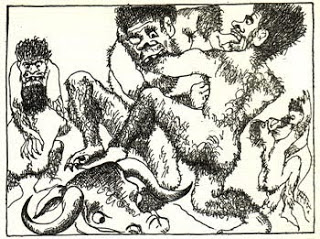
Yahoos, in one of their nicer portrayals from the 1947 edition of Gulliver's Travels.  Image from Wordmall.

Yahoos, in one of their nicer portrayals from the 1947 Crown edition of Gulliver’s Travels; drawing by Luis Quintanilla. Image from Wordmall.

Update:  As of Friday afternoon, the rally fizzled.  Organizers blamed the rain.  Proof that rain falls on the unjust, too?

More:


Bob Reitz remembers Dallas — this afternoon!

May 10, 2014

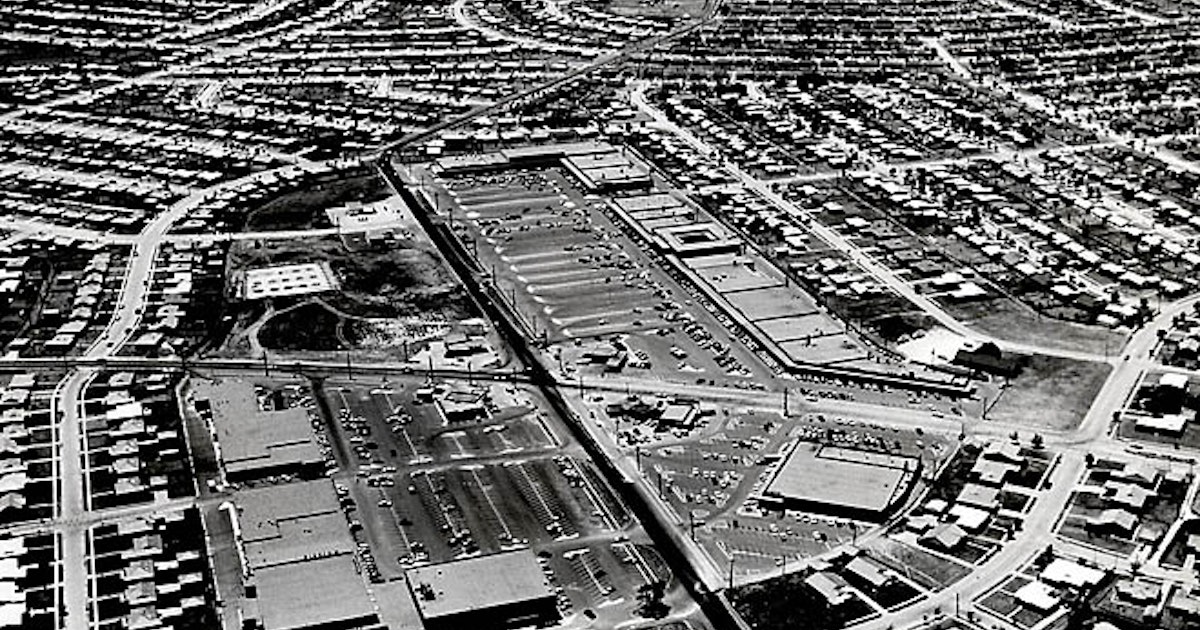
Caption from the Dallas Morning News blogs:  This aerial photo shows the Casa View shopping village and the surrounding area in 1957, three years after Bob Reitz moved into the neighborhood with his family at age 7. Reitz is presenting a talk titled

Caption from the Dallas Morning News blogs: This aerial photo shows the Casa View shopping village and the surrounding area in 1957, three years after Bob Reitz moved into the neighborhood with his family at age 7. Reitz is presenting a talk titled “A Time We Once Shared” from 2 to 4 p.m. Saturday at Dallas’ White Rock Hills Branch Library. File 1957 / Staff Photo

Steve Blow writes columns for the local section of the Dallas Morning News Wednesday he featured one of our veteran Scouters from Wisdom Trail District here in the southwest corner of Dallas County.

Dallas and Scout historian Bob Reitz - Photo by Ed Darrell

Dallas and Scout historian Bob Reitz

Bob Reitz is also the curator of the Jack Harbin Boy Scout Museum at Camp Wisdom, a surprisingly great store of Scout history.  Among many other things he does well, Bob is a historian of great stories.

This afternoon, May 10, he’s telling stories of Dallas in his growing up years in the “middle-middle class” neighborhood of Casa View, east of downtown.  Bob’s got two hours (it will seem like one or less) at the White Rock Hills Branch Library, starting at 2:00 p.m. (9150 Ferguson Rd, 75228 (map))

You ought to go.

Below the fold, Steve Blow’s column, should it disappear from the DMN site.

Read the rest of this entry »


Feynman Day comes Sunday; celebrate with your mother, and fly the flag!

May 9, 2014

No, we’re not joking.

May 11 is the anniversary of the birth of Richard Feynman (born 1918, died 1988).

Richard Feynman

Richard Feynman. Borrowed from Luciano’s Tumblr, LikeaPhysicist

In 2014, his birthday falls on Sunday, Mothers Day.  Mothers Day is one of the designated-by-law days to fly the U.S. flag — so fly your flag!  You can tell your mother it’s for her — but it’s also for Richard Feynman.

Why Feynman Day?  To celebrate invention, physics, interesting characters, and that essential, American quality of je ne sais quoi.

In addition to his winning the Nobel Prize for Quantum Electrodynamics (QED), Feynman popularized the critique of science and other enterprises with what we now call Cargo Cult science, or education, or whatever, where people follow the dance steps, but without the rhythm and music.

Those two things alone would make him a remarkable man.  But, like a product offered for $19.95 as a good buy in a 2:00 a.m. infomercial, with Feynman, there’s more.  With Feynman, there is always more.

I got alerted to Feynman in the first days of the old Quality Paperback Book Club, when they featured his new memoir, Surely You’re Joking, Mr. Feynman!  QPBC was hot on the book, and with a title like that, how could I resist?  When I got the book a week or so later, I read it within two days, while attending law school and working full time.  I remember Feynman.

Norton published the book — and their description, alone, should make you want to read it:

A New York Times bestseller—the outrageous exploits of one of this century’s greatest scientific minds and a legendary American original.

In this phenomenal national bestseller, the Nobel Prize­-winning physicist Richard P. Feynman recounts in his inimitable voice his adventures trading ideas on atomic physics with Einstein and Bohr and ideas on gambling with Nick the Greek, painting a naked female toreador, accompanying a ballet on his bongo drums and much else of an eyebrow-raising and hilarious nature.

All true, and that’s not even the half of the outrageousness, all done with great good humor, about a life lived in great good humor through what should have been a memorable age, but often was just terrifying.

I think sometimes that Feynman’s calm, alone, borne of that great good humor and insatiable curiosity,  may have gotten us through the birth of the atomic age and the Cold War.

Feynman was a giant, and we don’t revere him enough.  Consider:

  • Feynman’s high school sweetheart, Arlene, came down with tuberculosis.  He married her, and took her with him to New Mexico to make the atom bombs.  The stories of her confinement to a hospital, and the laborious trekking he had to make between Los Alamos and her bedside in Santa Fe, are touching, and heartbreaking.  It is one of the great love stories of the 20th century, certainly, and perhaps for all time.  It also provided the title for his second memoir, What Do You Care What Other People Think?
  • Every single, college-age man should read Feynman’s stories of how to date, and how to seduce women.  His approach was unique, and endeared him to women — in legend, to many women.  Feynman’s dating must have been part of the inspiration for the comedy series, “Big Bang Theory.”  Feynman’s stories are better.  (Heck, it’s even the subject of a popular, classic XKCD comic — probably only Feynman and Einstein among Nobel-winning physicists have made so much money for so many cartoonists.)
US postage stamp featuring Richard Feynman

US postage stamp featuring Richard Feynman

  • Yeah, he’s already been featured on a postage stamp, see at right.  That’s not good enough for Feynman, though — the U.S. Postal Service created a special cancellation stamp for Feynman, featuring a version of his Feynman Diagrams.

    A special postal cancel was authorized by the USPS (United States Postal Service) to honor the 80th birthday of Richard Feynman. This cancel was used in Lake Worth, Florida. For this special day the post office was renamed “Feynman Station.”

    Feynman Commemorative Cancel Feynman Diagram

    The Feynman Diagram used for the postal cancel on this envelope depicts what is known as a “bubble process.” It shows a high energy particle, for example, a cosmic ray (a) from a distant supernova, which emits a high energy photon, for example, a gamma ray (b). The photon, in turn, creates a particle (c) and an anti-particle (d) that exists for a brief moment and then recombines.

    As Feynman liked to point out, an anti-particle is the same thing as a particle with negative energy traveling backward in time (which is why the arrow at (d) points backwards, i.e. to the left). So you could say the photon created only one particle that, at first, traveled forward in time (the bottom semi-circle) and then reversed and went back in time (the top semi-circle) and annihilated itself! By inventing diagrams like this, Richard Feynman made it much easier to understand what is going on in the interactions between sub-atomic particles without getting lost in tremendous amounts of tedious math

  • Working at Los Alamos on the Manhattan Project, Feynman developed a keen appreciation for bureaucracy and all its follies.  His vexations for the security managers are also legendary.  Here’s a quick version of one story — he asked friends and family to write to him in code, but to not include a key to the code, so he’d have to crack the code to read the letter.  Feynman could do it, but the security people couldn’t.  Hilarity ensued.
  • Feynman developed a love for the still-relatively unknown, landlocked Asian nation of Tannu Tuva.  It’s just the sort of place to appeal to a character like Feynman — so obscure most atlases didn’t, and don’t, show it at all — seemingly consumed by the Soviet Union, but held in a special status.  Home of throat singing — and almost impossible to get to.  During the Cold War, Feynman struck up correspondence with people in Tuva, to the concern of Soviet and American intelligence agencies, who seemed not to understand someone might do such thing out of curiosity.  Feynman hoped to travel there to visit new friends, but his final bouts of cancer took him before it was possible.  Tuva, famous among philatelists only, perhaps, honored Feynman with postage stamps and postcards.
  • Just try to find a photo of Feynman not smiling. The man was a joy to be around, for most people, most of the time.
  • Quantum electro dynamics?  No, I can’t explain it, either — but his work had a lot to do with how particles wobble.  I remember that because, according to Feynman, he got the inspiration for the work for which he won the Nobel while spinning plates, like a Chinese acrobat on the Ed Sullivan Show, to the delight of students in the Cornell University cafeteria, and the shock and horror of the food service people.  Who else has yet confessed to such an inspiration for a Nobel?

There’s more — a lot more.  Feynman outlined our current generation of computer memory devices — in 1959.  No, he didn’t patent the idea.  He did patent an idea for a nuclear-powered spacecraft.  Another delightful story.

Feynman in an Apple ad

Feynman was featured in print and broadcast ads for Apple — not one, but two (did anyone else get that honor from Apple?). “Think Different.” This is one of Apple Computer’s most successful advertising campaigns. The theme of the campaign is one that celebrates figures in history who changed the world by thinking differently. Richard Feynman was among the chosen figures.

Feynman served on the board that approved science books for the California school system — his stories of that work will shock some, but it will make others shake their heads as they recognize the current crop of cargo-cultists and political bullies who dominate textbook approval processes, knowing nothing at all about what they are doing, or why.

No, I didn’t forget his brilliant work on the commission that studied the Challenger disaster, for NASA. There’s so much stuff to glorify!

In history, Feynman should be remembered much as we remember Thomas Jefferson, as a renaissance man in his time, a man who put great intellect to great work for his nation and all humanity.

Feynman's second Apple ad

The second Apple ad featuring Richard Feynman. An excerpt from Apple Computer’s campaign commercial: “Here’s to the crazy ones, the misfits, the rebels, the troublemakers, the round pegs in the square holes, the ones who see things differently. They’re not fond of rules and they have no respect for the status quo. You can quote them, disagree with them, glorify or vilify them… about the only thing you can’t do is ignore them, because they change things, they push the human race forward; and while some may see them as the crazy ones, we see genius, because the people who are crazy enough to think they can change the world are the ones who do.”

The sages say we shouldn’t have regrets, but I do have one.  When the Challenger Commission was meeting in Washington, D.C., I was working on another commission up the street.  I knew Feynman was ill, but our work was important, and we’d heard his disease was in remission.  I didn’t goof off a day and go to any of the hearings to see him, to get an autograph, to meet the man.  I though I’d have other opportunities to do that.  Now I regret not having met him in person.

In print, and in film, I know him well.  In our family, reading Feynman is something everybody does.  Feynman’s memoir was one of the last books I read to our son, Kenny, as he was growing up, and growing into reading on his own.  Even reading about Feynman, together, was an adventure.  Our son, James, took us into the real physics of Feynman, and though I struggle with it more than James, we still read Feynman, for humor, and physics.

What would be appropriate ways to mark Feynman’s birth?  At some future date, I hope we’ll have public readings of his books, showings of the documentaries about him, recreations of his lectures, perhaps.  And then everyone can get in a circle, beating drums and singing about getting some orange juice, before sending postcards to our friends in Tuva.

Richard Feynman, we still need you, and miss you dearly.

Tannu Tuva

Tuva’s capital is the delightfully-named Kyzyl. From this map, can you figure out where Tuva is, or how to get there — without Google, or Bing?

Tuva postcard honoring Richard Feynman

Tuva postcard, in honor of Richard Feynman — who loved to drum.

There will always be “More” about Richard Feynman, if we’re lucky:

Have a great Feynman Day!

Much of this is an encore post.


Insta-Millard: In the new Gilded Age, the rich do not share the wealth

May 6, 2014

Have the GOP and the Über-wealthy set up the whole world for another Great Depression?  Should we expect a World War to follow?

Or, do we have time to make our societies more egalitarian, and more anti-poverty, and more stable?  Graphic from BusinessWeek:

Super wealthy have concentrated the wealth of the world in their personal control.  Capitalism run riot? Graphic from BusinessWeek

Super wealthy have concentrated the wealth of the world in their personal control. Capitalism run riot? Graphic from BusinessWeek

Opportunity to move up, economically, is stifled when so much wealth blocks access to the top economic rungs.

These figures come out of a clever analysis by economists Emmanuel Saez of the University of California at Berkeley and Gabriel Zucman of the London School of Economics, who is a visiting professor at Berkeley. The Internal Revenue Service asks about income, not wealth, which is the market value of real estate, stocks, bonds, and other assets. Saez and Zucman were able to deduce wealth by exploiting IRS data going back to when the federal income tax was instituted in 1913. They figured out how much property different strata of society owned by looking at the income that was generated by that property, such as dividends and capital gains. To simplify, if a family reported $1 million in rental income one year and the market rate of return on rental properties was 10 percent, then Saez and Zucman concluded that the family must have owned property worth $10 million.

The message for strivers is that if you want to be very, very rich, start out very rich. The threshold for being in the top 0.1 percent of tax filers in 2012 was wealth of about $20 million. To be in the top 0.01 percent—that’s the 1 Percent club’s 1 Percent club—required net worth of $100 million. Of course, even $100 million is a pittance to Bill Gates, whose net worth, according to the Bloomberg Billionaires Index, is nearly 800 times that.

It will require great creativity to work our way out of this maldistribution without some sort of catastrophe.

More: 

Read the rest of this entry »


May 6, 1882: Race and immigration policy collide

May 6, 2014

Today is the anniversary* of our nation’s first** law generally governing immigration.

It’s a history we should work to change, to put behind us, to move away from.

Congress passed the Chinese Exclusion Act, which barred Chinese immigrants from the United States for 10 years.

1882 Chinese Exclusion Act, page 1 - National Archives

1882 Chinese Exclusion Act, page 1 – National Archives

1882 Chinese Exclusion Act, page 2 - National Archives

1882 Chinese Exclusion Act, page 2 – National Archives

We cannot paint over this part of history.  The Chinese Exclusion Act was racist in intent, and racist in content.

What should we learn from it?  Among justifications for the law were claims that immigrants from China were taking jobs from citizens, especially in California.  Chinese workers imported to build the Transcontinental Railroads sought new employment once the routes were built.

Reality probably differed a lot.  Chinese entrepreneurs, with money they had earned working on the railroads, established news businesses.  Yes, a lot of Chinese were getting jobs.  They were mostly new jobs, in new businesses, boosting the economy and creating more jobs.  That came to an almost-screeching halt.

Did America learn?  This law was renewed, then made permanent — not really fixed until World War II, when China was an ally in the War in the Pacific, against Japan.  Even then, it wasn’t a good fix.

The law was repealed by the Magnuson Act in 1943 during World War II, when China was an ally in the war against imperial Japan. Nevertheless, the 1943 act still allowed only 105 Chinese immigrants per year, reflecting persisting prejudice against the Chinese in American immigration policy. It was not until the Immigration Act of 1965, which eliminated previous national-origins policy, that large-scale Chinese immigration to the United States was allowed to begin again after a hiatus of over 80 years.

Can we learn from this history, for immigration reform now? Santayana’s Ghost wonders.

How much is resistance to immigration reform based on racism, the sort of racism that kills the U.S. economy?

The Chinese Exclusion Act proved to be an embarrassment for Uncle Sam:  “A Skeleton in His Closet,” by L.M. Glackens, published in Puck magazine on Jan. 3, 1912. Uncle Sam holding paper “Protest against Russian exclusion of Jewish Americans” and looking in shock at Chinese skeleton labeled “American exclusion of Chinese” in closet. Image from NorthwestAsianWeekly.com

The Chinese Exclusion Act proved to be an embarrassment for Uncle Sam: “A Skeleton in His Closet,” by L.M. Glackens, published in Puck magazine on Jan. 3, 1912. Uncle Sam holding paper “Protest against Russian exclusion of Jewish Americans” and looking in shock at Chinese skeleton labeled “American exclusion of Chinese” in closet. Image from NorthwestAsianWeekly.com

____________

*    I note the image says it was approved by President Chester Alan Arthur (who had succeeded to office after President James Garfield was assassinated a year earlier).  The New York Times calls May 6 the anniversary of Congress’s passing the law; if Arthur signed in on May 6, it was probably passed a few days earlier.  May 6 would be the anniversary of its signing into law.

**  The Chinese Exclusion Act was preceded by the Page Act of 1875, which prohibited immigration of “undesirable” people.  Who was undesirable?  “The law classified as undesirable any individual from China who was coming to America to be a contract laborer, any Asian woman who would engage in prostitution, and all people considered to be convicts in their own country.”  It was not applicable to many immigrants.  The Page Act was named after its sponsor, Rep. Horace F. Page of California.

This is based on, and borrows from, an earlier post at MFB.

More:


Birth of hydrogen phobia: May 6, 1937, the Hindenberg crash

May 6, 2014

May 6, 2014, is the 77th anniversary of the Hindenberg tragedy. Docking at its station in New Jersey, after crossing the Atlantic, a spark ignited the aluminum-based paint on the airship, and the entire craft exploded into flame.

35 people died on the airship, and one on the ground — did you know a few survived? The Associated Press interviewed a man who was 8-years old that day, and a passenger on the airship.

Werner Doehner, an 8-year-old passenger aboard the Hindenburg, saw chairs fall across the dining room door his father had walked through moments before the disaster. He would never see his father alive again.

“Just instantly, the whole place was on fire,” said Doehner, of Parachute, Colo., who is the last surviving passenger. “My mother threw me out the window. She threw my brother out. Then she threw me, but I hit something and bounced back. She caught me and threw me the second time out. My sister was just too heavy for her. My mother jumped out and fractured her pelvis. Regardless of that, she managed to walk.”

Hindenberg on fire

Hindenberg on fire, May 6, 1937.

The disaster erroneously condemned hydrogen in the public’s mind. Despite widespread use of hydrogen gas for cooking and some transportation during World War II (including in the U.S.), use of hydrogen as a fuel beyond that has always faced the hurdle of the “Hindenberg Syndrome,” the fear that the gas would explode.

Is the fear justified?  Fact is that gasoline is much more volatile, more explosive, and generally more dangerous, than hydrogen.  We move, and use, millions of gallons of gasoline in the U.S. every day, worldwide very hour, bound by laws enforcing strict liability, in relative safety.  Most people don’t think about the explosive power of the few gallons of gasoline stored under the rear seat of their car, where the children ride.

What other technologies do we fear irrationally?  What technologies do we irrationally fail to fear so much as we should?

This is mostly an encore post.


Gun nuts twisting the words of President Kennedy

May 4, 2014

Here’s the full text of President Kennedy’s statement on President Franklin D. Roosevelt’s birthday in 1961, urging Americans to join Kennedy in making things better, including enlisting in the military, from the Kennedy Library [links added here]:

January 29, 1961

This year, the celebrations of Roosevelt Day has special significance for Democrats everywhere; for we celebrate not only the triumphs of the past but the opportunities of the future.

Twenty-eight years ago Franklin Roosevelt assumed the leadership of a stricken and demoralized nation. Poverty, distress and economic stagnation blanketed the land. But it was not long before the great creative energies of the New Deal had lifted American from its despair and set us on the path to new heights of prosperity, power and greatness.

Today America is the richest nation in the history of the world. Our power and influence extend around the globe. Yet the challenges and dangers which confront us are even more awesome and difficult than those that face Roosevelt. And we too will need to summon all the energies of our people and the capacities of our leaders if America is to remain a great and free nations — if we are to master the opportunities of the New Frontier.

The dimensions of out problems overwhelm the imagination. At home millions are unemployed and the growth of our economy has come to a virtual halt. Abroad, we are faced with powerful and unrelenting pressure which threaten freedom in every corner of the globe, and with military power so formidable that it menaces the physical survival of our own nation.

To meet these problems will require the efforts not only of our leaders or of the Democratic Party–but the combined efforts of all of our people.; No one has a right to feel that, having entrusted the tasks of government to new leaders in Washington, he can continue to pursue his private comforts unconcerned with American’s challenges and dangers. For, if freedom is to survive and prosper, it will require the sacrifice, the effort and the thoughtful attention of every citizen.

In my own native state of Massachusetts, the battle for American freedom was begun by the thousands of farmers and tradesmen who made up the Minute Men — citizens who were ready to defend their liberty at a moment’s notice. Today we need a nation of minute men; citizens who are not only prepared to take up arms, but citizens who regard the preservation of freedom as a basic purpose of their daily life and who are willing to consciously work and sacrifice for that freedom. The cause of liberty, the cause of American, cannot succeed with any lesser effort.

It is this effort and concern which makes up the New Frontier. And it is this effort and concern which will determine the success or failure not only with Administration, but of our nation itself. [emphasis added]

Source: White House Central Subject Files, Box 111, “FDR”.

Other Information Sources:

“Know your Lawmakers,” Guns Magazine, April 1960.
Letter to President John F. Kennedy from the NRA,” [NRAcentral.com].
“New Minute Men Urged by Kennedy,” The New York Times, 30 January, 1961, pg. 13.
“Kennedy Says U.S. Needs Minute Men,” Los Angeles Times, 30 January, 1961, pg. 4.
“Minutemen’s Soft-Sell Leader: Robert B. DePugh,” The New York Times, 12 November 1961, pg. 76.

It seems to me that Kennedy was not asking yahoos to take up arms against the government, but was instead asking Americans to “ask not what your country can do for you; ask what you can do for your country.”  Specifically in the last paragraph, he noted his call was to join in the New Frontier efforts his administration pushed.

FDR, left, and JFK: Kennedy took the opportunity of Roosevelt's birth anniversary in 1961, January 29, to urge Americans to volunteer to serve the nation, to serve as the Minutemen did, voluntarily, where the nation needs help, and in support of the nation. Image from Ring of Fire Network

FDR, left, and JFK: Kennedy took the opportunity of Roosevelt’s birth anniversary in 1961, January 29, to urge Americans to volunteer to serve the nation, to serve as the Minutemen did, voluntarily, where the nation needs help, and in support of the nation. Image from Ring of Fire Network

If you’re not much a student of history, you may have forgotten about Kennedy’s New Frontier.  As presidents before him, with the Square Deal (Teddy Roosevelt, 1904), the New Deal (FDR, 1933), and the Fair Deal (Truman, 1949), Kennedy sought a shorthand term to apply to much of his program of changes.  In his speech accepting the nomination of the Democratic Party to run for president, he called this a New Frontier.

For I stand tonight facing west on what was once the last frontier. From the lands that stretch three thousand miles behind me, the pioneers of old gave up their safety, their comfort and sometimes their lives to build a new world here in the West. They were not the captives of their own doubts, the prisoners of their own price tags. Their motto was not “every man for himself” –but “all for the common cause.” They were determined to make that new world strong and free, to overcome its hazards and its hardships, to conquer the enemies that threatened from without and within.

Today some would say that those struggles are all over–that all the horizons have been explored–that all the battles have been won– that there is no longer an American frontier.

But I trust that no one in this vast assemblage will agree with those sentiments. For the problems are not all solved and the battles are not all won–and we stand today on the edge of a New Frontier–the frontier of the 1960’s–a frontier of unknown opportunities and perils– a frontier of unfulfilled hopes and threats.
[emphasis added]

Woodrow Wilson’s New Freedom promised our nation a new political and economic framework. Franklin Roosevelt’s New Deal promised security and succor to those in need. But the New Frontier of which I speak is not a set of promises–it is a set of challenges. It sums up not what I intend to offer the American people, but what I intend to ask of them. It appeals to their pride, not to their pocketbook–it holds out the promise of more sacrifice instead of more security.

But I tell you the New Frontier is here, whether we seek it or not. Beyond that frontier are the uncharted areas of science and space, unsolved problems of peace and war, unconquered pockets of ignorance and prejudice, unanswered questions of poverty and surplus. It would be easier to shrink back from that frontier, to look to the safe mediocrity of the past, to be lulled by good intentions and high rhetoric–and those who prefer that course should not cast their votes for me, regardless of party.

But I believe the times demand new invention, innovation, imagination, decision. I am asking each of you to be pioneers on that New Frontier. My call is to the young in heart, regardless of age–to all who respond to the Scriptural call: “Be strong and of a good courage; be not afraid, neither be thou dismayed.”

For courage–not complacency–is our need today–leadership–not salesmanship. And the only valid test of leadership is the ability to lead, and lead vigorously. A tired nation, said David Lloyd George, is a Tory nation–and the United States today cannot afford to be either tired or Tory.

Kennedy famously challenged Americans to stand up for service to the nation in his inaugural speech, and when he founded the Peace Corps, asking Americans to give up two or three years to work, peacefully, in other lands to promote progress there. Kennedy called Americans to share his vision, and to work for change, for a better America.

What were specifics of the New Frontier agenda?   Kennedy pushed a broad range of programs, many turned into laws in his brief term; Kennedy aimed to change America in economics, taxation, labor, education, welfare, civil rights, housing, unemployment, health, equal rights for women, environment, agriculture, crime and defense.   In each of these areas Kennedy sought to build on the legacies of Franklin D. Roosevelt and Harry Truman — in ways that conservatives today become apoplectic just thinking about.

Kennedy pushed for a higher minimum wage with built-in step increases over time not keyed to inflation.  He called for more taxcuts for the poor, coupled with targeted tax incentives to get businesses to spend their cash to create jobs.  Kennedy favored changes in law to give unions greater say in corporate expansion, tougher protection for workers from firing, and he extended collective bargaining to federal workers.  Kennedy called for expansion of federally-funded loans and scholarships for college students, and he started a program to use federal money to put technology into classrooms at the elementary and secondary levels.  Kennedy expanded unemployment and welfare benefits, and got a 20% increase in Social Security benefits.

Kennedy’s New Frontier called for sweeping changes in the way government protects the rights and welfare of all citizens.

Did Kennedy actually call for armed militias to fight government “over-reach” or expansion?

What do you think?  When a proponent of getting guns to protect himself against the U.S. government, by killing agents of the U.S. government (we must imagine), cites a part of Kennedy’s statement from 1961 as supporting arming individual citizens, is he being honest?

Please tell us what you think, in comments. Your opinion counts.

Poster from Americanfirearms.org; the quoate from Kennedy is accurate, but did Kennedy mean what this group wants us to think it means?

Poster from Americanfirearms.org; the quote from Kennedy is accurate, but did Kennedy mean what this group wants us to think it means?

Kennedy appears to have been fond of the image of the Minutemen at Lexington and Concord, trained militia from citizen volunteers, who started the path to American independence from Britain.  He invoked that image earlier, as senator from Massachusetts, in a speech honoring the Polish hero Casimir Pulaski, at a Pulaski Day Dinner in Milwaukee, Wisconsin on October 17, 1959:

We pay tribute to Casimir Pulaski tonight by honoring a great American of Polish descent, Clem Zablocki.  For he has demonstrated, in Washington and Wisconsin, the same courage and conscience, the same zeal for liberty, the same tireless patience and determination to help all who call for help.  He is a great Congressman – not only from Wisconsin – but of the United States . . .

But we also think of Casimir Pulaski tonight because his beloved Poland has once again fallen victim to a foreign power.  The independence for which he fought against the Russians at Czestochowa has been once again suppressed – and once again by the Russians.  Were he alive tonight, the hero of Savannah and Charleston would weep for his homeland – and we, inwardly or outwardly according to our custom, weep with him.

But weeping is not enough.  We know it is not enough.  And yet, while we give vent to our feelings of resentment and outrage, we are also caught up in a feeling of frustration.  What can we do about the situation in the satellites?  How can we help those liberty-loving peoples regain their liberty, without subjecting them to even more cruel repression – or subjecting the world to an even more disastrous war?  How can we let them know their fate is not forgotten – that we have not abandoned them to be – like the Irish of 1647 considered themselves when Owen Roe O’Neill was poisoned – “sheep without a shepherd when the snow shuts out the sky?”

This is the dilemma we face, as both last month and next year the President and Premier Khrushchev are pictured together in the press on both sides of the Iron Curtain.  And this is the dilemma with which this Administration has been confronted, in trying to make good on its tarnished promises of a new “liberation” policy.  For this is no longer an age when minutemen with muskets can make a revolution.  Hungary, we know, is not Cuba – and neither is Poland.  Mr. Khrushchev is not to be overthrown like Mr. Batista.  Brave bands of young men and women may be able to stop a few tanks – but street barricades and home-made hand grenades cannot long stand against a modern army and an atomic air force. [emphasis added]

The facts of the matter are that – no matter how bitter some feelings may be, or how confident some are of a victorious war for liberation – freedom behind the Iron Curtain and world peace are actually inextricably linked.  For if war should ever break out, the control and occupation of Eastern Europe would certainly be even more rigid and repressive than it is today.  That is why, in the days of upheaval in 1956, when Poland could have turned to violent rebellion as Hungary did, Cardinal Wyszynski kept advising his people that the condition of Polish freedom was peace.  Many scoffed – many thought him faint-hearted.  But by following his advice, Poland has now attained at least a measure of national independence and at least a relaxation of Communist rule.  Forced collectivization of the farmers has ceased and most of the collectives were dissolved – religious freedom has been restored in considerable degree – and freedom of speech is returning.

No one says that land of ancient freedom is once more free again.  But if Poland had not accepted this half-way house to freedom, it could have been, as Prime Minister Gomulka warned, wiped off the map of Europe.  If the present emphasis on a thaw in the Cold War should end and tensions rise again, the present good relations between Poland and the United States would undoubtedly cease, the growing contacts between the Polish people and the West would be cut off, and the present degree of freedom of speech and religion in Poland would prove to be short-lived.  On the other hand, if a real thaw develops and Soviet-American relations improve, the prospects for the continuation and perhaps the expansion of this limited degree of Polish freedom are good.  So, in a real sense, the condition for Polish freedom is peace.

President Kennedy addressing a Wisconsin group during the 1960 presidential campaign.  (Do you have more details?)

President Kennedy addressing a Wisconsin group during the 1960 presidential campaign. (Do you have more details?) Photo by Robert W. Kelley//Time Life Pictures/Getty Images

One does not get the sense that President Kennedy was urging citizens to establish their own arsenals, contrary to the actions of the Minutemen at Lexington and Concord, nor to take up arms against the U.S. government.

Who would suggest that’s what Kennedy meant?  Oh, yeah:  AmericanFirearms.org.

More:

Page one of a speech text then-Sen. John Kennedy delivered regarding why America arms, on March 9, 1960, in Mauston, Wisconsin. JFK Library image

Page one of a speech text then-Sen. John Kennedy delivered regarding why America arms, on March 9, 1960, in Mauston, Wisconsin. JFK Library image


Can America afford to be great anymore? Many say, “no”

May 1, 2014

A friend posted this on Facebook:

“As of today our total national debt is roughly $17 1/2 trillion. Of that number nearly $12 1/2 trillion is publicly owed. Can you even get your mind around it?”

To which I responded:

As a portion of GDP, our national debt was much greater in 1946.

So, the Congress did what it had to do.

Congress borrowed money to educate millions of returning veterans, and to subsidize their homes. The greatest education aid and housing aid programs in history, both in the GI Bill.

Poster honoring the Marshall Plan, to rebuild Europe after World War II -- on borrowed money.

Poster honoring the Marshall Plan, to rebuild Europe after World War II — on borrowed money.

Congress borrowed money to give it away to our allies in World War II, to rebuild their industrial capabilities, on the assumption that an ally with a strong industrial base and good economy is stronger, and can come to our aid if and when we need it.

Congress borrowed money to give it away to our enemies in World War II, to rebuild their industrial capabilities, because a nation with a good economy and health trade tends to stay out of war. Those nations became our allies.

Congress borrowed to build the greatest road system in history, connecting nearly every corner of America — under the pretense that such a road system would allow us to move troops and armaments quickly from coast to coast in event of a defense emergency.

Congress borrowed to finance space exploration, to go to the Moonbecause, you know, it’s hard.

Congress borrowed to build a library in every county in America, and fill it with books — so that if there were ever nuclear war, everybody who survived would be close to the information necessary to rebuild civilization.

Congress borrowed to build the world’s greatest air transportation system, with airports for sport, business and commercial aviation all over the place.

Congress borrowed to build sewer systems and water systems, doubling down on public health service spending, to prevent disease and make health people.

Funny things happened. Our economy boomed. The world economy boomed. Millions of new jobs were created, filled by people who paid whopping taxes. And the debt sorta melted away.
___________

When I hear people complain about our national debt, and how we as Americans must stop spending money, I hear them saying, “We cannot afford to be great anymore. Our time as the world’s leading economy and leading democracy has passed. It will be a lot cheaper for the nation to curl into a national fetal position, and then taxes won’t be so high.”

That’s what I hear the GOP saying, when they urge tax cuts for the rich, while taking away food stamps from the families of our military deployed overseas.  (Can you imagine anything like that happening during World War II? Not even “interned” families of soldiers went hungry.)

In 1946 — and in 1948, 1950, 1952, 1956, 1960, 1962, 1964, 1968, and other election years — there were plenty of Americans who said “we can’t afford the Marshall Plan; we can’t afford foreign aid; we can’t afford to build all these roads; we can’t afford to go to the Moon; we can’t afford to pay for college (or other schooling) for all these veterans/students.”

What would America look like, had leaders listened to those people, and then NOT borrowed the money to build America?  What would the world look like?

I don’t think George Washington spent 8 years at war to curl into the fetal position and give up.

Am I wrong?

The future of an America that is afraid to be great, even if we need to borrow money to do it? (Image from Brogan Knight)

The future of an America that is afraid to be great, even if we need to borrow money to do it? (Image from Brogan Knight)


Insta-Millard: Greenspan explains why and how Fed is accountable

April 30, 2014

A group of people, including a lot of the acolytes of Ron Paul, claim the Federal Reserve Bank system is a renegade organization, unaccountable to anyone.

Alan Greenspan, by the late, very great David Levine

Alan Greenspan, by the late, very great David Levine

Turns out that Ron Paul actually had the guts to ask Fed Chair Alan Greenspan about that.  Greenspan’s answer is worth watching, and hearing.

It was on CSPAN-2, so you probably didn’t see it.  Not the sort of thing Fox likes to run over, and over, and over again, to distraction.

Still looking for  video of Greenspan explaining the annual Fed audits that Ron Paul claims don’t exist . . .

http://twitter.com/StephanieKelton/status/450353383136698368