Quote of the moment: What if D-Day had failed? IKE said, ‘blame me’

June 11, 2012

Eisenhower's unused statement on the failure of D-Day

Eisenhower’s contingency statement, in case D-Day failed – image from the National Archives

This quote actually isn’t a quote. It was never said by the man who wrote it down to say it. It carries a powerful lesson because of what it is.

The Bathtub recently posted Gen. Dwight Eisenhower’s “order of the day” to the troops about to conduct the Allied invasion of Normandy — D-Day — to establish the toehold in Europe the Allies needed to march to Berlin, and to end World War II in Europe. As a charge to the troops, it was okay — Eisenhower-style words, not Churchill-style, but effective enough. One measure of its effectiveness was the success of the invasion, which established the toe-hold from which the assaults on the Third Reich were made.

When Eisenhower wrote his words of encouragement to the troops, and especially after he visited with some of the troops, he worried about the success of the operation. It was a great gamble. Many of the things the Allies needed to go right — like weather — had gone wrong. Victory was not assured. Defeat strode the beaches of Normandy waiting to drive the Allies back into the water, to die. [Photo shows Eisenhower meeting with troops of the 101st Airborne Division, 502nd Parachute Infantry Regiment, on the eve of the invasion. It was these men whose courage he lauded. Update: Someone “took hostage” the photo I linked to — a thumbnail version is appended; I leave the original link in hopes it might be liberated] eisenhower-with-paratrooper-eve-of-d-day.jpg

Eisenhower wrote a second statement, a shorter one. This one was directed to the world. It assumed the assault had failed. In a few short sentences, Eisenhower commended the courage and commitment of the troops who, he wrote, had done all they could. The invasion was a chance, a good chance based on the best intelligence the Allies had, Eisenhower wrote. But it had failed.

The failure, Eisenhower wrote, was not the fault of the troops, but was entirely Eisenhower’s.

He didn’t blame the weather, though he could have. He didn’t blame fatigue of the troops, though they were tired, some simply from drilling, many from war. He didn’t blame the superior field position of the Germans, though the Germans clearly had the upper hand. He didn’t blame the almost-bizarre attempts to use technology that look almost clownish in retrospect — the gliders that carried troops behind the lines, sometimes too far, sometimes killing the pilots when the gliders’ cargo shifted on landing; the flotation devices that were supposed to float tanks to the beaches to provide cover for the troops (but which failed, drowning the tank crews and leaving the foot soldiers on their own); the bombing of the forts and pillboxes on the beaches, which failed because the bombers could not see their targets through the clouds.

There may have been a plan B, but in the event of failure, Eisenhower was prepared to establish who was accountable, whose head should roll if anyone’s should.

Eisenhower took full responsibility.

Our landings in the Cherbourg-Havre area have failed to gain a satisfactory foothold and I have withdrawn the troops. My decision to attack at this time and place was based upon the best information available. The troop, the air [force] and the navy did all that bravery and devotion to duty could do. If any blame or fault attaches to the attempt, it is mine alone.

Do you think anyone in the U.S. command would write such a thing today?  I have several candidates.  Who do you think is leader enough to shoulder the blame for such a massive, hypothetical debacle?

  • The message may also be viewed here. Yes, it’s incorrectly dated July 5 — should have been June 5.

This is an encore post.


Where is that review of the book on Mark Felt?

June 4, 2012

“Deep Throat?”

I’m running desperately behind on the week. The review I promised would be up on June 1.  Perhaps later this afternoon.

My apologies.

Leak:  Why Mark Felt became Deep Throat, by Max Holland

(It’s got great stuff in it — buy it and read it while you wait!)

Check back, please

Also see:


Time Piece, Jim Henson on life and its brevity, circa 1965

May 30, 2012

Dr. Bumsted found this in her searches, on MySpace of all places, and passed it along for its use of typewriters . . .

Heck, it’s a nice little piece of art all on its own.  It’s fun to watch Jim Henson without any muppets.  It’s eerie, too — Henson argues in film that time is rather precious, and life often too short.  His time was precious, and his life was cut way too short, especially for fans of Kermit and The Muppet Show

This description comes from the MySpace site of “Charlie,” where Dr. Bumsted found it.

Dislocation in time, time signatures, time as a philosophical concept, and slavery to time are some of the themes touched upon in this nine-minute, experimental film, which was written, directed, and produced by Jim Henson-and starred Jim Henson! Screened for the first time at the Museum of Modern Art in May of 1965, Time Piece enjoyed an eighteen-month run at one Manhattan movie theater and was nominated for an Academy Award for outstanding short subject.

Vodpod videos no longer available.
Time Piece Video by Charlie – Myspace Video, posted with vodpod

The full film can be obtained from iTunes, now — in better fidelity, I’d imagine.

From Jim Henson’s 1966 Academy Award nominated short film.  Henson, as the writer/producer/director/star, created the experimental short about the effect of time keeping on us all.  The full video is available on iTunes here:  http://itunes.apple.com/us/movie/time-piece/id283450519?ign-mpt=uo%3D4

Scriptless!

Disney artists Joe Lanzisero and Tim Kirk drew...

Disney artists Joe Lanzisero and Tim Kirk drew this tribute of Mickey Mouse consoling Kermit the Frog, which appeared in the Summer 1990 issue of WD Eye, Walt Disney Imagineering’s employee magazine. (Photo credit: Wikipedia)


Texas primary TODAY! Voter ID law not applied

May 29, 2012

Registered voter in Texas?   Remember to vote today in the Texas primary.  Twice delayed due to the shenanigans on biased redistricting by the Republican Lege, we finally get going on voting — after the precinct and Senate district political conventions have already occurred (just two weeks from the Texas Democratic State Convention).

texas our texas

Flags fly at the Texas Capitol; fly your flags today for election day (Photo credit: jmtimages)

Happy to see the Texas Democratic Party sending out notices that voters won’t be turned away from the polls for identification issues. Texas’s Jim Crow Voter Identification Hurdle Law has been stayed in litigation separate from the redistricting law suit.  It’s a clear effort to deflate the voting discouragement campaign of State Attorney General Greg Abbott, Gov. Rick Perry, and the Republicans of the Texas Lege.

Earlier letter from the Texas Democrats:

TDP Banner

Dear Ed,

On Monday, the polls will open [TODAY] for early voting for the May 29th Democratic Primary Election. We’ll be selecting the Democratic nominees who will lead the charge towards taking back our state in 2012.

Here’s how you can make your voice heard:

Confirm that you’re registered to vote. You can verify your registration on the Secretary of State’s website.

Find your early voting location by contacting your county elections office. Early voting for the Primary Election runs from Monday, May 14th through Friday, May 25th.

Request to have a ballot mailed to you. Your application for a mail ballot must be received no later than Tuesday, May 22nd.

Use the same documents that you’ve used in the past to vote. No photo ID is required! The photo voter id legislation is not in effect for this election. All you need is:

  • Your voter registration card;
  • A driver’s license or personal identification card issued to you by Texas or another state (even if the license or card has expired);
  • A form of identification that contains your photograph and establishes your identity;
  • A birth certificate or other document confirming birth that is admissible in a court of law and establishes your identity;
  • Your United States citizenship papers;
  • Your United States passport;
  • Official mail addressed to you by a governmental entity; or
  • A copy of a current utility bill, bank statement, government check, paycheck, or other government document that shows your name and address.

Want to know who’s on the ballot? A list of the Democratic candidates is available on our website.

Want to know more about voting in Texas? Visit VoteTexas.gov.

Want to help elect Democrats in your county? Have questions about local races? Contact your Democratic County Chair.

Sincerely,

Boyd L. Richie

Boyd L. Richie
Chairman
Texas Democratic Party

Did the Republicans inform their voters of the ID requirements, or do they want to discourage even Republican voters?   They keep booting me off their lists. Anybody got a similar letter from them, especially one showing how the Texas Voter Identification law does not apply to this primary election?

_____________

* The elections were delayed by federal court orders. Texas is a place that historically discriminated against minority voters, and so under the 1965 Voting Rights Act, reapportionments by the legislature must be approved by the Justice Department or a federal court as complying with the nondiscrimination laws. AG Abbott tried to do an end run around Justice, suing for approval as a first step. As part of its War on Democracy, the Texas Lege wrote a spectacularly Gerrymandered reapportionment plan, depriving Texas Hispanics from new representation despite the dramatic increase in their populations. Consequently the federal courts balked at quick approval. Instead, they asked for more information.

In the delay, the Washington courts ordered the federal court in San Antonio to draw up a more fair plan, giving at least three new seats to districts where historically minority voters hold broad sway.

Litigation against the Texas Jim Crow Voter Identification law is separate.

ALEC CROW - 21st Century Disenfranchisement

ALEC CROW – 21st Century Disenfranchisement (Photo credit: DonkeyHotey) — not in effect for today’s Texas primary elections


Fly your flag today, Memorial Day 2012

May 28, 2012

Flags at DFW National Cemetery - IMGP4169 photo by Ed Darrell

U.S. flags wave at DFW National Cemetery, May 30, 2010. Photo by Ed Darrell

Our local Rotary Club provides a U.S. flag planted in your yard for flag-flying events from Memorial Day through Labor Day, for an annual subscription of about $15.00. Local groups, including especially Boy Scouts, Cub Scouts and Girl Scouts, take a route and plant the flags.

As a consequence, our town is loaded with flags on a weekend like this one.

But even if you don’t subscribe to a flag service, please remember to fly your flag today.

Memorial Day honors people who died in defense of the nation. Armed Forces Day honors those who serve currently, celebrated the third Saturday in May. Veterans Day honors the veterans who returned.

On Memorial Day itself, flags on poles or masts should be flown at half-staff from sunrise to noon. At noon, flags should be raised to full-staff position.

When posting a flag at half-staff, the flag should be raised to the full-staff position first, with vigor, then slowly lowered to half-staff; when retiring a flag posted at half-staff, it should be raised to the full staff position first, with vigor, and then be slowly lowered. Some people attach black streamers to stationary flags, though this is not officially recognized by the U.S. Flag Code.

On Memorial Day, 3:00 p.m. local time is designated as the National Moment of Remembrance.

Memorial Day traditionally came on May 30, but now comes on the last Monday in May.

US flag on home in NC Outer Banks

Flag flies at a home in North Carolina’s Outer Banks

This is mostly an encore post.


Rachel Carson’s birthday

May 28, 2012

May 27 is the anniversary of the birth of Rachel Carson.  Carson’s birth was May 17 1907 — 105 years ago.

1981 U.S. postage stamp honoring Rachel Carson

1981 U.S. postage stamp honoring Rachel Carson

Good writers and good scientists deserve to be celebrated.  Carson was both a good scientist and great writer.  We have two reasons to celebrate her birth.

One way you might appropriately celebrate:  Check with your local public library this week, to see whether they have both Carson’s book Silent Spring, and the best biography of Carson, by Linda Lear, Rachel Carson:  Witness for Nature.  If either one is missing, offer to donate the amount of money the library needs to purchase the book.

Spread the good words, spread the good news.

Gordo, Sunday comic strip honoring Rachel Carson, by Gus Arriola

Gordo, Sunday comic strip honoring Rachel Carson, by Gus Arriola; for this strip (from the 1960s?) Arriola signed as “Frenda Mann.”

More:


Why you need math

May 24, 2012

This must rank among the best explanations ever for why you need math outside of high school:

“Hard Day’s Night” Mystery chord solved using math

Five Beatles!  Indeed.


Would you even know a good teacher, if she pushed your kid to great achievement?

May 17, 2012

Yes, that’s Rod Serling‘s shadow, and that’s the “Twilight Zone” music you hear.

Consider the curious case of Carolyn Abbott in New York City (links added):

Carolyn Abbott was, in one respect, a victim of her own success. After a year in her classroom, her seventh-grade students scored at the 98th percentile of New York City students on the 2009 state test. As eighth-graders, they were predicted to score at the 97th percentile on the 2010 state test. However, their actual performance was at the 89th percentile of students across the city. That shortfall—the difference between the 97th percentile and the 89th percentile—placed Abbott near the very bottom of the 1,300 eighth-grade mathematics teachers in New York City.

How could this happen? Anderson is an unusual school, as the students are often several years ahead of their nominal grade level. The material covered on the state eighth-grade math exam is taught in the fifth or sixth grade at Anderson. “I don’t teach the curriculum they’re being tested on,” Abbott explained. “It feels like I’m being graded on somebody else’s work.”

The math that she teaches is more advanced, culminating in high-school level algebra and a different and more challenging test, New York State’s Regents exam in Integrated Algebra. To receive a high school diploma in the state of New York, students must demonstrate mastery of the New York State learning standards in mathematics by receiving a score of 65 or higher on the Regents exam. In 2010-11, nearly 300,000 students across the state of New York took the Integrated Algebra Regents exam; most of the 73 percent who passed the exam with a score of 65 or higher were tenth-graders.

Because student performance on the state ELA and math tests is used to calculate scores on the Teacher Data Reports, the tests are high-stakes for teachers; and because New York City uses a similar statistical strategy to rank schools, they are high-stakes for schools as well. But the tests are not high-stakes for the eighth-graders at Anderson.

By the time they take the eighth-grade tests in the spring of the year, they already know which high school they will be attending, and their scores on the test have no consequences. “The eighth-graders don’t care; they rush through the exam, and they don’t check their work,” Abbott said. “The test has no effect on them. I can’t make an argument that it counts for kids. The seventh-graders, they care a bit more.”

The state tests, she believes, are poorly equipped to assess real mathematical knowledge, especially for high-performing students. “They’re so basic; they ask you to explain things that are obvious if you’re three years ahead,” she says. The Anderson students “understand it at a different level. They want to explain with equations, not words.” But the scoring of the free-response items on the tests emphasizes a formulaic response, with the scoring instructions often looking for a single keyword in a response to garner credit.

“They’re not accepting answers that are mathematically correct,” Abbott notes, “and accepting answers that aren’t mathematically correct.” And the multiple-choice questions?  “Multiple-choice questions don’t test thinking,” she declares. Knowing how to answer them is “just an art.”

Ms. Abbott?  Oh, yes.  She is ranked the worst math teacher in New York City.

Read more of this fascinating, troubling case* at Aaron Palas’s blog at the Hechinger Report.

_____________

* Working hard to avoid using the term “colossal cluster f***.”


Still looking? Again, here’s how to find “separation of church and state” in the Constitution

May 16, 2012

It’s an election year. People get crazy. I’ve already heard from a dozen wacko candidates that “separation of church and state isn’t in the Constitution.”

Yes it is. Separation of church and state resides in the Constitution.  Here’s a post from 2010 to help them find it.

_____________

It’s been at least 20 years since I first heard the old canard of an argument that “there’s no separation of church and state in the Constitution.” I think I first heard it attributed to David Barton, which would make sense, since he doesn’t understand the Constitution, but neither does he fear sharing his misunderstandings.

It was an incorrect statement then, and it’s been incorrect since September 1787. Separation of state and church is woven throughout the Constitution, part of the warp and woof.

Recently, latter-day Constitution ignorami repeat the old canard.

Toles cartoon on dangers of marrying church and state

Toles cartoon on dangers of marrying church and state

I was surprised to discover I’ve not posted this before on this blog. So here’s a slightly-edited version of a response I gave many months ago to someone who made that silly claim, a basic description that I developed years ago to explain the issue, in speeches by members of the Senate Subcommittee on the Constitution:

Separation of church and state: It’s in the Constitution.

I don’t play a constitutional lawyer on television, I am one*, but it seems to me anyone can read the Constitution and see. Especially if one understands that the Constitution sets up a limited government, that is, as Madison described, one that can do only what is delegated to it. The Constitution is a short document.

Where should you look to find separation of church and state in the Constitution?

First, look in the Preamble. It is made clear that the document is a compact between citizens: “We the people . . . do ordain and establish this Constitution . . .” The usual role of God ordaining (in some western nations) is altered, intentionally. It is not God who establishes this government, but you and I, together. From the first words of the Constitution, there is separation of church and state. The power of our government grows out of a secular compact between you and me, and 308 million other residents of the nation. We have a government created by consent of the governed, as the Declaration of Independence said a just government should be. It is not a government created by the will of God directly (though some, including the Mormons, argue it is divinely inspired). We have no divine right kings or other monarchs. The government is not the grantor of rights from God, but is instead the protector of the rights of citizens, whatever the source of the rights.

Second, look in the key parts of the document itself. Start with Article 1. The legislative branch is given no role in religion; neither is any religion given any role in the legislature. In Article 2, the executive branch gets no role in religion, and religion gets no role in the executive branch. In Article 3, the judicial branch gets no role in religion, and religion gets no role in the judicial branch. In Article 4, the people get a guarantee of a republican form of government in the states, but the states get no role in religion, and religion gets no role in state government. This is, by design of the founders, a perfect separation of church and state.

Third, in Article 6, the convention wrote the hard and fast rule that no religious test can be used for any office in government, federal, state or local, means that no official will have a formal, governmental role in religion, and no religion can insist on a role in any official’s duties.

Fourth, Amendment 1 closes the door to weasling around it: Congress is prohibited from even considering any legislation that might grant a new bureaucracy or a new power to get around the other bans on state and church marriage, plus the peoples’ rights in religion are enumerated.

Fifth: In 1801 the Baptists (!) in Danbury, Connecticut, grew concerned that Connecticut would act to infringe on their church services, or teachings, or right to exist. So they wrote to President Jefferson. Jefferson responded with an official declaration of government policy on what the First Amendment and Constitution mean in such cases. Jefferson carefully constructed the form of the device as well as the content with his Attorney General, Levi Lincoln, to be sure that it would state what the law was. This “letter” is the proclamation. It’s an official statement of the U.S. government, collected in the president’s official papers and not in his personal papers. Make no mistake: Jefferson’s letter to the Danbury Baptists was an official act, an official statement of the law of the United States. Jefferson intended it to assuage the Baptists in Danbury, to inform and warn the Connecticut legislatures, and to be a touchstone to which future Americans could turn for information. It was only fitting and proper for the Supreme Court to use the letter in this capacity as it has done several times.

Sixth: The phrase, “separation of church and state” dates back another 100 years and more, to the founding of Rhode Island. It is the religion/state facet of the idea of government by consent of the governed without interference from religious entities, expressed so well in the Mayflower Compact, in the first paragraphs of the Declaration of Independence, and carried through in the Constitution (see especially the Preamble, above).

No, the phrase “separation of church and state” never appears in the Constitution. The principles of separation of church and state are part of the warp and woof, and history, of the document, however. The law is clear, the law was clear, the law has always been clear, and denying the Constitution says what it says won’t change it or make it go away. You could just as easily point out that the word “democracy” or “democratic” never appears in the document, though we rely on democratic mechanisms and institutions to make it work. You could point out that nowhere does it say that our national government is a republic, though it is. The Constitution doesn’t say “checks and balances,” nor does it say “federalism.” The Constitution doesn’t mention political parties. The Constitution was written before the advent of broadcasting, and makes no mention of radio nor television, nor of the internet — but the First Amendment freedoms apply there anyway. The Constitution doesn’t say “privacy,” though it protects your right to privacy.

You won’t find “separation of church and state” as a phrase in the Constitution. If you read it, you’ll find that the concept of the separation of state and church can’t be taken out of the document, either — it’s a fundamental principle of our government.

More, and Resources:

__________

* A non-practicing one. We have way more than 50,000 lawyers in Texas. That’s enough trouble for one lifetime. Someone has to look out for the welfare of the world.


One more time: Recognizing bogus history

May 14, 2012

2012 is an election year, a time when we make history together as a nation.  Potential turning points in history often get tarred with false interpretations of history to sway an election, or worse, a completely false recounting of history.  Especially in campaigns, we need to beware false claims of history, lest we be like the ignorants George Santayana warned about, doomed to repeat errors of history they do not know or understand.  How to tell that a purported piece of history is bogus?  This is mostly a repeat of a post that first appeared at Millard Fillmore’s Bathtub six years ago.

Recognizing bogus history, 1

Robert Park provides a short e-mail newsletter every Friday, covering news in the world of physics. It’s called “What’s New.” Park makes an art of smoking out bogus science and frauds people try to perpetrate in the name of science, or for money. He wrote an opinion column for the Chronicle of Higher Education [now from Quack Watch; CHE put it behind a paywall] published January 31, 2003, in which he listed the “7 warning signs of bogus science.”

Please go read Park’s entire essay, it’s good.

And it got me thinking about whether there are similar warning signs for bogus history? Are there clues that a biography of Howard Hughes is false that should pop out at any disinterested observer? Are there clues that the claimed quote from James Madison saying the U.S. government is founded on the Ten Commandments is pure buncombe? Should Oliver Stone have been able to to more readily separate fact from fantasy about the Kennedy assassination (assuming he wasn’t just going for the dramatic elements)? Can we generalize for such hoaxes, to inoculate ourselves and our history texts against error?

Bogus science section of Thinkquest logo

Perhaps some of the detection methods Park suggests would work for history. He wrote his opinion piece after the Supreme Court’s decision in Daubert v. Merrell Dow Pharmaceuticals, Inc., in which the Court laid out some rules lower courts should use to smoke out and eliminate false science. As Park described it, “The case involved Bendectin, the only morning-sickness medication ever approved by the Food and Drug Administration. It had been used by millions of women, and more than 30 published studies had found no evidence that it caused birth defects. Yet eight so-called experts were willing to testify, in exchange for a fee from the Daubert family, that Bendectin might indeed cause birth defects.” The Court said lower courts must act as gatekeepers against science buncombe — a difficult task for some judges who, in their training as attorneys, often spent little time studying science.

Some of the Daubert reasoning surfaced in another case recently, the opinion in Pennsylvania district federal court in which Federal District Judge John Jones struck down a school board’s order that intelligent design be introduced to high school biology students, Kitzmiller v. Dover Area School District.

Can we generalize to history, too? I’m going to try, below the fold.

Here are Park’s seven warning signs, boiled down:

Park wrote:

Justice Stephen G. Breyer encouraged trial judges to appoint independent experts to help them. He noted that courts can turn to scientific organizations, like the National Academy of Sciences and the American Association for the Advancement of Science, to identify neutral experts who could preview questionable scientific testimony and advise a judge on whether a jury should be exposed to it. Judges are still concerned about meeting their responsibilities under the Daubert decision, and a group of them asked me how to recognize questionable scientific claims. What are the warning signs?

I have identified seven indicators that a scientific claim lies well outside the bounds of rational scientific discourse. Of course, they are only warning signs — even a claim with several of the signs could be legitimate. [I have cut out the explanations. — E.D.]

  1. The discoverer pitches the claim directly to the media.
  2. The discoverer says that a powerful establishment is trying to suppress his or her work.
  3. The scientific effect involved is always at the very limit of detection.
  4. Evidence for a discovery is anecdotal.
  5. The discoverer says a belief is credible because it has endured for centuries.
  6. The discoverer has worked in isolation.
  7. The discoverer must propose new laws of nature to explain an observation.

Voodoo history

Here, with thanks to Robert Park, is what I propose for the warning signs for bogus history, for voodoo history:

  1. The author pitches the claim directly to the media or to organizations of non-historians, sometimes for pay.
  2. The author says that a powerful establishment is trying to suppress his or her work.  Bogus history relies more on invective than investigation; anyone with an opposing view is an “idiot,” or evil.
  3. The sources that verify the new interpretation of history are obscure, or unavailable; if they involve a famous person, the sources are not those usually relied on by historians.
  4. Evidence for the history is anecdotal.
  5. The author says a belief is credible because it has endured for some time, or because many people believe it to be true.
  6. The author has worked in isolation, and fails to incorporate or explain other, mainstream versions of the history of the incident, and especially the author fails to explain why they are in error.
  7. The author must propose a new interpretation of history to explain an observation.

Any history account that shows one or more of those warning signs should be viewed skeptically.

In another post, I’ll flesh out the reasoning behind why they are warning signs.

Save


Texas: No voter identification required for May 29 primary

May 13, 2012

Early voting for the twice-delayed* Texas primary elections opens this week.  The election is set for May 29.

Happy to see the Texas Democratic Party sending out notices that voters won’t be turned away from the polls.  It’s a clear effort to deflate the voting discouragement campaign of State Attorney General Greg Abbott, Gov. Rick Perry, and the Republicans of the Texas Lege.

Letter from the Texas Democrats:

TDP Banner

Dear Ed,

On Monday, the polls will open for early voting for the May 29th Democratic Primary Election. We’ll be selecting the Democratic nominees who will lead the charge towards taking back our state in 2012.

Here’s how you can make your voice heard:

Confirm that you’re registered to vote.  You can verify your registration on the Secretary of State’s website.

Find your early voting location by contacting your county elections office.  Early voting for the Primary Election runs from Monday, May 14th through Friday, May 25th.

Request to have a ballot mailed to you.  Your application for a mail ballot must be received no later than Tuesday, May 22nd.

Use the same documents that you’ve used in the past to vote. No photo ID is required! The photo voter id legislation is not in effect for this election. All you need is:

  • Your voter registration card;
  • A driver’s license or personal identification card issued to you by Texas or another state (even if the license or card has expired);
  • A form of identification that contains your photograph and establishes your identity;
  • A birth certificate or other document confirming birth that is admissible in a court of law and establishes your identity;
  • Your United States citizenship papers;
  • Your United States passport;
  • Official mail addressed to you by a governmental entity; or
  • A copy of a current utility bill, bank statement, government check, paycheck, or other government document that shows your name and address.

Want to know who’s on the ballot? A list of the Democratic candidates is available on our website.

Want to know more about voting in Texas? Visit VoteTexas.gov.

Want to help elect Democrats in your county? Have questions about local races? Contact your Democratic County Chair.

Sincerely,

Boyd L. Richie

Boyd L. Richie
Chairman
Texas Democratic Party

I’d be interested to see that the Republican Party in Texas is doing something similar. They keep booting me off their lists. Anybody got a similar letter from them, especially one showing how the Texas Voter Identification law does not apply to this primary election?

_____________

*  The elections were delayed by federal court orders.  Texas is a place that historically discriminated against minority voters, and so under the 1965 Voting Rights Act, reapportionments by the legislature must be approved by the Justice Department or a federal court as complying with the nondiscrimination laws.  AG Abbott tried to do an end run around Justice, suing for approval as a first step.  As part of its War on Democracy, the Texas Lege wrote a spectacularly Gerrymandered reapportionment plan, depriving Texas Hispanics from new representation despite the dramatic increase in their populations.  Consequently the federal courts balked at quick approval.  Instead, they asked for more information.  In the delay, the Washington courts ordered the federal court in San Antonio to draw up a more fair plan, giving at least three new seats to districts where Hispanics hold broad sway.

Litigation against the Texas Jim Crow Voter Identification law is separate.


Quote Jeremiad of the moment: Sen. Bill Bradley, do the right thing, the moral thing

May 8, 2012

Former Sen. Bill BradleyRhodes Scholar, All-American college basketball player, NBA Champion with the New York Knicks, and all-around good guy — has a book out, We Can All Do Better.  I’m reading it now, and I hope thousands of others will read it before we vote in November.

Did you know Bradley is an Eagle Scout?  If you didn’t know that, you should be able to tell from this excerpt from his book that he shares the values of Eagle Scouts, and works to practice them.

This is excerpted with express permission.

We Can All Do Better

Adapted excerpt from WE CAN ALL DO BETTER, by Bill Bradley. Published in May 2012 by Vanguard Press. 

Just as no one guaranteed that the Greek, Roman, or Ottoman Empires would last forever, no one has guaranteed America its continued dominance in the world. If overreaching abroad and decay at home cause us to falter, the world will be a place with considerably less hope.

America’s idealism, optimism, and spirit of self-reliance — all these have created the unique American character, a character that has inspired people around the globe. But the America of today is in a state of confusion. We don’t see our problems clearly, or if we do, we often — out of inertia, fear, or greed — fail to deal with them. The federal government has amassed an enormous debt in just the last ten years. Many of our state and local governments, have pursued the “free lunch,” spending lavishly on pensions and health care and then handing on the bill to future state administrations. The corporate sector is consumed with the short term, trapped in a financial prison of stock buybacks and quarterly earnings reports, unable to invest or hire in its own long-term interest. Ten years ago, sixty-one U.S. companies had triple-A bond ratings; today there are four.

As long as you act a hair’s width within your lawyer’s definition of the law, you get a pass that exempts you from doing what is not just legal, but also right. I had a friend who worked at the highest levels in three major investment banks over twenty-five years. He told me that once when he refused to work on a deal because he didn’t think it was right, the head of the firm came to him and said, “I know what we’re doing is unethical, even immoral, but I can assure you it’s not illegal.”

Exacerbating these failings is a mass media that champions the superficial, sensational, and extreme view. Only a few major newspapers, all of them under relentless financial pressure and apparently unable to reinvent themselves in order to attain a level of profitability, still attempt to ferret out the truth, but reporting, the craft of going out to discover what isn’t known, too often gives way to opinion pieces.

The losers here are the people, who would like to know: What happened in the city council meeting? Or in the congressional committee room? How was the money for schools spent? How did that special-interest tax break make it into the tax code? Who agreed to the pensions that bankrupted our town? What did corporation X do for the ten thousand workers it just fired? How will the latest technological innovation affect jobs? These are the kinds of questions that rarely get answered, at least on television. If people in power are not held responsible for what they do, it will be easier for them to abuse that power. Without facts to challenge a government official or a CEO, the peoples’ questions and accusations are parried by elementary public relations tactics.

Copyright © 2012 by Bill Bradley

This is a busy, busy month for me.  I hope to finish Bradley’s book and have more to say, soon.  It’s in bookstores now, if you want to get a copy and beat me to it.


1950 Boy Scout National Jamboree, on film

May 7, 2012

Turn up the sound, the recorded level is not high:  Film showing a Scout’s trip to the 1950 National Scout Jamboree in Valley Forge, Pennsylvania.

Scouts traveling to the new Summit Bechtel Reserve site in West Virginia in 2013 will have a much, much different experience.  How many differences can a student find, just watching the film?

http://www.scoutinghotfinds.com (turn up the volume all the way!) This great video was shot by the Boy Scouts and was released as an old strip on 1″ magnetic film after the 1950 National Scout Jamboree. The original film was digitized by Scouter Rick Maples and he has given me permission to post it on YouTube for all to see. There are lots of great pieces of history here and any Scout who has had the Jamboree experience will appreciate this tale of American history. Watching this it makes you wonder how much have changed as the 2013 National Scout Jamboree at the Summit is coming up soon.

189

(This is labeled “Part 1.”  Is there a Part 2?)

It’s almost 20 minutes of film, but fascinating to watch just to see how much is different.  Trains?  No sunscreen?

President Harry Truman appears about 13 minutes into the film.  His speech would probably be considered too political by today’s standards, and it’s interesting to see the reaction of the Scouts and leaders Truman (who was  awarded the Silver Buffalo, Scouting’s highest honor for a leader).

Interesting to see the re-enactment of the retreat of Washington’s forces to Valley Forge.  Interesting way to learn history.

47,000 Scouts participated in the 1950 National Jamboree.  2013 will be a bit bigger, and in a more wild location.


51 years they’ve pursued this woman who marched with Dr. King . . .

May 6, 2012

. . . and now they’ve figured out how to keep her from voting:  A “voter I.D. law” in Pennsylvania.  Viviette Applewhite is suing to keep her right to vote.

From the website of ACLU of Pennsylvania:

On May 1, 2012, the ACLU of Pennsylvania, the Advancement Project, the Public Interest Law Center of Philadelphia (PILCOP), and the Washington, DC law firm of Arnold & Porter LLP filed a lawsuit in the Commonwealth Court of Pennsylvania to overturn the voter ID law passed by the General Assembly in March 2012.

The lawsuit alleges that the state’s voter photo ID law violates the Pennsylvania Constitution by depriving citizens of their most fundamental constitutional right – the right to vote. The plaintiffs are asking the Commonwealth Court to issue an injunction blocking enforcement of the law before November’s election. If the law is not overturned, most of the plaintiffs will be unable to cast ballots in the fall, despite the fact that many of them have voted regularly for decades.

Voter identification laws passed through several legislatures in the past half decade frequently cause more voters to lose their voting privileges than frauds prevented.  While there is no evidence of significant voter fraud caused by someone stealing another’s identity to vote — the only voter fraud voter identification laws is aimed at — there are thousands, or tens of thousands of people in every state where these laws are passed who cannot get suitable identification papers to vote.

Although these citizens often are long-time voters, good citizen parents who have raised outstanding children and performed their civic duties thr0ughout their lives, they often lack the technically picky identity documents to get a voter identification card.  Their stories are not unique, but surprisingly common, shared by millions of Americans:

  • Many were born outside hospitals, and lack birth certificates.  Though no one doubts their life history, the voter laws do not allow usual forms of identification to get a voter card.  These people can get credit cards, can buy and sell property, and can cash checks in their towns.  But the identification used to secure financial transactions do not satisfy the voter identification laws.
  • A significant portion of these people are simply elderly, and gave up driving.  Consequently they lack a current drivers license.  Clearly they cannot get a new drivers license, but they also cannot get a voter identification card without great effort, sometimes without great cost, and almost always, in time to vote in this year’s elections.
  • In Texas, the now-stayed-by-a-federal-court voter ID law allows a handgun license to be used as identification, but not a photo identification from a state college or university.  Among other arguments the courts found convincing in staying the law, in 81 of Texas’s 254 counties, there is no office of any state agency that can issue an accepted voter identification card.  In other words, in a third of Texas counties, it’s impossible to get a valid voter identification card if you don’t already have one.
  • (Updated; see comments) Young people — students, soldiers at basic training, high school graduates still living at home to save money while working to make money — frequently cannot produce the documentation the voter identification laws ask for, like a utility bill in their name.  See the story at Radula, where Dorid discusses one state’s rejecting another state’s birth certificates (as if we hadn’t known that would happen . . .) and other problems; young voters don’t vote as they should, and now we know many who want to vote, will probably be denied.

Meanwhile, from time to time a real case of voter fraud shows up.  I have yet to find one that could have been prevented by voter identification laws.

How many of the voter identification laws were drafted in the smoke-filled, alcohol-laced backrooms of ALEC conferences?

Resources: 

More (with help from Zemanta):


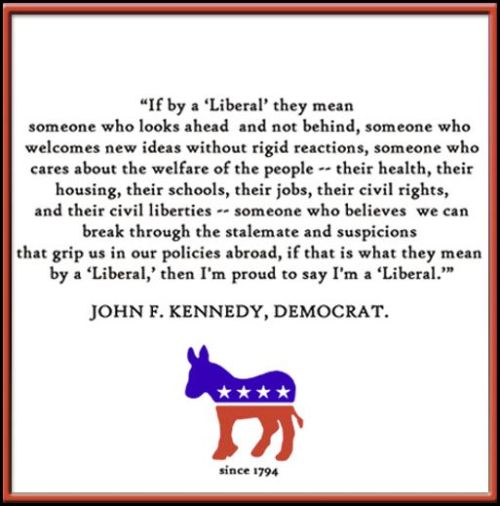
Proud to be a liberal, JFK

May 5, 2012

Somebody made a poster out of it:

JFK, proud to be a liberal

Quote from Sen. John F. Kennedy, September 14, 1960

You can read the entire original speech by Sen. John F. Kennedy here, at Millard Fillmore’s Bathtub.  There’s more defense of his being considered a liberal, and the good that liberals do.  It’s almost quaint the way he defends Adlai Stevenson.

Why do you wave the flag, help old ladies cross busy streets, keep children safe, and sing the “Star Spangled Banner?”

Tip of the old scrub brush to MoveOn.org, PBS and American Experience, and everyone who sent me a link to this today.