Chimney Rock National Monument, Colorado, and Moon. NPS image.
It’s off the tourist-beaten path, it’s relatively new to the National Parks system, and it’s not highly developed.
All of which means you can have a fantastic, unhurried adventure among ruins of ancient Americans, without the crowds.
We found it almost accidentally, driving by on our way to Abiquiue, New Mexico. Film from CRIA (Chimney Rock Interpretive Association?) recently dropped into my in-box.
I tried to get the definitive photo of a rufous hummingbird male who was trying to keep a dozen other hummers of three different species away from a battery of hummingbird feeders, but he was too fast.
Chimney Rock is a good example of the vast number of ruins from Puebloan Indian tribes and tribes even more ancient, found across the desert Southwest, mostly unprotected, uncatalogued, and unknown to any but local people who hunt pots, mostly illegally. As a nation, we should fund better preservation and more study of these human habitations.
Another short video:
Note there is at least one other formation in southern Colorado called Chimney Rock, and another formation in North Carolina that is probably more famous.
A view of the kiva and other ruins atop the small mesa formation of Chimney Rock N.P. USDA photo via OutThere Colorado.
In 1823, the poem “Account of a Visit from St. Nicholas” was published anonymously in the Troy (N.Y.) Sentinel; the verse, more popularly known as “‘Twas the Night Before Christmas,” was later attributed to Clement C. Moore.
Regardless who wrote the poem first published 196 years ago, how did the poem influence America’s view of St. Nicholas, or Santa Claus? And how much of the Santa Claus story really was invented in America?
Thomas Nast invented Santa Claus? Clement C. Moore didn’t write the famous poem that starts out, “‘Twas the night before Christmas, and all through the house . . . ?”
The murky waters of history from Millard Fillmore’s Bathtub soak even our most cherished ideas and traditions.
Isn’t that part of the fun of history?
In Janaury 1863, Thomas Nast portrayed Santa Claus as he delivered gifts to Union troops a few days earlier in Washington, D.C., wearing a blue, star-spangled coat.
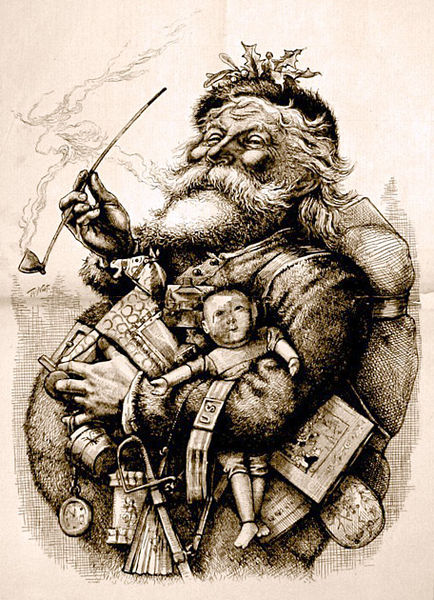
Yes, Virginia (and California, too)! Thomas Nast created the image of Santa Claus most of us in the U.S. know today. Perhaps even more significant than his campaign against the graft of Boss Tweed, Nast’s popularization of a fat, jolly elf who delivers good things to people for Christmas makes one of the great stories in commercial illustration. Nast’s cartoons, mostly for the popular news publication Harper’s Weekly, created many of the conventions of modern political cartooning and modeled the way in which an illustrator could campaign for good, with his campaign against the graft of Tammany Hall and Tweed. But Nast’s popular vision of Santa Claus can be said to be the foundation for the modern mercantile flurry around Christmas.
Nast’s drawings probably drew some inspiration from the poem, “Account of a Visit from St. Nicholas,” traditionally attributed to Clement C. Moore, a New York City lawyer, published in 1822. The poem is among the earliest to describe the elf dressed in fur, and magically coming down a chimney to leave toys for children; the poem invented the reindeer-pulled sleigh.
Modern analysis suggests the poem was not the work of Moore, and many critics and historians now attribute it to Major Henry Livingston, Jr. (1748-1828) following sleuthing by Vassar College Prof. Don Foster in 2000. Fortunately for us, we do not need to be partisans in such a query to enjoy the poem (a complete copy of which is below the fold).
The Library of Congress still gives Moore the credit. When disputes arise over who wrote about the night before Christmas, is it any wonder more controversial topics produce bigger and louder disputes among historians?
Moore is thought to have composed the tale, now popularly known as “The Night Before Christmas,” on December 24, 1822, while traveling home from Greenwich Village, where he had bought a turkey for his family’s Christmas dinner.
Inspired by the plump, bearded Dutchman who took him by sleigh on his errand through the snow-covered streets of New York City, Moore penned A Visit from St. Nicholas for the amusement of his six children, with whom he shared the poem that evening. His vision of St. Nicholas draws upon Dutch-American and Norwegian traditions of a magical, gift-giving figure who appears at Christmas time, as well as the German legend of a visitor who enters homes through chimneys.
Again from the Library of Congress, we get information that suggests that Moore was a minor celebrity from a well-known family with historical ties that would make a good “connections” exercise in a high school history class, perhaps (”the link from Aaron Burr’s treason to Santa Claus?”): (read more, below the fold)
Clement Moore was born in 1779 into a prominent New York family. His father, Benjamin Moore, president of Columbia University, in his role as Episcopal Bishop of New York participated in the inauguration of George Washington as the nation’s first president. The elder Moore also administered last rites to Alexander Hamilton after he was mortally wounded in a tragic duel with Aaron Burr.
A graduate of Columbia, Clement Moore was a scholar of Hebrew and a professor of Oriental and Greek literature at the General Theological Seminary in Manhattan. [See comment from Pam Bumsted below for more on Moore.] He is said to have been embarrassed by the light-hearted verse, which was made public without his knowledge in December 1823. Moore did not publish it under his name until 1844.
Tonight, American children will be tucked in under their blankets and quilts and read this beloved poem as a last “sugarplum” before slipping into dreamland. Before they drift off, treat them to a message from Santa, recorded by the Thomas Edison Company in 1922.
But Henry Livingston was no less noble or historic. He hailed from the Livingstons of the Hudson Valley (one of whose farms is now occupied by Camp Rising Sun of the Louis August Jonas Foundation, a place where I spent four amazing summers teaching swimming and lifesaving). Livingston’s biography at the University of Toronto site offers another path for a connections exercise (”What connects the Declaration of Independence, the American invasion of Canada, the famous poem about a visit from St. Nick, and George W. Bush?”):
Henry Livingston Jr. was born in Poughkeepsie, New York, on Oct. 13, 1748. The Livingston family was one of the important colonial and revolutionary families of New York. The Poughkeepsie branch, descended from Gilbert, the youngest son of Robert Livingston, 1st Lord of Livingston Manor, was not as well off as the more well-known branches, descended from sons Robert and Philip. Two other descendants of Gilbert Livingston, President George Walker Herbert Bush and his son, President-Elect George W. Bush, though, have done their share to bring attention to this line. Henry’s brother, Rev. John Henry Livingston, entered Yale at the age of 12, and was able to unite the Dutch and American branches of the Dutch Reformed Church. At the time of his death, Rev. Livingston was president of Rutgers University. Henry’s father and brother Gilbert were involved in New York politics, and Henry’s granduncle was New York’s first Lt. Governor. But the law was the natural home for many of Henry’s family. His brother-in-law, Judge Jonas Platt, was an unsuccessful candidate for governor, as was his daughter Elizabeth’s husband, U.S. Supreme Court Justice Smith Thompson. Henry’s grandson, Sidney Breese, was Chief Justice of the Illinois Supreme Court.
Known for his encyclopedic knowledge and his love of literature, Henry Livingston was a farmer, surveyor and Justice of the Peace, a judicial position dealing with financially limited criminal and civil cases. One of the first New Yorkers to enlist in the Revolutionary Army in 1775, Major Henry Livingston accompanied his cousin’s husband, General Montgomery, in his campaign up the Hudson River to invade Canada, leaving behind his new wife, Sarah Welles, and their week-old baby, on his Poughkeepsie property, Locust Grove. Baby Catherine was the subject of the first poem currently known by Major Livingston. Following this campaign, Livingston was involved in the War as a Commissioner of Sequestration, appropriating lands owned by British loyalists and selling them for the revolutionary cause. It was in the period following Sarah’s early death in 1783, that Major Livingston published most of his poems and prose, anonymously or under the pseudonym of R. Ten years after the death of Sarah, Henry married Jane Patterson, the daughter of a Dutchess County politician and sister of his next-door neighbor. Between both wives, Henry fathered twelve children. He published his good-natured, often occasional verse from 1787 in many journals, including Political Barometer, Poughkeepsie Journal, and New-York Magazine. His most famous poem, “Account of a Visit from St. Nicholas,” was until 2000 thought to have been the work of Clement Clarke Moore (1779-1863), who published it with his collected poems in 1844. Livingston died Feb. 29, 1828.
Thomas Nast’s full realization of Santa Claus, “Merry Old Santa Claus,” January 1, 1881. Harper’s Weekly, from Wikimedia.
Our views of Santa Claus owe a great deal also to Coca-Cola advertising campaigns. Coca-Cola first noted Santa’s use of the drink in a 1922 campaign to suggest Coke was a year-round drink (100 years after the publication of Livingston’s poem). The company’s on-line archives gives details:
In 1930, artist Fred Mizen painted a department store Santa in a crowd drinking a bottle of Coke. The ad featured the world’s largest soda fountain, which was located in the department store of Famous Barr Co. in St. Louis, Mo. Mizen’s painting was used in print ads that Christmas season, appearing in The Saturday Evening Post in December 1930.
1936 Coca-Cola Santa cardboard store display
1942 original oil painting – ‘They Remembered Me’
Archie Lee, the D’Arcy Advertising Agency executive working with The Coca-Cola Company, wanted the next campaign to show a wholesome Santa as both realistic and symbolic. In 1931, The Coca-Cola Company commissioned Michigan-born illustrator Haddon Sundblom to develop advertising images using Santa Claus — showing Santa himself, not a man dressed as Santa, as Mizen’s work had portrayed him.
For inspiration, Sundblom turned to Clement Clark Moore’s 1822 poem “A Visit From St. Nicholas” (commonly called “‘Twas the Night Before Christmas”). Moore’s description of St. Nick led to an image of Santa that was warm, friendly, pleasantly plump and human. For the next 33 years, Sundblom painted portraits of Santa that helped to create the modern image of Santa — an interpretation that today lives on in the minds of people of all ages, all over the world.
Santa Claus is a controversial figure. Debates still rage among parents about the wisdom of allowing the elf into the family’s home, and under what conditions. Theologians worry that the celebration of Christmas is diluted by the imagery. Other faiths worry that the secular, cultural impact of Santa Claus damages their own faiths (few other faiths have such a popular figure, and even atheists generally give gifts and participate in Christmas rituals such as putting up a decorated tree).
For over 100 years, Santa Claus has been a popular part of commercial, cultural and religious life in America. Has any other icon endured so long, or so well?
Coca-Cola’s film, “The Legend of Coca-Cola and Santa Claus”:
Do we, you and I in 2019, stand as witnesses to the end of newspapers in America? In recent years we’ve seen body blows to the New Orleans Times-Picayune, the San Diego Union, and The Cleveland Plain Dealer, and far too many others. Who anymore remembers the Washington Star, or the wonderfully-named San Antonio Light, or the Dallas Times-Herald? Some experiments might work. The Salt Lake Tribune turned non-profit.
Those are just the dailies. Smaller papers, especially weeklies, are all but wholly disappeared.
It’s painful to compare where Americans got their news, and what they thought about it, during the Watergate crises leading to the almost-impeachment and resignation of Richard Nixon, and today’s multiple crises leading to the impeachment of Donald Trump, and how it is yet to be resolved.
It’s been a grand history. Newspapering gave us great leaders like Benjamin Franklin. Newspapering gave us wars, like the Spanish-American War. Newspapering gave us Charlie Brown, Ann Landers, the Yellow Kid, Jim Murray, Red Smith, Thomas Nast (and Santa Claus), the Federalist Papers, Watergate, Herblock, news of Vietnam and Pearl Harbor, Neil Armstrong on the Moon, the Pentagon Papers, and coupons to save money on laundry soap.
It’s been a curious history, too. An 1897 editorial vouching for Santa Claus rates as the most popular editorial of all time, according to the Newseum in Washington, D.C. That’s 122 years ago, and that’s quite some staying power.
The man who saved Christmas, at least for Virginia O’Hanlon, Francis Pharcellus Church, probably about 1860 – Wikipedia image
In autumn, 1897, 8-year-old Virginia O’Hanlon of 115 West 95th Street in New York, wrote to the New York Sun with this simple question:
“Please tell me the truth; is there a Santa Claus?”
In the age of Yellow Journalism, the fiercely competitive Sun‘s editors turned the letter to Francis Pharcellus. He responded to little Virginia on September 21, 1897:
Church’s brother, William Conant Church, owned and published the newspaper. Both had followed their father into the news business. They co-founded The Army-Navy Journal in 1863, and went on to a series of journalistic collaborations. Francis was 58 years old when he answered Virginia’s letter. (He died at age 67, in 1906.)
The New York Sun held down the conservative corner in New York journalism at the time, versus the New York Times and the New York Herald-Tribune. But it also had an interesting history, to a blogger intrigued by hoaxes. In 1835 the paper published a series of six newspaper stories falsely attributed to Sir John Herschel, a well-known astronomer, claiming to describe a civilization on the Moon — the Great Moon Hoax. The discovery was credited to a new, very powerful telescope.
In 1844 the paper published a hoax written by Edgar Allen Poe, the Balloon Hoax. Under a pseudonym, Poe wrote that a gas balloon had crossed the Atlantic in three days.
The Sun also featured outstanding reporting. A 1947 and 1948 series about crime on the docks of New York City won a Pulitzer Prize for writer Malcolm Johnson. That series inspired Elia Kazan’s 1954 movie On the Waterfront starring Marlon Brando, Rod Steiger, Eva Marie Saint, Karl Malden and Lee J. Cobb.
Despite the occasional hoax, people trusted newspapers to get the basic facts right, most of the time.
The New York Sun ceased publication in 1950.
For all of its history, the Sun and the Churches are most remembered for that defense of belief in Santa Claus.
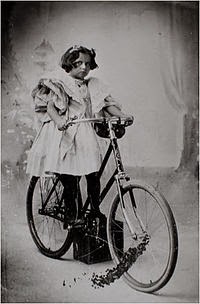
Virginia O’Hanlon, about the age of 8, when she wrote to The New York Sun’s editors to inquire about the veracity of the Santa Claus story.
Virginia O’Hanlon grew up, graduated from Hunter College, got a masters at Columbia, and earned a Ph.D. from Fordham Univeresity. She taught in the New York City Public School system, from which she retired in 1959. She died in 1971.
Birth of tradition
Columbia University was Church’s alma mater, as well as O’Hanlon’s. Her letter and his response get a reading each year at the Yule Log Ceremony at Columbia College, along with the poem “A Visit from St. Nicholas.” Animated, live-acting, and other television productions have been mounted in 1974, 1991, and 2009. Is there a Santa Claus? Did Church write a credible defense?The text of the letter and answer, below the fold.
More:
Yes, this is a Christmas tradition here at Millard Fillmore’s Bathtub. Some years I even edit and add something to the piece.
I wish it were not so. These words of Dickens’s through Scrooge, remain salient, damning and depressing, every day Donald Trump holds the Oval Office. Now Trump’s been impeached, but he still sits on his throne, messing up America in every way he can think to do it.
Ebenezer Scrooge, up a dark staircase; “Darkness was cheap, and Scrooge liked it.” Illustration by Roberto Innocenti, viaPinterest.
It’s a Quote of the Moment (an encore post for the season, with a bit of context thrown in later), Trump’s platform, and life, edited down to just three words, in green:
Isn’t that the entire GOP platform in three words? “Darkness is cheap.” Substitute “Trump” for “Scrooge,” you’ve got the picture.
I think of that line of Dickens’s often when I read of the celebrations of calumny that pass as discourse in Republican politics these days. Although, with the 2008 renewing of Limbaugh’s contract, it may no longer be true that his particular brand of darkness is cheap. With the advent of Donald Trump’s insult politics, offending America’s allies and all American ethnic groups possible, with un-ironic calls to drop nuclear weapons, GOP politics is even darker than ever.
Here is the sentence Dickens put before the quote, to add a little context; Scrooge was climbing a very large, very dark staircase.
Half-a-dozen gas-lamps out of the street wouldn’t have lighted the entry too well, so you may suppose that it was pretty dark with Scrooge’s dip.
Up Scrooge went, not caring a button for that. Darkness is cheap, and Scrooge liked it.
Speaking of darkness, a longer excerpt from a bit later in Dickens’s story, when the Ghost of Christmas Present ushers Scrooge to glimpse what is in the present, but what will be the future if Scrooge does not repent:
‘Forgive me if I am not justified in what I ask,’ said Scrooge, looking intently at the Spirit’s robe, ‘but I see something strange, and not belonging to yourself, protruding from your skirts. Is it a foot or a claw?’
‘It might be a claw, for the flesh there is upon it,’ was the Spirit’s sorrowful reply. ‘Look here.’
From the foldings of its robe, it brought two children; wretched, abject, frightful, hideous, miserable. They knelt down at its feet, and clung upon the outside of its garment.
‘Oh, Man! look here. Look, look, down here!’ exclaimed the Ghost.
They were a boy and girl. Yellow, meagre, ragged, scowling, wolfish; but prostrate, too, in their humility. Where graceful youth should have filled their features out, and touched them with its freshest tints, a stale and shrivelled hand, like that of age, had pinched, and twisted them, and pulled them into shreds. Where angels might have sat enthroned, devils lurked, and glared out menacing. No change, no degradation, no perversion of humanity, in any grade, through all the mysteries of wonderful creation, has monsters half so horrible and dread.
Scrooge started back, appalled. Having them shown to him in this way, he tried to say they were fine children, but the words choked themselves, rather than be parties to a lie of such enormous magnitude.
‘Spirit! are they yours?’ Scrooge could say no more.
‘They are Man’s,’ said the Spirit, looking down upon them. ‘And they cling to me, appealing from their fathers. This boy is Ignorance. This girl is Want. Beware them both, and all of their degree, but most of all beware this boy, for on his brow I see that written which is Doom, unless the writing be erased. Deny it!’ cried the Spirit, stretching out its hand towards the city. ‘Slander those who tell it ye! Admit it for your factious purposes, and make it worse. And bide the end!’
‘Have they no refuge or resource?’ cried Scrooge.
‘Are there no prisons?’ said the Spirit, turning on him for the last time with his own words. ‘Are there no workhouses?’ The bell struck twelve.
Scrooge looked about him for the Ghost, and saw it not. As the last stroke ceased to vibrate, he remembered the prediction of old Jacob Marley, and lifting up his eyes, beheld a solemn Phantom, draped and hooded, coming, like a mist along the ground, towards him.
Think of 2014, 2015, and 2016, children abused in Central America and in the Middle East, fleeing as best they can, only to die, off the shores of Greece, on the southern deserts of the U.S., or be cast into incarceration after having achieved a nation whose very name promised them refuge, the United States. “Two children; wretched, abject, frightful, hideous, miserable,” Dickens described. Whose children? “Man’s.” Yours, and mine.
Christmas is a festival to celebrate light, what many Christians call “the light of the world?” If so, let us work to stamp out the darkness which the unrepentant Scrooge so dearly loved.
Darkness may be cheap, but it is not good. Light a candle, and run into the darkness, spreading light. We need more light.
Hope you had a merry Christmas in 2016. Let us remember, as Tom and the late Ray Magliozzi always reminded us, the cheapskate pays more in the end, and usually along the way. Is Darkness cheap? Let us then eschew it as too costly for a moral nation, too costly for a moral people.
Is Donald Trump as smart as Ebenezer Scrooge? Is his heart as good as Scrooge’s heart?
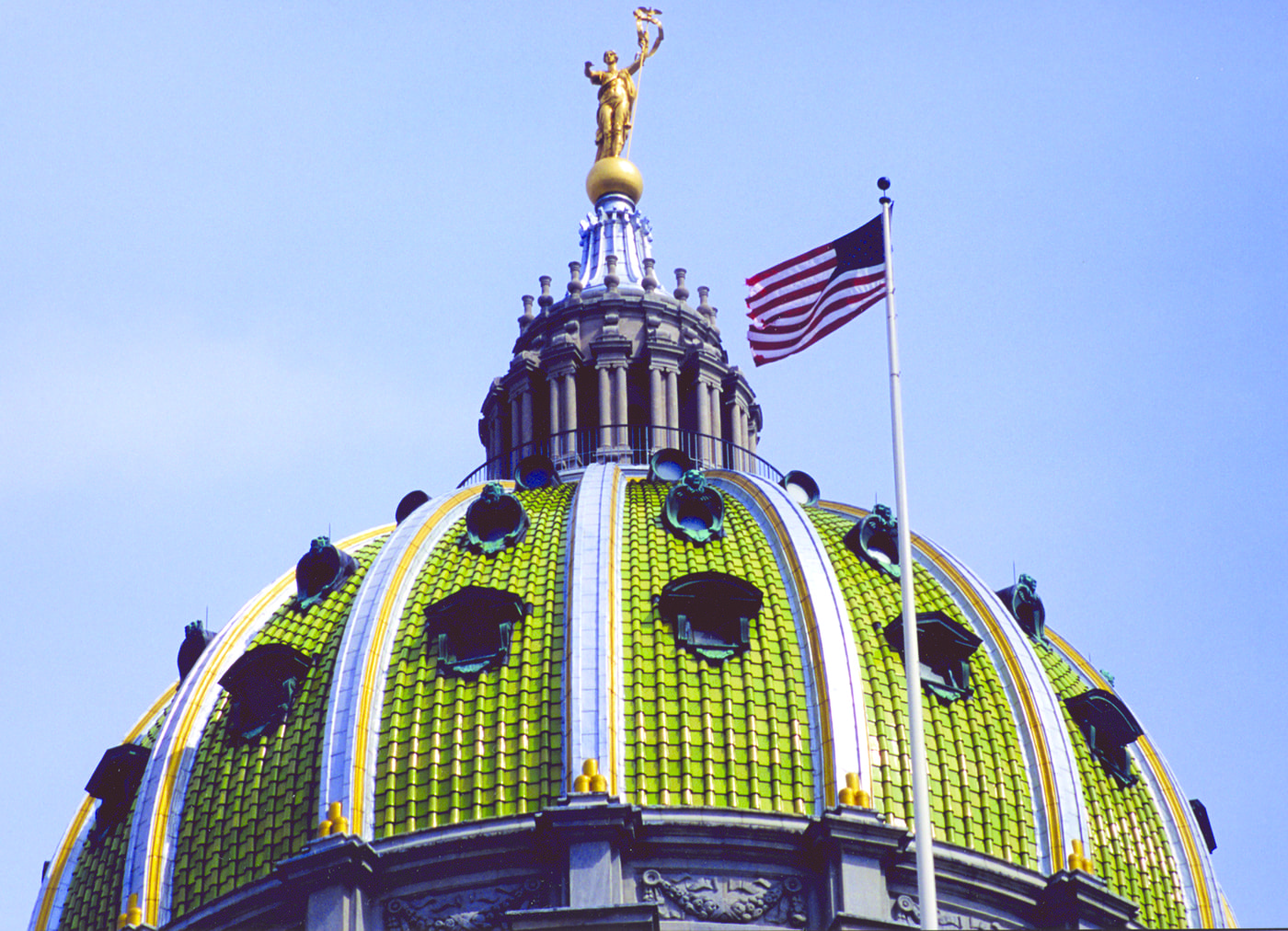
U.S. flag flies from the front portico of the Pennsylvania Capitol Building in Harrisburg, Pennsylvania. The elaborate building was completed in 1906, and dedicated by President Theodore Roosevelt, who called it one of the “handsomest buildings I ever saw.” UncoveringPA.com
As the U.S. flag code suggests, flags fly in Pennsylvania today honoring Pennsylvania Statehood.
Pennsylvania’s convention ratified the U.S. Constitution on December 12, 1787, just days after Delaware. Pennsylvania’s ratification was the second of nine states’ required to put the Constitution into effect.
If there is any ceremony or formal celebration planned, I haven’t found it yet. Any Pennsylvanians know?
Drone operator Matthew Dressler took to the skies recently for PennLive to capture a spectacular, birds-eye view of the Pennsylvania Capitol dome and complex. The Capitol, dedicated in 1906, was built and furnished for a cost of $13 million dollars and features paintings, stained glass and furnishings by some of the best artisans of the day. The exterior is faced with Vermont granite and the roof is made up of green glazed terra cotta tile. The 272-foot, 52 million-pound dome was inspired by Michelangelo’s design for St. Peter’s Basilica in Rome. The Capitol was the tallest building between Philadelphia and Pittsburgh for 80 years.
Newly-renovated Pennsylvania Capitol dome and the U.S. flag. Image from Wohlsen Construction, who performed the renovations.
A giant, 50 X 80 foot flag flies from a 232 foot flagpole at Glenbrook Dodge Chrysler Jeep in Fort Wayne, Indiana. Is it the largest regularly flown in the U.S.? Photo by Christopher Crawford, who sells prints of this giant patriotic display, at ChrisCrawfordPhoto.com
Why are the biggest flags in most states flown at car dealerships? Asking for a friend, who notes the Flag Code says flags are not to be flown as advertising devices.
The large American flag flying high above our dealership is now an established landmark in the city of Fort Wayne.
We believe this to be one of the largest continuously flying flags in the United States. It was erected in 2001. The flag symbolizes our appreciation to our country and to the many customers we’ve had the pleasure to serve over the years.
This flag measures 50 feet by 80 feet. The flagpole is 43 inches in diameter. The pole weighs 35,600 pounds! The base contains 400,000 lbs of concrete. The flag is made of nylon and weighs 80 pounds. The flag can last anywhere from 2 days to 2 months before it has to be changed.
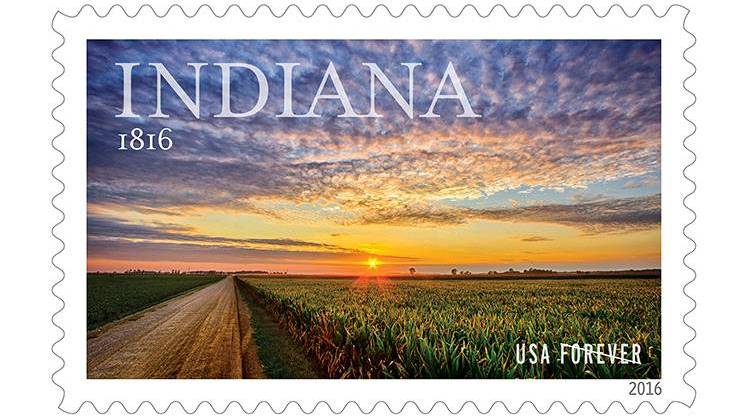
Indiana got a bicentennial stamp in 2016, from a stunning photograph from Indiana native Michael Matti.
Indiana’s bicentennial stamp, from a photography by Michael Matti.
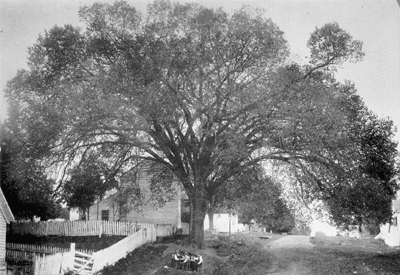
Interesting factoid: Delegates to a convention to create Indiana’s state constitution found the summer of 1816 too hot to stay indoors. So they adjourned most activities outdoors, under a massive elm tree, the Constitution Elm. The mighty tree succumbed to Dutch elm disease in 1925, sadly.
“This photograph of the ‘Constitution Elm’ was taken between 1921 and 1925. Delegates to the June 1816 constitutional convention apparently often worked in the shade of this tree. Although specific reports of dimensions vary, it was enormous with branches that spanned over 100 feet. It died of Dutch Elm Disease in 1925.” Indiana Division, Indiana State Library.
Here’s a story of Indiana’s path to statehood, produced in 2016 for Indiana’s Bicentennial.
Happy statehood day, Hoosiers; fly your flags today.
Flag on a barn, perhaps in Indiana, From IndianaPublicMedia.
Yes, this is an encore post. Defeating ignorance takes patience and perseverance.
Spread the word; friends don't allow friends to repeat history.
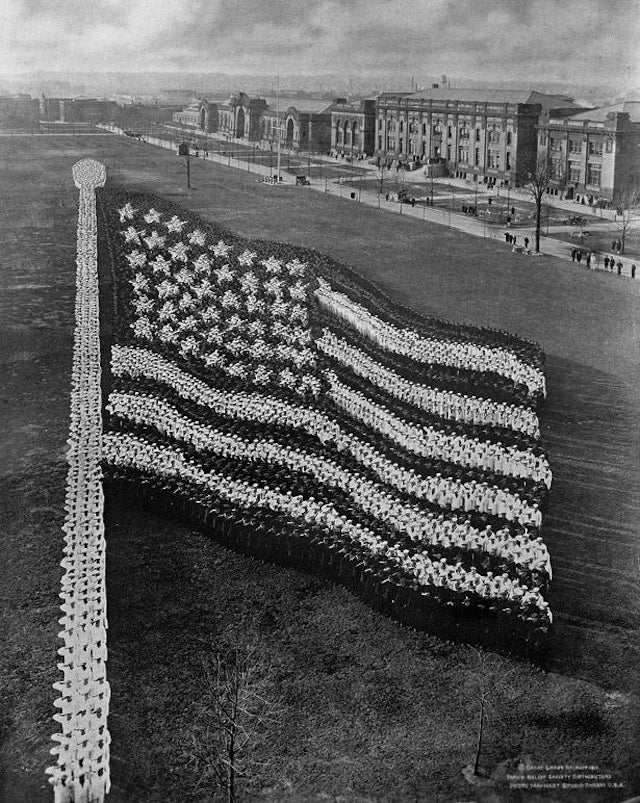
A “living flag” composed of 10,000 sailors, or “Blue Jackets at Salute,” by the Mayhart Studios, December 1917; image probably at the Great Lakes training facility of the Navy. Gawker media image
November offers several flag flying days, especially in years when there is an election.
But December may be the month with the most flag-flying dates, when we include statehood days.
December 25 is Christmas Day, a federal holiday, and one of the score of dates designated in the Flag Code. If you watch your neighborhood closely, you’ll note even some of the most ardent flag wavers miss posting the colors on this day, as they do on Thanksgiving and New Years.
Other dates?
Nine states attained statehood in December, so people in those states should fly their flags (and you may join them). Included in this group is Delaware, traditionally the “First State,” as it was the first colony to ratify the U.S. Constitution:
Illinois, December 3 (1818, 21st state)
Delaware, December 7 (1787, 1st state)
Mississippi, December 10 (1817, 20th state)
Indiana, December 11 (1816, 19th state)
Pennsylvania, December 12 (1787, 2nd state)
Alabama, December 14 (1819, 22nd state)
New Jersey, December 18 (1787, 3rd state)
Iowa, December 28 (1846, 29th state)
Texas, December 29 (1845, 28th state)
December 15 is Bill of Rights Day, marking the day in 1791 when the Bill of Rights was declared ratified; but though this event generally gets a presidential proclamation, there is no law or executive action that requires flags to fly on that date, for that occasion.
Eleven flag-flying dates in December. Does any other month have as many flag flying opportunities?
Have I missed any December flag-flying dates? 11 events on 10 days (Delaware’s statehood falls on the anniversary of the Pearl Harbor attack).
Here’s a list of the days to fly the flag, under national law, in chronological order:
Delaware, December 7 (1787, 1st state) (shared with Pearl Harbor Remembrance Day)
Mississippi, December 10 (1817, 20th state)
Indiana, December 11 (1816, 19th state)
Pennsylvania, December 12 (1787, 2nd state)
Alabama, December 14 (1819, 22nd state)
New Jersey, December 18 (1787, 3rd state)
Christmas Day, December 25
Iowa, December 28 (1846, 29th state)
Texas, December 29 (1845, 28th state)
Fly your flag with respect to the flag, for the republic it represents, and for all those who sacrificed that it may wave on your residence.
Appropriate to a snowy December. “The Barn on Grayson-New Hope Road. This barn with its old truck and ever-present American flag, is often the subject of photographs and paintings by the locals.” Photo and copyright by Melinda Anderson
Save
Save
Yes, this is an encore post. Defeating ignorance takes patience and perseverance.
Spread the word; friends don't allow friends to repeat history.
The Major, a very large U.S. flag made in honor of Maj. Brent R. Taylor, Mayor of North Ogden, Utah, killed in action in Afghanistan in 2018. The flag flew at the mouth of Coldwater Canyon. The flag is a quarter-acre in size, more than 100 feet on the longest side. North Ogden plans an annual celebration of the U.S. flag in early November. Photo by Ben Dorger, for the Ogden Standard-Examiner newspaper.
Running late. November flies by!
Eight events spread over seven different days come with urgings to fly the U.S. flag in November: Six states celebrate statehood, Veterans Day falls as always on November 11, and Thanksgiving Day on November 28.
Did I say eight? Elections are dates to fly the flag, and several states have “off-year” elections. You may fly your flag at home on election day, too. (Yes, flags should be flown at all early polling places, on days of early voting, too — do you know of poll where that did not occur? Tell us in comments.)
Two states, North Dakota and South Dakota, celebrate their statehood on the same date. Washington’s statehood day falls on Veterans Day, November 11 — so there are only seven days covering nine events.
In calendar order for 2019, these are the seven days:
North Dakota statehood day, November 2 (1889, 39th or 40th state)
South Dakota statehood day, November 2 (1889, 39th or 40th state) (shared with North Dakota)
Election day, November 5 (several states) — Go vote!
Montana statehood day, November 8 (1889, 41st state)
Veterans Day, November 11
Washington statehood day, November 11 (1889, 42nd state) (shared with Veterans Day)
Oklahoma statehood day, November 16 (1907, 46th state)
North Carolina statehood day, November 21 (1789, 12th state)
Thanksgiving Day, fourth Thursday in November (November 28 in 2018)
Most Americans will concern themselves only with Veterans Day and Thanksgiving Day. Is flying the U.S. flag for statehood day a dying tradition?
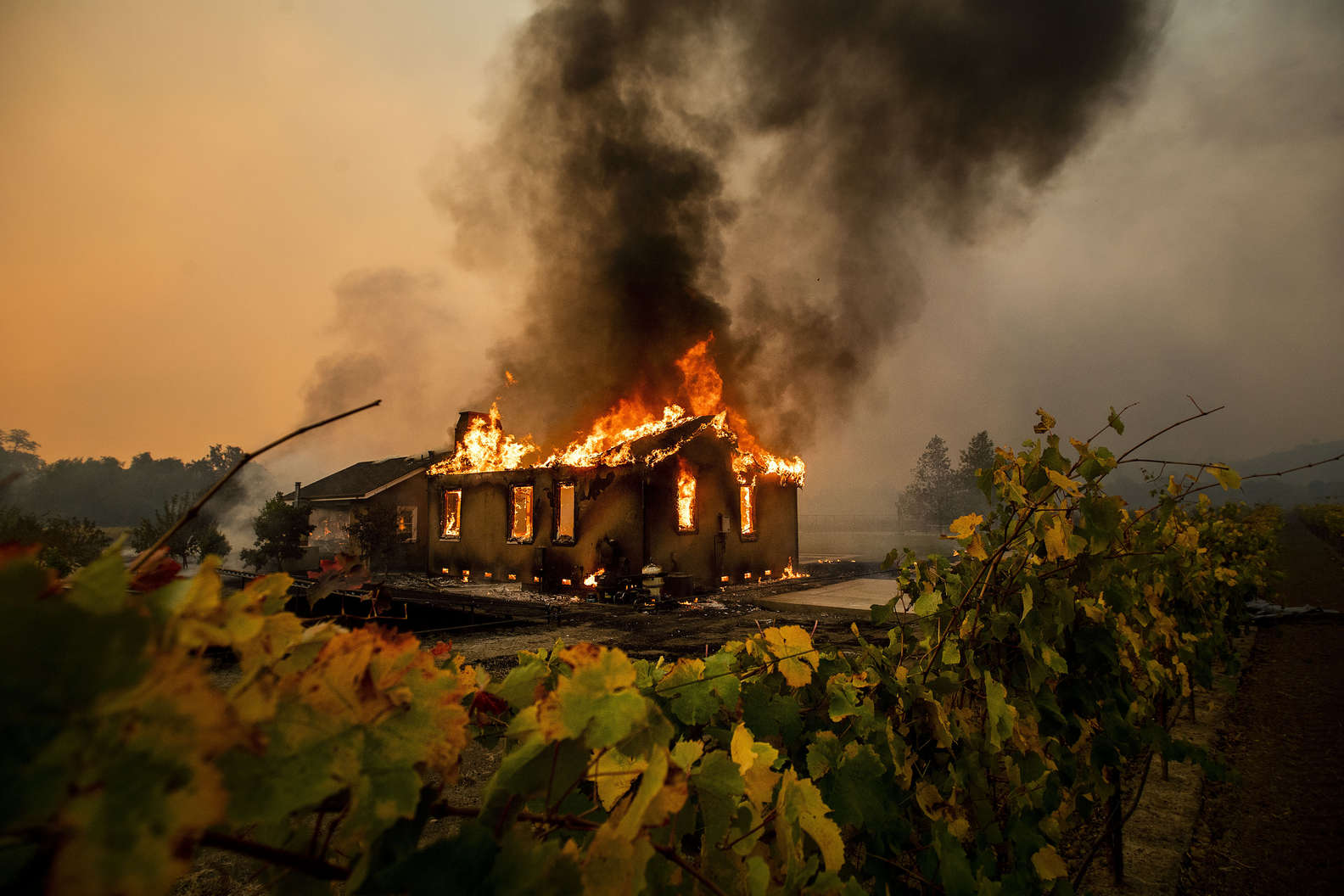
Wildfire burns a home in California. NowThis image.
NowThis runs compelling video on FaceBook, but just try to find that video on their YouTube channel or website to share.
This one will have to do. It makes the point.
California’s wildfires, growing steadily worse, rapidly, demonstrate problems of global heating/climate change that we need to solve, but which offer lots of bad arguments for Do Nothings and Climate Dismissives.
Here’s the problem in a nutshell, explained in this video: Rain patterns changed. California now gets massive rains in the spring, which drive overgrowth of grasses, quick-growing shrubs and other fire-prone plants.
Then the rains stop. Hotter summers and autumns dry out the new growth, creating explosive fuel for a fire.
So when a fire starts, it’s difficult-to-impossible to control.
Do Nothings argue that rain totals haven’t dropped, or maybe have increased, so drought fears are not warranted — though the summer without rain drives soil water levels into drought.
Then, they argue that the problem is environmentalists won’t let foresters clean understory dry wood and other fuels to prevent fires. That’s a whole cloth fabrication — reality is that federal budget cuts over the past 20 years leave the U.S. Forest Service unable to do significant brush clearing.
Then, Do Nothings argue that the problem is Caliornians build too many homes, and too many homes in near-wild areas.
In short, it’s always the fault of a “librul Californian,” with no causation left over for global warming.
Look at the video and please understand, much of that destruction is preventable. Fires will probably continue to get worse, with the fire season now running 12 months of the year in California.
Plagued by historically harsh winds, California has been hit with an onslaught of wildfires—the newest of which has broken out near the famed Getty Museum in Los Angeles. It joins several other fires burning across the state, including the Oak Fire in Calabasas, the Tick Fire in Southern California and the massive Kincade Fire in Northern California.
Last night, the Kincade Fire was still burning out of control in its fifth day, dropping from 10% containment to 5% due to hurricane-force winds and dry conditions that have allowed it to spread and made it difficult to control. There have been 200,000 evacuations in Sonoma County because of the fire, and it is expected to burn for another week and a half with no rain in the forecast.
The Getty Fire began early Monday, prompting police to ask thousands of people to evacuate, including Arnold Schwarzenegger, LeBron James, and LA Mayor Eric Garcetti’s parents. About 25,000 live in the LA evacuation zone, which covers a swath of high-priced real estate. A fire in December 2017 lit up the same area and forced drivers into a horrifying, apocalyptic-looking morning commute.
Governor Gavin Newsom secured Fire Management Assistance Grants to help fight the flames and announced a $75 million program to alleviate the fires’ impact on citizens. In an emergency declaration made Sunday, he urgent people not to ignore warnings, saying, , “It is critical that people in evacuation zones heed the warnings from officials and first responders, and have the local and state resources they need as we fight these fires.” At least 3,400 first responders and personnel are fighting the wildfires.
Pacific Gas & Electric (PG&E) the state’s biggest utility provider, shut off power to more than a million residents to try to curb further fire risks, but has received criticism for the lack of notice given. In a statement released Sunday, PG&E said more shut offs may come later in the week. In May, Cal Fire found PG&E was responsible for the Camp Fire, which left 85 dead and destroyed nearly 14,000 homes in 2018. It was the deadliest wildfire in the state’s history. PG&E had admitted it’s equipment was “likely” culpable.
The people hit hardest by California’s fires are those who are already vulnerable: homeless populations, the elderly, low-income populations without access to emergency preparations. The LA Times reported that a housekeeper and gardener showed up in the midst of ash and fire to their clients’ homes for work without realizing the homeowners had already evacuated.
Spread the word; friends don't allow friends to repeat history.
Note from the American Flagpole and Flag Company: Congress added another date to fly U.S. flags. From the e-mail:
Fly the United States Flag at Half-Staff on Sunday, October 6, 2019 in Honor of National Fallen Firefighters Memorial Service
The United States Congress created the National Fallen Firefighters Foundation to lead a nationwide effort to remember America’s fallen firefighters. Since 1992, the tax-exempt, nonprofit Foundation has developed and expanded programs to honor our fallen fire heroes and assist their families and coworkers. The 38th National Fallen Firefighters Memorial Service will be held Sunday, October 6, 2019, to honor 92 firefighters who died in the line of duty in 2018 and 27 firefighters who died in the line of duty in previous years.
In accordance to Public Law 107-51, the American flag should be lowered to half-staff on Sunday, October 6, 2019 from sunrise to sunset in observance of National Fallen Firefighters Memorial Service.
The date was added in October 2001, just over a month after the 9/11 attacks on the U.S. President George Bush signed the law. Maybe oddly, the resolution does not specify a fixed or floating date, but instead refers to a National Fallen Firefighters Memorial Service.
Every life lost in service to our country is precious and irreplaceable. Our deepest sympathy, utmost respect, unwavering support, and profound gratitude go to the families who must endure the ongoing pain of such loss. On Gold Star Mother’s and Family’s Day, we solemnly honor these families and pray for their continued strength and courage.
Since the founding of our Republic, our liberty has been defended by our men and women in uniform. Their love of country and devotion to duty represent the very best of America. Our Nation’s military families share in the demands and pressures of this noble calling. The cost is exceedingly high — with multiple deployments, relocations, and separations — but the sobering price of their sacrifice is most clearly seen in the families who have faced the life-altering loss of a father, mother, son, daughter, sister, or brother who died fighting for our freedom.
Because of tragedies that forever change the course of their lives, these families receive the designation of the Gold Star. Each story is unique; each death is profoundly personal. The fallen leave behind families who must learn to carve out a new future while coping with their loved one’s absence on holidays, at celebrations, and during everyday activities. Their pain permeates every facet of life, never fully fading.
Yet, in spite of their challenges and heartbreak, Gold Star families exemplify amazing grace and resilience. From the depths of grief, they emerge to find hope, purpose, and joy, serving as an example and a source of inspiration for others. These patriots know the true cost of freedom, and it is the responsibility of all Americans to stand alongside them and share in shouldering this profound burden.
The Congress, by Senate Joint Resolution 115 of June 23, 1936 (49 Stat. 1895 as amended), has designated the last Sunday in September as “Gold Star Mother’s Day.”
NOW, THEREFORE, I, DONALD J. TRUMP, President of the United States of America, by virtue of the authority vested in me by the Constitution and the laws of the United States, do hereby proclaim Sunday, September 29, 2019, as Gold Star Mother’s and Family’s Day. I call upon all Government officials to display the flag of the United States over Government buildings on this special day. I also encourage the American people to display the flag and hold appropriate ceremonies as a public expression of our Nation’s gratitude and respect for our Gold Star Mothers and Families.
IN WITNESS WHEREOF, I have hereunto set my hand this twenty-seventh day of September, in the year of our Lord two thousand nineteen, and of the Independence of the United States of America the two hundred and forty-fourth.
Armstrong said his client tells the provenance: The typewriter upon which John Irving wrote The World According to Garp. “It was completely worn out but after a complete rebuild my customer couldn’t be happier.”
This year marks 40 years since Garp was published — difficult to believe the time gone by. This may be the last novel I devoured in a day or so.
This year I’m celebrating the 40th anniversary of the publication of my novel, The World According to Garp. I remember thinking the title of my fourth novel would change; The World According to Garp was always just a working title until something better came along. I was still looking for “something better” when I delivered the manuscript to Henry Robbins, my editor. Henry, and everyone else at Dutton who read Garp in manuscript form, declared that the title had to be The World According to Garp. I was stuck with it.
More importantly, it is a bittersweet feeling to have only recently written a teleplay of Garp, a miniseries in five episodes, because I always imagined — more than forty years ago — that the sexual hatred in the novel might become dated soon after it was published. Sadly, sexual hatred is still with us — it hasn’t gone away. The suspicion of sexual differences, the discrimination against sexual minorities — including flat-out bigotry and violence — haven’t become the extinct dinosaurs I thought these things would (and should) become.
In part, The World According to Garp depicts the struggles of the writing process — the false starts, the blocks, the disappointments. Yet Garp never loses conviction in his purpose as a writer, “because he knew what every artist should know: as Garp put it, ‘You only grow by coming to the end of something and by beginning something else.’ Even if these so-called endings and beginnings are illusions.”
There are days I sorely miss my old Selectric.
Spread the word; friends don't allow friends to repeat history.
Mexico’s Independence Day is celebrated on September 16.
Dolores Hidalgo Church at night. Wikipedia image
But just to confuse things more, Mexico did not get independence on September 16.
September 16 is the usual date given for the most famous speech in Mexico’s history — a speech for which no transcript survives, and so, a speech which no one can really describe accurately. A Catholic priest who was involved in schemes to create an armed revolution to throw out Spanish rule (then under Napoleon), thought his plot had been discovered, and moved up the call for the peasants to revolt. At midnight, September 15, 1810, Father Miguel Hidalgo y Costilla declaimed the need for Mexicans to rise in revolution, from his church in the town of Dolores, near Guanajuato. The cry for freedom is known in Spanish as the Grito de Dolores.
Hidalgo himself was hunted down, captured and executed. Mexico didn’t achieve independence from Spain for another 11 years, on September 28, 1821.
To commemorate Father Hidalgo’s cry for independence, usually the President of Mexico repeats the speech at midnight, in Mexico City, or in Dolores. If the President does not journey to Dolores, some other official gives the speech there. Despite no one’s knowing what was said, there is a script from tradition used by the President:
Mexicans!
Long live the heroes that gave us the Fatherland!
Long live Hidalgo!
Long live Morelos!
Long live Josefa Ortiz de Dominguez!
Long live Allende!
Long live Galena and the Bravos!
Long live Aldama and Matamoros!
Long live National Independence!
Long Live Mexico! Long Live Mexico! Long Live Mexico!
Political history of Mexico is not easy to explain at all.
Hidalgo’s life was short after the speech, but the Spanish still feared the power of his ideas and names. In Hidalgo’s honor, a town in the Texas territory of Mexico was named after him, but to avoid provoking authorities, the name was turned into an anagram: Goliad.
In one of those twists that can only occur in real history, and not in fiction, Goliad was the site of a Mexican slaughter of a surrendered Tejian army during the fight for Texas independence. This slaughter so enraged Texans that when they got the drop on Mexican President and Gen. Santa Ana’s army a few days later at San Jacinto, they offered little quarter to the Mexican soldiers, though Santa Ana’s life was spared.
Have a great Grito de Dolores Day, remembering North American history that we all ought to know.
Father Hidalgo: Antonio Fabres, Miguel Hidalgo, oil on canvas, image taken from: Eduardo Baez, military painting in the nineteenth century Mexico, Mexico, National Defense Secretariat, 1992, p.23. Wikipedia image
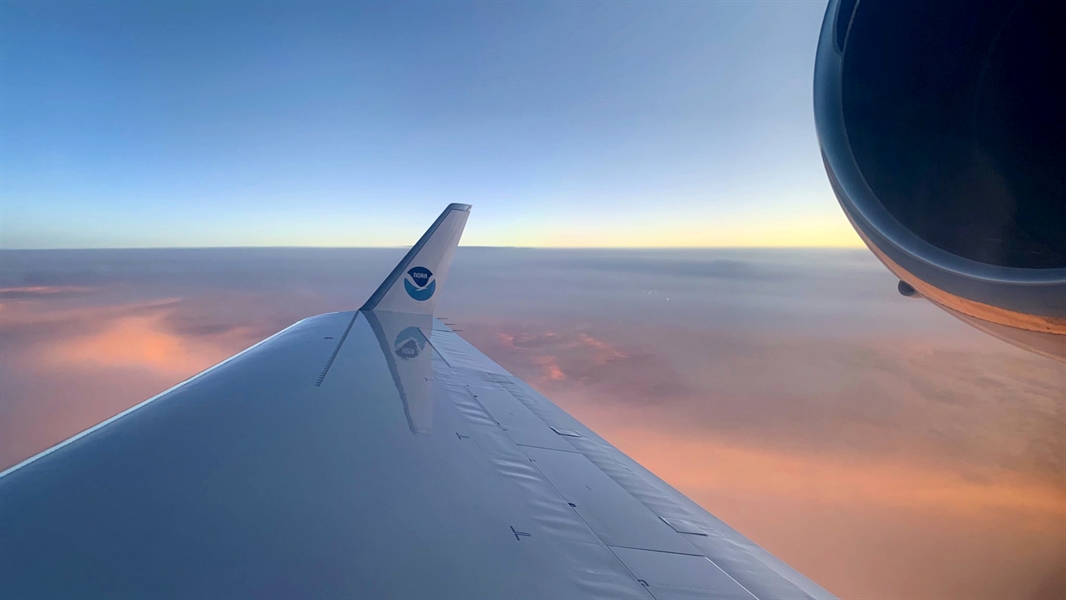
Photo from the window of a NOAA research flight. Masthead for NOAA press releases online.
NOAA’s chief scientist reminds everyone that accuracy with honor is necessary for science to be good.
Here is the entire message from NOAA Assistant Administrator Craig McLean, to NOAA staff, sent out Tuesday, September 10, 2019.
A Message from Craig McLean: Hurricane Dorian and Exceptional Service
This following is the original message Craig McLean, NOAA Research Assistant Administrator, sent to all NOAA Research employees on the morning of Monday, September 9th regarding Hurricane Dorian and its wide-ranging impacts.
Dear Colleagues,
The fierce storm we know as Hurricane Dorian has concluded its ferocious path through the Bahamas and along the U.S. East Coast. Many of you have contributed to the excellent science that has underpinned the forecasts and current understanding of storms such as this one, which accelerated quite rapidly in intensity. The storm also presented challenges in track which improved with enhanced observations. We know that our collective work, from the scientists in the aircraft penetrating the storm, to the scientists deploying the glider picket line, to the modelers and folks working the physics of the storms, across OAR and in our CI’s, and across all NOAA Lines, we are working the problem in order to give the NWS forecasters the best tools we possibly can to keep America and our neighbors safe. Thank you.
During the course of the storm, as I am sure you are aware, there were routine and exceptional expert forecasts, the best possible, issued by the NWS Forecasters. These are remarkable colleagues of ours, who receive our products, use them well, and provide the benefit of their own experience in announcing accurate forecasts accompanied by the distinction of all credible scientists—they sign their work. As I’m sure you also know, there was a complex issue involving the President commenting on the path of the hurricane. The NWS Forecaster(s) corrected any public misunderstanding in an expert and timely way, as they should. There followed, last Friday, an unsigned press release from “NOAA” that inappropriately and incorrectly contradicted the NWS forecaster. My understanding is that this intervention to contradict the forecaster was not based on science but on external factors including reputation and appearance, or simply put, political. Our NOAA Scientific Integrity Policy and Code of Scientific Conduct make clear that all NOAA employees shall approach all scientific activities with honesty, objectively, and completely, without allegiance to individuals, organizations, or ideology. The content of this press release is very concerning as it compromises the ability of NOAA to convey life-saving information necessary to avoid substantial and specific danger to public health and safety. If the public cannot trust our information, or we debase our forecaster’s warnings and products, that specific danger arises.
You know that the value of our science is in the complexity of our understanding, our ability to convey that understanding to a wide audience of users of this information, and to establish and sustain the public trust in the truth and legitimacy of that information. Unfortunately, the press release of last Friday violated this trust and violated NOAA’s policies of scientific integrity. In my role as Assistant Administrator for Research, and as I continue to administratively serve as Acting Chief Scientist, I am pursuing the potential violations of our NOAA Administrative Order on Scientific Integrity. Thankfully, we have such policies that are independently cited as among the best in the federal community, if not the best. Your NOAA and OAR management and leadership team believes in these policies and principles. I have a responsibility to pursue these truths. I will.
Thank you for your continued excellent work, and your trust. Carry on.
NOAA Assistant Administrator Craig McLean
Craig N. McLean Assistant Administrator Oceanic and Atmospheric Research National Oceanic and Atmospheric Administration
Or, until that account is unsuspended by the forces supporting Donald Trump: Follow @FillmoreWhite, the account of the Millard Fillmore White House Library
We've been soaking in the Bathtub for several months, long enough that some of the links we've used have gone to the Great Internet in the Sky.
If you find a dead link, please leave a comment to that post, and tell us what link has expired.
Thanks!
Retired teacher of law, economics, history, AP government, psychology and science. Former speechwriter, press guy and legislative aide in U.S. Senate. Former Department of Education. Former airline real estate, telecom towers, Big 6 (that old!) consultant. Lab and field research in air pollution control.
My blog, Millard Fillmore's Bathtub, is a continuing experiment to test how to use blogs to improve and speed up learning processes for students, perhaps by making some of the courses actually interesting. It is a blog for teachers, to see if we can use blogs. It is for people interested in social studies and social studies education, to see if we can learn to get it right. It's a blog for science fans, to promote good science and good science policy. It's a blog for people interested in good government and how to achieve it.
BS in Mass Communication, University of Utah
Graduate study in Rhetoric and Speech Communication, University of Arizona
JD from the National Law Center, George Washington University


 Posted by Ed Darrell





















 Millard Fillmore's Bathtub
