Christmas greetings, unapproved by Dallas First Baptist Grinchlist

December 23, 2010

This video does NOT have the seal of approval from Dallas First Baptist Church.  Also, the composer of the song was Jewish.  Reasoning Person discretion advised:

A 2007 post on YouTube, with these details:

Sung by The Drifters. Cartoon by Joshua Held.
Featuring Bill Pinkney on lead bass and Clyde McPhatter on tenor.
An animated Christmas Card, and a homage to a great song, a great band, and a great Holiday.

More me on: http://www.joshuaheld.com

Tip of the old scrub brush to Oh,  For Goodness Sake.

__________

Some guy, Melvin Rose,  posted this comment on a Dallas Morning News blog about First Baptist’s Grinchiness:

Pastor Jeffress, Dallas's Chief Grinch

Pastor Jeffress, in his deepest Grinch voice, orders the Whos in Whoville to toe the Christmas line. If you're not "religiously correct," you'd better watch out!

Imagine if a guy had a really primo parking space at the mall, right by the door, and you were circling round and round looking for a space, and he said to you, “Happy Holidays! I’m leaving. Would you like my space?”

Who amongst us, no matter what flavor of religion they choose, would turn the guy down?

Two people complained about it. I kid you not.

It’s not the War on Christmas we need to worry about — it’s the War for Fundamentalist Correctness that threatens us more.


Best law firm holiday card, from Manatt, Phelps & Phillips, LLP

December 20, 2010

Forget the imaginary War on Christmas and all the Fa-la-olderal surrounding that fight.What about the greeting from your company’s law firm? I understand this card, from Manatt, Phelps & Phillips, won the Wall Street Journal’s designation as best law firm card of 2010. Yes?

Apologies — it will play when you open the thing — I’ve put it below the fold so you don’t get surprised.

Read the rest of this entry »


Tuba Christmas near you?

November 28, 2010

Did I mention I really like a good tuba melody?  No, not the oompah back-up — I love it when tubas take the lead, when they sing as only a tuba can.

It’s that time of year I get a chance to hear organized tuba playing for Tuba Christmas.

Like here, in Dallas, at Thanksgiving Square  — the 31st annual Tuba Christmas (2008):

In Texas, the first performance I know of is in Brenham (home of Blue Bell Ice Cream!) on December 3; Amarillo is December 4.   Dallas is set for December 24, at Thanksgiving Square once again.

Is there a Tuba Christmas peformance near you?  Check the website of the Harvey Phillips Foundation, which promotes and organizes the events.

Do you play tuba, or euphonium (baritone), or Sousaphone?

Is America a great place, or what?


Veterans Day Video — History.com

November 11, 2010

President Barack Obama and First Lady Michelle Obama took on the cause of veterans as a special cause of this administration.  In this public service announcement from the History Channel, Michelle Obama and Dr. Jill Biden, wife of Vice President Joe Biden, urge honor to 24.9 million veterans.

November 11 is Veterans Day, a U.S. federal holiday dedicated to honoring veterans who served honorably in war or peacetime.

Vodpod videos no longer available.

Veterans Day Video — History.com, posted with vodpod


Labor Day history

September 6, 2010

A bit more on Labor Day and history, from this site and others:

More from Millard Fillmore’s Bathtub:

More from other sites:

Song music cover, "Look for the union label," 1900s

Union Label poster from the AF of L, early 1900s. Robert F. Wagner Labor Archives, New York University. Copyright Labor Arts Inc. (here under Fair Use for education)


July 4, 2010 – Fly your flag today

July 4, 2010

Fourth of July:  NPR has already read the Declaration of Independence, PBS has the Capitol Fourth concert this evening (8:00 p.m. Eastern — check your local listings), your town has a parade somewhere this weekend, and fireworks are everywhere.

Remember to put your flag up today.

Astronaut Eugene Cernan and the U.S. Flag -- Apollo 17 on the Moon (NASA photo)

Last flag on the Moon: Astronaut Eugene Cernan and the U.S. Flag -- Apollo 17 on the Moon (NASA photo)

Also:

Lunar Reconnaissance Orbiter photo of Apollo 17 landing site

Lunar Reconnaissance Orbiter photo of Apollo 17 landing site


Remembrance

May 31, 2010

I heard a sermon Sunday that made me stop to think.

Glenn Martin filled in at the pulpit of First Christian Church (Disciples of Christ) of Duncanville while Dr. Mike Oden is “vacationing” (preparing to move).  Glenn grew up in this congregation.  He’s a year away from a masters degree from Brite Divinity School at Texas Christian University. I’ve sung with him in the choir for several years, and been privileged to play bells with him — he’s a good musician on the bells, and he can make saves in an  astounding number of ways.  So I was interested in what he had to say just because he’s a friend.

It was a good sermon, even were he not my friend.  He threw in some good historic references, which always gets my attention.

For the Memorial Day weekend, this is Glenn’s sermon:

May 5, 1868, General John Logan, national commander of the Grand Army of the Republic issued general order number 11 specifying May 30 to be designated for the purpose of placing flowers or otherwise decorating the graves of Union and Confederate soldiers at Arlington National Cemetery.  This was the first official recognition of Decoration Day or what we now know as Memorial Day.  Unofficially, the practice likely began years earlier in a number of places as communities recognized and honored those who had fallen in war.

Some even attribute such a memorial service to Abraham Lincoln at Gettysburg.  Do you remember the reason the President was there?  There had been a battle at Gettysburg on [in July], and on November 19, 1863, and President Lincoln had come there to dedicate a portion of the field as a cemetery.  How long has it been since you thought of the some 260 words of Lincoln’s Gettysburg address which he would have delivered in about two minutes?

Four score and seven years ago our fathers brought forth on this continent a new nation, conceived in liberty, and dedicated to the proposition that all men are created equal.  Now we are engaged in a great civil war, testing whether that nation, or any nation so conceived and so dedicated, can long endure. We are met on a great battle-field of that war. We have come to dedicate a portion of that field as a final resting-place for those who gave their lives that that nation might live. It is altogether fitting and proper that we should do this.  But, in a larger sense, we cannot dedicate, we cannot consecrate, we cannot hallow, this ground. The brave men, living and dead, who struggled here, have consecrated it far above our poor power to add or detract. The world will little note nor long remember what we say here, but it can never forget what they did here. It is for us, the living, rather, to be dedicated here to the unfinished work which they who fought here have thus far so nobly advanced. It is rather for us to be here dedicated to the great task remaining before us; that from these honored dead we take increased devotion to that cause for which they gave the last full measure of devotion; that we here highly resolve that these dead shall not have died in vain; that this nation, under God, shall have a new birth of freedom; and that government of the people, by the people, for the people, shall not perish from the earth.

My topic for today is remembering.  That, in and of itself, deserves some attention.  What do I mean by remembering?  It is not so much the mental exercise of recalling factual details such as what you had for lunch yesterday or if you went to the grocery store on Monday or Tuesday.  The kind of remembering I’m getting at is much deeper than that.  It is the kind where you essentially choose to re-experience something or participate in a kind of reenactment.  Reminiscing after the death of a loved one is a good example of this kind of remembering.  We tell stories, stories that we have likely told many times before.  Stories that those who are reminiscing with us may be able to tell as well as we can.  Our intent is not to convey new information.  In some way, we are reliving or re-experiencing that story.

There is a formal word for this kind of remembering.  The word is anamnesis.  It derives from Greek, big surprise for those who know me.  The prefix means to go up or to come up; the root of the word is the word for mind; quite literally then we have the idea of coming up to the mind or as we say it, remembering.

Why do we remember?

First, it allows us to stay connected with our past.  This seems pretty obvious.  I wonder though if there might be something more to staying connected with our past than just the obvious.  Do you ever tell your children or grandchildren stories about your parents or grandparents?  Do they necessarily need to have known all the people in the story?

We occasionally talk of history and I know there are some people in this room that are history buffs.  I don’t personally put myself in this category.  There are elements of history that I find quite fascinating and a few topics that I have researched in much greater detail.  For me though, this has largely been a result of my interest in that other topic and researching some of its history was a natural part of exploring that topic.  The history buffs I’m talking about seem to exude history.  If you were to ask them about the Civil War for instance, they can tell you about military history, economic history of the time period, distinctions between the North and the South, things that were going on in the church, and even world events of the time.  Not only can they tell you details of these different kinds of histories, they can even suggest ways in which these details relate.

Every once in a while, someone will talk about “what really happened.”  I understand what they are getting at when they say that but is history what really happened or might it be more of what we remember of what happened?

Why do we remember?  The first reason is that it allows us to stay connected with our past.  The second reason is that it allows us to better understand our present.  Here again, this is fairly obvious though perhaps not quite as obvious as the first reason.

I think it is reasonably safe to say that most of us believe the idea of cause and effect.  We even have sayings about it.  For example, “What goes up must… come down” or how about “Look before you… leap” Exactly.

Have you ever thought of tracing cause and effect backwards? This thing over here was caused by such and such.  But that was the result of this other event.  And that event needed these other things to happen for it to occur.  Some of you are interested in genealogy.  This is a perfect example of cause and effect.  We wouldn’t be here if it weren’t for our parents.  Our grandparents had to be here for our parents to be here.  Our great-grandparents had to be here before our grandparents could be.  You get the idea.  What was the very first cause?  Science tends to point to the Big Bang.  I don’t think this is the first cause at all.  I am not advocating for or against this particular theory, I just don’t think the logic holds that this would be first.  If all the matter currently in our universe were contained in this alleged singularity, what caused it to go bang?  Even my question suggests a prior action of some sort.  It seems much more reasonable to me to locate the beginning point in God.  This is a separate thought however and we’ll have to leave it for another time.

Remembering gives us a way of understanding and interpreting our past so that we can then understand better why things are now the way they are.  Consider for a moment people who get amnesia.  The cause of the amnesia isn’t really important for the illustration.  Some of you have already recognized the Greek origins of this word too. There is same root for mind that I mentioned earlier plus the prefix “a” meaning without so we have without the mind.  People with amnesia have lost that connection with their past.  They have lost their sense of story and have the question of who am I.  Did you note the tense of the question?  It isn’t “who was I” as it would be for the past tense; it is “who am I.”  Very much the present tense, it suggests our self-identity is linked to remembering our past and where we have been.

The third reason we remember is that remembering allows us to look ahead to the future.

Today is the tomorrow we wondered about yesterday and tomorrow will then become the today we wonder about now.  In much the same way that we understand our present in light of our past, we similarly perceive the upcoming future as our past plus the actions we take.  Here is that cause and effect thing again.  I’m not going to dwell too long here.  I want to move to more of a practical example from our faith.

Let’s summarize quickly.  I’ve said that we remember for 3 reasons.
1. It allows us to stay connected with our past
2. It allows us to better understand our present
3. It allows us to look ahead to the future

More importantly, remembering allows us to see God.

The scripture I chose for today was in the context of the Passover.  The Israelites were to remember this day when God delivered them from bondage in Egypt.  Every year, they would celebrate the feast of unleavened bread and reenact the story.

For us, this story is part of the past.  It is also part of the past that we recognize that Jesus added to this narrative.  We remember it every Sunday.  Because we do remember it every Sunday, this story is part of our present.  Jesus was celebrating the Passover with his disciples.  While they were eating, Jesus took the bread, gave thanks, and gave it to them saying “This is my body.  Do this in remembrance of me.” In the same way after supper, he took the cup saying “This cup is the new covenant in my blood.  Do this as often as you drink it, in remembrance of me.”  You remember the word anamnesis that I mentioned earlier.  The Greek word we translate as remembrance here is this same word.  It is as though Jesus was saying that we should experientially reenact, relive, and remember every time we come to communion.

The apostle Paul further states in 1 Cor 11 that when we eat this bread and drink this cup we proclaim the Lord’s death until he returns.  This addresses both the present and the future.  I know a number of you took Dr. Mike’s class on Revelation.  The marriage supper of the Lamb (Revelation 19) also addresses the future.

In remembering, we can recall God’s mighty deeds.  We can be assured of God’s continuing and abiding presence with us.  And we can anticipate a future with numerous possibilities.

I started off recalling some of the history around Memorial Day.  In 1971, federal observance of Memorial Day was changed from May 30 to the last Monday in May.  Hooray for 3 day weekends.

By 2000, a number of Americans had lost the sense of the true meaning of the day.  In an effort to reeducate and remind us, the National Moment of Remembrance resolution was passed.  It asks that at 3:00 p.m. local time, for all Americans “To voluntarily and informally observe in their own way a Moment of remembrance and respect, pausing from whatever they are doing for a moment of silence or listening to Taps.”  Since we are Christians, I will give you another alternative to consider.  Place commemoration of the day under the auspices of God and share a communion service with whomever is with you and remember.  Thanks be to God.

Nota bene: I said it made me think.  That’s why I’ve asked Glenn for permission to post it here, to keep me thinking, and maybe make you think, too.  For example, Glenn lists three reasons remembering is valuable.  They parallel the tactic business consultants use to get businesses to think ahead — look back at what happened in the past, consider the condition of the company today, then look ahead to see what is in store for the company, and think about how the company can face challenges identified.

What do you think about remembrance, and remembering, and Glenn’s advice?

1 SermonScript5/30/2010 1
1 1
M ay 5,1868,GeneralJohn Logan,nationalcom m anderofthe G rand Arm y ofthe Republic issued generalordernum ber11specifying M ay 30 to be designated for the purpose ofplacing flow ersorotherw ise decorating the gravesofUnion and Confederate soldiersatArlington NationalCem etery.Thisw asthe firstoficial recognition ofDecoration Day orw hatw e now know as M em orialDay. Unoficialy,the practice likely began yearsearlierin a num berofplacesas com m unities recognized and honored those w ho had falen in w ar. Som e even attribute such a m em orialservice to Abraham Lincoln atGettysburg. Do you rem em berthe reason the Presidentw asthere? There had been a battle at Gettysburg on Novem ber19,1863,and PresidentLincoln had com e there to dedicate a portion ofthe field asa cem etery. How long has itbeen since you thoughtofthe som e 260 w ordsofLincoln’sGettysburg addressw hich he w ould have delivered in abouttw o m inutes? Fourscore and seven yearsago ourfathers broughtforth on thiscontinenta new nation,conceived in liberty,and dedicated to the proposition thatalm en are created equal. Now w e are engaged in a greatcivilw ar,testing w hetherthat nation,orany nation so conceived and so dedicated,can long endure.W e are m et on a greatbattle-field ofthatw ar.W e have com e to dedicate a portion ofthat field asa finalresting-place forthose w ho gave theirlivesthatthatnation m ight live.Itisaltogetherfitting and properthatw e should do this. But,in a larger sense,w e cannotdedicate…w e cannotconsecrate…w e cannothalow …this ground.The brave m en,living and dead,w ho struggled here,have consecrated it farabove ourpoorpow erto add ordetract.The w orld w illittle note norlong rem em berw hatw e say here,butitcan neverforgetw hatthey did here.Itisfor us,the living,rather,to be dedicated here to the unfinished w orkw hich they w ho foughthere have thusfarso nobly advanced.Itis ratherforusto be here dedicated to the greattask rem aining before us…thatfrom these honored dead w e take increased devotion to thatcause forw hich they gave the lastfulm easure
2 SermonScript5/30/2010 2
2 2
ofdevotion;thatw e here highly resolve thatthese dead shalnothave died in vain;thatthis nation,underGod,shalhave a new birth offreedom ;and that governm entofthe people,by the people,forthe people,shalnotperish from the earth. M y topicfortoday is rem em bering.That,in and ofitself,deservessom e attention. W hatdo Im ean by rem em bering? Itis notso m uch the m entalexercise of recaling factualdetailssuch asw hatyou had forlunch yesterday orifyou w entto the grocery store on M onday orTuesday.The kind ofrem em bering I’m getting at is m uch deeperthan that. Itisthe kind w here you essentialy choose to re- experience som ething orparticipate in a kind ofreenactm ent. Rem iniscing after the death ofa loved one isa good exam ple ofthis kind ofrem em bering.W e tel stories,storiesthatw e have likely told m any tim es before.Storiesthatthose w ho are rem iniscing w ith us m ay be able to telasw elasw e can.O urintentis notto convey new inform ation. In som e w ay,w e are reliving orre-experiencing that story. There isa form alw ord forthis kind ofrem em bering.The w ord isanam nesis. It derivesfrom G reek,big surprise forthose w ho know m e.The prefix m eansto go up orto com e up;the rootofthe w ord isthe w ord form ind;quite literaly then w e have the idea ofcom ing up to the m ind orasw e say it,rem em bering. W hy do w e rem em ber? First,italow s usto stay connected w ith ourpast.Thisseem s pretty obvious. I w onderthough ifthere m ightbe som ething m ore to staying connected w ith our pastthanjustthe obvious. Do you evertelyourchildren orgrandchildren stories aboutyourparentsorgrandparents? Do they necessarily need to have know n al the people in the story? W e occasionaly talkofhistory and Iknow there are som e people in this room that are history bufs. Idon’tpersonaly putm yselfin thiscategory.There are
3 SermonScript5/30/2010 3
3 3
elem entsofhistory thatIfind quite fascinating and a few topicsthatIhave researched in m uch greaterdetail. Form e though,this has largely been a resultof m y interestin thatothertopicand researching som e ofits history w asa natural partofexploring thattopic.The history bufs I’m talking aboutseem to exude history. Ifyou w ere to askthem aboutthe CivilW arforinstance,they can telyou aboutm ilitary history,econom ic history ofthe tim e period,distinctions betw een the North and the South,thingsthatw ere going on in the church,and even w orld eventsofthe tim e. Notonly can they telyou detailsofthese diferentkindsof histories,they can even suggestw ays in w hich these details relate. Every once in a w hile,som eone w iltalkabout“w hatrealy happened.” I understand w hatthey are getting atw hen they say thatbutis history w hatrealy happened orm ightitbe m ore ofw hatw e rem em berofw hathappened? W hy do w e rem em ber? The firstreason isthatitalow s usto stay connected w ith ourpast.The second reason isthatitalow s usto betterunderstand ourpresent. Here again,this isfairly obviousthough perhaps notquite asobviousasthe first reason. Ithink itis reasonably safe to say thatm ostofus believe the idea ofcause and efect.W e even have sayingsaboutit. Forexam ple,“W hatgoes up m ust… com e dow n” orhow about“Look before you… leap” Exactly. Have you everthoughtoftracing cause and efectbackw ards?Thisthing overhere w ascaused by such and such. Butthatw asthe resultofthisotherevent.And that eventneeded these otherthingsto happen foritto occur.Som e ofyou are interested in genealogy.This isa perfectexam ple ofcause and efect.W e w ouldn’tbe here ifitw eren’tforourparents.O urgrandparents had to be here forourparentsto be here.O urgreat-grandparents had to be here before our grandparentscould be.You getthe idea.W hatw asthe very firstcause? Science tendsto pointto the Big Bang. Idon’tthinkthis isthe firstcause atal. Iam not
4 SermonScript5/30/2010 4
4 4
advocating fororagainstthis particulartheory,Ijustdon’tthinkthe logic holds thatthisw ould be first. Ifalthe m atercurrently in ouruniverse w ere contained in thisaleged singularity,w hatcaused itto go bang? Even m y question suggestsa prioraction ofsom e sort. Itseem s m uch m ore reasonable to m e to locate the beginning pointin God.This isa separate thoughthow everand w e’lhave to leave itforanothertim e. Rem em bering gives usa w ay ofunderstanding and interpreting ourpastso that w e can then understand betterw hy thingsare now the w ay they are.Considerfor a m om entpeople w ho getam nesia.The cause ofthe am nesia isn’trealy im portantforthe ilustration.Som e ofyou have already recognized the G reek originsofthisw ord too.There issam e rootform ind thatIm entioned earlierplus the prefix “a” m eaning w ithoutso w e have w ithoutthe m ind. People w ith am nesia have lostthatconnection w ith theirpast.They have losttheirsense of story and have the question ofw ho am I. Did you note the tense ofthe question? Itisn’t“w ho w as I” as itw ould be forthe pasttense;itis “w ho am I.” Very m uch the presenttense,itsuggestsourself-identity is linked to rem em bering ourpast and w here w e have been. The third reason w e rem em beristhatrem em bering alow s usto lookahead to the future. Today isthe tom orrow w e w ondered aboutyesterday and tom orrow w ilthen becom e the today w e w onderaboutnow . In m uch the sam e w ay thatw e understand ourpresentin lightofourpast,w e sim ilarly perceive the upcom ing future asourpastplusthe actionsw e take. Here isthatcause and efectthing again. I’m notgoing to dw eltoo long here. Iw antto m ove to m ore ofa practical exam ple from ourfaith. Let’ssum m arize quickly. I’ve said thatw e rem em berfor3 reasons. 1.Italow s usto stay connected w ith ourpast
5 SermonScript5/30/2010 5
5 5
2.Italow s usto betterunderstand ourpresent 3.Italow s usto lookahead to the future M ore im portantly,rem em bering alow s usto see God. The scripture Ichose fortoday w as in the contextofthe Passover.The Israelites w ere to rem em berthisday w hen God delivered them from bondage in Egypt. Every year,they w ould celebrate the feastofunleavened bread and reenactthe story. Forus,thisstory is partofthe past. Itisalso partofthe pastthatw e recognize thatJesusadded to this narrative.W e rem em beritevery Sunday. Because w e do rem em beritevery Sunday,thisstory is partofourpresent.Jesusw ascelebrating the Passoverw ith hisdisciples.W hile they w ere eating,Jesustookthe bread,gave thanks,and gave itto them saying “This is m y body. Do this in rem em brance of m e.” In the sam e w ay aftersupper,he tookthe cup saying “Thiscup isthe new covenantin m y blood. Do thisasoften asyou drink it,in rem em brance ofm e.” You rem em berthe w ord anam nesisthatIm entioned earlier.The G reekw ord w e translate as rem em brance here isthissam e w ord. ItisasthoughJesusw assaying thatw e should experientialy reenact,relive,and rem em berevery tim e w e com e to com m union. The apostle Paulfurtherstates in 1 Cor11thatw hen w e eatthis bread and drink thiscup w e proclaim the Lord’sdeath untilhe returns.Thisaddresses both the presentand the future. Iknow a num berofyou took Dr.M ike’sclasson Revelation.The m arriage supperofthe Lam b (Revelation 19)also addressesthe future. In rem em bering,w e can recalGod’s m ighty deeds.W e can be assured ofGod’s continuing and abiding presence w ith us.And w e can anticipate a future w ith num erous possibilities.
6 SermonScript5/30/2010 6
6 6
Istarted ofrecaling som e ofthe history around M em orialDay. vaoccIrBMlineooosynbsatadnmlse2ouyesn0nnmlr.irudee0tivntHasuef0aigfpoonrr,noie.ointlacoyrocetrPwntnaalT,toayuansoapcfemsdfaperoMrepsubvicrna.eseei”ocf3sdirmoenmsSudogerowicmamfdnfaryAicri.aettaoewehmlmIllmtywDweaeoaoeanewrrhsidybakckoahestaswmrraeinoenettardeshmenvCssvaveho.hiectenafirhradrnditastitshttunlh3oeihwsagese,epndytititdsmarthah,yohefrIyleerwouwooNcsdnnmuaiaedoltlwlaneiiMgtonsnariiegvndmayteayhfoaeroleefy3,MrMotmf0aaohuouoetersmomammaptnoteerlibolchumnneAeteettrhsem.olomeanoeffTrstfeIrtRnharoaGieceaMlfn1toammne9sidonnkeir7elsngsneam1mda”nbon,TtabcebdffioyeevrrtatsaedhioohnnneetacrGcoredraeoealdya..

This is Memorial Day: Please fly your flag

May 31, 2010

Flags at DFW National Cemetery - IMGP4169 photo by Ed Darrell

U.S. flags wave at DFW National Cemetery, May 30, 2010. Photo by Ed Darrell

Our local Rotary Club provides a U.S. flag planted in your yard for flag-flying events from Memorial Day through Labor Day, for an annual subscription of about $15.00.  Local groups, including especially Boy Scouts, Cub Scouts and Girl Scouts, take a route and plant the flags.

As a consequence, our town is loaded with flags on a weekend like this one.

But even if you don’t subscribe to a flag service, please remember to fly your flag today.

Memorial Day honors people who died in defense of the nation.  Armed Forces Day honors those who serve currently, celebrated  the third Saturday in May.  Veterans Day honors the veterans who returned.

On Memorial Day itself, flags on poles or masts should be flown at half-staff from sunrise to noon. At noon, flags should be raised to full-staff position.

When posting a flag at half-staff, the flag should be raised to the full-staff position first, with vigor, then slowly lowered to half-staff; when retiring a flag posted at half-staff, it should be raised to the full staff position first, with vigor, and then be slowly lowered. Some people attach black streamers to stationary flags, though this is not officially recognized by the U.S. Flag Code.

On Memorial Day, 3:00 p.m. local time is designated as the National Moment of Remembrance.

_____________

Update: Honoring our war dead makes unusual bedfellows, no? Agreement on honorable things creates hope that we can agree on more things, on other important things.


Memorial Day 2010: Fly your flag, study history, honor the dead

May 29, 2010

(Much of this post is encore material, from Memorial Day 2009.)

Please fly your flag this weekend, and especially Monday, to honor those who gave up their lives in defense of the nation and our freedoms.

Memorial Day, traditionally observed on May 30, now observed the last Monday in May, honors fallen veterans of wars. Traditionally, family members visit the cemetery where loved ones are interred and leave flowers on the grave.

Memorial Day honors people who died in defense of the nation.  Armed Forces Day honors those who serve currently, celebrated  the third Saturday in May.  Veterans Day honors the veterans who returned.

On Memorial Day itself, flags on poles or masts should be flown at half-staff from sunrise to noon. At noon, flags should be raised to full-staff position.

When posting a flag at half-staff, the flag should be raised to the full-staff position first, with vigor, then slowly lowered to half-staff; when retiring a flag posted at half-staff, it should be raised to the full staff position first, with vigor, and then be slowly lowered. Some people attach black streamers to stationary flags, though this is not officially recognized by the U.S. Flag Code.

On Memorial Day, 3:00 p.m. local time is designated as the National Moment of Remembrance.

Got another week of school? Here’s a quiz about the history of Memorial Day that might make a warm-up, provided by Carolyn Abell writing in the Tifton (Georgia) Gazette:

1. Memorial Day was first officially proclaimed by a general officer. His name was: A. Robert E. Lee; B. John A. Logan; C. Douglas MacArthur D. George Washington.

2. The first state to officially recognize Memorial Day was A. Virginia; B. Rhode Island; C. New York; D. Georgia.

3. The use of poppies to commemorate Memorial Day started in A. 1870 B. 1915 C. 1948; D. 1967.

4. The original date of Memorial Day was A. May 30; B. July 4; C. May 28; D. Nov 11.

5. Which U.S. Senator has tried repeatedly to pass legislation that would restore the traditional day of Memorial Day observance? A. John McCain B. Ted Kennedy C. Saxby Chambliss D. Daniel Inouye.

The answers, again provided by the Tifton Gazette:

OK, now for the answers. General John Logan, national commander of the Grand Army of the Republic, proclaimed May 30, 1968 as Memorial Day in his General Order Number 11, issued on May 5, 1868. The purpose was to honor the dead from both sides in the War Between the States. Subsequently flowers were placed on the graves of both Union and Confederate soldiers in Arlington National Cemetery on May 30 of that year.

New York was the first state to officially recognize the Memorial Day, in 1873. Southern states, though paying tribute to their dead on separate dates, refused to use May 30 as the official date until after World War I, when the holiday was broadened to honor those who died in any war.

In 1915 a woman named Moina Michael, inspired by the poem, “In Flanders Fields,” (by Canadian Colonel John McRae) began wearing red poppies on Memorial Day to honor our nation’s war dead. The tradition grew and even spread to other countries. In 1922 the VFW became the first veterans’ organization to sell the poppies made by disabled veterans as a national effort to raise funds in support of programs for veterans and their dependents. In 1948 the US Post Office issued a red 3-cent stamp honoring Michael for her role in founding the national poppy movement.

As stated above, May 30 was the original Memorial Day. In 1971, with the passage of the national Holiday Act, Congress changed it so that Memorial Day would be celebrated on the last Monday of May. Some citizens feel that turning it into a “three-day weekend” has devalued the importance and significance of this special holiday. In fact, every time a new Congress has convened since 1989, Senator Daniel Inouye of Hawaii has introduced a bill to the Senate calling for the restoration of May 30th as the day to celebrate Memorial Day.

In his 1999 introductory remarks to the bill, Senator Inouye declared:

“Mr. President, in our effort to accommodate many Americans by making the last Monday in May, Memorial Day, we have lost sight of the significance of this day to our nation. Instead of using Memorial Day as a time to honor and reflect on the sacrifices made by Americans in combat, many Americans use the day as a celebration of the beginning of summer. My bill would restore Memorial Day to May 30 and authorize the flag to fly at half mast on that day.

In addition, this legislation would authorize the President to issue a proclamation designating Memorial Day and Veterans Day as days for prayer and ceremonies honoring American veterans. This legislation would help restore the recognition our veterans deserve for the sacrifices they have made on behalf of our nation.” (from the 1999 U.S. Congressional Record).

Flat at half-staff, U.S.Capitol in background - from Flag Bay

Other sources:

Image of flag and U.S. Capitol from Flags Bay.


Cinco de Mayo, really (encore post)

May 5, 2010

(Mostly an encore post, from 2009)

You thought Cinco de Mayo was Independence Day for Mexico?

No, it’s not.

History.com has a nice explanation, with a nice little video. Yahoo has a video this year, mostly animation with lots of advertising.

Perhaps the U.S. should celebrate the day, too, at least in those states who were not in the old Confederacy. On May 5, 1862, Mexicans under the command of 33 year old Commander General Ignacio Zaragoza Seguín stopped the quick advance of superior French forces trying to invade Mexico to take it over, at the Battle of Puebla. While France did eventually defeat Mexican forces (after getting 30,000 men in reinforcements), the spirit of May 5 inspired Mexicans to continue to fight for freedom. And ultimately, Mexican forces overpowered and captured the French forces and Emperor Maximilian, who was executed.

Thus ended a great hope for the Confederacy, that French-supported Mexican Army would lend aid to the Confederates in their struggle to secede from the Union.

It is one of the great what-ifs of history: What if France had kept Mexico, and what if French-led Mexican forces backed up the Confederate Army?

One thing is rather sure: Had that happened, and had the Confederacy been successful, we wouldn’t be celebrating Cinco de Mayo in Texas today.

Battle of Puebla, Wikimedia (artist?)

Battle of Puebla, Wikimedia (artist?)

Mexican Independence Day is September 16.

_______________________________________

Update: Sam DeBerry sends a note that Seguin was a Texan.  So the Mexican hero of the Battle of Puebla was a Texan.  You couldn’t make this stuff up — real history is always more interesting than fiction.


Earth Day/Lenin’s Birthday hoax

April 22, 2010

One surefire way to tell an Earth Day post is done by an Earth Day denialist:  They’ll note that the first Earth Day, on April 22, 1970, was an anniversary of the birth of Lenin.

Coincidentally, yes, Lenin was born on April 22 (new style calendar; it was April 10 on the calendar when he was born — but that’s a digression for another day).

It’s a hoax.  There is no meaning to the first Earth Day’s falling on Lenin’s birthday — Lenin was not prescient enough to plan his birthday to fall in the middle of Earth Week, a hundred years before Earth Week was even planned.

My guess is that only a few really wacko conservatives know that April 22 is Lenin’s birthday (was it ever celebrated in the Soviet Union?).  No one else bothers to think about it, or say anything about it, nor especially, to celebrate it.

Wisconsin’s U.S. Sen. Gaylord Nelson, usually recognized as the founder and father of Earth Day, told how and why the organizers came to pick April 22:

Senator Nelson chose the date in order to maximize participation on college campuses for what he conceived as an “environmental teach-in.” He determined the week of April 19–25 was the best bet; it did not fall during exams or spring breaks, did not conflict with religious holidays such as Easter or Passover, and was late enough in spring to have decent weather. More students were likely to be in class, and there would be less competition with other mid-week events—so he chose Wednesday, April 22.

In his own words, Nelson spoke of what he was trying to do:

After President Kennedy’s [conservation] tour, I still hoped for some idea that would thrust the environment into the political mainstream. Six years would pass before the idea that became Earth Day occurred to me while on a conservation speaking tour out West in the summer of 1969. At the time, anti-Vietnam War demonstrations, called “teach-ins,” had spread to college campuses all across the nation. Suddenly, the idea occurred to me – why not organize a huge grassroots protest over what was happening to our environment?

I was satisfied that if we could tap into the environmental concerns of the general public and infuse the student anti-war energy into the environmental cause, we could generate a demonstration that would force this issue onto the political agenda. It was a big gamble, but worth a try.

At a conference in Seattle in September 1969, I announced that in the spring of 1970 there would be a nationwide grassroots demonstration on behalf of the environment and invited everyone to participate. The wire services carried the story from coast to coast. The response was electric. It took off like gangbusters. Telegrams, letters, and telephone inquiries poured in from all across the country. The American people finally had a forum to express its concern about what was happening to the land, rivers, lakes, and air – and they did so with spectacular exuberance. For the next four months, two members of my Senate staff, Linda Billings and John Heritage, managed Earth Day affairs out of my Senate office.

Five months before Earth Day, on Sunday, November 30, 1969, The New York Times carried a lengthy article by Gladwin Hill reporting on the astonishing proliferation of environmental events:

“Rising concern about the environmental crisis is sweeping the nation’s campuses with an intensity that may be on its way to eclipsing student discontent over the war in Vietnam…a national day of observance of environmental problems…is being planned for next spring…when a nationwide environmental ‘teach-in’…coordinated from the office of Senator Gaylord Nelson is planned….”

Nelson, a veteran of the U.S. armed services (Okinawa campaign), flag-waving ex-governor of Wisconsin (Sen. Joe McCarthy’s home state, but also the home of Aldo Leopold and birthplace of John Muir), was working to raise America’s consciousness and conscience about environmental issues.

Lenin on the environment?  Think of the Aral Sea disaster, the horrible pollution from Soviet mines and mills, and the dreadful record of the Soviet Union on protecting any resource.  Lenin believed in exploiting resources, not conservation.

So, why are all these conservative denialists claiming, against history and politics, that Lenin’s birthday has anything to do with Earth Day?

Can you say “propaganda?”

Good information:

Wall of Lenin’s Birthday Propaganda Shame:

Warn people not to be sucked in by the hoax:

Add to FacebookAdd to NewsvineAdd to DiggAdd to Del.icio.usAdd to StumbleuponAdd to RedditAdd to BlinklistAdd to TwitterAdd to TechnoratiAdd to Furl


Fly your U.S. flag today, in honor of the Rev. Dr. Martin Luther King, Jr.

January 18, 2010

King Center poster for MLK Day 2010

King Center poster for MLK Day 2010

Fly your flag today.

U.S. law encourages Americans to fly the U.S. flag on holidays and a few other occasions.  Congress set aside the third Monday in January as a holiday to commemorate the life of the Rev. Dr. Martin Luther King, Jr.

To honor Dr. King, for several years civil rights leaders and others have urged us to find some way to serve our communities on this day — Americans have done it long enough to make it a tradition.  Here’s the official find-a-way-to-serve page from the the federal government; look out your window, go spend a few minutes at your city hall, post office, or at the biggest church in town, or walk into any middle school in America, and opportunities to serve will caress you at every turn.

More, much more:

King, by photographer Ben Fernandez's "Countdown to Eternity"

King, by photographer Ben Fernandez's portfolio of photos from one year in the life of Dr. King, "Countdown to Eternity"

MLK logo from Google mlk2010

Google's logo for Martin Luther King, Jr. Day, 2010 - click for more information

Share a dream:

Add to FacebookAdd to NewsvineAdd to DiggAdd to Del.icio.usAdd to StumbleuponAdd to RedditAdd to BlinklistAdd to TwitterAdd to TechnoratiAdd to Furl


Salute Martin Luther King, Jr.: Volunteer

January 15, 2010

Obama’s old campaign organization urges people to get out to do service to their communities this weekend, to honor the Rev. Dr. Martin Luther King, Jr.  An e-mail from the campaign urges:

Ed —

Throughout the country, Organizing for America volunteers and staff are planning service events for this Martin Luther King Jr. Day weekend.

It’s a great chance to come together, spend time with friends and neighbors, and help create a more just and equal world as we honor Dr. King this weekend. I hope you can come out and take part in an event near you.

Sign up to participate in a Martin Luther King Jr. service event in your area. No experience is necessary and it’s a great way to give back.

Martin Luther King Jr. gave so much of his talent and energy to his family and community, his neighbors and friends. I hope you will continue in that grand tradition as we honor him this weekend.

Like so many of you did last year, OFA supporters are joining together in communities all across America — in food banks and shelters, in health clinics and nursing homes.

They’re coming together to remember the great legacy of Martin Luther King Jr. and to give back to their communities. There are so many different and fun ways to participate in this weekend of service, I hope you find one that means something special to you.

Please sign up to participate in a service event near you:

http://my.barackobama.com/MLKService

Thank you for your service,

Jeremy

Jeremy Bird
Deputy Director
Organizing for America

I’ve got school projects and Scout projects already lined up; Monday, I may need something more to do, and something more service oriented.

What sort of service are you planning to celebrate the heritage and history of Dr. Martin Luther King, Jr.?


New Year’s resolutions

December 31, 2009

“Plagiarism is the root of all culture,” Pete Seeger jokingly notes.  (Oh, he encourages people to steal his songs — that’s rather his business and pleasure.  He also quotes Woody Guthrie, remarking on the news that some folksinger had “stolen” one of his songs:  “Oh, he just stole from me.  I steal from everybody.”)

So, having trouble with your resolutions for change for the new year?

Go see what Anna Brones said, in five short, concise points — like these first two:

1. Spend more time outside, and drag someone else along while you’re at it. Taking off on a four day backcountry adventure seemed like no big deal. Why? Because I grew up with a father that encouraged and inspired outdoor pursuits at an early age. Take a child, a cousin, a friend — hell, even an enemy — on an outdoor adventure and see where it takes them. We could all use a little more fresh air in our lives.

sunset warrior

2. Watch at least one sunset and one sunrise every week. Experiencing this fantastic part of the daily natural rhythm is inspiring. And it doesn’t cost anything. (P.S. That’s my 62 year-old mother doing a Christmas Day warrior on a very rocky beach…)

Heck, those are good resolutions, even if you didn’t write them originally yourself.


Typewriter of the moment: Santa Claus, Indiana’s Post Office

December 27, 2009

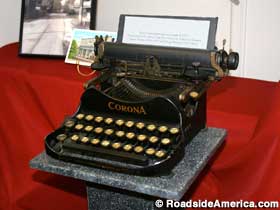
maybe a little late for Christmas:  Here’s the typewriter used to answer letters to Santa Claus, at the U.S. Post Office of Santa Claus, Indiana:

Typewriter used to answer letters to Santa Claus, from the U.S. Post Office in Santa Claus, Indiana - Roadside America photo

Typewriter used to answer letters to Santa Claus, from the U.S. Post Office in Santa Claus, Indiana - Roadside America photo

For 30 years, kids letters to Santa Claus were answered, with the responses typed on this Corona at the Post Office.  The machine rests on display at the Santa Claus Museum in Kris Kringle Plaza in Santa Claus, Indiana, about 40 miles east northeast from Evansville (south of Interstate 64).

Answers to letters to Santa Claus are answered from the museum today.

You can see the typewriter; Roadside America’s website says the museum is open 9:00 a.m. to 5:00 p.m. daily — but you may want to call ahead to confirm:

Santa Claus Museum

Address:
41 N. Kringle Place, Santa Claus, IN
Directions:
On the north side of Hwy 162/Christmas Blvd just west of Holiday World. In Kringle Plaza. Look for the Holiday Foods and the Post Office.
Admission:
Donations.
Hours:
9 am-5 pm daily. (Call to verify)
Phone:
812-937-2687

Spread Santa’s cheer!

Add to FacebookAdd to NewsvineAdd to DiggAdd to Del.icio.usAdd to StumbleuponAdd to RedditAdd to BlinklistAdd to TwitterAdd to TechnoratiAdd to Furl