Robert Johnson’s centennial, May 8: Memorial to the blues

May 8, 2011

May 8, 2011, is the 100th anniversary of the birth of bluesman Robert Johnson.
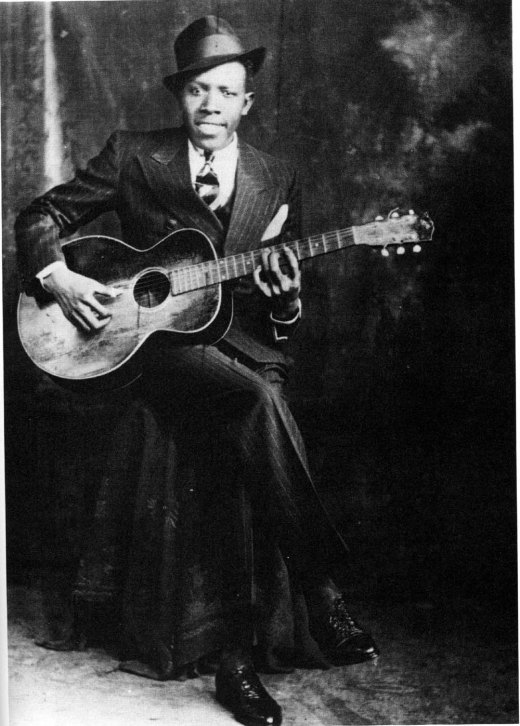
Robert Johnson, hat and guitar
Robert Johnson — one of two known photographs of the Delta blues legend

In a fitting tribute to Johnson and an important coming-of-age coming-to-senses moment, First Presbyterian Church in downtown Dallas announced plans to save the old Brunswick Records Building at 508 Park Avenue, a site where Johnson recorded songs in 1937 that changed the blues, changed recording, and left us a legacy of Johnson to study from his short life.

(On at least one day of those 1937 recordings, Johnson could have brushed shoulders with the Light Crust Doughboys, the Texas Swing legends, who were recording in the same building.  The Doughboys set their own pace and gave birth to Bob Wills and the Texas Playboys.  Two of Texas’s greatest music legends, in the same building on the same day, both just stepping on the platform of the train to immortality.)

Saving 508 Park Avenue vexed Dallas for a couple of decades.  First, blues is not the music of Dallas cognescenti, though the world class musicians in town including Dallas Symphony Orchestra’s Jaap van Zweden tend to support the eclectic music scence and honoring musicians of all genres (and Texas is loaded with different music genres).  Second, while Park Avenue may have been a bustling business district adjunct once, Dallas’s city center suffered 50 years of decline after school desegregation.  Parts of downtown and Uptown begin to look prosperous again, but the southern peninsula of the city, away from the now-packed-with-performance venues Arts District, a freeway and ten blocks away from Uptown, with its back up against another freeway, part of Interstate 30 and the famous Dallas Mixmaster.

508 Park Avenue, Dallas, Robert Johnson's early recording site, photo by Justin Terveen for the Dallas Observer in 2011
508 Park Avenue, Dallas, Robert Johnson’s early recording site, photo by Justin Terveen for the Dallas Observer, 2011

Plus, the building is directly across the street from the Stewpot, a kitchen operated by First Presbyterian Church to serve Dallas large and unfortunately thriving homeless population.

Who wants to renovate an abandoned building that has homeless people as scenery for the better part of the day?

Big news this week:  508 Park Avenue was sold to First Presbyterian, who have plans to save the building (and recording studio!), add a performance amphitheatre at one end of the block, and a park at the other.  This is people-friendly development well ahead of its time — there is not a resident population in that part of the city to support such a venue — yet.

Last summer, it was the neighbors, First Presbyterian Church of Dallas, who made an offer to buy 508 Park Avenue and the adjacent building and empty lot. But the deal was contingent on the city allowing the church, which also operates the Stewpot, to tear down an unrelated building next door, at 1900 Young, and replace it with an outdoor amphitheater for church socials and concerts. The Landmark Commission went into last Monday’s meeting with angels on one shoulder and devils on the other: The commission’s task force suggested approval; city staff, denial. The latter would have sent 508 Park Avenue back into purgatory.

But Landmark OK’d the plan, and the church says it will restore 508 Park Avenue to its former glory, inside and out—including the construction of a real recording studio where Johnson once sat and played “Hell Hound on My Trail.”

The church promises: It has musicians lined up to participate, but it can’t yet reveal who. The church promises: 508 Park Avenue will be resurrected.

One hell of a birthday gift for a man who supposedly sold his soul to the Devil.

The second authenticated photo of blues legend Robert Johnson

So, on Robert Johnson’s 100th birthday (assuming he wasn’t really born in 1912 . . . another mystery for another time, perhaps), the news is that the legendary bluesman who burned out like a shooting star helped save one of the few examples of art deco building decoration in Dallas, when a group of Christians who help the homeless, decided to step in an update their downtown Dallas campus.

Every step of the way, it’s an unlikely story.  Truth is, in this case, much, much stranger than fiction.

Ovation Music released to YouTube the video of Eric Clapton playing and singing “Me and the Devil,” at 508 Park Avenue, in the same room where Robert Johnson sang for a record early on.  Johnson recorded the song at that same location on Sunday, June 20, 1937.

508 Park Avenue, Dallas, is already a memorial to Robert Johnson, to the blues, and to the city where these early blues hits were made.  The struggle remains to make the memorial accessible, and not threatened with destruction.

More, resources: 


Boston Tea Party: An anti-corporation protest?

April 3, 2011

Thom Hartmann said so.  In Hartmann’s reading, the 1773 Boston Tea Party was as much a protest against corporate oligarchy as a protest against government — quite the opposite of the way most Neo Tea Partiers see things.   Is he right?  Historians, what say you?

Hartmann relies on his copy of George R. T. Hewes’ book, A retrospect of the Boston tea-party, with a memoir of George R. T. Hewes, a survivor of the little band of patriots who drowned the tea in Boston harbour in 1773 (1834). Are you familiar with the book?

George R. T. Hewes in 1835, a veteran of the 1773 Boston Tea Party - CUNY image

George Robert Twelves Hewes in 1835 at age 93, a veteran of the 1773 Boston Tea Party. Painting by Joseph G. Cole. CUNY image

More, and resources:


Columbus’s most prized possession

September 28, 2010

Columbus feared that King Ferdinand and Queen Isabella would not honor pledges they had made to him as recompense and honor for his great work of discovery on their behalf.  Before his final voyage, he assembled a legal document showing those promises made to him, and his work for Spain.

This illustrates, once again, the human dimension of the great drama of the age of exploration, of Columbus’s stumbling on to the America’s in his efforts to get to China.

The Library of Congress and the History Channel team up again to show off these grand snippets of history:

On January 5, 1502, prior to his fourth and final voyage to America, Columbus gathered several judges and notaries in his home in Seville. The purpose? To have them authorize copies of his archival collection of original documents through which Isabel and Fernando had granted titles, revenues, powers and privileges to Columbus and his descendants. These 36 documents are popularly called “Columbus’ Book of Privileges.” Four copies of his “Book” existed in 1502, three written on vellum and one on paper. The Library’s copy, one of the three on vellum, has a unique paper copy of the Papal Bull Dudum siquidem of September 26, 1493, which extended the Spanish claim for future explorations.

Borrowed with permission from Mr. Darrell’s Wayback Machine.


Astounding lightning strike photo — Chicago Tribune readers show proper skepticism

June 27, 2010

Amazing photo of two Chicago buildings struck by lightning simultaneously, by Chicago Tribune photog  Chris Sweda:

Dual lightning strike in Chicago, June 2010 - photo by Chris Sweda, Chicago Tribune

Dual lightning strike in Chicago, June 2010 - photo by Chris Sweda, Chicago Tribune

Among other things, the photo isn’t perfect enough to suggest post-shutter-snap manipulation — you can see from other photos that the rain drops on the window disappear with a focus farther away.

Blair Kamin writing at Cityscapes discussed skepticism from readers of the Chicago Tribune about whether the strikes were really simultaneous, or instead the result of a very long exposure.

Exactly the sort of skepticism anti-warmists should have exhibited when confronted with the story of a fourth-grade student in Beeville, Texas, disproving global warming, or the story of a Spanish solar energy company sending a bomb by courier to an anti-warmist, and then bragging about it.

Kamin offers a couple of paths by which a reasonable person can determine it was a chance photo, the photographer pushing the shutter release coincidentally with a double lightning strike (see the “postscripts” section of Kamin’s post).

Were they true to their warming science, in the anti-warmist world two camps would be forming.  One camp would argue the photograph was manipulated, a clever collage of two different photos, or maybe a clever use of miniatures; the other camp would argue that lightning doesn’t strike man-made objects.


Maybe, 4th grader disproves much warming in Beeville, not entire planet?

June 7, 2010

Hmmm.  News from Beeville is tough to come by when limited to calls that tend to catch school officials before they get to their office or after they go home (early, by most standards — but it’s summer, so we cut ’em some slack).

But we can find more information on what would be an astounding, groundbreaking study by 4th grader Julisa Castillo, which has been advertised as disproving global warming.

Again from the Beeville Bee-Picayune, about five months ago:

Conclusion: ‘pretty creative’

by Scott Reese Willey
As world leaders meet in Copenhagen to draft legislation to rein in the release of greenhouse gases and stem climate change, an R.A. Hall Elementary School student is questioning the science supporting global warming.

High school student judging R. A. Hall Elementary science fair projects

Caption from Beeville Bee-Picayune: A.C. Jones High School student Zachary Johnson, above, looks over a science experiment entered in R.A. Hall’s annual science fair. Zachary and other members of the high school’s science club judged the exhibits. Photo from, and read more at: mySouTex.com - Conclusion ‘pretty creative’

“There is not enough evidence to prove global warming is occurring,” fourth-grader Julisa Raquel Castillo concluded in a science project she entered in the campus’ annual science fair on Tuesday.

Julisa studied temperatures in Beeville for the past 109 years to develop her conclusion.

She researched online data basis of the National Oceanic and Atmospheric Administration, or NOAA, the National Weather Service, and checked out books on climate change at the Joe Barnhart Bee County Library.

Her findings:

• temperatures rose and fell from 1900 to 1950.

• temperatures in Beeville cooled down over a 20-year period beginning in 1955 and ending in 1975.

• Since 2001, temperatures in Beeville have grown cooler year after year.

Close to 200 R.A. Hall students entered projects in this year’s science fair, said organizer Denise Salvagno, who also teaches the school’s gifted and talented students.

Fourth- and fifth-graders were required to enter projects as part of class work; however, students in grades first, second and third could enter projects if they desired.

Students in Ben Barris’ science club at A.C. Jones High School judged the projects.

“Some of these projects are pretty creative,” said Zachary Johnson, a senior at A.C. Jones and one of the judges. “You can tell a lot of the students put a lot of effort into their projects. Some of them didn’t put much effort into it but a lot of them did and, overall, I’m impressed with what I am seeing.”

Fourth-grader Kaleb Maguire proved that all tap water in Beeville was the same quality.

He took samples of water at 10 different sites across town and came to the conclusion that because the water originated at the same source — the city’s fresh water plant — the samples contained the same amount of alkalinity, pH and free chlorine.

Fourth-grader Amber Martinez concluded that worms subjected to music were more alert than those not.

And fourth-grader Sam Waters’ project was no doubt much enjoyed by his pet pooch, Lucky.

Sam wanted to know which meat his dog would like more. Turns out Lucky preferred chicken over both hotdogs and sausage.

Fifth-grader Savannah Gonzales found out that ants prefer cheese over sugar, but classmate Misty Nienhouse concluded that ants preferred sugar over cheese. Tessa Giannini’s science project also seemed to prove that ants preferred sugar over cheese, bread or anything else.

However, fourth-grader Faith Hernandez conducted a similar experiment and concluded ants preferred cheese over ham.

Yet, Jose Vivesos, a fourth-grader, concluded that ants prefer sugar water over anything else.

Nathanial Martinez, also a fourth-grader, built a working seismograph and demonstrated how it detected and recorded earthquakes.

Fifth-grader Jamison Hunter decided to see if money in the hand made a difference in someone’s heart rate.

He recorded the heart rate of each volunteer without money in their hand, with one dollar bill in their hand, two one dollar bills in their hand and three one dollar bills in their hand.

His conclusion: “From this experiment, I learned that everyone’s heart rate is different by how much money they hold,” he said. “No two people had the same results even with the test being done the same way.”

Read more: mySouTex.com – Conclusion ‘pretty creative’

Temperatures may have cooled in Beeville.  Can we extrapolate Beeville to the entire planet?

The title of the project may be a little bit ambitious.

[See earlier post on the issue here.]

More:


Beeville fourth grader disproves global warming?

June 7, 2010

John Mashey alerted me to this news story from the online Beeville Bee-Picayune via mySouTex.com:

R.A. Hall fourth-grader is science national champion

R. A. Hall fourth grader Julisa Castillo, national science fair winner?

Caption from mySouTex: R.A. Hall fourth-grader Julisa Castillo (center) is the 2010 national junior division champion for the National Science Fair. Her project, “Disproving Global Warming,” beat more than 50,000 other projects from students all over the nation. She is pictured with her father, J.R. Castillo (left), and R.A. Hall Principal Martina Villarreal. Read more: mySouTex.com - R A Hall fourth grader is science national champion

R.A. Hall Elementary School fourth-grader Julisa Castillo has been named junior division champion for the 2010 National Science Fair.

Her project, “Disproving Global Warming,” beat more than 50,000 other projects submitted by students from all over the U.S.

Julisa originally entered her project in her school science fair before sending it to the National Science Foundation (NSF) to be judged at the national level.

The NSF panel of judges included former U.S. Vice President Al Gore, 14 recipients of the President’s National Medal of Science, and four former astronauts.

“Before she sent it off, she just had to add more details, citations for her research, and the amount of hours she spent working on it,” said Julisa’s father, J.R. Castillo.

In addition to a plaque, trophy and medal, Julisa has won an all-expenses-paid trip to Space Camp at the U.S. Space & Rocket Center in Huntsville, Ala., which she plans to attend this summer.
Read more: mySouTex.com – R A Hall fourth grader is science national champion

The blog of the North County Times (California) has doubts.  There are signs of hoax.  While the Beeville Independent School District does have an R. A. Hall elementary, the list of winners of last December’s science fair does not include Ms. Castillo.  To go from not placing at the local school to winning the national would be quite a feat!

I suspect an error somewhere, perhaps in the title of the project, or in the understanding of what the title implies.

Most of the obvious hoax signs check out against a hoax:  Beeville exists (improbably Texan as the name may be), R. A. Hall is an elementary school in Beeville ISD.  The principal of R. A. Hall is Martina Villareal.  Beeville has a guy named J. R. Castillo (listed as Julisa’s father in the photo caption), and his photos at the site promoting his music shows photos of a guy who looks a lot like the guy in the photo here.  Most hoaxers wouldn’t go so far for accuracy on details.

Fun little mystery.  I have made inquiries with the newspaper, and hope to follow up with the school.  Stay tuned.  There may be a great little science project somewhere in here.

_____________

See update here: Quick summary, big title, project not quite filling those shoes. I’ve made inquiries at the paper and school district without answers; there’s more to the story, but not much.  A good project with a misleading title, for those who would be misled by a 4th grade science fair project.


One more way to know Apollo 11 landed on the Moon

April 4, 2010

Every year at this time . . .

In a discussion of the Cold War, the Space Race, and the Race to the Moon, we get to a photo about Apollo 11’s landing on the Moon.

Like clockwork, a hand goes up:  “Mr. Darrell, wasn’t that landing a hoax?  They didn’t really go to the Moon then, did they?”

There are a lot of ways to know that Apollo 11 landed on the Moon.  Among other things, students could talk to people alive at the time who have the slightest bit of technological savvy:  With lots of other people, I tracked part of the trip with my 6-inch reflecting telescope.  Ham radio operators listened in on the radio broadcasts.  And so on.

But I really like this chunk of evidence:  How about a photograph of the landing site?

Holy cow!  You can see the tracksof Neil Armstrong’s footprints to the lip of Little West crater (see arrow below).

Tranquility Base, from the LROC -- showing evidence of Apollo 11's landing -

Tranquility Base, shot from the Lunar Reconnaissance Orbiter Camera (LROC), showing the traces left by Apollo 11's landing on the Moon. It really happened. Credit: NASA/GSFC/Arizona State University

According to the LROC website:

The astronaut path to the TV camera is visible, and you may even be able to see the camera stand (arrow). You can identify two parts of the Early Apollo Science Experiments Package (EASEP) – the Lunar Ranging Retro Reflector (LRRR) and the Passive Seismic Experiment (PSE). Neil Armstrong’s tracks to Little West crater (33 m diameter) are also discernable (unlabeled arrow). His quick jaunt provided scientists with their first view into a lunar crater.

Check out this video made from the photos, “High Noon at Tranquility Base”:

Fox News?  What’s your story now?

More:

Tip of the old scrub brush to Collect Space forum, and the Carnival of Space #147 at Weird Sciences.  Thanks to ScienceBlips for telling us about Carnival of Space.


Idle thinking, among the bookporn

March 28, 2010

Night out for the boys — well, for Kenny and me — while Kathryn had some of the girls over.

Kenny introduced me to a Dallas sushi venue, Asian Mint.  His appearing-to-be deep-fried Texas Roll was a pleasant, crunchy blend of oriental and Texas.  The mango sauce added a sweet smoothness.  My more standard tuna came with a little internal heat — the wasabi perfectly blended (Kenny is the one who doesn’t like horseradish heat, having somehow missed that gene from my grandfather).

Asian Mint is a Dallas hit (“Asian fusion”).  It’s not Salt Lake City’s Takashi, but for 1,000 miles from the Wasatch Front, it’s a good place for Saturday night.  We got there early.  Families were lined up waiting when we left.

We closed off the night at Half-Price Books, at the store on Northwest Highway fans and employees fondly deem “the mother ship.”  (Years ago, across the street to the east, the store was in an old, converted restaurant which had a pirate’s ship inside; the store kept the ship as a kids’ reading area.  Was that the origin of “mother ship?”)

Books?  Today?

I don’t read enough.  20 years ago I found a study that said if you read one book a month, 12 books a year, you’re in the 99th percentile of readers.

The coffee mug with Einstein on it says “Coffee makes me smart.”  Kenny, our family’s most-tech savvy early-adopter — a high commendation in a family where Mom and Dad have been in computers since mainframes were the way to go — agreed that it’s more likely books that make us smart.  We don’t read enough, but we stay in the 99th percentile.

What an easy, easy way to get ahead!  Get a book:  Read it.

Michael D. Green, the real estate impresario for Murray Hill who formerly headed the Louis August Jonas Foundation when I had so much fun there, used to say that he was not educated, but he read the book reviews.  Reading the book reviews would be better than not knowing.  At a Manhattan cocktail party he could hold his ground with just about anyone.  I’ve never found a topic on which he didn’t know something, usually cutting-edge.  His book recommendations are always epiphanies.

Bookstores are full of them, epiphanies.

So are libraries.  Idle Think’s “bookporn” series cheers me up enormously, most of the time.


Speaking of Texas education policy

January 5, 2010

Moon landing and wrestling in America

from Funnyjunk

This is a troubling piece of humor.  From Funnyjunk.


Stubborn Birthers soldier on

January 4, 2010

Birther “Dr. Kate” sez there’s a case coming to a hearing in Pennsylvania that will go to the Supreme Court no matter how this hearing turns out.

Here’s the table of contents to Kerchner v. Obama. Here’s the full complaint, according to Dr. Kate.

Probably the best thing going for the plaintiffs is that Orly Taitz only appears by name in a bizarre accounting of everything ever said on the issue (except for the lack of evidence and reasons this case will fail which, oddly, isn’t included in the complaint; everything else is included).

I predict the case will be dismissed, but it may be dismissed with prejudice.  That is, if it really does come to a hearing.  Is that really possible?

Warn others so they don’t get trampled:

Add to FacebookAdd to NewsvineAdd to DiggAdd to Del.icio.usAdd to StumbleuponAdd to RedditAdd to BlinklistAdd to TwitterAdd to TechnoratiAdd to Furl


December 30 – Happy Hubble Day 2009!

December 30, 2009

Ultraviolet image of the Andromeda Galaxy, first known to be a galaxy by Edwin Hubble on December 30, 1924 - Galaxy Evolution Explorer image courtesy NASA

Ultraviolet image of the Andromeda Galaxy, first known to be a galaxy by Edwin Hubble on December 30, 1924 - Galaxy Evolution Explorer image courtesy NASA

Today is a good day to celebrate the universe in all it’s glory – December 30. This year, the International Year of Astronomy, makes it a double celebration.

On December 30, 1924, Edwin Hubble announced he’d discovered other galaxies in distant space.  Though it may not have been so clear at the time, it meant that, as a galaxy, we are not alone in the universe (whether we are alone as intelligent life is a separate question).  It also meant that the universe is much, much bigger than most people had dared to imagine.

Logo for International Year of Astronomy 2009 - Astronomy2009.org

Go to Astronomy2009.org

Below, mostly an encore post.

Last year for Hubble Day, Wired picked up on the story (with a gracious link to 2007’s post here at the Bathtub). Wired includes several links to even more information, a good source of information.  See Wired’s 2009 post here.

Hubble was the guy who showed us the universe is not only bigger than we imagined, it’s probably much bigger and much more fantastic than we can imagine. Hubble is the guy who opened our imaginations to the vastness of all creation.

How does one celebrate Hubble Day? Here are some suggestions:

  • Easier than Christmas cards: Send a thank-you note to your junior high school science teacher, or whoever it was who inspired your interest in science. Mrs. Hedburg, Mrs. Andrews, Elizabeth K. Driggs, Herbert Gilbert, Mr. Willis, and Stephen McNeal, thank you.
  • Rearrange your Christmas/Hanukkah/Eid/KWANZAA lights in the shape of the Andromeda Galaxy — or in the shape of any of the great photos from the Hubble Telescope (Andromeda Galaxy pictured above; Hubble images here)

    A few of the images from the Hubble Telescope

    A few of the images from the Hubble Telescope

  • Go visit your local science museum; take your kids along – borrow somebody else’s kids if you have to (take them along, too)
  • Spend two hours in your local library, just looking through the books on astronomy and the universe
  • Anybody got a good recipe for a cocktail called “The Hubble?” “The Andromeda?” Put it in the comments, please

The encore post, from 2007:

December 30, 1924, Edwin Hubble announced the results of his observations of distant objects in space.

PBS

Edwin Hubble - source: PBS

In 1924, he announced the discovery of a Cepheid, or variable star, in the Andromeda Nebulae. Since the work of Henrietta Leavitt had made it possible to calculate the distance to Cepheids, he calculated that this Cepheid was much further away than anyone had thought and that therefore the nebulae was not a gaseous cloud inside our galaxy, like so many nebulae, but in fact, a galaxy of stars just like the Milky Way. Only much further away. Until now, people believed that the only thing existing outside the Milky Way were the Magellanic Clouds. The Universe was much bigger than had been previously presumed.

Later Hubble noted that the universe demonstrates a “red-shift phenomenon.” The universe is expanding. This led to the idea of an initial expansion event, and the theory eventually known as Big Bang.

Hubble’s life offered several surprises, and firsts:

Hubble was a tall, elegant, athletic, man who at age 30 had an undergraduate degree in astronomy and mathematics, a legal degree as a Rhodes scholar, followed by a PhD in astronomy. He was an attorney in Kentucky (joined its bar in 1913), and had served in WWI, rising to the rank of major. He was bored with law and decided to go back to his studies in astronomy.

In 1919 he began to work at Mt. Wilson Observatory in California, where he would work for the rest of his life. . . .
Hubble wanted to classify the galaxies according to their content, distance, shape, and brightness patterns, and in his observations he made another momentous discovery: By observing redshifts in the light wavelengths emitted by the galaxies, he saw that galaxies were moving away from each other at a rate constant to the distance between them (Hubble’s Law). The further away they were, the faster they receded. This led to the calculation of the point where the expansion began, and confirmation of the big bang theory. Hubble calculated it to be about 2 billion years ago, but more recent estimates have revised that to 20 billion years ago.

An active anti-fascist, Hubble wanted to joined the armed forces again during World War II, but was convinced he could contribute more as a scientist on the homefront. When the 200-inch telescope was completed on Mt. Palomar, Hubble was given the honor of first use. He died in 1953.

“Equipped with his five senses, man explores the universe around him and calls the adventure Science.”

That news on December 30, 1924, didn’t make the first page of the New York Times. The Times carried a small note on February 25, 1925, that Hubble won a $1,000 prize from the American Academy for the Advancement of Science.

(Does anyone have a suitable citation for that video? Where did it come from? Who produced it? Is there more somewhere?)

Happy Hubble Day! Look up!

Resources:

Alert others to look up and toast Hubble:

Add to FacebookAdd to NewsvineAdd to DiggAdd to Del.icio.usAdd to StumbleuponAdd to RedditAdd to BlinklistAdd to TwitterAdd to TechnoratiAdd to Furl


A neglected, “Neglected Anniversary” – Mencken, Fillmore and the bathtub

December 29, 2009

Otherwise occupied, I nearly forgot:  92 years ago yesterday, on December 28, 1917, this column by H. L. Mencken was published in The New York Evening Mail:

A Neglected Anniversary

Mencken on April 7, 1933 - end of low-alcohol beer - Baltimore Sun Photo

H. L. Mencken at approximately 12:30 a.m., April 7, 1933, at the Rennert Hotel, corner of Saratoga and Liberty Streets, 17 years later, not neglecting a sudsy anniversary - Baltimore Sun photo

On December 20 there flitted past us, absolutely without public notice, one of the most important profane anniversaries in American history, to wit, the seventy-fifth anniversary of the introduction of the bathtub into These States. Not a plumber fired a salute or hung out a flag. Not a governor proclaimed a day of prayer. Not a newspaper called attention to the day.

True enough, it was not entirely forgotten. Eight or nine months ago one of the younger surgeons connected with the Public Health Service in Washington happened upon the facts while looking into the early history of public hygiene, and at his suggestion a committee was formed to celebrate the anniversary with a banquet. But before the plan was perfected Washington went dry (This was war-time Prohibition, preliminary to the main catastrophe. — HLM), and so the banquet had to be abandoned. As it was, the day passed wholly unmarked, even in the capital of the nation.

Bathtubs are so common today that it is almost impossible to imagine a world without them. They are familiar to nearly everyone in all incorporated towns; in most of the large cities it is unlawful to build a dwelling house without putting them in; even on the farm they have begun to come into use. And yet the first American bathtub was installed and dedicated so recently as December 20, 1842, and, for all I know to the contrary, it may still be in existence and in use.

Curiously enough, the scene of its setting up was Cincinnati, then a squalid frontier town, and even today surely no leader in culture. But Cincinnati, in those days as in these, contained many enterprising merchants, and one of them was a man named Adam Thompson, a dealer in cotton and grain. Thompson shipped his grain by steamboat down the Ohio and Mississippi to New Orleans, and from there sent it to England in sailing vessels. This trade frequently took him to England, and in that country, during the ’30s, he acquired the habit of bathing.

The bathtub was then still a novelty in England. It had been introduced in 1828 by Lord John Russell and its use was yet confined to a small class of enthusiasts. Moreover, the English bathtub, then as now, was a puny and inconvenient contrivance — little more, in fact, than a glorified dishpan — and filling and emptying it required the attendance of a servant. Taking a bath, indeed, was a rather heavy ceremony, and Lord John in 1835 was said to be the only man in England who had yet come to doing it every day.

Thompson, who was of inventive fancy — he later devised the machine that is still used for bagging hams and bacon — conceived the notion that the English bathtub would be much improved if it were made large enough to admit the whole body of an adult man, and if its supply of water, instead of being hauled to the scene by a maid, were admitted by pipes from a central reservoir and run off by the same means. Accordingly, early in 1842 he set about building the first modern bathroom in his Cincinnati home — a large house with Doric pillars, standing near what is now the corner of Monastery and Orleans streets.

There was then, of course, no city water supply, at least in that part of the city, but Thompson had a large well in his garden, and he installed a pump to lift its water to the house. This pump, which was operated by six Negroes, much like an old-time fire engine, was connected by a pipe with a cypress tank in the garret of the house, and here the water was stored until needed. From the tank two other pipes ran to the bathroom. One, carrying cold water, was a direct line. The other, designed to provide warm water, ran down the great chimney of the kitchen, and was coiled inside it like a giant spring.

The tub itself was of new design, and became the grandfather of all the bathtubs of today. Thompson had it made by James Cullness, the leading Cincinnati cabinetmaker of those days, and its material was Nicaragua mahogany. It was nearly seven feet long and fully four feet wide. To make it water-tight, the interior was lined with sheet lead, carefully soldered at the joints. The whole contraption weighed about 1,750 pounds, and the floor of the room in which it was placed had to be reinforced to support it. The exterior was elaborately polished.

In this luxurious tub Thompson took two baths on December 20, 1842 — a cold one at 8 a.m. and a warm one some time during the afternoon. The warm water, heated by the kitchen fire, reached a temperature of 105 degrees. On Christmas day, having a party of gentlemen to dinner, he exhibited the new marvel to them and gave an exhibition of its use, and four of them, including a French visitor, Col. Duchanel, risked plunges into it. The next day all Cincinnati — then a town of about 100,000 people — had heard of it, and the local newspapers described it at length and opened their columns to violent discussions of it.

The thing, in fact, became a public matter, and before long there was bitter and double- headed opposition to the new invention, which had been promptly imitated by several other wealthy Cincinnatians. On the one hand it was denounced as an epicurean and obnoxious toy from England, designed to corrupt the democratic simplicity of the Republic, and on the other hand it was attacked by the medical faculty as dangerous to health and a certain inviter of “phthisic, rheumatic fevers, inflammation of the lungs and the whole category of zymotic diseases.” (I quote from the Western Medical Repository of April 23, 1843.)

The noise of the controversy soon reached other cities, and in more than one place medical opposition reached such strength that it was reflected in legislation. Late in 1843, for example, the Philadelphia Common Council considered an ordinance prohibiting bathing between November 1 and March 15, and it failed of passage by but two votes. During the same year the legislature of Virginia laid a tax of $30 a year on all bathtubs that might be set up, and in Hartford, Providence, Charleston and Wilmington (Del.) special and very heavy water rates were levied upon those who had them. Boston, very early in 1845, made bathing unlawful except upon medical advice, but the ordinance was never enforced and in 1862 it was repealed.

This legislation, I suspect, had some class feeling in it, for the Thompson bathtub was plainly too expensive to be owned by any save the wealthy; indeed, the common price for installing one in New York in 1845 was $500. Thus the low caste politicians of the time made capital by fulminating against it, and there is even some suspicion of political bias in many of the early medical denunciations. But the invention of the common pine bathtub, lined with zinc, in 1847, cut off this line of attack, and thereafter the bathtub made steady progress.

The zinc tub was devised by John F. Simpson, a Brooklyn plumber, and his efforts to protect it by a patent occupied the courts until 1855. But the decisions were steadily against him, and after 1848 all the plumbers of New York were equipped for putting in bathtubs. According to a writer in the Christian Register for July 17, 1857, the first one in New York was opened for traffic on September 12, 1847, and by the beginning of 1850 there were already nearly 1,000 in use in the big town.

After this medical opposition began to collapse, and among other eminent physicians Dr. Oliver Wendell Holmes declared for the bathtub, and vigorously opposed the lingering movement against it in Boston. The American Medical Association held its annual meeting in Boston in 1849, and a poll of the members in attendance showed that nearly 55 per cent of them now regarded bathing as harmless, and that more than 20 per cent advocated it as beneficial. At its meeting in 1850 a resolution was formally passed giving the imprimatur of the faculty to the bathtub. The homeopaths followed with a like resolution in 1853.

But it was the example of President Millard Fillmore that, even more than the grudging medical approval, gave the bathtub recognition and respectability in the United States. While he was still Vice-President, in March, 1850, he visited Cincinnati on a stumping tour, and inspected the original Thompson tub. Thompson himself was now dead, but his bathroom was preserved by the gentlemen who had bought his house from the estate. Fillmore was entertained in this house and, according to Chamberlain, his biographer, took a bath in the tub. Experiencing no ill effects, he became an ardent advocate of the new invention, and on succeeding to the Presidency at Taylor’s death, July 9, 1850, he instructed his secretary of war, Gen. Charles M. Conrad, to invite tenders for the construction of a bathtub in the White House.

This action, for a moment, revived the old controversy, and its opponents made much of the fact that there was no bathtub at Mount Vernon, or at Monticello, and that all the Presidents and other magnificoes of the past had got along without any such monarchical luxuries. The elder Bennett, in the New York Herald, charged that Fillmore really aspired to buy and install in the White House a porphyry and alabaster bath that had been used by Louis Philippe at Versailles. But Conrad, disregarding all this clamor, duly called for bids, and the contract was presently awarded to Harper & Gillespie, a firm of Philadelphia engineers, who proposed to furnish a tub of thin cast iron, capable of floating the largest man.

This was installed early in 1851, and remained in service in the White House until the first Cleveland administration, when the present enameled tub was substituted. The example of the President soon broke down all that remained of the old opposition, and by 1860, according to the newspaper advertisements of the time, every hotel in New York had a bathtub, and some had two and even three. In 1862 bathing was introduced into the Army by Gen. McClellan, and in 1870 the first prison bathtub was set up at Moyamensing Prison, in Philadelphia.

So much for the history of the bathtub in America. One is astonished, on looking into it, to find that so little of it has been recorded. The literature, in fact, is almost nil. But perhaps this brief sketch will encourage other inquirers and so lay the foundation for an adequate celebration of the centennial in 1942.

(Text courtesy of Poor Mojo’s Almanac(k))

The entire history was a hoax composed by Mencken.

Even conservative wackoes appreciate the column.

Content with his private joke, Mencken remained silent about the hoax until a follow-up article, “Melancholy Reflections,” appeared in the Chicago Tribune on May 23, 1926, some eight years later. This was Mencken’s confession. It was also an appeal for reason to the American public.

His hoax was a joke gone bad. “A Neglected Anniversary” had been printed and reprinted hundreds of times in the intervening years. Mencken had been receiving letters of corroboration from some readers and requests for more details from others. His history of the bathtub had been cited repeatedly by other writers and was starting to find its way into reference works. As Mencken noted in “Melancholy Reflections,” his “facts” “began to be used by chiropractors and other such quacks as evidence of the stupidity of medical men. They began to be cited by medical men as proof of the progress of public hygiene.” And, because Fillmore’s presidency had been so uneventful, on the date of his birthday calendars often included the only interesting tidbit of information they could find: Fillmore had introduced the bathtub into the White House. (Even the later scholarly disclosure that Andrew Jackson had a bathtub installed there in 1834—years before Mencken claimed it was even invented—did not diminish America’s conviction that Fillmore was responsible.)

(No, dear reader, probably not correct; surely John Adams brought a bathtub with him when he moved into the White House, then called the President’s Mansion.  Plumbing, hot water, and finally hot water to a bathtub in the president’s residence, were installed between 1830 and 1853, as best I can determine.)

Mencken wrote an introduction to the piece in a later bookA Mencken Chrestomathy (Alfred A. Knopf, 1949):

The success of this idle hoax, done in time of war, when more serious writing was impossible, vastly astonished me. It was taken gravely by a great many other newspapers, and presently made its way into medical literature and into standard reference books. It had, of course, no truth in it whatsoever, and I more than once confessed publicly that it was only a jocosity . . .  Scarcely a month goes by that I do not find the substance of it reprinted, not as foolishness but as fact, and not only in newspapers but in official documents and other works of the highest pretensions.

There’s a moral to the story:  Strive for accuracy!

So, Dear Reader, check for accuracy, and question authority.

Resources:

Warn others of the hoax!

Add to FacebookAdd to NewsvineAdd to DiggAdd to Del.icio.usAdd to StumbleuponAdd to RedditAdd to BlinklistAdd to TwitterAdd to TechnoratiAdd to Furl


Yeah, it’s ironic (hacked e-mails and global warming)

November 26, 2009

James’s Empty Blog:

It is hard to miss the irony in people eagerly poring through illegally-obtained private email, looking for ethical breaches by the writers! I’m sure we can all imagine the outrage if one of the emails revealed that a scientist had hacked into one of the sceptics’ computers and was reading all their correspondence. So a bit of perspective is called for here.

James Is A Scientist (IANAS), and he has much good stuff to say (read some of the other posts about the hacked e-mails while you’re there) — but you gotta wonder about a blog that follows such a post with this:

Prawns, Jules Berry

Prawns not in their native habitat. Probably Tastimus deliciousus

Tip of the old scrub brush to Stoat.


Naomi Oreskes: The lecture Lord Monckton slept through, which he hopes you will not see

October 23, 2009

Here’s another example of where historians show their value in science debates.

Naomi Oreskes delivered this lecture a few years ago on denialism in climate science.  Among other targets of her criticism-by-history is my old friend Robert Jastrow.  I think her history is correct, and her views on the Marshall Institute and denial of climate change informative in the minimum, and correct on the judgment of the facts.

You’ll recognize some of the names:  Jastrow, Frederick Seitz, S. Fred Singer, and William Nierenberg.

Oreskes details the intentional political skewing of science by critics of the serious study of climate warming.  It’s just under an hour long, but well worth watching.  Dr. Oreskes is Professor of History in the Science Studies Program at the University of California at San Diego.  The speech is titled “The American Denial of Global Warming.”

If Oreskes is right — and I invite you to check her references thoroughly, to discover for yourself that her history and science are both solid — Lord Monckton is a hoaxster.  Notice especially the references after the 54 minute mark to the tactic of claiming that scientists are trying to get Americans to give up our sovereignty.

Nothing new under the sun.

“Global warming is here,  and there are almost no communists left,” Oreskes said.

Nudge your neighbor:

Add to FacebookAdd to NewsvineAdd to DiggAdd to Del.icio.usAdd to StumbleuponAdd to RedditAdd to BlinklistAdd to TwitterAdd to TechnoratiAdd to Furl


We become the ephemera of history: ‘Only the privileged few of us get to be fossils’

October 21, 2009

From “Whose father was he?” a four-part essay on tracking down the story of three children whose photograph was discovered on the corpse of a Union soldier killed at the Battle of Gettysburg, in 1863:

Perhaps more than any other artifact, the photograph has engaged our thoughts about time and eternity. I say “perhaps,” because the history of photography spans less than 200 years. How many of us have been “immortalized” in a newspaper, a book or a painting vs. how many of us have appeared in a photograph [32]? The Mayas linked their culture to the movements of celestial objects. The ebb and flow of kingdoms and civilizations in the periodicities of the moon, the sun and the planets. In the glyphs that adorn their temples they recorded coronations, birth, deaths. Likewise, the photograph records part of our history. And expresses some of our ideas about time. The idea that we can make the past present.

The photograph of Amos Humiston’s three children — of Frank, Alice and Fred — allows us to imagine that we have grasped something both unique and universal. It suggests that the experience of this vast, unthinkable war can be reduced to the life and death of one man — by identifying Gettysburg’s “Unknown Soldier” we can reunite a family. That we can be saved from oblivion by an image that reaches and touches people, that communicates something undying and transcendent about each one of us.

And the footnote, number 32:

[32] I had an opportunity to visit the fossil collections at the Museum of the Rockies in Bozeman, Montana. It was part of a dinosaur fossil-hunting trip with Jack Horner, the premier hunter of T-Rex skeletons. Downstairs in the lab, there was a Triceratops skull sitting on a table. I picked it up and inserted my finger into the brain cavity. (I had read all these stories about how small the Triceratops brain had to have been and I wanted to see for myself.) I said to Jack Horner, “To think that someday somebody will do that with my skull.” And he said, “You should be so lucky. It’s only the privileged few of us who get to be fossils.”

See Errol Morris’s whole series, “Whose father was he?” at the New York Times blogs:

  • Whose Father Was He? (Part Five)
  • Whose Father Was He? (Part Four)
  • Whose Father Was He? (Part Three)
  • Whose Father Was He? (Part Two)
  • Whose Father Was He? (Part One)
