An Ohio friend alerted my wife to this piece from the University of Texas Tuba/Euphonium Studio:
Nice production of an old folk/gospel tune, “Down in the River to Pray.” (Considerably different from the Allison Krauss “O, Brother Where Art Thou” version, no?)
Did they record this as a recruiting tool? Or just for the beauty of it?
Credits:
The University of Texas Tuba/Euphonium Studio
Charles Villarrubia, Associate Professor Tuba/Euphonium
Euphonium
Alex Avila
Jose Flores
Luke Gall
Eric Gonzales
Fabian Vargas
Tuba
John Flores
Clay Garrett (soloist)
Keith Packman
Danny Trumble
Ben Vasko
T.J. West
Taylor Rudd, Director of Photography
Mario Mattei, Camera Operator
Jacob Ryan Hamilton, Aerial Photography
Joshua Gall, Recording Engineer
Ani Villarrubia, Production Assistant
U.S.S. Reuben James (DD-245) on the Hudson River in April 1939, over two years before she was sunk in the Battle of the Atlantic. Photo from the Ted Stone Collection, Marines Museum, Newport News, Virginia, via Wikipedia
It was a tragedy in 1941, but before the U.S. could develop a serious policy response to Germany’s action, Japan attacked Pearl Harbor. Within a week after that, our policy towards Germany was set by Germany’s declaration of war on the U.S.
It’s important history for a couple of reasons.
The sinking was part of the massive, years-long Battle of the Atlantic, which the Allies won only by building ships faster than Germany could sink them. Had the Allies lost this battle, the war would have been lost, too.
While the USS Reuben James was a Navy destroyer, the key weapons of the Battle of the Atlantic were Merchant Marine cargo ships, carrying goods and arms to Britain and other Allied nations. “Civilians” played a huge role in World War II, supplying the soldiers, armies, navies and air forces.
Recently, politicians took to making claims that the U.S. declared war on Germany without any hostile action having passed between them, without Germany having perpetrated any hostilities toward the U.S. Look at the dates, it’s not so.
Woody Guthrie wrote a song about the event, giving us a touchstone to remember.
Millard Fillmore’s Bathtub covered the event with longer, detailed articles in past years, including these, which you should see especially if you are a student in a history class or a teacher of one:
Europe has changed. The world has changed. The U.S. has changed. War has changed. We should remember, especially those people who died defending the merchants who defended the idea of the Four Freedoms.
Reuben James was born in Delaware, Ohio about 1776. He joined the U.S. Navy and served on various ships, including the frigate USS CONSTELLATION. It was during the infamous Barbary Wars that the American frigate PHILADELPHIA was captured by the Barbary pirates. Having run aground in the pirate capital of Tripoli on the southern shores of the Mediterranean Sea, the crew had to abandon ship and formulate a plan of attack. Lieutenant Stephen Decatur, along with a group of volunteers which included Boatswain’s Mate Reuben James, entered Tripoli harbor under the cover of darkness in an attempt to set the PHILADELPHIA to the torch so that the pirates could not make use of her.
The American volunteers boarded the PHILADELPHIA on 16 February 1804 and were met by a group of the savage Barbary pirates who were guarding their prize. A furious battle ensued, and during the bloody chaos of hand-to-hand combat, a villanous pirate made ready to end the life of Lieutenant Decatur. Reuben James, with both of his hands already wounded, in an act of selfless dedication and courage did throw his hand before the pirate’s cleaving blade! Willing to give his life in defense of his captain, Reuben James took the blow from the sword!
Having proved to the world over the courage and dedication of United States Sailors, Reuben James also hammered home the fact that US Sailors are undefeatable by not only surviving, but recovering from his wounds and continuing his career in the U.S. Navy! After spending many more years with Decatur, James was forced to retire in January 1836 because of declining health brought on because of past wounds. He died on 3 December 1838 at the U.S. Naval Hospital in Washington, D.C.
In the spirit of “Playing for Change,” Jewish cantors and congregations from around the world cooperated to produce the 92nd Street Y’s version of “A New Year,” a song by Michael Hunter Ochs. Pictured is Cantor Julia Cadrain, Central Synagogue, New York City.
New York’s arts-active 92nd Street Y produced a fine little video of several Jewish congregations and cantors from around the world collaborating on a tune for Rosh Hashana.
“A New Year” would be a suitable tune for any congregation that sings, I think, regardless faith. While the video is for the new Jewish year 5777, no reason it can’t be adopted by any group needing a song to see in 2017, or a new liturgical year, or a new fiscal year.
In fact, it would do the nation good were Congress to walk out on the steps of the U.S. Capitol and sing this song at the start of every Fiscal Year, on October 1 (not too late for this year, Paul Ryan . . .).
At Bill Moyers’s site the blog features an historic post from Peter Rothberg, associate editor at The Nation, feature his admittedly-too-exclusive Top Ten Labor Day songs.
Einstein playing his violin in 1931, aboard the S.S. Belgenland, travelling from New York to San Diego. Vintage Everyday image. Einstein claimed to get great joy from his violin. Did it also help his physics work?
Albert Einstein played a mean violin. I don’t think any recordings exist, but some say he was good enough to have earned a slot in a decent symphony.
Albert Schweitzer made money to support his work for health in Africa by offering organ recitals.
Thomas Edison liked to hire men in his lab who played instruments. In the midst of high pressure experimentation, they would often take a break as a group, and do a performance just for themselves.
People who make music often claim they do it to relax, but there may be more than mere relaxation going on when we play an instrument or sing. It’s possible making music makes us better at doing other things, too.
Should we be surprised this showed up from the World Economic Forum?
Over the past two decades, several investigators have reporteddifferences in the brain and behavior of musicians compared to nonmusicians.
Music training has been found to be related to better language and mathematical skills, higher IQ and overall greater academic achievement. Also, differences between musicians and nonmusicians have been found in areas of the brain related to hearing and movement, among others.
However, the interpretation of the findings remains unclear. For example, the differences reported between adult musicians and nonmusicians might be due to long-term intensive training or might result primarily from inherent biological factors, such as genetic makeup.
Or, as with many aspects of the nature-versus-nurture debate, the differences may well result from contributions of both environmental and biological factors.
One way to better understand the effects of music training on child development would be to study children before they start any music training and follow them systematically after, to see how their brain and behavior change in relation to their training.
It would involve including a comparison group, as all children change with age. The ideal comparison group would be children who participate in equally socially interactive but nonmusical training, such as sports. Follow-up assessments after their training would reveal how each group changes over time.
Go take a look.
If you’re a teacher, ask whether you should be incorporating more music into your social studies, language or science classes. If you’re a manager or employer, ask whether you should be encouraging your team members to find musical outlets.
If you’re just curious, ask whether you wouldn’t be better off to volunteer in a local choir or band.
Maybe we should all dance to beats of different drummers, and violinsts, and guitarists, and clarinetists and . . .
Three years of this study remain. But these interim results are promising. They support previous findings on the positive impact of music training on brain development.
Our findings suggest that music training during childhood, even for a period as brief as two years, can accelerate brain development and sound processing. We believe that this may benefit language acquisition in children given that developing language and reading skills engage similar brain areas. This can particularly benefit at-risk children in low socioeconomic status neighborhoods who experience more difficulties with language development.
Should we be using this tool to better educate our kids?
Spread the word; friends don't allow friends to repeat history.
Yes, it’s a form of advertisement, for Woodford Reserve. But it’s timely, with the 2016 Kentucky Derby just hours away.
And, it’s beautiful. Ben Sollee’s arrangement of this old chesnut of a tune is wonderful, performed with elan on a cello, which is hardly a folk staple. The video appears to have been shot in ambient light (check the reflections on Ben’s glasses).
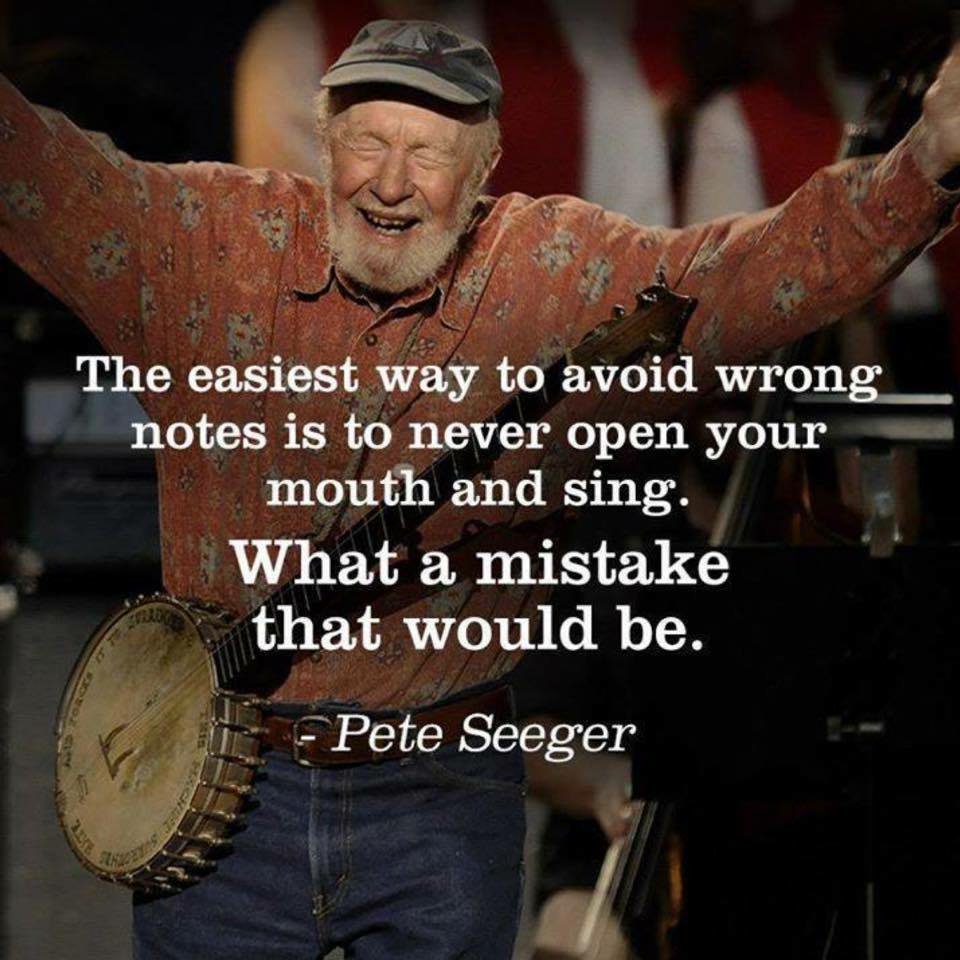
I don’t have a citation for where Pete Seeger said this, but it’s wholly within his character and mission. Anyone got a cite?
A Tweet from @Area9Handbells: Pete Seeger got it right with the exception of one word – “sing.” We think he meant “ring.”
“The easiest way to avoid wrong notes is to never open your mouth and sing. What a mistake that would be.”
∇ Pete Seeger
I’ve asked for a citation, for accuracy and to keep the anti-plagiarism and accuracy mavens happy, but don’t have one yet. Nor do I know to whom goes credit for the poster and photo. Can you help?
Spread the word; friends don't allow friends to repeat history.
Image from Avi Ofer’s film, “Jingle Bells,” with the JLCO. Image from Jazz Blog
Great animation, great orchestra, great arrangement, great song!
YouTube description and details:
Make the Yuletide swing with Jingle Bells from the Jazz at Lincoln Center Orchestra with Wynton Marsalis! Jingle Bells is featured on BIG BAND HOLIDAYS, their new album out now on Blue Engine Records.
Produced by Jazz at Lincoln Center and 1504
Animation by Avi Ofer
BIG BAND HOLIDAYS is the first holiday album ever released by DownBeat Readers Poll’s Best Big Band of 2013 & 2014, Big Band Holidays features original big band arrangements of timeless favorites including Have Yourself a Merry Little Christmas, We Three Kings, and White Christmas. Nine-time GRAMMY Award winner and Pulitzer Prize winner Wynton Marsalis and the JLCO are joined by special guest vocalists Cécile McLorin Salvant, Gregory Porter, and René Marie on what’s sure to become a holiday classic.
Especially with two or three FM stations in Dallas running Christmas music nonstop from Thanksgiving to Christmas, I grow weary of the same, hoary old arrangements. Nor can I live forever on the great choral stuff from the classical station.
Jazz at Christmas puts me at ease, and into the spirit.
So it is that every Christmas, after the actual holiday, I go shopping for deals on Christmas jazz. This new album from Wynton Marsalis and the Jazz at Lincoln Center Orchestra (JLCO) is good enough, it may not be discounted. Marketers will hold it until next year. When we buy from Blue Engine Records, profits probably support Jazz at Lincoln Center.
But you can listen to it now, with the wonderful Avi Ofer animation above.
Or, listen to every song from the album performed live just a few weeks ago:
Spread the word; friends don't allow friends to repeat history.
Beethoven takes an unplanned swim in his rush to the concert hall in Google’s Doodle honoring the composer’s 245th year. Image from Google, via Washington Post
Maybe we should say “happy baptism.” The infant Ludwig von Beethoven was baptized on December 17, 1770; he was born the previous day, perhaps (some historians disagree).
But the point is, Google honors Beethoven with an interactive Google Doodle, one of the best they’ve ever done. The Doodle features the composer finishing scores and heading to the concert hall — with a series of mishaps along the way that scatter his musical scores and leaves them torn up, speared and generally out of order.
Then you, Dear Reader, get a chance to re-arrange the score in order. When you do that, it plays. Finally Beethoven gets to the concert hall.
It’s a great learning device, really. Can Google do this for history? Can we figure out a way to create these for use in our classrooms?
Now that you’ve finished the quizzes, relax for 42 minutes with Beethoven’s Symphony No. 6, The Pastorale, performed by the Bremen symphonie, directed by Paavo Jarvi.
Before I new much about him, back in the late 1970s I fell into tickets to see Pat Metheney and his band (with Lyle Mays) at the old Cellar Door in Washington, D.C. (If I recall correctly; anyone know better?)
The amplifier lineup, as I recall, was most impressive, long before the musicians got on stage. There were two massive pillars of speakers that reminded me much of Blue Cheer and their claim to be the loudest band ever. When Metheny opened up, it was by far the loudest concert I’d ever heard (no, I never did make it to hear Blue Cheer).
I was hooked. It’s been fun watching his journey through many incarnations of his own band, and working with others including Joni Mitchell on the Shadows and Light Tour. I can’t keep up with every release of bands I like, but we have several Metheny discs in vinyl and CD.
I’d heard he has some custom-built instruments, including a 42-string monstrosity. But today on ran into a photo of the beast on Pinterest.
Pat Metheny’s 42-string harp guitar, called a Pikasso guitar (I don’t know why).
That made me curious, so I nosed around and found this video of Metheny and a band in performance, in which he plays this thing. From a 2007 concert, Jazzaldia; the piece is called “The Sound of Water”:
In the video you can see a cord coming out of the instrument. How are the pickups set, and what kind does it use?
(This is a slightly-edited encore post, for St. Patrick’s Day — I like the Corrigan Brothers’ droll tune.)
I’d forgotten about the birthers’ greatest nightmare — Obama’s got Irish blood in him!
Democratic Underground features a series of photos of President Obama with an Irish cousin at one of my favorite old haunts in Washington, the Dubliner.
President Barack Obama drinks a Guinness with his ancestral cousin from Moneygall Ireland Henry Healy, center, and the owner of the pub in Moneygall Ireland, Ollie Hayes, right, at The Dubliner Restaurant and Pub and Restaurant on St. Patrick’s Day, Saturday, March 17, 2012, in Washington (Official White House Photo by Pete Souza)
Many great memories of the Dubliner, including its own great business success.
In 1974, when I interned at the Senate, the Dubliner was just a small bar on the first floor of the Commodore Hotel. Rocky Johnson of Sen. Mike Gravel‘s office, one of my roommates, introduced me to Guinness. The Dubliner was the most reliable source in D.C. at the time. The bartender was a guy named Paddy. It was never crowded — and they had good fish and chips with a fine, imported malt vinegar. I wasn’t exactly a regular, but I made several a lot of visits.
Ironically, for my summer job later that year with the Louis August Jonas Foundation, we had a trip to D.C. planned with about 16 “boys from abroad” and the designated hotel was the Commodore — it was cheap and met our needs, being close to the Capitol. I was asked to chaperone, and happily went. So Freddy Jonas, the great benefactor of the foundation and Camp Rising Sun, and I could sneak down to the Dubliner for a nightcap after the boys were asleep. Michael Greene, the foundation’s executive director at the time, warned me that Freddy would always ask if you wanted a second drink, but Freddy would not take one himself — and so, of course, neither should staffers.
One night while Freddy and I were capping off the evening we ran into a friend from my interning, Avis Ortner, a former rodeo barrel rider who had starred in a Kodak commercial series, and who worked in a Washington law firm. She and Freddy struck it off very nicely. I was surprised at how much Freddy knew about horses, and the questions he had about rodeo riding. At some point in the evening he asked me if I were going to have a second drink, and of course I declined. “Well, you only live once. Avis and I are having a second one, and you should join us.” People who knew Freddy well still don’t believe me when I tell them the story. But it’s true. It’s the magic of the Dubliner. [Is Avis still cleaning up at bridge in D.C.? [Yes!]]
I was back in D.C. in 1975, again with the Jonas Foundation bunch, and again at the Commodore. The Dubliner had a successful year, and had taken over the small cafe/dining room next door to bar.
In 1976 I visited again, and after a very successful year the Dubliner kicked out the gift shop of the hotel and opened a second bar there. It was crowded on weekends.
In 1979 I moved to D.C. Within a couple of years the Dubliner bought out the Commodore. You couldn’t get a seat at the bar most nights. St. Patrick’s Day 1980 the line wrapped around the block, and though the place never had a great or large stage, the live act was the Clancy Brothers with Tommy Makem, if I recall correctly.
Reconstruction and massive redecorating made the hotel into a great stop, and a sometimes pricey room. Eventually the bar company sold the hotel, but kept the location for the bar. After Kathryn and I got married, we’d walk over to the Dubliner for lunch at least a couple of times a month, and the fish and chips at the Dubliner got better. I may have done in half the cod from the Grand Banks all by myself.
We’ve been in Texas now since 1987. I miss the Dubliner. Have been able to make it back only a couple of times. Obama’s lucky he could get in, on St. Patrick’s Day. I hope he appreciates his luck.
Yes, this is mostly an encore post. Fighting ignorance requires patience.
Spread the word; friends don't allow friends to repeat history.
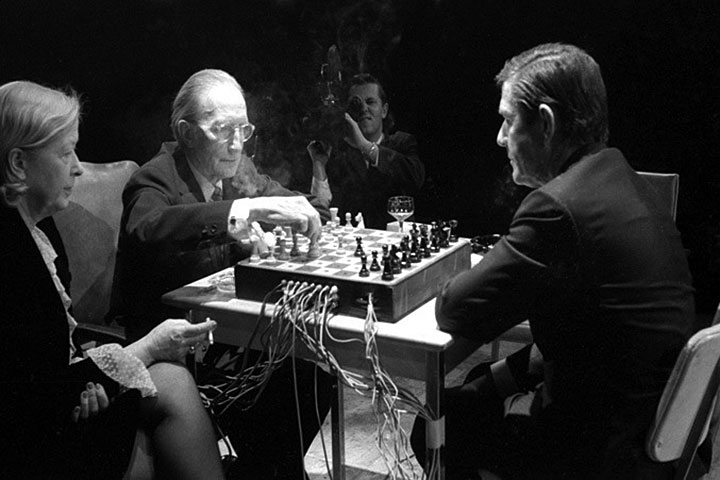
Marcel Duchamp plays white, John Cage plays black, on a chessboard modified to generate tones depending on where the chess pieces are. Toronto, 1968. Teeny Duchamp at far left, cameraman in the background. This was a performance.
Composer John Cage sought him out in Duchamp’s last years, and made a point of meeting with the artist at least once a week. Cage experimented with a chessboard designed to generate music depending on the positions of the chess pieces on the board (hence, the wires). This photo came from a performance at a festival in Toronto in 1968.
Yeah, it’s processed. Nice image, good photography, deft hand at the computer.
Happy Statehood Day, Kansas.
Photo from the Wichita Eagle. Caption there: Star trails paint the night sky above the Home on the Range Cabin. Home on the Range cabin built was 1872 by Brewster Higley, author to the words of Home on the Range song. —The photo is a composite photo of more than 500 individual photos to capture the night sky. (May 2, 2014) Read more here: http://www.kansas.com/news/state/article8132118.html#storylink=cpy
Photo of a cabin built in 1872 by Brewster Higley, the lyricist to the so-old-and-loved-it’s-almost-traditional “Home On the Range.” A bill in the Kansas State Senate proposes to designate part of U.S. Highway 36 as the Home On the Range Memorial Highway.
(Who took the photo? The Wichita Eagle didn’t give a credit!)
Spread the word; friends don't allow friends to repeat history.
Now everybody’s celebrating. Time for a quick reprise of this post from June.
Published on Jun 19, 2014
Grammy Award winning bluegrass band the Steep Canyon Rangers, well known for their work with Steve Martin, perform a special version of “The Star-Spangled Banner” for the Smithsonian’s National Museum of American History in honor of the song’s 200th anniversary.
The museum will “Raise It Up!” and celebrate the 200th anniversary by uniting the original manuscript with the flag at the Museum from June 14-July 6, 2014 and holding a special event at the museum on Flag Day (Saturday, June 14, 2014). Join the party: http://anthemforamerica.smithsonian.com/
Special thanks to the team at Wool and Tusk for their hard work and creativity: Scott Mele, Roger Pistole, Derek West, Joe Pisapia, David Bartin, Michael Freeman, Alexis Kaback, Daniel Walker, Jeff Rosen, Harvey Moltz, and Greg and Erin Whiteley.
On August 4, 1964, President Johnson awoke to the news that two U.S. Navy ships cruising in the Tonkin Gulf had been fired upon by North Vietnamese Navy gunboats; then the FBI called and announced that the bodies of three civil rights workers had been found, young men registering African Americans to vote in Mississippi. Both of these events rumble through history like a Rocky Mountain avalanche to today; either was a make-or-break event for any presidency.
And also on that day, the U.S.S. Maddox reported it had been attacked by gunboats of the North Vietnamese Navy, in the Gulf of Tonkin. The Gulf of Tonkin incident led to the Gulf of Tonkin Resolution, which gave Johnson the authority to expand and escalate the war in Vietnam, which he did.
Cover for the CD of the Dallas Symphony’s Grammy-nominated performance of Steven Stucky’s “August 4, 1964,” Jaap van Zweden conducting.
The Dallas Symphony commissioned the work, from composer Steven Stucky and librettist Gene Scheer, in commemoration of President Johnson’s 100th birth anniversary — he would have been 100 on August 27, 2008. The works were premiered in Dallas in 2008.
The music is outstanding, especially for a modern piece. The Dallas Symphony was at its flashiest and most sober best, under the baton of new conductor Jaap van Zweden. It was a spectacular performance. According to the New York Times:
Mr. van Zweden, hailed in his debut as music director a week before, scored another triumph here. And the orchestra’s assured and gritty performance was rivaled by that of the large Dallas Symphony Chorus, both corporately and individually, in shifting solo snippets charting the course of the fateful day.
The strong cast, mildly amplified, was robustly led by the Johnson of Robert Orth, last heard as another president in John Adams’s “Nixon in China” in Denver in June. Laquita Mitchell and Kelley O’Conner, wearing period hats, were touching as Mrs. Chaney and Mrs. Goodman. Understandably, the taxing role of a high-strung McNamara took a small toll on the tenor of Vale Rideout in his late aria.
The entire thing deserves more commentary, perhaps soon. There is stellar history in the choral piece. And there is this: Consider that Lyndon Johnson, the best legislator and second most-effective executive we ever had as president, got hit with these two crises the same day. On the one hand the nation got the Voting Rights Act, the Fair Housing Act, executive orders and government support to end segregation and the evils it created. On the other hand, we got stuck with the disaster of the Vietnam War.
How would the nation fared had a lesser person been in the White House on that day?
(August 4 is a busy, busy day in history; much to think about.)
Or, until that account is unsuspended by the forces supporting Donald Trump: Follow @FillmoreWhite, the account of the Millard Fillmore White House Library
We've been soaking in the Bathtub for several months, long enough that some of the links we've used have gone to the Great Internet in the Sky.
If you find a dead link, please leave a comment to that post, and tell us what link has expired.
Thanks!
Retired teacher of law, economics, history, AP government, psychology and science. Former speechwriter, press guy and legislative aide in U.S. Senate. Former Department of Education. Former airline real estate, telecom towers, Big 6 (that old!) consultant. Lab and field research in air pollution control.
My blog, Millard Fillmore's Bathtub, is a continuing experiment to test how to use blogs to improve and speed up learning processes for students, perhaps by making some of the courses actually interesting. It is a blog for teachers, to see if we can use blogs. It is for people interested in social studies and social studies education, to see if we can learn to get it right. It's a blog for science fans, to promote good science and good science policy. It's a blog for people interested in good government and how to achieve it.
BS in Mass Communication, University of Utah
Graduate study in Rhetoric and Speech Communication, University of Arizona
JD from the National Law Center, George Washington University


 Posted by Ed Darrell











 Millard Fillmore's Bathtub