How to start a hoax against a presidential candidate

June 29, 2008

Hoax complaints against presidential candidates are old ideas. In 1796, Alexander Hamilton paid newspaper editors to print stories saying Thomas Jefferson was atheist. It was a minor theme in that campaign, but after John Adams’ political fortunes foundered on the Alien and Sedition Acts, among other missteps, Hamilton stepped up the attacks in the election of 1800.

Jefferson’s great biographer, Dumas Malone, estimates that by election day, fully half the American electorate believed Jefferson was atheist. Jefferson made a perfect target for such a charge — staunch advocate of religious freedom, he thought it beneath the dignity of a politician to answer such charges at all, so he did not bother to deny them publicly. Ministers in New England told their congregations they would have to hide their Bibles because, as president, Jefferson would send troops to confiscate them.

In a warning to hoaxers, we might hope, Americans elected Jefferson anyway.

Such nefariousness plagues campaigns today, still. Boone Pickens, who helped fund the Swiftboat Veterans’ calumny against war hero John Kerry, has an offer to pay $1 million to anyone who can show the charges false. In a replay of Holocaust denial cases, Pickens refuses to accept any evidence to pay the award, last week turning away the affidavits of the men who were present at the events.

At the Bathtub, we’ve already sampled a crude and steady attempt to brand Hillary Clinton a Marxist with creative editing of a few of her speeches.

The assaults on Barack Obama are already the stuff of legend. The comic strip, “Doonesbury,” is running a story line with a volunteer for the internet rumor stopping part of the campaign, FighttheSmears.com. The smears are real.

Doonesbury strip 6-28-2008

Matthew Most of the Washington Post wrote a lengthy piece in yesterday’s paper, “An attack that came out of the ether,” on the research done by a woman at the Institute for Advanced Study in Princeton, New Jersey, on the origins of the internet hoax that Barack Obama is a Muslim — a rumor so potent that Georgetown University Prof. Edward Luttwak repeated it in a New York Times op-ed article, without the fact checkers catching it (the Times consulted five scholars of Islam who all agreed the foundation for the claim is incorrect).

Danielle Allen has tracked the rumor back to its sources, in a failed campaign against Obama in Illinois and a candidate who admittedly was looking for mud, and one constant sniper at FreeRepublic.com. It’s impressive sleuthing, and the article would be a good departure for study of how media affect campaigns in a government or civics class.

The “how to” list is really very short:

  • Pick an area of a candidate’s life that is not well known. As the Hamilton campaign against Jefferson demonstrates, it’s useful if the candidate does not feature the issue in official biographies, and more useful if the candidate doesn’t respond. Michael Dukakis let several issues slide in his campaign for the presidency, saying that he didn’t think the public would be misled. The public was waiting for a rebuttal.
  • It helps if there is a factoid that is accurate in the rumor. Obama’s father was Muslim. Most Americans were receptive to the false claim that in Islam, a child is considered Muslim unless there is a conversion. A part of the rumor claims Obama was never baptized Christian. Of course, no one has asked to see John McCain’s baptismal papers. One wonders whether a rumor about McCain’s not being born inside the U.S. could get similar traction among voters (McCain was born in Panama while his father was serving in the Panama Canal Zone in the Navy; children of U.S. citizens are automatically U.S. citizens regardless where they are born. The issue was litigated during Barry Goldwater’s candidacy in 1964, since Goldwater was born in Arizona before Arizona was a state.)

According to the Post story: [A] search showed that the first mention of the e-mail on the Internet had come more than a year earlier. A participant on the conservative Web site FreeRepublic.com posted a copy of the e-mail on Jan. 8, 2007, and added this line at the end: “Don’t know who the original author is, but this email should be sent out to family and friends.”

Allen discovered that theories about Obama’s religious background had circulated for many years on the Internet. And that the man who takes credit for posting the first article to assert that the Illinois senator was a Muslim is Andy Martin.

Martin, a former political opponent of Obama’s, is the publisher of an Internet newspaper who sends e-mails to his mailing list almost daily. He said in an interview that he first began questioning Obama’s religious background after hearing his famous keynote speech at the 2004 Democratic National Convention.

  • Repeat the claim, as often as possible, to audiences that are inflamed by it. No one would dare make such a claim before an audience of Democratic delegates from the Texas 23rd Senatorial District Democratic Convention, almost 80% of whom were black — at least not at the convention. However, flyers making the charge might show up on windows of cars parked during church services at Christian churches where delegates attend. A speaker at the Republican convention for the same district might not be hooted down. This rumor of Obama’s faith went to right-wing forums known for rumor hospitality, notably Free Republic. In forums at that site, rumors frequently appear to be judged on just how damaging they might be if true, not on their veracity.
  • Repeat the claim, even after denials.

The story is well worth reading. It can help educate us to how to avoid being victims of such rumors in the future.

Tip of the old scrub brush to e-mail correspondent MicahBrown.


Creationists win in Louisiana. What’s the prize?

June 27, 2008

According to the Associated Press, Louisiana Gov. Bobby Jindal signed the latest creationism bill to come out of the Louisiana legislature “in the last few days.”

Discovery Institute operatives claimed credit for authoring the bill and provided close support to advocates of the bill in Louisiana.  Oddly, now that the bill has become law and is likely to be a litigation magnet, DI has backed off of supporting the bill.

That is an object lesson, which may be lost on Louisiana school boards.  The bill is a bit of a stealth creationism bill.  It doesn’t directly advocate creationism by name.  It adopts the creationist tactics of claiming that criticism of evolution is critical thinking, a confused statement of what critical thinking is if ever there was one.  Critical thinking should involve real information, real knowledge, and serious criticism of a topic.   The bill is designed to frustrate the teaching of evolution.  The part Louisiana school boards need to watch is this:  The bill passes the buck on litigation to the school boards.

In other words, the Louisiana legislature, Louisiana Family Forum, and Discovery Institute will not support any school district that allows a teacher to teach the religious dogma that commonly passes as creationism and intelligent design.

As part of the War on Education and the War on Science, this is effective tactics in action.  If any teacher in Louisiana seeks approval for anti-evolution materials as the law encourages, school boards are put on the spot.  If the school board approves the anti-evolution material, it is the school board’s action that will be the subject of the suit; if the board disapproves the material, but the teacher teaches it, the teacher can be fired and would be personally liable for any lawsuit.

But if a science teacher teaches evolution as the textbook has it, the Louisiana Family Forum will complain to the school board that “alternative materials” were not offered.

So to avoid trouble, evolution will be left out of the curriculum.  The kids are failing the tests anyway — who will notice, or care?  Not the Louisiana lege, not the Louisiana governor.

As America slips farther behind the rest of the industrialized world on education achievement in science, Louisiana’s legislature has sided with those who promote the “rising tide of mediocrity.”  If a foreign government had done this to us, we’d regard it as an act of war, the Excellence in Education Commission said in 1983.

So what is it when the Louisiana legislature and Gov. Jindal do it to us?  Treason?  Maybe Bill Dembski will ask Homeland Security to investigate this attack on America by Louisiana’s elected officials.


USAID allows DDT use in Africa

June 25, 2008

Africa Science News Service reports that USAID signed a contract that allows U.S. money to be used to purchase DDT for Indoor Residual Spraying (IRS) against malaria-carrying mosquitoes.

If so, this is one of the final barriers to use of U.S. funds for DDT use. Oddly, the news report offers no details on when or where the contract was made.

DDT use in Uganda was halted pending a suit by Uganda agricultural businesses to stop the spraying. The contract discussed would allow purchase of other insecticides to be used in place of DDT for IRS.

It’s important to note that no environmental organizations have expressed opposition to the limited use of DDT in IRS applications. It may be significant to note that the programs involving indoor spraying fall into the category of integrated pest management, which is what Rachel Carson urged in her 1962 book, Silent Spring.


NY story: More money = better schools, better tests

June 24, 2008

Headlines across New York this morning shout about improved test scores, especially in reading and math, almost across the board. Scores are up in the “troubled” schools of New York City (and in the less-mentioned untroubled schools), scores are up in Buffalo. The news is so universally good that some are worried about statistical goofs, or cheating.

And while most economists with the possible exception of Milton Friedman would think it’s not news, some people point out that scores are up in poorer districts that got more money for educational programs.

At a news conference in Albany, the state education commissioner, Richard P. Mills, called the results “encouraging and exciting,” saying they were evidence that the state’s emphasis on giving more money to poorer school districts and focusing on high standards was successful. “The schools have delivered,” he said. (New York Times)

The War on Education continues unabated, however. The headline in the New York Daily News: “State math and reading exam scores released; critics question improvements.”

A beleaguered parent commented at the Daily News site:

our children are forced to do homework over weekends, Christmas vacation, winter break, spring break, etc. to prepare for these tests – their scores are up because they’ve worked hard all year!

If we’re wise, we’ll applaud the students and teachers, and we’ll wait for a lot more analysis. NYC Educator? JD2718? Is this good news for teachers in New York? Good news from teachers?

Update, June 26: NYC Educator takes note, “Test Scores Explode Statewide.”  JD2718, “Integrated Algebra Conversion Chart, Later Today.” Also:

Other notes and resources:


Torturing children, the Constitution, and a teacher’s duty to protect children

June 23, 2008

This is the device Ohio teacher John Freshwater was using to shock students and brand them with crosses: A BD-10A high-frequency generator tester for leak detection, from Electro-Technic Products, Inc.:

   BD10ASV  OUTPUT: 10,000-50,000 volts at frequency of approx. 1/2 megahertz. Power 230 V, with a momentary ON/OFF switch

BD-10A high frequency generator tester leak detector, from Electro-Technic Products.  “BD10ASV OUTPUT: 10,000-50,000 volts at frequency of approx. 1/2 megahertz. Power 230 V, with a momentary ON/OFF switch”

As described at the company’s website:

  • Model BD-10A is the standard tester
  • Model BD-10AS features a momentary ON/OFF switch
  • OUTPUT: 10,000-50,000 volts at frequency of approx. 1/2 megahertz

The company also offers a line of instruments for teaching science — notably absent from that part of the catalog is this shocking device (literally).

Generally, this tester should not produce serious injury, even when misapplied. Standard middle school lab safety rules would suggest that it should never be used to “test” a human for leaks. Such voltages are designed to produce sparks. Sparks do not always behave as one expects, or hopes. High voltages may make cool looking sparks, but the effects of high voltage jolts differ from person to person. It may be harmful.

“We have instructions to warn people that it’s not a toy,” said Cuzelis, who owns Electro-Technic Products in Chicago. “If this device is directed for seconds (on the skin), that’s a clear misuse of the product.”

Cuzelis said he is not aware of anyone seriously hurt with the device and said that his company has never been sued for injuries.

What sort of lab safety rules did Freshwater have for other experiments?

If you discovered your child’s science teacher had this device, designed to produce high-voltage sparks to highlight holes in rubber and plastic liners of tanks, would you be concerned? If you know what should go on in a science class, you’d know there is probably little use for such a device in a classroom. It’s been described as a Tesla coil.

Tesla coils of extremely small voltages can be safe. They should be safe. But one occasionally finds a safety warning, such as this generalized note at Wikipedia:

Even lower power vacuum tube or solid state Tesla Coils can deliver RF currents that are capable of causing temporary internal tissue, nerve, or joint damage through Joule heating. In addition, an RF arc can carbonize flesh, causing a painful and dangerous bone-deep RF burn that may take months to heal. Because of these risks, knowledgeable experimenters avoid contact with streamers from all but the smallest systems. Professionals usually use other means of protection such as a Faraday cage or a chain mail suit to prevent dangerous currents from entering their body.

Freshwater was using a solid state Tesla coil, if I understand the news articles correctly. Knowing that these sparks can cause deep tissue and bone damage in extreme cases, I suspect that I would not allow students to experience shocks as a normal course of a science classroom, especially from an industrial device not designed with multiple safety escapes built in.

Freshwater had been zapping students for years.

Here is a classic photo of what a Tesla coil does, a much larger coil than that used by John Freshwater, and a photo not from any classroom; from Mega Volt:

Tesla coil in action, from Mike Tedesco

Tesla coil in action, from Mike Tedesco

There is nothing in the Ohio science standards to suggest regular use of a Tesla coil in contact with students performs any educational function.

I offer this background to suggest that the normal classroom procedures designed to ensure the safety of students were not well enforced in Freshwater’s classrooms, nor was there adequate attention paid to the material that should have been taught in the class.

The teacher, John Freshwater, has been dismissed by his local school board. Freshwater supporters argue that this is a case of religious discrimination, because Freshwater kept a Bible on his desk.

Among the complaints are that he burned crosses onto the arms of students with the high-voltage leak detector shown above. This gives an entirely new and ironic meaning to the phrase “cross to bear.”

Cafe Philos wrote the most succinct summary of the case I have found, “The Firing of John Freshwater.” Discussion at that site has been robust. Paul Sunstone included photos of one of the students’ arms showing injuries from the schocks. He also included links to news stories that will bring you up to date.

Amazingly, this misuse of an electrical device may not be the most controversial point. While you and I may think this physical abuse goes beyond the pale, Freshwater has defenders who claim he was just trying to instill Biblical morality in the kids, as if that would excuse any of these actions. Over at Cafe Philos, I’ve been trying to explain just why it is that Freshwater does not have a First Amendment right to teach religion in his science class. There is another commenter with the handle “Atheist” who acts for all the world like a sock puppet for anti-First Amendment forces, i.e., not exactly defending a rational atheist position.

Below the fold I reproduce one of my answers to questions Atheist posed. More resources at the end.

Read the rest of this entry »


Louisiana creationists gear up campaign to deceive students

June 20, 2008

My earlier post urging readers to contact Louisiana Gov. Bobby Jindal to urge him to veto the latest creationist eruption the Louisiana Lege gave him, produced an interesting comment. A fellow named Wayne provided links to a presentation by some guy named Perry Marshall, in which Marshall flails vainly against evolution theory.  The video is billed as one the Louisiana Coalition for Science “fears.”  Wayne wants to know, should we keep children from seeing it?

Marshall apparently isn’t even an engineer, but instead designs ads for internet placement — at least one step removed from the usual joke about engineers as creationists. Of course, that doesn’t help any of his arguments.

Wayne linked to three YouTube presentations, about half of the presentation Marshall made at an unidentified church (there are five segments total, I gather). What you see is bad PowerPoint slides, with audio. Marshall suggests that evolution couldn’t get from the American pronghorn antelope to the African giraffe, but in classic creationist form, he doesn’t address the unique signs of evolution we find in giraffes (neck, vagus nerve, for example) nor in pronghorns (bred for speed to beat the American cheetah, which is now extinct, and thereby hangs a great tale of sleuthing by evolution).

Marshall’s presentation is insulting. To me as a historian, it’s astounding how he can’t accurately list sequences of events well known to history. The science errors he makes are errors any 7th-grade student might make — but he’s passing them off as valid criticism of evolution theory.

Here’s the first YouTube presentation, and below the fold, my response to Wayne.

These presentations are an omen. They are sent to us as a warning for what the Discovery Institute will try to sneak into classrooms if Jindal signs that bill into law — heck, they’ll try anyway, but we don’t have to drill holes in our kids’ heads to make it easier for con men and snake oil salesmen to get their fingers in there.

My response below the fold.

Read the rest of this entry »


Campaign underwater? (and classroom DVD offer)

June 19, 2008

Who are these guys?

Who are these guys in the pool? Can you identify them?

Can they swim?

(Answers below the fold.)

Read the rest of this entry »


Geography hidden in plain sight

June 18, 2008

Strange Maps features federally-owned lands. Those of us who grew up in the west tramping those federal lands, and those of us who worked policy for those lands rarely think they should be listed as “strange” maps. Beautiful land maps, perhaps. God’s Country. It’s funny others regard it as so strange.

But we get clues. In comments at Strange Maps I noted a corporate meeting where I was chastised and ostracized for making a simple statement of fact about the ownership of lands in the west. Other than we veterans of the Sagebrush Rebellion (on all sides), ranchers, miners, and members of the Sierra Club, Wilderness Society, National Recreation and Parks Association (NRPA) [Barry Tindall? Are you still out there?], National Parks Conservation Association (NPCA), and enrolled tribal members, who pays attention to that stuff?

Too few in government pay enough attention. Fewer people outside government pay attention, especially if they don’t live in states in which the federal lands reside.

Public lands are all around us, yet we don’t see them as anything much different from any other land. Too often we don’t even see them for the resources they are. It’s as if we had a treasure of diamonds, rubies and gold, and we put it on display, and no one could see it.

For example, there was a major decision in federal district court on an issue of federalism last Friday — did you hear of it in your local newspaper, or on your local television or radio news? Nor are most people familiar with the move to amend the 1872 Mining Act, nor could most Americans describe for you what the 1872 Mining Act is or why it’s worth billions of dollars annually to the federal government, state governments, and mining corporations.

Strange Maps showed only the amount of land in federal hands in each state. Below is a map that shows where are the actual federal holdings, from the online National Atlas (nationalatlas.gov) — a map of federal lands and Indian Reservations. (A .gif preview is below; below that is a link to a .pdf file you can download.) The light green is National Forest land; the yellow is Bureau of Land Management land. The red plots are Indian reservations. Click on the map for the enlargement, you can see that Nevada, for example, has just thin threads of private lands (in white), mostly along U.S. Highway 50, and around Las Vegas.

All Federal Lands and Indian Reservations; NationalAtlas.gov, now archived at USGS

All Federal Lands and Indian Reservations; NationalAtlas.gov, now archived at USGS


Flip the pages of most geography texts, however, and you’ll find little clue of the role federal lands play in modern America, let alone the historical roles played.

History?

Sure. Notice that most of the public lands held today are in 13 western states, generally the last states allowed into the union (not exactly; Oklahoma is a 20th century admission — but it has Indian reservations; read on). Outside the 13 original colonies, which became the 13 original states, and Vermont (#14), all the land in the U.S. was held by the federal government at one time. Much of the territory between the 13 original states and the Mississippi was ceded to the U.S. by Britain in the Treaty of Paris, which ended the American Revolution. Americans thought the land useful for farming, chiefly, so the intention was to devise the lands to private holders. To that end the various Northwest Ordinances (e.g., 1785, 1786, 1787 and later) established systems to sell off the lands into private hands.

Disposal of the lands required the creation of a bureau to do the job. The General Land Office was created in 1812, and remained part of the federal government until it was folded into the new Bureau of Land Management in 1946.

That some of the lands might have national value, and should be held in federal title, did not surface as a complete idea until the Progressive Era, with the emphasis on land stewardship, under Teddy Roosevelt, Taft, and their successors. Even then, the general idea was to get most of the lands into private ownership. Roosevelt worked to preserve the most scenic and most unique lands.

Beginning with the Northwest Ordinances, the federal government set aside two sections in every township for the benefit of education. Local governments sold the tracts and put the money to school construction, or put the schools on those sections. Some of the tracts in the far western states are still there, unsold and providing no benefits to the schools. In some cases this is because the tracts are stuck inside federally-held tracts, in National Forests, in National Parks. Texas dedicated some of its state lands to provide funding for the University of Texas. Fortunately, these tracts happened to be on a pool of oil. When oil development took off, Texas’s university systems benefited (the Texas A&M System got a third of the rights along the way).

Poster advertising lands in Nebraska and Iowa

Development of the Transcontinental Railroad was financed by massive grants of land to the railroad companies. Even today the fortunes of the old Burlington Northern Railroad (now BNSF) are swelled by coal on land granted to the original companies building the rails, land the company has held for all these years. The thin line of private land across northern Nevada originally was the route of the Central Pacific Railroad — now it is approximately the route of U.S. Highway 50, “America’s Loneliest Highway.”

President Abraham Lincoln signed the Homestead Act on May 20, 1862. Under the Act, any American could lay claim to public lands for a small fee, and if he could live on the land for five years, title was vested in that citizen. This explanation comes from a lesson plan at the National Archives:

The new law established a three-fold homestead acquisition process: filing an application, improving the land, and filing for deed of title. Any U.S. citizen, or intended citizen, who had never borne arms against the U.S. Government could file an application and lay claim to 160 acres of surveyed Government land. For the next 5 years, the homesteader had to live on the land and improve it by building a 12-by-14 dwelling and growing crops. After 5 years, the homesteader could file for his patent (or deed of title) by submitting proof of residency and the required improvements to a local land office.

When I was a child in southern Idaho, customers at my parents’ furniture store included many people who were still trying to make a go of things on homesteads north of Burley, Idaho, on “the North Side.” Much of the land granted this way could not support a family, and the failure rate of these homesteads in the 1950s and 1960s was probably more than 50 percent (I’m swagging the figure — if you have better statistics, send them along).

Overall, the Homestead Act shaped America’s character as a home for entrepreneurs:

By 1934, over 1.6 million homestead applications were processed and more than 270 million acres—10 percent of all U.S. lands—passed into the hands of individuals. The passage of the Federal Land Policy and Management Act of 1976 repealed the Homestead Act in the 48 contiguous states, but it did grant a ten-year extension on claims in Alaska.

Much of the land that open for homesteading was desert, unsuitable for farming. It was available for grazing cows and sheep, though, and much of it was overgrazed. (Grazing alone wouldn’t meet the homestead requirements.) It was not until the 1970s that people outnumbered sheep in Utah, for example. In the first three decades of the 20th century enormous flocks of sheep grazed much of what is now considered Utah’s western desert territory, flocks of thousands of sheep, or tens of thousands.

These lands, too arid for farming, too hilly for much of anything else, too far away from settlements for other commerce, eventually formed the core of lands held by the Bureau of Land Management (BLM) in the Department of Interior. BLM manages 264 million acres of land, far and away the biggest land management agency in the federal government. Much of the land was severely overgrazed by 1930, and after the harsh lessons of the Dustbowl, Congress tried to rope in grazing and set it up in a rational scheme in the Taylor Grazing Act of 1934, one of the lesser noted chunks of the New Deal era.

The major federal land management agencies today include the Department of Interior’s BLM, National Park Service, Fish and Wildlife Service, Bureau of Reclamation, and to a lesser and more complicated degree, the Bureau of Indian Affairs; the Department of Agriculture’s National Forest Service; and the Department of Defense, especially in the western public lands states (think Nevada gunnery range, Skull Valley and Dugway Proving Grounds, Utah, and Area 51).

Each area of land management policy is controversial to some degree, but even these controversies rarely rise to the level of public acknowledgment. The latest starlet’s sexcapades will grab headlines away from the major effort to overhaul mining law, for example. In the 1980s, Alaska voted on a proposal to secede from the union, but the issue barely got three paragraphs in the Washington Post or New York Times, two of the newspapers that are generally very good in covering such issues. This post barely scratches the surface of these issues.

(Digression: I first encountered Molly Ivins when she reported for the NY Times out of the Denver bureau; as a Scout I had hiked and traveled much of Utah and the west; as a Senate staffer to a western senator, I was intimately familiar with most of the land in Utah especially. Ivins wrote a story on a protection issue on a chunk of land and a formation I’d not been familiar with, and in sparring with her about the article, it became very clear that she had pulled out sources we didn’t know about, and that she knew the stuff about as well as we did. Anyone who bothers to give a damn about western lands can earn my respect with such careful research.)

As a side note, Strange Maps suggested that the District of Columbia was all federal lands, but most of the District has been devised into private property, and commenters noted that. Here is a map of the District showing its federally-maintained lands.

District of Columbia and Federal Lands; NationalAtlas.gov (now at USGS)

District of Columbia and Federal Lands; NationalAtlas.gov (now at USGS)

Other resources:

Other related posts at the Bathtub:


Lawmakers in the dark

June 17, 2008

Just how much will YouTube affect this year’s campaigns?

The Sierra Club offers this spot on the politics of fixing global warming on YouTube. Would they even bother to produce it, if YouTube didn’t exist?


Not Bobby Jindal: The Parable of the Idiot Candidate

June 16, 2008

Bobby Jindal’s experience at exorcisms and rejection of the Catholic Church’s position on teaching creationism are getting some attention. He is young and makes an appearance of governmental competence (though, New Orleans is still a mess and he’s had several months to start making things happen that aren’t happening). But on science issues, the man is without sense, without reason.

In response to a post at Pharyngula, someone commented:

No, no no…. we WANT McCain to pick Jindal.

Because Jindal claims to have performed an exorcism.

http://www.time-blog.com/swampland/2008/06/jindals_exorcism.html

PleaseohpleaseohpleaseohPLEASE pick Jindal!!!!!!

Let me tell you a story. This looks like a parable, and after a fashion, it is.  It is also history.  You can look it up.  Call it a parable from Santayana’s Ghost.

Once upon a time, back in the Cretaceous (okay, 1976), when Utah was still split among Democrats and Republicans, especially for national offices like senator and representative, there was a great congressman in Utah’s first district (which you might call the “cursed First,” because it has had its share of misfortunes, like Enid Greene, and Douglas Stringfellow; except that at the time, it was the 2nd. No, I’m not about to explain). Rep. Alan Howe was a smart, well-connected Democrat, and a very good first-term Congressman. He’d won election in 1974 when Wayne Owens vacated the seat to run for the U.S. Senate unsuccessfully against Jake Garn.* In 1976, Howe was considered unbeatable.

Howe’s brother was president of the Utah State Senate. Howe was a friend of outgoing Gov. Calvin Rampton. As a former director of the Four Corners Commission, he had a good bead on water, energy, agricultural, industrial and environmental issues in the entire state. He was rising rapidly up the ladder in Democratic leadership. Republicans who might have made a run looked at Howe’s war chest of campaign contributions, his record and sterling reputation, and sat out the race.

At that time the state’s parties held their conventions in June. Under Utah’s system, all candidates for an office would appeal to the delegates of the state convention, and if one candidate got 50% plus 1 of the delegates to vote for her or him, there would be no primary. If no candidate got a majority, the top two would face off in a primary in September, and the winner would go to the general election in November.

Utah’s Republicans had five people file for the office, all of them unknowns, all of them considered appropriate to fill the ballot out for a losing election. The five were so undistinguished, and so undistinguishable, that the race was close between all of them. An insurance salesman named Dan Marriott (no relation to the J. W. Marriotts) scraped enough delegate votes to stand against a proctologist in the primary election. Both candidates were unfamiliar with national politics and national issues. It would be one gaffe after another up to the primary.

But that’s not the story. I was a part-time reporter for KUTV, helping Lucky Severson (later of NBC) and a great documentary unit in coverage of all things political in the state. Since there was no great race on the Democratic side, I got the short straw and a good chance to cover the local Democratic convention. It was uneventful enough I didn’t even get a stand-up out of it.

Alan Howe’s campaign was loaded with people I knew from college. They invited me to a post-convention party which was, unfortunately, a fund-raiser. Consulting with the assignment desk, we figured that since the invitation came as a comp ticket, and not as an invitation to cover the thing, it was a freebie that was unacceptable under the station’s gift policies. I could go on my own, we determined, but I’d have to pay for the ticket myself. I didn’t have the change.

So I didn’t get even a stand-up. And I didn’t get to go to the party with the Congressman.

About 2:00 a.m. the assignment desk called, asking hopefully whether I’d gone to the fundraiser after all. When I said “no,” the guy yelled “Damn!”

“Look,” I said. “We discussed this — it’s against the station’s policies.”

“Yeah, but a good story isn’t. We just got a tip from the County Jail that Howe was picked up for soliciting a prostitute.”

Utah, then, was much more provincial than it is now. Still, there are few places outside of Louisiana where soliciting sex for hire is not a death knell in an election campaign.

Alan Howe had just handed his congressional seat to a Republican to be named later.

Dan Marriott and the proctologist, J. Preston Hughes fought a gaffe-filled campaign all the way to the primary. Hughes avoided using all the great campaign slogans a proctologist could use fairly and accurately, indicating a great lack of a sense of humor (“Send Hughes to Washington — he’s made a career out of cutting up a–holes to make life better!”) Marriott beat Hughes, 56,000 votes to 25,500 votes roughly.

The campaign for the general election was a groaner. Utah Democrats tried to get Howe to resign the election, but he refused, even after he was convicted. Howe refused to debate Marriott, appearing to hope that Marriott wouldn’t get any publicity. A Democrat ran a write-in campaign, further sapping Howe’s hopes.

Television debates were set up, but Howe refused to appear. These turned into painful interviews of Dan Marriott, who had no real good ideas about what he was getting into, it appeared. In one public television “debate,” open to voters to call in questions, when the host, Rod Decker then of the Deseret News went to the phones, not even crickets chirped. Decker ended up asking questions himself, though he hadn’t prepared to do that. In one exchange seared into my memory, Decker asked Marriott what committees he might like to be on in Congress, since it was all but absolutely certain he’d win the election and be able to stay out of the way of speeding buses and trains. Marriott explained that he’d been on a few committees in his local PTA, and they didn’t seem to get anything done, so he hoped he wouldn’t get any committee assignments.

Utah, so dependent on largesse from the Interior Committees and Agriculture Committees, issued a collective groan.

Utah got stuck with a candidate no one wanted, and had to send him to the House of Representatives.

Do not ever — EVER! — hope the other party will nominate an idiot against your candidate. Even the good candidates are idiot enough to blow an election. But sure as the other side nominates an idiot that even other idiots can see unable to do the job, something will happen to push that nominated idiot into the position.

There is a good history of surprise office-holders rising to the occasion. Teddy Roosevelt was nominated for the Vice Presidency largely to get him out of New York politics, where his mere presence threatened to clean up some of the corruption. New Yorkers thought he’d never recover from serving as Vice President. You know the rest of the story, of course, how President William McKinley showed up in Buffalo to shake hands, how Leon Czolgosz got in line and shot McKinley fatally.

Dan Marriott with large rubber gloves

Even Utah got lucky. Dan Marriott had enough sense to learn a bit about Congress. He lucked into a seat on the House Interior Committee, and in a Democratic Congress, with everyone ignoring him, he sneaked through a bill to clean up radioactive mill tailings in Salt Lake County. Managing to avoid major embarrassments, he went on to serve four terms. Utah swatted him down when he stood for election as governor in 1984.

Photo at left: Dan Marriott, on right, with large rubber gloves. Dan Marriott Photograph Collection at the J. Willard Marriott Library, University of Utah.

Events can intervene. Good candidates get tripped up — think Ed Muskie defending his wife’s honor in New Hampshire, but with a few tears, before tears were acceptable. Think all those Republicans who avoided the nastiness of the campaign against Nixon in 1968, since Robert Kennedy would easily outdistance Nixon. Sen. Paul Wellstone was a lock in a close race in Minnesota in 2002, until an airplane crash changed the race — as happened to Mel Carnahan in Missouri in 2000, and to Dick Obenshain in Virginia in 1978. Or think of former Speaker of the House Tom Foley of Washington, who simply lost his seat when an unexpected change of mind of the voters of Washington got him, in 1994, when the Newt Gingrich Contract On America was executed.

Every vote counts, until it’s dismissed or uncounted. Every race is important. Pray that each party puts up the best available people, and that the best of them win.

Remember: Do not ever — EVER! — hope the other party will nominate an idiot against your candidate. Even the good candidates are idiot enough to blow an election. But sure as the other side nominates an idiot that even other idiots can see is unable to do the job, something will happen to push that nominated idiot into the position.

________

* Shortly after his election in 1974 I interviewed Jake Garn with a panel for KUED-TV. I asked Garn what he would bring to the Senate, a good, softball question. He went on at length about his viewpoint as a former mayor, noting that no one else in the Senate had that experience. I named five or six former mayors in the Senate, and I asked him what was the difference. “I won’t become federalized like they did,” he said. I thought of that quote often as he orbited the Earth. Glad he didn’t fall victim to the siren song of federalization.


McLeroy declares war on science in Texas classrooms?

June 15, 2008

Considering recent history and the Texas State Board of Education, how can any reasonable voter or parent read this, except as a declaration of war on science? According to the blogs at the Dallas Morning News:

State Board of Education chairman David Bradley of Beaumont told GOP delegates [at the Texas State Republican Convention] that the board was about to take up the science curriculum for public schools. He forecasted a fight over evolution vs. creationism.
Bradley said there are some on the board (he’s among them) that believe God created Man.
“There are others who think their ancestors were apes. That’s okay. But I’m going to vote the right way,” Bradley said.

Is there anything there that suggests Bradley wants good science in Texas textbooks and Texas classrooms?

Remember the Excellence in Education Commission Report in 1983? The Commission warned that the nation was facing “a rising tide of mediocrity” in schools, in such things as lax science standards.

“Our nation is at risk. The educational foundations of our society are presently being eroded by a rising tide of mediocrity. If an unfriendly foreign power had attempted to impose on America the mediocre educational performance that exists today, we might well have viewed it as an act of war. We have, in effect, been committing an act of unthinking, unilateral educational disarmament. History is not kind to idlers.”

25 years later, Commissar Don McLeroy is leading the tide of mediocrity, doing crippling things to our education system that the likes of Nikita Khruschev and Mao Ze Dong could only dream about.


Friends of Rachel Carson win a quiet victory

June 13, 2008

How quiet?

None of my news readers pulled it up, either last August and September, when U.S. Rep. Jason Altmire, D-Penn., got the bill through Congress and signed into law by President Bush, nor a couple of weeks ago when the action occurred.

The Post Office in Rachel Carson’s home town, Springdale, Pennsylvania, has been named in her honor. The ceremony at the Post Office was held on May 27, 2008.

Rep. Rob Bishop’s, R-Utah, incendiary and inaccurate statement on the bill was what caught my eye originally about the continuing campaign of calumny against the author and scientist.

Rep. Altmire conducted a petition campaign in Pennsylvania, and used the lever of popular, bipartisan support to pry the bill loose from U.S. Sen. Tom Coburn’s hold in the Senate. Coburn is a Republican from Oklahoma, a physician, and an ardent advocate of spraying DDT. He had placed a hold on the bill in committee, stopping all action under the Senate’s rules of profound deference to members.

The swell of popular support made clear by Altmire’s campaign appears to have persuaded Sen. Coburn to allow the bill to move. The bill passed the Senate by unanimous consent on August 3, 2007, and got President Bush’s signature on August 9. These sorts of honorary bills generally are not targeted for political points. That Coburn allowed the bill through suggests a good deal of maturation as a senator on Coburn’s part.

Below the fold, Rep. Altmire’s press releases on the bill’s passing the Senate, and on President Bush’s signing the bill.

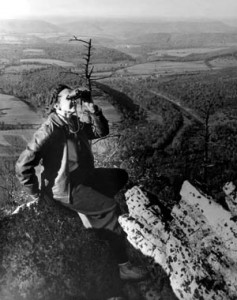
Photo below: Rachel Carson, birding, on a ridge (in Pennsylvania); photo originally found at site of Professor Catherine Lavender, The College of Staten Island of CUNY.

Rachel Carson, birding at Hawk Mountain Sanctuary

Rachel Carson, birding at Hawk Mountain Sanctuary

Read the rest of this entry »


Alma Conference statement pending: Don’t ease DDT restrictions

June 11, 2008

Here is the press release, from Alma College in Alma, Michigan:

Continued Use of DDT Is a Global Health Concern

Scholars who attended the Eugene Kenaga International DDT Conference on Health and the Environment at Alma College are drafting a consensus statement urging global policymakers to reconsider the future use of the synthetic pesticide DDT.

The scholars acknowledge that the use of DDT has prevented millions of infections and deaths from insect-borne diseases, especially malaria. Yet, substantial exposure to DDT poses serious health risks for human populations and the environment, says Edward Lorenz, director of the Public Affairs Institute at Alma College.

“The consensus of the scholars was a recognition of the serious impediments to further restricting DDT use, given that several million people die each year from malaria, most of whom are under the age of five,” says Lorenz. “However, these scholars have documented in numerous human health studies what can be called a ‘deepening understanding of the effects of DDT use on humans.’ The collective wisdom of the experts at the Kenaga Conference was that world policymakers need to use extreme caution when considering easing restrictions on DDT use.”

The March 14 conference attracted international experts in the areas of public health and the environment, including South African scholars Riana Bornman, Henk Bouwman and Christiaan de Jager; Aimin Chen of Creighton University; Barbara Cohn and Brenda Eskenazi of the University of California at Berkeley; Henry Anderson of the Wisconsin Division of Public Health; Suzanne Snedeker of Cornell University; Diane Henshel of Indiana University; Darwin Stapleton of the Rockefeller Archives; Lorenz and John Leipzig of Alma College; and Felicia Leipzig of the Pine River Superfund Citizen Task Force.

The anticipated DDT conference “consensus statement” is expected to list the following summary statements and recommendations, says Lorenz:

  • Repeated use of DDT results in serious health risks for humans.
  • Many sites of chemical-manufacturing facilities continue to be a source of DDT contamination to area residents. While clean-up efforts continue, some DDT proponents, such as John Tierney (New York Times, June 5, 2007), have claimed that, “the billions spent cleaning up Superfund sites would be better spent on more serious dangers.”

“The experts at the DDT Conference unanimously disagree with Tierney’s assessment,” says Lorenz. “Because of the known DDT impacts on human health, the experts not only support continued Superfund clean up, but also endorse assessment of health impacts on residents of communities with DDT sites, such as St. Louis, Mich.”

  • Children and pregnant women in malaria endemic areas where DDT is used are most at risk.
  • Studies have shown that DDT impedes breast milk production, the best source of infant nutrition in many parts of the world.

“Because of the negative impacts on breastfeeding, resulting in more low birth weight babies, communities potentially exposed to DDT to control malaria must be told that the short-term benefits of DDT may spawn longer-term problems,” says Felicia Leipzig.

  • New methods of malaria control should be encouraged and tested.

“Those who are lobbying for DDT use should focus on support for research into alternative chemicals and public health strategies that ultimately will allow for the full phase-out of DDT,” says John Leipzig, director of Alma’s Center for Responsible Leadership.

  • The socio-economic development of malaria-affected communities is the best solution to malaria eradication.
  • Conference experts call for “full support for the Stockholm Convention that will phase out the use of the 12 most dangerous persistent organic pollutants, including DDT,” says Lorenz.

“The Stockholm Convention mandates that each country using DDT have an implementation and management plan on controlling the use of DDT,” he says. “Ultimately it envisions eventual reliance on sustainable methods of disease vector control.”

The scholars argue that sufficient evidence exists that DDT exposure is occurring and posing significant health risks.

“Because of both DDT related Superfund sites and continued use of DDT, exposure to the pesticide is occurring around the world with significant health risks to current and future generations,” says Lorenz.

“The conference experts are challenging policy makers to provide support to further determine health risks associated with DDT exposure in both the developing world and in U.S. communities near contaminated Superfund sites,” he says. “The experts were especially critical of special interests groups and their lobbyists who negate the clear evidence of human health dangers of DDT exposure.”

-mjs-

Other coverage of the Alma DDT Conference at the Bathtub:


Carnivals for the mind and soul

June 11, 2008

For the mind: Encephalon 47 is up at Channel N.  Lots of videos this time, eating disorders, rembrances of lunches past, and a lot, lot more.

For the soul: Carnival of the Liberals #66 at The OtherWhirled.  Ten good items there, including a response to the bizarre claim running on conservative blogs and minds that Obama is a Marxist.

2008 is going to be one of those years when we need to keep our minds sharp and our emotional banks with sufficient funds.   I hope we can.


Typewriter of the moment: Mencken and the 1948 conventions

June 10, 2008


Mencken at 1948 Democratic Convention

Mencken at 1948 Democratic Convention

Photo from the collection of the School of Journalism and Mass Communication, at the Park Library, University of North Carolina.

H. L. Mencken at one of the 1948 political conventions (Thomas Dewey was the Republican nominee, Harry S. Truman was the Democratic nominee). Obviously the photo is a copy from the National Press Club Library. The Park Library site describes the photo and Mencken:

H. L. Mencken (1880-1956) was a familiar figure at many national political conventions. This photo, taken at the one in 1948, was his last political convention. He is well known for his attacks on American taste and culture, or the lack of same. His magnum opus, The American Language: An Inquiry into the Development of English in the United States, was first published in 1919 and remains a classic. From 1906 to 1941, he worked chiefly as a reporter, editor, and columnist for the Baltimore Sun. (Photo courtesy of the Baltimore Sun Library.)

Assuming Mencken covered both conventions, this photo was taken at the Democratic convention in Philadelphia in mid-July, 1948. We know it was taken in Philadelphia since both parties held their conventions there that year, the Republicans from June 21 to June 26, and the Democrats from July 12 to July 14.

Republicans nominated New York Gov. Thomas J. Dewey and California Gov. Earl Warren for president and vice president.

After a contentious convention that saw Minneapolis Mayor Hubert H. Humphrey propose a civil rights plank that got South Carolina Gov. Strom Thurmond to walk out of the convention and found his own States’ Rights (Dixiecrat) Party (with himself as the nominee for president), and former Vice President Henry Wallace walk out because the party platform was too conservative (Wallace ran on the Socialist Progressive Party ticket), Democrats nominated President Harry S Truman and Kentucky Sen. Alben W. Barkley for president and vice president. Truman narrowly defeated Georgia Sen. Richard B. Russell for the nomination. Had Thurmond not walked out, Truman may well have lost the nomination of his own party.

And the rest of the story?

  • Truman had a contentious second term, and was defeated in the New Hampshire primary in 1952 by Sen. Estes Kefauver; Truman ended his campaign for a second full term shortly after.
  • Earl Warren was appointed Chief Justice of the Supreme Court by Truman’s successor, President Dwight D. Eisenhower, in late 1953. Warren is remembered for engineering the 9-0 decision in Brown vs. Topeka Board of Education which ruled “separate but equal” school systems to violate the Constitution’s equal protection clause, and for his chairing the commission that investigated the assassination of President John F. Kennedy.
  • Hubert Humphrey moved on to the U.S. Senate, served as Vice President to Lyndon Johnson, and won the Democratic nomination for president in another contentious convention in 1968 in Chicago. Humphrey lost the election to Richard Nixon, and returned to the U.S. Senate two years later.
  • Strom Thurmond won election to the U.S. Senate in 1954, switching parties to Republican in 1964, and serving until his death in 2003.
  • Russell, who had served as Georgia’s senator since 1933, continued to serve to his death on January 21, 1971; he was a key member of the Warren Commission that investigated the assassination of President John F. Kennedy. The Russell Senate Office Building is named in his honor, the oldest of the three Senate office buildings.
  • Barkley was the oldest vice president ever inaugurated, aged 71. He remarried in his first year as vice president (his first wife died in 1947). Barkley’s nephew suggested that he should be called “the veep” because “Mr. Vice President” was too long. The title was seized up on by headline writers. Considered too old to run for the presidency in 1952, Barkley won a U.S. Senate seat from Kentucky in the 1954 elections, serving from 1955 to his death in 1956. Barkley Dam on the Cumberland River is named in his honor, as is the lake behind it, Lake Barkley.
  • Henry Wallace finished a distant fourth in the 1948 election, behind Dewey and Thurmond. His political career was essentially over due to his inability or unwillingness to disavow communist support. He achieved success as a chicken breeder. In a daramatic turnabout, he wrote a book, Where I Was Wrong, disavowing communism and critical of Joseph Stalin, and endorsed Republican candidates in 1956 and 1960. He died of Amyotrophic Lateral Sclerosis (ALS, or Lou Gehrig’s Disease) in 1965.
  • Dewey returned to his law practice. In 1952, Dewey helped engineer the nomination of Eisenhower over his old political nemesis Sen. Robert Taft of Ohio, pushed Richard Nixon as the Vice Presidential nominee, and in 1956 first convinced Ike to run again, and then to keep Nixon on the ticket. Dewey politely refused offers of offices, including refusing a nomination to the U.S. Supreme Court, sticking to his law practice which made him very wealthy. He died suddenly of a heart attack in 1971, at age 68.
  • Mencken suffered a stroke later in 1948 that left him unable to speak, or read, or write for a time. He spent much of the rest of his life working to organize his papers, and died in 1956. His epitaph, on his tombstone and on a plaque in the lobby of the Baltimore Sun, reads: “If, after I depart this vale, you ever remember me and have thought to please my ghost, forgive some sinner, and wink your eye at some homely girl.”