“Maybe the best reason yet for being happy that Obama was elected”

January 4, 2009

Go look at Barry Weber’s post at First Morning.

Spend at least a full minute looking at that photograph.

Wow!

Look at every single face. Each face is the verse of an epic poem. Each expression is a note in a symphony. Here are a hundred eyes full of excitement and joy, and..(though these kids don’t know it yet their parents and grandparents do)..hope. This is the kind of Hope that straightens paths, brightens colors, and builds bridges to possibilities. It is the kind of Hope that I feel so grateful to have been able to witness, and even feel in my own heart.

But, just look at these kids! Whatever I might feel is peanuts compared to the smiles, laughter, and amazement of these young ones.

By many accountings, these are dark days for the United States.  Those faces show the light of the future — they may be the light of the future.

Nice catch, Mr. Weber.


FAIL repeated: Challenges to Obama’s eligibility

December 26, 2008

Some weeks ago we visited six hurdles that the case against Barack Obama’s eligibility for the presidency would have to overcome to disqualify him.

All six hurdles still remain.  No one has made any serious response to any of the six.

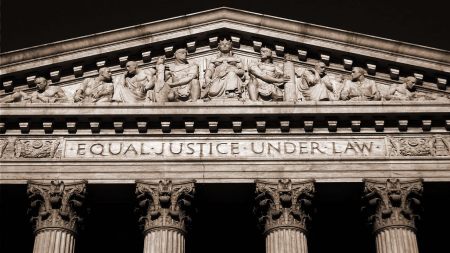
Above the West Entrance to the U.S. Supreme Court is engraved Equal Justice Under Law

Above the West Entrance to the U.S. Supreme Court is engraved "Equal Justice Under Law"

But the Birth Certificate Obsessed (BCO) people go on and on.

Let me note that the six hurdles still stand — six reasons why the objections to Obama’s eligibility will fail:

  1. Obama has a U.S. passport (claims that he doesn’t have a passport were put to rest when it was revealed, in March 2008, that State Department workers had illegally accessed his passport records).
  2. Because we know Obama has a U.S. passport, we can be quite sure his draft status was verified before it was issued — which puts to bed any issue about his registering for the draft (which he wouldn’t have been required to do in any case until 1980 — draft registration had been suspended in 1973 until the Afghanistan/Soviet crisis).
  3. Obama’s a lawyer; the National Conference of Bar Examiners, or the Illinois Bar, would have checked on any problems that surfaced when verifying his fitness to practice law.
  4. Obama was a U.S. senator; as a matter of course, the FBI does a background check on every U.S. senator to verify they may view top secret material. Security clearances are absolutely necessary for members of the Intelligence Oversight Committee, the Foreign Relations Committee, and the Armed Services Committee.  Obama was a member of the Foreign Relations Committee, chairing the subcommittee that deals with U.S. relations with NATO — a post that requires top secret clearances.
  5. Obama has been getting the full national security briefing every day that the president gets; CIA and Homeland Security would have to verify his top secret clearances, and then some.  There is absolutely no indication that this top, top check was not carried out.
  6. Perhaps most important, Obama posted an image of his birth certificate on-line in June; experts who checked the actual document verify it is real, and therefore authoritative.

Each of these six circumstances creates a rebuttable presumption that Obama is a citizen, and a natural born citizen under the somewhat ambiguous requirements of Article II of the Constitution.  In order to make a case that Obama is ineligible, contestants would need to make a strong showing, with clear evidence, to rebut the presumptions created by by these official actions.

Professional poker player Leo Donofrio has made no such evidentiary showing, anywhere, at any time.  Nor has any other Obama critic presented any evidence to overcome any of these six presumptions.

Recently a poster named Carlyle complained that my previous post had been unknown to him. While I posted trackbacks to his post at Texas Darlin’, that blog censors my posts and trackbacks, and thereby deprived this BCO from knowing about the facts (indeed, trackbacks are automatic, since Texas Darlin’ is also a WordPress blog; the only way the trackbacks and comments don’t show up at TD’s blog is because she censors them).  With some fury, Carlyle and others found that post from November 27 and complained I was unfair to them.  However, none has presented any serious challenge to the six hurdles.

How can I be unfair when they won’t make a case?

Here, below the fold, is an example of the heated and off-target responses I’ve gotten.  Of course, I offer comments as we go.

Read the rest of this entry »


CNN Poll: 20% of Americans

December 23, 2008

Either 20% of Americans have never heard of Aaron Burr, or only 20% of Americans are paying attention.  I can’t decide which, but this CNN poll clearly points to one, or the other, depending on your view:

WASHINGTON (CNN) – A new national poll suggests that one of out of five Americans think that Dick Cheney is the worst vice president in American history.

Twenty-three percent of those questioned in a CNN-Opinion Research Corporation survey released Tuesday say that Cheney is the country’s worst vice president, when compared to his predecessors. Another 41 percent feel that Cheney is a poor vice president, with 34 percent rating him a good number two.

Only 1 percent of those polled say that Cheney is the best vice president in U.S. history.

Aaron Burr, Library of Congress image

Aaron Burr, Library of Congress image

Vice President Richard Cheney, White House photo

Vice President Richard Cheney, White House photo

Aaron Burr, you recall, is the vice president who, when the electoral college organization goofed and put him into a tie with Thomas Jefferson for president, suddenly thought he was better qualified than Jefferson and tried to take the race from him; the only vice president ever tried for treason; and the fellow whose dueling killed Alexander Hamilton, the financial genius of our nation’s early years.

20% of Americans think Cheney was worse than Aaron Burr?  Wow.  Just wow.

Aaron Burr shooting Alexander Hamilton, or Dick Cheney hunting doves in Texas?

Aaron Burr shooting Alexander Hamilton, or Dick Cheney hunting doves in Texas?


Domestic terrorist at the White House

December 16, 2008

Old joke said Nixon took crime off the streets, and put it into the White House.  It’s not really funny, though.  Read the story at Dispatches from the Culture Wars, and more at Secular Right.

Where are those who worry about Bill Ayers when the terrorists actually show up at the White House?  Chuck Colson got a medal?

There’s an air of hypocrisy about the whole thing, and an air of sadness, and oddly, an air of fire and brimstone that makes Hugo Chavez look like a prophet.  Anything with anyone who makes Hugo Chavez look good is beyond funny.  Farce or tragedy, Madison worried, or maybe both;  in this case tragedy eclipses farce.

There were deserving medal winners, too.  Perhaps much good, with the bad. January 21, 2009, cannot come too soon.


Typewriter of the moment: Sheryl Oring, and “the next president”

December 14, 2008

Sheryl Oring at her typewriter, collecting messages from Americans to the next president.

Sheryl Oring at her typewriter, collecting messages from Americans "to the next president."

Remember Sheryl Oring?  In the spring of 2008 she was wandering the nation with her typewriter and portable table in tow, typing out postcards to “the next president” from people she found in public spaces willing to share their hopes for the next presidential administration.

Five weeks away from the inauguration of Barack Obama, I wonder what Oring’s postcards could tell us?  Where is she now?

Check out her website, I Wish to Say.  Maybe your classroom could support a similar project from your students.  What do these cards tell us about Americans?  What do they tell us about our electoral process?  What do they tell us about our hopes and fears?  DBQ, anyone?

One of several thousand postcards from Americans, collected by Sheryl Oring (and typed by her) to send to the next president -- who we now know will be Barack Obama.

Two of several hundred postcards from Americans, collected by Sheryl Oring (and typed by her) to send to "the next president" -- who we now know will be Barack Obama.

Many of the postcards will be on display through January 25, 2009, at the McCormick Foundation‘s Freedom Museum in Chicago.  Admission is free.

In comments, tell us what you would have told Oring to put on a postcard from you.

Resources:


Baltimore Sun: Obama eligibility challenge likely to be refused

December 7, 2008

Responsible media, generally called in denigrating styel “mainstream media” by many of our more nutty nut cases, have held off in commenting on the Supreme Court’s position on the case against Obama’s election discussed in conference last Friday, December 5.

Except the Baltimore Sun, which notes as the Bathtub did, that the appeal is likely to go no further.

We won’t know for sure until tomorrow.

Meanwhile, Eric Zorn at The Chicago Tribune says “enough already,” and calls for the conservative moonbats to give up the nasty, fruitless calumny.  (Also see this Tribune story.)


Without hysterics, the Obama eligibility issue

December 5, 2008

In a conference today [December 5, 2008] the Supreme Court will reconsider together whether to take on a suit challenging the eligibility of Barack Obama to be president of the United States under a sometimes-arcane  section of Article II of the Constitution.

Is Barack Obama a “natural born” citizen of the U.S.?

In the building where “Equal Justice Under Law” is engraved high over the front door, poker-player Leo Donofrio’s challenge will be examined to see whether at least four of the nine justices of the Court think he has enough of a case to actually merit a hearing.  Justice David Souter rejected Donofrio’s case earlier, so this is a hail-Mary play on the part of Obama’s opponents.

Equal Justice Under Law, the West Pediment of the U.S. Supreme court. AAPF image

Equal Justice Under Law, the West Pediment of the U.S. Supreme court. AAPF image

The Court takes seriously the principle engraved over the door, however.  This is the same Court that ruled earlier this year an accused terrorist and all-around bad guy held at Guantanamo Bay has the right to a writ of habeas corpus over the objections of the Most Power Man in the World, U.S. President George W. Bush.  The humble, gritty, or even unsavory history of litigants does not limit their rights under the law.

Leo Donofrio in his usual office. Leo Donofrio image

Leo Donofrio in his usual office. Leo Donofrio image

So the question is, what sort of case does Donofrio have against Obama’s eligibility?

Would Justice Clarence Thomas have agreed to bring this case to the conference if it doesn’t have a chance to succeed?

I’ve not lunched with Thomas in more than two decades, so I can’t speak with any inside knowledge.  Historically, the Court, and indeed all the federal courts, have agreed to examine cases like this often simply to provide an authoritative close to the issue.  In this case, the outright hysteria of the anti-Obama partisans suggests the issue should be put to bed if possible.

Under usual Court procedures, we won’t learn the results of the conference until Monday.  I would not be surprised if the results are announced today, just to promote the settling of the issue.

Does Donofrio have a case?

I don’t see a case.  It’s clear that Obama is a U.S. citizen now.  Donofrio’s argument is rather strained, and sexist.  He claims that Obama’s father having been a British subject in 1961 (Kenya was not yet independent), Obama had dual citizenship at birth — and, further, Donofrio alleges, this dual citizenship trumps both Obama’s birth on U.S. soil (which should be dispositive) AND Obama’s mother’s U.S. citizenship, conferring a special status that doesn’t meet the intentions of the framers of the Constitution.

Donofrio’s claim is odd in that it would grant a lesser-status to children of legal immigrants than is allowed by law to children of illegal immigrants, or temporary visitors.  It also is bizarre, to me, in the way it dismisses Obama’s mother’s existence as a factor in Obama’s citizenship status — and while equal rights for women were not wholly obtained in 1961, no one has successfully argued that the citizenship of the father trumps that of the mother in citizenship cases.

Donofrio is arguing that Obama’s dual citizenship at birth disqualifies him from holding the presidency, technically, in a very narrow reading — though Obama would have absolutely every other right of a natural born citizen.

A couple of observations:

First, this is not an easy issue to litigate. Standing is the easiest way for a federal court to avoid a decision — what harm can a citizen claim from letting Obama be president?  It’s difficult to find an injury even were Donofrio’s claims valid.  No blood, no foul.  No injury, no standing to sue.  It is upon this basis that most of the cases against Obama’s eligibility have been tossed out, as Donofrio’s has been tossed, twice already.

Second, it is unclear what entity enforces the eligibility clause of the Constitution, or indeed, whether any entity can. For most of the summer Obama’s critics were pressuring the Federal Election Commission (FEC) to do something, even though the FEC lacks a quorum of members to do anything.  More to the point, there is nothing in any law that confers on the FEC the function of checking the citizenship status of any candidate.  Sometime in October they finally figured out that state secretaries of state might have a role, since they set up the ballots in each state.

I admit I thought that, until I reflected on the issue of the electoral college.  In U.S. presidential elections, voters do not vote directly for president and vice president.  Instead, we vote to elect people who will be the electors who decide — electors of the electoral college.  The history of this institution can be found elsewhere.  For the sake of these suits, however, it means that the secretaries of state have no role at all in the eligibility of the candidates.  They rule on the eligibility of the electors, which is an entirely different kettle of fish. Some states even list the electors on the ballot.

But in any case, it means Donofrio is suing the wrong entity, even if we can’t tell him what the correct entity is.

Third and most important, Donofrio is asking for U.S. citizenship law to be overturned in a most inconvenient time and place. Dual citizenship is a bar to very little in American life.  There is an assumption that people who hold that status are fully American citizens, absent a showing of contrary facts.  There are no contrary facts in evidence from Donofrio, nor from anyone else, despite promises of the revelation of conspiracies.

In short, Donofrio is arguing that there is, somewhere, somehow, some information that Barack Obama is not the shining patriot his life story reveals.  Donofrio doesn’t know what that information is, or where it might be found, but he thinks maybe the State of Hawaii is complicit in a conspiracy to hide this information, which is hidden on the hand-written records of Obama’s birth in 1961.  You might think Donofrio has watched “National Treasure” a few too many times, and whether it’s that movie or some other source, you’d be right — paranoid suspicions of conspiracy are not the stuff good court cases are made of.

The dozen or more cases against Obama’s eligibility all suffer from this astounding, dramatic lack of evidence.  Is there an affidavit from someone who alleges that Obama’s citizenship should be called into question?  If so, they’ve not been presented to any court.  (Obama tormentor Corsi claims to have interviewed Obama’s Kenyan grandmother, and he alleges she said through an interpreter that Obama was born in Kenya; oddly, he didn’t bother to get an affidavit from the woman, nor from anyone else — and others who listen to the tape think she thought Corsi was asking about the birth of her son, not grandson.  This is not solid evidence.)

I argued earlier there is a long chain of evidence creating rebuttable presumptions that Obama’s a natural born U.S. citizen.  To contradict this chain of evidence, contestants should provide extraordinary, clear evidence of contradiction.  What is offered by Donofrio is neither extraordinary, nor clear, nor necessarily contradictory to the presumptions.

This is not an issue solely for the hysterical.  Lawyers and scholars have looked at the issue through the years, and intensely this year, and arrived at the conclusion that Obama is perfectly eligible for the presidency.

Will sanity ever prevail?

Resources you may want to consult:

Vodpod videos no longer available.


Thanksgiving 2008 – Fly your flag today

November 27, 2008

Thanksgiving? Texas had it first. No kidding (unless you count the Vinlanders, who probably were grateful to be out of Greenland, but left no records that they ever actually had a feast to say so — but see the comments in the posts linked at various places).

Last year, Mrs. Bathtub was in the hospital. We sprang her before dinner, but barely.  This year, #2 son is off in the wilds of Wisconsin — the first Turkey Day he’s spent away from home and family.  We empathize with the families the first colonizers left behind.

Still, there will be dinner with the family, thanks for the endurance of storms and trials, reflections on good times past, and hopes for the future.

Thanksgiving is a national holiday, one of the 18 days designated by Congress as a “Fly the flag” day.  It’s been a historic year.  It’s a good day to fly the flag.

So, in keeping with that spirit of remembrance, it’s reprise post stuff mostly, today. If you need more, go here:

Google's Thanksgiving logo, 2007

Here’s the main reprise post, text below (there were some good comments in 2006); Margaritas and nachos do sound good, don’t they?
___________________________
Patricia Burroughs has the story — you New Englanders are way, way behind.

Palo Duro Canyon in a winter inversion

Palo Duro Canyon during inversion, Winter 2001, site in 1541 of the first Thanksgiving celebration in what would become the United States. Go here: www.visitamarillotx.com/Gallery/index3.html, and here: www.tpwd.state.tx.us/park/paloduro/

Update, 11/27/2006: Great post here, “Top 10 Myths About Thanksgiving.”

_______________________

Resources for 2007:

Google's 2008 Thanksgiving logo - click here for search on "Thanksgiving"

Google's 2008 Thanksgiving logo - click for search on "Thanksgiving"


Pulitzer-winner Doris Kearns Goodwin in Arlington, Texas – TONIGHT

November 19, 2008

If I didn’t have two other competing meetings, one which is rather life-or-death, I’d love to on my way to Arlington, Texas, and the University of Texas at Arlington, right now.

Tickets are free to hear Doris Kearns Goodwin, the eminent historian, lively lecturer, and author late of Team of Rivals, which must surely be one of the more enlightening and surprising biographies of Abraham Lincoln.

When the senator from the Land of Lincoln, Barack Obama meets with John McCain to smoke the peace pipe, and seems to be on the verge of inviting his chief rival, Hillary Clinton, into his cabinet, Goodwin’s lecture cannot be more timely.

And, probably, fun.

DR. DORIS KEARNS GOODWIN

Admission is free, but tickets are required. Go to www.utatickets.com for your free tickets.

Dr. Doris Kearns Goodwin (MOVED TO TEXAS HALL)

Pulitzer Prize-winning author and historian

November 19, 2008 · 8:00 pm · Texas Hall

Dr. Doris Kearns Goodwin

A recap of the presidential election and discussion of her book Team of Rivals: The Political Genius of Abraham Lincoln

Here’s a link to maps of UTA’s campus; you can get closer directions to Texas Hall there.


Why we liked Obama then

October 31, 2008

On July 27, 2004, candidate for the U.S. Senate from Illinois, Barack Obama, delivered the keynote address to the National Democratic Convention.

It was a turning point speech.  Obama went on to win the Illinois senate race.  His candidate for president, John Kerry, lost.  But the power of his speech and its ready reception earned Obama consideration as a candidate for the presidency in 2008.

As the 2008 campaign winds down to election day next Tuesday, it’s interesting to revisit Obama’s debut on a national stage.  What was it that made his speech so well received?  What was it about the biographical portions that made Obama look like a potential president?

PBS’s Online Newshour described the speech:

Illinois Senate candidate Barack Obama introduced himself to Democrats and a national television audience Tuesday, giving the keynote address at the Democratic National Convention. Obama told the story of his working class family and urged the nation to elect Democratic presidential candidate John Kerry, saying he would ensure more educational and economic opportunities for all.

Here is the full text (borrowed from PBS), so you can see for yourself.

A YouTube capture of the CSPAN broadcast:

BARACK OBAMA: On behalf of the great state of Illinois, crossroads of a nation, land of Lincoln, let me express my deep gratitude for the privilege of addressing this convention. Tonight is a particular honor for me because, let’s face it, my presence on this stage is pretty unlikely. My father was a foreign student, born and raised in a small village in Kenya. He grew up herding goats, went to school in a tin-roof shack. His father, my grandfather, was a cook, a domestic servant.

But my grandfather had larger dreams for his son. Through hard work and perseverance my father got a scholarship to study in a magical place; America which stood as a beacon of freedom and opportunity to so many who had come before. While studying here, my father met my mother. She was born in a town on the other side of the world, in Kansas. Her father worked on oil rigs and farms through most of the Depression. The day after Pearl Harbor he signed up for duty, joined Patton’s army and marched across Europe. Back home, my grandmother raised their baby and went to work on a bomber assembly line. After the war, they studied on the G.I. Bill, bought a house through FHA, and moved west in search of opportunity.

And they, too, had big dreams for their daughter, a common dream, born of two continents. My parents shared not only an improbable love; they shared an abiding faith in the possibilities of this nation. They would give me an African name, Barack, or “blessed,” believing that in a tolerant America your name is no barrier to success. They imagined me going to the best schools in the land, even though they weren’t rich, because in a generous America you don’t have to be rich to achieve your potential. They are both passed away now. Yet, I know that, on this night, they look down on me with pride.

I stand here today, grateful for the diversity of my heritage, aware that my parents’ dreams live on in my precious daughters. I stand here knowing that my story is part of the larger American story, that I owe a debt to all of those who came before me, and that, in no other country on earth, is my story even possible. Tonight, we gather to affirm the greatness of our nation, not because of the height of our skyscrapers, or the power of our military, or the size of our economy. Our pride is based on a very simple premise, summed up in a declaration made over two hundred years ago, “We hold these truths to be self-evident, that all men are created equal. That they are endowed by their Creator with certain inalienable rights. That among these are life, liberty and the pursuit of happiness.”

That is the true genius of America, a faith in the simple dreams of its people, the insistence on small miracles. That we can tuck in our children at night and know they are fed and clothed and safe from harm. That we can say what we think, write what we think, without hearing a sudden knock on the door. That we can have an idea and start our own business without paying a bribe or hiring somebody’s son. That we can participate in the political process without fear of retribution, and that our votes will be counted — or at least, most of the time.

This year, in this election, we are called to reaffirm our values and commitments, to hold them against a hard reality and see how we are measuring up, to the legacy of our forbearers, and the promise of future generations. And fellow Americans — Democrats, Republicans, Independents — I say to you tonight: we have more work to do. More to do for the workers I met in Galesburg, Illinois, who are losing their union jobs at the Maytag plant that’s moving to Mexico, and now are having to compete with their own children for jobs that pay seven bucks an hour. More to do for the father I met who was losing his job and choking back tears, wondering how he would pay $4,500 a month for the drugs his son needs without the health benefits he counted on. More to do for the young woman in East St. Louis, and thousands more like her, who has the grades, has the drive, has the will, but doesn’t have the money to go to college.

Don’t get me wrong. The people I meet in small towns and big cities, in diners and office parks, they don’t expect government to solve all their problems. They know they have to work hard to get ahead and they want to. Go into the collar counties around Chicago, and people will tell you they don’t want their tax money wasted by a welfare agency or the Pentagon. Go into any inner city neighborhood, and folks will tell you that government alone can’t teach kids to learn. They know that parents have to parent, that children can’t achieve unless we raise their expectations and turn off the television sets and eradicate the slander that says a black youth with a book is acting white. No, people don’t expect government to solve all their problems. But they sense, deep in their bones, that with just a change in priorities, we can make sure that every child in America has a decent shot at life, and that the doors of opportunity remain open to all. They know we can do better. And they want that choice.

In this election, we offer that choice. Our party has chosen a man to lead us who embodies the best this country has to offer. That man is John Kerry. John Kerry understands the ideals of community, faith, and sacrifice, because they’ve defined his life. From his heroic service in Vietnam to his years as prosecutor and lieutenant governor, through two decades in the United States Senate, he has devoted himself to this country. Again and again, we’ve seen him make tough choices when easier ones were available. His values and his record affirm what is best in us.

John Kerry believes in an America where hard work is rewarded. So instead of offering tax breaks to companies shipping jobs overseas, he’ll offer them to companies creating jobs here at home. John Kerry believes in an America where all Americans can afford the same health coverage our politicians in Washington have for themselves. John Kerry believes in energy independence, so we aren’t held hostage to the profits of oil companies or the sabotage of foreign oil fields. John Kerry believes in the constitutional freedoms that have made our country the envy of the world, and he will never sacrifice our basic liberties nor use faith as a wedge to divide us. And John Kerry believes that in a dangerous world, war must be an option, but it should never be the first option.

A while back, I met a young man named Shamus at the VFW Hall in East Moline, Illinois. He was a good-looking kid, 6’2” or 6’3”, clear eyed, with an easy smile. He told me he’d joined the Marines and was heading to Iraq the following week. As I listened to him explain why he’d enlisted, his absolute faith in our country and its leaders, his devotion to duty and service, I thought this young man was all any of us might hope for in a child. But then I asked myself: Are we serving Shamus as well as he was serving us? I thought of more than 900 service men and women, sons and daughters, husbands and wives, friends and neighbors, who will not be returning to their hometowns. I thought of families I had met who were struggling to get by without a loved one’s full income, or whose loved ones had returned with a limb missing or with nerves shattered, but who still lacked long-term health benefits because they were reservists. When we send our young men and women into harm’s way, we have a solemn obligation not to fudge the numbers or shade the truth about why they’re going, to care for their families while they’re gone, to tend to the soldiers upon their return, and to never ever go to war without enough troops to win the war, secure the peace, and earn the respect of the world.

Now let me be clear. We have real enemies in the world. These enemies must be found. They must be pursued and they must be defeated. John Kerry knows this. And just as Lieutenant Kerry did not hesitate to risk his life to protect the men who served with him in Vietnam, President Kerry will not hesitate one moment to use our military might to keep America safe and secure. John Kerry believes in America. And he knows it’s not enough for just some of us to prosper. For alongside our famous individualism, there’s another ingredient in the American saga.

A belief that we are connected as one people. If there’s a child on the south side of Chicago who can’t read, that matters to me, even if it’s not my child. If there’s a senior citizen somewhere who can’t pay for her prescription and has to choose between medicine and the rent, that makes my life poorer, even if it’s not my grandmother. If there’s an Arab American family being rounded up without benefit of an attorney or due process, that threatens my civil liberties. It’s that fundamental belief — I am my brother’s keeper, I am my sisters’ keeper — that makes this country work. It’s what allows us to pursue our individual dreams, yet still come together as a single American family. “E pluribus unum.” Out of many, one.

Yet even as we speak, there are those who are preparing to divide us, the spin masters and negative ad peddlers who embrace the politics of anything goes. Well, I say to them tonight, there’s not a liberal America and a conservative America — there’s the United States of America. There’s not a black America and white America and Latino America and Asian America; there’s the United States of America. The pundits like to slice-and-dice our country into Red States and Blue States; Red States for Republicans, Blue States for Democrats. But I’ve got news for them, too. We worship an awesome God in the Blue States, and we don’t like federal agents poking around our libraries in the Red States. We coach Little League in the Blue States and have gay friends in the Red States. There are patriots who opposed the war in Iraq and patriots who supported it. We are one people, all of us pledging allegiance to the stars and stripes, all of us defending the United States of America.

In the end, that’s what this election is about. Do we participate in a politics of cynicism or a politics of hope? John Kerry calls on us to hope. John Edwards calls on us to hope. I’m not talking about blind optimism here — the almost willful ignorance that thinks unemployment will go away if we just don’t talk about it, or the health care crisis will solve itself if we just ignore it. No, I’m talking about something more substantial. It’s the hope of slaves sitting around a fire singing freedom songs; the hope of immigrants setting out for distant shores; the hope of a young naval lieutenant bravely patrolling the Mekong Delta; the hope of a mill worker’s son who dares to defy the odds; the hope of a skinny kid with a funny name who believes that America has a place for him, too. The audacity of hope!

In the end, that is God’s greatest gift to us, the bedrock of this nation; the belief in things not seen; the belief that there are better days ahead. I believe we can give our middle class relief and provide working families with a road to opportunity. I believe we can provide jobs to the jobless, homes to the homeless, and reclaim young people in cities across America from violence and despair. I believe that as we stand on the crossroads of history, we can make the right choices, and meet the challenges that face us. America!

Tonight, if you feel the same energy I do, the same urgency I do, the same passion I do, the same hopefulness I do — if we do what we must do, then I have no doubt that all across the country, from Florida to Oregon, from Washington to Maine, the people will rise up in November, and John Kerry will be sworn in as president, and John Edwards will be sworn in as vice president, and this country will reclaim its promise, and out of this long political darkness a brighter day will come. Thank you and God bless you.


Alaskans protest Palin

September 16, 2008

It takes guts, but some Alaskans are protesting their governor’s campaign.  They plan to use their First Amendment Rights while they can.

Description here, at the venerable Mudflats blog.  Is it true that this protest against Palin was the largest political rally in Alaska, ever?

Photos of some truly original protest signs here, at Mamadance.


Governors with broad foreign policy experience? Here’s a short list, Sen. Hutchison

September 14, 2008

Sen. Kay Bailey Hutchison, R-Texas, joined a panel on CBS’s “Face the Nation” this morning, discussing the qualifications to be vice president of Alaska Gov. Sarah Palin.

She said, “Four of the last presidents have been governors, and they have come in, every one of them, without an in-depth foreign policy experience.”  Hutchison suggested that Palin reads the newspapers and knows as much as the average governor about foreign policy, but doesn’t need significant knowledge in foreign affairs.

Hutchison challenged:  “Name one governor who has become president who has had in-depth foreign policy experience.”

It pains me when public officials demonstrate such a vast lack of knowledge about American history.  Because you’re from Texas, Sen. Hutchison, let me give you the facts, so you can avoid gaffes in the future.

1.  Thomas Jefferson, former governor of Virginia, assumed the presidency after having served as the American Ambassador to France, after extensive travels through Europe specifically to study government and foreign affairs, and after having served as both Secretary of State to George Washington, and vice president to John Adams.  If we ignore Jefferson’s service after his governorship, we would note that he read fluently in both Greek and Latin before he was 20, and had read extensively of the histories of Rome, Greece, France, Britain and the rest of Europe.  By the time he assumed the presidency he had added fluent French, passing Italian, and Hebrew to his catalog of languages.

Jefferson was a Democratic-Republican (the first of that party), the party that is today known as the Democratic Party.  Perhaps Sen. Hutchison is party blind.

2.  Theodore Roosevelt — you remember him, the guy with the glasses on Mt. Rushmore? — came to the vice presidency in 1901 from being governor of New York.  Prior to that he had been Assistant U.S. Secretary of the Navy, a post from which he wrote the book on naval power in the new age, for foreign affairs.  When the Spanish American War broke out, Roosevelt thought his desk job as head of the Navy too tame, so he created an elite corps of cavalrymen, recruiting almost equally from his old cowboy friends in the Dakotas and his Harvard friends, and insisted on service in the front lines.  His 1st U.S. Volunteer Cavalry Regiment, the “Rough Riders” were deployed to Cuba.  Coming under fire, they stormed San Juan Hill and pushed better-trained, veteran Spanish troops off, thereby winning the battle (Roosevelt was awarded the Congressional Medal of Honor for this action, though many years after his death).  Among the more interesting facts:  Their horses had not made it to Cuba; Roosevelt led the charge on foot.  He always was impatient.

Roosevelt’s experience came in handy.  He was the guy who pushed the Japanese and Russians to a peace treaty, ending the Russo-Japanese War, in 1906.  Roosevelt was awarded the Nobel Prize in Peace for this work (he’s the only person ever to have won the Congressional Medal of Honor and been president, and the only Congressional Medal of Honor winner to win a Nobel Prize, and vice versa.  If we’re making a case that one doesn’t need foreign affairs experience to be vice president, for fairness, we should consider that vice president’s with foreign affairs experience provide great advantages to the nation, and have advanced the cause of peace, and readiness.

New York City, the major city in New York, was in 1900 one of the world’s greatest cities, a major trading center, and one of America’s largest ports (Roosevelt had been police commissioner there, earlier).  The population of the city alone was 3,437,202.  The population of the entire state was 7,268,894.  Alaska’s population today is about 670,000

3.  Franklin D. Roosevelt arrived at the White House after four years as governor of New York. Like his cousin before him, Roosevelt had served as Assistant Secretary of the Navy, during a period of frequent intervention in Central America and Caribbean nations.  It is reputed that FDR wrote the constitution imposed on Haiti in 1915.  In his Navy post, Roosevelt visited England and France, and made the acquaintance of Winston Churchill.  Roosevelt played a key role in the establishment of the Navy Reserve, and fought to keep the Navy from decommissioning after the end of World War I.  FDR came from a privileged family.  They made frequent trips to Europe, and by the time he was 18 FDR was conversant in both French and German.  A philatelist, his knowledge of the world’s business and trade was rather legendary.

4.  Jimmy Carter graduated high in his class at the U.S. Naval Academy, where the required curriculum includes extensive instruction in foreign affairs.  He was chosen by Adm. Hyman Rickover for the elite nuclear submarine corps.  As Georgia’s governor, Carter was elected to the Council on Foreign Relations, a non-governmental group whose intention is to create knowledge about foreign relations in the U.S. in order to aid in defense and trade, and the Trilateral Commission, a group founded on the idea that trade between the U.S., Japan and Europe can be a basis for improving international relations and trade.

5. Bill Clinton graduated from Georgetown University with the degree of Bachelor of Science in Foreign Service (BSFS), from the Edmund A. Walsh School of Foreign Service.  Phi Beta Kappa, he won a Rhodes Scholarship, designed to pick from the next generation of great leaders, and got a degree in government in his studies at University College, Oxford.  He also traveled Europe during that time.

Hutchison’s point may apply to two Republican governors who won the White House, Ronald Reagan and George W. Bush.  They brought other gifts, but their lack of foreign policy experience nearly led to a nuclear war with the Soviet Union in Reagan’s first term, and Bush’s lack of foreign policy knowledge probably led to the unfortunate invasion of Iraq, which has led our nation too close to the brink of national calamity.

And for good measure, let’s list this guy at #6:  Bill Richardson, the current governor of New Mexico, has a sound reputation in international relations, as a former Secretary of Energy, and former U.S. Ambassodor to the United Nations.  Among other things, Richardson talked the North Koreans into shutting down their nuclear bomb plans and operations in 1994.  When the Bush administration squirreled that deal, it was Bill Richardson again who stepped in (at the request of the North Koreans — they trust him), and got them to agree to back off the most recent bomb plans and development.  “Richardson has been recognized for negotiating the release of hostages, American servicemen, and political prisoners in North Korea, Iraq, and Cuba.”  In 14 years as a congressman representing New Mexico, Richardson “visited Nicaragua, Guatemala, Cuba, Peru, India, North Korea, Bangladesh, Nigeria, and Sudan to represent U.S. interests.”  He previously staffed the Foreign Relations Committee of the U.S. Senate, and worked for Henry Kissinger’s State Department in the Nixon Administration.

Contrary to Hutchison’s claim, of the four “recent” governors to gain the White House, two (both Democrats) had foreign relations education or experience far beyond that of Gov. Sarah Palin of Alaska, and at least three other governors brought extensive foreign relations experience with them; one other has foreign relations experience a Secretary of State might envy.

Those are the facts.

Sen. Hutchison:  Can you earmark about $200,000 for education in foreign affairs for Dallas high schools?  Perhaps you can see, now, that experience and education in foreign affairs is useful for high office.  My students will be seeking those offices sooner than we may expect.

I wouldn’t want them wandering the world thinking lack of knowledge about foreign affairs is a good thing.

Update:  Calvin Coolidge was governor of Massachusetts before being elected to the vice presidency on a ticket with Warren G. Harding.  Coolidge’s foreign relations experience could be said to be lacking.  However, Coolidge’s experience as a mayor and governor differed greatly from Palin’s:

[From Wikipedia’s entry on Coolidge] Instead of vying for another term in the state house, Coolidge returned home to his growing family and ran for mayor of Northampton when the incumbent Democrat retired. He was well-liked in the town, and defeated his challenger by a vote of 1,597 to 1,409.[29] During his first term (1910 to 1911), he increased teachers’ salaries and retired some of the city’s debt while still managing to effect a slight tax decrease.[30] He was renominated in 1911, and defeated the same opponent by a slightly larger margin.[31]

And, later:

Coolidge was unopposed for the Republican nomination for Governor of Massachusetts in 1918. He and his running mate, Channing Cox, a Boston lawyer and Speaker of the Massachusetts House of Representatives, ran on the previous administration’s record: fiscal conservatism, a vague opposition to Prohibition, support for women’s suffrage, and support for American involvement in the First World War.[49] The issue of the war proved divisive, especially among Irish– and German-Americans.[50] Coolidge was elected by a margin of 16,773 votes over his opponent, Richard H. Long, in the smallest margin of victory of any of his state-wide campaigns.[51]

*   *   *   *   *   *

By the time Coolidge was inaugurated on January 1, 1919 the First World War had ended, and Coolidge pushed the legislature to give a $100 bonus to Massachusetts veterans. He also signed a bill reducing the work week for women and children from fifty-four hours to forty-eight, saying “we must humanize the industry, or the system will break down.”[65] He signed into law a budget that kept the tax rates the same, while trimming four million dollars from expenditures, thus allowing the state to retire some of its debt.[66]

Update:  Lisa has a series of interesting posts on presidents and their executive experience, at As If You Care.

“I-have-gall” (not “I got Gaul”) update:  Some clown actually compared Palin to Roosevelt in a letter to the Wall Street Journal, according to Snopes.comSnopes’s response was much kinder, and less flattering to Roosevelt, than I would have been.  WSJ left off the San Juan Hill episode, the Medal of Honor, and the Nobel Peace Prize (though he won that for his actions as president).


The energy policy speech the candidates should give

September 14, 2008

It emphasizes conservation and development of alternatives, but conservation mostly.  Conservation has already been tried and shown to work.

The crises in Iran and Afghanistan have dramatized a very important lesson: Our excessive dependence on foreign oil is a clear and present danger to our Nation’s security. The need has never been more urgent. At long last, we must have a clear, comprehensive energy policy for the United States.

Sounds like this guy has the proper perspective.  Who advocates a policy designed to keep us from war in the ‘Stans and the Middle East?

Jimmy Carter.  In 1980.  In his State of the Union speech.

Check it out at Patriots and Peoples. Carter’s policy is compared to McCain’s, and Obama’s.

And then consider the price of lost opportunities, and whether we can ever learn enough to avoid the punishing sword of Santayana’s Ghost, when we don’t learn from history.


Biden, aye!

August 23, 2008

Joe Biden it is. I’ve known Biden and watched him since my first turn staffing the Senate, 34 years ago. Day in and day out, he’s a good man. More, he will make a great vice president.

Sen. Joe Biden, D-Del., at a Foreign Relations Committee hearing on Iraq (September 11, 2007) - Wikimedia photo

Sen. Joe Biden, D-Del., at a Foreign Relations Committee hearing on Iraq (September 11, 2007) - Wikimedia photo

One of the things that has always distinguished Biden to me is his dedication to his family. Shortly after he was elected to the Senate, his wife and infant daughter were killed in a car-train accident, which also injured is two sons, Beau and Hunt. Biden informed Senate leaders he would not leave his children at such a time, and that he’d resign his election. Majority Leader Mike Mansfield and several others worked to persuade Biden to find some way to serve. By the time I joined Mansfield’s office in 1974, Mansfield was glad to have persuaded Biden, since his expertise and cool judgment were needed in the latter days of the Watergate Constitutional crises.

Bill Bradley tells the story, touchingly, in his book Time Present, Time Past, about how Arkansas Sen. John L. McClellan told Biden the best thing he could do would be to serve in the Senate and work hard — McClellan having lost his wife to spinal meningitis while driving back to Arkansas on business, and then one son to the same disease (in Africa, a few years later), and two more sons in an auto crash and an airplane crash.

Biden resolved the problem by commuting every day, from Wilmington, Delaware, to Washington, D.C. Not moving to the capital kept Biden grounded, in a way most senators cannot be.

Beau Briden today is Delaware’s attorney general, and a Captain in the National Guard, deploying to Iraq in October 2008. Hunt is an attorney working in Washington, D.C. Biden remarried in 1977. He and his wife, Jill, have a daughter, Ashley.

Ear worm: For several years while I staffed the Senate, Biden led off the roll call votes. I cannot hear his name without hearing in my head the Clerk of the Senate calling the roll for votes, “Sen. Biden,” and when Biden offered his assent the clerk would quickly intone, “Biden, ‘aye.'” When my phone beeped and I saw it was Biden, I still heard the Clerk’s voice, “Biden, aye.”

Great pick on Obama’s part.

You should check out:


Darkest political skullduggery: Coup d’etat in the U.S.

August 20, 2008

Here’s a story you won’t read in your U.S. history text: Sore from losing the White House, conservatives try to use an economic “crisis” as an excuse to seize the White House and oust the sitting president.

It might make a good movie — but it hasn’t yet. It actually happened.

Maj. Gen. Smedley D. Butler, The Fighting Quaker - twice winner of the Congressional Medal of Honor

Maj. Gen. Smedley D. Butler, "The Fighting Quaker" - twice winner of the Congressional Medal of Honor

The American Liberty League tried to persuade double-Medal of Honor winner Major Gen. Smedley Darlington Butler to do one more military campaign to save the nation — from Franklin Delano Roosevelt, in 1933. The story was told in a book that quoted extensively from hearings before the U.S. House of Representatives’ Un-American Activities Committee, the group that would become infamous for harassing leftists before the House finally choked it to death. Of course, since no one would believe such a plot, the book is out of print.  The American Liberty League was quite the opposite of leftist – they favored the fascists.

Oh, the wonder of the intertubes! You can download the book, Jules Archer’s The Plot to Seize the White House, at a site called Information Clearinghouse, “News you won’t find on CNN.”

None of the plotters faced any other official investigation beyond the hearings in Congress.

Had the plot succeeded how different would World War II have been?

Tip of the old scrub brush to Progressive Gold’s del.icio.us feeds.