Presidents Day 2013: Fly your flag today

February 18, 2013

Yes, I’m late — an airport run, a telephone installation, not enough coffee in the pot.

You’re already flying your flag today, right?  Let’s recapitulate from last year

Presidents Day is February 18, 2013 — fly your U.S. flag today.

National Park Service photo, Lincoln Memorial through flags at Washington Monument

The Lincoln Memorial, seen through flags posted at the Washington Monument, Washington, D.C.; National Park Service Photo via About.com

Oddly enough, some controversy arises from time to time over how to honor President Washington and President Lincoln, and other presidents.  Sometimes the controversy simmers over how to honor great Americans — if Lincoln deserves a day, why not FDR?  Why not Jefferson? — and sometimes the controversy covers more mundane ground — should the federal government give workers a day off?  Should it be on a Monday or Friday to create a three-day weekend to boost tourism?  About.com explains the history of the controversy:

Presidents’ Day is intended (for some) to honor all the American presidents, but most significantly George Washington and Abraham Lincoln. According to the Gregorian or “New Style” calendar that is most commonly used today, George Washington was born on February 22, 1732. But according to the Julian or “Old Style” calendar that was used in England until 1752, his birth date was February 11th. Back in the 1790s, Americans were split – some celebrated his birthday on February 11th and some on February 22nd.

When Abraham Lincoln became president and helped reshape our country, it was believed he, too, should have a special day of recognition. Tricky thing was that Lincoln’s birthday fell on February 12th. Prior to 1968, having two presidential birthdays so close together didn’t seem to bother anyone. February 22nd was observed as a federal public holiday to honor the birthday of George Washington and February 12th was observed as a public holiday to honor Abraham Lincoln’s birthday.

In 1968, things changed when the 90th Congress was determined to create a uniform system of federal Monday holidays. They voted to shift three existing holidays (including Washington’s Birthday) to Mondays. The law took effect in 1971, and as a result, Washington’s Birthday holiday was changed to the third Monday in February. But not all Americans were happy with the new law. There was some concern that Washington’s identity would be lost since the third Monday in February would never fall on his actual birthday. There was also an attempt to rename the public holiday “Presidents’ Day”, but the idea didn’t go anywhere since some believed not all presidents deserved a special recognition.

Even though Congress had created a uniform federal holiday law, there was not a uniform holiday title agreement among the individual states. Some states, like California, Idaho, Tennessee and Texas chose not to retain the federal holiday title and renamed their state holiday “President’s Day.” From that point forward, the term “Presidents’ Day” became a marketing phenomenon, as advertisers sought to capitalize on the opportunity for three-day or week-long sales.

In 1999, bills were introduced in both the U.S. House (HR-1363) and Senate (S-978) to specify that the legal public holiday once referred to as Washington’s Birthday be “officially” called by that name once again. Both bills died in committees.

Today, President’s Day is well accepted and celebrated. Some communities still observe the original holidays of Washington and Lincoln, and many parks actually stage reenactments and pageants in their honor. The National Park Service also features a number of historic sites and memorials to honor the lives of these two presidents, as well as other important leaders.

Fly your flag, read some history, enjoy the day.

More, Resources, and Related Articles:

English: Air Force One, the typical air transp...

President’s airplane, Air Force 1, flying over Mount Rushmore National Monument, in South Dakota – Image via Wikipedia; notice, contrary to Tea Party fears, the bust of Obama is not yet up on Rushmore (and also note there remains no room for another bust).


Getting a more complete picture of Herbert Hoover: His dog liked him

February 6, 2013

Not sure how to file this.  Should it go under “Things we didn’t know about Herbert Hoover,” or “Hoover the mensch,” or “Some campaign photo ops never change?”

This is a campaign photo from 1928, Herbert Hoover and his dog, King Tut:

Herbert Hoover and dog, King Tut, in 1928 campaign photo

Campaign photo from 1928, of Republican candidate Herbert Hoover and his dog, King Tut. Image from Hoover Presidential Library and Museum, National Archives.

Tip of the old scrub brush to The Hoover Blackboard, a blog of the Hoover Library.

More:

Hoover Library

Herbert Hoover was Secretary of Commerce in the Harding and Coolidge administrations. What else don’t we remember about Hoover, most of the time? Hoover Library display, photo by akasped.


Obamacare: Still the better way, still saving money, still a good deal

January 20, 2013

A guy named William Duncan at a blog called Sensible Thoughts posted something I found inherently unsensible a while back.  He listed six reasons why he thought the Affordable Care Act should be repealed. (“A while?” “Yeah, July 2012 is ‘a while.'”)

His sixth point was the old canard about Congress and the President being exempt.  Of course they are not exempt, and so I told him.

Your sixth reason is in error. There is no provision to exempt either the president or Congress from the act. There is no language in the bill such as you describe. Language from page 114 can be found here:

https://timpanogos.wordpress.com/2012/04/17/obamacare-making-stuff-up-to-complain-about/

At some length, Mr. Duncan removed that point, but said he still thinks the law should be repealed on the other five points I hadn’t dealt with.

Ed:
Thank you for the correction on point #6. I have gone back and looked at this, and you are absolutely right. Although the Wall Street Journal and folks like Sean Hannity reported that the President and members of Congress are exempt from participation in the Affordable Care Act, in the end that did NOT make it into the language of the legislation. I have deleted point #6 from the post as a result. Thank you for the correction. Now, if you copuld only prove me wrong on the rest of the points listed…. Unfortunately, this remains a bill the the American public did not want, and was purchased by shenanigans that the Administration should be ashamed of.

A quick and dirty response; we may need to put more meat on these response bones in the next couple of months, because the opposition to ObamaCare relies on severely distorted claims about the law and what it actually does.  Much if not most of the good stuff in the law is completely ignored by these critics, and we should point that out, too.

I responded (images added here):

Disproof?

What makes you think Americans didn’t want it? There was a whale of an anti-health care campaign after the act passed, but when it passed, it enjoyed a majority of support. And, when we take each provision of the bill and ask people about that provision, they approve overwhelmingly.

English: Depiction of the House vote on H.R. 3...

Depiction of the House vote on H.R. 3590 (the Patient Protection and Affordable Care Act) on March 21, 2010, by congressional district. Democratic yea, dark blue; Democratic nay, light blue; Republican nay, red; No representative seated, white. Image from Wikipedia

For example, not even you are opposed to continuing the Reagan-era program that encourages medical schools to train more general practitioners. No one seriously objects to the provisions that pay physicians to practice in under-served areas, like West Texas, Iowa, and West Virginia. No one objects to the provisions that train more nurses. Only the most rabid racists complain about continuing and expanding the health care clinics on Indian reservations.

The law has dozens of provisions like those, and no one in their right mind objects to them.

Your other five points?

  1. The Supreme Court killed that one for you. They said that, even if you call it a fine, it’s a tax. And at that, it’s a helluva bargain. For those who do not purchase health insurance because they can’t afford to, they must pay $695 additional tax, per year. That’s about what I’d pay monthly on the open market.In any case, there are no fines, according to the Supreme Court.
    English: Depiction of the Senate vote on H.R. ...

    Depiction of the Senate vote on H.R. 3590 (the Patient Protection and Affordable Care Act) on December 24, 2009, by state. Color code is difficult to decipher; let it suffice that if there are two Democratic yea votes, the state is colored deep blue; if two Republican nay votes, very red. Image from Wikipedia

    But I can’t imagine why you oppose bargains in health care, especially when they lower the costs of health care to the insured, who will no longer pay the 15% to 25% premium to cover indigent care.

  2. With all the “new taxes,” CBO, the non-partisan group that scores these issues for Congress, projects the bill will decrease federal spending and cut the deficits annually, when fully enacted in 2014 and all out years.Do you oppose deficits or not?All the other taxes are fair, strike only the tippy-top income tiers, and are cheap at that.These taxes make the system more fair. It’s stacked against anyone making less than $150,000 a year, now. That’s most of us. I don’t like it when government helps the rich, at the expense of the poor — that’s contrary to moral standards my church holds, for example, and it tends to damage the economy.So I think more fair taxes, and lower costs, will be quite popular, once we see them.So, new taxes aren’t a good justification to oppose the law.
  3. Speaking of fallacious accounting — CBO, the group you cite, says the bill will reduce the deficits. You assume the Law won’t work, while small portions of it have already slashed inflation in health care costs, from 20% in 2009 to 4% in 2011 and 2012.But, what about repeal? CBO looked at that, too — repeal of the law will increase deficits, not decrease them. It’s only $109 billion increase in deficits, but these number directly refute all claims that repeal would be cheaper. See the analysis gateway here: http://www.cbo.gov/publication/43471
  4. This Medicare issue was hashed out, accurately and well I thought, in the campaign. Medicare costs will be reduced by holding costs down — benefits will not be reduced. Eric Cantor and Paul Ryan ran into some difficulty with this, because their budget plans assumed the savings from the Affordable Care Act, while eliminating the law that produced the savings.I’m sure there will be some adjustments required. Medicare seems a little ham-fisted when it comes to dealing with local and regional cost differences, but nationwide, over the past 40 years, enormous savings have been realized by reducing some reimbursements for procedures that once were uncommon and expensive, to a less expensive rate, now that they are more common. On the whole, over 40 years, over thousands of procedures, physicians have changed their expectations, and things have worked fine. Oh, there have been grumblings, I know. But the cuts in costs, without cuts in benefits, have stuck.Under the Affordable Care Act, we hope a lot more people will move to company plans from Medicare, or at least to the exchange plans offered in each state.One of the changes already introduced is working [link added here]. Rather than pay providers for each procedure, Medicare now reimburses hospitals for effective hospitalization — that is, when a patient is discharged and then re-enters a hospital for the same complaint, the hospital will lose money. Hospitals are keeping patients a few days longer on many procedures, to insure that one hospitalization is all that is required. Savings are already being made in costs, while improvements have resulted in the health care – better health in the patients!In all, CBO says costs will come down with the Affordable Care Act, as advertised, and costs will rise and deficits will rise if the Act is repealed.
  5. Your abortion argument is too metaphysical, and not enough real-world. Do you want to reduce the number of abortions? Then provide health care, make sure contraception is freely available (not for free, but freely), and stand back. Those two things reduce abortions, as they did during the Clinton administration.Restrictions on abortion, on the other hand, make it more likely a woman will choose to terminate a pregnancy under a number of circumstances: She doesn’t have health care coverage, her coverage does not cover pre-natal care, her coverage won’t cover a new infant, the pregnancy is unplanned due to lack of good information on family planning or lack of access to affordable contraception.You can choose: Restrict abortions and increase the number of abortions, or provide health care, and reduce the number of abortions.It may be a bit counter-intuitive, but you’d better study the issue. The Affordable Care Act’s provisions, Obamacare, have over the years reduced abortions where applied; cutting off that care has increased the number of abortions.My advice would be, don’t kill the babies to make a political point.

I am concerned that you don’t appear much familiar with what the bill actually does. Here are a few reasons to keep the law.

  1. We need more physicians, and the bill provides them.
  2. We need more physicians in underserved areas, and the bill provides them.
  3. We need more nurses, and the bill provides them.
  4. We need more community clinics in underserved urban areas [link added here], where illnesses and injuries frequently go untreated until extreme trauma results, and the victim must get extremely expensive care in an emergency room. This will be one of the biggest cost savers — and the law provides those clinics.
  5. The law will cut the private bureaucracy, and completely dismantle the private death panels set up by insurance companies, saving at least 10% of every health care dollar, applying that money to care instead of bureaucracy. This is already occurring.
  6. Preventive care under the Act is greatly encouraged — if we can boost flu vaccines by another 10%, it will save thousands of lives annually, and millions of dollars in hospitalization costs. Flu shots came with no co-pay this year — did you notice? — so that anyone with any insurance at all could drop by any pharmacy offering flu shots and get one with no out-of-pocket expenses.
    This is huge. Everyone agrees the cheapest health care is for healthy people. The Affordable Care Act changes the way health care is delivered, to emphasize prevention of disease and injury, instead of triage. Prevention usually costs about 10% what the triage would cost.
  7. Removing the lifetime cap on insurance payments, per patient, will save a few thousands of lives, annually. It should kill the phenomenon where many families, hit with a costly disease or accident, had to declare bankruptcy as a result. A significant portion of all bankruptcies have been “not adequately-insured” cases. Those should almost disappear.
  8. Allowing children to stay insured, on a parent’s plan, for those critical years after high school and college and into the second job, with benefits has already benefited millions of Americans, saving millions of dollars and probably a few lives.

I cannot imagine why anyone would want to go back to 20% annual health care cost inflation, the highest per capita health care costs in the world by a factor of two, while leaving one out of every seven people uninsured even though we were paying amounts more than the insurance would have cost.

Obamacare reduces the deficits, and puts our health system on the path to catch up to the rest of the industrialized world, with better care for less cost.

I’ll keep it, thank you.

(See this, too: “More good news about Obamacare: CBO says it will save money”

More:


Happy 213th Birthday, Millard Fillmore!

January 7, 2013

January 7 is Millard Fillmore‘s birthday.

Statue of President Millard Fillmore, a Buffal...

Statue of President Millard Fillmore, a Buffalo native, on southeast corner of the administration building of the University of Buffalo. Photo credit: Wikipedia

Why isn’t it a national holiday?

UB celebrates Fillmore’s birthday

BUFFALO, N.Y. (WIVB) [Monday, January 7, 2013] – The University at Buffalo is celebrating one of its Founding Fathers. Monday would be Millard Fillmore’s 213th birthday, and to mark the occasion, UB helped host a ceremony at the former president’s grave site.

A wreath from the White House was placed at the grave sit, to honor the former leader for his services to the nation and western New York.

After his presidency, Fillmore returned to Buffalo, New York, and a life of good citizenship. He founded the Buffalo and Erie County Historical Society, for example. And though he himself was about a third-grade dropout, and though he refused an honorary degree from Oxford because he said no man should get a degree he can’t read (it was in Latin), he founded what is now the University at Buffalo.

There’s a moral there, somewhere.

More:

Cake for Millard Fillmore's 213th birthday, Summerhill, New York

Birthday celebration for President Millard Fillmore in Summerhill, New York; caption from the Auburn, New York, Citizen: Sue Stoyell, treasurer of the Cayuga-Owasco Lakes Historical Society, serves a slice of Millard Filmore’s birthday cake to Roger Stoyell during a celebration of Fillmore’s 213th birthday Sunday at the town hall in Summerhill.

There was music:

Flock of Free Range Children sing for Millard Fillmore's 213th Birthday, Summerhill, New York

Fillmore’s 213th birthday bash in Summerhill, New York; photo by Michelle Bixby, Auburn Citizen: From left, John Davis, Ron Van Nostrand and Don Watkins, three of the seven members of the band “Flock of Free Range Children,” entertain attendees of Millard Filmore’s 213th birthday celebration Sunday at the town hall in Summerhill.


Quote of the moment: John Adams, on government debt

December 12, 2012

John Adams, by Asher B. Durand

President John Adams, painted by Asher B. Durand; U.S. Navy image, via Wikipedia

Our second President, the author of the Constitution and Bill of Rights of Massachusetts, John Adams was quite pragmatic about debt — use it when you have to, don’t use it too much. In his first Annual Message to Congress, on November 22, 1797, Adams said:

Since the decay of the feudal system, by which the public defense was provided for chiefly at the expense of individuals, the system of loans has been introduced, and as no nation can raise within the year by taxes sufficient sums for its defense and military operations in time of war the sums loaned and debts contracted have necessarily become the subjects of what have been called funding systems. The consequences arising from the continual accumulation of public debts in other countries ought to admonish us to be careful to prevent their growth in our own. The national defense must be provided for as well as the support of Government; but both should be accomplished as much as possible by immediate taxes, and as little as possible by loans.

Taxes over loans.  Who would have guessed that?

In contrast to some of the things circulating around the internet today attributed to John Adams, he actually wrote this in his message to Congress.


Millard Fillmore: Victim of yet another hoax

December 6, 2012

The Washington Post’s usually great blog on politics, The Fix, features a list of the best presidential biographies.  This comes just in time for the holidays, of course.  It could be a guide to getting the book for that wonk you know, the one who says Franklin Pierce is underrated, or the woman you know who is fixated on what might have been had Warren G. Harding not died in San Francisco.

The list links to good versions of obscure and arcane history, as well as some major stuff — any good biography of Thomas Jefferson, George Washington, Abraham Lincoln, or Teddy Roosevelt, has to have some major chops going for it, in those crowded niches of good biographies of important people.

English: 1938 u.s. postage stamp of Millard Fi...

1938 U.S. postage stamp of Millard Fillmore, a 13-cent stamp for our 13th president – Wikipedia image

Then there is poor old, hapless Millard Fillmore.

We can excuse Natalie Jennings and Sean Sullivan, perhaps.  After all, there are not many books on Millard Fillmore.  Pickings are slim.

Ever since America’s favorite curmudgeon, H. L. Mencken, created a World War I hoax on the gullibility of the public, with a completely invented history that claimed the only thing of note ever done by Millard Fillmore was putting a bathtub in the White House, against the advice of the American Medical Association, poor Fillmore has been the butt of jokes, but more often the cruel butt of unintended slights when people cite the fictions of his life rather than his accomplishments.  We approach the anniversary of the Mencken “Fillmore’s Bathtub” Hoax, on December 28.

I said the pickings on Fillmore books were slim.  The list at The Fix  includes a parody history of some five years back by George Pendle, The Remarkable Millard Fillmore: The Unbelievable Life of a Forgotten President.

At Amazon, we learn of Pendle’s book:

Millard Fillmore has been mocked, maligned, or, most cruelly of all, ignored by generations of historians–but no more! This unbelievable new biography finally rescues the unlucky thirteenth U.S. president from the dustbin of history and shows why a man known as a blundering, arrogant, shallow, miserable failure was really our greatest leader.

In the first fully researched portrait of Fillmore ever written, the reader can finally come face-to-face with a misunderstood genius. By meticulously extrapolating outrageous conclusions from the most banal and inconclusive of facts, The Remarkable Millard Fillmore reveals the adventures of an unjustly forgotten president. He fought at the Battle of the Alamo! He shepherded slaves to freedom on the Underground Railroad! He discovered gold in California! He wrestled with the emperor of Japan! It is a list of achievements that puts those of Washington and Lincoln completely in the shade.

Refusing to be held back by established history or recorded fact, here George Pendle paints an extraordinary portrait of an ordinary man and restores the sparkle to an unfairly tarnished reputation.

Of course it’s parody!  There’s no indication Fillmore, never a member of the military, fought at the Alamo.  Fillmore never made it to California, nor was he the Mormon who discovered gold at Sutter’s Mill.  In one of his greatest acts, Fillmore dispatched Commodore Perry to Japan to coerce that nation to open its doors to American sailing ships, and trade with the rest of the world.  Fillmore himself did not journey to Japan, and never met the Japanese emperor, let alone wrestled the man. (After his presidency, Fillmore visited Europe; Queen Victoria is attributed with having said he was one of the handsomest men she’d ever met; he refused an honorary degree because, he said, he couldn’t read the Latin it was written in — you can’t make up the real stuff.)

Despite its clearly being a parody, however, there it is on the list of The Fix, as the best biography of Millard Fillmore.

Fillmore parody history listed as best Fillmore biography

Screen clip showing parody Fillmore biography on The Fix’s list of best presidential biographies

H. L. Mencken lifts a beer to toast end of Prohibition

H. L. Mencken at approximately 12:30 a.m., April 7, 1933, at the Rennert Hotel, corner of Saratoga and Liberty Streets, 17 years later, not neglecting a sudsy anniversary – Baltimore Sun photo

The Ghost of H. L. Mencken notes that this item appeared on December 5, 2012, the anniversary of the end of Prohibition — and knocks back a brew.  Every other president gets a serious biography mentioned; for Millard Fillmore, The Fix lists a hoax book as his “best presidential biography.”

More:

A note on fairness to Mr. Pendle:  Pendle has argued here before that his book does contain real history, and it’s there despite the embellishments which he says at least get the book sold.  Earlier, in comments he said:

Dear Sir,

I am the author of the recently published ‘The Remarkable Millard Fillmore’, which I have just discovered has been mentioned by your website on a couple of occasions. Judging by your website’s wonderful name, and your obvious interest in making people more aware of American history, I was slightly troubled to see that you thought I treated Millard Fillmore unfairly in my book.

I don’t know if you have had a chance to read ‘TRMF’ yet, but I can assure you that while it is a faux-biography, and does indeed poke fun at Millard Fillmore’s perceived image (or lack of it), its larger target is that of presidential biographies that are unthinkingly reverential of the office of the president. The cynical revision of history, in which one man is placed at the center of the world’s events is a historical fallacy, as you are probably well aware. Yet it is one which – unlike my book – many historians perpetrate with a straight face.

In ‘TRMF’ I attempted to mock this school of biography by extrapolating the most ridiculous situations from the most basic and inconclusive of historical facts. For instance, I have Millard Fillmore stowing away to Japan, and Sumo-wrestling with the Mikado’s champion, because in real life Fillmore opened up Japan to western trade (albeit from a safe distance in Washington D.C.).

Lest you think I am playing too fast and loose with the truth (some readers have complained that they did not realize my book was a spoof, despite the picture of Millard Fillmore riding a unicorn on its cover!) my book also includes a large appendix of strange but true historical notes to show that many of the ridiculous situations I place Fillmore in were actually based on fact. By reading them I hope one can discover that even the most staid of human lives can be touched by the fantastic.

In short I come not to bury Fillmore, but to praise him, and all those forgottens who have not been granted a role as a ‘Great Man of History’ by the Academy. I very much hope that although ‘The Remarkable Millard Fillmore’ is primarily a spoof and designed to make people giggle, readers will, possibly without being aware of it, come away from the book with a better knowledge of American History than when they started it.

Yours sincerely,
George Pendle

So we are left with a little mystery.  Did the WaPo reporters know that Pendle’s book is a parody, and are they saying it works wonderfully as a tool of history telling?  Or, did they not know?

_____________

Update:  Comes word this morning that The Fix changed its listing for Fillmore, to the Rayback book (Thanks, Lea).  The column says only that it’s been “updated,” but doesn’t explain where or why.   Mr. Pendle might argue his book should be there:  How many books are there on Fillmore after all?


Dallas honors assassin’s second victim, policeman J. D. Tippit

November 21, 2012

Forty-nine years.

That’s how long it took people in Dallas to get around to erecting a memorial for police officer J. D. Tippit, killed in the line of duty on November 22, 1963.

07-27-2011 Colo Bend to 6th Floor, Pentax K-10 158 - 10th & Patton in Oak Cliff, where J. D. Tippitt died

Residential street in Oak Cliff, a section of Dallas, Texas, where police officer J. D. Tippit died on November 22, 1963; photo from July 27, 2011.  Officer Tippit was discovered about the location of the Crime Watch sign.

For the first 20 years, most people probably thought the idea too raw, to mark the place where Officer Tippit died.  More recently people complained that there was no other memorial to Tippit, whose actions may well have smoked out the assassin of President John F. Kennedy that day.

With pressure from the Dallas Police Department, and assists from the Dallas Independent School District, the marker was installed on school property at the intersection, across the street from the spot where Tippit was shot.

Tippit died near the intersection of 10th Street and Patton Street, in Oak Cliff, a section of Dallas across the Trinity River from downtown.

Dallas Police Officer J. D. Tippit's patrol car, on E. 10th St, in Dallas, on November 22, 1963

Wikipedia caption to Warren Commission photo: Dallas Police Officer J. D. Tippit’s patrol car, on E. 10th St, in Dallas, on November 22, 1963 – now via Mary Farrell Foundation.

Dallas ISD’s Adamson High School is about two blocks away, to the northwest; the campus has been expanded to come within a block of the site.  The marker sits next to tennis courts recently installed by the district, in a small park cut out from the athletic complex.  Dallas ISD acquired many of the residences in the area.  Renovations in the past two years included closing part of 10th Street west of Patton.

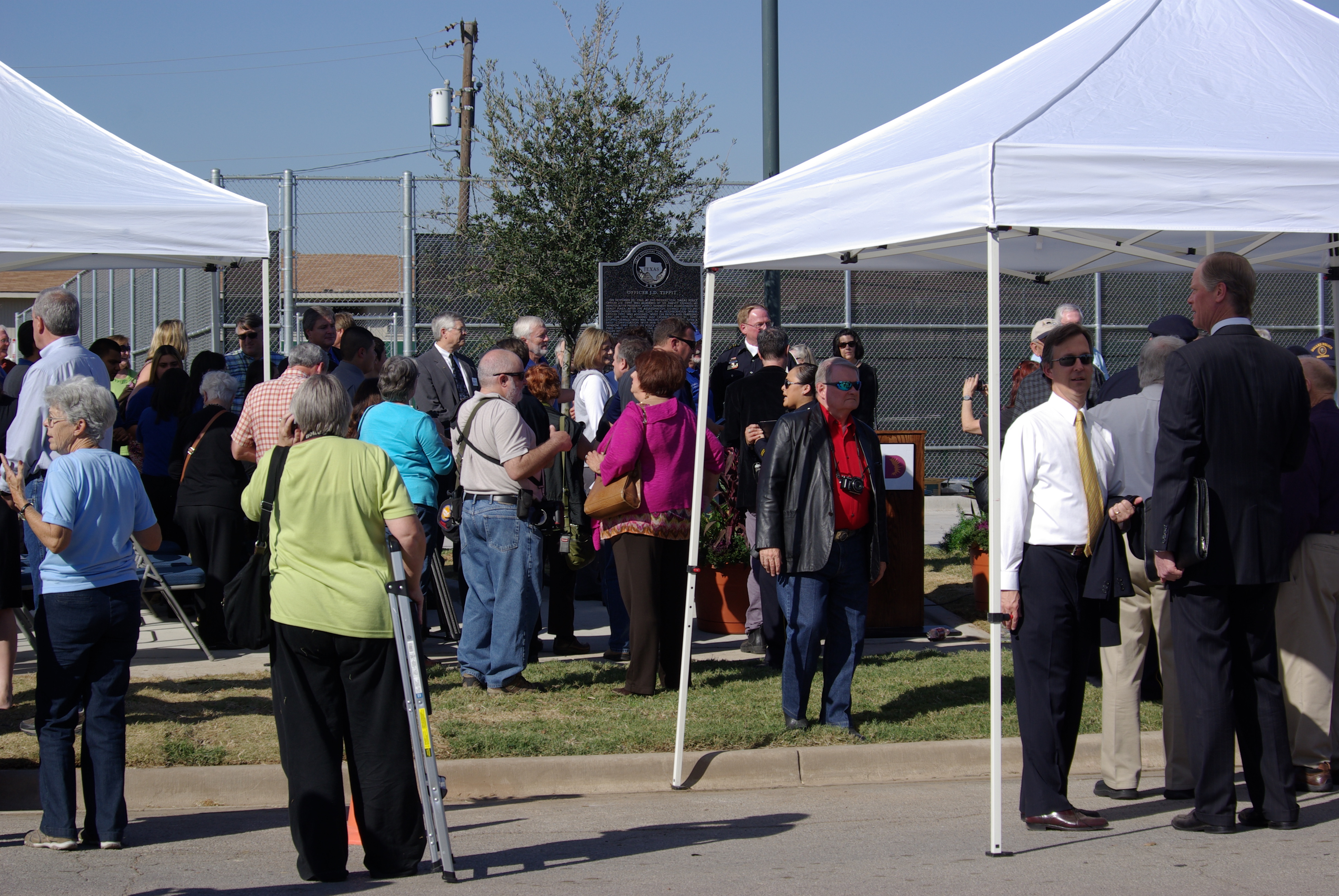
A brighter though still-somber mood pervaded the marker’s dedication on November 20, 2012.  About 200 people gathered for the ceremony, including a lot of police officers and school officials.

Roy Appleton described it at a blog of the Dallas Morning News:

Brad Watson, a reporter for WFAA-TV, Channel 8, questioned the lack of recognition for Tippit in a broadcast two years ago. Michael Amonett, then president of the Old Oak Cliff Conservation League, took up the cause, with help from Farris Rookstool III, a Kennedy assassination historian.

The school district provided the land. And the Texas Historical Foundation donated $5,000 to the project.

The crowd of about 200 people Tuesday included Tippit’s widow Marie; his children, Allan, Brenda and Curtis Tippit; his sister Joyce DeBord; other family members; and police officers past and present.

Standing and sitting under a cloudless sky, they watched members of the Adamson ROTC present the colors, heard the Dallas police choir sing God Bless America and listened while speakers praised the slain officer and his family.

Watson covered the ceremony for his station.  The ceremony might be noted for its lack of higher dignitaries; it was a working cop’s ceremony, with Dallas Police Chief David Brown being the top rank present.

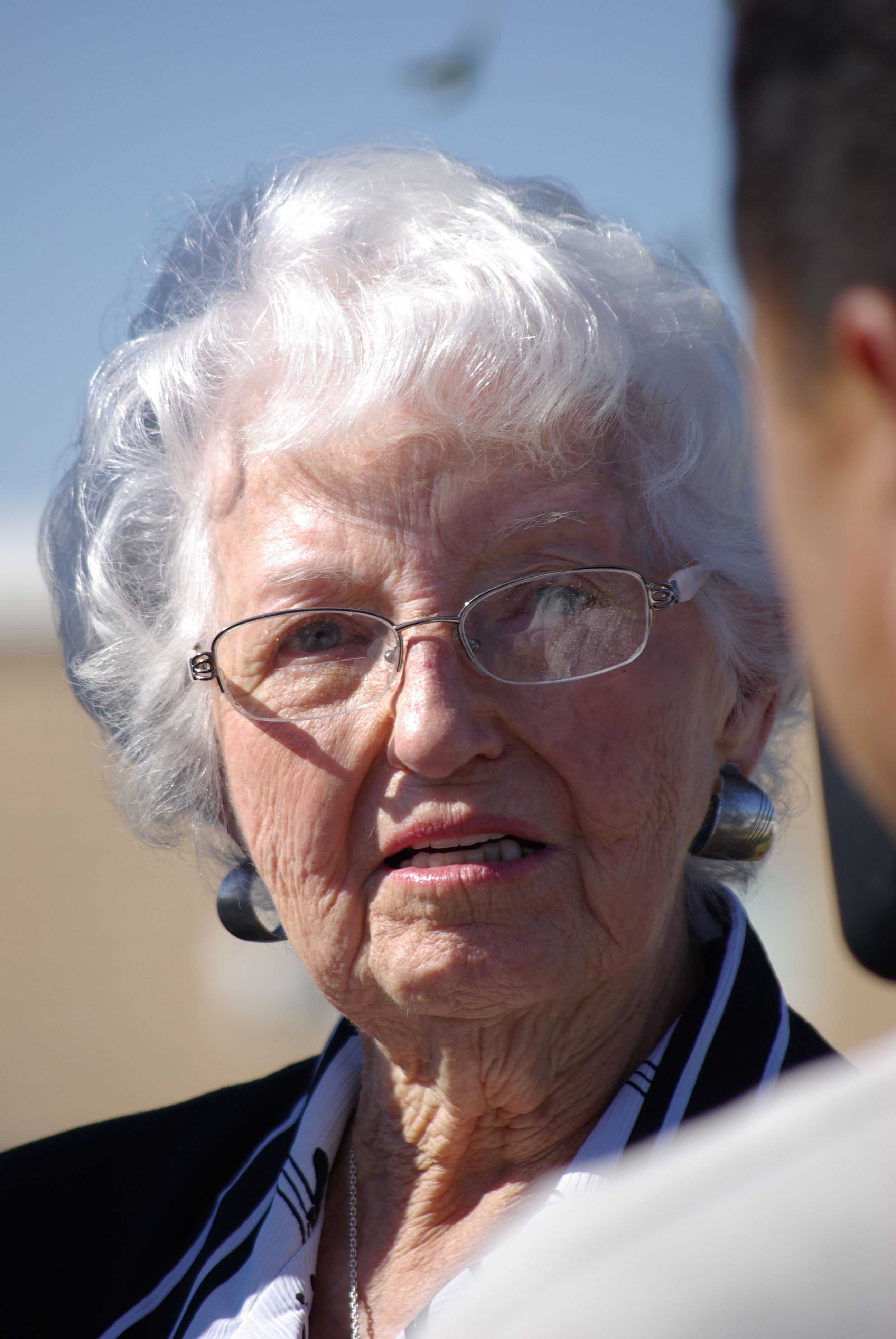
2012-11-20 Tippitt Memorial 013  Marie Tippit answers questions, dedication of marker to her late husband, J. D. Tippit - photo by Ed Darrell, use permitted with attribution

Marie Tippit, officer Tippit’s widow, answered questions from a reporter Tuesday at the dedication of the marker to her husband. Photos by Ed Darrell except where noted.

2013 is the 50th anniversary of the assassination of President John F. Kennedy, in Dallas.  Proponents wanted to get the tribute to Officer Tippit installed in time for the anniversary year.  Particularly with the aid of scholars at the 6th Floor Museum, tourists and historians have been retracing routes taken that day 50 years ago, the parade route of President Kennedy from Love Field, with the emergency reroute to Parkland, and the route Oswald is thought to have used to flee after the shooting, from the Texas School Book Depository, through the bus station, across the Trinity River to his boarding house in Oak Cliff, and from there to the Texas Theater where he was captured.

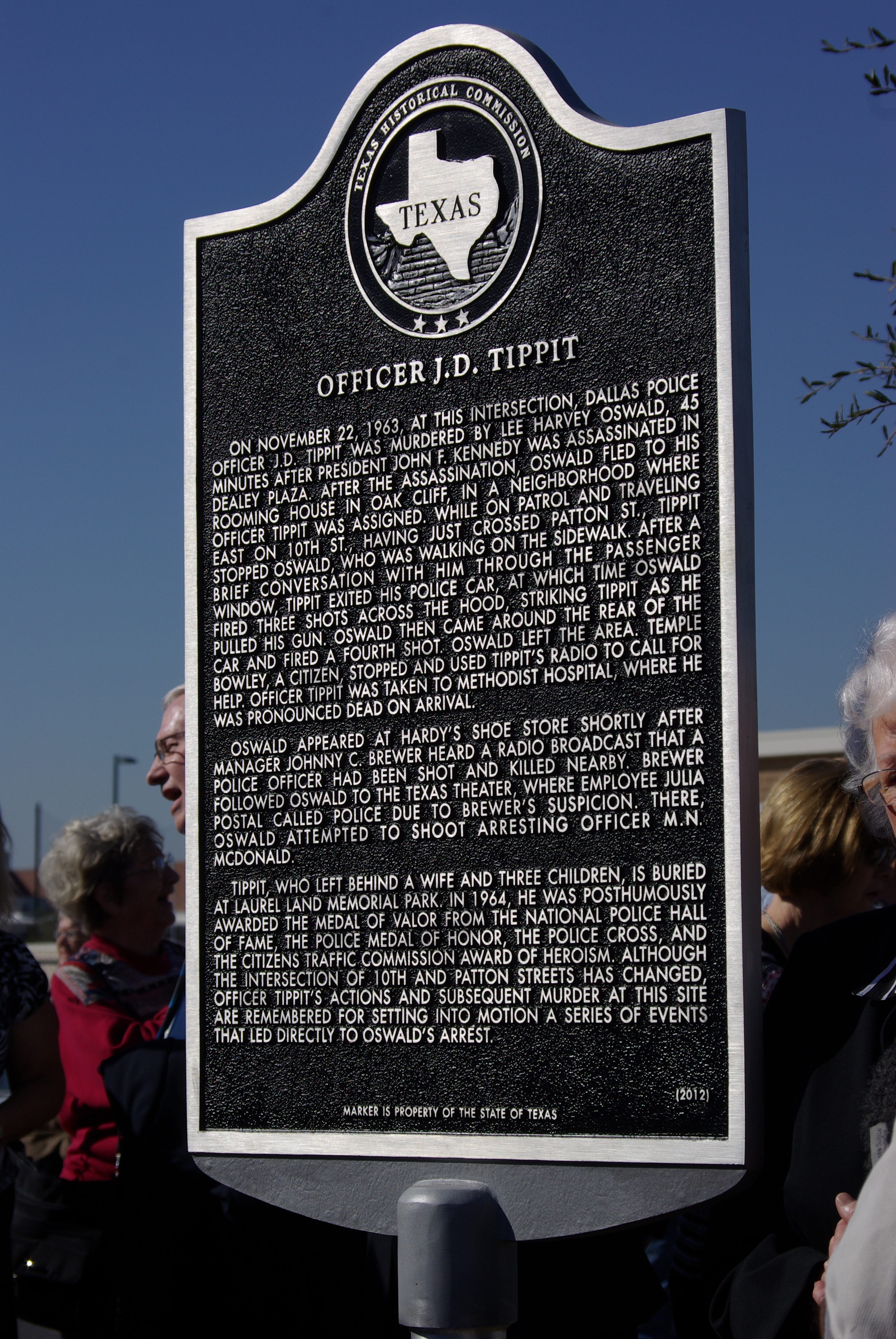
2012-11-20 Tippitt Memorial 017 plaque honoring J. D. Tippit, photo by Ed Darrell
Plaque from the Texas Historical Commission explaining the history of the spot in Oak Cliff where Officer Tippit confronted suspected assassin Lee Oswald.

Particular striking in this history is the role played by ordinary citizens — Officer Tippit on his rounds, witnesses in the surrounding homes and the people who used Tippit’s radio to notify Dallas Police of Tippit’s shooting (in an era before cell phones, and probably before most local phone lines even had Touch Tone™ dialing), the alert salesman at the now-defunct Hardy’s shoe store, and the ticket seller at the Texas Theater who phoned police after Oswald stiffed the theater on a ticket price.

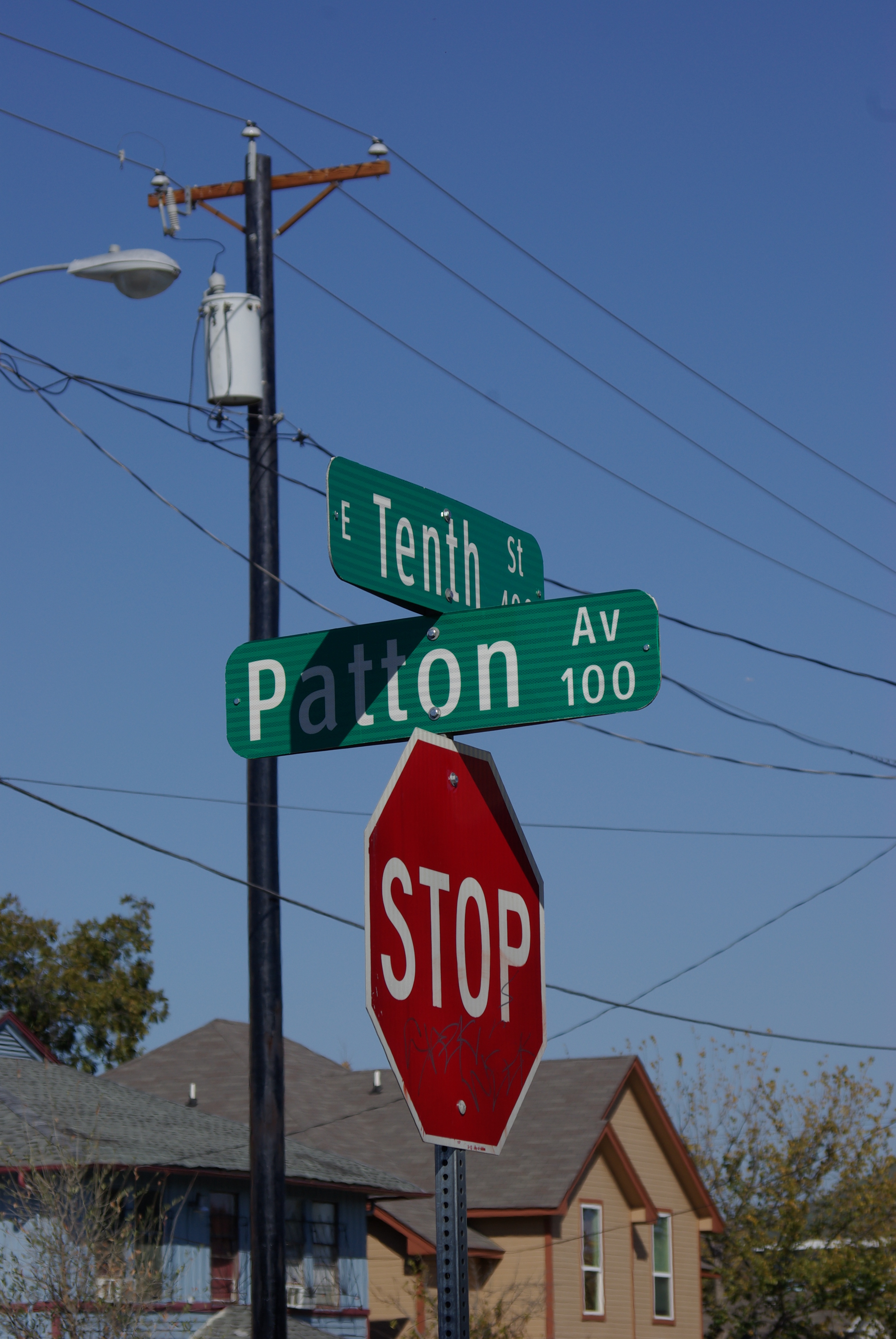
2012-11-20 Home and Tippitt Memorial 036 Street sign at 10th and Patton, site of confrontation between Lee Oswald and Officer Tippit - photo by Ed Darrell

Even the street signs and stop signs have been updated at 10th and Patton, the site of the new historical marker.

Hardy’s Shoe Store was a Quinceanera dress shop in 2011 and may have gone through other incarnations since 1963.   Assassination histories note that students playing hooky from W. H. Adamson or Sunset High Schools were in the Texas Theater when Oswald was arrested, though most of them ran out to avoid being questioned by police and outed for having skipped school.  Adamson’s campus is greatly expanded recently.

But for the intervention of ordinary citizens along the path, it is entirely conceivable that the assassin of the president of the United States might have gone undetected long enough to dispose of evidence that linked him to the crime, or escaped from the country.

My students over the past five years, all residents of Oak Cliff, knew very little about the Kennedy assassination, nor especially the links to Oak Cliff.  We need to do a better job as parents, teachers, newspapers, broadcast organizations, community associations and municipal government, in preserving and commemorating our local histories.

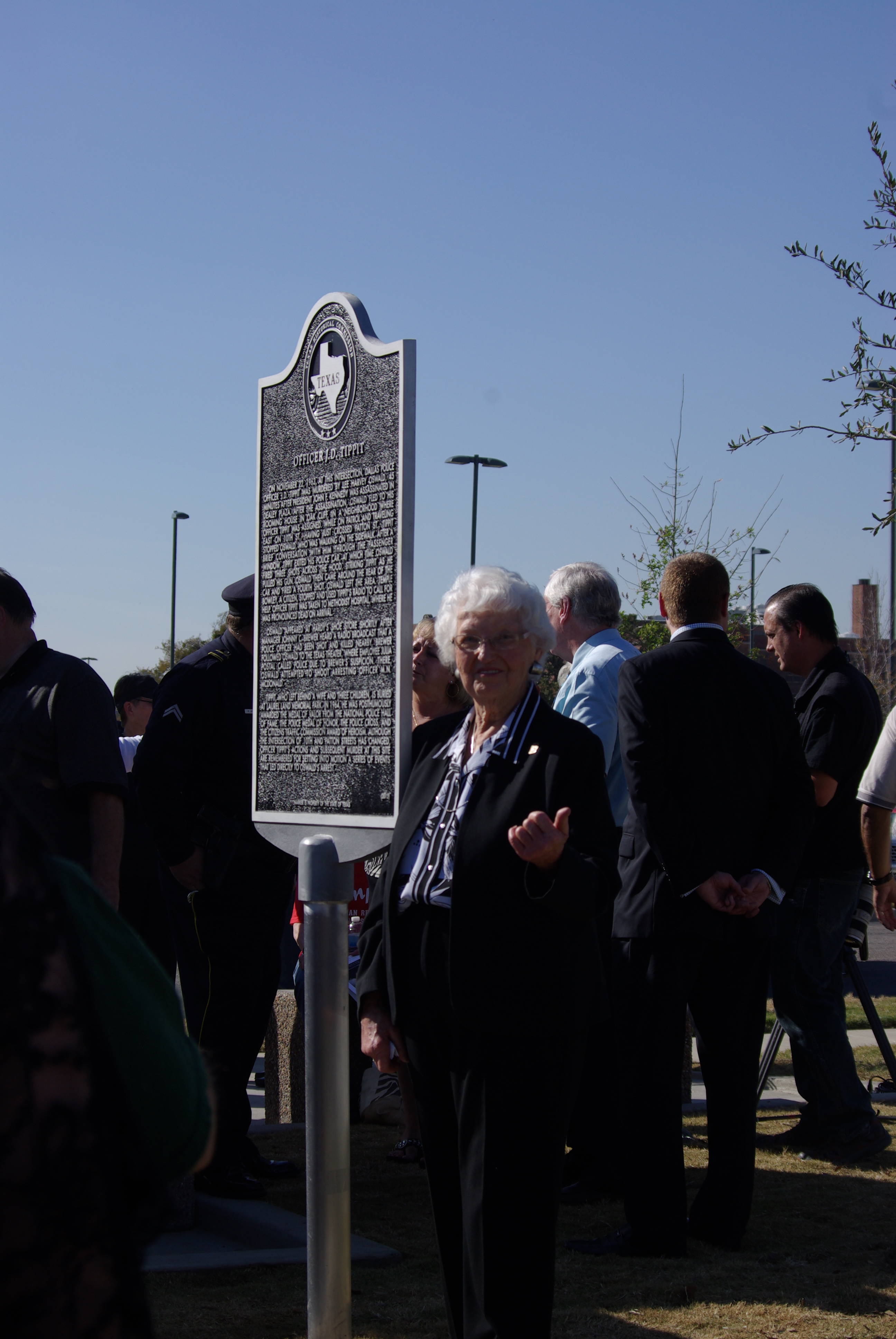
2012-11-20 Tippitt Memorial 019 Marie Tippit next to the memorial plaque to her husband, Officer J. D. Tippit

Marie Tippit standing next to the historical marker for her husband, J. D. Tippit, at the marker’s dedication, November 20, 2012.

2012-11-20 Tippitt Memorial 030 crowd devoid of dignitaries - Brad Watson at right

Other than the police chief and a couple of Dallas ISD board members, the crowd was pleasantly devoid of dignitaries; it’s a monument to a working man doing his job. WFAA Channel 8 reporter Brad Watson is the tallest man on the right; his reports several months ago spurred the action to carve out the memorial site from Dallas ISD-acquired land, greatly boosting the work to get a marker put up.

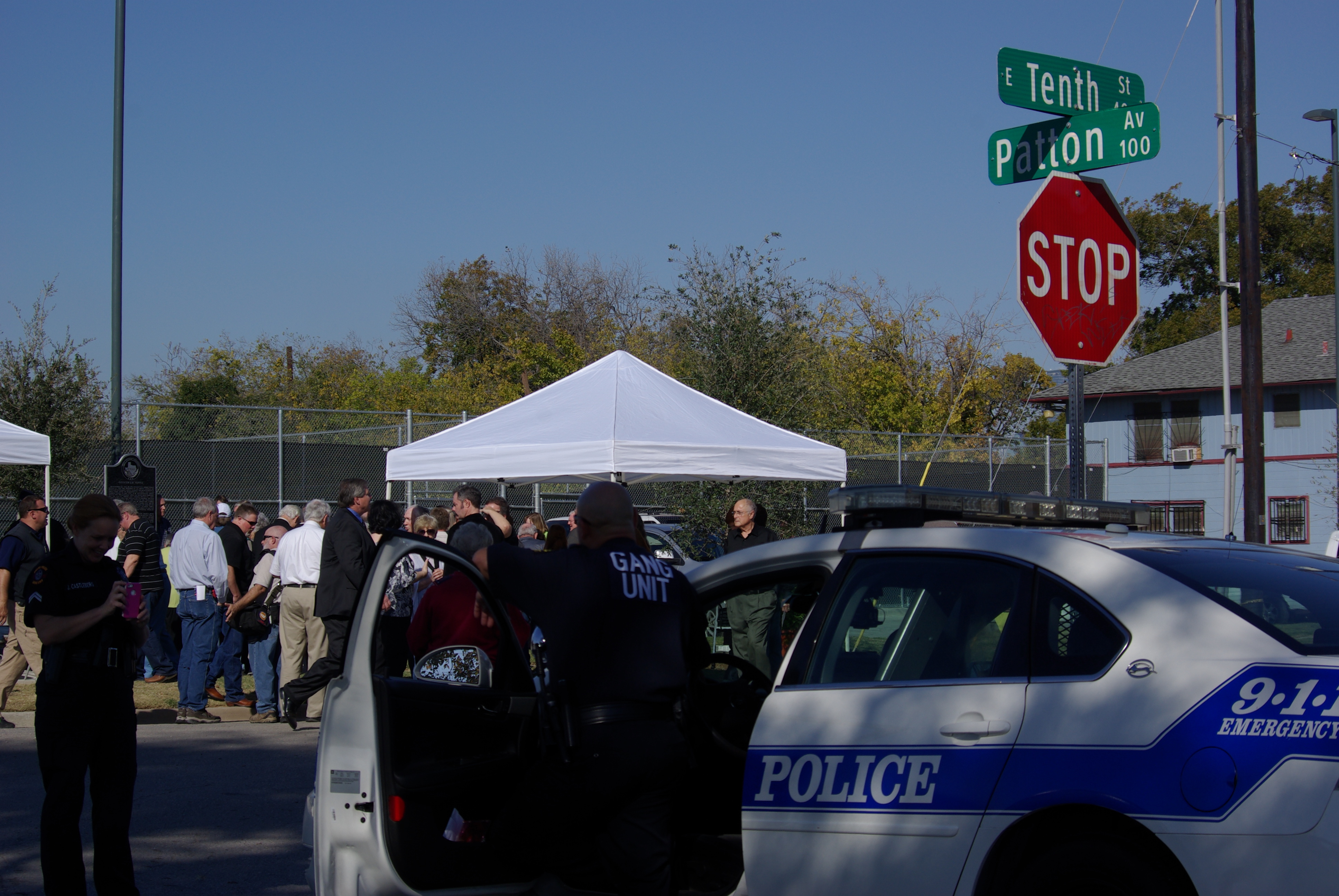
2012-11-20 Tippitt Memorial 037 Dallas Police cruiser 2012, at site of 1963 shooting - photo by Ed Darrell

History of technology: Compare this photograph of two Dallas police with the photo of Officer Tippit’s car earlier in this post. This squad car comes equipped with full-time dash-mounted cameras, instant radio and computer links; police also carry their own personal communication devices, such as the pink smartphone being used to photograph another officer. The car itself carries the phone number for emergency calls, and some carry the URL of the Dallas Police website. The traditional lights atop the car in Dallas have been updated to LEDs, which did not exist in 1963. How many other significant changes in technology can be found in these photos?

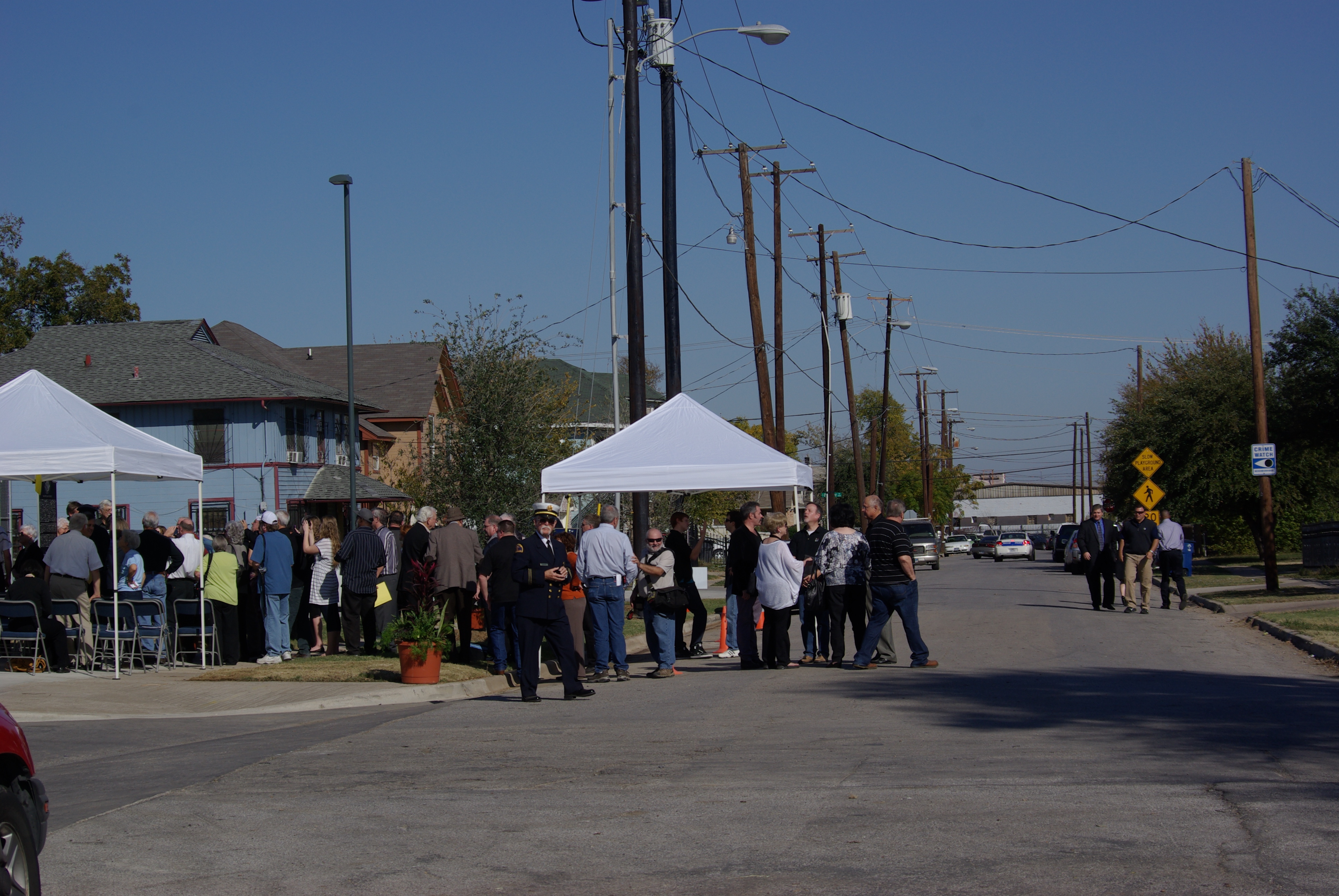
2012-11-20 Tippitt Memorial 039 10th St at Patton, Oak Cliff, Texas, at Tippit ceremony 11-20-2012 - photo by Ed Darrell

Dallas school district construction changed much of the neighborhood over the past five years; note the absence of trees shading the street that were present in 1963; they may have been elms struck down by blight decades ago.  Compare this photo with the first photo in this post, taken about 16 months earlier.

More:


Celebrate Social Security “birthday,” August 14, 2012 at FDR Library

August 1, 2012

Press release from the FDR Presidential Library and Home; some informational links added here:
FOR IMMEDIATE RELEASE
For press inquiries: Cliff Laube (845) 486-7745

FDR Presidential Library and Museum to host

2012 NATIONAL BIRTHDAY PARTY FOR SOCIAL SECURITY

August 14, 2012 at 11:00 a.m.
Henry A. Wallace Center at the FDR Presidential Library and Home

Reservations are required as seating is limited. For reservations call co-chair Stefan Lonce at (914) 629-4580.

HYDE PARK, NY — The Franklin D. Roosevelt Presidential Library and Museum will host a 2012 National Birthday Party for Social Security at 11:00 a.m. on Tuesday, August 14, 2012. Event co-chair Dr. Christopher Breiseth, Francis Perkins Center board member and former President and CEO of the Roosevelt Institute, will lead the festivities. The program will celebrate the 77th Anniversary of the signing of the Social Security Act by President Franklin D. Roosevelt with readings of the 1935 and 1983 social security signing statements, “A Promise to All Generations: Stories and Essays about Social Security and Frances Perkins” (co-edited by Dr. Breiseth), and “Driving with FDR: A Calendrical Biography.” The forthcoming book “Driving with FDR” is written by event co-chair Stefan Lonce, editor of The Montauk Sun newspaper.

Attendees will celebrate the occasion with refreshments — including two special birthday cakes — and free admission to the Roosevelt Library’s current special exhibition, “The Roosevelts: Public Figures, Private Lives,” the largest photography exhibit ever assembled on the lives and public careers of Franklin and Eleanor Roosevelt. This program will be held in the Henry A. Wallace Visitor and Education Center at the FDR Presidential Library and Home.

Reservations are required as seating is limited. For reservations call co-chair Stefan Lonce at (914) 629-4580.

The Franklin D. Roosevelt Presidential Library and Museum is dedicated to preserving historical material and providing innovative educational programs, community events, and public outreach. It is one of thirteen presidential libraries administered by the National Archives and Records Administration. For information about the FDR Presidential Library call (800) 337-8474 or visit www.fdrlibrary.marist.edu.

Historic Hyde Park is a group of government and private non-profit organizations based in Hyde Park, New York. Each has a unique mission, but all are united in their dedication to extending the legacy of Franklin and Eleanor Roosevelt to new generations. HHP includes the Franklin D. Roosevelt Presidential Library and Museum, the Home of Franklin D. Roosevelt National Historic Site, Eleanor Roosevelt National Historic Site, the Eleanor Roosevelt Center at Val-Kill, the Franklin and Eleanor Roosevelt Institute, and Vanderbilt Mansion National Historic Site. For more information about HHP visit www.HistoricHydePark.org.

# # #

Composite photo of people at FDR's signing of Social Security Act -- SSA image

From Social Security Administration: There were many photographs taken of the Social Security Act signing ceremony. The posing was different in many of the photographs and in no single photograph are all the participants visible. This composite photograph shows all of the participants in a single image. (See identification below)

People listed in the photograph, according to the Social Security Administration, “Who is who, and why they were there”:

1. Rep. Jere Cooper (D-TN). Cooper was a member of the House Ways and Means Committee and would go on in subsequent years to become something of an expert on Social Security topics and he was a major force in Social Security legislative developments during the 1940s to the mid-1950s. Mr. Cooper also rose to the position of Chairman of the Ways & Means Committee during the Eighty-fourth and Eighty-fifth Congresses.

2. Rep. Claude Fuller (D-AR). Fuller was a member of the Ways & Means Committee and was generally opposed to the Administration’s bill. During Committee consideration he made motions seeking to strike key provisions of the legislation. But when his efforts failed, he compromised with the Administration and joined in voting for passage of the bill.

3 . Rep. Robert Doughton (D-NC) was chairman of the House Ways and Means Committee. As such he was the principal official sponsor of the legislation in the House.

4. Rep. Frank Buck (D-CA) was a second-generation industrialist and fruit grower from California. He was a member of the House Ways & Means Committee, which had jurisdiction of the bill in the House. He graduated from Harvard Law School and served five terms in Congress, from 1933 until his death in 1942. (Representative Buck has often been misidentified in photos of the signing as being Edwin Witte. Witte, in fact, was not in the signing photographs.)

5. Rep. John Boehne, Jr.(D-IN) succeeded his father as a representative from Indiana. He was first swept into office in the 1932 elections with President Roosevelt and strongly supported FDR’s programs. At first, he was against the Social Security bill and wanted to exempt industrial employers with their own pension systems.

6 . Sen. Robert Wagner (D-NY) was born in Germany, immigrated to New York City, attended law school and was elected to the Senate in 1926. He served four terms. He was a close associate of Frances Perkins and helped draft several early New Deal measures. Wagner introduced the bill into the Senate. His son, Robert F. Wagner, was mayor of New York City for 16 years.

7 . Sen. Alben Barkley (D-KY) was a seven-term Congressman before being elected to the Senate in 1926. By 1937, he was Senate Majority Leader and a decade later, Vice President of the United States. He was an ardent New Dealer and helped shepherd the Social Security Act through the Senate. He argued for “a universal and uniform program in general.” He didn’t want to exempt certain private groups merely because they already had pension systems, as was proposed by some conservatives in the Congress.

8 . This individual is presently unknown.

9 . Sen. Robert LaFollette, Jr., (PROG-WI) was the eldest son of Robert LaFollette, a progressive Senator from Wisconsin and one-time presidential candidate. When his father died in 1925, Robert Jr., then only 30 years old, was appointed to succeed him. Initially elected as a Republican, LaFollette changed his party affiliation to the Progressive Party in 1934. LaFollette served on the House-Senate conference committee that drafted the final version of the Social Security bill. He served in the Senate until 1946, when he was defeated by Joseph McCarthy. In 1953, LaFollette committed suicide in Washington, D.C.

10 . Rep. John Dingell, Sr. (D-MI). Rep. Dingell was a member of the House Ways & Means Committee. He was a prominent leader in Congress in sponsoring social insurance legislation and teamed with Senator Wagner he authored a couple of important precursor bills to the Social Security Act. (Several authors have identified Dingell as “unidentified man” in some versions of the signing photo.)

11. Sen. Augustine Lonergan (D-CT) was a native of Connecticut and a graduate of Yale University. Although he was a four-term Congressman, he served only one term in the Senate. During the discussions on the Social Security bill, Lonergan gave information about various private insurance annuities to show how they compared to the social insurance program that was being proposed.

12 . Frances Perkins was appointed Secretary of Labor in 1933, making her the first woman to hold a cabinet-level position. Like FDR, she was a child of privilege, but became a strong advocate for the poor and working class. She began her career in New York City as a social worker and held several responsible State government jobs. She served as head of Roosevelt’s Committee on Economic Security, set up in 1934. The Social Security legislation sprang from this committee.

13. Rep. Frank Crowther (R-NY) was a Republican member of the House Ways & Means Committee;

14. Sen. William H. King (D-UT). King was a conservative Democrat and member of the Senate Finance Committee. King expressed persistent opposition to many features of the bill as it was being considered, and his support of the legislation was in doubt until the last possible minute. In the end, he voted for passage of the Social Security Act. (Senators King and Harrison have often been confused in the signing photos, including,we are embarrassed to admit, in SSA’s own OASIS magazine. Clue: King has a bowtie, Harrison has a regular long tie.)

15. Rep. David J. Lewis (D-MD) was a member of the House Ways & Means Committee and was probably the leading expert on social insurance legislation on the Committee. It was Lewis, a former coal miner and self-taught lawyer, who introduced the Social Security bill into the House on January 17, 1935. However, Chairman Doughton, exercising what he took to be the Chairman’s privileges, made a copy of Lewis’ bill and submitted it himself. Then he persuaded the House clerk to give him a lower number than Lewis’ copy. Newspapers then began calling the bill “The Wagner-Doughton bill.” When Lewis found out, he sputtered and swore, then went to work to understand every sentence and master the arguments in favor of the bill. And when David Lewis walked down the aisle of the House to debate on the bill’s behalf, he received a standing ovation–a subtle rebuke to Chairman Doughton’s high-handed treatment.

16 . Sen. Byron Patton “Pat” Harrison (D-MS) was a Congressman for 8 years before being elected to the Senate in 1918. In his book “The Development of the Social Security Act,” Edwin Witte gives Harrison credit for his “adroit” handling of the Social Security bill in the Senate Finance Committee. According to Witte, Title II would not have been approved by the Committee without Sen. Harrison’s help. Harrison went on to serve in the Senate for the rest of his life and was elected President pro tempore 6 months before his death in June 1941. (In other versions of the signing photo, Sen. Harrison can be more clearly seen wearing a white suit and tie and holding his trademark cigar.)

17. Sen. Joseph Guffey (D-PA) was 65 years old at the time the Social Security Act was passed, although he was only a first-term Senator. From Pennsylvania, he served two terms before being defeated in 1946. His vote on the Social Security bill was in doubt until the final roll call.

18. Senator Edward Costigan (D-CO), a member of the Finance Committee.

19. Rep. Samuel B. Hill (D-WA) was a member of the House Ways & Means Committee.

20. Rep. Fred Vinson (D-KY) was a member of the House Ways & Means Committee. He would go on to serve as Secretary of the Treasury and as a Justice and Chief Justice of the Supreme Court.

21 . President Franklin D. Roosevelt.

NOTE: For more biographical information on any of the members of Congress see the U. S. Senate Biographical Directory of the United States Congress on the Senate website

Astonishing to me that one person in the photograph remains unidentified.  Can you help identify the man?

More:


Romney 2012, vs. Obama 2008

February 26, 2012

It’s not really a fair comparison, is it?  In 2008, Sen. Barack Obama was in a hotly contested race for the Democratic nomination to be president.  His team worked to get the crowds out, at a rally before Super Tuesday.

In 2012, it’s former Gov. Mitt Romney who is in a hotly-contested race for the nomination — but of the GOP, not the Democrats.  So it’s not really a fair comparison, Democrats against Republicans, just before Super Tuesday, is it?

Still, we see these two photos making the rounds.  These two photos were taken four years and 20 days apart:

Romney vs. Obama, gate in Detroit (from MoveOn.org)

Political rallies for presidential candidates, in Detroit, Michigan, 2012, and Hartford, Connecticut, 2008

Oh, that’s not straight up, is it. One was in Detroit, the other in Hartford.  Okay, let’s compare Detroit rallies.  Here’s Mitt Romney in Detroit:

And here is Obama in Detroit in 2008, in Joe Louis Arena:

If you’re a red-blooded American, you’ll find Obama’s speech in Detroit frustrating, in retrospect.  Where Obama said America can’t wait to solve problems, Republicans since then have said “Yes, We Can Wait,” and they’ve frustrated action to fix so many problems.   We’ve lost so much time.


Bathtub myth still haunts the ghost of Millard Fillmore

February 23, 2012

Presidents Day this year brought out columns and commentary in newspapers and other media across the country, with trivia about presidents.

Millard Fillmore in March, 1849, daguerreotype by Matthew Brady - Wikipedia image

Millard Fillmore in a daguerreotype by Matthew Brady in March, 1849, in a sitting at the U.S. Capitol. In 1849 the presidential inauguration took place in March — this may be a photo taken on inauguration day, but almost certainly when Fillmore was Vice President. Wikipedia image

What did we learn?  We learned that the old hoax, that Millard Fillmore put the first bathtub in the White House, still stands strong.  The ghost of H. L. Mencken, the guy who started the hoax, high-tails it to the nearest hotel bar for a beer; the ghost of Santayana smiles and shakes its head.  Fillmore’s ghost looks around for a good book to read.

Did one of the wires services run a story on the trivia that reporters picked up?

In the Diamond Bar (California) Patch, in a column of presidents trivia, editor Catherine Garcia reported:

  • Millard Fillmore installed the first bathtub and kitchen stove in the White House.

In that version of history, presidents were both dirty and hungry from 1801 to 1850, I suppose.

In the Quincy (Illinois) Herald-Whig, Steve Eighinger seconded the error:

º For some reason, Millard Fillmore, the 13th president, has been the butt of a lot of jokes over the years and I don’t know why. The guy seems pretty upstanding. When Fillmore moved into the White House, it didn’t have a Bible, so he corrected that oversight. He and his wife, Abigail, installed the first library at the White House, plus the first bathtub and kitchen stove. Fillmore could not read Latin and refused an honorary degree from Oxford University, saying a person shouldn’t accept a degree he could not read. (So how did the first 12 presidents take a bath?)

Give Mr. Eighinger credit.  In that parenthetical question, he begins to see the problems with the story, the hoax Mencken wrote.  Too bad he didn’t chase it down.

Yes, the Fillmores installed the first library in the White House — though it was more out of their love of books than a lack of a Bible.  And they updated the kitchen, but certainly someone had some sort of stove to cook on prior to 1850.

Punditty (a nome de plume, I hope) got the facts right at AllVoices:

13. Millard Fillmore wasn’t really the first president to have a bathtub installed in the White House. The actual answer is more complicated. See the link below under “Additional Sources.” He was, however, a member of three political parties during his lifetime: Anti-Masonic (1828-1832); Whig (1832-1856, including his presidency of 1850-53); and American (1856-1860).

I didn’t find the link to “Additional Sources.”  Perhaps the author referred to the notes under the Wikipedia article on Fillmore, which was linked from the site.  You should remember that the “American Party” to which Fillmore belonged, and on whose ticket he ran for the presidency in 1856, was also known as the “Know-Nothing Party.”

How many other newspapers carried the hoax in the past week, that my news hounds did not find?

Even in 1952, when President Harry Truman told the hoax, there was general knowledge that the story was false.  Why does it still circulate, 95 years after Mencken invented it?

When did the first plumbed bathtub go into the White House, and who was president at the time?

Read the rest of this entry »


Presidents Day 2012: Fly your flag today

February 20, 2012

Presidents Day is February 20, 2012 — fly your U.S. flag today.

National Park Service photo, Lincoln Memorial through flags at Washington Monument

The Lincoln Memorial, seen through flags posted at the Washington Monument, Washington, D.C.; National Park Service Photo via About.com

Oddly enough, some controversy arises from time to time over how to honor President Washington and President Lincoln, and other presidents.  Sometimes the controversy simmers over how to honor great Americans — if Lincoln deserves a day, why not FDR?  Why not Jefferson? — and sometimes the controversy covers more mundane ground — should the federal government give workers a day off?  Should it be on a Monday or Friday to create a three-day weekend to boost tourism?  About.com explains the history of the controversy:

Presidents’ Day is intended (for some) to honor all the American presidents, but most significantly George Washington and Abraham Lincoln. According to the Gregorian or “New Style” calendar that is most commonly used today, George Washington was born on February 22, 1732. But according to the Julian or “Old Style” calendar that was used in England until 1752, his birth date was February 11th. Back in the 1790s, Americans were split – some celebrated his birthday on February 11th and some on February 22nd.

When Abraham Lincoln became president and helped reshape our country, it was believed he, too, should have a special day of recognition. Tricky thing was that Lincoln’s birthday fell on February 12th. Prior to 1968, having two presidential birthdays so close together didn’t seem to bother anyone. February 22nd was observed as a federal public holiday to honor the birthday of George Washington and February 12th was observed as a public holiday to honor Abraham Lincoln’s birthday.

In 1968, things changed when the 90th Congress was determined to create a uniform system of federal Monday holidays. They voted to shift three existing holidays (including Washington’s Birthday) to Mondays. The law took effect in 1971, and as a result, Washington’s Birthday holiday was changed to the third Monday in February. But not all Americans were happy with the new law. There was some concern that Washington’s identity would be lost since the third Monday in February would never fall on his actual birthday. There was also an attempt to rename the public holiday “Presidents’ Day”, but the idea didn’t go anywhere since some believed not all presidents deserved a special recognition.

Even though Congress had created a uniform federal holiday law, there was not a uniform holiday title agreement among the individual states. Some states, like California, Idaho, Tennessee and Texas chose not to retain the federal holiday title and renamed their state holiday “President’s Day.” From that point forward, the term “Presidents’ Day” became a marketing phenomenon, as advertisers sought to capitalize on the opportunity for three-day or week-long sales.

In 1999, bills were introduced in both the U.S. House (HR-1363) and Senate (S-978) to specify that the legal public holiday once referred to as Washington’s Birthday be “officially” called by that name once again. Both bills died in committees.

Today, President’s Day is well accepted and celebrated. Some communities still observe the original holidays of Washington and Lincoln, and many parks actually stage reenactments and pageants in their honor. The National Park Service also features a number of historic sites and memorials to honor the lives of these two presidents, as well as other important leaders.

Fly your flag, read some history, enjoy the day.

More, Resources, and Related Articles:

English: Air Force One, the typical air transp...

President's airplane, Air Force 1, flying over Mount Rushmore National Monument, in South Dakota - Image via Wikipedia


Millard Fillmore at 212 – boiling mad?

January 7, 2012

Millard Fillmore was born January 7, 1800. Had he lived, Millard Fillmore would be 212 years old today, very cranky, and looking for a good book to read.  Had each year been a degree Fahrenheit, he’d be boiling!

Millard Fillmore clipart from University of South Florida

Millard Fillmore clipart from University of South Florida - Free! Click image to go to USF site.

Would you blame him for being cranky? He opened Japan to trade. He got from Mexico the land necessary to make Los Angeles a great world city and the Southern Pacific a great railroad, without firing a shot. Fillmore promoted economic development of the Mississippi River. He managed to keep a fractious nation together despite itself for another three years. Fillmore let end the practice of presidents using slaves to staff the White House, then called “the President’s Mansion,” eight years before the election of Abraham Lincoln.

Then in 1852 his own party refused to nominate him for a full term, making him the last Whig to be president. And to add insult to ignominy, H. L. Mencken falsely accused him of being known only for adding a bathtub to the White House, something he didn’t do.

As Antony said of Caesar, the good was interred with his bones — but Millard Fillmore doesn’t even get credit for whatever evil he might have done: Fillmore is remembered most for being the butt of a hoax gone awry, committed years after his death. Or worse, he’s misremembered for what the hoax alleged he did.

Even beneficiaries of his help promoting the Mississippi River have taken his name off their annual celebration of the event. Fillmore has been eclipsed, even in mediocrity (is there still a Millard Fillmore Society in Washington?).

Happy birthday, Millard Fillmore.

Millard Fillmore, free clipart from University of South Florida

Millard Fillmore, free clipart from University of South Florida

Millard Fillmore was a man of great civic spirit, a man who answered the call to serve even when most others couldn’t hear it at all. He was a successful lawyer, despite having had only six months of formal education (a tribute to non-high school graduates and lifelong learning). Unable to save the Union, he established the University of Buffalo and the Buffalo and Erie County Historical Society. During the Civil War, he led the local militia in support of the war effort, many rungs down from his role of Commander-in-Chief. And, it is said of him that Queen Victoria said he was the most handsome man she had ever met.

A guy like that deserves a toast, don’t you think?

Resources:


Oh, say, can Republicans see?

December 18, 2011

Old Jules was referring to something else, a serious enough issue on its own, and not necessarily the lack of vision among Republican presidential candidates.

But it fits from time to time:

Zero Visibility, a warning sign - photo by Old Jules, perhaps

Zero Visibility, a warning sign - photo by Old Jules, perhaps

Bill Cosby once asked if anyone else had the same chill of fear he gets when the lights start to go down at the theater:  Are the lights getting dim, or are you going blind?

Is there zero visibility, or are our eyes shut tightly?  Can the candidates see what it takes to get us out of this olio, this olla podrida of messes, or is there too much fog, or are they just not looking?  Worse, is it dark AND they are not looking?

What say you?


6th Floor Museum, Dallas — go see it

November 23, 2011

The 6th Floor Museum in Dallas presents in-depth studies of the assassination of President John F. Kennedy, on November 22, 1963.

There’s a lot more to such a study than you might think.  It’s a relatively quick tour — you can view the museum’s displays and films in about two hours, comfortably, stopping to read exhibit cards and really analyze objects on display.  A couple of the films present a great deal of history quickly and well (Walter Cronkite narrates one).

One cannot avoid a great deal of history of the Civil Rights Movement, the Cuban Missile Crisis and the Cold War, and the start of the Vietnam conflict.  Kennedy’s administration covered only three years, but a very active and important three years in the 20th century.

Increasingly the 6th Floor Museum is a stop for researchers and scholars.  The recent addition of a good reading room for scholars is a great asset.

Curator Gary Mack offers a quick introduction in this video:

1,276

Plan to spend three or four hours.  You’ll find the place very interesting.  After the museum, most likely you’ll want to spend some time exploring Dealey Plaza, the road where Kennedy’s car was when he was shot, and the famous grassy knoll.  It’s a part of downtown that is almost always filled with people in daylight in all but the absolute worst weather.  (Check out the EarthCam at Dealey Plaza.)

Old Red, the old Dallas County Courthouse, with its own museum, is just a half block away.


September 14: President McKinley died, 1901

September 14, 2011

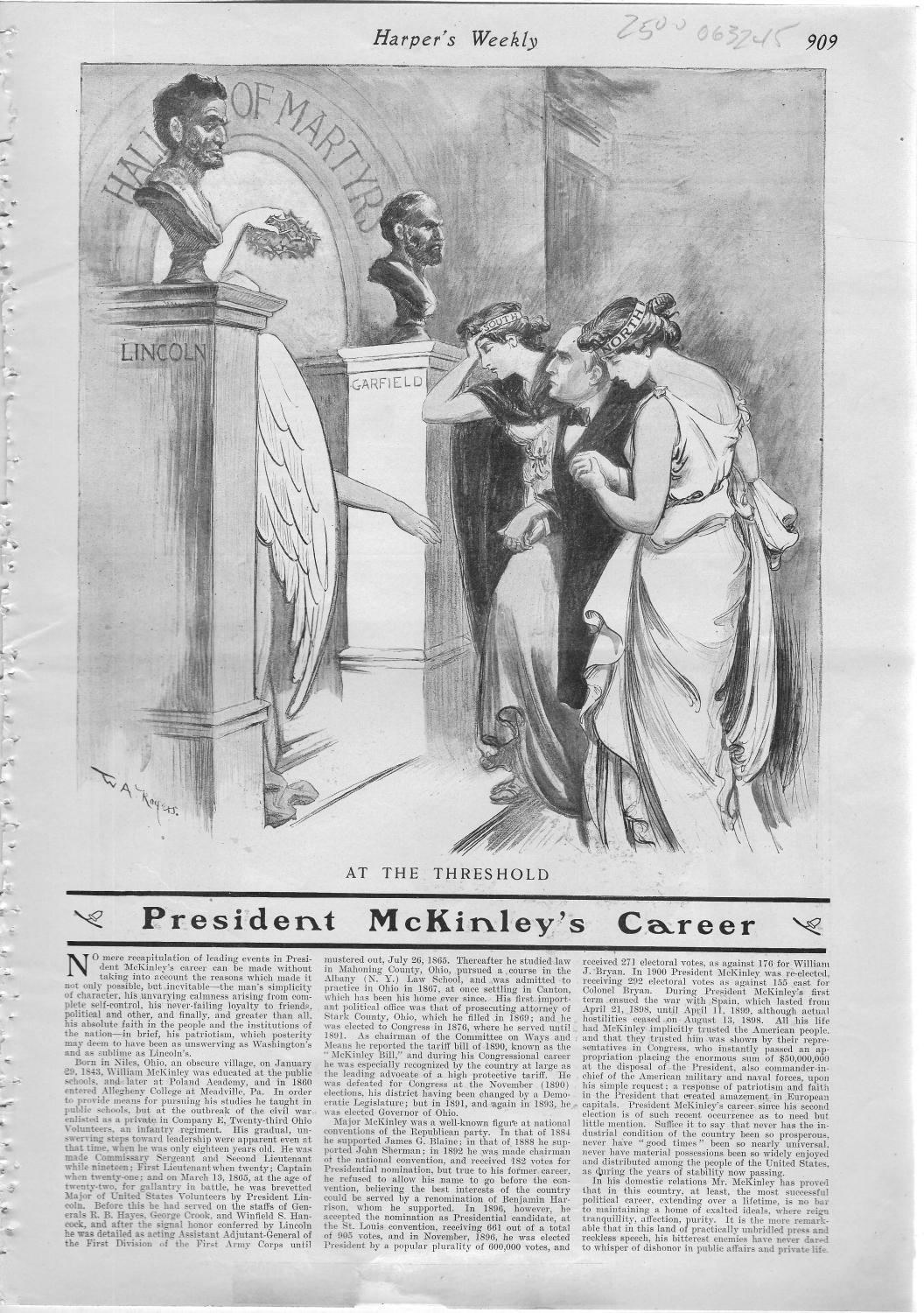
Image from Harper’s Magazine, September 14, 1901 -= McKinley “At the Threshold” of Martyrs’ Hall

Teachers should be mining the “On This Day” feature at the New York Times, which usually features an historic cartoon or illustration from an antique Harper’s Weekly. It is a favorite feature, to me.

Yesterday, it featured the illustration from Harper’s upon the death of President William McKinley, on September 14, 1901.

At the Threshold

Artist: William Allen Rogers

his post-dated cartoon was published as President William McKinley lay dying from an assassin’s bullet. He had been shot on September 6, 1901, by anarchist Leon Czolgosz (pronounced chol-gosh) at the Pan-American Exposition in Buffalo, New York. The president died on September 14. Here, McKinley is led to the Hall of Martyrs by grief-stricken personifications of the North and South. Between pillars topped by busts of the two previously slain presidents, Abraham Lincoln and James Garfield, the angel of death prepares to place a laurel wreath of honor upon McKinley’s head. (Images related to Garfield’s assassination also showed a reconciled North and South.)

There is much more at the Times site.

Robert Lincoln, the son of Abraham Lincoln, was present when McKinley was shot. Accounts I have read but not confirmed say that Robert Lincoln had been invited to attend Ford’s Theatre with his father and mother, the night his father was shot. As a member of President James Garfield’s cabinet, Robert Lincoln had been awaiting Garfield’s arrival at Union Station in Washington, D.C., when Garfield was shot.

And as a visitor in Buffalo, Robert Lincoln had as a matter of respect lined up to shake President William McKinley’s hand.

Astounding if true. Four U.S. presidents have been assassinated. Robert Lincoln was close to the first, the assassination of his father, and present for the next two. Where can we confirm that story?

McKinley’s death catapulted the do-gooder, Theodore Roosevelt, into the presidency, probably to the great chagrin of corrupt Republican politicians who had hoped that by getting him nominated to the vice presidency they could get him out of New York politics.

The rest is history.

(This is an encore post.)

Image is available for purchase at AbeBooks.