Biography of Millard Fillmore — not up to the bathtub test?

September 4, 2011

A new biography of Millard Fillmore popped out last spring, and the publisher didn’t send me a copy to review!

Not that my review could boost sales much — nor harm them — but don’t publishers use Google to figure out how they might get some publicity for their books?  Most internet searches for “Millard Fillmore” end up here.

No, I’m not really offended.  But I did find it interesting that none of my “Millard Fillmore” keyword  compilers picked up on the book.

Details:  Millard Fillmore, Paul Finkelman, Times Books, $23.

Cover of Millard Fillmore, by Paul Finkelman

Cover of Millard Fillmore, by Paul Finkelman

In a review for the Wall Street Journal, Fergus M. Bordewich wrote:

In this short, fierce book—part of the “American Presidents” series—Mr. Finkelman has delivered an unvarnished but compelling portrait of one of our least remembered but far from insignificant presidents. Against his grain, he gives Fillmore credit for promoting a number of “visionary” ideas that would come to fruition only after he left the presidency in 1853: the transcontinental railroad, the assertion of American power in Hawaii, the building of a Central American canal. “But on the central issues of the age,” Mr. Finkelman writes at the end of “Millard Fillmore,” “his vision was myopic and his legacy is worse.”

Has anyone read the book?  Is it any good?

More: 


Teaching with original documents, at the 6th Floor Museum

July 29, 2011

6th Floor Museum Seminar - teachers in the Dallas Police Station, at Oswald's interrogation room

Teachers inspect the Dallas Police station, where accused assassin Lee Harvey Oswald was held. The door at left opens on the room where Oswald was interrogated by police. Panorama photo by Ed Darrell, use encouraged, with attribution; click for larger version

It’s been a good week of finding sources, for history issues across the spectrum, not just about the Kennedy assassination in Dallas.

Certainly one of the highlights was a bus tour that carried us from Dallas’s Love Field airport, along the route of Kennedy’s motorcade, to Parkland Hospital, and then through Oak Cliff along the route accused assassin Lee Oswald is believed to have traveled after the assassination to his capture at the much restored Texas Theatre on Jefferson Boulevard.

In the photo above we discuss the actions of Dallas Police after Oswald’s capture.  This room is in the old homicide division of the old Dallas Police Station, a building still in use for municipal offices and being renovated after the police department moved to a newer building a few years ago.  The door at the left leads to the room where Oswald was questioned about his actions and his knowledge of the day’s events.

Oswald's interrogation room in the old Dallas Police Department - photo by Ed Darrell, 6th Floor Museum teachers seminar

Cops and their desks departed years ago, but Oswald's interrogation room holds a fascinating, film noir atmosphere; view from inside the room, as teachers discuss events of November 22, 1963, in the larger office outside. Photo by Ed Darrell; click for larger view


Hard truths about the debt ceiling and uncertainty in the Treasury market

July 16, 2011

Two organizations provide information to Congress in an unbiased manner, with great care for accuracy and completeness of information:  The Congressional Research Service (CRS), an arm of the Library of Congress, and the General Accountability Office (GAO), formerly the General Accounting Office.  Both agencies share the unique status of being organs of the Congress, and not the executive branch.

Consequently, we and Congress should give particular consideration to a report issued by GAO on February 22, 2011:

Debt Limit: Delays Create Debt Management Challenges and Increase Uncertainty in the Treasury Market

GAO-11-203 February 22, 2011
Highlights Page (PDF)   Full Report (PDF, 52 pages)   Accessible Text   Recommendations (HTML)

Summary

GAO has prepared this report to assist Congress in identifying and addressing debt management challenges. Since 1995, the statutory debt limit has been increased 12 times to its current level of $14.294 trillion. The Department of the Treasury (Treasury) recently notified Congress that the current debt limit could be reached as early as April 5, 2011, and the Congressional Budget Office (CBO) projects that under current law debt subject to the limit will exceed $25 trillion in 2021. This report (1) describes the actions that Treasury traditionally takes to manage debt near the limit, (2) analyzes the effects that approaching the debt limit has had on the market for Treasury securities, and (3) describes alternative mechanisms that would permit consideration of the link between policy decisions and the effect on debt when or before decisions are made. GAO analyzed Treasury and market data; interviewed Treasury officials, budget and legislative experts, and market participants; and reviewed practices in selected countries.

The debt limit does not control or limit the ability of the federal government to run deficits or incur obligations. Rather, it is a limit on the ability to pay obligations already incurred. While debates surrounding the debt limit may raise awareness about the federal government’s current debt trajectory and may also provide Congress with an opportunity to debate the fiscal policy decisions driving that trajectory, the ability to have an immediate effect on debt levels is limited. This is because the debt reflects previously enacted tax and spending policies. Delays in raising the debt limit create debt and cash management challenges for the Treasury, and these challenges have been exacerbated in recent years by a large growth in debt. In the past, Treasury has often used extraordinary actions, such as suspending investments or temporarily disinvesting securities held in federal employee retirement funds, to remain under the statutory limit. However, the extraordinary actions available to the Treasury have not kept pace with the growth in borrowing needs. For example, unlike the past, the amount potentially provided by the extraordinary actions for 1 month in fiscal year 2010 was less than the monthly increase in debt subject to the limit for most months of the year. As a result, once debt reaches the limit, Congress will likely have less time than in prior years to debate raising the debt limit before there are disruptions to government programs and services. This trend is likely to continue given the long-term fiscal outlook. Failure to raise the debt limit in a timely manner could have serious negative consequences for the Treasury market and increase borrowing costs. Also, some of the actions that Treasury has taken to manage the amount of debt near the limit add uncertainty to the Treasury market. In the past, Treasury has postponed auctions and dramatically reduced the amount of bills outstanding, which compromised the regularity of auctions and the certainty of supply on which Treasury relies to achieve the lowest borrowing cost over time. GAO’s analysis suggests that borrowing costs modestly increased during debt limit debates in 2002, 2003, and most recently in 2010. In addition, managing debt near the debt limit diverts Treasury’s limited resources away from other cash and debt management issues at a time when Treasury already faces challenges in lengthening the average maturity of its debt portfolio. Observers and participants suggested improving the link between the spending and revenue decisions that drive debt and changes in the debt limit. Better alignment could be possible if decisions about the debt level occur in conjunction with spending and revenue decisions as opposed to the after-the-fact approach now used. This practice, which is similar to practices used in some other countries, might facilitate efforts to change the fiscal path by highlighting the implications of tax and spending decisions on changes in debt. To avoid potential disruptions to Treasury markets and help inform fiscal policy decisions in a timely way, Congress should consider ways to better link decisions about the debt limit with decisions about spending and revenue. Treasury provided technical comments on a draft of this report, which GAO incorporated as appropriate.

Recommendations

Our recommendations from this work are listed below with a Contact for more information. Status will change from “In process” to “Open,” “Closed – implemented,” or “Closed – not implemented” based on our follow up work.

*     *     *     *     *     *     *

Matters for Congressional Consideration

Recommendation: The projections of a growing debt burden have raised concerns both in Congress and in the public. Well-designed budget processes and metrics can help as Congress and the President seek to address the federal government’s long-term fiscal challenge. The current design of the debt limit does not engender or facilitate debate over specific tax or spending proposals and their effect on debt. In addition, the uncertainty it creates can lead to disruptions in the Treasury market and in turn to higher borrowing costs. To avoid these potential disruptions to the Treasury market and to help inform the fiscal policy debate in a timely way, Congress may wish to consider ways to better link decisions about the debt limit with decisions about spending and revenue. Such a process would build on the approach used in 2008 and 2009 when Congress passed and the President signed three laws that were expected to increase borrowing with a corresponding increase in the debt limit. This report presents a number of approaches that could serve as a basis for better linking decisions about spending and revenue with decisions about the debt limit.

Status: In process

Comments: When we determine what steps the Congress has taken, we will provide updated information.

Use the links near the top of the report to get to the full report.

Pay particular attention to this, repeated from above:

The debt limit does not control or limit the ability of the federal government to run deficits or incur obligations. Rather, it is a limit on the ability to pay obligations already incurred. While debates surrounding the debt limit may raise awareness about the federal government’s current debt trajectory and may also provide Congress with an opportunity to debate the fiscal policy decisions driving that trajectory, the ability to have an immediate effect on debt levels is limited. This is because the debt reflects previously enacted tax and spending policies. Delays in raising the debt limit create debt and cash management challenges for the Treasury, and these challenges have been exacerbated in recent years by a large growth in debt.

Tip of the old scrub brush to Michael A. Ryder.

_____________

Wall of shame:  Bloggers and others who do not have a clue


Kennedy said, in the struggle for freedom, we are all citizens of Berlin (Quote of the moment)

June 26, 2011

49 years ago, on June 26, 1962, in Berlin:

President Kennedy addresses Berlin citizens, 6-26-1962 (photographer unidentified)

President John F. Kennedy addressing a crowd in Berlin, Germany, June 26, 1962 - image from NARA and/or Kennedy Library

From the Smithsonian Magazine site:

June 26, 1963: “Ich bin ein Berliner”

In West Berlin, President John F. Kennedy delivers the famous speech in which he declares, “Ich bin ein Berliner.” Meaning literally “I am a citizen of Berlin,” the statement shows U.S. solidarity with democratic West Berlin, surrounded by communist territory.

View a video of President Kennedy’s speech at American Rhetoric, Top 100 Speeches.

Audio of the famous line, from the National Archives:

Photos and complete audio, at The Sounds of History.com:

Text and transcript, and other materials, from the Kennedy Library and Museum:

Kennedy’s entire speech was good. It was well drafted and well delivered, taking advantage of the dramatic setting and the dramatic moment. John Kennedy well understood how to give a speech, too.

Below is most of the speech, nearly five minutes’ worth, from a YouTube file — another indication that schools need to open up their filters to allow at least some of the best YouTube material through:

Transcript, from the JFK Library:

I am proud to come to this city as the guest of your distinguished Mayor, who has symbolized throughout the world the fighting spirit of West Berlin. And I am proud to visit the Federal Republic with your distinguished Chancellor who for so many years has committed Germany to democracy and freedom and progress, and to come here in the company of my fellow American, General Clay, who has been in this city during its great moments of crisis and will come again if ever needed.

Two thousand years ago the proudest boast was “civis Romanus sum.” Today, in the world of freedom, the proudest boast is “Ich bin ein Berliner.”

I appreciate my interpreter translating my German!

There are many people in the world who really don’t understand, or say they don’t, what is the great issue between the free world and the Communist world. Let them come to Berlin. There are some who say that communism is the wave of the future. Let them come to Berlin. And there are some who say in Europe and elsewhere we can work with the Communists. Let them come to Berlin. And there are even a few who say that it is true that communism is an evil system, but it permits us to make economic progress. Lass’ sie nach Berlin kommen. Let them come to Berlin.

Freedom has many difficulties and democracy is not perfect, but we have never had to put a wall up to keep our people in, to prevent them from leaving us. I want to say, on behalf of my countrymen, who live many miles away on the other side of the Atlantic, who are far distant from you, that they take the greatest pride that they have been able to share with you, even from a distance, the story of the last 18 years. I know of no town, no city, that has been besieged for 18 years that still lives with the vitality and the force, and the hope and the determination of the city of West Berlin. While the wall is the most obvious and vivid demonstration of the failures of the Communist system, for all the world to see, we take no satisfaction in it, for it is, as your Mayor has said, an offense not only against history but an offense against humanity, separating families, dividing husbands and wives and brothers and sisters, and dividing a people who wish to be joined together.

What is true of this city is true of Germany–real, lasting peace in Europe can never be assured as long as one German out of four is denied the elementary right of free men, and that is to make a free choice. In 18 years of peace and good faith, this generation of Germans has earned the right to be free, including the right to unite their families and their nation in lasting peace, with good will to all people. You live in a defended island of freedom, but your life is part of the main. So let me ask you as I close, to lift your eyes beyond the dangers of today, to the hopes of tomorrow, beyond the freedom merely of this city of Berlin, or your country of Germany, to the advance of freedom everywhere, beyond the wall to the day of peace with justice, beyond yourselves and ourselves to all mankind.

Freedom is indivisible, and when one man is enslaved, all are not free. When all are free, then we can look forward to that day when this city will be joined as one and this country and this great Continent of Europe in a peaceful and hopeful globe. When that day finally comes, as it will, the people of West Berlin can take sober satisfaction in the fact that they were in the front lines for almost two decades.

All free men, wherever they may live, are citizens of Berlin, and, therefore, as a free man, I take pride in the words “Ich bin ein Berliner.”

You may also want to note these posts:


Too incendiary for GOPUSA: The facts

June 12, 2011

GOPUSA, a radically right-wing blog claiming affiliation with the Republican Party, can’t stand the heat, and so works to keep serious comments out of their blog kitchen.

That’s the only half-way rational explanation for why they won’t let this comment out of moderation, at their post stupidly claiming President Obama dishonored fallen soldiers by golfing after spending 6 to 8 hours in ceremonies honoring fallen soldiers.

Context:  I called bluff on the claim that George Bush gave up golf to honor vets (turns out he did in  fact give up golf after his physician told him he should to avoid further injury to his knee, but that’s almost beside the point).  I also questioned the attempted smear, that Obama went golfing on Memorial Day instead of honoring fallen soldiers (he spent the entire morning and a good chunk of the afternoon honoring fallen soldiers).

In any case, I offered a photo of Bush off to  . . . not golf, it appears now, but hardly giving up recreation to support soldiers.  Also note that Bush is wearing socks emblazoned with the Presidential Seal.  Good heavens, is there no institution Bush wouldn’t disparage, even his own?

No one could offer any evidence Bush gave up golf, but the photo must be suspect because it is found at a “liberal” blog.  My response still suffers in moderation over there:

Comment by edarrell
June 6, 2011 @ 10:52 am Your comment is awaiting moderation.

onewildman, the author of that site is a former Reagan administration official, one of the original leaders of the neo-conservative movement.

The photo is 2007 as stated — you could have checked it out:
http://www.thefashionpolice.net/2007/06/george_bush_giv.html
Or here:
http://www.usnews.com/news/blogs/washington-whispers/2007/06/14/quick-call-the-fashion-police

Or, if you claim it’s incorrect, show us Bush’s schedule, show us the Bush announcement.  You’ve been suckered by a made up tale.

GOPUSA is run by a guy named Bobby Eberle, probably a scion of the radical right-wingers who thought Ronald Reagan too liberal back in the 1980s.

Bottom line:  Making up petty charges, like criticizing Obama for golfing on Memorial Day, reveals the paucity of policy and patriotism both in Republican political circles.  On Memorial Day Obama continued his administration’s formal dedicated work to help veterans, inviting Gold Star families to breakfast in the State Room of the White House (Gold Star families are those who have lost a member of the family in war).  Then he visited the Tomb of the Unknowns at Arlington National Cemetery, laying a wreath to honor them and their colleagues who served and died in service; then he participated in the formal ceremony honoring fallen heroes.  From at least 8:00 a.m. to 2:00 p.m., Obama spent his time honoring our fallen soldiers.

Mrs. Obama motored to Walter Reed Hospital in the afternoon, to spend a couple of hours visiting wounded soldiers.

We’re supposed to feel that a golf game then dishonors soldiers?  How many hours did Bobby Eberle spend with soldiers and the families of fallen soldiers on Memorial Day?

Any normal, well-balanced person must wonder:  Is there anyone with horse sense left in Republican circles?  Is there anyone there with the sense God gave chickens?

Here’s the logo of GOPUSA:

GOPUSA logo, a hand creeping across the table to steal your wallet

Logo of GOPUSA. What is it?

What is it?  To me, it looks like a hand creeping towards you to steal your wallet.  I wonder what they think it’s supposed to be?


Old-Picture.com, good resource for teachers and students

May 31, 2011

Here’s a source of high-quality photos, most at least 90 years old.  A lot of these photos would fit nicely into presentations for history classes:  Old-Picture.com.

Many of the photos don’t appear much of any place else.  There are historic maps, too.

For example:  What’s a “whistlestop tour?”

Here is President William H. Taft making such a tour, or rather, speaking during a stop on such a tour, at Redfield (what state?  South Dakota?  Iowa?  New York?):

W. H. Taft on whistlestop tour, in Redfield

W. H. Taft on whistlestop tour, in Redfield

Here’s Taft, again, at “Boutelle at Janesville;” note especially the boys climbing the pole to get a better look:

1908 Taft whistlestop tour, Boutelle at Janesville (wherever that is!)

1908 Taft whistlestop tour, Boutelle at Janesville (wherever that is!)

Janesville is probably the city in Wisconsin.

Here’s Taft at a train, again in 1908 — might we assume it’s the same trip?

W. H. Taft at a train, in 1908 - campaigning?

W. H. Taft at a train, in 1908 -- campaigning?

Here Taft and his party are pictured on a train, in Chicago.  Same train?  Same trip?  Who are the other men with him?

W. H. Taft and party on a train, 1908 presidential campaign

W. H. Taft and party on a train in Chicago, 1908 presidential campaign

For another view, here’s what Taft saw at one of his stops — the crowd assembled to listen to him speak, in 1908:

Crowd gathered to hear Taft's campaign speech, 1908 (location, "West?")

Crowd gathered to hear Taft's campaign speech, 1908 (location, "West?") -- love that Tom Mix-looking hat on the guy in the middle, no?

Put these pictures together in a different order — it’s a clear illustration of just what a “whistlestop” tour is.  These slides could complement a presentation comparing this trip with Harry Truman’s 1948 whistlestop tour, just two generations later.  Or, juxtapose these pictures with pictures of John F. Kennedy in 1960, or Richard Nixon in 1968, or Bill Clinton’s bus tours in 1992 and 1996.

I’ll wager you’ve not seen at least one of these photos before (they are all new to me).  Old-Picture.com has a great collection of stuff.  So far as I can tell, the site administrator lists no copyright restrictions (there’s got to be a story in there somewhere).

What can you do with this collection?


O’Donnell: Obama ‘soft on terror?’

May 7, 2011

MSNBC’s Lawrence O’Donnell, in his feature “The Last Word”: Who’s soft on terror?


It’s on: Obama opened the campaign for 2012

April 4, 2011

I get e-mail — with a few million others, I’m sure:

2012

Ed —

Today, we are filing papers to launch our 2012 campaign.

We’re doing this now because the politics we believe in does not start with expensive TV ads or extravaganzas, but with you — with people organizing block-by-block, talking to neighbors, co-workers, and friends. And that kind of campaign takes time to build.

So even though I’m focused on the job you elected me to do, and the race may not reach full speed for a year or more, the work of laying the foundation for our campaign must start today.

We’ve always known that lasting change wouldn’t come quickly or easily. It never does. But as my administration and folks across the country fight to protect the progress we’ve made — and make more — we also need to begin mobilizing for 2012, long before the time comes for me to begin campaigning in earnest.

As we take this step, I’d like to share a video that features some folks like you who are helping to lead the way on this journey. Please take a moment to watch:

In the coming days, supporters like you will begin forging a new organization that we’ll build together in cities and towns across the country. And I’ll need you to help shape our plan as we create a campaign that’s farther reaching, more focused, and more innovative than anything we’ve built before.

We’ll start by doing something unprecedented: coordinating millions of one-on-one conversations between supporters across every single state, reconnecting old friends, inspiring new ones to join the cause, and readying ourselves for next year’s fight.

This will be my final campaign, at least as a candidate. But the cause of making a lasting difference for our families, our communities, and our country has never been about one person. And it will succeed only if we work together.

There will be much more to come as the race unfolds. Today, simply let us know you’re in to help us begin, and then spread the word:

http://my.barackobama.com/2012

Thank you,

Barack


No, Henry Wallace would not have been president long, had FDR died a few months early

March 25, 2011

Oh, it’s a technical quibble, I know.

Henry Wallace campaign button from 1948

Henry Wallace campaign button, probably from 1948. R. Emmett Tyrell worries unnecessarily that Henry Wallace might have been president, had FDR died a few months earlier.

I’ve read R. Emmett Tyrell for years.  Back in the day, when American Spectator was scratching to get anyone to read, they sent me free copies — I presume because they got my name off of a list for National Review.  At some point they decided they could actually get someone to pay for the magazine, and I fell off their list.

It was a fun read back then.  American Spectator showed up on newsprint, not slick paper.  There was a college newspaper feel to it.  They had a great section called “Brayings from the barnyard,” in which they’d quote stupid things that people said.  That was the first place I encountered the old saw, “Those whom the gods destroy, they first make mad.”

And I’m sure that, had he thought about it for three minutes, he wouldn’t have written it.  But Tyrell didn’t think.

In the on-line blog for the Spectator, in the traditionally-named “The Current Crisis,” Tyrell wrote:

Progressives have long been in favor of One World vouchsafed by the United Nations. Henry Wallace, Franklin Delano Roosevelt’s second vice president and the 1948 presidential candidate for the Progressive Party, spoke of it often. On the campaign trail in 1948 he spoke of “jobs, peace, and freedom” that “can be attained together and make possible One World, prosperous and free, within our lifetime.” He too promised to coordinate policy through the United Nations. Had President Roosevelt died but six months earlier, America would have had this fantastico in the White House. As it was, in one last act of cunning for his country, Roosevelt maneuvered Wallace out of the vice presidency and Harry Truman in. Harry was green but he was not naïve. We came that close to Henry Wallace and his “Gideon’s Army” in the White House.

Does Tyrell really believe that?

Henry Wallace could not have succeeded to the presidency at any time after noon, January 21, 1945, and had he succeeded to the presidency any time before January 21, he’d have served only until January 21.  Had Roosevelt died any time after November 7, 1944, Harry S Truman would have been inaugurated on January 21, 1945.  Had Roosevelt died between the Democratic Convention and the election, one could make an argument that Truman would not have won the nomination nor the presidency — we’ve never had a candidate die before election day, nor between election and inauguration (though William Henry Harrison sure pushed it).

Berryman cartoon, 1948, Truman v. Tom Dewey

Berryman cartoon, probably from the Washington Star, 1948 — New York Gov. Thomas Dewey was expected to handily defeat President Harry S Truman; the election was held anyway. Elections have consequences.

Roosevelt died on April 12, 1945.  Six months earlier quickly calculated would have been October 12.  [I goofed when I submitted a comment at the Spectator site, and calculated December — too quick a calculation!]  Wallace, then the vice president to FDR, almost certainly would not have won the Democrats’ nomination for president.  It may have been possible for the party to name a new ticket, and if so, it would not have had Wallace on top.  One can make a case that Truman wouldn’t have been on top of a new ticket, either — but even October 12 may have been too late to change the ballot, for pragmatic purposes, prior to the election.  Most discussions I’ve seen suggest that the vice presidential candidate would be moved up in such a case.

So, had Roosevelt died months prior to April 12, 1945, we would have had Henry Wallace as president for only a few weeks, until inauguration day the next January.  Then we would have had Harry S Truman, or Thomas E. Dewey.  Dewey ran against Truman in 1948, and lost.  There’s a good case to be made that Truman would have defeated Dewey in 1944, had they run against each other then.  Truman would have had the sympathy vote, and he would have been thought to have been the heir to the Roosevelt legacy and policies near the end of World War II.  With Hitler and Tojo on the run, it would have been a bad time to switch parties and policies.

We’ll never know, but Tyrell need not worry.

Harry Truman and Chicago Tribune from November 4, 1948

Harry Truman and Chicago Tribune from November 4, 1948


Phillis Wheatley: Poem for Presidents Day

February 21, 2011

From the Poem-a-Day folks at the American Academy of Poets:

His Excellency General Washington
by Phillis Wheatley

George Washington

George Washington, as he appears on the one dollar bill.


Celestial choir! enthron’d in realms of light,
Columbia’s scenes of glorious toils I write.
While freedom’s cause her anxious breast alarms,
She flashes dreadful in refulgent arms.
See mother earth her offspring’s fate bemoan,
And nations gaze at scenes before unknown!
See the bright beams of heaven’s revolving light
Involved in sorrows and the veil of night!

The Goddess comes, she moves divinely fair,
Olive and laurel binds Her golden hair:
Wherever shines this native of the skies,
Unnumber’d charms and recent graces rise.

Muse! Bow propitious while my pen relates
How pour her armies through a thousand gates,
As when Eolus heaven’s fair face deforms,
Enwrapp’d in tempest and a night of storms;
Astonish’d ocean feels the wild uproar,
The refluent surges beat the sounding shore;
Or think as leaves in Autumn’s golden reign,
Such, and so many, moves the warrior’s train.
In bright array they seek the work of war,
Where high unfurl’d the ensign waves in air.
Shall I to Washington their praise recite?
Enough thou know’st them in the fields of fight.
Thee, first in peace and honors—we demand
The grace and glory of thy martial band.
Fam’d for thy valour, for thy virtues more,
Hear every tongue thy guardian aid implore!

One century scarce perform’d its destined round,
When Gallic powers Columbia’s fury found;
And so may you, whoever dares disgrace
The land of freedom’s heaven-defended race!
Fix’d are the eyes of nations on the scales,
For in their hopes Columbia’s arm prevails.
Anon Britannia droops the pensive head,
While round increase the rising hills of dead.
Ah! Cruel blindness to Columbia’s state!
Lament thy thirst of boundless power too late.

Proceed, great chief, with virtue on thy side,
Thy ev’ry action let the Goddess guide.
A crown, a mansion, and a throne that shine,
With gold unfading, WASHINGTON! Be thine.

American Poet Phyllis Wheatley, detail from the Boston Women's Memorial on Commonwealth Ave.

American Poet Phillis Wheatley, detail from the Boston Women’s Memorial on Commonwealth Ave.

Who was the inspiring woman, Phillis Wheatley? Read her biography at the Academy of American Poets site.

Phillis Wheatley was the first black poet in America to publish a book. She was born around 1753 in West Africa and brought to New England in 1761, where John Wheatley of Boston purchased her as a gift for his wife. Although they brought her into the household as a slave, the Wheatleys took a great interest in Phillis’s education. Many biographers have pointed to her precocity; Wheatley learned to read and write English by the age of nine, and she became familiar with Latin, Greek, the Bible, and selected classics at an early age. She began writing poetry at thirteen, modeling her work on the English poets of the time, particularly John Milton, Thomas Gray, and Alexander Pope. Her poem “On the Death of the Rev. Mr. George Whitefield” was published as a broadside in cities such as Boston, New York, and Philadelphia and garnered Wheatley national acclaim. This poem was also printed in London. Over the next few years, she would print a number of broadsides elegizing prominent English and colonial leaders.

More, at the AAP site.


Where do I sign the petition? Ronald Reagan Memorial National Debt

February 6, 2011

It would be a fitting tribute, would it not?

In the rush to name things after Ronald Reagan, especially stuff he screwed up (“Ronald Reagan National Airport” after he fired thousands of air traffic controllers and made our airways much less safe), could we not aim for appropriate memorials?

One of Ronald Reagan’s biggest legacies is his multiplying the national debt.  Reagan’s supporters want to name a mountain somewhere after him — how about the mountain of debt, which is everywhere?

Artist's conception, Ronald Reagan on Mt. Rushmore - Fred J. Eckert, Eckert/Ambassador Images

Artist's conception, Ronald Reagan on Mt. Rushmore - Fred J. Eckert, Eckert/Ambassador Images. Gutzon Borglum, the designer and sculptor for Mt. Rushmore, determined the rock on either side of the current four busts is unsuitable for carving -- Jefferson was moved from Washington's right where it was originally planned because the rock crumbled when carved.

Perhaps we could name it in his honor:  The Ronald W. Reagan Memorial National Debt. Just imagine how that would change the tone and direction of discussions on spending and taxes in Washington and the state capitals.

What Republican could possibly vote against the “Ronald W. Reagan Memorial National Debt Ceiling Raising Act?”

Who will start the petition?  Maybe Grover Norquist?

More:

Ronald Reagan Building and International Trade Center

Ronald Reagan Building and International Trade Center - most expensive government building ever built


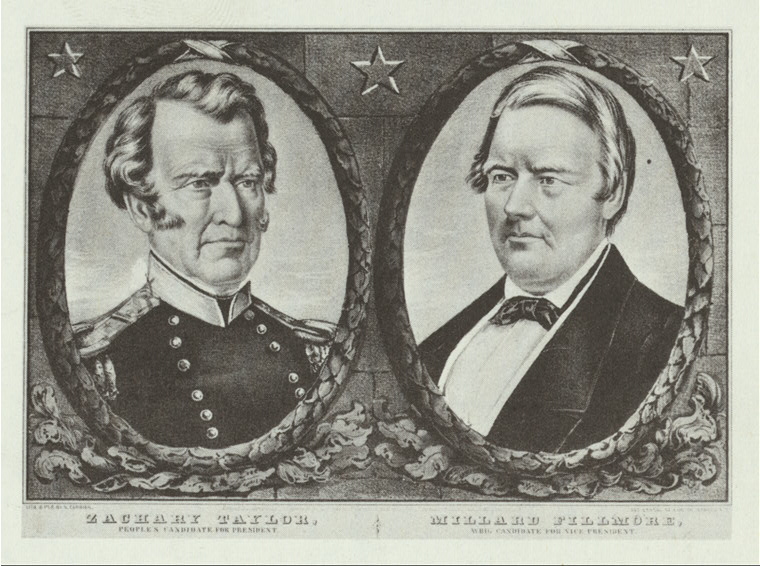
Millard Fillmore in 1848

January 15, 2011

From a flyer or something published for the 1848 presidential campaign, images of the Whig Party ticket, Zachary Taylor for president and Millard Fillmore for vice president:

Campaign flyer for Taylor/Fillmore Whig ticket, 1848 - NY Public Library image

"Zachary Taylor, People's candidate for president; Millard Fillmore, Whig candidate for vice president"

We probably shouldn’t read anything into Taylor’s being identified as the “People’s Candidate” and Fillmore’s being identified as the “Whig Candidate.”  Probably just the copy writer’s way of not sounding redundant.

Found it at the massive digital image collection of the New York Public Library.  Image details from the NYPL:

Image Title:  Millard Fillmore.

Source: Print Collection portrait file. / F / Millard Fillmore. / Portraits.

Location: Stephen A. Schwarzman Building / Print Collection, Miriam and Ira D. Wallach Division of Art, Prints and Photographs

Digital ID: 1234729

Record ID: 583391

Digital Item Published: 12-8-2004; updated 6-25-2010

Image Title

:  Millard Fillmore.


Source

: Print Collection portrait file. / F / Millard Fillmore. / Portraits.


Location

: Stephen A. Schwarzman Building / Print Collection, Miriam and Ira D. Wallach Division of Art, Prints and Photographs


Digital ID

: 1234729


Record ID

: 583391


Digital Item Published

: 12-8-2004; updated 6-25-2010


Millard Fillmore’s 211th

January 7, 2011

Millard Fillmore was born January 7, 1800. Had he lived, Millard Fillmore would be 211 years old today, very cranky, and looking for a good book to read.

Millard Fillmore clipart from University of South Florida

Millard Fillmore clipart from University of South Florida - Free! Click image to go to USF site.

Would you blame him for being cranky? He opened Japan to trade. He got from Mexico the land necessary to make Los Angeles a great world city and the Southern Pacific a great railroad, without firing a shot. Fillmore promoted economic development of the Mississippi River. He managed to keep a fractious nation together despite itself for another three years. Fillmore let end the practice of presidents using slaves to staff the White House, then called “the President’s Mansion,” eight years before the election of Abraham Lincoln.

Then in 1852 his own party refused to nominate him for a full term, making him the last Whig to be president. And to add insult to ignominy, H. L. Mencken falsely accused him of being known only for adding a bathtub to the White House, something he didn’t do.

As Antony said of Caesar, the good was interred with his bones — but Millard Fillmore doesn’t even get credit for whatever evil he might have done: Fillmore is remembered most for being the butt of a hoax gone awry, committed years after his death. Or worse, he’s misremembered for what the hoax alleged he did.

Even beneficiaries of his help promoting the Mississippi River have taken his name off their annual celebration of the event. Fillmore has been eclipsed, even in mediocrity (is there still a Millard Fillmore Society in Washington?).

Happy birthday, Millard Fillmore.

Millard Fillmore, free clipart from University of South Florida

Millard Fillmore, free clipart from University of South Florida

Millard Fillmore was a man of great civic spirit, a man who answered the call to serve even when most others couldn’t hear it at all. He was a successful lawyer, despite having had only six months of formal education (a tribute to non-high school graduates and lifelong learning). Unable to save the Union, he established the University of Buffalo and the Buffalo and Erie County Historical Society.  During the Civil War, he led the local militia in support of the war effort, many rungs down from his role of Commander-in-Chief.  And, it is said of him that Queen Victoria said he was the most handsome man she had ever met.

A guy like that deserves a toast, don’t you think?

Resources:


University of Buffalo President Simpson to speak at Millard Fillmore’s 2010 birthday observance

January 5, 2011

Baird Point at University of Buffalo's North Campus

Baird Point at University of Buffalo's North Campus; tradition holds that the university was founded by Millard Fillmore, its first chancellor

John B. Simpson, President of the University of Buffalo

John B. Simpson, President of the University of Buffalo, will speak at a ceremony honoring President Millard Fillmore on the 211th anniversary of Fillmore's birth.

Press release from the University of Buffalo:

News Release

Simpson to Speak at Ceremony Commemorating 211th Birthday of Millard Fillmore

Release Date: January 4, 2011

BUFFALO, N.Y. — The 211th anniversary of the birth of Millard Fillmore, the University at Buffalo’s first chancellor and 13th president of the United States, will be celebrated at a ceremony to be held at 10 a.m. Jan. 7 at Fillmore’s gravesite in Buffalo’s Forest Lawn Cemetery.

UB President John B. Simpson will present the memorial address at the annual observance, which honors Fillmore, who played a major role in the founding of numerous cultural, civic and community organizations in Erie County.

Hosted by UB, the Forest Lawn Group and the Buffalo Club, the event will be free and open to the public, and each year draws a wide range of community supporters.

“The annual Millard Fillmore commemoration is a time-honored tradition that celebrates the life of a man who made considerable contributions to Buffalo and the United States,” said William J. Regan, director of special events at UB.”

Col. Jim S. McCready, vice wing commander of the 107th Airlift Wing of the New York Air National Guard based at Niagara Falls Air Reserve Station, will place a wreath from the White House at the gravesite.

Officials from the Buffalo Club, the Forest Lawn Group and UB will also be on hand to present wreaths.

The Rev. Joel Miller of the Unitarian Universalist Church of Buffalo will provide an invocation. The UB Police Color Guard will present the flags. To close the ceremony, West Richter, a UB undergraduate and a member of the UB Marching Band, will play taps.

A reception will follow immediately in the Forest Lawn Chapel.

Born on Jan. 7, 1800, Fillmore was instrumental in founding the Buffalo & Erie County Historical Society, the Buffalo Club and the Buffalo General Hospital. His activities also led to the creation of the Buffalo and Erie County Public Library, the Buffalo Fine Arts Academy and the Buffalo Society of Natural Sciences.

Some historians credit the former teacher, postmaster, lawyer and member of Congress with establishing the White House Library.

This year’s commemoration marks the 46th consecutive year UB has programmed the ceremony, a tradition that dates back to 1937.

From 1937 until 1965, the anniversary ceremonies were a cooperative staging by the City of Buffalo and the Buffalo Board of Education.

The events were administered by Irving R. Templeton, a 1909 graduate of UB, who scheduled two programs annually on or near Jan. 7, one in City Hall and one in Forest Lawn. Templeton was a partner in the law offices of Templeton, Turnabull & Templeton.

Following his death in 1965, responsibility for the event shifted to UB through an agreement between Chancellor Clifford C. Furnas and Alfred E. Kirchhofer, editor of The Buffalo Evening News. While UB participated in programming prior to Templeton’s death, the 1966 event marked the start of UB’s role as official steward of the annual community event.

The vice president for university relations and the Office of Public Affairs programmed the event from 1966-87, when the Office of Special Events began managing the program.

The University at Buffalo is a premier research-intensive public university, a flagship institution in the State University of New York system and its largest and most comprehensive campus. UB’s more than 28,000 students pursue their academic interests through more than 300 undergraduate, graduate and professional degree programs. Founded in 1846, the University at Buffalo is a member of the Association of American Universities.


Almost neglecting the “neglected anniversary” of Millard Fillmore’s Bathtub, H. L. Mencken’s hoax, and the lessons that lie therein

December 29, 2010

Could I get a longer title?  Here is our annual tribute to the hoax that gave its name and much inspiration to this blog.

Otherwise occupied — Kenny’s due to board an airplane in Beijing soon; tires for the cars; papers to correct, curriculum to correct; our wedding anniversary I cannot forget pending —  I nearly forgot: 93 years ago yesterday, on December 28, 1917, this column by H. L. Mencken was published in The New York Evening Mail:

A Neglected Anniversary

Mencken on April 7, 1933 - end of low-alcohol beer - Baltimore Sun Photo

H. L. Mencken at approximately 12:30 a.m., April 7, 1933, at the Rennert Hotel, corner of Saratoga and Liberty Streets, 17 years later, not neglecting a sudsy anniversary – Baltimore Sun photo

On December 20 there flitted past us, absolutely without public notice, one of the most important profane anniversaries in American history, to wit, the seventy-fifth anniversary of the introduction of the bathtub into These States. Not a plumber fired a salute or hung out a flag. Not a governor proclaimed a day of prayer. Not a newspaper called attention to the day.

True enough, it was not entirely forgotten. Eight or nine months ago one of the younger surgeons connected with the Public Health Service in Washington happened upon the facts while looking into the early history of public hygiene, and at his suggestion a committee was formed to celebrate the anniversary with a banquet. But before the plan was perfected Washington went dry (This was war-time Prohibition, preliminary to the main catastrophe. — HLM), and so the banquet had to be abandoned. As it was, the day passed wholly unmarked, even in the capital of the nation.

Bathtubs are so common today that it is almost impossible to imagine a world without them. They are familiar to nearly everyone in all incorporated towns; in most of the large cities it is unlawful to build a dwelling house without putting them in; even on the farm they have begun to come into use. And yet the first American bathtub was installed and dedicated so recently as December 20, 1842, and, for all I know to the contrary, it may still be in existence and in use.

Curiously enough, the scene of its setting up was Cincinnati, then a squalid frontier town, and even today surely no leader in culture. But Cincinnati, in those days as in these, contained many enterprising merchants, and one of them was a man named Adam Thompson, a dealer in cotton and grain. Thompson shipped his grain by steamboat down the Ohio and Mississippi to New Orleans, and from there sent it to England in sailing vessels. This trade frequently took him to England, and in that country, during the ’30s, he acquired the habit of bathing.

The bathtub was then still a novelty in England. It had been introduced in 1828 by Lord John Russell and its use was yet confined to a small class of enthusiasts. Moreover, the English bathtub, then as now, was a puny and inconvenient contrivance — little more, in fact, than a glorified dishpan — and filling and emptying it required the attendance of a servant. Taking a bath, indeed, was a rather heavy ceremony, and Lord John in 1835 was said to be the only man in England who had yet come to doing it every day.

Thompson, who was of inventive fancy — he later devised the machine that is still used for bagging hams and bacon — conceived the notion that the English bathtub would be much improved if it were made large enough to admit the whole body of an adult man, and if its supply of water, instead of being hauled to the scene by a maid, were admitted by pipes from a central reservoir and run off by the same means. Accordingly, early in 1842 he set about building the first modern bathroom in his Cincinnati home — a large house with Doric pillars, standing near what is now the corner of Monastery and Orleans streets.

There was then, of course, no city water supply, at least in that part of the city, but Thompson had a large well in his garden, and he installed a pump to lift its water to the house. This pump, which was operated by six Negroes, much like an old-time fire engine, was connected by a pipe with a cypress tank in the garret of the house, and here the water was stored until needed. From the tank two other pipes ran to the bathroom. One, carrying cold water, was a direct line. The other, designed to provide warm water, ran down the great chimney of the kitchen, and was coiled inside it like a giant spring.

The tub itself was of new design, and became the grandfather of all the bathtubs of today. Thompson had it made by James Cullness, the leading Cincinnati cabinetmaker of those days, and its material was Nicaragua mahogany. It was nearly seven feet long and fully four feet wide. To make it water-tight, the interior was lined with sheet lead, carefully soldered at the joints. The whole contraption weighed about 1,750 pounds, and the floor of the room in which it was placed had to be reinforced to support it. The exterior was elaborately polished.

In this luxurious tub Thompson took two baths on December 20, 1842 — a cold one at 8 a.m. and a warm one some time during the afternoon. The warm water, heated by the kitchen fire, reached a temperature of 105 degrees. On Christmas day, having a party of gentlemen to dinner, he exhibited the new marvel to them and gave an exhibition of its use, and four of them, including a French visitor, Col. Duchanel, risked plunges into it. The next day all Cincinnati — then a town of about 100,000 people — had heard of it, and the local newspapers described it at length and opened their columns to violent discussions of it.

The thing, in fact, became a public matter, and before long there was bitter and double- headed opposition to the new invention, which had been promptly imitated by several other wealthy Cincinnatians. On the one hand it was denounced as an epicurean and obnoxious toy from England, designed to corrupt the democratic simplicity of the Republic, and on the other hand it was attacked by the medical faculty as dangerous to health and a certain inviter of “phthisic, rheumatic fevers, inflammation of the lungs and the whole category of zymotic diseases.” (I quote from the Western Medical Repository of April 23, 1843.)

The noise of the controversy soon reached other cities, and in more than one place medical opposition reached such strength that it was reflected in legislation. Late in 1843, for example, the Philadelphia Common Council considered an ordinance prohibiting bathing between November 1 and March 15, and it failed of passage by but two votes. During the same year the legislature of Virginia laid a tax of $30 a year on all bathtubs that might be set up, and in Hartford, Providence, Charleston and Wilmington (Del.) special and very heavy water rates were levied upon those who had them. Boston, very early in 1845, made bathing unlawful except upon medical advice, but the ordinance was never enforced and in 1862 it was repealed.

This legislation, I suspect, had some class feeling in it, for the Thompson bathtub was plainly too expensive to be owned by any save the wealthy; indeed, the common price for installing one in New York in 1845 was $500. Thus the low caste politicians of the time made capital by fulminating against it, and there is even some suspicion of political bias in many of the early medical denunciations. But the invention of the common pine bathtub, lined with zinc, in 1847, cut off this line of attack, and thereafter the bathtub made steady progress.

The zinc tub was devised by John F. Simpson, a Brooklyn plumber, and his efforts to protect it by a patent occupied the courts until 1855. But the decisions were steadily against him, and after 1848 all the plumbers of New York were equipped for putting in bathtubs. According to a writer in the Christian Register for July 17, 1857, the first one in New York was opened for traffic on September 12, 1847, and by the beginning of 1850 there were already nearly 1,000 in use in the big town.

After this medical opposition began to collapse, and among other eminent physicians Dr. Oliver Wendell Holmes declared for the bathtub, and vigorously opposed the lingering movement against it in Boston. The American Medical Association held its annual meeting in Boston in 1849, and a poll of the members in attendance showed that nearly 55 per cent of them now regarded bathing as harmless, and that more than 20 per cent advocated it as beneficial. At its meeting in 1850 a resolution was formally passed giving the imprimatur of the faculty to the bathtub. The homeopaths followed with a like resolution in 1853.

But it was the example of President Millard Fillmore that, even more than the grudging medical approval, gave the bathtub recognition and respectability in the United States. While he was still Vice-President, in March, 1850, he visited Cincinnati on a stumping tour, and inspected the original Thompson tub. Thompson himself was now dead, but his bathroom was preserved by the gentlemen who had bought his house from the estate. Fillmore was entertained in this house and, according to Chamberlain, his biographer, took a bath in the tub. Experiencing no ill effects, he became an ardent advocate of the new invention, and on succeeding to the Presidency at Taylor’s death, July 9, 1850, he instructed his secretary of war, Gen. Charles M. Conrad, to invite tenders for the construction of a bathtub in the White House.

This action, for a moment, revived the old controversy, and its opponents made much of the fact that there was no bathtub at Mount Vernon, or at Monticello, and that all the Presidents and other magnificoes of the past had got along without any such monarchical luxuries. The elder Bennett, in the New York Herald, charged that Fillmore really aspired to buy and install in the White House a porphyry and alabaster bath that had been used by Louis Philippe at Versailles. But Conrad, disregarding all this clamor, duly called for bids, and the contract was presently awarded to Harper & Gillespie, a firm of Philadelphia engineers, who proposed to furnish a tub of thin cast iron, capable of floating the largest man.

This was installed early in 1851, and remained in service in the White House until the first Cleveland administration, when the present enameled tub was substituted. The example of the President soon broke down all that remained of the old opposition, and by 1860, according to the newspaper advertisements of the time, every hotel in New York had a bathtub, and some had two and even three. In 1862 bathing was introduced into the Army by Gen. McClellan, and in 1870 the first prison bathtub was set up at Moyamensing Prison, in Philadelphia.

So much for the history of the bathtub in America. One is astonished, on looking into it, to find that so little of it has been recorded. The literature, in fact, is almost nil. But perhaps this brief sketch will encourage other inquirers and so lay the foundation for an adequate celebration of the centennial in 1942.

(Text courtesy of Poor Mojo’s Almanac(k))

The entire history was a hoax composed by Mencken.

Even conservative wackoes appreciate the column.

Content with his private joke, Mencken remained silent about the hoax until a follow-up article, “Melancholy Reflections,” appeared in the Chicago Tribune on May 23, 1926, some eight years later. This was Mencken’s confession. It was also an appeal for reason to the American public.

His hoax was a joke gone bad. “A Neglected Anniversary” had been printed and reprinted hundreds of times in the intervening years. Mencken had been receiving letters of corroboration from some readers and requests for more details from others. His history of the bathtub had been cited repeatedly by other writers and was starting to find its way into reference works. As Mencken noted in “Melancholy Reflections,” his “facts” “began to be used by chiropractors and other such quacks as evidence of the stupidity of medical men. They began to be cited by medical men as proof of the progress of public hygiene.” And, because Fillmore’s presidency had been so uneventful, on the date of his birthday calendars often included the only interesting tidbit of information they could find: Fillmore had introduced the bathtub into the White House. (Even the later scholarly disclosure that Andrew Jackson had a bathtub installed there in 1834—years before Mencken claimed it was even invented—did not diminish America’s conviction that Fillmore was responsible.)

(No, dear reader, probably not correct; surely John Adams brought a bathtub with him when he moved into the White House, then called the President’s Mansion. Plumbing, hot water, and finally hot water to a bathtub in the president’s residence, were installed between 1830 and 1853, as best I can determine.)

Mencken wrote an introduction to the piece in a later book, A Mencken Chrestomathy (Alfred A. Knopf, 1949):

The success of this idle hoax, done in time of war, when more serious writing was impossible, vastly astonished me. It was taken gravely by a great many other newspapers, and presently made its way into medical literature and into standard reference books. It had, of course, no truth in it whatsoever, and I more than once confessed publicly that it was only a jocosity . . . Scarcely a month goes by that I do not find the substance of it reprinted, not as foolishness but as fact, and not only in newspapers but in official documents and other works of the highest pretensions.

There’s a moral to the story: Strive for accuracy!

So, Dear Reader, check for accuracy, and question authority.

Fact checks — what else might need to be corrected in this story?

Resources: