History of public health victories in the U.S.

October 19, 2007

I wish U.S. history texts for public schools would invest more in the history of public health practice in the U.S.  Much of our prosperity can be traced to good public health practices — the wide availability of generally safe drinking water, effective systems to remove sewage and garbage, and other work to diminish illness.

So, in quick note form pirated directly from the Centers for Disease Control (CDC) (and because this has been hanging fire in my “to edit” box for way too long), here are some public health achievements I think the textbook editors need to consider for the next editions: 

Ten Great Public Health Achievements — United States, 1900-1999

  • Vaccination
  • Motor-vehicle safety
  • Safer workplaces
  • Control of infectious diseases
  • Decline in deaths from coronary heart disease and stroke
  • Safer and healthier foods
  • Healthier mothers and babies
  • Family planning
  • Fluoridation of drinking water
  • Recognition of tobacco use as a health hazard

More internet friendly version here, with links to articles on each one:

http://www.cdc.gov/od/oc/media/tengpha.htm

Here are the details.

Much more available. Here is a site, with a good section talking about careers in public health (for those career planning courses out there). Here’s a similar, less wowee site from the American Schools of Public Health (ASPH). Ethics issues here.

I include the links — there is no reason you can’t add this to your courses, especially in the sections that meet the standards on discussion of achievements of technology.  Surely these are technological achievements of great merit.


A history of environmental disasters (Day After Blog Action Day)

October 16, 2007

Blog Action Day, 2007: We’re writing about environmental issues.

Blog Action Day 2007

Each January 1 I reflect on one of many forgotten environmental disasters, because it’s a focus of television coverage. Oh, the disaster itself isn’t covered — most often it’s not even mentioned — but it’s there if you know anything at all about it.

The Tournament of Roses Parade.

With the Bowl Championship Series game in town, and thousands of tourists out to see the parade, the games, and other festivities, no one really wants to talk about the why of the Rose Bowl, and the Rose Parade.

But once upon a time, under the sunny skies of southern California, Pasadena hosted a flower industry. Cut flowers were the produce. The Los Angeles Basin around Pasadena produced $1 billion in cut flowers annually by the late 1940s. Partly to promote that industry, local civic movers pushed a festival named to celebrate the flowers, to promote them, to feed local industry. The shtick was this: Parade floats had to be decorated exclusively with flowers and flower petals. What better way to showcase the local agricultural miracle?

Nearly 60 years later, I’ll wager less than 0.1% of the flowers used in the parade come from the Los Angeles Basin.

Air pollution forced the flower growers to move. Air pollution mottled the petals of the roses, browned the daisies, and otherwise spoiled blossoms. The greenhouses, the fields, the entire industry left the area. And today, all that is left is the parade and football game. Parade floats are decorated with flowers imported from Venezuela, Israel, Europe, Hawaii, Mexico, South America and Asia.

And so it goes. Significant upheavals in human activities, prompted by environmental goofs by humans, get shuffled out of the history books, out of our collective consciousness — and as Santayana warned, we repeat them, over and over. Los Angeles is not the only city ever to have suffered from air pollution — there were killer fogs in London and Pennsylvania within a decade after World War II. Surely people learned, no?

Consider Mexico City today. Consider Beijing today.

So I just want to list some environmental disasters that we would be better off, if we remembered them and considered how to avoid them in the future, rather than forget them and be doomed to repeat them.

(I reserve the right to post links and edit this list to add to it, as I find additional information, and as readers may add information in comments.)

Environmental disasters you should know

It’s not an exhaustive list by any means — I wager some of these are new to most readers. I wager some of you can provide better information, and other disasters that I, perhaps, have forgotten. Please, inform us.


Malaria control: Requires health care system improvements

October 13, 2007

WHO’s former malaria expert, John Litsios, notes that controlling malaria requires integrated programs, especially including overhaul of local health care delivery systems.

Socrates Litsios, from his website

Copyrighted article from Resources for the future. “Chapter 17: Malaria Control and the Future of International Public Health,” in The Contextual Determinants of Malaria (Washington DC: Resources for the Future), Elizabeth Casman and Hadi Dowlatabadi, editors


West Nile virus: No call for DDT

October 8, 2007

DDT-obsessed politicos look for any opportunity to slam scientists and policy makers who urge caution about using the chemical. Sen. Tom Coburn’s (R-Okla) unholy campaign against the memory of Rachel Carson, author of Silent Spring, is only Exhibit A in how the obsession skews public policy now.

In earlier posts I’ve warned that there will be calls for more DDT use, with reports of West Nile virus spreading this season. Winter is coming slowly to the American Midwest, so mosquitoes still crop up carrying the virus. Voodoo science and junk science advocates look for such opportunities to claim that we need to “bring back” DDT, ‘since the claims of harm have been found to be false.’

No public health official, no mosquito abatement official, has asked for DDT to fight West Nile virus, even as the virus infects humans across the nation. Nor has any harm of DDT been refuted (quite the opposite — we now know of more dangers).

One reason, of course, is that DDT is not the pesticide of choice to use against West Nile vector mosquitoes. Mosquito abatement efforts aim at the larvae, where DDT use would be stupid.

A survey of the nation, in places where West Nile is a problem provides a good view of how West Nile virus is fought by public health and mosquito abatement officials. DDT is used in no case.

While you’re at it, take a look at what LeisureGuy has to say about DDT and scaria. Then wander over to Townhall.com, and see what scaria really looks like, in a shameless column from Paul Driessen, the author of the anti-environmentalist screed Eco-Imperialism: Green Power, Black Death. According to Driessen, it appears that environmentalists have been biting Africans to spread malaria, not mosquitoes. He may exaggerate some.

West Nile virus is a great problem for people in the United States. No health official, mosquito abatement official, or anyone else in a position of responsibility, has called for DDT.


Carnival of DDT

October 3, 2007

Information on DDT is scattered clouds of information, lately.  Some of these really should get more comment — but time is quite short for me right now.

Here’s the news:

One more study on DDT and breast cancer.  Stop the presses on this one.  It’s a good study, and it shows a link.  Effect Measure at the Seed Stables has a good post on it.   One of the key differences here is that this study looked for childhood exposure.  Exposure of children to DDT seems to be more damaging than exposure to adults.  This should be especially worrying considering DDT’s daughter products and their ability to mimic estrogen in the wild.

Bill Moyers’ program on PBS looked at the recent campaign against Rachel Carson, and found the campaign ethically challenged.  Moyers takes a more in-depth and gentle view of Carson, from a perspective from the arts.  Solid information, interesting view.

All Africa.com had a news report on the current anti-malaria campaign in Malawi:  “Rescuing children from malaria.”  Real news — it doesn’t call for broadcast spraying of DDT.  (Surprised?)  In fact, it attacks the colleagues of the Rachel Carson critics, the tobacco companies.

A blogger named Aaron Swartz takes on the Rachel Carson critics rather directly:  “Rachel Carson:  Mass Murderer?” 

A recent think piece out of the always-informative Christian Science Monitor:  “Bring back DDT?  Think again.”

Perhaps a minor blip:  Plaintiffs ask damages against chemical companies and others because the DDT dumped next door has decreased the value of their properties.  An Alabama appeals court ruled that plaintiffs may call in experts to testify that DDT dumping decreases property value.  (Maybe Roger Bate would like to buy the property at market value?  All that DDT would mean no mosquitoes forever, right?)

And from the lost-but-now-found archives, a story that demonstrates subtly the bias that Rachel Carson critics have — Roger Bate defending tobacco companies in a 1996 Wall Street Journal opinion piece.  Perhaps one should not be surprised that people who defend tobacco against health regulators and health care education could turn around and argue for DDT and against Rachel Carson.


Quote of the moment: Washing hands of the matter

September 23, 2007

Ignaz Semmelweiss

This is one of the classic stories of public health, an issue that most U.S. history and world history texts tend to ignore, to the detriment of the students and the classroom outcomes.

This is the story as retold by Christopher Cerf and Victor Navasky in The Experts Speak:

In the 1850s a Hungarian doctor and professor of obstetrics named Ignaz Semmelweis (pictured at left) ordered his interns at the Viennese Lying-in Hospital to wash their hands after performing autopsies and before examining new mothers. The death rate plummeted from 22 out of 200 to 2 out of 200, prompting the following reception from one of Europe’s most respected medical practitioners:

“It may be that it [Semmelweis’ procedure] does contain a few good principles, but its scrupulous application has presented such difficulties that it would be necessary, in Paris for instance, to place in quarantine the personnel of a hospital during the great part of a year, and that, moreover, to obtain results that remain entirely problematical.”

Dr. Charles Dubois (Parisian obstetrician), memo to the French Academy
September 23, 1858

Semmelweiss’ superiors shared Dubois’ opinion; when the Hungarian physician insisted on defending his theories, they forced him to resign his post on the faculty.

Update, September 26, 2007: Stephen J. Dubner at the Freakonomics blog pointed to a video, to an essay by Semmelweis, and to a column he and Steven D. Levitt had done earlier on handwashing. Maybe things aren’t as good as we had hoped.


Breastfeeding still recommended, despite DDT contamination

September 23, 2007

Despite DDT’s being affiliated with reduced cognitive ability in infants after intrauterine exposure, and despite indications that DDT may retard fetal development, a team of Spanish researchers urges mothers to breastfeed anyway. Their study shows that breastfed kids develop better despite after birth even when exposed to DDT in utero, despite any dangers of exposure to DDT and other chemicals in breast milk.

No, the study does not say DDT is harmless.

From the American Journal of Epidemiology, abstracts of the study have been released in advance of publication in the October 2007 edition.

Beneficial Effects of Breastfeeding on Cognition Regardless of DDT Concentrations at Birth

Núria Ribas-Fitó1, Jordi Júlvez1, Maties Torrent2, Joan O. Grimalt3 and Jordi Sunyer1,4 1 Centre de Recerca en Epidemiologia Ambiental, Institut Municipal Investigació Mèdica, Barcelona, Spain
2 Àrea de Salut de Menorca, Servei de Salut de les Illes Balears, Menorca, Spain
3 Departament de Química Ambiental, Institut d’Investigacions Químiques i Ambientals de Barcelona–Centre Superior d’Investigacions Científiques, Barcelona, Spain
4 Departament de Ciències Experimentals i de la Salut, Universitat Pompeu Fabra, Barcelona, Spain

Correspondence to Dr. Núria Ribas-Fitó, Centre de Recerca en Epidemiologia Ambiental, Institut Municipal Investigació Mèdica, C. Doctor Aiguader 88, 08003 Barcelona, Catalonia, Spain (e-mail: nribas@imim.es)

Received for publication March 19, 2007. Accepted for publication June 13, 2007.

The authors previously reported that intrauterine exposure to background concentrations of p,p’-dichlorodiphenyltrichloroethane (DDT) reduces cognitive performance among preschoolers. Breastfeeding has been associated with both increased exposure to certain pollutants during infancy and better performance on cognitive tests. Thus, the authors examined the role of breastfeeding in cognitive function among preschoolers, taking prenatal DDT exposure into account. Two birth cohorts in Spain (Ribera d’Ebre and Menorca) were recruited between 1997 and 1999 (n = 391). Infants were assessed at age 4 years using the McCarthy Scales of Children’s Abilities. Levels of organochlorine compounds were measured in umbilical cord serum. Information on type and duration of breastfeeding was obtained by questionnaire when the children were 1 year of age. Children who were breastfed for more than 20 weeks had better cognitive performance regardless of their in utero exposure to DDT. A linear dose response between breastfeeding and cognition was observed in all DDT groups (for children highly exposed to DDT, adjusted ß = 0.30 (standard error, 0.12) per week breastfed). Despite the possibility of harm from environmental contaminants in breast milk, breastfeeding for long periods should still be recommended as the best infant feeding method.

breast feeding; child; child development; child, preschool; cognition; DDT; infant; intelligence

Abbreviations: DDE, p,p’-dichlorodiphenyldichloroethylene; DDT, p,p’-dichlorodiphenyltrichloroethane; IQ, intelligence quotient

Some of the members of this research team have also tied DDT’s daughter product, DDE, to increased asthma in children, in research published in Environmental Health Perspectives in December 2005.


River blindness “curse” lifted

September 17, 2007

Editor’s note: Dr. Vincent Resh of the University of California at Berkeley addressed the distinguished, long-lived Commonwealth Club of San Francisco on August 22, 2007. Below is a column by Resh which appeared in the San Francisco Chronicle a few days before the speech, covering much of the same material.

Resh tells the story of a public health victory in Africa against a disease called river blindness. People victimized are made blind by a parasitic worm which lives in the victim’s eyes. I relate it here because Resh tells how the victory is achieved without resorting to the use of destructive DDT, which had been proposed. Note carefully what Resh says about DDT. This is one more chunk of evidence against the broadcast use of DDT, a story in support of the ban on DDT imposed in the U.S. since 1972. Rachel Carson was right.
_____________________

  • Vincent H. Resh has been a professor of entomology at UC Berkeley since 1975. He was the senior environmental adviser for the onchocerciasis control program.

This article appeared on page E – 5 of the San Francisco Chronicle.


River blindness ‘curse’ lifted

Sunday, August 19, 2007

Insect-transmitted diseases typically come to our attention through local news reports of the threat of West Nile virus or of dengue fever in our neighborhoods. The works of the Gates Foundation have made us more aware of malaria, the mosquito-transmitted disease that kills well more than a million people each year. But there are scores of insect-transmitted diseases that affect humans, and the insects responsible for many of them live in water.

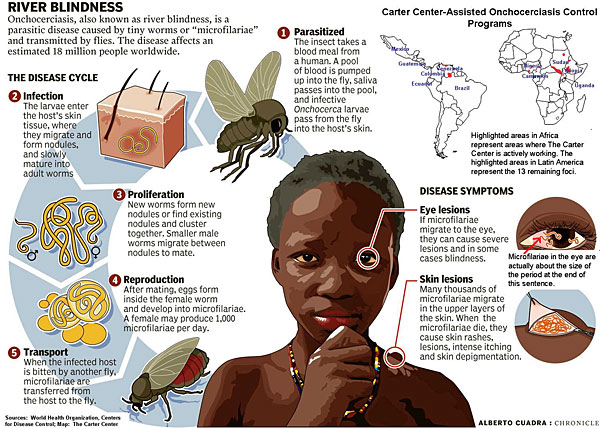
River Blindness Cycle, Carter Center - Alberto CuadroClick on thumbnail image for a chart showing the life cycle of river blindness from the Carter Center, by Alberto Cuadra

DDT and its descendents were initially effective in controlling the water-dwelling vectors of human diseases. However, the effects of these insecticides on environmental health also had significant, indirect effects on human health. The fish in rivers, which are the main protein source for humans in most developing countries, were drastically reduced by these poisons.

Read the rest of this entry »


Using snake oil to lubricate jaws

September 15, 2007

Oooh, I missed this one; Instapundit said:

August 20, 2007

SOME KIND WORDS FOR DDT — in the New York Times, no less. “Today, indoor DDT spraying to control malaria in Africa is supported by the World Health Organization; the Global Fund to Fight AIDS, Tuberculosis and Malaria; and the United States Agency for International Development. . . . Even those mosquitoes already resistant to poisoning by DDT are repelled by it.”

The debate over DDT is over. There’s scientific consensus. Anyone who disagrees is a DDT denialist and a mouthpiece for Big Mosquito.

The debate should be over.  There is scientific consensus that DDT is dangerous and the ban on broadcast use was wise, fair, and still necessary.  Reynolds is one of the denialist brigade who keeps trying to paint environmentalists wrong for working for the ban.

Reynolds claim is deceptive in at least three ways:

  1. Omission, failing to note history:  Reynolds fails to note that without the ban on broadcast use of DDT (like crop spraying, or spraying of swamps and rivers), DDT would by now be completely ineffective against mosquitoes.  The ban on crop spraying (broadcast use) has been instrumental in preserving the effectiveness of DDT against malaria.  The debate is over, Reynolds lost, and its time he quit denying it (speaking of denialism).  The ban on DDT spraying in the U.S., following similar bans in Europe, and with similar following bans in other nations, has been a key factor in our current victories against malaria — a key factor for the anti-malaria forces.
  2. Omission, not understanding the science:  Reynolds may not know that DDT was cast against other  pesticides that are known to have very low repellent characteristics.  There are other, much more effective and less toxic, and less expensive, ways to repel mosquitoes.
  3. Failure to state the whole case:  Reynolds, the DDT-advocate in the New York Times,  and the study cited, fail to note that DDT is inadequate to more than a very short-term, partial campaign against malaria-carrying mosquitoes.  Other studies recently published note powerful, long-term reduction in malaria infections by use of mosquito netting; these declines do not require multiple, expensive and logistically difficult sprayings of poison in homes every year.  Perhaps more critically, research now shows that mosquito nets produce malaria reductions in the absence of DDT spraying, and the reductions stick; DDT spraying alone cannot produce either a long-term reduction in malaria (say, longer than a year), nor will the reductions stick, nor will the reductions be as great.  Nets work without DDT; DDT does not work without nets.

Other than that, Reynolds is right:  The debate is over.  Reynolds’ “spray DDT on everything — it works better than snake-oil” argument lost.  It’s time Reynolds stops denying the facts.


DDT as snake oil

September 15, 2007

“It’ll cure what ails ya!”

emergency-dvd-cover-51cea8wqbkl_aa240_.jpg

My first year in college, we spent Saturday nights watching “Emergency!” I don’t recall now whether it was on NBC or ABC, but after we saw it once, we were all hooked, Al, Ben and me.

No, it wasn’t great drama. An hour-long drama about paramedics in Los Angeles probably has a lot of potential — this wasn’t that drama. Jack Webb, of “Dragnet” fame, directed. It had a cast amazing for its “how-did-HE- get-there” quality: Bobby Troup, the jazz pianist and composer of “Route 66″ (” . . . get your kicks on . . .”) played a doctor; his wife, jazz vocalist Julie London, played a nurse. Loved Julie London. Beautiful, but she had all the acting chops of David Janssen (“the man of a thousand faces” of “The Fugitive” fame). Martin Milner was there, too — he actually starred earlier in NBC’s “Route 66” which featured Corvettes, but not Bobby Troupe’s hit song (go figure) — and so was Kevin Tighe and Randolph Mantooth. And Robert Fuller, and Kent McCord. Whew!

For undergraduate college students, the show was a riot. We noticed early on that the script writers were defibrillator happy. Every time the paramedic truck showed up, the first thing off was the defibrillator. Heart attacks seemed to be a big problem in LA at the time — maybe Jack Webb’s own mortality subconsciously sneaking into the scripts — so the defib unit got a lot of use.

But it also came out at all the wrong times. Drowning victim? Defibrillator first, THEN artificial respiration. Poison victim? Defib. Auto accident? Defibrillate the victim, THEN worry about the spurting, arterial bleeding (if it’s spurting, is the defib necessary?). Classic kitten in the tree? Defib the tree, THAT will get that kitten down. Read the rest of this entry »


Unstrange maps: Security, health, economics

September 3, 2007

Strange Maps features odd maps, often fictional. I like the site, especially for the inherent humor in some of the maps — and since it’s such a popular site among the more than 1 million WordPress weblogs, it’s clear others share my enthusiasm.

Global map of energy security risk - Maplecroft Maps

There are a lot of unstrange and beautiful maps based on reality, too, used to give a quick, graphic image to the brains of people working on serious problems. Maps guide policy makers, and illustrate geographical range of problems, and sometimes geographical causes and vulnerabilities.

Here’s a source of interactive maps that every economics, government, history, and health teacher should bookmark: Maplecroft Maps.

Maps at this site cover a nearly complete range of issues that worry leaders of businesses and nations. I found the site looking for information about malaria.

Of special note is the wealth of information available from the interactive features. Clicking on nations or on symbols on the map provides details of issues the map covers; three tabs with the maps take the viewer of most of the maps to an extensive list of resources on the issue, and case studies, and analysis. These sources seem tailor made to help students doing geography projects.

Issue maps include disasters, malaria, child labor, climate change, poverty, land mine risk, political risk and a wide variety of others. You’ll need Macromedia Flash on your computer; there does not appear to be any way to download the maps, so you’ll need a live internet link to use these in class.

Information from these maps will be more current than any geography, history or economics book. Go see.

Maplecroft is a network of academic and business consultants. These maps are made to help their clients; Maplecroft’s description of the series is below the fold.

Read the rest of this entry »


Instapundit supports pollution, but with a smile

August 23, 2007

DDT follows the same path as PCBs in the environment, both persistent organic pollutants. From World Ocean Review:  Bioaccumulation of toxins in the marine food chain has long been recognized as a problem. The process illustrated here relates to polychlorinated biphenyls (PCBs), a typical environ-mental toxin.

DDT follows the same path as PCBs in the environment, both persistent organic pollutants. This illustration from World Ocean Review: Bioaccumulation of toxins in the marine food chain has long been recognized as a problem. The process illustrated here relates to polychlorinated biphenyls (PCBs), a typical environmental toxin.

Instapundit is happy to promote the use of poison:

SOME KIND WORDS FOR DDT — in the New York Times, no less. “Today, indoor DDT spraying to control malaria in Africa is supported by the World Health Organization; the Global Fund to Fight AIDS, Tuberculosis and Malaria; and the United States Agency for International Development. . . . Even those mosquitoes already resistant to poisoning by DDT are repelled by it.”

The debate over DDT is over. There’s scientific consensus. Anyone who disagrees is a DDT denialist and a mouthpiece for Big Mosquito.

posted at 10:18 AM by Glenn Reynolds

No, Glenn, the debate is not over so long as people continue to deny the harmful effects of DDT and act as mouthpieces for Big Poison, Big Garbage, Big Cancer, Big Pollution, voodoo science and Big Stupid.

There is a scientific consensus, but Reynolds misstates it. Scientists agree that DDT kills birds, bats, reptiles and beneficial insects that prey on malaria-bearing mosquitoes, making control of malaria more difficult (among many other harms). Consequently, DDT use under the rules laid down by the U.S. EPA in 1972 make a lot of sense. Those rules are the same as agreed to in the Persistent Organic Pollutants Treaty (POPs) — no DDT use in broadcast spraying, especially on crops; DDT use is allowed when necessary to fight disease; alternatives to DDT must be researched and created. The POPs Treaty lists DDT as one of the “Dirty Dozen” persistent pollutants.

POPs are a set of chemicals that are toxic, persist in the environment for long periods of time, and biomagnify as they move up through the food chain. POPs have been linked to adverse effects on human health and animals, such as cancer, damage to the nervous system, reproductive disorders, and disruption of the immune system. Because they circulate globally via the atmosphere, oceans, and other pathways, POPs released in one part of the world can travel to regions far from their source of origin.

Reynolds appears not to have read the treaty, nor even the article he cites, by Donald Roberts, from the odd, industry-funded Africa Fighting Malaria; even the most optimistic DDT fanatics generally nod in the direction of the dangers. Roberts wrote:

It would be a mistake to think we could rely on DDT alone to fight mosquitoes in Africa. Fortunately, research aimed at developing new and better insecticides continues — thanks especially to the work of the international Innovative Vector Control Consortium. Until a suitable alternative is found, however, DDT remains the cheapest and most effective long-term malaria fighter we have.

Africa Fighting Malaria is apoplectically happy to have one study that shows some repellent effects of DDT. As Bug Girl and Deltoid note, AFM urged unreasonable responses from many of us (I got their request, too). The study is encouraging, but it fails to make DDT the panacea Roberts paints it, and the study completely ignores the dangers of DDT, which have not changed a whit.

The best solutions to fighting malaria do not require DDT. Other new studies show that simple mosquito netting is amazingly effective — in Kenya, a switch in policy to give the nets out for free reduced malaria incidence by 44%. Under policies urged by U.S. conservatives, Kenyans had been required to pay for the nets previously. Reducing the cost of the nets left them beyond the means of many poor Kenyans.

Where is Glenn Reynolds’ promotion of non-poisonous and non-polluting, effective means to fight malaria. Why does he only go for the damaging solutions?

Perhaps Glenn Reynolds and Donald Roberts could make a showing of good faith in this case. Since this one study did tend to break their way, perhaps they could show their gratitude by calling on Sen. Tom Coburn to stop acting like a brat throwing a tantrum and remove his holds on the bill that would name a post office in Pennsylvania for Rachel Carson, honoring her work against pollution.  (Coburn cites junk science and voodoo science as his justification — and he’s an M.D.!)
Or, would making a statement against pollution be contrary to their politics?

To the chronically science challenged, DDT is an answer to more ills than you can imagine. We face new infestations of bed bugs — how long before AFM’s editorial ghosts have people urging DDT spraying wholesale to fight bed bugs? West Nile virus continues to plague the U.S., and already articles have appeared calling for broadcast spraying of towns and marshes to fight it, though that would probably be exactly the wrong thing to do.

The fight against ignorance goes on, but some wear ignorance like a badge of honor.


How to fight malaria – Kenya’s example

August 17, 2007

Kenya has cut malaria by nearly half. Without further comment from me, here’s the news story from Gulf Times, Doha, Qatar, and below that, from a few other sources:

Kenya nearly halves child deaths from malaria

Published: Friday, 17 August, 2007, 01:27 AM Doha Time

NAIROBI: Kenya announced yesterday that it almost halved malaria deaths among small children by using insecticidal nets (INTs), spurring the World Health Organisation (WHO) to advocate free nets for all as it tackles Africa’s deadliest disease.

Health Minister Charity Ngilu said distribution of 13.4mn INTs over the past five years among children and pregnant women had helped curtail infections, a key success against a disease threatening 40% of the world’s population.

“Childhood deaths have been reduced by 44% in high-risk districts, in-patient malaria cases and deaths are falling (and) there are reduced cases at the community level,” she said in a statement.

“For every 1,000 treated nets used, seven children who might have died of malaria are saved.”

Malaria kills 34,000 children under the age of five each year in Kenya, and threatens the lives of more than 25mn of its population of 34mn people, the ministry said.

Children sleeping under INTs in malaria risk areas are 44% less likely to die than those who are not, according to a survey carried out in four districts representing the country’s epidemiological pattern.

The government has distributed 12mn doses of artemisinin-based therapy (ACT), the latest surefire anti-malaria drug cocktail to replace the mono-therapies that had developed resistance.

In addition, some 824,600 houses in 16 epidemic-prone districts underwent indoor spraying this year.
The government and donors spent 4.7bn shillings ($70.2mn) for the campaign, yet the funds were not enough.

Ngilu said the government would freely provide 2mn treated nets annually to ward off mosquitoes at night when they are active, calling on donors to boost the blanket distribution.

“The impact we have seen and the lessons we have learnt through massively distributing INTs, rather than selectively marketing and selling them, will not only benefit Kenya’s children but all Africa’s children,” she said.

In a statement, the WHO said it had abandoned its earlier guideline of targeting only vulnerable groups – under fives and pregnant women – in favour of “making their protection immediate while achieving full coverage”.

“Recent studies have shown that by expanding the use of these nets to all people in targeted areas, increased coverage and enhanced protection can be achieved while protecting all community members.”

WHO chief Margaret Chan said that Kenya’s success “serves as a model that should be replicated throughout ‘malarious’ countries in Africa.”

“This data from Kenya ends the debate about how to deliver the long-lasting nets. No longer should the safety or well-being of your family be based upon whether you are rich or poor,” said WHO’s Global Malaria Programme director Arata Kochi.

Chan and Kochi were deriding the “social marketing” model widely backed by donors of distributing INTs by selling them at subsidised rates, even to vulnerable groups, and raising awareness of their importance.

Although supporting anti-malaria campaigns, public health watchers have chided British and US foreign development agencies for pushing for social marketing in the world’s poorest continent.

The WHO launched a global programme in 1955 to eradicate the disease that has frustrated attempts to create a vaccine owing to its constant mutations.

Using dichloro-diphenyl-trichloroethane (DDT), a powerful insecticide, and the drug chroloquine, the organisation managed to eradicated the disease in the West by the 1960s.

But the programme never got off the ground in the humid and low-lying tropics in sub-Saharan Africa where the disease persisted.

By 1969, the programme collapsed as financing withered in the face of rising poverty, political upheavals and surging opposition to DDT for misuse, not by anti-malaria campaigners, but farmers.

But Kochi said the Stockholm Convention on Persistent Organic Pollutants allowed the use of DDT in endemic countries for “public health only” and Uganda and Malawi were the only African nations keen on the chemical.

Malaria affects more than 1bn people worldwide and kills 1mn – mainly under age five – every year, the vast majority in sub-Saharan Africa. – AFP (Agence France Press) Read the rest of this entry »


Fisking “Junk Science’s” campaign for DDT: Point #6

August 9, 2007

Another in a continuing series, showing the errors in JunkScience.com’s list of “100 things you should know about DDT.” (No, these are not in order.)

Steven Milloy and the ghost of entomologist J. Gordon Edwards listed this as point six in their list of “100 things you should know about DDT “[did Edwards really have anything to do with the list before he died?]:

6. “To only a few chemicals does man owe as great a debt as to DDT… In little more than two decades, DDT has prevented 500 million human deaths, due to malaria, that otherwise would have been inevitable.”

[National Academy of Sciences, Committee on Research in the Life Sciences of the Committee on Science and Public Policy. 1970. The Life Sciences; Recent Progress and Application to Human Affairs; The World of Biological Research; Requirements for the Future.]

In contrast to their citation for the Sweeney hearing record, which leads one away from the actual hearing record, for this citation, the publication actually exists, though it is no longer available in print. It’s available on-line, in an easily searchable format. [I urge you to check these sources out for yourself; I won’t jive you, but you should see for yourself how the critics of Rachel Carson and WHO distort the data — I think you’ll be concerned, if not outraged.] The quote, though troubled by the tell-tale ellipses of the science liar, is accurately stated so far as it goes.

The problems? It’s only part of the story as told in that publication.  The National Academy of Science calls for DDT to be replaced in that book; NAS is NOT calling for a rollback of any ban, nor is NAS defending DDT against the claims of harm.  The book documents and agrees with the harms Rachel Carson wrote about eight years earlier.

Cover of the electronic version of Life Sciences, the 1970 book looking to future needs in biology and agriculture.

Cover of the electronic version of Life Sciences, the 1970 book looking to future needs in biology and agriculture.

Milloy (and Edwards, he claims), are trying to make a case that the National Academy of Sciences, one of the more reputable and authoritative groups of distinguished scientists in the world, thinks that DDT is just dandy, in contrast to the views of Rachel Carson and environmentalists (who are always cast as stupid and venal in Milloy’s accounts) who asked that DDT use be reduced to save eagles, robins and other songbirds, fish, and other wildlife, and to keep DDT useful against malaria.

First, there is no way that a ban on DDT could have been responsible for 500 million deaths due to malaria.  Calculate it yourself, the mathematics are simply impossible: At about 1 million deaths per year, if we assume DDT could have prevented all of the deaths (which is not so), and had we assumed usage started in 1939 instead of 1946 (a spot of 7 years and 7 million deaths), we would have 69 million deaths prevented by 2008. As best I can determine, the 500 million death figure is a misreading from an early WHO report that noted about 500 million people are annually exposed to malaria, I’m guessing a bit at that conclusion — that’s the nicest way to attribute it to simple error and not malicious lie. It was 500 million exposures to malaria, not 500 million deaths. It’s unfortunate that this erroneous figure found its way into a publication of the NAS — I suppose it’s the proof that anyone can err.

Read the rest of this entry »


Accuracy: A good bias (DDT again)

August 4, 2007

Jay Ambrose retired from editing newspapers, and now writes commentary for the Scripps News chain of papers. Because of his experience in editing, I was suprised to see his commentary from last week which takes broad, inaccurate swipes at environmental groups (here from the Evansville, Indiana, Courier & Press).

Ambrose is victim of the “DDT and Rachel Carson bad” hoax.

His column addresses bias in reporting, bias against Christians, which he claims he sees in reporting on issues of stem cell research, and bias “in favor” of environmentalists, which has resulted in a foolish reduction in the use of DDT. I don’t comment here on the stem cell controversy, though Ambrose’s cartoonish presentation of how federally-funded research works invites someone to correct its errors.

Relevant excerpts of Ambrose’s column appear below the fold, with my reply (which I have posted to the Scripps News editorial section, and in an earlier version, to the on-line version of the Evansville paper).

Read the rest of this entry »