Point numero three-oh: The phrase “ill-informed blog” is redundant.
o Panhandle Truth Squad contributor R. Spacedark
Quote of the moment: Wisdom from a Texas blogger
May 19, 2007
 Leave a Comment » |
  Famous quotes, Quotes, Texas, Weblogs |
  Permalink
 Posted by Ed Darrell
Quote of the moment: Martin Luther, on wine, women and song
May 15, 2007
Martin Luther, by Lucas Cranch
Wer nicht liebt Wein, Weib, und Gesang, Der bleibt ein Narr sein Lebenlang.
Who loves not wine, women and song, remains a fool his whole life long.
Attributed in Matthias Claudius, Der Wandsbecker Bothe (1775). Read the rest of this entry »
Leave a Comment » | Famous quotes, Quotes | Permalink
Posted by Ed Darrell
Quote of the moment: Lincoln on Labor
May 12, 2007
Labor is prior to, and independent of,capital. Capital is only the fruit of labor, and could not have existed if labor had not first existed. Labor is the superior of capital, and deserves much the higher consideration.
Lincoln in the Annual Message to Congress, December 3, 1861
The photograph shows Lincoln as president-elect; it is one of a series taken on February 23, 1861; from The History Place.
Leave a Comment » | Abraham Lincoln, Economics, Famous quotes, Free market economics, Good Quotes, History, Labor and unions, Presidents, Quotes | Permalink
Posted by Ed Darrell
Quote of the moment: James Madison
May 2, 2007
A popular Government, without popular information, or the means of acquiring it, is but a Prologue to a Farce or a Tragedy; or perhaps both. Knowledge will forever govern ignorance.
— James Madison in a letter to W. T. Barry, August 4, 1822
1 Comment | Accuracy, Education, Famous quotes, First Amendment, James Madison, Journalism, Quotes | Permalink
Posted by Ed Darrell
“April is the cruellest month” – poem for the moment
April 25, 2007No, not here.
Clio Bluestocking has it up at her blog; Eliot and Picasso, together — go see. An interesting partnering of painting and poetry, for another National Poetry Month celebration.
1 Comment | Famous Battles, History, Patriotism, Peace, Quotes, War | Permalink
Posted by Ed Darrell
Quote of the Moment, October 29, 1941: Churchill, ‘never give in’
April 11, 2007
Churchill speaking at the Albert Hall in London, 1944, at an American Thanksgiving Celebration. Churchill Centre image
Never give in, never give in, never, never, never, never — in nothing, great or small, large or petty — never give in except to convictions of honour and good sense!
Winston S. Churchill, address to the boys of Harrow School, October 29, 1941.
6 Comments | Famous quotes, Good Quotes, Leadership, Quotes, Winston Churchill | Tagged: Famous quotes, Great Speeches, History, Leadership, Quotes, Winston Churchill, World War II | Permalink
Posted by Ed Darrell
Quote of the Moment: John Fitzgerald Kennedy and negotiating
April 9, 2007 Let us never negotiate out of fear, but let us never fear to negotiate.
John Fitzgerald Kennedy, in his Inaugural Address, January 20, 1961
Leave a Comment » | Cold War, Democracy, Famous quotes, Good Quotes, Leadership, Presidents, Quotes | Permalink
Posted by Ed Darrell
Quote to think by: Timothy J. Campbell and the Constitution
March 29, 2007What’s the Constitution between friends?
–Timothy J. Campbell (1840-1904), Attributed, circa 1885
A little more below the fold? Certainly. Read the rest of this entry »
2 Comments | Bad Quotes, Famous quotes, Good Quotes, Patriotism, Politics, Presidents, Quotes, U.S. Constitution | Permalink
Posted by Ed Darrell
Quote of the moment: Fillmore on sunshine in government, clarity in laws
March 25, 2007
Statue of Millard Fillmore at the City Hall in Buffalo, New York.

From Millard Fillmore’s second State of the Union speech, December 2, 1851:
The public statutes of the United States have now been accumulating for more than sixty years, and, interspersed with private acts, are scattered through numerous volumes, and, from the cost of the whole, have become almost inaccessible to the great mass of the community. They also exhibit much of the incongruity and imperfection of hasty legislation. As it seems to be generally conceded that there is no “common law” of the United States to supply the defects of their legislation, it is most important that that legislation should be as perfect as possible, defining every power intended to be conferred, every crime intended to be made punishable, and prescribing the punishment to be inflicted. In addition to some particular cases spoken of more at length, the whole criminal code is now lamentably defective. Some offenses are imperfectly described and others are entirely omitted, so that flagrant crimes may be committed with impunity. The scale of punishment is not in all cases graduated according to the degree and nature of the offense, and is often rendered more unequal by the different modes of imprisonment or penitentiary confinement in the different States.
Many laws of a permanent character have been introduced into appropriation bills, and it is often difficult to determine whether the particular clause expires with the temporary act of which it is a part or continues in force. It has also frequently happened that enactments and provisions of law have been introduced into bills with the title or general subject of which they have little or no connection or relation. In this mode of legislation so many enactments have been heaped upon each other, and often with but little consideration, that in many instances it is difficult to search out and determine what is the law.
The Government of the United States is emphatically a government of written laws. The statutes should therefore, as far as practicable, not only be made accessible to all, but be expressed in language so plain and simple as to be understood by all and arranged in such method as to give perspicuity to every subject. Many of the States have revised their public acts with great and manifest benefit, and I recommend that provision be made by law for the appointment of a commission to revise the public statutes of the United States, arranging them in order, supplying deficiencies, correcting incongruities, simplifying their language, and reporting them to Congress for its action.
Leave a Comment » | Freedom of Information, Law, Millard Fillmore, Quotes | Permalink
Posted by Ed Darrell
Quote stumbled upon: Clarence Day, on descendants of apes
March 24, 2007
What fairy story, what tale from the Arabian Nights of the jinns, is a hundredth part as wonderful as this true fairy story of simians! It is so much more heartening, too, than the tales we invent. A universe capable of giving birth to many such accidents is — blind or not — a good world to live in, a promising universe. . . . We once thought we lived on God’s footstool; it may be a throne.
Clarence Day (1874-1935), This Simian World (1920), XIX
More from that chapter, below the fold
Leave a Comment » | Evolution, History, Natural history, Quotes, Science | Tagged: Evolution, Famous quotes, Natural history, Quotes, Science | Permalink
Posted by Ed Darrell
Quote of the Moment: Churchill’s Iron Curtain speech
March 19, 2007

Winston Churchill delivering the “Iron Curtain” speech, Westminster College, Fulton, Missouri, March 5, 1946 – Photo by George Skadding
“From Stettin in the Baltic to Trieste in the Adriatic, an iron curtain has descended across the Continent. Behind that line lie all the capitals of the ancient states of Central and Eastern Europe. Warsaw, Berlin, Prague, Vienna, Budapest, Belgrade, Bucharest and Sofia, all these famous cities and the populations around them lie in what I must call the Soviet sphere, and all are subject in one form or another, not only to Soviet influence but to a very high and, in many cases, increasing measure of control from Moscow.”
Some historians mark the beginning of the Cold War from this speech, in which a respected world leader first spelled out the enormous stakes at issue, and also pointed out that Russian, communist totalitarian governments were replacing more democratic governments in nations only recently freed from the spectre of Nazi rule, in World War II.
Oh, why not: Below the fold is the speech in its entirety, from the transcript at the Churchill Centre. Read the rest of this entry »
5 Comments | Accuracy, Cold War, Democracy, Freedom - Economic, Freedom - Political, Quotes, Winston Churchill | Tagged: Accura, Accuracy, Cold War, Democracy, Famous quotes, freedom, Quotes, Westminster College, Winston Churchill | Permalink
Posted by Ed Darrell
Quote of the Moment: Nikita Khruschev, whose side is history on?
March 15, 2007About the capitalist states, it doesn’t depend on you whether or not we exist. If you don’t like us, don’t accept our invitations, and don’t invite us to come and see you. Whether you like it or not, history is on our side. We will bury you.*
Nikita Sergeyevich Khruschev (1894-1971); reported statement at a reception for Wladyslaw Gomulka at the Polish Embassy, Moscow, November 18, 1956
Soviet Premier Nikita Khruschev enjoying a hot dog in Des Moines, Iowa, during his 1959 tour of the U.S. (Photo from American Meat Institute, National Hot Dog & Sausage Council, http://www.hot-dog.org)

* The exact phrasing of the last line is debatable. As Bartlett’s Familiar Quotations, 16th Edition has it, “Neither the original nor the translation of the last two sentences appeared in either Pravda or the New York Times, which carried the rest of the text. Another possible translation of the last sentence is: We shall be present at your funeral, i.e., we shall outlive you; but the above is the familiar version.”
3 Comments | Cold War, Famous quotes, Free market economics, Freedom - Economic, Freedom - Political, Good Quotes, History, Politics, Quotes, Socialism | Permalink
Posted by Ed Darrell
Quote of the Moment: Teddy Roosevelt on beating depression
March 14, 2007After the same-day deaths in 1884 of his beloved wife Alice, in childbirth, and his mother, who lived with the family, Teddy Roosevelt went into a depression. To beat the depression, he moved to South Dakota and became a cowboy, a very good cowboy.
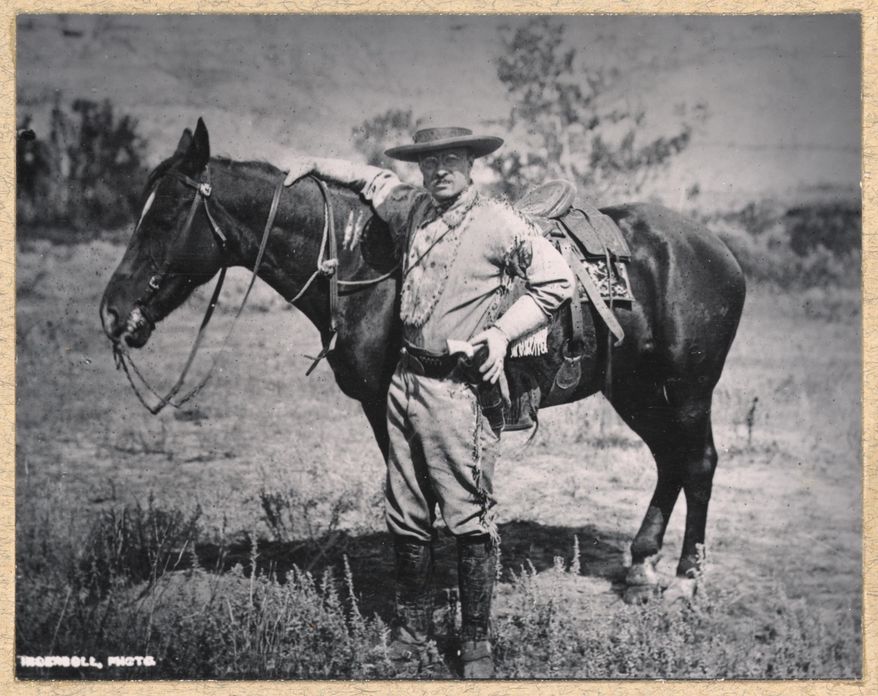
Black care rarely sits behind a rider whose pace is fast enough.
— Attributed to Teddy Roosevelt by David McCullough, on the frontispiece for McCullough’s biography of Roosevelt, Mornings on Horseback (Simon & Schuster, 1981).
6 Comments | Famous quotes, History, Quotes, Theodore Roosevelt | Tagged: Famous quotes, History, Quotes, Theodore Roosevelt | Permalink
Posted by Ed Darrell
Quote of the Moment: Charles Darwin, noble monkey ancestors
March 13, 2007
Charles Darwin, image from Deviant Art; Artwork : http://www.davidrevoy.com
For my own part I would as soon be descended from that heroic little monkey, who braved his dreaded enemy in order to save the life of his keeper, or from that old baboon, who, descending from the mountains, carried away in triumph his young comrade from a crowd of astonished dogs — as from a savage who delights to torture his enemies, offers up bloody sacrifices, practices infanticide without remorse, treats his wives like slaves, knows no decency, and is haunted by the grossest superstitions.
– Charles R. Darwin,
The Descent of Man, 1871, ch. 6
Leave a Comment » | Darwin, Evolution, Good Quotes, History, Quotes | Tagged: Altruism, Darwin, Evolution, Famous quotes, History, Quotes | Permalink
Posted by Ed Darrell
Millard Fillmore: Still dead, still misquoted, 133 years later
March 8, 2007
A wax likeness of Millard Fillmore’s head, appearing to be for sale for $950.00.
March 8, 2007, is the 133rd anniversary of Millard Fillmore’s death.
Manus reprints the text from the New York Times story a few days later:
Buffalo, N.Y., March 8 — 12 o’clock, midnight. — Ex-President Millard Fillmore died at his residence in this city at 11:10 to-night. He was conscious up to the time. At 8 o’clock, in reply to a question by his physician, he said the nourishment was palatable; these were his last words. His death was painless.
First, I wonder how the devil the writer could possibly know whether Fillmore’s death was painless?
And second, accuracy obsessed as I am, I wonder whether this is the source of the often-attributed to Fillmore quote, “The nourishment is palatable.” Several sources that one might hope would be more careful attribute the quote to Fillmore as accurate — none with any citation that I can find. Thinkexist and Brainyquote charge ahead full speed. Wikipedia lists it. Snopes.com says the quote is “alleged,” in a discussion thread.
I’ll wager no one can offer a citation for the quote. I’ll wager Fillmore didn’t say it.
Millard Fillmore: We’d protect his legacy, if only anyone could figure out what it is.
1 Comment | Accuracy, Bad Quotes, Capturing history, Famous quotes, History, Millard Fillmore, Newspapers, Presidents, Quotes | Permalink
Posted by Ed Darrell




 Millard Fillmore's Bathtub