September 8, 2006
Several weeks ago I noted Bob Park’s characteristics of Bogus Science, and then, based on his work, I listed some characteristics of bogus history, here in Bogus History 1, and here in Bogus History 2.
Here’s a test, more of the Bogus Science than Bogus History, but still a test: Almost-creationist astronomer Hugh Ross claims to have a hypothesis of creation that is not Darwin, that is testable, and which will be published shortly in his new book.
Do you see any of the warning signs of “bogus” yet? (Some answers suggested at the end, below the fold.)
Read the rest of this entry »
Spread the word; friends don't allow friends to repeat history.
 5 Comments |
  Accuracy, Bogus history, Creationism, Intelligent Design, Public education, Religious Freedom, Texas Freedom Network |
  Permalink
 Posted by Ed Darrell
August 27, 2006
John Dean, former counsel to the president, has some stern words for religious dominionists, including Coral Ridge Ministries’ D. James Kennedy, in his column at Findlaw.com. You may want to check it out.
Spread the word; friends don't allow friends to repeat history.
Leave a Comment » | Bogus history, Law, Religious Freedom | Permalink
Posted by Ed Darrell
August 23, 2006
Voodoo history just will not die.
Several years ago I caught the tail end of a television program featuring the Rev. D. James Kennedy railing against evolution and especially Charles Darwin. What caught my aural attention was a rant claiming that Darwin somehow bore responsibility for Stalin’s manifold evils perpetrated in the old Soviet Union.
That is bogus history of the first order, of course. Stalin banned the teaching of evolution, and he banned research even based on evolution.
Soviet genetics, top of the world in the early 1920s, was set back decades (and still has not recovered). Some top scientists were fired; some were imprisoned; some were sent to Siberia in hopes they would die (and some did); a few disappeared, perhaps after being shot. Soviet anti-Darwinian science contributed to the massive crop failures of the 1950s that led to the starvation of more than 4 million people. Claiming that Stalin loved Darwinian theory is bad history revisionism of first order. (If you’re Googling, look for the story of Trofim Lysenko, Stalin’s henchman against biology.)
Kennedy is at it again. The past couple of weeks have featured new rants against Darwin, leading up to a promised climax this weekend in which Kennedy will claim Darwin was responsible for Hitler and Nazi atrocities — again a fantastic claim, since Hitler directly repudiated Darwin, never expressed support for the idea of evolution, and since anti-Darwin quackery led to any number of stupid science moves in Nazi Germany, such as a ban on blood banks for fear that soldiers would get Jewish blood and turn Jewish (no, you can’t make that stuff up — see Ashley Montague’s essay in his 1959 book, Human Genetics).
Unfortunately for Kennedy and his Coral Ridge Ministries (CRM), his advance flackery got the attention of biologists like P. Z. Myers and others, like the Jewish Anti-Defamation League.
There is much bogus history to deal with there, and so little time. Check out the links. More to come from here, I hope.
Spread the word; friends don't allow friends to repeat history.
2 Comments | Bogus history, Creationism, Evolution, History Revisionism, Hoaxes, Holocaust, Holocaust denial, Intelligent Design, Plagiarism, Religious Freedom, Voodoo history | Permalink
Posted by Ed Darrell
August 21, 2006
Brett Younger is pastor at Fort Worth’s Broadway Baptist Church. In the Baptist Standard he tells a story of a near-disaster in his high school chemistry class, on the way to urging Christians to use common sense on the issues of evolution in public school science classes. One more voice of reason, for sanity.
Spread the word; friends don't allow friends to repeat history.
2 Comments | Creationism, Education, Evolution, Intelligent Design, Public education, Religious Freedom | Permalink
Posted by Ed Darrell
August 18, 2006
Althouse tees off on the content and tone of an article in the New York Times that describes a school in the United States where young boys spend nine hours a day in rote memorization of the Qur’an.
During my law school time our informal study group had one guy who could study the tarnation out of any topic we had. Tom got his high school education in a Catholic system, and he had four years of Latin. It wasn’t exactly rote memorization, but it was a lot of work dealing with a system of writing that is difficult to master, at best, and language-logic defying at worst. In the group, we determined (over a few fermented grain beverages) that this experience had well prepared Tom to deal with the oddities of legal thought. Of course, it may have been just that Tom had learned to study with all those stern taskmasters who taught the Latin courses.
Readers here know I think school should grab a student’s interest whenever possible to improve the educational value of any topic offered. Rote memorization has a place — I required history kids to memorize the Gettysburg Address and the Preamble to the Constitution last year — but it is a place in a larger menu of educational offerings.
Howard Gardner claims there are different domains of genius available to everybody. Of the eight (maybe nine) domains he has identified, how many of them are neglected by pure, rote memorization of an untranslated text?
Ann Althouse is right. One question we need to consider is, how many others were outraged by that article in the Times, and for the right reasons?
Update: P. Z. Myers also found the article’s description of the school troubling. He gets a lot more traffic than I do — a lot more comments are available there, at Pharyngula, “This is not a school.”
Spread the word; friends don't allow friends to repeat history.
Leave a Comment » | Curricula, Education, First Amendment, Pedagogy, Religious Freedom, Teaching | Permalink
Posted by Ed Darrell
August 15, 2006
It just gets better every time you go! The 37th Carnival of History is up at Mode for Caleb.
There’s a pointer to my James Madison post of some days ago, where I noted the need for a new, popular biography of Madison, to round out and balance the couple dozen fine books on the American Revolution, and the people who made it and cemented it into place. There’s also a pointer to a very interesting bit of Madison/Jefferson trivia, their use of codes, at the American Presidents Blog.
(I know some people who would love to do the Madison book, should any of you be publishers in need.)
Spread the word; friends don't allow friends to repeat history.
Leave a Comment » | History, James Madison, Religious Freedom | Permalink
Posted by Ed Darrell
August 14, 2006
I’ll make this quick (back to the grindstone, you know).
In my immediately previous post I make a minor case that advocacy of intelligent design is the less preferable alternative to understanding evolution, for moral reasons. Advocacy of intelligent design has so farproven incapable of making a case in a straightforward and honest fashion. All cases for intelligent design rest in large part, or completely, in distortions of science and history. What originall caught my eye and my ire was the mischaracterization of the recent decision in the Pennsylvania intelligent design case. Read the rest of this entry »
Spread the word; friends don't allow friends to repeat history.
8 Comments | Accuracy, Creationism, Current History, Curricula, Education, Evolution, First Amendment, Intelligent Design, Law, Public education, Religious Freedom | Permalink
Posted by Ed Darrell
August 14, 2006
I’m straying only a bit off topic, and only by certain legalistic interpretations. History folks, bear with me.
My complaint about what is called “intelligent design” in biology is the same complaint I have against people who wish to crown Millard Fillmore as a great light for bringing plumbing to the White House over the complaints of health officials — that is, my complaint against those who push H. L. Mencken’s hoax over the facts.
Joe Carter at Evangelical Outpost listed at great lengths his list of reasons that arguing for science actually promotes intelligent design instead (Part 1, Part 2, Part 3). This blog’s response was in two parts, one and two. Other people offered other rebuttals, including notably, P. Z. Myers at Pharyngula, a very good blog that features the hard science of biology and especially evolution.
Joe provided a first affirmative rebuttal here. This post is my reply, on the single point of whether it’s fair to say creationists, IDists, or others who twist the facts and research, are “dishonest.”
The text is below the fold; I left it in remarks at Evangelical Outpost. I have one other observation I’ll make quickly in the next post.
Enjoy, and chime in with your own remarks (I’m headed back to the grindstone). Read the rest of this entry »
Spread the word; friends don't allow friends to repeat history.
23 Comments | Creationism, Current History, Curricula, Education, Evolution, First Amendment, Intelligent Design, Public education, Religious Freedom, Science | Tagged: Creationism, Current History, Curricula, Darwin, Education, Evolution, First Amendment, Intelligent Design, Joe Carter, Religious Freedom, Science, Voodoo science | Permalink
Posted by Ed Darrell
August 10, 2006
It’s only nine months since Judge John Jones’ extremely well-reasoned and carefully-written decision in Kitzmiller vs. Dover Area School District, which declared unconstitutional the efforts by the school board in Dover, Pennsylvania, to sneak creationism into their schools’ biology curriculum. But the revisionists are out in force. On August 8, Joe Carter at Evangelical Outpost posted “10 ways Darwinists help intelligent design,” in extreme length.
Other people were bothered by the post, too. I see that Matt over at Pooflingers fisked the thing, too. I haven’t read his post yet — his is no doubt more incisive than what I’ve written below. But can there be too much taking to task those who would sacrifice our children’s education on a cross of hooey? Read the rest of this entry »
Spread the word; friends don't allow friends to repeat history.
3 Comments | Accuracy, Bad Quotes, Bogus history, Creationism, Current History, Ethics, Evolution, History Revisionism, Hoaxes, Religious Freedom | Permalink
Posted by Ed Darrell
August 5, 2006
Libertarian-bent lawyer Tim Sandefur posts this note at Panda’s Thumb:
Neal McCulskey of the Cato Institute and Matthew Yglesias of The American Prospect have a debate going over whether school choice programs would help resolve the evolution/creationism controversy. Here’s McCulskey’s first post, Yglesias’ reply, and McCulskey’s rebuttal.
Vouchers. Parental choice is an issue across the curriculum, but it is especially poignant in sex education, biology, and history. In those three areas there are national movements to direct curricula, some of the movements in each area based on a great deal of misinformation and disinformation.
Read the rest of this entry »
Spread the word; friends don't allow friends to repeat history.
14 Comments | Creationism, Curricula, Education, Geography - Political, Intelligent Design, Public education, Religious Freedom, School vouchers, State school boards | Permalink
Posted by Ed Darrell
August 1, 2006
Robert Park provides a short e-mail newsletter every Friday, covering news in the world of physics. It’s called “What’s New.” Park makes an art of smoking out bogus science and frauds people try to perpetrate in the name of science, or for money. He wrote an opinion column for the Chronicle of Higher Education published January 31, 2003, in which he listed the “7 warning signs of bogus science.”
Please go read Park’s entire essay, it’s good.
And it got me thinking about whether there are similar warning signs for bogus history? Are there clues that a biography of Howard Hughes is false that should pop out at any disinterested observer? Are there clues that the claimed quote from James Madison saying the U.S. government is founded on the Ten Commandments is pure buncombe? Should Oliver Stone have been able to to more readily separate fact from fantasy about the Kennedy assassination (assuming he wasn’t just going for the dramatic elements)? Can we generalize for such hoaxes, to inoculate ourselves and our history texts against error?
Perhaps some of the detection methods Park suggests would work for history. He wrote his opinion piece after the Supreme Court’s decision in Daubert v. Merrell Dow Pharmaceuticals, Inc., in which the Court laid out some rules lower courts should use to smoke out and eliminate false science. As Park described it, “The case involved Bendectin, the only morning-sickness medication ever approved by the Food and Drug Administration. It had been used by millions of women, and more than 30 published studies had found no evidence that it caused birth defects. Yet eight so-called experts were willing to testify, in exchange for a fee from the Daubert family, that Bendectin might indeed cause birth defects.” The Court said lower courts must act as gatekeepers against science buncombe — a difficult task for some judges who, in their training as attorneys, often spent little time studying science.
Some of the Daubert reasoning surfaced in another case recently, the opinion in Pennsylvania district federal court in which Federal District Judge John Jones struck down a school board’s order that intelligent design be introduced to high school biology students, Kitzmiller v. Dover Area School District.
Can we generalize to history, too? I’m going to try, below the fold. Read the rest of this entry »
Spread the word; friends don't allow friends to repeat history.
4 Comments | Accuracy, Bad Quotes, Bogus history, History Revisionism, Religious Freedom, Voodoo history | Permalink
Posted by Ed Darrell
August 1, 2006
 *
*
In his Autobiography Jefferson recounted the 1786 passage of the law he proposed in 1779 to secure religious freedom in Virginia, the Statute for Religious Freedom:
The bill for establishing religious freedom, the principles of which had, to a certain degree, been enacted before, I had drawn in all the latitude of reason and right. It still met with opposition; but, with some mutilations in the preamble, it was finally passed; and a singular proposition proved that its protection of opinion was meant to be universal. Where the preamble declares, that coercion is a departure from the plan of the holy author of our religion, an amendment was proposed, by inserting the word “Jesus Christ,” so that it should read, “a departure from the plan of Jesus Christ, the holy author of our religion;” the insertion was rejected by a great majority, in proof that they meant to comprehend, within the mantle of its protection, the Jew and the Gentile, the Christian and the Mahometan, the Hindoo, and the Infidel of every denomination.
Life and Selected Writings of Thomas Jefferson, Modern Library 1993 edition, pp. 45 and 46.
* Image is a photo of detail from a painting of Jefferson by Rembrandt Peale, courtesy of the New York Historical Society by way of the Library of Congress.
Spread the word; friends don't allow friends to repeat history.
2 Comments | America's founding, First Amendment, Good Quotes, Religious Freedom, Thomas Jefferson | Permalink
Posted by Ed Darrell
July 31, 2006
School starts soon. History classes will study the founding of the United States. And especially under the topical restrictions imposed by standardized testing, many kids will get a short-form version of history that leaves out some of the most interesting stuff.
James Madison gets short shrift in the current canon, in my opinion. Madison was the fourth president, sure, and many textbooks note his role in the convention at Philadelphia that wrote the Constitution in 1787. But I think Madison’s larger career, especially his advocacy for freedom from 1776 to his death, is overlooked. Madison was the “essential man” in the founding of the nation, in many ways. He was able to collaborate with people as few others in order to get things done, including his work with George Mason on the Virginia Bill of Rights, with George Washington on the Constitution and national government structure, Thomas Jefferson on the structure and preservation of freedom, Alexander Hamilton on the Constitution and national bank, and James Monroe on continuing the American Revolution.
We need to look harder at the methods and philosophy, and life, of James Madison. This is an opinion I’ve held for a long time. Below the fold I reproduce a “sermon” I delivered to the North Texas Church of Freethought in November 2001. Read the rest of this entry »
Spread the word; friends don't allow friends to repeat history.
2 Comments | 1789, America's founding, Freedom - Political, History, James Madison, Religious Freedom, Thanksgiving, U.S. Constitution | Permalink
Posted by Ed Darrell
July 30, 2006
Dictionaries of the future will feature “bartonizing,” after Texas mathematics teacher David Barton, with a reference to “bowdlerization.” Ed Brayton at Dispatches from the Culture Wars details a recent flurry of correcting a Barton misapprehension of history about one of Thomas Jefferson’s studies of the gospels, which resulted in a book called The Jefferson Bible.
The issue is a strange claim by Barton, repeated by Dr. D. James Kennedy at Coral Gables Ministries, that Jefferson wrote the thing in an attempt to convert Indians to Christianity. Students of Jefferson immediately recognize that claim as contrary to Jefferson’s character on several fronts.
The discussion is enlightened and enlightening; I noted the similar claim that Jefferson built a church and hired a priest for the Kaskaskias (in Illinois), with federal funds, is similarly in error. The fight against revisionist history — revising history to add errors — continues.
(One current edition of the Jefferson Bible on sale at Monticello features a forward by Rev. F. Forrester Church, minister at senior minister of the Unitarian Church of All Souls in New York City; that must frost Kennedy and Barton.)
Spread the word; friends don't allow friends to repeat history.
Leave a Comment » | Accuracy, Bad Quotes, History Revisionism, Religious Freedom, Thomas Jefferson | Permalink
Posted by Ed Darrell
July 26, 2006
Dispatches from the Culture Wars features a set of comments on an interview right-right-wing pundit John Lofton did with Roy Moore, the former chief justice of Alabama’s Supreme Court who lost his job when he illegally tried to force his religion on the court and on Alabama. This year Moore ran for governor of Alabama, losing in the primary election.
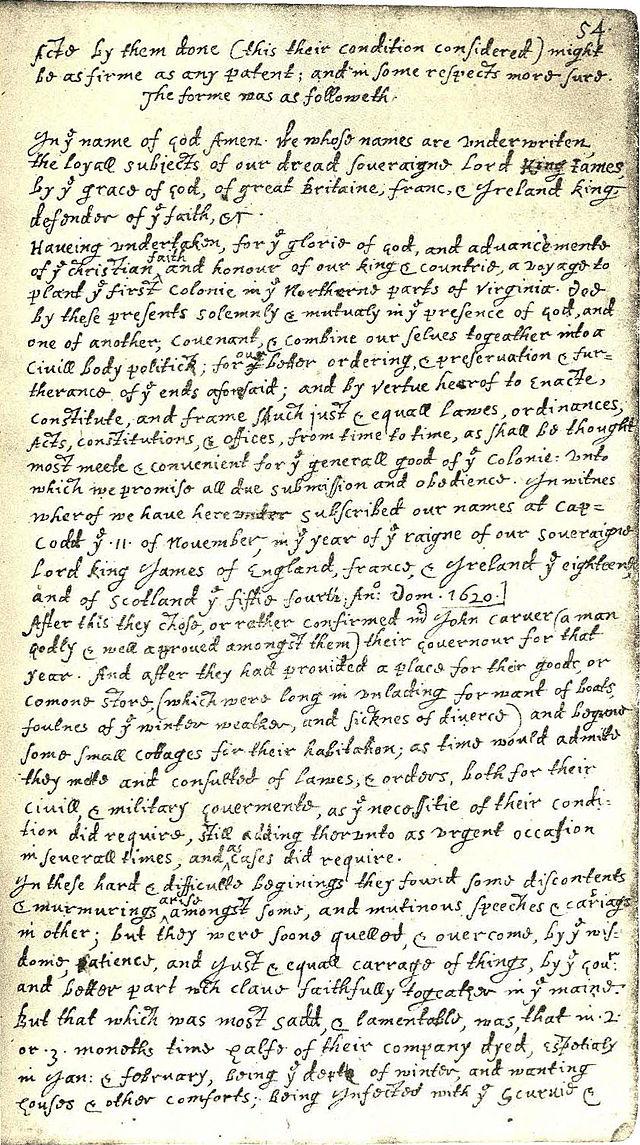
Mayflower Compact. It’s a contract between people. God is a witness, but not a party.
One of the grandest canards in current thought about U.S. history is that the Mayflower Compact set up a theocracy in Massachusetts. Lofton and Moore banter about it as if it were well established fact — or as if, as I suspect, neither of them has looked at the thing in a long time, and that neither of them has ever diagrammed the operative sentence in the thing.
The Mayflower Compact was an agreement between the people in two religiously disparate groups, that among them they would fairly establish a governing body to fairly make laws, and that they would abide by those laws. Quite the opposite of a theocracy, this was the first time Europeans set up in the New World a government by consent of the governed. That is something quite different from a theocracy. Read the rest of this entry »
Spread the word; friends don't allow friends to repeat history.
4 Comments | America's founding, History Revisionism, Religious Freedom, U.S. Constitution | Permalink
Posted by Ed Darrell




 Millard Fillmore's Bathtub