Fossil walrus porn

December 23, 2011

Walrus baculum fossil, from Retrieverman

What is it? If you were a lady walrus a few million years ago, you wouldn't have to ask!

I can’t do it justice.  Go read about the photo at Retrieverman’s site.

My students hear it often:  Truth is stranger and often much more interesting than fiction.  It certainly applies in history, and it applies in science, too.


More misunderstanding of the case against DDT

December 21, 2011

Well-meaning but misinformed dog breeder Terrierman (a guy who goes by the handle PBurns, too)  is just the latest to fall victim to false and nearly false claims about DDT and its effects on birds.

One of the claims made by pro-DDT and anti-environmental protection, anti-science groups is that DDT is not the bad guy in bird deaths.  The late DDT-nut Gordon Edwards said DDT had nothing to do with eagle deaths, and pointed to the 300-year decline in eagle populations from the time European settlers began shooting at them.  This idea has been touted by the chief junk science purveyor, Steven Milloy, and by many others over the years.

So, in one of his several posts slamming eagle conservation efforts that include stopping the use of DDT, Terrierman said:

What’s the story? Simple: that Bald Eagles and Osprey were pushed to the edge of extinction by DDT.

Not True.

Actually, that is true.  Terrierman got it wrong.  DDT was, indeed, threatening the very existence of the bald eagle.  While it is true that there were other pressures, some long-standing, it is also true that once those problems were cleared, DDT still barred the recovery of the eagle, plus other species like osprey, peregrine falcons, and brown pelicans.

What is the story?  The story is that eagles have been under assault since Europeans found America.  By 1900, eagle populations across North America were dramatically and drastically reduced.  A federal law in 1918 made it illegal to shoot eagles, but it had little effect.  A tougher law passed in 1940 finally got some traction.

But eagle recovery didn’t take off.  In the late 1940s and early 1950s bird watchers, and bird counters like those volunteers who contribute to the annual Audubon Christmas Bird Count, noticed that young eagles disappeared.  Simply, adult, breeding eagles were not able to produce young who survived to migrate, mature, and breed later.

The culprit was DDT.  DDT kills young eagles in three ways, known in the 1960s.  It poisons them so they cannot grow in the egg.  It poisons them so they die after a period of growth.  It poisons them so they are unable to eat and digest properly, so they die shortly after they hatch.

DDT can also screw up the sexual organs of young birds, so they are unable to breed — perhaps a fourth way DDT kills young, by simply preventing their creation.

Then, in the 1970s, we found another way DDT kills species:  DDT makes the eagle hens unable to form competent eggshells.  The young die because the eggs cannot survive incubation.

DDT also kills adult eagles, especially migrating birds.  DDT accumulates in fat tissues, those fats that migrating birds burn.  When the birds migrate, the DDT comes out, and it can literally stop the heart or brain of the bird in flight.  (It kills bats the same way.)  Birds lost in migration rarely get found for necropsy.   The bird count simply falls, the population sinks one individual closer to extinction.

Does the dog breeder know all of this?  I can’t tell — I tried to correct his errors at his blog site, but after I provided a link to an article that showed DDT appears to be harming California condors as well — in a post he has censored in moderation and which will never see the light of day at Terrierman, I predict — it’s clear he’s not up to gentle correction.

One more blog from which I am banned from telling the facts.

PBurns, if you’re bold enough to comment here, your comments won’t be censored (so long as not profane).  We need robust discussion, and I encourage it.

Below the fold — my final post to Terrierman, which he won’t allow through moderation.

Read the rest of this entry »


Scenes from a beach: At the edge of the sea

December 20, 2011

Interesting little bauble in the Biloxi-Gulfport (Mississippi) Sun-Herald, I think from their columnist George Thatcher:

Cover of Rachel Carson's "The Edge of the Sea"

Good teacher resource for National Environmental Week, April 15-21, 2012

December 20 Scenes from the beach

“To stand at the edge of the sea,” wrote Rachel Carson, “… is to have knowledge of things that are as eternal, as any earthly life can be.”* The things that we see this morning–a cerulean sea and sky, the shorebirds, the sun still near the horizon — are identically the same objects that could be seen in Cambrian times, eons ago. There is a sense of the eternal in the objects viewed today. And I suppose there will be little change in a faraway eon that lies in some future age. — Diary, autumn 2011

* At the Edge of the Sea by Rachel Carson; Signet Books, New York (1955)

Read more here: http://www.sunherald.com/2011/12/19/3641733/december-20-scenes-from-the-beach.html#storylink=cpy

One should read Rachel Carson to get closer to the universe, not for political reasons, not necessarily for the science.  But being scientifically accurate, and being close to the pulse of the universe, Carson’s views will change your politics for the better if you really read and listen.


SkepticGate II: Fizzled assault on science

December 19, 2011

Skepticgate cartoon from the Houston Chronicle, 2009

This Anderson cartoon from the Houston Chronicle in 2009 gets the facts right, but sadly, is still accurate

Remember the pathetic, disgusting attempt to derail the climate talks in Durban, just a few days ago?  The “climate skeptics”™ dumped a bunch more private e-mails from the scientists who work on climate. (Stolen e-mails, here; be prepared to be bored, with no smoking guns, no cold guns, no guns at all.)

Unless one thinks the self-proclaimed skeptics are James Bond nemesis enough to actually hope for the end of the world (as opposed to just being monumentally, stupidly misled), their train still can’t get back on the tracks.  Revealing that someone among them has stolen more e-mails than previously known, didn’t help.  Here is a list of just how bad the derailment has been for the denialists:

  1. No great world-changing agreement, but the climate talks in Durban, South Africa, produced a consensus that a massive treaty is not coming soon, and that action to save the planet can’t wait for guys in suits who defer by people like Ralph Hall to do the right thing.  Generally, the comity at Durban is bad for the denialists — Christopher Monckton went into full panic mode, suggesting the language of the agreement available isn’t the whole story and something else — something sinister — is really going on.  (One wonders how Monckton can stand to turn out the lights at night.)  They can’t tell the difference between their burro and a burrow, and with Ralph Hall leading them they’re likely to find the edge of the cliff and leave it before they realize just how far up they are and how far they have to fall.  (Skeptic/denialist Judith Curry carried a rundown of headlines from Durban, with links — remember her bias.)
  2. British authorities raided the digs of a skeptic blogger, seizing his computer upon which he got the first round of stolen e-mails.  It’s unlikely the raidee is guilty of much beyond making the stolen stuff public (is that a crime in Britain?), but one hopes Britain’s crime fighters have access to cyber trackers who may be able to learn more from the signatures on the posts.  Searches have been noticed for other bloggers, including Jeff Id at the Air Vent, but warrants and actual searches haven’t taken place yet.
  3. One paper in climate science was officially retracted — alas for the denialists, it was one of theirs.  Plagiarism and rank error in the so-called Wegman Report to a committee of the U.S. House of Representatives prompted the call-back.  John Mashey’s gumshoe work in the libraries of academe lent a new shine to the word “scholarship.”  Republicans have yet to admit the paper’s errors.  (
  4. Texas Congressman Ralph Hall granted a rare interview, and spoke out about climate change.  He revealed that he doesn’t know much about one of the hottest issues facing the committee he chairs, and what little he knows, is wrong.  Cue the Kin Hubbard/Mick Jagger duet.
  5. Skeptics actually completed a research project and prepared it for publication.  A group at Berkeley, with funding from conservative warming denialists like the Koch brothers, and featuring the work and cooperation of leading anti-science people like Anthony Watts, took on the challenge of looking at temperatures reported from weather stations, especially in the U.S., and especially those Anthony Watts had targeted as providing unduly warm and inaccurate readings that skewed all of the science of global warming.  The not-loudly-mentioned target, of course, was the “hockey stick” graph.  Alas for the skeptics, the Berkeley Earth Surface Temperature (BEST) study produced results that verify the accuracy of measurements that show warming, and which suggest the IPCC-published hockey stick is accurate enough that it deserves credence.  Anthony Watts promptly disavowed all his own work on the project.
  6. Meanwhile, warming continued unabated by almost every measure.  Galileo could say:  Eppure, lei si scalda!

One question we need to be asking is why the incidents around the stolen e-mails are known as “Climategate” in the circles of warming denialists.  The thieves in this case came from the ranks of the so-called skeptics, and the release of the e-mails was done on the blogs of those who deny warming, or human causation, or human ability to mitigate at all.  (Fox News got it bass ackwards, of course — wondering whether the government is somehow complicit in hiding information, while all the information is public and almost all of the private communication is public.  At Fox, they don’t even get Homer Simpson doh! moments of understanding — that’s how bad it is in Denialville.)

Not climategate, but skepticgate -- follow the money cartoon

So far no one’s listening to the bear on this one — follow the money, and bring the criminals to justice.

It’s really SkepticGate, with a more-than two-year coverup and continuing, and the recent release is SkepticGate II.

Denialists, and even those who question global warming on legitimate grounds, must be frustrated.  Nothing they do stops the world from warming.  As the massive wave of evidence demonstrating the Earth warms and humans share the blame turns to a tsunami, even policy makers (Ralph Hall excepted) look for solutions to warming problems.  It’s so bad for the skeptics that even the old trick of stealing e-mails from the scientists, the trick that helped fog up the Copenhagen proceedings, did almost nothing to the Durban talks.  While no treaty came out, none was expected — but the sudden action in the last couple of days of the conference to get action despite the continued interference by climate skeptics  and their political allies, must have caught them off guard.

Now the cops are after them, too.

Happy Hanukkah, Merry Christmas, Cool KWAANZA, Ebullient Edwin Hubble Looking Up Day, Happy New Year!


Comet Lovejoy danced too close to the Sun — but defied death!

December 17, 2011

Great pictures from NASA’s Solar Dynamics Observatory.

A newly-discovered comet, Comet Lovejoy, orbited dangerously close to the Sun for a ball of ice.  Experts predicted it would be the last trip for the little planetoid.

But, then Lovejoy zoomed out from the other side of our home star.  Amazing.

See it for yourself:

How surprising was this?  Look at this earlier piece, inviting people to watch the end of the comet:

A wonderful fail, no?

See also:

Comet Lovejoy Plunges into the Sun and Survives

Dec. 16, 2011: This morning, an armada of spacecraft witnessed something that many experts thought impossible.  Comet Lovejoy flew through the hot atmosphere of the sun and emerged intact.

“It’s absolutely astounding,” says Karl Battams of the Naval Research Lab in Washington DC.  “I did not think the comet’s icy core was big enough to survive plunging through the several million degree solar corona for close to an hour, but Comet Lovejoy is still with us.”

The comet’s close encounter was recorded by at least five spacecraft: NASA’s Solar Dynamics Observatory and twin STEREO probes, Europe’s Proba2 microsatellite, and the ESA/NASA Solar and Heliospheric Observatory.  The most dramatic footage so far comes from SDO, which saw the comet go in (movie) and then come back out again (movie).

Comet Lovejoy (exit splash, 512px)

NASA’s Solar Dynamics Observatory caught Comet Lovejoy emerging from its scorching close encounter with the sun. [Entrance movie:Quicktime (22 MB), m4v (0.8 MB)] [Exit movie:Quicktime (26 MB), m4v (0.8 MB)]

In the SDO movies, the comet’s tail wriggles wildly as the comet plunges through the sun’s hot atmosphere only 120,000 km above the stellar surface. This could be a sign that the comet was buffeted by plasma waves coursing through the corona.  Or perhaps the tail was bouncing back and forth off great magnetic loops known to permeate the sun’s atmosphere.  No one knows.

“This is all new,” says Battams.  “SDO is giving us our first look1 at comets travelling through the sun’s atmosphere. How the two interact is cutting-edge research.”

Curiosity and the Solar Storm (signup)

“The motions of the comet material in the sun’s magnetic  field are just fascinating,” adds SDO project scientist Dean Pesnell of the Goddard Space Flight Center.   “The abrupt changes in direction reminded me of how the solar wind affected the tail of Comet Encke in 2007 (movie).”

Comet Lovejoy was discovered on Dec. 2, 2011, by amateur astronomer Terry Lovejoy of Australia.  Researchers quickly realized that the new find was a member of the Kreutz family of sungrazing comets.  Named after the German astronomer Heinrich Kreutz, who first studied them, Kreutz sungrazers are fragments of a single giant comet that broke apart back in the 12th century (probably the Great Comet of 1106).  Kreutz sungrazers are typically small (~10 meters wide) and numerous. The Solar and Heliospheric Observatory sees one falling into the sun every few days.

At the time of discovery, Comet Lovejoy appeared to be at least ten times larger than the usual Kreutz sungrazer, somewhere in the in the 100 to 200 meter range.  In light of today’s events, researchers are re-thinking those numbers.

Comet Lovejoy (coronagraph splash, 512px)

This coronagraph image from the Solar and Heliospheric Observatory shows Comet Lovejoy receding from the sun after its close encounter. The horizontal lines through the comet’s nucleus are digital artifacts caused by saturation of the detector; Lovejoy that that bright! [movie]

“I’d guess the comet’s core must have been at least 500 meters in diameter; otherwise it couldn’t have survived so much solar heating,” says Matthew Knight. “A significant fraction of that mass would have been lost during the encounter. The remains are probably much smaller.”

SOHO and NASA’s twin STEREO probes are monitoring the comet as it recedes from the sun. It is still very bright and should remain in range of the spacecrafts’ cameras for several days to come.

What happens next is anyone’s guess.

“There is still a possibility that Comet Lovejoy will start to fragment,” continues Battams. “It’s been through a tremendously traumatic event; structurally, it could be extremely weak. On the other hand, it could hold itself together and disappear back into the recesses of the solar system.”

“It’s hard to say,” agrees Knight.  “There has been so little work on what happens to sungrazing comets after perihelion (closest approach).  This continues to be fascinating.”
Author:Dr. Tony Phillips| Production editor: Dr. Tony Phillips | Credit: Science@NASA

More Information

Footnote:1“When SDO was launched we thought we would see nothing besides the Sun and the dark disks of the Moon, Earth, Venus, and Mercury in our images,” says SDO project scientist Dean Pesnell of GSFC. “No other bright object would be visible because our instruments are designed to look at the Sun. Now we are measuring the mass and composition of comets by turning the comet inside out.”


Schneider on global warming, Parts 1, 3 and 4

December 12, 2011

Earlier I posted a video of Stanford’s late Dr. Stephen Schneider in a meeting with Australian climate “skeptics.”  It was one of a four-part series, Part 2, to be precise.

Here are the other parts.  They are excerpted from an Australian television program, “Insight,” taped in June 2010.

Part 1:

Links promised in the video above can be found below the fold.
764

Part 2 is here, in a previous post.

Part 3:

742

Part 4:

479

Read the rest of this entry »


Stephen Schneider explains global warming so even a “skeptic” can get it

December 12, 2011

Impressive.  Schneider explains, to Australian “skeptics,” how CO2 accumulates in the atmosphere, why that’s bad, what the urban heat island effect is and why it does not negate temperature measures that show global warming.  He savages the argument about CO2’s “logarithmic” absorption characteristics negating scientists’ findings.

Sadly, Dr. Schneider died a few weeks after this was taped in 2010.

This is, I see, part 2 of a 4 part series.  Hmmm.  WhHere are the other parts?.


Annals of Global Warming: It didn’t start with the hockey stick . . .

December 12, 2011

Peter Sinclair comes through with a good explanation of the history of concern about global warming — how the warming trend was discovered.

It wasn’t scientists trying to get government grants.  It was the U.S. Air Force, trying to beat the commies and keep America safe for democracy and, ironically, safe for dissent from such applications of science.


9,996

Real history couldn’t be published as fiction, which is one way we can tell real history from the stuff that gets made up.  In the story told in this video, note carefully the serendipity of figuring out the CO2 issues:  Who could invent a story about warfare leading to the discovery of global warming?  As with the coincidence of John Adams and Thomas Jefferson both dying on the 50th anniversary of the Declaration of Independence, no editor of fiction would accept it as believable.

More:

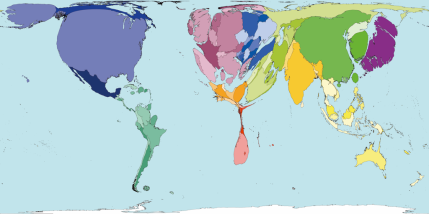
Why we worry, why policy makers are involved:  Carbon Emissions, 2000 – from WorldMapper, with a serendipitous tip of the old scrub brush to Petra Tschakert at Penn State.

Carbon emissions 2000, from worldmapper.org - creative commons license

Carbon Emissions 2000, from worldmapper.org - creative commons license

Carbon Emissions 2000 © Copyright 2006 SASI Group (University of Sheffield) and Mark Newman (University of Michigan). “We welcome use of our maps under the Creative Commons conditions by educational, charitable and other non-profit organisations.”

Progress from Durban?

December 11, 2011

Meeting in Durban, South Africa, government officials from many nations worked to find solutions to human causation of destructive climate change, in the framework of proposed treaties under United Nations aegis.

Negotiations at Durban, South Africa, December 10, 2011 - UK DECC photo

Negotiators at the COP17 Climate Conference in Durban work late into the night to reach agreement on a roadmap to a legally binding deal, 10 December 2011. UKDECC photo and caption

Did anyone expect good reports out of these meetings?

From the UK Department of Energy and Climate Change, we get this press release, dated Sunday, December 11, 2011:

Road open to new global legal climate treaty

  • Global agreement achieved on a roadmap to a legally binding deal
  • Second commitment period of Kyoto Protocol to be agreed next year
  • Green Climate Fund to be set up

The UN climate talks in South Africa have been heralded a success after a climate change deal was struck in the early hours of Sunday morning.194 parties have spent the past two weeks in Durban discussing how to cut emissions to limit global temperature rise to below two degrees to avoid dangerous climate change.

In a major realignment of support, well over 120 countries formed a coalition behind the EU’s high ambition proposal of a roadmap to a global legally binding deal to curb emissions. African states together with the least developed countries such as Bangladesh and Gambia, and small island states vulnerable to rising sea levels, like the Maldives, joined with the EU to put forward a timetable which would see the world negotiate a new agreement by 2015 at the latest.

The talks resulted in a decision to adopt the second commitment period of the Kyoto Protocol next year in return for a roadmap to a global legal agreement covering all parties for the first time. Negotiations will begin on the agreement early next year.

Energy and Climate Change Secretary Chris Huhne said:

“This is a significant step forward in curbing emissions to tackle global climate change. For the first time we’ve seen major economies, normally cautious, commit to take the action demanded by the science.

“The EU’s proposal for the roadmap was at the core of the negotiations and the UK played a central role in galvanising support. This outcome shows the UNFCCC system really works and can produce results. It also shows how a united EU can achieve results on the world stage and deliver in the UK’s best interests.

“There are still many details to be hammered out, but we now need to start negotiating the new legal agreement as soon as possible and there are still many details to be hammered out.”

Also the conference agreed to get the Green Climate Fund up and running, this will help deliver financial support to developing countries to reduce emissions and adapt to the effects of climate change.

Notes to editors:

Further details on the Durban climate talks can be found at: www.unfccc.int

Visit the Durban COP 17 pages of the DECC website www.decc.gov.uk/durban

Call me skeptical that this report is completely accurate, but as I refuse to be “skeptical” of the reality that the Earth warms, call me hopeful, too.  It’s an agreement to keep talking.

More:


Japan and U.S. team up on new topographic map of the world

December 9, 2011

This will strike a note of joy in the heart of every Boy Scout and every orienteer in the world:  The U.S. and Japan have teamed up for new, super-accurate topographic maps.

Here’s the NASA press release:

RELEASE : 11-351

NASA, Japan Release Improved Topographic Map Of Earth

WASHINGTON — NASA and Japan released a significantly improved version of the most complete digital topographic map of Earth on Monday, produced with detailed measurements from NASA’s Terra spacecraft.

The map, known as a global digital elevation model, was created from images collected by the Japanese Advanced Spaceborne Thermal Emission and Reflection Radiometer, or ASTER, instrument aboard Terra. So-called stereo-pair images are produced by merging two slightly offset two-dimensional images to create the three-dimensional effect of depth. The first version of the map was released by NASA and Japan’s Ministry of Economy, Trade and Industry (METI) in June 2009.

“The ASTER global digital elevation model was already the most complete, consistent global topographic map in the world,” said Woody Turner, ASTER program scientist at NASA Headquarters in Washington. “With these enhancements, its resolution is in many respects comparable to the U.S. data from NASA’s Shuttle Radar Topography Mission (SRTM), while covering more of the globe.”

The improved version of the map adds 260,000 additional stereo-pair images to improve coverage. It features improved spatial resolution, increased horizontal and vertical accuracy, more realistic coverage over water bodies and the ability to identify lakes as small as 0.6 miles (1 kilometer) in diameter. The map is available online to users everywhere at no cost.

“This updated version of the ASTER global digital elevation model provides civilian users with the highest-resolution global topography data available,” said Mike Abrams, ASTER science team leader at NASA’s Jet Propulsion Laboratory in Pasadena, Calif. “These data can be used for a broad range of applications, from planning highways and protecting lands with cultural or environmental significance, to searching for natural resources.”

The ASTER data cover 99 percent of Earth’s landmass and span from 83 degrees north latitude to 83 degrees south. Each elevation measurement point in the data is 98 feet (30 meters) apart.

NASA and METI are jointly contributing the data for the ASTER topographic map to the Group on Earth Observations, an international partnership headquartered at the World Meteorological Organization in Geneva, Switzerland, for use in its Global Earth Observation System of Systems. This “system of systems” is a collaborative, international effort to share and integrate Earth observation data from many different instruments and systems to help monitor and forecast global environmental changes.

ASTER is one of five instruments launched on Terra in 1999. ASTER acquires images from visible to thermal infrared wavelengths, with spatial resolutions ranging from about 50 to 300 feet (15 to 90 meters). A joint science team from the United States and Japan validates and calibrates the instrument and data products. The U.S. science team is located at JPL.

NASA, METI, Japan’s Earth Remote Sensing Data Analysis Center (ERSDAC), and the U.S. Geological Survey validated the data, with support from the U.S. National Geospatial-Intelligence Agency and other collaborators. The data are distributed by NASA’s Land Processes Distributed Active Archive Center at the U.S. Geological Survey’s Earth Resources Observation and Science Center in Sioux Falls, S.D., and by ERSDAC in Tokyo.

Users of the new version of the ASTER data products are advised that while improved, the data still contain anomalies and artifacts that will affect its usefulness for certain applications.

Data users can download the ASTER global digital elevation model at:

https://lpdaac.usgs.gov/or

http://www.ersdac.or.jp/GDEM/E/4.html

For more information about NASA’s Terra mission, visit:

http://www.nasa.gov/terra

– end –

New topographical map of Earth from Ministry of Economy, Trade, and Industry (METI) of Japan and the United States National Aeronautics and Space Administration (NASA)

New topographical map of Earth released October 17, 2011, from the Ministry of Economy, Trade, and Industry (METI) of Japan and the United States National Aeronautics and Space Administration (NASA)

Save


Farewell, Lynn Margulis

November 25, 2011

The National Center for Science Education (NCSE) sent out news that the prolific writer about origins of life, Lynn Margulis, died on November 22.

Lynn Margulis, image from Cambridge Forum Speakers

Lynn Margulis, image from Cambridge Forum Speakers

LYNN MARGULIS DIES

The eminent biologist Lynn Margulis died on November 22, 2011, at the age of 73, according to the University of Massachusetts at Amherst. Born Lynn Alexander in Chicago on March 5, 1938, she enrolled in the University of Chicago at the age of fourteen. She received her A.B. in liberal arts from the University of Chicago in 1957, a joint master’s degree in zoology and genetics from the University of Wisconsin in 1960, and a Ph.D. in genetics from the University of California, Berkeley, in 1963. After a stint as a post-doctoral researcher at Brandeis University, she spent twenty-two years in the Department of Biology at Boston University before moving to the University of Massachusetts at Amherst, where she was Distinguished University Professor. Among her honors and awards were membership in the National Academy of Sciences, the William Procter Prize for Scientific Achievement from Sigma Xi, the Darwin-Wallace Medal from the Linnean Society, and the National Medal of Science. A prolific writer (often in collaboration with her son Dorion Sagan), her books include Origin of Eukaryotic Cells (Yale University Press 1970), Origins of Sex (Yale University Press, 1986), Microcosmos (HarperCollins, 1987), Slanted Truths: Essays on Gaia, Symbiosis, and Evolution (Springer, 1997), Symbiotic Planet (Basic Books, 1998), and Acquiring Genomes (Basic Books, 2002).

Margulis was perhaps most celebrated for her advocacy of the endosymbiotic theory of the origin of organelles, starting with her paper “On the origin of mitosing cells,” published in the Journal of Theoretical Biology in 1967. The endosymbiotic theory is now generally accepted for mitochondria and chloroplasts, if not for all of the organelles that Margulis thought. She was also known for her advocacy of the Gaia hypothesis and symbiogenesis, the idea that speciation is driven largely by symbiosis. Her proclivity for such unconventional evolutionary mechanisms allowed her to be steadily misrepresented by antievolutionists hoping to convince the public that evolution is a theory in crisis. But Margulis firmly rejected creationism, writing, for example, “Anthropocentric writers with a proclivity for the miraculous and a commitment to divine intervention tend to attribute historical appearances like eyes, wings, and speech to ‘irreducible complexity’ (as, for example, Michael Behe does in his book, Darwin’s Black Box) or ‘ingenious design’ (in the tradition of William Paley who used the functional organs of animals as proof for the existence of God). Here we feel no need for supernatural hypotheses. Rather, we insist that today, more than ever, it is the growing scientific understanding of how new traits appear, ones even as complex as the vertebrate eye, that has triumphed” (Acquiring Genomes, p. 202). She was a Supporter of NCSE.

For the obituary from the University of Massachussetts, Amherst, visit:  http://www.umass.edu/newsoffice/newsreleases/articles/141605.php

This is a great blow to creationism.  Margulis was one of the favorite scientists for quote mining and misquoting among creationism defenders.

It is a greater blow to science and friends of science.  All the rest of us will miss the brilliant insights and the questions that forced people to look at life in a new way, often.


Quote of the moment: Al Gore on facing reality

November 25, 2011

Michael Tobis says Gore said it — that’s good enough citation for me:

Reality of climate change crises, Matt Mahurin for Rolling Stone

Matt Mahurin in Rolling Stone, June 11, 2011

Even writing an article like this one carries risks; opponents of the president will excerpt the criticism and strip it of context.

But in this case, the President has reality on his side. The scientific consensus is far stronger today than at any time in the past. Here is the truth: The Earth is round; Saddam Hussein did not attack us on 9/11; Elvis is dead; Obama was born in the United States; and the climate crisis is real. It is time to act.

Al Gore, in Rolling Stone, June 22, 2011

Actually, Real Aspen has audio of Gore saying stuff like that, and you’ll probably want to listen.  NPR has a story on Gore’s essay in Rolling Stone.


Stupid-Boy-Cries- “Wolf” Department: Thieves release more e-mails stolen from climate scientists

November 23, 2011

In his clear style, Tim Lambert at Deltoid lays out the basic facts:

Some more of the emails stolen from the Climate Research Centre in 2009 have been released. This time they are accompanied by a readme with out-of-context quotes that asserts the purpose of the release is information transparency, but that’s an obvious lie, since they’ve sat on them for two years and released them just before Durban conference. The timing suggests that the people behind the theft and release have a financial interest in preventing mitigation of greenhouse gas emissions. It is most unlikely that there is anything incriminating in these emails — if there was, it would have been released two years ago.

Gavin Schmidt is providing context for the emails, Brendan DeMelle has an extensive roundup and Stephan Lewandowsky writes about the real scandal.

I remind readers that the last round revealed wrong-doing only by accomplices and friends of the thieves, and revealed no wrong-doing on the part of climate scientists.

Especially, the last round revealed no data to show warming is not happening, nor any data to show anything but righteous and noble concern to mitigate or stop the human contribution to the pollution that causes unnatural global warming.  This round of releases will do the same, I predict.

Joe Romm illustrated his post on the issue (which you will want to read) with this cartoon from Drew Sheneman of the Newark Star-Ledger:

Drew Sheneman, Newark Star-Ledger, on politics around findings of global warming

Drew Sheneman, Newark Star-Ledger, on politics around findings of global warming; polar bears won't read the stolen e-mails, refuse to be convinced findings of warming comprise a hoax

(Does anyone have the date on that cartoon?  Is it, like this one from Tom Toles, so old it indicates denialists do nothing new under the sun?)

In the two years since the last release of stolen e-mails, a few hundred studies on global warming have been published confirming the fact that warming occurs, and confirming the links to human activity as a cause of unnatural warming.  Even Anthony Watts’s work was published, but when analyzed, it also showed global warming and not miscalculations of data or misreadings of data  (Watts denies the results from his data).

So, in two years, climate change denialists have been unable to find any significant chunk of data to support any of their claims, while the planet continues to warm at an increasingly alarming rate. 

How many times do we allow the miscreant to call “wolf” falsely?  Why would we believe him on any other issue?

More, Resources: 


Joy of pollination, according to Louie Schwartzberg

November 21, 2011

It’s a TEDS Talk, of course

Birds do it, bees do it, even educated fleas do it.  Plants do it, too, but often with the help of animals.

Here are some of the most glorious pictures of sex you’ll ever see, filmed by Louie Schwartzberg.  Anyone who has ever tried to take a good photograph should marvel at these shots, and the skill and artistry and luck it took to get them:

What will we do if the bees vanish?

The lowdown:

http://www.ted.com Pollination: it’s vital to life on Earth, but largely unseen by the human eye. Filmmaker Louie Schwartzberg [of Moving Art] shows us the intricate world of pollen and pollinators with gorgeous high-speed images from his film “Wings of Life,” inspired by the vanishing of one of nature’s primary pollinators, the honeybee.


Leonid meteor shower? Not much here . . .

November 18, 2011

I haven’t seen anything this year (but I’ve not left the city,either).

1833 Leonid shower, from 7th Day Adventist book- Wikimedia

Wikipedia describes this old woodcut: "The most famous depiction of the 1833 actually produced in 1889 for the Adventist book Bible Readings for the Home Circle - the engraving is by Adolf Vollmy based upon an original painting by the Swiss artist Karl Jauslin, that is in turn based on a first-person account of the 1833 storm by a minister, Joseph Harvey Waggoner on his way from Florida to New Orleans."

There are a few spectacular shots of the Leonid meteors this year — got one you want to share?

Peak night was supposed to be November 17 Astronomy Magazine’s website holds out some hope that you might catch a few shooting stars on November 18.  It’s worth a look, if you’ve got skies.

Next up:  Geminids, with a peak night of December 13, 2011.