February 11, 2007
Today is Evolution Sunday. It’s a day when thinking Christians make a modest stand for reason, it’s a day when caring Christians make a stand for facts and truth, versus calumny and voodoo science and voodoo history.
Debunking hoaxes — finding the truth about who put the first plumbed bathtub in the White House, repeating the debunking of the “Lady Hope hoax” that claimed Darwin recanted his life’s work on his deathbed, holding a spotlight on the facts of the Gulf of Tonkin Resolution and the events in the Gulf of Tonkin, highlighting the bravery of Cmdr. Lloyd Bucher and the crew of the Pueblo, noting that there never was a family of chainsaw murderers in Travis County, Texas — is difficult work. One wag I used to see posting on an internet bulletin board had a tagline, “Fighting ignorance since 1974 1973– it’s taking longer than I thought.”*
So, if you’re in church today, light a candle against the darkness, as Carl Sagan would say. Candles show us where demons are not, and where it is safe for humans to go. The more candles against ignorance, the greater the realm for human reason.
As Einstein almost certainly did not say, the difference between stupidity and genius is that genius has its limits. And as Frank Zappa probably did say, hydrogen is not the most abundant thing in the universe — ignorance is. Light some candles against ignorance today, in church or out of it. Reason gives us hope, and there is precious little of both today.
Be grateful for those things that keep us free, for those things that keep us seeking and acquiring knowledge, and for those people (like P. Z. Myers) who prod us — righteously — to stand up for the truth.
Spread the word; friends don't allow friends to repeat history.
 1 Comment |
  Accuracy, Charles Darwin, Education, Evolution, First Amendment, Free speech, Freedom - Political, Public libraries, Science, Science and faith |
  Permalink
 Posted by Ed Darrell
February 7, 2007
Wolf reintroduction to several places in the United States has been such a success that the federal government is planning to remove the wolf from the endangered species list. (Ralph Maughn’s Wildlife News blog covers this issue in detail.)
As if in a bad melodrama, some states are rubbing their hands in glee, planning hunts to more than decimate the wild populations, once the delisting is complete. In its excellent science section yesterday, the New York Times explained the issue, and featured wonderful photos of wolves.
For anyone interested, the issues with elk are also covered at Maughn’s blog, with an photo showing some of the serious mismanagement of elk that may be alleviated with introduction of wild wolves as predators.

In my several trips through Yellowstone National Park dating back to the 1950s, I had never seen a wolf until our last foray in 2003. At the same time, there are significant changes in the Park’s natural environment plainly visible. To my delight some prime moose habitat has returned in recent years. Grassy areas in some stream and river bottoms are turning back into more mixed plants, with willows and bushes intruding. This makes it more difficult to see wildlife, sometimes.
But it’s a good effect, and it’s a result of the introduction of the wolves. Elk graze in those areas, and they eat the willows and other bushes, keeping the river bottoms more like prairies than forest. Wolves love to hunt elk in those places, however, and the presence of wolves has put the elk on alert. Elk spend less time grazing the brush back, and the brush grows, providing habitat for a number of other animals, habitat that had been in serious decline.
One might wonder if some people are serious about these issues at all.
Spread the word; friends don't allow friends to repeat history.
Leave a Comment » | Cost of Green, Environmental protection, Green Politics, Natural history, Science | Permalink
Posted by Ed Darrell
January 22, 2007
No, this really isn’t off topic.
The Natural History Museum of Los Angeles County has a good website with good materials. On the way to find something else (just what I don’t remember) I found a discussion of the evolution of dogs, and artificial selection in dog breeding.
 Here are a few ways the site can be used:
Homeschoolers, you just got a puppy, and the kids are all about learning everything they can about dogs. Here’s a page to sneak in some serious biology on evolution and how it works. Your kids will be reminded of it every time they see a different dog.
Elementary school biology courses can be supplemented with information about how natural selection works to provide the wild dogs native to your area — coyotes for the western U.S., for example (which can lead to a wonderful discussion of how coyotes have spread to all 50 states from the west in just the past 30 years, and how and why that happened).
High school biology students can be directed to this site for supplemental information that I can all but guarantee is not in the textbook — about dogs, an animal that most students will know first-hand.
I had expected that there might be a good, on-line version of exhibits on La Brea Tarpit fossils, but it’s not there. There are a few links on archaeological information, however. The museum seems solid in early Latin American cultures, material that is probably quite useful for junior high and middle school history courses in California, Arizona, New Mexico and Texas, and probably Nevada, Utah and Colorado, too.
If you have a local museum with good on-line resources, please drop a line and let me know — edarrell(at)sbcglobal-dot-net.
Spread the word; friends don't allow friends to repeat history.
4 Comments | Evolution, Homeschooling, Natural history, Science | Permalink
Posted by Ed Darrell
January 20, 2007
Swedes entertain skepticism much better than U.S. residents do, or they attain much better understanding of science.
That conclusion can be deduced from the results of a poll showing that 23% of Swedes think astrology is scientific. Most poll results show more Americans put stock in their daily horoscopes than the 23% of Swedes, but not a lot more.
Swedes really doubt intelligent design: Only 14% think there is any science there.
The poll was conducted by the Swedish group Vetenskap & Allmänhet (Public and Science) (VA).
So, contrary to the recent efforts of Seattle’s Discovery Institute to make inroads in Europe, their push for intelligent design is just more than half as credible as Sidney Omar and other fortune tellers.
The poll found support for science and hope for good results from research very high among Swedes:
Nine out of ten people have high confidence in the potential of research to develop more effective and environmentally friendly sources of energy. A smaller but increasing proportion believes that research can contribute to reducing segregation in cities.
Seven out of ten people believe that there is a strong possibility that research will help increase economic growth, which represents a marked increase since 2005. Six out of ten believe that there is a strong chance that research can help reduce climate change.
The poll also hints at a way scientists can more successfully argue against crackpottery and crank science, such as intelligent design: Emphasize the benefits people get from applied research.
Research areas that are currently in the news tend to be viewed by many as important. Most people would like to see support for research that people can benefit directly from, says Karin Hermannson, Research Manager at VA.
Scientists in the U.S. should spend more time explaining how their research is used in the real world.
Spread the word; friends don't allow friends to repeat history.
3 Comments | Accuracy, Creationism, Intelligent Design, Science, Science and faith | Permalink
Posted by Ed Darrell
January 8, 2007
Kentucky is shopping for a new state commissioner of education. The outgoing commissioner, cognizant of the legal failures of education agencies to insert ID into curricula during the past year, advised that the new person should not be an ID advocate.
Members of the Kentucky State School Board say it is not an issue. The story is here, in the Kentucky version of the Cincinatti Post.
Spread the word; friends don't allow friends to repeat history.
Leave a Comment » | Accuracy, Bogus history, Creationism, Evolution, Intelligent Design, Science, Science and faith, State school boards | Permalink
Posted by Ed Darrell
January 5, 2007
 Texas’ regular license plate features a Space Shuttle, some stars and a crescent Moon, but a lot of Texas 8th graders are foggy on just why. I hope kids living near Houston have a better idea, since the
 Houston Johnson Space Center is in their area. To most kids under the age of 20 in Texas, space exploration is not a part of Texas history. I had one student in class ask why it was that in the movie version of the Apollo 13 story, the astronauts said “Houston, we have a problem.”
The drive to get a private spacecraft into commercial use has at least one company using Texas as a base. Space exploration may once again become a current event item in Texas social studies classes.
Jeff Bezos’ company, Blue Origin, tested their space craft in November, and the tardy news is bustling around the internet — and present in print and broadcast media, too. That the story is so hot on the internet should be a cue to mass media that it’s time to start paying attention.
The company’s test site is in Culberson County, in far west Texas — far away from the giant media markets in San Antonio, Houston and Dallas-Fort Worth. El Paso is the closest major market, and it’s in a different time zone from the rest of the state.
This space exploration group reverses NASA’s Houston-to-Cape Canaveral style of operations — Blue Origin is headquartered in Kent, Washington, closer to Bezos’ Amazon roots.
Blue Origin is hiring engineers, by the way.
Watch that space.

Tip of the old scrub brush to Futuresheet.
Spread the word; friends don't allow friends to repeat history.
3 Comments | Current History, Geography - Physical, History, Science, Space exploration, Texas | Permalink
Posted by Ed Darrell
December 31, 2006
National Review kept me alert to developments in the world of conservatives with brains in the latter part of my high school life and through college. I must confess, though, that I have not been a regular reader for nearly two decades. A lot of the intellectual air seemed to leak out after William F. Buckley left.
NR still offers a window into conservatism in America, though. John Derbyshire in his wrap-up of 2006 offers a review of intelligent design advocates that they would do well to pay attention to. Derbyshire keeps alive the flames of thought at NR.
Welcome, readers clicking over from Pharyngula. More posts on intelligent design issues can be found here, at the index of ID posts on this blog.
Spread the word; friends don't allow friends to repeat history.
2 Comments | Creationism, Intelligent Design, Politics, Science, Science and faith | Permalink
Posted by Ed Darrell
December 29, 2006
“Let me try to make crystal clear what is established beyond reasonable doubt, and what needs further study, about evolution. Evolution as a process that has always gone on in the history of the earth can be doubted only by those who are ignorant of the evidence or are resistant to evidence, owing to emotional blocks or to plain bigotry. By contrast, the mechanisms that bring evolution about certainly need study and clarification. There are no alternatives to evolution as history that can withstand critical examination. Yet we are constantly learning new and important facts about evolutionary mechanisms.”
— Theodosius Dobzhansky, “Nothing in Biology Makes Sense Except in the Light of Evolution,” American Biology Teacher vol. 35 (March 1973); reprinted in Evolution versus Creationism, J. Peter Zetterberg, ed., ORYX Press, Phoenix, Arizona, 1983

Dobzhansky in California, c. 1966. American Philosophical Society photo
Video on evolution as the “breakthrough of the year” in 2005, for Science magazine, is here: http://video.biocompare.com/137_1.wmv.
Tip of the old scrub brush to Talk.Origins and Laurence Moran.
Spread the word; friends don't allow friends to repeat history.
1 Comment | Accuracy, Creationism, Evolution, Science | Permalink
Posted by Ed Darrell
December 23, 2006
Olduvai George is just wonderful; go see his card.
The tree is up — a new one to us, still not natural in hopes of preventing the family-wide sinusitis the physicians say is caused by living things on the real trees. The wreaths are up outside (a bit late, but still before Christmas). One batch of mulled cider down already; St. Olaf’s and King’s College and Colorado State Choirs on the CD player (Emmy Lou and Louis Armstrong coming up).
Gotta find the Santa hat to put on the bust of Einstein, though.
Christmas cards always vex. It’s difficult to walk the line between the friends who border on fanatic Christian and take offense at humorous cards, the friends who border on radical atheist and take offense at religious themes, the friends whose international concerns virtually dictate cards from international children’s agencies that feed several villages in Africa or Bengla Desh.
A mammoth card walks the line nicely, I think. I’ve urged George to publish them; if you think you might like one, go tell him.
Tip of the old scrub brush to P. Z. Myers and Pharyngula.
Spread the word; friends don't allow friends to repeat history.
Leave a Comment » | Accuracy, Natural history, Prehistory, Science | Permalink
Posted by Ed Darrell
December 22, 2006
I’m a day behind — but, that just makes it more like real history, no?

Carl Sagan and the Mars “Viking” Lander, NASA/JPL photo
Yesterday was the tenth anniversary of Carl Sagan’s death. Several bloggers are blogging to commemorate his memory.
I’ll borrow wholesale; John Pieret at Thoughts in a Haystack pulled out a passage from Sagan’s book, Demon-Haunted World, that has rung true for me. Here it is:
Pieret wrote: For this passage (pp. 414-15), Sagan begins by discussing George Orwell’s 1984 and its roots in Stalinism:
Soon after Stalin took power, pictures of his rival Leon Trotsky — a monumental figure in the 1905 and 1917 revolutions–began to disappear. Heroic and wholly anhistoric paintings of Stalin and Lenin together directing the Bolshevik Revolution took their place, with Trotsky, the founder of the Red Army, nowhere in evidence. These images became icons of the state. You could see them in every office building, on outdoor advertising signs sometimes ten stories high, in museums, on postage stamps.
New generations grew up believing that was their history. Older generations began to feel that they remembered something of the sort, a kind of political false-memory syndrome. Those who made the accommodation between their real memories and what the leadership wished them to believe exercised what Orwell described as “doublethink.” Those who did,not, those old Bolsheviks who could recall the peripheral role of Stalin in the Revolution and the central role of Trotsky, were denounced as traitors or unreconstructed bourgeoisie or “Trotskyites” or “Trotsky-fascists,” and were imprisoned, tortured, made to confess their treason in public, and then executed. …
In our time, with total fabrication of realistic stills, motion pictures, and videotapes technologically within reach, with television in every home, and with critical thinking in decline, restructuring societal memories even without much attention from the secret police seems possible. What I’m imagining here is not that each of us has a budget of memories implanted in special therapeutic sessions by state-appointed psychiatrists, but rather that small numbers of people will have so much control over news stories, history books, and deeply affecting images as to work major changes in collective attitudes.
We saw a pale echo of what is now possible in 1990-1991, when Saddam Hussein, the autocrat of Iraq, made a sudden transition in the American consciousness from an obscure near-ally — granted commodities, high technology, weaponry, and even satellite intelligence data — to a slavering monster menacing the world. I am not myself an admirer of Mr. Hussein, but it was striking how quickly he could be brought from someone almost no American had heard of into the incarnation of evil. These days the apparatus for generating indignation is busy elsewhere. How confident are we that the power to drive and determine public opinion will always reside in responsible hands?
Good things for historians to ponder.
Spread the word; friends don't allow friends to repeat history.
3 Comments | Bogus history, History, Science, Science and faith, Voodoo history | Permalink
Posted by Ed Darrell
December 21, 2006
Here’s a post with a ready-made student project in it: “Alaska and Eskimo data in 1920 British report,” at Grassroots Science (Alaska).
This would be a good AP History project, or a cross-discipline project for history and biology.
The influenza pandemic of 1918 killed millions, between 20 million and 40 million people by good estimates — it is estimated that 16 million died in India, alone. Soldiers returning from Europe and World War I carried the plague to hundreds of towns and villages where it might not have gone otherwise. The flu was a particularly deadly one for some people, striking them dead within 24 hours of the onset of symptoms.
Public health issues are largely disregarded in most U.S. and world history texts. This story, of the 1918 flu pandemic, needs to be told and studied carefully, however, because of the danger that such a thing could occur again. Small villages and towns need to be ready to deal with the effects, to try to prevent further spread, and to handle the crisis that occurs when many people in a small community die.
Spread the word; friends don't allow friends to repeat history.
Leave a Comment » | Capturing history, Creationism, Evolution, History, Influenza, Lesson plans, Public health, Science, Student projects, World War I | Permalink
Posted by Ed Darrell
December 20, 2006
 Photo at left shows work to install a permeable reactive barrier (PRB) to help clean up contamination from arsenic, molybdenum, nitrate, vanadium and uranium wastes at an EPA Superfund Site managed by the U.S. Department of Energy near Monticello, Utah. The cleanup was done under the Comprehensive Environmental Response, Compensation and Liability Act (CERCLA), the law better known as Superfund. (DOE photo)
GOAT, the blog of High Country News, carried a short story that brought me nasty flashbacks.
Families in Monticello, Utah, wonder whether there is a connection between local clusters of leukemia the old, abandoned uranium works at the edge of town.
“Each depth had its own color. If the sun was just right, it was really pretty.” That’s how Steve Pehrson described the ponds he and his friends swam in as kids, as told to the Grand Junction Daily Sentinel. He and other Monticello, Utah, kids commonly cooled off in the tailings ponds at the uranium mill that sat on the edge of town. The kids also dug into the tailings piles, and the tailings were used in gardens and even sandboxes. Now, people in Monticello are looking into the link between these habits and cases of leukemia and other diseases that have cropped up amongst the citizenry.
If you follow that link to the Grand Junction (Colorado) Daily Sentinel, you find more stories, and more horrifying stories. Read the rest of this entry »
Spread the word; friends don't allow friends to repeat history.
Leave a Comment » | Accuracy, Atomic Bomb, Boy Scouts of America, Cold War, Current History, Environmental protection, History, Public health, Science | Permalink
Posted by Ed Darrell
December 10, 2006

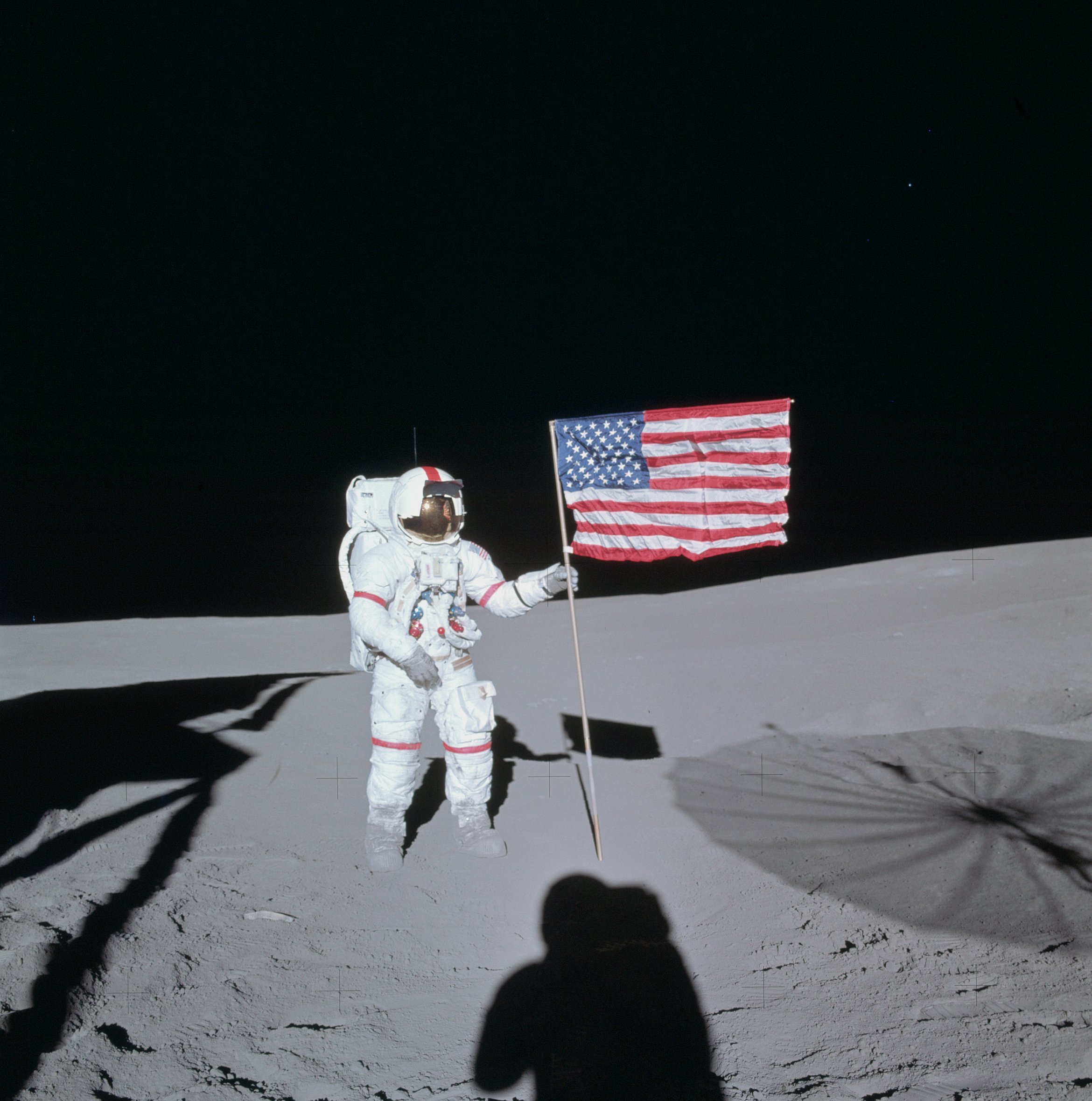
Photo from Apollo 14 Moon Mission
In a classroom discussion of “how do we know what we know” about history, another student brought up the allegations that the National Aeronautics and Space Administration (NASA) faked the manned Moon landings. That makes about a dozen times this year a kid has mentioned this claim (who thinks to start counting these things?). The kid was pretty unshakable in his convictions — after all, he said, how can a flag wave in a vacuum?
I usually mention a couple of things that the fake claimers leave out — that dozens, if not hundreds, of amateur astronomers tracked the astronauts on their way to the Moon, that many people intercepted the radio transmissions from the Moon, that one mission retrieved debris from an earlier unmanned landing, etc. Younger students who lack experience in serious critical thinking have difficulty with these concepts. They also lack the historic background — the last manned Moon landing occurred when their parents were kids, perhaps. They didn’t grow up with NASA launches on television, and the whole world holding its breath to see what wonders would be found in space.
Phil Plait runs a fine blog called Bad Astronomy. Five years ago he got fed up with the Fox Television program claiming the Moon landings were hoaxes, and he made a significant reply that should be in some hall of fame for debunking hoaxes. Since the claim that the Moon landings were hoaxes is, itself, a hoax, I have titled this “Debunking the Moon landing hoax hoax.”
In any case, if you’re wondering about whether the Moon landings were hoaxes, you need to see Phil Plait’s post. Phil writes:
From the very first moment to the very last, the program is loaded with bad thinking, ridiculous suppositions and utterly wrong science. I was able to get a copy of the show in advance, and although I was expecting it to be bad, I was still surprised and how awful it was. I took four pages of notes. I won’t subject you to all of that here; it would take hours to write. I’ll only go over some of the major points of the show, and explain briefly why they are wrong.
Also, consider these chunks of evidence, which Phil does not mention so far as I know:
First, the first Moon landing left a mirror on the surface, off of which Earth-bound astronomers may bounce laser transmissions in order to measure exactly the distance from the Earth to the Moon. Read the rest of this entry »
Spread the word; friends don't allow friends to repeat history.
20 Comments | Accuracy, Astronomy, History, Hoaxes, How do we know what we know, Moon, Reason, Science, Space exploration, Space Race, War on Science | Tagged: Apollo 11, Apollo Project, Astronomy, Bad Astronomy blog, Debunked Hoaxes, Flag on the Moon, History, Hoaxes, How do we know what we know, Jim Scotti, Moon, Moon Hoax, NASA, Phil Plait, Reason, Science, Space exploration, Space Race | Permalink
Posted by Ed Darrell
December 9, 2006
Remembering history so as not to repeat it has academic value, sure. In public policy, it can help change things for the better. And in some cases it can literally be life and death.
Six health care professionals — five nurses and a physician, all Bulgarians — are scheduled for execution shortly in Libya for a crime that would have been almost impossible for them to have committed. They were convicted of spreading HIV to patients. Health professionals are almost unanimous in pointing out that the timing of the onset of the disease indicates that the disease was transmitted before these people came to Libya, but government-operated facilities and government-paid health care workers.
More trouble for the ignorance-as-knowledge set: Evolutionary principles, applied, allow scientists to track the real origin of the infections, exonerating the convicted workers. In short, tracking the provenance of the viruses that infected the victims rules out almost all of the possibility that the accused health care workers could have played a role. Here is a link to a free .pdf paper which lays out the exculpatory science evidence, published by the eminent science journal Nature.
Will Libya’s government listen to the evidence? Nick Matzke, a research whiz at the National Center for Science Education, has a post at Panda’s Thumb laying out most of the facts, and providing links to high quality information sources. Health professionals worldwide urge Libya’s courts to legally exonerate and free the accused.
You can help. Mike Dunford at The Questionable Authority lays out actions you can take to urge Libya to free the health workers.
Please write today.
More information:
Spread the word; friends don't allow friends to repeat history.
Leave a Comment » | Accuracy, Current History, Justice, Law, Science | Permalink
Posted by Ed Darrell
November 28, 2006
Really.
A psychology grad student is doing a paper on the speed with which a meme will spread through Bloggerland. Scott Eric Kaufman is testing a hypothesis that posts and ideas are skyhooked by high-traffic sites (this is a low-traffic site, Millard Fillmore being dead all these years and all; I got the post from Pharyngula, who gets as many hits in a day as I would get in a year at this rate — the hypothesis might be right.
Your role? You need to link to the original post at Acephalous from your blog, and then ask others to do the same. Here is the link at Acephalous: http://acephalous.typepad.com/acephalous/2006/11/measuring_the_s.html.
Well, Acephalous is a much better writer than I, so here’s how he explains it:
- Write a post linking to this one in which you explain the experiment. (All blogs count, be they TypePad, Blogger, MySpace, Facebook, &c.)
- Ask your readers to do the same. Beg them. Relate sob stories about poor graduate students in desperate circumstances. Imply I’m one of them. (Do whatever you have to. If that fails, try whatever it takes.)
- Ping Techorati.
It’s all in the name of research. Honest.
Think of all the poor graduate students in desperate circumstances. Oh! The humanity!
Spread the word; friends don't allow friends to repeat history.
Leave a Comment » | Education blogs, Science, Technology | Permalink
Posted by Ed Darrell