
Social studies teacher Jeff Brazil gets his head shaved alongside Lars Schou on Thursday at Jackson Hole High School as part of St. Baldrick’s, a cancer awareness campaign and fundraiser - News&Guide Photo / Price Chambers/JACKSON HOLE DAILY
Social studies teacher Jeff Brazil gets his head shaved alongside Lars Schou on Thursday at Jackson Hole High School as part of St. Baldrick’s, a cancer awareness campaign and fundraiser - News&Guide Photo / Price Chambers/JACKSON HOLE DAILY
 Leave a Comment » |
  Humor, Social Studies, Teachers | Tagged: Charities, Education, Humor, Jackson Hole, Social Studies, St. Baldrick's Day, Teachers, Wyoming |
  Permalink
 Posted by Ed Darrell
It’s astounding in its error.
Cynthia Dunbar told Chris Matthews today that Thomas Aquinas played a more important role in the American Revolution than Thomas Jefferson.
Jefferson, Texas students learn in other places, wrote the great body of the Declaration of Independence, and the Virginia Statute for Religious Freedom, which is the direct forebear of religious freedom in U.S. Constitutional law.
If you hurry, you can see it tonight (at 6:00 p.m and 11:00 p.m Central, I’m told) on Chris Matthews’ “Hardball.”
Isn’t it astounding people who claim to be Christian will tell such bold lies to children? It’s as if they think Jesus said “make the children suffer” instead of what Jesus did say. Voodoo history at its most voodoo; history revisionism of the rankest sort. Where’s Mermelstein?
You can see it online here, at Hardball’s website.
Dunbar and her fellow travellers are effing idiots. Strong post to follow.
______________
SSOE? State Soviet of Education. Why do you ask?
2 Comments | Economics, History, Rampant stupidity, Social Studies, State school boards, Texas, Textbook Selection | Tagged: Declaration of Independence, Economics, History, Rampant stupidity, Religious Freedom, Social Studies, Thomas Jefferson, Voodoo history | Permalink
Posted by Ed Darrell
Tuesday, March 16 was the 259th anniversary of the birth of James Madison, the Father of the Constitution, the sponsor of the Bill of Rights, the life-long campaigner for good government based on knowledge of the errors of history, especially in the area of religious freedom.
Under social studies standards proposed by the Texas State Board of Education, Texas students will never study Madison’s views, or Madison’s Constitution, without intervention by their parents or good teachers who run some risk to teach the glories of American history to students.
Newspaper stories across the nation concentrated on Madison’s birthday expressed revulsion and rejection of the crabbed and cramped views of the Texas SBOE, and the cup of revulsion runneth over.
For example, the attempted evisceration and hobbling of science standards occurred last year, but the editorial cartoon in USA Today reached back to remind us just what is going on in Austin.

By Scott Stantis, Chicago Tribune, for USA TODAY, March 16, 2010
More comment to come.
Tip of the old scrub brush to Christina Castillo Comer.
2 Comments | Accuracy, America's founding, American Revolution, Economics, Education, Education quality, Evolution, History, Science, Social Studies, State school boards, Texas | Tagged: Economics, Education, education standards, Evolution, History, Science, Social Studies, Texas State Board of Education | Permalink
Posted by Ed Darrell
Texas Tribune quickly establishes itself as a Really Useful journal on Texas politics, especially with features like this summary of the proposed Texas social studies standards, with comments on changes and the history of the changes.
For example, explaining an insulting cut of Texas and African American heroes, Texas Tribune explains:
Tuskegee Airman Commander dumped: Board member McLeroy made the motion to pull Oveta Culp Hobby and Benjamin O. Davis from this standard. Hobby — a Houston newspaper publisher, the director the federal health department in the 1950s, and the wife of Texas Governor William P. Hobby — shows up elsewhere, in the 7th grade curriculum. Davis, however, does not. Davis was the first African-American general in the U.S. Air Force and the commander of the Tuskegee Airmen in the World War II. The board did insert a phrase on the “contributions of the Tuskegee Airman” in the next section.
Straightforward explanation. If it raises your ire, it’s not because the writing is inflammatory, but because the facts are so clearly presented.
Tip of the old scrub brush to the Texas Freedom Network and their e-mail alerts.
Leave a Comment » | Education, Education Administration, Education quality, Historic documents, History, History Revisionism, Social Studies, State school boards, TEKS, Texas | Tagged: Benjamin O. Davis, Education, education standards, History, Oveta Culp Hobby, Social Studies, state board of education, Texas, Texas Tribune | Permalink
Posted by Ed Darrell
A couple of months can make a big difference. Can.
A difference which way?
Two months ago the Texas State Board of Education suspended its revamping of social studies standards — the efforts to grind the standards into a right-wing crutch were so controversial that hearings, discussion and amending proposed standards took up more time than allotted. SBOE delayed final votes until March 10.
Today.
Last week Texas voted in primary elections. Several board members’ terms are up. Two incumbents lost primary challenges, Don McLeroy, the Boss Tweed of the right wing cultural war ring, and Geraldine Miller, a long-term veteran from Dallas, whose very conservative views cast her as a moderate among SBOE members. Both are Republicans.
How will those primary losses affect them and their work on the board?
In addition, other members of the culture war ring are retiring, including Cynthia Dunbar. Will the lame ducks be content to vote up the changes urged by history and economic professionals and professional educators, or will they do as McLeroy suggested they need to do earlier, and fight against the recommendations of experts?
How will the lame ducks walk and quack?
Stakes are high. New York Times Magazine featured the culture wars on the cover on Valentine’s Day (you should read the article). Texas Monthly weighed in against the culture wars, too — a surprise to many Texans.
Cynicism is difficult to swim against. I expect McLeroy to try as best he can to make social studies standards a monument to right wing bigotry and craziness. We’ve already seen SBOE vote to delete a wonderful children’s book from even being mentioned because the text author shares a name with a guy who wrote a book on socialism earlier.
Most of us watching from outside of Austin (somebody has to stay back and grade the papers and teach to the test . . .) expect embarrassments. On English and science standards before, the culture war ring tactics were to make a flurry of last-minute, unprinted and undiscussed, unannounced amendments apparently conspired to gut the standards of accuracy (which would not make the right wing political statements they want) and, too often, rigor. Moderates on the board have not had the support mechanisms to combat these tactics successfully — secret e-mail and telephone-available friends standing by to lend advice and language on amendments. In at least two votes opponents of the culture war voted with the ring, not knowing that innocent-sounding amendments came loaded.
In a test of the No True Scotsman argument, religious people will be praying for Texas kids and Texas education. Meanwhile, culture warriors at SBOE will work to frustrate those prayers.
Oy.
Thomas Jefferson toyed with the idea of amendment the U.S. Constitution to provide a formal role for the federal government in guaranteeing education, which he regarded as the cornerstone of freedom and a free, democratic-style republic. Instead, American primary and secondary education are governed by more than 15,000 locally-elected school boards with no guidance from the national government on what should be taught. Alone among the industrial and free nations of the world, the U.S. has no mechanism for rigorous national standards on what should be taught.
For well over a century a combined commitment to educating kids better than their parents helped keep standards high and achievement rising. Public education got the nation through two world wars, and created a workforce that could perform without peer on Earth in producing a vibrant and strong economy.
That shared commitment to quality education now appears lost. Instead we have culture warriors hammering teachers and administrators, insisting that inaccurate views of Jefferson and history be taught to children, perhaps to prevent them from ever understanding what the drive for education meant to freedom, but surely to end Jeffersonian-style influences in the future.
Texas’s SBOE may make the case today that states cannot be trusted with our children’s future, and that we need a national body to create academic rigor to preserve our freedom. Or they will do the right thing.
Voters last week expressed their views that SBOE can’t be trusted to do the right thing. We’re only waiting to see how hard McLeroy is willing to work to put his thumb in the eye of Big Tex.
More:


1 Comment | Cargo Cults, Economics, Education, Education quality, Education reform, Government, History, History Revisionism, Rampant stupidity, Social Studies, State school boards, Texas, Texas Freedom Network, Voodoo history, War on Education | Tagged: Culture Wars, Don McLeroy, Economics, Education, Education reform, Government, History, Rampant stupidity, Social Studies, Texas, Texas State Board of Education, War on Education | Permalink
Posted by Ed Darrell
From the National Science Foundation, we get more stuff that students in high school ought to learn, stuff which would give the conservatives on the Texas State Board of Education full-fledged conniptions, stuff that just doesn’t fit into Texas’s Teach-To-The-Test™ education standards.
Reading the press release brings home two points to me. First, for the sake of Texas social studies standards, this story tells the physical effects of “choke points.” The Bering Strait limited human migration to populate the America’s, meeting the definition of choke point favored by Texas Essential Knowledge and Skills (TEKS), and this story sheds light on that issue. But it also points out that choke points affect more than just humans. This was a key finding of the President’s Commission on Americans Outdoors that led to a recommendation that we create green corridors favorable for animal migration. In the Bering Strait, it’s migration of ice and cold and warm water that get choked off — and that, too, affects human history. Second, this may enlighten students to the butterfly effect noted in the science we call chaos, where a small physical perturbation in one area can have enormous consequences later, and far away, in the dynamic systems that keep our planet alive. (Yeah, the Bering Strait is bigger than a butterfly. I know.)
Press Release 10-003
Global Ice Age Climate Patterns Influenced by Bering Strait
Small geographic feature has large impacts on climate
Ice is shown choking the Bering Strait in recent times; the ice moves from the strait south to the Bering Sea. Credit: NASA
January 10, 2010
In a vivid example of how a small geographic feature may have far-reaching impacts on climate, new research shows that water levels in the Bering Strait helped drive global climate patterns during ice age episodes dating back more than 100,000 years.
The international study, led by scientists at the National Center for Atmospheric Research (NCAR) in Boulder, Colo., found that the repeated opening and closing of the narrow strait due to fluctuating sea levels affected currents that transported heat and salinity in the Atlantic and Pacific Oceans.
As a result, summer temperatures in parts of North America and Greenland oscillated between comparatively warm and cold phases, causing ice sheets to alternate between expansion and retreat and affecting sea levels worldwide.
While the findings do not directly bear on current global warming, according to Steve Nelson, National Science Foundation (NSF) program director for NCAR, they highlight the complexity of Earth’s climate system and the fact that seemingly insignificant changes can lead to dramatic tipping points for climate patterns, especially in and around the Arctic.
“The global climate is sensitive to impacts that may seem minor,” says NCAR scientist Aixue Hu, the project’s lead scientist. “Even small processes, if they are in the right location, can amplify changes in climate around the world.”
The research results are published this week in the journal Nature Geoscience.
Funded by NSF and the U.S. Department of Energy, the scientists used the latest generation of supercomputers to study past climate at a level of detail that would have been impossible just a few years ago.
Hu and his colleagues set out to solve a key mystery of the last glacial period: Why, starting about 116,000 years ago, did northern ice sheets repeatedly advance and retreat for about the next 70,000 years? The enormous ice sheets held so much water that sea levels rose and dropped by as much as about 100 feet (30 meters) during these intervals.
In other cases, scientists have associated such major oscillations in climate with fluctuations in Earth’s orbit around the Sun. But in the time period the research team looked at, the orbital pattern did not correspond with the geologic movement of the ice sheets and associated sea level changes.
The researchers considered an alternative possibility: that changes in the Bering Strait, the main gateway in the Northern Hemisphere between the Atlantic and Pacific Oceans, might have affected ocean currents across much of the globe.
Although small–the strait is currently about 50 miles (80 kilometers) wide between Russia and the westernmost islands of Alaska–it allows water to circulate from the relatively fresh north Pacific to the saltier north Atlantic via the Arctic Ocean. This flow is instrumental to regulating the strength of a current known as the meridional overturning circulation, a key driver of heat from the tropics to the poles.
Using the NCAR-based Community Climate System Model, a powerful computer tool for studying worldwide climate, the researchers compared the responses of ice age climate to conditions in the Bering Strait.
They ran the model on new supercomputers at NCAR and the Department of Energy’s Oak Ridge National Laboratory, enabling them to focus on smaller-scale geographic features that, until recently, could not be captured in long-term simulations of global climate.
The simulations accounted for the changes in sea level, revealing a recurring pattern–each time playing out over several thousand years–in which the reopening and closing of the strait had a far-reaching impact on ocean currents and ice sheets.
As the climate cooled because of changes in Earth’s orbit, northern ice sheets expanded. This caused sea levels to drop worldwide, forming a land bridge from Asia to North America and nearly closing the Bering Strait.
With the flow of comparatively fresh water from the Pacific to the Atlantic choked off, the Atlantic grew more saline. The saltier and heavier water led to an intensification of the Atlantic’s meridional overturning circulation, a current of rising and sinking water that, like a conveyor belt, pumps warmer water northward from the tropics.
This circulation warmed Greenland and parts of North America by about 3 degrees Fahrenheit (1.5 degrees Celsius)–enough to reverse the advance of ice sheets in those regions and reduce their height by almost 400 feet (112 meters) every thousand years. Although the Pacific cooled by an equivalent amount, it did not have vast ice sheets that could be affected by the change in climate.
Over thousands of years, the Greenland and North American ice sheets melted enough to raise sea levels and reopen the Bering Strait.
The new inflow of fresher water from the Pacific weakened the meridional overturning circulation, allowing North America and Greenland to cool over time. The ice sheets resumed their advance, sea levels dropped, the Bering Strait again mostly closed, and the entire cycle was repeated.
The combination of the ocean circulation and the size of the ice sheets–which exerted a cooling effect by reflecting sunlight back into space–affected climate throughout the world.
The computer simulations showed that North America and Eurasia warmed significantly during the times when the Bering Strait was open, with the tropical and subtropical Indian and Pacific Oceans, as well as Antarctica, warming slightly.
The pattern was finally broken about 34,000 years ago, the point in Earth’s 95,000-year orbital cycle at which the planet was so far from the Sun at certain times of year that the ice sheets continued to grow even when the Bering Strait closed.
When the orbital cycle brought Earth closer to the Sun in the northern winter, the ice sheets retreated sufficiently about 10,000 years ago to reopen the strait. This helped lead to a relatively stable climate, nurturing the rise of civilization.
“This kind of study is critical for teasing out the nuances of our climate system,” says NCAR scientist Gerald Meehl, a co-author of the paper. “If we can improve our understanding of the forces that affected climate in the past, we can better anticipate how our climate may change in the future.”
In addition to NCAR, the study team included researchers from the National Center for Scientific Research (CNRS) in France, University of Colorado in Boulder, Catholic University of Louvain in Belgium, Australian National University and Harvard University.
-NSF-
Download the high-resolution JPG version of the image [of ice flowing through the Bering Strait, above]. (1.4 MB)The Bering Strait separates the U.S. and Russia by only 90 kilometers. Credit: NASA
Download the high-resolution JPG version of the image. (570 KB)
Altered currents once produced ocean warming (right, dark red) that melted ice sheets. Credit: UCAR
Download the high-resolution JPG version of the image. (680 KB)
Media Contacts
Cheryl Dybas, NSF (703) 292-7734 cdybas@nsf.gov
David Hosansky, NCAR/UCAR (303) 497-8611 hosansky@ucar.edu
The National Science Foundation (NSF) is an independent federal agency that supports fundamental research and education across all fields of science and engineering. In fiscal year (FY) 2009, its budget is $9.5 billion, which includes $3.0 billion provided through the American Recovery and Reinvestment Act. NSF funds reach all 50 states through grants to over 1,900 universities and institutions. Each year, NSF receives about 44,400 competitive requests for funding, and makes over 11,500 new funding awards. NSF also awards over $400 million in professional and service contracts yearly.
Useful NSF Web Sites:
NSF Home Page: http://www.nsf.gov
NSF News: http://www.nsf.gov/news/
For the News Media: http://www.nsf.gov/news/newsroom.jsp
Science and Engineering Statistics: http://www.nsf.gov/statistics/
Awards Searches: http://www.nsf.gov/awardsearch/
Bookmark those sites, teachers.
More:
1 Comment | Climate change, Geography - Physical, Geography - Political, geology, Glaciers, Global warming, Green Politics, History, oceans, Science, Social Studies | Tagged: Bering Strait, Climate change, geography, Global warming, human migration, Ocean Currents, Science, Social Studies | Permalink
Posted by Ed Darrell
Steve Schafersman will live blog the hearings on social studies standards before the Texas State Board of Education (SBOE) today, at Evo-Sphere. Schafersman is president of Texas Citizens for Science, and a long-time activist for better education in Texas on all topics.
Rapid updates or live-blogging should be available at the blog of the Texas Freedom Network, TFN Insider.
It’s Item #6 on the SBOE agenda, with a title that tips off the trouble:
Item #6 — Public Hearing Regarding Proposed Revisions to 19 TAC Chapter 113, Texas Essential Knowledge and Skills for Social Studies, and Chapter 118, Texas Essential Knowledge and Skills for Economics with Emphasis on the Free Enterprise System and Its Benefits.
Schafersman e-mailed an introduction to the meeting:
Some say the Social Studies public testimony by the religious right, liberals, etc., then the SBOE debate, motions to amend, votes, etc. is a bigger circus than adopting the science standards. Judge for yourself. You can watch the entire circus, carnival, and sideshow on the webcast video at http://www.texasadm in.com/cgi- bin/tea.cgi
This is Texas democracy in action, when sullen and tight-lipped State Board members listen to public testifiers for 3 minutes each and profoundly ignore them since they already know what they are going to do. But I, at least, feel better after speaking so I don’t later feel responsible for the crappy amendments, changes, and policies that come out of this horrible Board because I did nothing. The proposed Social Studies standards written by the panels composed of teachers and professors are excellent (when have I heard this before), but the SBOE can’t wait to shamelessly impose their own Religious Right agenda on them.
You’ll recall that SBOE has at every possible turn disregarded the advice of famous and serious historians, respected free-market-advocating economists, geographers and educators on these standards. Economists, for example, want Texas kids to learn about “capitalism,” since that’s what it’s called by economists and policy makers, and colleges. SBOE thinks “capitalism” sounds too subversive, and wishes instead to require Texas kids to learn about “free enterprise” instead.
‘A rose by any other name’ you think, until you start thinking of how Texas kids do on standardized tests, college admission exams, and the punchline on the joke, about Texas kids being told not to study capitalism. No siree, no capitalism in the fictional home of J. R. Ewing, never mind the real-life capitalists like T. Boone Pickens or H. Ross Perot (Jr. and Sr.).
In Dallas, the city prepares to name a street after Cesar Chavez, the great Hispanic union organizer and advocate for working Americans. In Austin, SBOE works to strike all mentions of Chavez, because they dislike the politics of heroes of our ethnic minorities (soon to be a majority in Texas). In Washington historians and policy-makers follow the legacy of Thurgood Marshall, the great civil rights attorney and first African-American to sit on the U.S. Supreme Court. In Austin, SBOE thinks Marshall should be left out of history books. Many of us suspect he’s anathema to the white right-wing in Austin: A smart, successful and noble man of color.
Mel and Norma Gabler died years ago, but their history lingers in the halls of education policy in Austin. It’s Shakespearean.
This is a massive battle. David Barton worked for 30 years to gut history standards nationally to teach a history of America that never was, and as the official religionist appointee of the right-wing SBOE members, he stands on the brink of accomplishing much of the revisionism he’s advocated. See the Texas Tribune story on the issue, “Hijacking History.”
Generally we shouldn’t negotiate with terrorists, Ronald Reagan said. At the SBOE, we’ve put the terrorists in charge of history and economic curricula — if not the terrorist themselves, at least the terrorists’ camels’ noses. Texas’s process has earned flashing red-light, claxon-sounding repeating of the words of Ronald Reagan’s Commission on Excellence in Education: If a foreign nation did this to us, we’d consider it an act of war [excerpt below the fold].
Make no mistake about it. SBOE’s goal is to roll back any of the reforms left from Reagan’s Commission’s work. Our nation is more at risk from foreign competition than ever before. SBOE plans to give away a bit more of our future to China, this week.
Our saving grace is the general incompetence of SBOE members to make significant reform in Texas’s wounded schools, reeling from unworkable and damaging requirements under the No Child Left Behind Act and a testing program that severely limits what can be taught in any social studies course other than those bastions of learning left in International Baccalaureate programs and Advanced Placement courses (estimates are that between 5% and 10% of Texas high school students can take one of those good courses). Whatever silliness, craziness or lies SBOE orders to be taught, it can’t be taught and tested well. Inertia preventing change works to save America in this case.
In business, most CEOs at least appreciate the value of having good front-line employees who are the ones who really deliver the service or product and produce the profit of the enterprise (even if they don’t treat those employees so well as the employees deserve). Education may be the last bastion of flogging the horse that should be pulling the cart instead. In this case, having well-trained teachers in the classroom is the last hope for Texas, Texas parents and Texas students — and Texas’s economic future and future in liberty. Teachers are the last defense of freedom in Texas. Today SBOE will make another assault on the ramparts that protect the teachers in their work.
When will the French fleet arrive to lend aid? Will it arrive at all? And if it arrives, will Texas kids know better than to shoot at the ships?
Carol Haynes, who claims to have a doctorate in some discipline, told the board how to rewrite the standards to completely change the history of the civil rights movement in their last hearing on the topic. According to Haynes, apparently, Dr. Martin Luther King, Jr., was opposed to civil rights and Barry Goldwater was in favor — the Board didn’t offer to correct her revisionism, but instead asked her to go beyond her three minutes in fawning acceptance. This appears to be SBOE’s approval of various Other Universe hypotheses offered by Star Trek, allowing any damned thing at all to be taught as history (except the right stuff). Haynes is scheduled to testify again (#128), probably very late at night, but perhaps in time for the 10:00 p.m. Texas television news broadcasts. Oy.
Excerpt from the Report of the Commission on Excellence in Education, A Nation at Risk, below the fold.
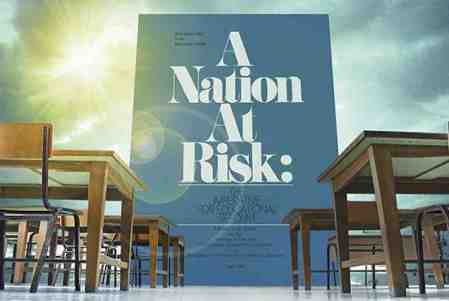
Cover of A Nation at Risk: The Imperative for Educational Reform, the 1983 report that started the education reform mess. AFT graphic.
Stand up for your nation, it’s children and future; sound the alarm:
2 Comments | Economics, Education, Education quality, Free market economics, Freedom - Economic, Freedom - Political, Geography - Economic, Geography - Physical, Geography - Political, History, Politics, Social Studies, State school boards, Testing, Texas, Texas Citizens for Science, Texas Freedom Network, Textbooks | Tagged: A Nation At Risk, Economics, Education, geography, History, Politics, Social Studies, Texas, Texas Citizens for Science, Texas Freedom Network, Texas State Board of Education | Permalink
Posted by Ed Darrell
In a post titled “The Battle Joined,” the Texas Freedom Network repeated for us the press release from their Tuesday press conference at the Texas Education Agency, about the hearings on social studies standards, graduation requirements and other issues in Austin this week.
Watch that space (see also this explanatory piece) and this space, and your non-faux news outlets.
The Texas Freedom Network sent out the following press release after our press conference this morning at the Texas Education Agency:
The state’s leading religious liberties group today joined with clergy and scholars in calling on the State Board of Education to approve new curriculum standards that don’t undermine religious freedom in Texas social studies classrooms.
“Curriculum writers have drafted proposed standards that rightly acknowledge the influence of faith on the Founders and in our nation’s history,” Texas Freedom Network President Kathy Miller said today. “But those writers also respected religious freedom by rejecting political pressure to portray the United States as favoring one faith over all others. Doing otherwise would aid the teaching of bad history and promote something that is fundamentally un-American.”
Miller spoke in advance of a Wednesday public hearing on proposed new social studies curriculum standards. Teachers, academics and community members from around the state have spent the last year crafting the new standards. Publishers will use the standards to write new textbooks scheduled for adoption by Texas in 2011. The state board will debate the standards drafts on Thursday and has scheduled a final vote in March.
Derek Davis, dean of humanities and the graduate school and director of the Center for Religious Liberty at Mary Hardin-Baylor University, a Baptist institution in Belton, called on the board to respect the work of teachers and other experts who helped write the new standards.
“Religious liberty stands as one of our nation’s bedrock principles,” Davis said. “Yet it seems always under siege by those who fail to appreciate the astute thinking of the founding fathers that caused them to write into the Constitution the principle that guarantees religious liberty: the separation of church and state. This distinctly American value continues to set our nation apart from those embroiled in religious conflict in the rest of the world.”
Miller and Davis were joined at a press conference by the Rev. Marcus McFaul of Highland Park Baptist Church in Austin and Steven Green, a professor of law and of history and director of the Willamette Center for Religion at Willamette University in Salem, Oregon.
“The instruction of religious faith, discipleship, and a life of service and piety is the responsibility of each faith community, whether church, synagogue or mosque,” Rev. McFaul said. “It is the responsibility of parents and parishes, not public schools. We all note – as the curriculum writers did – the role and influence of religion in American history, but not to advance, promote or seek advantage for any particular religion’s point of view.”
The state board has revised curriculum standards for language arts and science over the past two years. In both cases the board either threw out or heavily revised standards crafted by curriculum writing teams that included teachers, curriculum specialists and academic experts. Last year, for example, creationists on the state board pushed through science standards that call into question long-established scientific evidence for evolution.
“This is not a good way to make sound education policy,” Miller said of the board’s habit of rejecting the work of teachers and experts. “It’s past time that state board members stop playing politics with the education of Texas children, respect the hard work teachers and other experts have put into writing standards, and acknowledge that experts – not politicians – know best what our children need to learn.”
Educate somebody else on this issue:
3 Comments | Education, Education blogs, Education quality, Education reform, Social Studies, State school boards, Texas, Texas Education Agency (TEA), Texas Freedom Network, Voodoo history, War on Education | Tagged: Education, SBOE, Social Studies, Texas, Texas Freedom Network, War on Education | Permalink
Posted by Ed Darrell
Here is a news rundown of stories on the Texas State Board of Education, who have been planning for a year now to mess up social studies standards for Texas public schools, this week.
Get on your horse and warn Texans: The Idiots are coming to get your good schoolbooks:
5 Comments | Capitalism, Economics, Free market economics, Geography - Economic, Geography - Physical, Geography - Political, History, History Revisionism, Social Studies, State school boards, Texas, Texas Citizens for Science, Texas Education Agency (TEA), Texas Freedom Network, Texas history, Textbook Selection, Textbooks | Tagged: Economics, Education, First Amendment, geography, History, Politics, Religion, Separation of church and state, Social Studies Standards, state board of education, Texas | Permalink
Posted by Ed Darrell
How bad is it? Washington Monthly features a solid, long story on what is going on in Austin this week and next in Texas social studies standards. I wish that outstanding publication had a much greater circulation.
Even in Minnesota, P. Z. Myers is concerned: “Be afraid” he warns his readers. In comments there, a guy named BlackWolf puts it bluntly:
Once, a guy in a schoolbook storage room was the killer.
Now, the books themselves are becoming dangerous.
You can help. You can testify next week. You can send comments. The Texas Freedom Network can help you be heard.
Please let the State Board of Education know that Texas, and the nation, needs good social studies standards. As we noted last month, it’s time to stand up for education and social studies:
Make Your Voice Heard at January Public Hearing
The process of revising social studies curriculum standards for Texas public schools is moving into a critical stage. And a public hearing the board has scheduled for January may be the only opportunity for you to speak out against the far right’s efforts to corrupt standards for history, government and other social studies classes.
The final drafts of the proposed standards prepared by writing teams made up of teachers, academics and other community members are reflective of mainstream academic scholarship in the various subject areas. It is clear that members of these writing teams largely resisted intense political pressure from far right, rejecting attempts to remove key civil rights figures and make other politically motivated revisions. (See the Background section at the bottom of this e-mail for a more detailed account of the politicization of this curriculum process.)
But as with science and language arts, far-right SBOE members are already plotting to undo the work of the writing teams of social studies.
Take Action
The State Board of Education so far has scheduled only one public hearing on the proposed standards. That hearing is likely to occur either on January 13 or January 14 in Austin.
If you are interested in speaking at the hearing, please click here. TFN will help you register to speak before the board and be an effective voice against efforts to politicize our children’s classrooms.
This may be the only opportunity the board provides for Texans to speak out on the proposed standards. If we are to prevent far-right SBOE members from turning social studies classrooms into tools for promoting political agendas, then it’s critical that the board hears from people like you! Click here to sign up for more information on how to testify in January.
___________________________________________________
Background on Social Studies Review Process to Date
Earlier this year, TFN exposed and derailed several attempts by the far right to hijack the social studies curriculum revision process. Members of the state board – or their appointees to review panels and writing teams – tried at various times to:
- Remove civil rights champions like César Chávez and Thurgood Marshall from the standards, calling them poor examples of citizenship
- Turn Joseph McCarthy – who discredited himself and dishonored Congress with his infamous Red-baiting smear campaign in the 1950s – into an American hero
- Rewrite history and portray America’s Founders as intending to establish a Christian nation with laws based on a fundamentalist reading of the Bible
Members of the writing teams largely rejected these fringe ideas in the final drafts of the standards they submitted to the board. Chávez and Marshall remain in the curriculum. The American history standards do not whitewash the damaging history of McCarthyism. And under the proposed standards students would still learn that the Founders created a nation in which all people are free to worship – or not – as they choose without coercion or interference by government.
We must ensure that the board adopts curriculum standards that reflect mainstream academic scholarship in social studies. This is vitally important because the results of this decision will be reflected in the next generation of social studies textbooks around the country.
Click here to let TFN know you are willing to testify at the state board.
2 Comments | Education, Education quality, History, Social Studies, State school boards, Texas, Texas Freedom Network | Tagged: Education, Social Studies, Standards, Texas, Texas Freedom Network, Texas State Board of Education, Textbooks | Permalink
Posted by Ed Darrell
Jon Taplin explains why knowing world history is valuable. The sad thing is that, of course, the story that makes his reason doesn’t appear in the Texas Essential Knowledge and Skills list for world history, nor in any other social studies course.
Now that the Texas State Board of Education has taken off the cloak of education and made it clear that social studies in Texas is considered a political free-fire zone, and that they plan to vitiate anything but the propaganda value for the Republican Party, Taplin’s piece has all the more poignance.
The Renaissance, and Florence, were more than just a minor question on the TAKS test. Santayana’s Ghost weeps bitterly.
Why isn’t Jon Taplin’s blog required reading in more places, by more people in government and politics? We know why the Texas State School Board doesn’t want anyone to read it — that alone should make people fight to see what Taplin says.
Promote this idea in your own study group:
1 Comment | Education, Education quality, History, Renaissance, Santayana's ghost, Social Studies, State school boards, Taxes, Texas, Texas Freedom Network, War, War on Education, World history | Tagged: Afghanistan, Florence, Santayana's ghost, Social Studies, State School Board, Texas, War, War on Education, World history | Permalink
Posted by Ed Darrell
So, you’re a student doing a paper on climate change, and you need help limiting the topic, or finding information about related topics.
Hot Topic has just the thing: Interactive “debate maps.”
Hot Topic is a website dedicated to the issue climate change in New Zealand — after the book by the same name.
Does anyone know where similar maps might exist for other social studies topics?
2 Comments | Climate change, climate_change, Cost of Green, Global warming, Green Politics, Science, Social Studies, Student projects, Teaching | Tagged: Climate change, Global Warming Science, Social Studies, Student projects, Student Resources, Teaching | Permalink
Posted by Ed Darrell
I’m posting on the run from an AP Summer Institute at Texas Christian University, so just the facts.
Today’s Fort Worth Start Telegram featured a story on the social studies curriculum battles in the Texas State Board of Education. It’s one of those stories that does well in presenting the facts, but for the sake of “objectivity” treats the yahoos of the review committee — David Barton and Peter Marshall in particular — as respected academics.
Should Texas be worried?
See immediately previous post with the address to listen to live webcasts of the Board’s meetings this week.
Leave a Comment » | Economics, Geography - Economic, Geography - Physical, Geography - Political, History, Politics, Social Studies, Texas, Texas history, War on Education | Tagged: Politics, Religion, Social Studies, Texas, Texas Sate Board of Education, War on Education | Permalink
Posted by Ed Darrell
Starting at 1:00 p.m. Central today, the Texas State Board of Education will be in session. You can listen to a live webcast of the meeting here.
According to the note I got from Steve Schafersman at Texas Citizens for Science, this is the agenda today:
Important agenda items include 3. Ethics Training, 4. Legislative Update, 6. Discussion of Expert Reviewers, and 7. Discussion of Texas High School Graduation Requirements.
More meetings tomorrow and Friday — they should all be webcasts.
Leave a Comment » | Education, Social Studies, State school boards, Texas, Texas Citizens for Science | Tagged: Education, Social Studies, state board of education, Texas, War on Education | Permalink
Posted by Ed Darrell
Dallas Morning News columnist Jackie Floyd gets at the real issues week after week, stripping away the spin and silliness other reporters cover in the misaimed hope for objectivity.
And today her column looks at the social studies recommendations from a special review panel, released last week: “Curriculum debate marred by ideologues.”
A lot of what the expert advisers have to say about the standards for teaching social studies to Texas kids is genuinely depressing stuff.
It’s depressing because, as you wade through the half-dozen point-by-point reports that will be used to advise the people deciding what your kids will learn, you might wonder whether the people who oversee our public schools care a lot less about education than they do about ideology.
You might even get the sense they care an awful lot less about helping the next generation of Texans lead meaningful, productive lives than about telling them how to vote.
It’s not a big surprise, since some members of the State Board of Education sometimes behave as if schooling children is simply a matter of making them memorize an encyclopedic list of political talking points.
She names names, though I doubt she had a chance to actually kick the butts that need kicking.
And it’s the board that appointed a panel of experts that includes a family-values activist from Aledo and a minister in Massachusetts who specializes in “Christian heritage.” It’s that awful, embarrassing fight over evolution all over again.
As a result, what is presumably supposed to be a sensible discussion about what children need to learn has been reduced to a self-serving bickering match over who gets to be commandant of the indoctrination camp.
“To have Cesar Chavez listed next to Ben Franklin is ludicrous,” snarls one of the panelists; another says kids must be drilled more about Roe vs. Wade, which he says has “arguably more impacted American life than any other Supreme Court decision in the 20th century.”
Another expert makes careful tallies over whether curriculum recommendations cite Latinos with the same frequency as black and white historical figures – as if classroom studies can be reduced to a racial quid pro quo of the number of times specific historical figures are mentioned.
It’s not all ideological flag-waving, of course – but a lot of it is. There’s a silly freedom-fries debate over whether to substitute the term “free enterprise system” for “capitalism,” of whether suggested teaching examples should exclude Carl Sagan or Neil Armstrong or the guy who invented canned milk; of whether there are too many women and minorities and not enough founding fathers; of whether religion and the rule of law should be taught with more or less vigor than civil liberties and colonial adventurism.
Best, she notices that there were a couple of real experts on the panel whose reports have gotten short shrift in the news, and whose reports will be give short shrift by the politically-driven education board.
Miraculously – or at least astonishingly – in one of the reports, I found that awareness candidly articulated.
Somehow, Dr. Lybeth Hodges, a Texas Woman’s University history professor and a last-minute panel appointee, did not see a need to draft a political manifesto. She just made (get this!) sensible, useful curriculum recommendations.
She pointed out items that might actually help kids learn more and be better prepared for tests, such as that specific grade-level curriculum doesn’t always match the dreaded TAKS tests.
She noted that there are more than 90 “student expectations” for fifth-graders, an unrealistic pipe dream given that “some sound like test questions I give my college freshmen.”
Hodges, unlike some other appointees, took the blessedly pragmatic view that constantly trying to balance dueling ideologies will only result in a bloated, unmanageable list of standards that few kids will find meaningful and retain.
“It should not be a political exercise,” she said briskly, when we spoke a few days ago.
“I never thought about the political aspect at all,” she said. “I thought we were being asked to do what is reasonable and helpful for teachers. … They have enough red tape as it is.”
As we talked, my head was gradually swaddled in a pleasurable sense of optimism: Here was one person, at least, more interested in getting something useful done than in endlessly re-enacting the same old tired-out culture battle.
Call me a starry-eyed dreamer, but American education isn’t supposed to be a tedious exercise in demagoguery.
“To me, teachers aren’t there to carry out indoctrination in our schools,” Hodges said. “These people are trying to open little minds.”
If we’re going to open them successfully, we need more big minds at the top.
Also, check out the comments on the newspaper’s education blog, on the report of Gail Lowe being appointed chair of the SBOE. It’s instructive.
2 Comments | Bogus history, Education, Education quality, Education reform, Politics, Social Studies, State school boards, TEKS, Texas, Voodoo history | Permalink
Posted by Ed Darrell
You are currently browsing the archives for the Social Studies category.


Ed Darrell on Texas's Colorado River


Come on in, the water's fine. Come often: Cleanliness is next to godliness.


 Millard Fillmore's Bathtub