Making history class interesting: A lesson plan

September 12, 2007

Getting kids to dive into history can be a chore — but a chore well worth the effort.

Here’s what it might look like, if the kids dive in:

ON the kind of humid summer day that sends visitors to Washington running for cool cover, not even free air-conditioning could lure more than a trickle of tourists into the art museums lining the National Mall.

But 35 miles south at the National Museum of the Marine Corps near Quantico, Va., visitors in a virtual boot camp tested their mettle against drill instructors and their marksmanship on an M-16 laser-rifle range.

Up the Potomac at Mount Vernon, crowds spilled onto a four-acre replica of George Washington’s working farm, while inside the Revolutionary War Theater the rumble of cannons and the cold prick of snow falling overhead lent verisimilitude to the re-enactment of his troops crossing the Delaware River.

And at the International Spy Museum in downtown Washington, visitors with $16 advance tickets snaked out the door as they waited their turn to practice fantasy espionage, complete with assumed identities, pen cameras, shoe phones and the kind of super-spy cars Q might have dreamed up for 007.

Admit it. Learning about history has rarely been so much fun.

You’re not close to Quantico, nor to Washington, D.C.?  How about you get your kids to invent a museum.

The New York Times collaborates with Columbia University’s Bank Street College of Education to produce lesson plans based on stories from the Times, every week day.

You may subscribe to get a lesson plan to your e-mail box every dayOr you can track them down at the Times’ website.

Below the fold, without editing, I list the lesson plan sent out September 10, as an example.  Sounds like a good day in class, to me.

Read the rest of this entry »


Baltimore Scout collects, makes history

September 7, 2007

How about having your students work with the Library of Congress on a history project?

The Veterans History Project encourages people to contribute oral histories of veterans, a project that I think has some wonderful possibilities. Below the fold, read about Tim Mantegna, a Baltimore teen who collected histories as part of his Eagle project. This fall he enters the University of Maryland – Baltimore County to study political science, as an Eagle Scout.  (Also see this story:  “Iraq Veterans Record Their Stories”)

Read the rest of this entry »


North American wildlife photos: Send yours in!

August 21, 2007

Elron Steele submitted one of his — I’ll wager several readers here have photos that should be included in the encyclopedic site of photos of North American Wildlife. The project is collecting mammal photos right now (birds, reptiles and invertebrates yet to come?)

Richardson's Ground Squirrel, photo by Elron Steele, all rights reserved

I note the project has only one not-very-clear photo of a tassel-eared squirrel, and I know there are at least two species of these things ranging through Arizona, New Mexico and Colorado, and I know there are no fewer than four Boy Scout Camps in those areas — so does some Scout or Scouter have a good shot of one of the tassel-eared guys to include?

So, if you have a good photo, send it along to North American Wildlife, or drop it in an e-mail to the curator of the site.

In my recent excursion into New Mexico, we were south of Raton when I spotted a fine specimen of a pronghorn antelope alongside the road. Within a few minutes we had spotted way over a dozen, and returning along the route a week later we must have seen at least 50 of them, in groups as large as a dozen. While I got no decent photos zipping along at 60 mph, surely someone from one of the mountain states has a very good picture that could be contributed.

And teachers: This is a great source of images for student projects and presentations for biology, environmental science, history and geography.


Cool tool: Tag clouds of presidents’ thoughts

August 5, 2007

Only Crook pointed this out in a comment — and it’s neat enough to raise to a headline:

 . . . have you seen the U.S. Presidential Speeches Tag Cloud http://chir.ag/phernalia/preztags/ I happened upon a speech by Millard Fillmore, so naturally I thought of this blog. I can’t link you directly to the speech I looked at, which was his 1850 State of the Union Address, (you have to use the slider to get there) but these were the most common words in that speech according to the tag cloud:

appropriations california constitution negotiation pacific ports revenue territory treasury treaty war

Go try it out.   It’s a very interesting tool for the visual portrayal of information — visual portrayals that I don’t know how to copy for display here.

For example, notice the arrival of the word “California” in presidential speeches, circa 1848.  Note how the word grows over the next few years, but then disappears just prior to the Civil War — what might that suggest to students about events in California, compared to events in the rest of the U.S.?  Or, track the word “Constitution” from the earliest speeches/writings listed to the latest.  Or track the use of the word “Iraq” in President Bush’s speeches, between 2000 and 2007.

The tool is ahead of its time, a fun device now.  The key question is, how should we be using such information?

Chirag Mehta created the program. Browsing his site will give teachers good ideas about what can be done by a decent programmer.  Does any school have a programmer to make such things for the classroom?  And we’re supposed to be using technology?  (Mehta’s stuff may be as good as it looks — see this article about the tag cloud device, in the Wall Street Journal, no less.)


Encore post: Recognizing bogus history, 2

July 3, 2007

Editor’s Note:  I’m traveling this week, celebrating our independence 231 years on.  While mostly out of pocket, I’ll feature some encore posts, material that deserves another look to keep it from fading from memory.  This post, below, is the second of a two-part series from August 2006.

Recognizing bogus history, 2

Bogus history infects political discussions more than others, though there are some areas where bogus history strays into the realm of science (false claims that Darwin and Pasteur recanted, for example).

1. The author pitches the claim directly to the media or to organizations of non-historians, for pay.

Historians are detectives, and they like to share what they find. One historian working in the papers of one figure from history will find a letter from another figure, and pass that information on to the historian working on the second figure. Historians teach history, write it up for scholarly work, and often spin it in more fascinating tales for popular work. Most years there are several good works competing for the Pulitzer Prize in history. Academic historians, those tied to universities and other teaching institutions, join societies, attend meetings, and write their material in journals — all pitched to sharing what they have learned.

Bogus historians tend to show up at conferences of non-historians. Douglas Stringfellow’s tales of World War II derring do were pitched to civic clubs, places where other historians or anyone else likely to know better, generally would not appear (Stringfellow’s stories of action behind enemy lines in World War II won him several speaking awards, and based on his war record, he was nominated to a seat in Congress for Utah, in 1952, which he won; a soldier who knew Stringfellow during the war happened through Salt Lake City during the 1954 re-election campaign, and revealed that Stringfellow’s exploits were contrived; he was forced to resign the nomination). Case in point: David Barton speaks more often to gun collectors than to history groups.

2. The author says that a powerful establishment is trying to suppress his or her work.

Sen. Joseph McCarthy insisted that anyone who opposed his claims that communists dominated certain government agencies, or that any given person was a communist, was because those who challenged him were, themselves, part of the greater conspiracy, trying to silence him. Utah Sen. Arthur V. Watkins, who chaired the committee that recommended censure for Sen. McCarthy, lost his own re-election campaign in 1958 in part to the belief by Utah voters that such a conspiracy existed and had succeeded in suppressing McCarthy.

But there was no organized campaign against McCarthy.  Individual Americans, spurred by patriotism, the Boy Scout Law, or just a sense that truth is valuable, spoke up against him, time and again in many different forums.  Sen. Watkins powerfully opposed communism.  Later historians found any truth in McCarthy’s claims against the State Department and other government agencies, and his critics, got there accidentally, below the usual levels of coincidence.

3. The sources that verify the new interpretation of history are obscure; if they involve a famous person, the sources are not those usually relied on by historians.

Most internet hoaxes simply don’t list sources. Bogus quotes circulating that have been attributed to Madison, Jefferson, Washington, Lincoln, and others, often list a year, and nothing else. When I staffed the Senate, several times a year I’d get letters to work on with claims that the Supreme Court had ruled in 1892 that the U.S. is, officially, a “Christian nation.” Usually there there was no case name attached, but I came to understand that the case referred to was the Church of the Holy Trinity vs. U.S. 1892 was far enough back that it was a difficult case for people outside of a decent law library to get — and then, it is couched in 1892 legalese, which makes it difficult to understand. It is an obscure enough case that most of the time it won’t be checked out. If the case can be produced, rarely will it be among lawyers who can interpret what happened from the fog of the language of the decision. The case is not listed at the Cornell University Law School’s on-line Legal Information Institute, nor at Findlaw.com — the databases they rely on go back to 1893. There is a full text copy at the Justicia website. [This was written in 2007.]

The case involved a law that prohibited the importing of laborers, and the Court ruled that the law probably was not intended to apply to a white, white collar worker, a preacher from England (the law was probably aimed at Chinese workers, coming as it did in that time when immigration from China was prohibited). It appears from the case that the church had argued some First Amendment justification to be exempt, and the U.S. Solicitor General had argued in response that the First Amendment requires the courts to assume that the government is hostile to religion; Justice David Brewer wrote at length about how the nation had accommodated religion over the years, especially Christianity, in dismissing the Solicitor General’s argument (he did not accept the church’s argument, either). This sort of writing is called obiter dicta in legal studies — words of an opinion wholly unnecessary to the decision. The case is cited rarely, and never for its religious “ruling,” because that was not what was ruled, and the language was not applied as law then, nor has it been since.  The Supreme Court ruled that importing preachers from England was not covered by the law. The ruling makes no mention of religion.

A bit of reflection on what really happened in history should make this clear: Consider the effect of such a ruling by the Supreme Court on later cases involving textbooks, busing of parochial students, student prayer, Bible readings, etc. Had such a precedent existed, lawyers would have sniffed it out regardless its obscurity.

4. Evidence for the history is anecdotal.

America’s founders carefully wrote laws that assure religious freedom, largely by creating a separation of state and church. To those unhappy with such a separation, every utterance of a founder in which God is praised, or invoked in any way, becomes “proof” that the founders did not mean what they wrote in the laws. Anecdote trumps any other evidence, to these people.
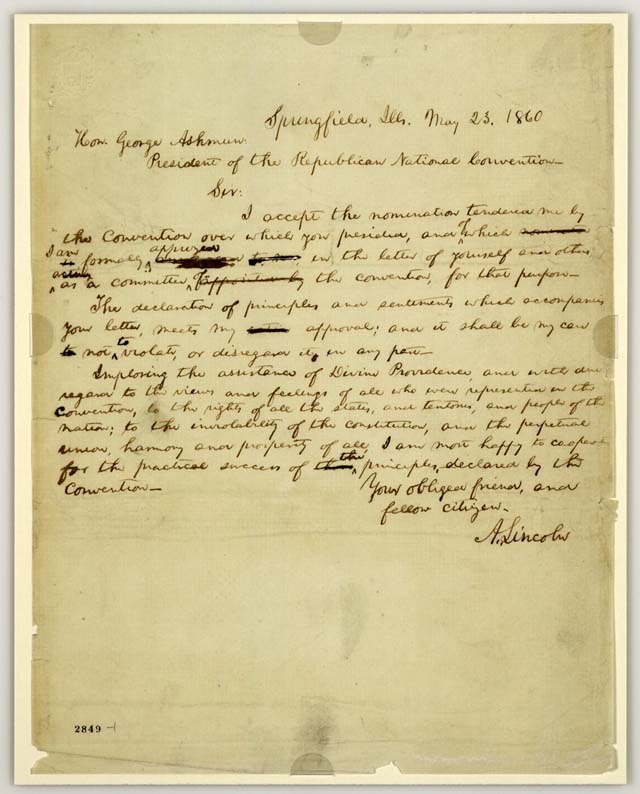
Abraham Lincoln's letter to the president of the Republican National Convention of 1860, accepting the convention's nomination for the presidency.

Abraham Lincoln’s letter to the president of the Republican National Convention of 1860, accepting the convention’s nomination for the presidency. It was written, you will note, from Springfield, Illinois, 200 miles away from Chicago where the convention was held.

To prove to me the piety of Abraham Lincoln, a fellow showed me photograph of a plaque on a church in Chicago, said to be the church where Abraham Lincoln said his prayers every morning during the Republican Convention of 1860, at which Lincoln got the nomination for president. Other records — newspapers, Lincoln’s letters and other documents, show that, as was the fashion in 1860, Lincoln did not attend the convention in Chicago, but as a candidate for president, stayed at home in Springfield, nearly 200 miles away.

Most real history can be read in documents, and does not need to rely on folk retellings exclusively.

5. The author says a belief is credible because it has endured for some time, or because many people believe it to be true.

Faced with the evidence that a dozen quotes he had attributed to figures such as James Madison, George Washington and Patrick Henry were whole cloth inventions, Texas quote-purveyor David Barton issued a statement urging people not to rely on them because they were “questionable.

A great example of belief triumphing over fact presents itself as the Cardiff Giant, now on display at the Farmers’ Museum in Cooperstown, New York (go visit when you visit the Baseball Hall of Fame). After an argument with a cleric over whether the Bible’s claim that giants once existed, a tobacconist named George Hull hired stonecarvers to carve a giant; then he hired a farmer to bury the carving on his farm, and claim to have struck it when planting. Once discovered the “petrified man” was put on display, for a fee. Hull got lucky: Syracuse businessmen offered to buy it from him for an enormous sum.

Paleontologist Othniel Marsh inspected it on display, and pronounced it a hoax. For some odd reason, that increased the popularity of the attraction. Carnival and side show entrepreneur P. T. Barnum offered $60,000 for the carving, but was refused. Barnum then had a plaster replica made and put on display. The owners of the original hoaxed carving sued, but the suit was thrown out because they could not demonstrate the “genuineness” of their own hoax.  Barnum made more money than the original.  A hoaxed hoax is even more popular than the truth.

A photo (staged?) of the 1869 unearthing of the Cardiff Giant (Cardiff, New York). Photograph courtesy Farmers Museum via Associated Press, and via National Geographic.

A photo (staged?) of the 1869 unearthing of the Cardiff Giant (Cardiff, New York). Photograph courtesy Farmers Museum (where the carving now rests, on display to museum visitors)  via Associated Press, and via National Geographic.

6. The author has worked in isolation.

Historians often help each other. Good historians put out queries to many sources, the better to assure accuracy. So, conversely, if there are only a few people who know anything about an account, that fact alone may cause suspicion. Clifford Irving’s hoax biography of Howard Hughes, while remarkably accurate in some regards, was unraveled when enough people familiar with Hughes called the bluff — including, of course, Hughes himself. The book got as far as it did with extreme secrecy on Irving’s part. Working alone makes error easier, and is essential for intentional frauds.

7. The author must propose a new interpretation of history to explain an observation.

Various conspiracy claims require that key people act counter to their known character. If Franklin Roosevelt had “allowed” Pearl Harbor to occur in order to get the U.S. into war, his actions over the previous six years to support Britain start to make little sense. Had Lyndon Johnson been part of a conspiracy to assassinate John Kennedy, his later carrying out the legislative plan of Kennedy runs contrary to all such motivations. If the founders of the U.S. actually intended to make Christianity the state religion, their efforts to disestablish the churches in all 13 colonies, efforts to write bills of rights for each state including freedom of religion, and efforts to create the First Amendment in the Bill of Rights seem like incredible, repeated errors.

Bogus history is much like the conjectured problems that result from time travel: Change one jot of history, and there is a cascading effect on later events. In many cases,were the bogus histories accurate, what follows could not be so, and we wouldn’t be here to discuss it.

Those are the seven warning signs of bogus history. Bogus, or voodoo history should be suspected if two or more of the signs are present — though it is quite possible for actual history to show more than two signs (perhaps actual history could show all seven signs — but I’d have to see an example before stating it’s so).

More:


Maps of lost worlds: Caddoland

June 29, 2007

Caddoland collage, UT-Austin, Texas Beyond History (Click on thumbnail for a larger view of this Caddoland Collage)

Caddos, Anadarkoes, Tawaconies, Southern Delawares — so many Native American tribes disappear from U.S. history books, and from U.S. history. These histories should be better preserved and better taught.

Texas history texts mention the Caddo Tribe, but largely ignore what must have been a significant cultural empire, if not an empire that left large stone monuments. Teaching this material in Texas history classes frustrates me, and probably others. Student projects on the Caddos are frequently limited in what they cover, generally come up with the same three or four factoids and illustrations.

The Caddo Tribe lived in an area spanning five modern states, Louisiana, Texas, Arkansas, Oklahoma, and eventually Missouri. Here is an interactive map that offers more information and useful photos of Caddoland than I have found in any other source: The Caddo Map Tool.

Basic map of Caddoland

This is just an image of the tool — click on the image above and it will link to the actual site. One of the things that excites me about this map is its interactive features, especially the map that carries links to photos that show just what the local environment looks like.

Read the rest of this entry »


In a world of electronics, why we still learn the map and compass

June 22, 2007

Why do we bother to teach map reading still, since “everyone” has a GPS?

Wholly apart from plotting the Sweet Tea Line, there is this: Batteries die. Wonderful post at the secret life of a teacher.

While you’re there, gander at his proposals for Alaska’s death-defying fishercrabmen, and a response, and a redirect. When I read it, I thought it had to be the result of a classroom exercise. What could your kids design, if you gave them a dangerous situation somewhere in the world affecting some culture, and asked them to come up with a solution?


PowerPoint templates for students

June 18, 2007

I really don’t like assignments to “do a PowerPoint presentation” for kids who are not expert at all on their subjects — there is too much room for too much unintentional mischief when people who know little about a topic are to use a tool designed for people who know too much about a topic.

Among other things, kids who have never had to do a five-page report, nor an outline of a report, do not have the experience to stick to five bullets of less than five words per slide. And don’t get me going on “fireworks” animation of letters to explain things like the death of Medgar Evers, or the evils of child labor.

But if you want some ideas, the Paducah, Kentucky, school system offers some templates for student reports, and a few presentations teachers could use as foundations, here at “Connecting Teachers and Students.” There is advice, too. *

Use these as starting points, please. If you can’t improve on them, you’re not trying (no offense, Paducah — I hope).

A good exercise for you would be to spend an hour reading suggestions from Presentation Zen, and then edit a couple of those presentations from Paducah to make them more, um, zen reflective.

Remember, “template” is just a part of “contemplate.”

(I hope I don’t regret having pointed out that Paducah site to you.)

Update, November 24, 2007: Take a look at the video included in this post to see an effective use of a presentation tool like PowerPoint — though this one was done with Apple’s Keynote. Check the links in the post, too.
Update March 8, 2008:  Paducah’s school district archived the PowerPoint stuff.  I have changed the links above to link to the archive sites.  I replaced “www” with “old” in the URL.

National History Day live webcast, June 14 (2008)

June 13, 2007

8:30 a.m. Eastern time, here: http://www.history.com/classroom/nhd/

Here’s the History Channel blurb:

National History Day – Live Webcast
Thursday, June 14th at 8:30am ET

National History Day is a year-long education program that engages students in grades 6-12 in the process of discovery and interpretation of historical topics. Students produce dramatic performances, imaginative exhibits, multimedia documentaries and research papers based on research related to an annual theme. Click the links [on the History Channel site] to view the Awards Ceremony during a LIVE Webcast on Thursday, June 14th at 8:30am [EDT]. The History Channel is a proud sponsor of National History Day.


National History Day finalists posted

June 12, 2007

If you’re in the Washington, D.C., area, get on over to the University of Maryland tonight for the junior performance and documentary finals, or tomorrow morning for the senior performance and documentary finals of the National History Day competitions.

Finalists, and their scheduled project presentations, are listed here at the National History Day site.  Winners will be announced Thursday evening.

A few of the entries in the junior, individual performance category suggest just how good high school historians can be:

  • Is the Night too Dark?
  • The Triumph and Tragedy of the Ohio Canal System
  • Freedom from Fear: Triumphing over the Tragedy of Polio
  • They Called Her Tokyo Rose: The Tragedy and Triumph of Iva Toguri
  • Turning Tragedy into Triumph: The Fight to Eradicate Poliomyelitis
  • Douglas MacArthur and Harry Truman: Changing Perceptions of Their Triumphs and Tragedies
  • Philippines
  • Taking the Lid Off a National Scandal: Teapot Dome and the Politics of Power
  • Play Ball! A Triumph for Women Begins Amidst the Tragedy of World War II
  • “Deterred But Not Defeated:” The Duluth Tragedy and Triumph Over Racial Hatred
  • The Color of Blood: The Tragic Effect of Racial Barriers on Dr. Charles R. Drew’s Triumphant Innovations
  • One Woman’s Voice From the Oregon Trail: Abigail Scott Duniway’s Traumatic Journey and Triumphant Fight for Women’s Suffrage in the New Frontier
  • Operation Dynamo: Transforming Tragedy to Triumph on the Beaches of Dunkirk
  • Hershey’s Bittersweet Legacy

In that list is two semesters’ worth of enrichment for any classroom.

The National History Day webcast is also scheduled for Thursday, but I’m not sure when.


Classroom musical – “Hey, Teach!”

June 6, 2007

Prangstgrüp?

Have you ever wondered whether your misbehaving students were setting you up, perhaps with their cell-phone video cameras running?

Hope they have the grace, wit and production values of this group: Prangstgrüp (click on “Lecture Musical”)

Tip of the old scrub brush to neurocontrarian.

[Couldn’t get this video to embed — sorry.]


Internet search tips from Google, on posters

June 6, 2007

Have you tried out Google for Educators?

Google is a powerful search tool that is way under-utilized by most of us. Working with students, I constantly find they have difficulty using Google or any other search engine to cut out worthless material and focus on specific items they need for their research.

Google for Educators has several posters offering tips on searching to help out.  Click here for .pdf version of Book Search, from GoogleBook Search poster, from Google for Educators

You can download the posters as .pdf files in a format suited to 8.5 X 11 inch pages, or for 17 X 22 inch pages. The larger size can be printed on the color “blueprint” printers your school’s drafting classes have (This is a good opportunity to go make friends with the drafting instructor — you can use those machines for great maps, too.).  If your school lacks such printers, you’ll find commercial copy centers will reproduce them (we have Kinko’s here) — though my experience is it can sometimes be cheaper to have them treated as photos and processed at a local photo center (Ritz/Wolf’s/Inkley’s, etc.)

I particularly like the “Better Searches, Better Results” poster.

The Texas teacher evaluation forms encourage evaluation on stuff hanging on the walls fo the classroom — if you lack stuff to hang, especially stuff that helps students in times of need, Google offers several posters.  Make the most of it.

[Has anyone else noticed that, as important as visual displays are supposed to be, very few schools make arrangements for easy display of materials?]


Who is reporting from National History Day?

May 30, 2007

Are you planning to be at the National History Day festivities in Maryland, June 10 through 14?

Did any of your kids put an entry into the National History Day Contest?

It may not be a national spelling bee, but I hope it gets some news coverage. If nothing else, go check out the collections of lesson plans and resources that come out of this competition.


Happy Birthday, Chester Nimitz!

February 18, 2007

Fleet Admiral Chester W. Nimitz, USN Oil on canvas, 46.5

Fleet Admiral Chester W. Nimitz, USN Oil on canvas, 46.5″ x 30″, by Adrian Lamb, 1960. via Wikipedia

Chester William Nimitz was born on 24 February 1885, near a quaint hotel in Fredericksburg, Texas built by his grandfather, Charles Nimitz, a retired sea captain.” (Courtesy of the Naval Historical Center).

In honor of his birthday, the Nimitz Museum in Fredericksburg reopens after a three-year renovation, on Sunday, February 25, 2007. The museum is formally known as the National Museum of the Pacific War.

The ceremony begins at 1:30, Sunday February 25 at the museum. Keynote speaker is retired General Michael Hagee, 33rd commandant of the Marine Corps. Others responsible for seeing the renovations to fruition will also be in attendance. You’re invited, too.

Nimitz was Commander in Chief, Pacific Fleet and Pacific Ocean Areas, during World War II. When he accepted the surrender of Japan aboard the U.S.S. Missouri in Tokyo Bay in 1945, he was the first to hold the newly-created rank of Fleet Admiral. Read the rest of this entry »


Student project sources: Influenza in Alaska

December 21, 2006

Here’s a post with a ready-made student project in it: “Alaska and Eskimo data in 1920 British report,” at Grassroots Science (Alaska).

This would be a good AP History project, or a cross-discipline project for history and biology.

The influenza pandemic of 1918 killed millions, between 20 million and 40 million people by good estimates — it is estimated that 16 million died in India, alone. Soldiers returning from Europe and World War I carried the plague to hundreds of towns and villages where it might not have gone otherwise. The flu was a particularly deadly one for some people, striking them dead within 24 hours of the onset of symptoms.

Public health issues are largely disregarded in most U.S. and world history texts. This story, of the 1918 flu pandemic, needs to be told and studied carefully, however, because of the danger that such a thing could occur again. Small villages and towns need to be ready to deal with the effects, to try to prevent further spread, and to handle the crisis that occurs when many people in a small community die.
