Jailing the teachers . . .

April 13, 2011

. . . who ruined Wall Street.  Or something.

When teachers and NPR crashed the stock market

Teachers are not to blame - pass it on

Our nation faces real crises.  While much of the wealth destroyed by the Crash of 2008 has been recovered, it’s been reallocated from working families to large banks and the wealthy.  We still have a crisis in the Gulf of Mexico, not least over how and whether we can explore for ever-more-precious oil in ever-more-dangerous places — Congress cut the money to improve regulations to prevent future spills.  We need secure pensions for people who work for their entire lives, and want to retire so a younger person can have their job — heck our economy needs people to retire earlier, not later.  We need secure funding for education, for primary and secondary education, and for college, which is increasingly a necessity.

None of those problems was created by teachers, NPR, Planned Parenthood, Head Start, PBS, the guy next door who lost his job, nor the many immigrants who came to this nation to build our economy while building their own little store of wealth.

Ronald Reagan said that for every difficult problem, there is a solution that is simple, easy to understand, popular — and wrong.  I wish people would quit endorsing those solutions to problems we don’t have, and work for real solutions to the problems we do have.


EDUSolidarity Day After, Part 3: Why would a teacher like me hang with a union?

March 23, 2011

I mean, really.  I have two degrees after attending three colleges.  I’ve taught at three different universities.  My parents were (nominally) Republicans.  I worked the Republican side of the U.S. Senate, for Orrin Anti-Labor-Law-Reform Hatch, for heaven’s sake.  I sat  through the hearings on the graft in the Operating Engineers local, the graft in the welders union in Pennsylvania that provided workers to the nuclear reactors, and the graft in the Central States Teamsters Pension Fund.  Two of my staff colleagues went on to chair the National Labor Relations Board, one is a well-known anti-labor lobbyist, and I’ve sat through the “no union here, ever” courses at three different corporations as a member of management.

What gives?

Why do I and other teachers stick with the union?

Diagram of a Liberty Ship

Diagram of a Liberty Ship

My father did carry a union card, though he was a Republican.  He had lots of stories about the difficulty of working with unions from his days with the United Cigar Stores in Los Angeles, and he probably had plenty of reason  to dislike them — but he got a job as a pipefitter building Liberty Ships.  He had to join the pipefitters union, and so he did.

Deep at heart, my father wanted to be a successful businessman.  After the war, he went back to sales.  He wound up in Burley, Idaho, managing a Western Auto store, when he struck out on his own.  Well, he and a partner.  Sedam and Darrell Furniture.  They had a disagreement, and it ended up as Sedam’s on one side of town, and Paul Darrell Hotpoint on the other.

Liberty Ships under construction during World War II

Liberty Ships under construction during World War II

It was about that time that he got a lung x-ray for something, and they found the spot.  He’d given up smoking in the 1930s, but as a pipefitter, he put a lot of asbestos on pipes to shield merchant marines from heat, to insulate the pipes, to prevent shipboard fires.  That was before the dangers of asbestos were well understood.  On the x-ray, it looked like cancer.

But it didn’t grow.  The spot just stayed there, for years.

The store in Burley fell victim to a bad economy when the union at J. R. Simplot Potatoes struck one year, in November.  The strikers weren’t buying Christmas gifts.  There were about 16 furniture and appliance stores in a county with about 16,000 people total.  Several of them didn’t survive the strike and my father’s was one of them.  A lot of people in town cursed the union for causing the strike.  On one of our trips moving to Utah, I rode with Dad and asked him about it, and why the union went on strike.  As a victim of the strike, he could have unloaded.  But he didn’t.

He explained how workers organized to get power to negotiate with big businesses.  Jack Simplot was a man we knew, a good man and a customer from all we knew — but the workers were good people, too, my father explained.  Sometimes workers and employers can’t agree.  My father explained that a strike was one of the few tools workers could use to get an employer to change his position against his will.  I told him I thought it was unfair that workers could strike and force other businesses out.  My father explained that it was tougher on the workers who didn’t buy from us — they needed the stuff they didn’t buy.

Over the next few years I watched as my father got screwed over by good people running good companies, people who were anti-union, but more, anti-employee.  He lost guaranteed bonuses.  He lost promised promotions.  He didn’t get promised raises.  My father never again owned his own business.  Instead he was an employee, unprotected by unions in a string of positions where union protection would have been a good deal for him.  He could not strike, as the workers at J. R. Simplot had.

One of the investigators for the Senate Labor Committee was a character of great proportion — no central casting bureau could have thought up a character like Frank Silbey.  Silbey headed Orrin Hatch’s investigations into unions, and he was a marvel to watch.  Soon after Hatch took over as chair of Labor, Silbey and I had a long lunch to work out just how we would work together.  I expressed to him my concern that any investigation of a union might hurt unions, and hurt workers.

Silbey thought for a minute, and took in a deep breath.  He started to put his finger in my face, but he stopped, and used it to doodle on the table cloth at the old Monocle, near his office in an odd building the Senate owned.

“Listen,” he said.  “You need to know that I am not anti-union.  I can’t be.”  And he told me about his own father.

I don’t remember the business.  I remember that Frank talked about how his family was not rich by any stretch, and his father worked hard at a union job.  The old man had not a lot of time for friends off the job, not after spending the time he wanted to with his wife and kids.  And so it was that, when he died unexpectedly, too young, Frank’s mother knew that it would be a sad funeral, with very few people attending.

When they got to the synagogue for the funeral, though, there was a huge crowd.  The place was literally overflowing with people.  The union had closed the business in honor of Mr. Silbey, and the union turned out for the funeral.  Each of the workers spent time meeting the widow, and telling her what a great man and good friend her husband had been.

“And that’s why I can’t ever be anti-union,” Frank said.  “When all is said and done, the union will stick by you when nobody else does.”

Over the next five years we found a few unions where that was not exactly true, but in most of those cases, those people who made that not true, went to jail.

The health care side of the Senate Labor Committee had a hearing into lung diseases, including black lung, brown lung, and the mesothelioma, the disease pipefitters got from asbestos.  One of the witnesses came from a pipefitters union.  Among other things, he testified to the astonishing rates of illness and untimely deaths among the pipefitters on the World War II Liberty Ships.

On the way out of the hearing I mentioned to the guy that my father had worked on the Liberty Ships, as a pipefitter.  He looked stricken, and paled.  He pulled me off to the side of the hallway, and said, “I am so sorry for you.  Your father did heroic work and the nation owes him a deep debt.”  No one had ever spoken about my father like that to me before, and I teared up.

“How long has he been gone,” the guy asked.

“Well, he’s got a spot on his lung, but it hasn’t changed.  He’s still alive,” I said (my father would die within the decade).

The pipefitters representative smiled, then laughed.  “He’s one of a very small band of survivors.  He’s still a hero, though.”

Throughout his life, my father was a very good man.  Think of the character Jimmy Stewart played in “It’s a Wonderful Life.”  That was my father.  He organized across party lines for local elections.  He organized blood drives.  During the Korean War he headed the local program to take care of soldiers passing through town who ran out of money, or got sick, or got thrown in jail.  My father served on more Troop Committees for the various Boy Scout units my brothers and I joined than anyone had a right to expect.

For all his good work, he didn’t get anything but his own satisfaction out of it.

It was a staffer who never met him, for a union he hadn’t worked in for 40 years who called him the hero he was.

“When all is said and done, the union will stick by you when no one else does,” Frank Silbey said.

It’s still true.  In America, we still need that kind of loyalty to working people, especially to teachers.  We need it now more than ever.


EDUSolidarity Day

March 22, 2011


From the EDUSolidarity site:

Throughout the day of March 22, teachers will be sharing posts entitled “Why Teachers Like Us Support Unions”.  For those of you here to share, thank you for doing so.  To submit your posts, click here.

For those of you not sharing, we hope you will take the time to read from an extremely varied and wide variety of teachers across the country and world.  We ask that you read with open minds.  You will read many different reasons for support, some of them contradictory.  What all stories will share though is a desire to serve students.  We all feel that teachers unions give us the best shot to give our students the best possible education.

The full list of posts can be found here.

If you’re a blogger and you want to join us, please do.  Send the link to your post to the EDUSolidarity site — and let us know about it here, in comments.

Teachers in New York City are wearing red in support of union teachers (so are some in Dallas).

Of course, this is a part-time activity for those of us who teach.  I don’t have my post up yet, and may not until the school day is over.

We’re professional teachers, not professional lobbyists.  We don’t have billionaires paying for our political speech, only our hearts and minds.

Other bloggers’ contributions

  1. Rachel Levy at All Things Education
  2. Sarah Puglisi at A Day in the Life
  3. Leo Casey at EdWize
  4. Sherman Dorn
  5. f(t)
  6. Gregg Lundahl at Edwize
  7. Doug Noon – Borderland – Fairbanks, AK.
  8. Jamie JosephsonDontworryteach – Washington, DC.
  9. Kate Nowakf(t) – Syracuse, NY.
  10. Sabrina Stevens Shupe – Failing Schools – Denver, CO.
  11. Jonathan – jd2718 – Bronx, NY.
  12. Anthony Cody – Living in Dialogue – Oakland, CA.
  13. Stephen Lazar – Outside the Cave – Gotham Schools – Bronx, NY.
  14. Nancy Flanagan – Teacher in a Strange Land – Cedar, MI.
  15. Ken Bernstein aka “teacherken”teacherken at Daily Kos – Arlington, VA. teacherken
  16. Jose Vilson – The Jose Vilson – New York, NY. thejlv
  17. Sophie Germain – A Brand New Line – Santa Clara, CA. sophgermain
  18. Sarah PuglisiA Day In the Life – Oxnard, CA.
  19. Jeff Silva-BrownA Passion for Teaching and Opinions – Ukiah, CA. ukiahcoachbrown
  20. Dan Anderson – A Recursive Process – Saratoga Springs, NY. dandersod
  21. Mr. A. TalkAccountable Talk – New York, NY.
  22. Frank Noschese – Action-Reaction – Cross River, NY. fnoschese
  23. Lisa Butler – Adventures with Technology – Harrisburg, PA. SrtaLisa
  24. Rachel Levy – All Things Education – Ashland, VA. RachelAnneLevy
  25. Jason BuellAlways Formative – San Jose, CA. jybuell
  26. The Reflective EducatorAn Urban Teacher’s Education – New York, NY. urbanteachersed
  27. Apple A Day – Apple A Day Project – Boston, MA. appleadayproj
  28. Amy Valens – August to June: Bringing Life to School – New York, NY. augusttojune
  29. Chana – Blogging at the Edge of Democracy – Durham, NC. democracysedge
  30. Bud Hunt – Bud the Teacher – Fort Collins, CO. budtheteacher
  31. ChazChaz’s School Daze – Queens, NY.
  32. Marc Bousquet – Chronicle of Higher Education – Los Gatos, CA.
  33. David Coffey – Delta Scape – Spring Lake, MI. delta_dc
  34. Leo CaseyDissent Magazine – New York, NY.
  35. Brent NyczDon’t Settle – New York, NY. BNiche
  36. Peter – Ed in the Apple – New York, NY.
  37. Norm ScottEducation Notes – Rockaway Beach, NY.
  38. Deven Black – Education on the Plate – New York City, NY. devenkblack
  39. David Andrade – Educational Technology Guy – Bridgeport, CT. daveandcori
  40. educator4WI – educator4WI – Madison, WI.
  41. Francis S. Midy – EduSolidarity Essays – Bronx, NY.
  42. Suzanne Donahue – EduSolidarity Essays – Rockland County, NY.
  43. Eric BrunsellEdutopia – STEM Blog – Appleton, WI. Brunsell
  44. Esther BerksonEdwize – Bronx, NY.
  45. Jason LeibowitzEdwize – New York, NY.
  46. Jessica JacobsEdwize – Staten Island, NY.
  47. Lissette VelazquezEdwize – New York, NY.
  48. Marc KorashanEdwize – New York, NY.
  49. Roseanne McCoshEdwize – Bronx, NY.
  50. JennyElementary, My Dear, or Far From It – Springfield, VA. jenorr
  51. Marie Levey-Pabst – English Teachin’ Vegan – Boston, MA.
  52. Christal WattsFive Feet of Feisty – Fairfield, CA. christal_watts
  53. Jay Bullockfolkbum’s rambles and rants – Milwaukee, WI. folkbum
  54. Fred Klonsky – Fred Klonsky’s Blog – Chicago, IL. fklonsky
  55. Zeno – Halfway There – Northern CA.
  56. Mimi YangI Hope This Old Train Breaks Down… – El Salvador (formerly NYC). untilnextstop
  57. Cathy B – I.M.O. In My Opinion – Detroit, MI. Cathy_Brackett
  58. David B. Cohen – InterACT – Palo Alto, CA. CohenD
  59. Ruben BrosbeIs Our Children Learning? – New York, NY. blogsbe
  60. Lynne Winderbaumjd2718 (friend’s blog) – Rockland County, NY.
  61. Larry Ferlazzo – Larry Ferlazzo’s Websites of The Day – Sacramento, CA. larryferlazzo
  62. Julia TsyganLearning (by) Teaching – Stockholm, Sweden.
  63. Kathryn Coffey – Literacy Gurl – Spring Lake, MI. literacygurl
  64. Gregg LundahlLundahl – New York, NY.
  65. Brian CohenMaking the Grade – Philadelphia, PA. bncohen
  66. Mark Anderson – MAnderson’s Bubble – New York, NY. mandercorn
  67. Nick Yates – Maryland Math Madness – Baltimore, MD. nyates314
  68. CurmudgeonMath Curmudgeon – VT.
  69. Chris Hill – Math is a Shovel – Seattle, WA. hillby258
  70. Sue VanHattum – Math Mama Writes – Richmond, CA.
  71. Owen Thomas – MathEdZineBlog – Columbus, OH. vlorbik
  72. John Goldenmathhombre – Grand Haven, MI. mathhombre
  73. Miss Adventure – Miss Adventure’s Adventures – GA.
  74. Michael Dunn – Modern School – San Francisco, CA. ModSchool
  75. Bill IveyMy Blog at ISENET.ning.com – Shelburne Falls, MA.
  76. Tricia DiPasqualeMy Life – Somerville, MA. PDiPasquale
  77. Kristen FoussMy Web 2.0 journey – Cincinnati, OH. fouss
  78. Courtney FerrellNo Teacher Left Behind – New York, NY.
  79. Miss EyreNYC Educator – New York, NY.
  80. Christopher SearsOmega Unlimited – Maysville, KY.
  81. Stephen LazarOutside the Cave – Bronx, NY. SLazarOtC
  82. John Mcrann – Outside the Cave (guest post) – Bronx, NY.
  83. Penelope MillarOutside the Cave (Guest post) – VA. PetiteViking
  84. Alexa – Pas Pour Tout Les Yeux (personal blog, mostly private) – Chicago, IL.
  85. Chris Spiliotispassing notes – Enterprise, FL. _thelink
  86. Pat BallewPat’s Blog – USA.
  87. Peggy RobertsonPeg with Peg – Centennial, CO. PegwithPen
  88. Brendan Murphy – Philosophy Without A Home – Waukegan IL. dendari
  89. pissedoffteacherPissedoffteacher – Queens, NY.
  90. Chris LehmannPractical Theory – Philadelphia, PA. chrislehmann
  91. Gamal Sherif – ProgressEd – Philadelphia, PA.
  92. Alice Mercer – Reflections on Teaching – Sacramento, CA. alicemercer
  93. Chuck Olynyk – Remember Fremont – Pomona, CA.
  94. Nancy Cavillones – Se Hace Camino al Andar – Bronx, NY.
  95. Shakespeare’s SisterShakespeare’s Sister – CO. shakes_sister
  96. Sherman Dorn – Sherman Dorn – Tampa, FL. shermandorn
  97. Chris Janotta – SOS Million Teacher Blog Site – Tinley Park IL. SOSMTM
  98. Ira David Socol – SpeEdChange – Holland, MI. irasocol
  99. Maria AngalaTeacher Sol – Washington, DC. TeacherSol
  100. Mary Rice-BootheThe Education Traveler – New York, NY. Edu_Traveler
  101. Jose VilsonThe Jose Vilson – New York, NY. thejlv
  102. Timothy Boyle – The Notebook – Philadelphia, PA.
  103. Samuel ReedThe Philadelphia Public School Notebook – Philadelphia, PA. sriii2000
  104. Kelly Mueller – The Power of Accomplished Teaching – St. Louis, MO. lkelly46
  105. Rich Trash – The Trashman’s Disposable Reader – Queens, NY. RichTrash
  106. David ReberTopeka K-12 Examiner – Lawrence, KS. David_Reber
  107. Tuba BauhoferTuba Bauhofer – Kent. springrose12
  108. Mary Tedrow – Walking to School – Winchester, VA. mtedrow
  109. Katie Svoboda – What’s on Katie’s Mind? – Sturgis, MI.
  110. Paul Wagnerzenbassoon at Daily Kos – Hebron, IN. BssnistPaul

When reform efforts frustrate themselves

March 20, 2011

Sometimes, state and administrative pressure to change school culture is counterproductive, sometimes destructive enough to derail reform efforts.  How?

When the teachers are made scapegoats.

Dana Goldstein, Lady Wonk, followed up on the reform efforts at Central Falls High School in Rhode Island, from last year:

Despite their clear pleasure in working with the students, Kulla and Cherko said teacher morale throughout the building remains low, in part because of last year’s termination crisis and the resulting high-turnover among staff, and in part because student discipline remains a major problem.

“The kids, when they’re here, need to know this is a place of learning,” Kulla said. “Right now they don’t.” Cherko added that the layoff crisis was interpreted by many students as a sign that their teachers were incompentent. “I’m not sure they realize how nationally-driven what happened last year was,” he said. “They say, ‘The teachers got fired because they’re bad at their jobs.'”

The Central Falls administration certainly seems hard at work attempting to improve discipline and attendence; the fact that the numbers remain problematic show just how difficult it is to revitalize a school’s culture. The termination crisis, unfortunately, probably worsenend the problem by sending students and their parents the message that CFHS teachers are not respected professionals.

Goldstein discusses other issues, and it’s worth a read.


Bathtub reading near the end of spring break, 2011

March 18, 2011

No, they are not trying to get rid of unions, just trying to balance their budgets.  Right?

Other than Rand Paul, Republicans don’t need low-flow toilets, because when it comes to conservation, climate change and the facts, Republicans just don’t give a s—.

Oooh.  Signs from the teacher protests of budget cuts in Austin, Texas!

Does this ass, Rick Perry, make my sign look big?  Austin, March 2011

Protester in Austin, Texas, March 2011

Peace Corps celebrates 50 years this year.  Steve Mott tells of his first year as a Peace Corps volunteer in a remote corner of Nepal. (From the Norwell (Massachusetts) Mariner Wicked Local online.) (Suitable for a warm-up at least, teachers — maybe good for your unit on the 1960s and the Kennedy administration.  “In 1966 it was the Beach Boys and when I got back in ’68 it was Janis Joplin,” he said.  “A lot of social changes had taken place in two years.”

Oh, those jocular Tea Partiers!  Now they want to bring back child labor, in Maine, and in Missouri.  They’re serious when they say they oppose all the “progressive agenda” from the Progressive Era.  Look out Women’s Christian Temperance Union and anti-child abuse laws.  (Tea Partiers get all get their marching orders from Tea Bag Central — surely other states will follow; let us know if similar bills are in the hopper in your state legislature, eh?)

I keep finding good and interesting stuff in the Imperial War Museum.  Have you ever been there?  I wish they would do more online.  “War Shapes Lives,” a motto on their website.  An understatement of history.  This painting hangs in the museum, John Singer Sargent’s  “Gassed.”  At the museum, you may view it in its majesty, 20 feet along the wall, 7½ feet high.

Gassed, by John Singer Sargent.  Imperial War Museum

Gassed, by John Singer Sargent. Imperial War Museum


War on education, war on teachers: A little historical perspective

March 16, 2011

A post from Nicholas Meier at Deborah Meier’s Blog:

Perennial Headlines on Education

Here are some Headlines from newspapers over the years. Can you guess when they were written?

1. “Attack Mounted on Dropouts/City Sets Standards for Schools”

2. “New York’s Great Reading Score Scandal”

3. “Diagnostic reading tests are being given this week to 150,000 high school students as the first step in a new program—the largest and most systematic ever. …We intend to follow through…to overcome deficiencies.”

4. “The University of California (Berkeley) found that 30 to 40 percent of entering freshmen were not proficient in English.”

5. “Hope for the Blackboard Jungle: … Every year New Yorkers’ performance had been getting a little worse, until by YEAR? only 32 percent of the city’s pupils [were] doing as well or better than the national average.”

6. “Even Boston’s ‘brightest students’ didn’t know ‘whether water expanded or contracted when it freezes.’ And while 70 percent of this elite group knew that the U.S. had imposed an embargo in 1812 only five knew what ’embargo’ meant.”

7. “Tougher Standards in Our High. The average freshman is a year and three months behind national standards in reading.”

8. “City Pupils Remain Behind … Official Asserts the Tests Suggest Difficulty in Early Grades. Last fall 40.1 percent were reported on grade level or above … but in March, 43 percent … were reading at grade level or above”; and “Bleak drop out stats are raising concern.”

9. “Our standard for high school graduation has slipped badly. Fifty years ago a high school diploma meant something. … We have misled our students. … and our nation.”

10, “During the past 40 or 50 years those who are responsible for education have progressively removed from the curriculum … the western culture which produced the modern democratic state.”

The quotes above come from mainstream publications over the past 150 years. The earliest is 1845, the latest . . .

[Answers below the fold]

Read the rest of this entry »


Teachers standing up for teachers, unions, and education: EDUSolidarity

March 15, 2011

Teaching is a lonely profession, oddly enough.  All too often teachers get stuck on an island away from other adults, away from socializing with colleagues even just a few feet away in the next room.  Different from most other professions, teachers in most schools are required to function without basic support for much of what they do, or with minimal support.

Consequently, teachers organizing to support teachers is difficult and too rare.

Unions become vital organizations to fight against unhealthy social isolation, to fight for teachers, to fight for education.

On March 22 union teachers in New York will wear red as an expression of solidarity with and support for teachers under attack in Wisconsin, Tennessee, Texas, Ohio, Indiana, and dozens of other places that we don’t know much about because, after all, brutal legislative attacks on teachers and teaching are so commonplace these days — “dog bites man” stories.

I was asked to join a group of bloggers who will blog on the importance of teaching, the importance of education, and why we support teacher unions on March 22.

If you teach and blog, will you join us?  If you had a teacher who made a difference in your life, and blog, will you join us?

Here’s an invitation from our group, EDUSolidarity:

edusolidarityIMAGE

Please join us!


As we all know, teachers and our unions, along with those of other public sector employees, face unprecedented attacks in the national media and from local and state governments. It is easy for politicians and the media to demonize the “unions” and their public faces; it is far more difficult to demonize the millions of excellent teachers who are proud union members. Those of us who are excellent teachers and who stand in solidarity with our unions are probably no stranger to the question “Well, why are you involved with the union if you’re a good teacher?” It’s time for us to stand up and answer that question loudly and clearly.

On Tuesday, March 22, teachers in NYC will wear red in solidarity with our brothers and sisters who are under attack in Wisconsin, Ohio, Indiana, Tennessee and elsewhere. We also stand with teachers in places like Idaho, California, and Texas who are facing massive layoffs. We would like to take this stand on the web as well. We encourage you to publish a piece on March 22 entitled “Why Teachers Like Me Support Unions.” In this piece, please explain your own reasons for being a proud union member and/or supporter. Including personal stories can make this a very powerful piece. It would be great to also explain how being a union member supports and enables you to be the kind of teacher that you are. We want these posts to focus not only on our rights, but also on what it takes to be a great teacher for students, and how unions support that.

After you have published your post, please share it through the form that will go live on March 22 at http://www.edusolidarity.us. Posts should also be shared on Twitter using the tag #edusolidarity.

In Solidarity,
Ken Bernstein – Social Studies, MD – teacherken
Anthony Cody – Science Instructional Coach, CA – Living in Dialogue
Ed Darrell – Social Studies, TX – Millard Fillmore’s Bathtub
Nancy Flanagan – Educational Consultant, MI – Teacher in a Strange Land
Jonathan Halabi – Math, NY – JD2718
Jamie Josephson – Social Studies, DC – Dontworryteach
Stephen Lazar – Social Studies/English, NY – Outside the Cave
Deborah Meier – Professor of Education, NY – Deborah Meier’s Blog
Doug Noon – Elementary, AK – Borderland
Kate Nowak – Math, NY – f(t)
Jose Vilson – Math, NY – The Jose Vilson


Homework for Wisconsin Gov. Scott Walker (and it was due a few days ago . . .)

March 13, 2011

Eric Brehm teaches in Wisconsin. Now you know the answers to any questions about bias you may have.

It’s been more than three weeks, and Mr. Brehm has gotten no answer from Wisconsin Gov. Scott Walker.  It’s not exactly like Walker is a student who hasn’t done his homework, but it’s close enough.

From Brehm’s blog, Bang the Buckets, the letter:

On Saturday, February 19, 2011, I sent the following letter to Wisconsin Governor Scott Walker.  It has since been reposted and blogged a number of times, for which I am grateful.  However, this blog would not be complete unless I included a copy of it here.  And so, here is where it all began:

To the Duly-Elected Governor of Wisconsin, Scott Walker (and anyone else who gives a hoot):

It has only been a week, and I grow weary of the political struggle that your Budget Repair Bill has caused.  I am tired of watching the news, though I have seen many of the faces of those I hold dear as they march on the Capitol.  I am tired of defending myself to those who disagree with me, and even a bit tired of fist-bumping those who do.  I am tired of having to choose a side in this issue, when both sides make a certain degree of sense.  And so I offer you this desultory (aimless or rambling) philippic (angry long-winded speech), because at the end of the day I find that though this issue has been talked to death, there is more that could be said.  And so, without further ado, here are my points and/or questions, in no particular order.

1.  You can have my money, but. . .. Ask any number of my students, who have heard me publicly proclaim that a proper solution to this fiscal crisis is to raise taxes.  I will pay them.  I have the great good fortune to live in a nation where opportunity is nearly limitless, and I am willing to pay for the honor of calling myself an American.  Incidentally, Warren Buffett, the second richest man in the nation (and a Democrat) agrees with me.  Your proposed Budget Repair Bill will cost me just under $3000 per year at my current salary, with the stated goal of saving $30 million this year on the state budget.  I say, take it.  You can have it.  It will hurt me financially, but if it will balance the budget of the state that has been my home since birth, take it with my blessing.  But if I may, before you do, I have some questions.

According to the 2009 estimate for the U.S. Census, 5,654,774 people live in the state of Wisconsin.  Of those, 23.2% are under the age of 18, and presumably are not subject to much in the way of income tax.  That still leaves about 4,342,867 taxpayers in the state of Wisconsin.  If you wished to trim $30 million off of the budget, that works out to about $6.91 per Wisconsin taxpayer.  So I must ask:  Is it fair that you ask $3000 of me, but you fail to ask $6.91 of everyone?  I know that times are tough, but would it not be more equitable to ask that each taxpayer in the state contribute an extra 13 cents a week?

  • Would you please, kindly, explain exactly how collective bargaining is a fiscal issue?  I fancy myself to be a fairly intelligent person.  I have heard it reported in the news that unless the collective bargaining portion of this bill is passed, severe amounts of layoffs will occur in the state.  I have heard that figure given as 6,000 jobs.  But then again, you’ve reportedly said it was 10,000 jobs.  But then again, it’s been reported to be as high as 12,000 jobs.  Regardless of the figure, one thing that hasn’t been explained to my satisfaction is exactly how or why allowing a union to bargain collectively will cost so much money or so many jobs.  Am I missing something?  Isn’t collective bargaining essentially sitting in a room and discussing something, collectively?  Is there now a price tag on conversation?  How much does the average conversation cost?  I feel your office has been eager to provide doomsday scenarios regarding lost jobs, but less than willing to provide actual insight as to why that is the case.  I would welcome an explanation.
  • Why does your concern over collective bargaining, pensions, and healthcare costs only extend to certain unions, but not all?  Why do snow plow drivers and child care providers and teachers and prison guards find themselves in “bad” unions, but firefighters and state police and local police find themselves in unions that do not need to be effected by your bill?  The left wing news organizations, of course, state that this is because these are unions that supported your election bid, while you seek to punish those unions that did not; I would welcome your response to such a charge.  You have stated that the state and local police are too vital to the state to be affected.  Can I ask how child care, or prison guards, or nurses or teachers are not vital?  Again, I would welcome a response.
  • Though you are a state employee, I have seen no provision in your bill to cut your own pension or healthcare costs.  The governor’s salary in Wisconsin was about $137,000 per year, last I checked.  By contrast, I make about $38,000 per year.  Somewhere in that extra $99,000 that you make, are you sure you couldn’t find some money to fund the state recovery which you seem to hold so dear?  As you have been duly elected by the voters of Wisconsin, you will receive that salary as a pension for the rest of your life.  I don’t mean to cut too deeply into your lifestyle, but are you sure you couldn’t live off $128,000 per year so that you could have the same 7% salary reduction you are asking certain other public employees to take?

2.  Regarding teachers being overpaid and underworked. I don’t really have many questions in this regard, but I do have a couple of statements.  If you haven’t already figured it out, I am a teacher, so you may examine my statement for bias as you see fit.  I admit I find it somewhat suspect that teachers are mentioned so prominently in your rhetoric; those protesting at the Capitol are indeed teachers.  But they are also students, and nurses, and prison guards, and plumbers, and firefighters, and a variety of other professions.  If you could go back to “public sector employees,” I would appreciate it.  But as far as being overpaid and underworked . . . I grant you, I have a week’s vacation around Christmas.  I have a week off for Spring Break.  I have about 10 weeks off for summer.  With sick days and personal days and national holidays and the like, I work about 8.5 months out of every year.  So perhaps I am underworked.  But before you take that as a given, a couple of points in my own defense.

  • The average full-time worker puts in 40 hours per week, 50 weeks per year, with two weeks’ vacation time.  That makes for a grand total of 2000 hours per year.  Part of the teachers’ arguments regarding their time is that no one sees how many hours they work at home to grade papers, or create lesson plans, or things of that nature.  I am in a rare state, in that I am not one of those teachers.  I work an hour from where I live, and I like to keep my work at work.  I, therefore, do not bring work home with me, but rather stay at school, or come in early, so that I can grade papers or create lesson plans while at school.  So I am more prepared than most to explain the hours it takes to do my job.  I also supervise an extra-curricular activity (as many teachers do), in that I serve as the Drama Coach for my school.  The school year, so far, has lasted for 24 weeks.  I have, in that time, averaged 78 hours per week either going to school, being at school, or coming home from school.  If you remove my commute, of course, I still average 68 hours per week, thus far.  That means I have put in 1,632 hours of work time this year, which works out to over 80% of what your average full time worker does in a calendar year.  If you include my commute, I’m over 90%.  If ikeep going at my current pace, I will work 2,720 hours this school year (or 3,120 hours if you include my commute).  That means I work 136% to 156% as much as your average hourly worker.
  • As to underpaid — I’m not sure I am underpaid in general, though I do believe I am underpaid in terms of the educational level expected to do my job.  I have two Bachelor’s Degrees, and will be beginning work toward my Master’s this summer.  By comparison, sir, you never completed college, and yet, as previously stated, you outearn me by almost $100,000 per year.  Perhaps that is an argument that I made the wrong career choice.  But it is perhaps an argument that we need to discuss whether you and others like you are overpaid, and not whether teachers are.

3.  Regarding the notion that teachers that are protesting, or legislators currently in Illinois, are hurting the state. Very briefly, if I may:

  • Teachers have been accused of shirking their duties by protesting for what they believe to be their rights instead of being in school.  The argument has been, of course, that no lessons have been taught when classes aren’t in session.  I must submit that lessons in protest, in exercise of the First Amendment right to peaceable assembly, in getting involved as a citizen in political affairs, have been taught these past few days.  The fact that they haven’t been taught in the classroom is irrelevant.  Ultimately a very strong duty of the school system is to help students become citizens — I think that has clearly happened this week.
  • As to the legislators, it seems to me as though they feel their constituents deserve to have a length of time to examine the proposed bill on its merits, not vote it straight up or down three days after it was presented.  As the current budget does not expire until June, this seems to me like the only response left them in light of your decision to fast-track the bill without discussion.  Give them another option, and perhaps they will come back.  I can’t say that I agree with their decision, but I can say that I understand it.

4.  Regarding the notion that protestors at the Capitol are rabble-rousers and/or thugs. Such name-calling on the part of conservatives in the state and the conservative media could be severely curtailed if you would speak out against it.  True, most of the people protesting, if not all, are liberals.  Historically, liberals have always tended to think that they have far more support than they actually do.  They also (in my opinion) have a tendency to get extremely organized about three months too late, if at all.  So you can fault them for their decision-making, but I would ask you to speak out against the notion of thuggery.  Again, very briefly:

  • So far, 12 arrests have been made.  Estimates say there were about 25,000 people at the Capitol today, and about 20,000 yesterday.  Let’s be conservative (mathematically) and say that 40,000 people protested over two days.  That would mean that officers arrested .0003% of all protestors.  By almost any definition, that is an extremely peaceful demonstration, and of course you are aware that the U.S. Constitution guarantees the right of peaceable assembly for a redress of grievances.  So in the main, these people have done nothing wrong.

5.  If I may provide you with a sense of history. You work in the largest and most magnificiently appointed state capitol in the nation, built by Bob LaFollette (a Republican).  You work in the same building where Phil LaFollette (a Republican) helped guide Wisconsin out of the Great Depression.  You work in the same building where Gaylord Nelson (a Democrat) was the first in the nation to offer rights to unions of state employees, rights that you now seek to overturn.  And you work in the same building where Tommy Thompson (a Republican) provided more state funding to education than any other governor before or since.  Are your current actions truly how you would choose to be remembered?

6.  Finally, Governor, a note of thanks.  Whatever the outcome of the next several days, you deserve a certain degree of credit.  As an educator, I understand how difficult it can be to get young people interested in politics.  You have managed to do this in the space of one week.  A number of Wisconsin’s youth support you.  A number of them do not.  But whatever else can be said of you, you have them paying attention, and thinking about voting, and walking around the Capitol, and turning out to be involved.  You have taught your own lessons this week, Governor, and that has its own value.

Thank you for your time,

Eric Brehm

XXX North XXXXXX Street

Endeavor, WI  53930

While I recognize that the governor has many issues on his plate, I should note that I am still waiting for a response.

Tip of the old scrub brush to Mother Jones, and Positively Persistent Teach.


Can’t fire the bums to make a quality school: Principals division

February 8, 2011

Be sure to see the story in the New York Times today. Obama administration “Race to the Top” money went to states who proposed to replace principals in failing schools. A problem in the strategy threatens the program:  Not enough qualified people exist to replace all the “bad” ones.

Wrong-headed education “reformers” keep talking about “firing the bad ones,” teachers, administrators, or janitors.  Without significantly raising the pay for teachers, without greatly increasing the number of teachers and administrators in the pipeline from teaching colleges or any other source, reformers can’t attract anyone better qualified than the people they wish to replace.

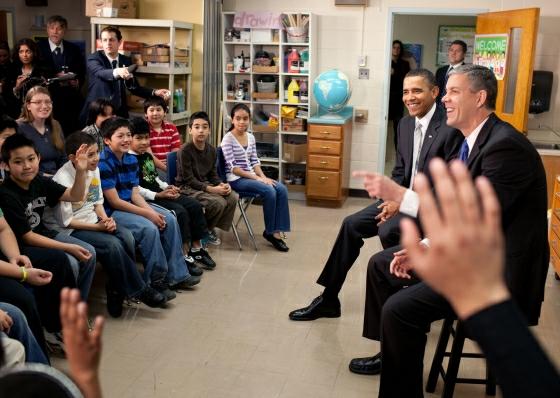
Pres. Obama and Sec. Duncan and the 6th grade at Graham Road Elementary, Falls Church, Virginia

President Barack Obama and Education Secretary Arne Duncan took questions from a 6th grade class at Graham Road Elementary School in Falls Church, Virginia, January 18, 2010 – photo credit unknown

Maybe, just maybe, it’s time these reformers took a step back and did some study, perhaps from the quality gurus, Deming and Juran and Crosby, or from the heights of championship performance, in basketball, football, soccer, sailing (try the America Cup), horse racing or politics:  No one can use firing as a chief tool to turn an organization around, nor to lead any organization to a championship.  Threatening people’s jobs does not motivate them, nor make the jobs attractive to others.

How can we tell the fire-the-teachers-and-principals group is on the wrong track?  See the article:

“To think that the same leader with a bit more money is going to accomplish tremendous change is misguided,” said Tim Cawley, a managing director at the Academy for Urban School Leadership, a nonprofit group that began leading turnaround efforts in Chicago when Mr. Duncan was the superintendent there.

“This idea of a light-touch turnaround is going to sully the whole effort,” Mr. Cawley added.

Tell that to Steve Jobs, who turned Apple around.  Tell it to Jack Welch, the tough-guy boss from GE (who had his own peccadilloes about firing, but who emphasized hiring and pay, at least, as the way to create a succession plan for the vacancies).  Tell it to any CEO who turned around his organization without falling on his own sword.

Any competent quality consultant would have foreseen this problem:  Nobody wants to train for a job with little future, less money to do the job right, little authority to get the job done, and the sole promise that the exit door is always open.

Secretary of Education Arne Duncan should know better, intuitively.  He used to play basketball, professionally.  Surely he knows something about team building and team turnarounds.  What caused his astounding, expensive amnesia?

Part of the issue identified in the article is training:

Because leading schools out of chronic failure is harder than managing a successful school — often requiring more creative problem-solving abilities and stronger leadership, among other skills — the supply of principals capable of doing the work is tiny.

Most of the nation’s 1,200 schools, colleges and departments of education do offer school leadership training. “But only a tiny percentage really prepare leaders for school turnaround,” said Arthur Levine, a former president of Teachers College who wrote a 2005 study of principal training.

That only contributes to the larger problem, that people in the positions are, often, the best ones for the job already; firing them damages turnaround efforts.

In Chicago, federal money is financing an overhaul of Phillips Academy High School. Mr. Cawley’s nonprofit trained Phillips’s new principal, Terrance Little, by having him work alongside mentor principals experienced at school makeovers.

“If we’re talking about turning around 700 schools, I don’t think you can find 700 principals who are capable of taking on the challenge of this work,” Mr. Little said. “If you could, why would we have this many failing schools?”

Education’s problems are many.  Few of the problems are the result of the person at the chalkboard in the classroom.  Firing teachers won’t help.  W. Edwards Deming claimed that 85% of the problems that plague front-line employees, like teachers, are management-caused.  Firing their bosses won’t solve those problems, either, but will just push the problems around.   (What?  “Deck chairs?”  “Titanic?”  What are you talking about?)

Did you hear?  Texas plans to cut state funding to all education by at least 25% for next year, due to Gov. Rick Perry’s $25 billion deficit, which he worked so hard to conceal during last year’s election campaign.

Santayana’s Ghost just dropped by to remind us, suitably the day after Ronald Reagan’s 100th birthday anniversary, of the Report of the Commission on Excellence in Education, the report that saved Reagan’s presidency and got him a second term:

Our nation is at risk. The educational foundations of our society are presently being eroded by a rising tide of mediocrity. If an unfriendly foreign power had attempted to impose on America the mediocre educational performance that exists today, we might well have viewed it as an act of war. We have, in effect, been committing an act of unthinking, unilateral educational disarmament. History is not kind to idlers.

When do we get political leaders who will swim against that tide instead of trying to surf it?


Dan Wasserman cartoon, Boston.com

Dan Wasserman, Boston Globe

See a small collection of  Dan Wasserman’s cartoons on Race to the Top, here.


Ohio news: No creationist right to burn crosses on junior high science students

December 1, 2010

Oops!  Update and correction, from NCSE, applies equally here:

Update and correction (December 1, 2010): The case is apparently not officially settled after all. What was approved was not the overall proposed settlement, but the terms of the settlement as it concerns Zachary Dennis (a minor) — the “James Doe” of the suit — and it was approved not by the judge presiding over the case, Gregory L. Frost of the Federal District Court for the Southern District of Ohio, but by Licking County Probate Judge Robert Hoover, acting in his role as Juvenile Court Judge for the county. The settlement still needs to be approved by Judge Frost.

John Freshwater’s side finally agreed to a settlement in the suit against him and the local school district prompted by his using an electrical device, a small Tesla coil testing device, to burn crosses on the arms of students.  Thus mostly ends one of the more bizarre stories of creationism and misguided religion in a public school classroom.

Here is the entire story in all its anticlimactic wonder, from the Mount Vernon (Ohio) News:

Judge approves settlement in civil lawsuit

NEWARK — Licking County Probate Judge Robert Hoover on Nov. 23 approved a settlement agreement with regard to the civil lawsuit filed on behalf of Zachary Dennis against suspended Mount Vernon Middle School teacher John Freshwater.

The lawsuit was originally filed in the U.S District Court on June 13, 2008, and included as defendants the Mount Vernon City Schools Board of Education and various school employees. The suit alleged that Freshwater violated the constitutional rights of Zachary Dennis and those of his parents, Stephen and Jennifer Dennis, by, among other things, displaying religious items in his classroom, by teaching intelligent design and by expressing his own religious beliefs to students in the classroom.

The board’s portion of the lawsuit was resolved on or about Aug. 26, 2009, and Freshwater was the sole remaining defendant.

With Judge Hoover’s ruling last Tuesday, the suit against Freshwater was officially settled. The settlement of $475,000 to the Dennis family includes $25,000 for attorney fees, $150,000 each to Stephen and Jennifer, and $150,000 to be used for an annuity for Zachary.

At Panda’s Thumb, Richard B. Hoppe’s complete covering of the case notes that we still await the decision of the referee in the proceeding of John Freshwater’s appeal of his firing, and school board action on that recommendation.

At length, then, officially, it’s a bad idea for a creationist science teacher to burn crosses on the arms of supposedly-willing students using a Tesla coil, in any configuration. Yet to be determined:  May a school board fire a teacher who does that anyway?

More:


You have a friend in the Bill of Rights Institute . . .

November 3, 2010

. . . or should have.

Bill of Rights Institute

Click here, "friend" the Bill of Rights Institute

Bill of Rights Institute does good work.  They’re looking for a few friends on Facebook — they want at least 2,010 friends by the end of 2010.

They’re over 1,100 now.  Go see if you can’t get them to their goal by the end of the week, eh?  If you’re on Facebook, go give them the thumbs up.


H. W. Brands on the study of history, with technology

September 26, 2010

Spent half a day with H. W. Brands, professor of history at the University of Texas, and author of at least one of my favorite history books, The First American (and several others).

Brands banned the use of computers for notetaking in his classrooms this fall.  It’s not the notes he objects to, of course, but the students’ side-activities of checking e-mail, eBay, and ESPN, rather than paying attention to the lecture, and other activities in lieu of taking notes.

Nominally our discussion centered on the decade of 1890 to 1900, the Reckless Decade, as Brands’ book on the era titles it.   Brands took a larger, circular route to the topic, today.  These discussions come under the aegis of the Dallas Independent School District’s Teaching American History Grant, and the Gilder-Lehrman Institute chipped in today, too.  We are a polyglot group of teachers of American history, and a few other related social studies subjects, in Dallas high schools.

I asked about technology beyond lecture, or “direct instruction” as the curriculum and teacher berating  rubrics so dryly and inaccurately phrase it.   Brands focused on the effects of connected students in the lecture, a problem which we officially should not have in Dallas schools.  We discovered he’s using Blackboard (probably the electronic classroom standard for UT-Austin).  I’ve used Blackboard in college instruction, and a somewhat less luxurious version in high schools.  Blackboard works better than others I’ve tried.

Over several hours Brands said he teaches best when he performs well as a story teller — when the students put down their note-taking pencils and listen.  Two observations:  It helps to be a good story teller, and, second, that requires that one know a story to tell.

Our grant could give us better stories to tell.  Most educational enterprises produce great benefits as by-products of the original learning goal.  Our teacher studies of history are no different.


Blogging longhand

August 29, 2010

From the Department of Education where my group was in charge of dragging the rest of the research branch into the computer age — putting computers on desks of contract managers for the first time, in most cases — I moved to American Airlines.  Though American boasted the best computer reservations system in the world, at headquarters my cubicle came with no computer, not even a typewriter.

I requested a typewriter to draft documents.  “That’s what we have secretaries for,” I was told.  “You draft longhand, let the secretaries turn them into print.”

That quickly changed, thank the business gods, but I feel like I’ve been thrust back to 1987 in many ways since my laptop crashed last week.

The good people at Fry’s noted the fan wasn’t working, but feared it might be damage beyond that.  I’m informed now that it’s been sent to its birthplace with HP/Compaq in California for a more serious assessment and, I hope, quick repair.  Alas, when we bought the extended warranty (the first time such a purchase seems to have not been a really stupid idea) we did not purchase the “automatic loaner” rider.

Oh, I’ve got the data backed up.  What I don’t have is an easy access to one computer I can use regularly  or transport with me to get that information into the formats I need.  Lesson plans, presentations, worksheets and tests are essentially on hold.

A somewhat better prepared group of juniors this year.  They have heard of Columbus.  They know basic map stuff, like in which direction we say the sun rises.  Prehistory remains mysterious to them, human migrations prior to 1750 are fuzzy to them, and the Age of Exploration seems to be complete news.  All that stuff I put together last year in case this happened?   It’s on the backup drive, the drive that I don’t have enough USB ports to tap into while doing much of anything else.

My classroom for a good book!  Of course, I’d have to reinvent the book check out process, and find some way to transport a half-ton of books from the book room to the classroom, and check them out.

We had a meeting Friday on what we’re doing to differentiate classroom lessons for differently-abled learners.  Unable to get lessons to any learners, I found it a waste of time at the moment.  How much other work teachers do is frustrated by the assumptions that all systems are go for teachers, when few systems are.

A reader, nyceducator,  noted he’s never had a working computer in his classroom in 25 years.  He’s better prepared than I am as a result, and I envy him at the moment.  Should I retrench and prepare for a paper future?

Teaching in America is, too often, a constant reinvention of the wheel.

The laptop I’m typing this on is 9 years old, old enough that it can connect to the home WiFi only with an expensive modem.  That takes up the one USB port.  I think I donated the last wired mouse I had, and the touchpad on the computer is failing (which is a big reason I bought the now-ailing computer back in 2009).  The battery has been failing for a long time, but that model is no longer manufactured.  Used batteries are tough to find on eBay, even.

I can write it out longhand, and fax it to a secretarial service who will convert it to electronic files for me.

How is your 1987 going?


Want to teach evolution? Then be ready for THIS!

August 25, 2010

Threat to Bug Girl, Child of Satin

What would the police make of such a threat?

Bug Girl lifts the tent flap to show us just a little of what it’s like to be a teacher of evolution, including mysterious threats made on notes left under windshield wipers.

At least, I think it’s a threat.  (“If you teach evolution, I’ll make you giggle till you choke!”)

I figure that note came from the sort of person who would pray for this to happen to a good professor of biology.

(Do you think the note writer was trying to say something about the sheets upon which Bug Girl’s parents frolicked?)


Inspiration for the first day of school, part 2 – Taylor Mali, and “What do you make?”

August 23, 2010

It ain’t easy being a teacher.  Newsweek puts you on the cover, saying you need to be fired.  Texas Gov. Rick Perry says you don’t need job security, as if getting additional money for teacher salaries would make teachers secure in places like Dallas, where mid-year RIFs are a too-recent, bitter memory.  Heck, just looking at the curriculum in Texas can depress a teacher.  Parents think you don’t call them enough, or too much — but never the Goldilocks optimum.  Students?  Even the best student is surly in the last period of the first day back at school.

Taylor Mali knows all about that.  He taught for several years — but he struck out as a professional slam poet.  His work there remains among the best tributes to teaching of the past 50 years, at least.  You probably heard this poem, or somebody sent it to you in an e-mail (especially if you’re a teacher) — but attributed to “Anonymous.”

Well, here is Anonymous, the Unknown Teacher — whose name is Taylor Mali.  Watch for him and his work.

This is an encore post from 2007.  (Mild profanity.)

_________________________

Killer lesson plans:  Teachers as superheroes

Reader Bernarda noted this site in comments, and it’s good enough to promote more formally: Teachers as the alter egos of superheroes.

Teachers ARE superheroes, a lot of them. More than in other professions, certainly.

Which reminds me of this video. Teachers, you need to watch this sometime here in the first month of school. What do you say when someone rudely asks, “What do you make?” Wholly apart from the Ann Landers-style answer, “Whatever would possess anyone to ask such a personal question?” there is an answer to give, as explained by slam poet Taylor Mali; surely you’ve seen this before, but watch it again — to remember what teachers should be doing, as well as how to talk about it. See below.

[Update August 2010:  Hmmmmm.  Well, that video is out of commission at the moment — Mali and copyright?

Mali has a version at his website, for sale.  Buy it, you have it in high fidelity audio, video and emotion.

Here’s a shorter version of the tape not available above:

It remains the single best piece about teaching and why teachers do it when they don’t get paid the big bucks, when administrators make it so hard, and when society at large wants to fire them all — they do it for the kids.  What do they make?]

You can support Mr. Mali. Just purchase a pen that includes that little poem.

You can support Mr. Mali and his campaign for good teachers in another way, too. Make sure that whenever you talk about this poem of his, you credit it to him. I think we as teachers owe that to artists, and other teachers, as part of our continuing struggles against plagiarism.

But we also owe it to ourselves to get credit to Mr. Mali. Odds are he has some other good things to say. When you properly attribute his work, you increase the chances that someone else will find the rest of his work. You increase the chances that some superintendent will hire Mr. Mali to speak to the teachers in his district. You increase the chances that someone will understand that Mr. Mali is a real human being who loves teaching — he is, in short, one of those superheroes we call “teachers,” even without a cape.

Uncaped crusaders need compliments, too.