January 12, 2008
Put your paper into Georgia, a serif font, and your grades may rise.
Some enterprising fellow at Fadtastic did the research (now available here in archives), and discovered Georgia-fonted papers tend to get A grades, Times Roman-fonted papers get A- grades, and Trebuchet-fonted papers get B grades (“The Secret Lives of Fonts).
Of course, that’s what the type designers, book designers and web designers have been telling us for 20 years — a serif font is easier to read, and makes the reader feel more at ease. When graders feel good, the paper gets a good grade. That’s logical.

Georgia Font examples, from Wikipedia
I also discovered that when faxed to news editors, sans serif fonts get better play. If the press release is legible, it goes farther.
And, when I was taking broadcast courses, my grades rose significantly when my IBM Correcting Selectric II arrived, and I started doing all my scripts in Orator font. The teacher, an active newsman at the time, graded higher when he recognized the font more — it was roughly the same font on the teleprompter at his station.
Pick your font and your transmission method accordingly.
The author of this non-scientific study is a web designer, of course.
I’ll bet you’ll find that conclusion, backed with some sort of research, in the book design and web design texts.
Remember when we all used typewriters, and such choices were not options at all?
Tip of the old scrub brush to Graceful Flavor.
Spread the word; friends don't allow friends to repeat history.
 5 Comments |
  Business, Presentations, Student projects, Technology, Weblogs, Writing | Tagged: Business, font choices, getting good grades, Media, Technology, writing well |
  Permalink
 Posted by Ed Darrell
January 3, 2008
Penguin Burgers appears to be a blog of a graduate student who will be off to Antarctica on a project, working with a team at North Carolina State University.
The blog appears to be rather an afterthought, an add-on. But consider: What if your class were able to follow this guy to Antarctica, and keep up regular communication with him through the blog?
There’s some great potential there. I plan to watch. Looks like this fellow is really looking forward to the trip.
Spread the word; friends don't allow friends to repeat history.
Leave a Comment » | Geography - Physical, Graduate study, On-line learning, Research, Science, Technology, Technology in the classroom | Tagged: Antarctica, geography, Science, science in the classroom, Technology | Permalink
Posted by Ed Darrell
December 29, 2007
Sputnik’s launch by the Soviet Union just over 50 years ago prompted a review of American science, foreign policy, technology and industry. It also prompted a review of the foundations of those practices — education.
Over the next four years, with the leadership of the National Science Foundation, Americans revamped education in each locality, beefing up academic standards, adding new arts classes, new science classes, new humanities classes especially in history and geography (1957-58 was the International Geophysical Year) and bringing up to date course curricula and textbooks, especially in sciences.
On the wave of those higher standards, higher expectations and updated information, America entered an era of achievement in science and technology whose benefits we continue to enjoy today.
We were in the worst of the Cold War in 1957. We had an enemy that, though not really formal in a declared war sense, was well known: The Soviet Union and “godless communism.” Some of the activities our nation engaged in were silly — adding “under God” to the Pledge of Allegiance smoked out no atheists or communists, but did produce renewed harassment of Jehovah’s Witnesses and anyone else opposed to such oaths — and some of the activities were destructive — Sen. Joseph McCarthy’s excessive and ultimately phony zeal in exposing communists led to detractive hearings, misplaced fears of fellow citizens and serious political discussion, and violations of Americans’ civil rights that finally prompted even conservative Republicans to censure his action. The challenges were real. As Winston Churchill pointed out, the Soviet Union had drawn an “Iron Curtain” across eastern Europe. They had maintained a large army, gained leadership in military aviation capabilities, stolen our atomic and H-bomb secrets, and on October 4, 1957, beaten the U.S. into space with a successful launch of an artificial satellite. The roots of destruction of the Soviet Empire were sown much earlier, but they had barely rooted by this time, and no one in 1957 could see that the U.S. would ultimately triumph in the Cold War.
That was important. Because though the seeds of the destruction of Soviet communism were germinating, to grow, they would need nourishment from the actions of the U.S. over the next 30 years.

Sen. John F. Kennedy and Counsel Robert F. Kennedy, McClellan Committee hearing, 1957; photo by Douglas Jones for LOOK Magazine, in Library of Congress collections
Fourteen days after the Soviet Union orbited Sputnik, a young veteran of World War II, Massachusetts Sen. John F. Kennedy, spoke at the University of Florida. Read the rest of this entry »
Spread the word; friends don't allow friends to repeat history.
4 Comments | 1957, Cold War, Education, Forgotten speeches, History, International law, Santayana's ghost, Science, Space Race, Technology | Tagged: 1957, Cold War, Education, History, Politics, Science, science education, Sen. John F. Kennedy | Permalink
Posted by Ed Darrell
December 18, 2007

Photo by Susana Raab for The New York Times; caption: “The writer Flannery O’Connor’s desk and typewriter in her bedroom at Andalusia, her farm near Milledgeville, Ga. She was a master of the Southern Gothic.”
From the Travel section article of the New York Times, February 4, 2007, by Lawrence Downes:
I was met at the door by Craig R. Amason, the executive director of the Flannery O’Connor-Andalusia Foundation, the nonprofit organization set up to sustain her memory and preserve her home. When the affable Mr. Amason, the foundation’s sole employee, is not showing pilgrims around, he is raising money to fix up the place, a project that is a few million dollars short of its goal. The foundation urgently wants to restore the house and outbuildings to postcard-perfection, to insure its survival. Last year the Georgia Trust for Historic Preservation placed Andalusia on its list of most endangered places in the state.
For now, the 21-acre property is in a captivating state of decay.
There is no slow buildup on this tour; the final destination is the first doorway on your left: O’Connor’s bedroom and study, converted from a sitting room because she couldn’t climb the stairs. Mr. Amason stood back, politely granting me silence as I gathered my thoughts and drank in every detail.
This is where O’Connor wrote, for three hours every day. Her bed had a faded blue-and-white coverlet. The blue drapes, in a 1950’s pattern, were dingy, and the paint was flaking off the walls. There was a portable typewriter, a hi-fi with classical LPs, a few bookcases. Leaning against an armoire were the aluminum crutches that O’Connor used, with her rashy swollen legs and crumbling bones, to get from bedroom to kitchen to porch.
There are few opportunities for so intimate and unguarded a glimpse into the private life of a great American writer. Mr. Amason told me that visitors sometimes wept on the bedroom threshold.
Spread the word; friends don't allow friends to repeat history.
1 Comment | Books, History, Literature, Technology, Travel, Typewriters | Tagged: Flannery O'Connor, Georgia, Literature, Media, Technology, Travel | Permalink
Posted by Ed Darrell
December 18, 2007
Here’s a new blog carnival you may find useful: The Educational Technology Carnival. The 6th running of that particular midway is posted at Global Citizenship in a Virtual World.
Which rather reminds me that I’ve added to my list of things I want in a technological adapted classroom: Movie lighting. I’ve lost count of the number of times I’ve been in a different classroom, and discovered that when the projector goes on, the lights must come down in order to see the image — and then discovered that when the lights go down, there’s not enough light to see to take notes, or to see for anything else.
I was filling in for a teacher who uses a lot of video (“Great!” I thought). Students picked up on the problem right away. “Another sleep lab today?” they asked.
But I digress.
I have fought in four districts to get filters off on sites that discuss evolution for biology students. In one district, it was easier to put filters on the creationism sites, IT told me, than get the filters off the sites that discussed the material the students needed. I discovered my own district now blocks this blog, which makes it difficult to refer students to specific material, at least from school. (Time to change districts?) So the discussion on who filters, and why, caught my eye. I’m not sure there is a good result.
This edition of the carnival also points to Rebecca Wallace-Segall’s Wall Street Journal opposite-editorial page piece on student competition in intellectual areas, a hot topic for me right now as I contemplate the Federal Reserve Board’s competition for economics students, the Fed Challenge.
So as you ponder why your school doesn’t give you lighting to view your projected material, why you don’t have adequate audio reproduction, where are you going to get a projector to show the PowerPoint presentation during 4th block, why can’t anyone make a non-boring, really dynamic PowerPoint, and whether your computer lab kids are downloading racy music videos to spike your bandwidth clogging problems, think that on your lunch hour you can take a look at blog carnival that at least empathizes — if it’s not blocked in your school.
Spread the word; friends don't allow friends to repeat history.
Leave a Comment » | Classroom technology, Economics, Education, Education success, Literature, Teaching, Technology, Technology in the classroom, Weblogs, Writing | Tagged: Economics, Education, Technology | Permalink
Posted by Ed Darrell
December 17, 2007
I bought my Royal Standard typewriter in 1965. It was secondhand. I have written everything I’ve ever had published on it, and there is nothing wrong with it.

- Pulitzer-winner David McCullough, defending his refusal to write on a computer during a Dallas book-signing.
(Found in Dallas Morning News, Alan Peppard, “Salutations, Year in Review, Local Celebrities,” December 17, 2007, page 1E, in graphic on page 4E)
More from McCullough on typing, and on writing, reading and understanding history, below the fold.
Read the rest of this entry »
Spread the word; friends don't allow friends to repeat history.
2 Comments | Capturing history, History, History and art, Quotes, Teaching, Technology, Typewriters, Writing history | Tagged: David McCullough, History, Quotes, Technology, Typewriters | Permalink
Posted by Ed Darrell
December 17, 2007

Photo from Treasures of the Library of Congress; “First Flight” by John T. Daniels (d. 1948); this is a modern gelatin print from the glass negative.
Ten feet in altitude, 120 feet traveled, 12 seconds long. That was the first flight in a heavier-than-air machine achieved by Orville and Wilbur Wright of Dayton, Ohio, at Kittyhawk, North Carolina, on December 17, 1903.
From the Library of Congress:
On the morning of December 17, 1903, Wilbur and Orville Wright took turns piloting and monitoring their flying machine in Kill Devil Hills, North Carolina. Orville piloted the first flight that lasted just twelve seconds. On the fourth and final flight of the day, Wilbur traveled 852 feet, remaining airborne for 57 seconds. That morning the brothers became the first people to demonstrate sustained flight of a heavier-than-air machine under the complete control of the pilot.
No lost luggage, no coffee, no tea, no meal in a basket, either.
Resources on the Wright Brothers’ first flight:
Spread the word; friends don't allow friends to repeat history.
1 Comment | Heroes, History, History images, Technology | Tagged: Airplanes, flight, History, Technology | Permalink
Posted by Ed Darrell
December 12, 2007
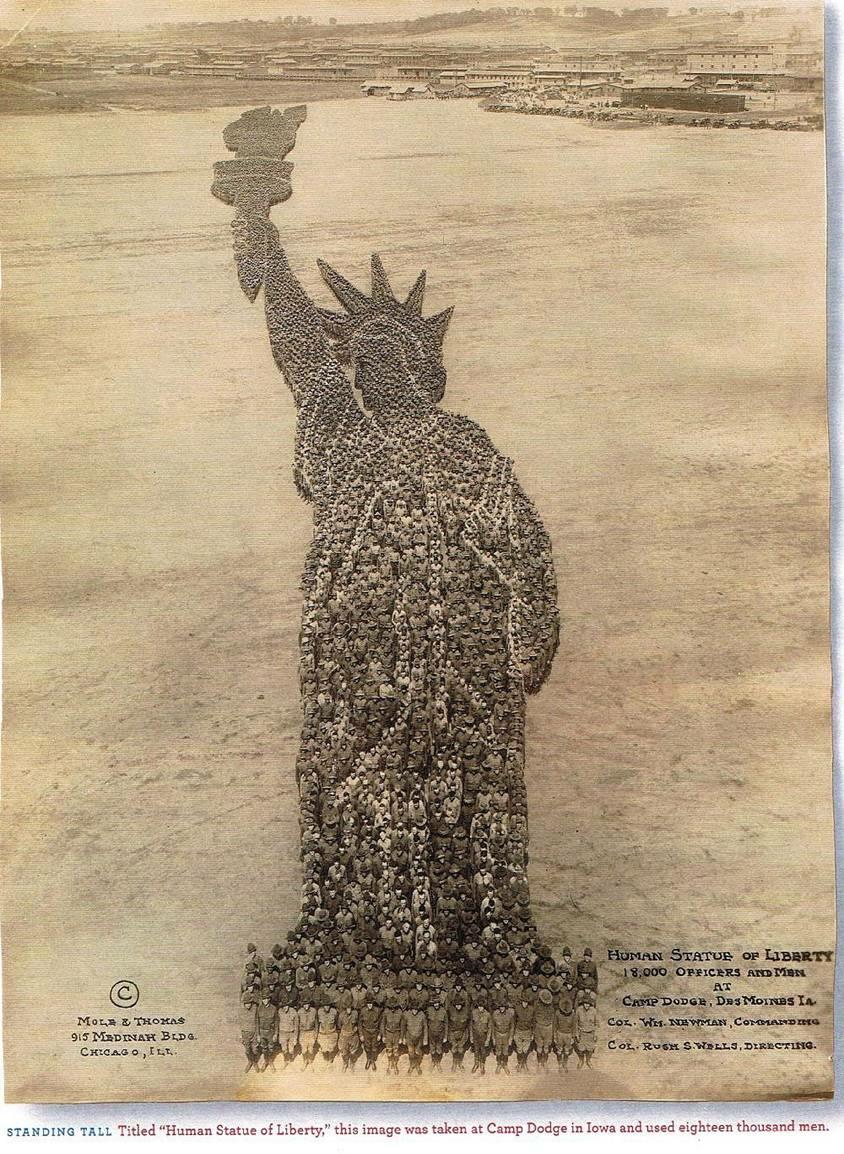
Surely you’ve seen some of these photos; if you’re a photographer, you’ve marveled over the ability of the photographer to get all those people to their proper positions, and you’ve wondered at the sheer creative genius required to set the photos up.
Like this one, a depiction of the Liberty Bell — composed of 25,000 officers and men at Fort Dix, New Jersey. The photo was taken in 1918.
 The Carl Hammer Gallery in Chicago featured an exhibit of these monumental photos in April and May, 2007:
The outbreak of World War I and its inherent violence engendered a new commitment by the world’s photographers to document every aspect of the fighting, ending an era of In A Patriotic Mole, A Living Photograph, Louis Kaplan, of Southern Illinois University, writes, “The so-called living photographs and living insignia of Arthur Mole [and John Thomas] are photo-literal attempts to recover the old image of national identity at the very moment when the United States entered the Great War in 1917.
Mole’s [and Thomas’s] photos assert, bolster, and recover the image of American national identity via photographic imaging. Moreover, these military formations serve as rallying points to support U.S. involvement in the war and to ward off any isolationist tendencies. In life during wartime, [their] patriotic images function as “nationalist propaganda” and instantiate photo cultural formations of citizenship for both the participants and the consumers of these group photographs.”
The monumentality of this project somewhat overshadows the philanthropic magnanimity of the artists themselves.Instead of prospering from the sale of the images produced, the artists donated the entire income derived to the families of the returning soldiers and to this country’s efforts to re-build their lives as a part of the re-entry process.
Eventually, other photographers, appeared on the scene, a bit later in time than the activity conducted by Mole and Thomas, but all were very clearly inspired by the creativity and monumentality of the duo’s production of the “Living” photograph.
One of the most notable of those artists was Eugene Omar Goldbeck. He specialized in the large scale group portrait and photographed important people (Albert Einstein), events, and scenes (Babe Ruth’s New York Yankees in his home town, San Antonio) both locally and around the world (Mt. McKinley). Among his military photographs, the Living Insignia projects are of particular significance as to how he is remembered.
Using a camera as an artist’s tool, using a literal army as a palette, using a parade ground as a sort of canvas, these photographers made some very interesting pictures. The Human Statue of Liberty, with 18,000 men at Camp Dodge, Iowa?
Most of these pictures were taken prior to 1930. Veterans who posed as part of these photos would be between 80 and 100 years old now. Are there veterans in your town who posed for one of these photos?
Good photographic copies of some of these pictures are available from galleries. They are discussion starters, that’s for sure.
Some questions for discussion:
- Considering the years of the photos, do you think many of these men saw duty overseas in World War I.
- Look at the camps, and do an internet search for influenza outbreaks in that era. Were any of these camps focal points for influenza?
- Considering the toll influenza took on these men, about how many out of each photo would have survived the influenza, on average?
- Considering the time, assume these men were between the ages of 18 and 25. What was their fate after the Stock Market Crash of 1929? Where were they during World War II?
- Do a search: Do these camps still exist? Can you find their locations on a map, whether they exist or not?
- Why do the critics say these photos might have been used to build national unity, and to cement national identity and will in time of war?
- What is it about making these photos that would build patriotism? Are these photos patriotic now?
These quirky photos are true snapshots in time. They can be used for warm-ups/bell ringers, or to construct lesson plans around.
Tip of the old scrub brush to Gil Brassard, a native, patriotic and corporate historian hiding in Baton Rouge, Louisiana.
Spread the word; friends don't allow friends to repeat history.
10 Comments | 1914-1918, Art, History, History images, History museums, Lesson plans, Technology, World War I | Tagged: Art, History, photography, Technology, World War I | Permalink
Posted by Ed Darrell
December 9, 2007
1nhjvgbfffffffffffbng
[This was written by our 18-year old. She generally putters around the kitchen and avoids the laptop when it’s there; occasionally she takes a few stabs at the keyboard of the desktop. But never before has she shown any interest in actually writing anything. Last night she said she was hungry, and she was plainly irritated that I was doing nothing to get her dinner to her. When I answered the telephone, she took the opportunity to write her own little headline and a short line for the body of the post. I’m posting it as revenge.
Did I say she is 18? You expect more?
Did I mention Meow is a cat?]
Spread the word; friends don't allow friends to repeat history.
4 Comments | Humor, Personal, Technology | Tagged: cats, Humor, Technology | Permalink
Posted by Ed Darrell
December 6, 2007
Ignoble Gases nicely describes the mashup between on-line mapping services and digital photography, with a bit of blogging thrown in.
Mapping services now have the capacity to link photographs of a site with its exact latitude and longitude, or exact address. Maps of cities can feature links to photos of the site (other than satellite or aerial photos) submitted by readers, and other descriptive material.
So, geography teachers: Have your kids mapped out your town and put it on the web to encourage tourism? Great discussion topics: What are the advantages of such technologies, and what are the parent-scaring disadvantages, or dangers of them?
I really cannot do justice to the concepts here — read the article at Ignoble Gases.
Spread the word; friends don't allow friends to repeat history.
Leave a Comment » | Geography - Physical, Internet, Lesson plans, Student projects, Teaching, Technology, Technology in the classroom | Tagged: geography, interactive mapping, Internet, Lesson plans | Permalink
Posted by Ed Darrell
December 4, 2007

Fun map. Readers at Strange Maps noted lots of geographical challenges in these train routes. Wouldn’t this make a great warm-up/bell-ringer, to have students find the geographical difficulties, errors and impossibilities?
And then there’s the book itself. The perfect gift for Dr. Jack Rhodes*, perhaps, or for Jim Lehrer, or someone else to whom transportation has been a great and grand pastime, as it has been for author Mark Ovenden.

Cool. Funny. Maybe instructive.
This would be a heckuva two-week study in geography, no? There are those great films on the construction of the New York subway system; there must be wonderful photos of the art in the Moscow system.
Or am I being too pedantic?
(Click thumbnail below for a larger view of the map.)

Tip of the old scrub brush, and go visit, Strange Maps.
* Jack Rhodes was director of forensics at the University of Utah when I was an undergraduate there — my old debate coach. He was so familiar with bus and train schedules, as a hobbyist, that we frequently tried to stump him with questions about a passing train or bus we’d see driving around the nation. To my knowledge, he always got the name of the train right, and the bus’s scheduled next stop right. You sorta had to be there, but it was an amazing series of feats of memory.
Spread the word; friends don't allow friends to repeat history.
3 Comments | Bell Ringers, Books, Geography - Physical, Harry Wong, Technology, Transportation, Warm-up exercises | Tagged: Books, Education, geography, Maps, public transit, subway | Permalink
Posted by Ed Darrell
November 24, 2007
Larry Lessig, speaking at TED, makes the case for kids who use stuff borrowed from others in their classroom presentations.
First, this speech should open your eyes to the danger of our only preaching against plagiarism to kids who borrow copyrighted stuff off the internet (see especially the last two minutes of his almost-19 minute presentation). What’s the alternative, you ask? See what Prof. Lessig says. What are the alternatives?
Second, Lessig shows how to use slides in a live presentation, to significantly increase the content delivered and the effectiveness of the delivery.
Wow.
Tip of the old scrub brush to Presentation Zen. Go there now and read Garr Reynolds’ take on Lessig’s presentation.
Who is Larry Lessig? You don’t know TED? See below the fold.
Read the rest of this entry »
Spread the word; friends don't allow friends to repeat history.
7 Comments | Economics, Ethics, History, Law, Pedagogy, Plagiarism, Presentations, Student projects, Teaching, Technology, Technology in the classroom | Tagged: copyright, Economics, Garr Reynolds, Larry Lessig, Plagiarism, Presentations, Teaching, Technology | Permalink
Posted by Ed Darrell
November 18, 2007
Vouchers in Utah have the wooden stake right in the heart. That’s one proposal in one state. More voucher proposals are promised, and the debate continues.
Voucher advocates generally make a plea that colleges have something akin to school vouchers with Pell Grants (Basic Education Opportunity Grants), Stafford Grants, the GI Bill and other federal programs, plus many state programs, which give money to a student to use at a college of the student’s choice.
Why won’t this work for kindergartners, 8th graders and 10th graders? the voucher advocates ask.
The short answer is that we regard college students as adults. Beyond that are several other differences between elementary schools and colleges that we should, perhaps, explore.
Texas Ed: Comments on Education from Texas has a couple of posts that provide some insights to the issues. In the first one, “We Have Vouchers for Higher Education,” the question is raised about why not let elementary students operate like veterans, and take their government money where they choose to.
In the second, “Vouchers Are About Choice, Not Quality,” we get a glimpse of real life — parents fighting to keep open their neighborhood school, despite there being better performing schools available to take their kids.
We might want to compare systems, at least briefly.
Read the rest of this entry »
Spread the word; friends don't allow friends to repeat history.
1 Comment | College, Education quality, Education reform, Teacher Pay, Teaching, Technology, Tenure | Tagged: colleges, Education, NCLB, Politics, school choice, School vouchers, Teachers | Permalink
Posted by Ed Darrell
November 12, 2007
Your classes are gearing up for the competition, no?
Alfie Kohn might not like the idea of competition in history. In a state famous for competition in almost everything, but most famous for athletic competitions to the detriment of academics, I find great appeal in a contest that requires kids to find, analyze and write history.
Then the students get together to present and discuss history — and usually about 60 Texas kids go on to the National History Day festival. (Details here from the Texas State Historical Association)
Q. What is Texas History Day?
A. Texas History Day, a part of the National History Day program, is a yearlong education program that culminates in an annual state-level history fair for students in grades six through twelve. It provides an opportunity for students to demonstrate their interest in, and knowledge of, history through creative and original papers, performances, documentaries, individual interpretive web sites, or three-dimensional exhibits.
Over the course of the school year, students research and produce a History Day entry, the results of which are presented at a regional competition in early spring. From there, some students advance to the state fair in May, or even to the national contest held each June at the University of Maryland at College Park. At each level of competition, outstanding achievement may be recognized through certificates, medals, trophies, or monetary awards. The most important rewards are the skills and insight that students acquire as they move through the History Day program.
As many as 33,000 young Texans are involved in the program at the regional and state level each year. More than 900 students participate in Texas History Day, and approximately 60 students represent Texas at National History Day each year.
The 2008 National History Day Theme is “Conflict and Compromise in History.”
Texas has 23 regions for preliminary rounds. Details here. A list of sample topics for Texas students should give lots of good ideas.
The topics and the papers promise a lot. These projects could make good lesson plans. (Who publishes the winning entries? I have not found that yet.)
Don’t forget the Texas History Day T-shirt Design Contest — entries are due by December 14, 2007.
Spread the word; friends don't allow friends to repeat history.
3 Comments | Capturing history, Education, Historic documents, History, Lesson plans, Pedagogy, Teaching, Technology, Texas history | Tagged: Education, History, National History Day, Teaching, Texas history | Permalink
Posted by Ed Darrell
November 1, 2007
Our house had two or three of the things around from my three older brothers — you know, the old Gilbert or Chemcraft chemistry sets, complete with potentially dangerous chemicals, test tubes, an alcohol lamp, a couple of beakers and stands, and instructions for how to make cool reactions with warnings about not making things explode.

We all made things explode, of course. That’s the fun stuff. Making jellied alcohol was fun, too — older brother Wes did that at Halloween, as I recall, the better to make a flaming hand (once was enough, thanks). We didn’t worry so much about the poisonous qualities of hydrogen sulfide, as we did worry about how to claim somebody else was suffering from flatulence when we made it. The kits and their metal boxes were in poor repair by the time I got around to them, but other kids in the neighborhood had new ones, and we always had the labs at the junior high and high school, which were stocked with enough dangerous stuff to keep us on the edge of blowing up the school, we thought (probably incorrectly).
One sign of laboratory experience: The acid holes in the Levi jeans. Older son Kenny recently discovered these things still happen in a lab at college. It had never occurred to him to worry about it before — one of his favorite t-shirts, too. (Holes in clothes appear not to be the fashion statement they were for his parents . . .)
12 Angry Men laments the wussification of these old chemistry sets. No danger anymore, he says.
Someone in comments claims you can still get the dangerous stuff.
But someone else claims such kits may be illegal under Homeland Security and DEA rules. Heck, they say even Erlenmeyer flasks are illegal in Texas. They used to be very popular among the secretaries in the biology department because they made such fine vases for the single-stemmed flowers their grad-student admirers could afford. Gotta see what’s up with that.
Technology changes so you can’t get it anymore.
But, kids with solid chemistry experience make more money in the real world — especially chemical engineers. Here’s a Catch-22: Kids can make more money if they have the experience to get the job, but they can’t get the experience until they get the job.
Update, November 1: The PBS/Wired Science segment on kids doing chemistry, and chemistry sets
Spread the word; friends don't allow friends to repeat history.
4 Comments | Education, History, Learning, Life, Science, Technology, Technology in the classroom | Tagged: chemistry sets, children, Education, Erlenmeyer flasks, Technology | Permalink
Posted by Ed Darrell






 Millard Fillmore's Bathtub