Just for the Texas State Board of Education: Biology texts

June 1, 2007

This is a little test of reading comprehension for the Texas State Board of Education.

So if you’re not one of those people, you can click to the next post.  Of course, if you’re reading this, it’s unlikely that you are a board member, but a Texas parent can dream, can’t he?

Here’s the point:  When you review biology texts for adoption next time, someone will testify that the books you review have errors in them because they carry copies of Ernst Haeckel’s drawings of embryoes, and those drawings are “known to be fakes.”

But that’s not exactly accurate:  Not since 1923 has any book carried the Haeckel drawings, except to point out that they are fakes.

P. Z. Myers at Pharyngula has a post today that lays out the details, “Return of the Son of the Bride of Haeckel,” as he Fisks another Chicken-Little-sky-is-falling press release from the Discovery Institute.

So, in short:  When that first person testifies to you, saying the Haeckel drawings are in some book, ask that person if they’ve read Dr. Pat Frank’s account of searching for that book, and whether they can explain why they think the Texas State Board of Education would be so stupid as to buy that claim, since it hasn’t been accurate in 84 years, since 1923 (older than all of the members of the SBOE, at least).

Then politely thank the witness for their concern, go to the next witness, and don’t ever, ever, ever claim that you think the current textbook publishers need to “get their act together” or whatever language you want to use, to get rid of the Haeckel drawings.

The drawings are gone, long gone, and you know better.

Back to our regular programming:  Did you know that it’s not true that Millard Fillmore put the first bathtub in the White House?


Baylor’s Beckwith returns to the Catholic Church

May 7, 2007

Dr. Francis Beckwith, the Baylor University professor whose writings formed much of the justification for claims that intelligent design could be taught as science in public schools (prior to the Dover decision), announced he is returning to the Catholic Church and resigning as president of the Evangelical Theological Society.

Beckwith explains his faith switch at Right Reason. Contrast comments there with the snarky, uncharitable posts from the “evangelical” side, with Constructive Curmudgeon as an example. If this is the way ID advocates (such as Doug Groothuis) treat someone who merely changes sect, what would they do to someone who became rational on science?

Beckwith’s road at Baylor has not been a smooth one. One wishes him well when brickbats are already flying his direction, for silly reasons.

Educators and scientists, including especially those of faith traditions, may wish he had left the church of intelligent design instead. Perhaps he has, or will, if the attacks from fundamentalists keep up — similar to the way such attacks on Charles Darwin encouraged him to distance himself from the church.

How does this alter the Texas biology textbook fight discussion?


Quote of the moment: Textbook fights in Texas, how math books encourage drug use

February 27, 2007

Michael King, writing in the Austin Chronicle (a weekly newspaper, as I recall), December 24, 2004:

A moment of nondenominational silence for longtime Christian fundamentalist textbook critic Mel Gabler, who died Sunday in Longview at 89. Gabler and his wife, Norma, had long been fixtures at State Board of Education textbook review hearings, although in recent years age and declining health had lessened their participation. The Longview News-Journal reported that Gabler “emphasized accuracy and a Christian perspective in examining school children’s books,” but it would be more true to say that the Gablers and their “Education Research Analysts” never let the former get in the way of the latter. Gabler was notorious for his attacks on any positive mention of evolution in biology textbooks, insisting that “special creation” get equal time and that the textbooks record “what’s wrong” with evolutionary theory. His reviews did indeed reveal factual errors in the textbooks – but his moralistic Pecksniffery is reflected best in statements like this, on mathematics texts: “When a student reads in a math book that there are no absolutes, suddenly every value he’s been taught is destroyed. And the next thing you know, the student turns to crime and drugs.” May he take it up with the Master Mathematician. – M.K.

Tip of the old scrub brush to . . . drat! From whom did I get this link?


Georgia legislator tries end run around evolution — in Texas legislature

February 14, 2007

Be sure to see update here, next post.  Worse, even more, here.

Don’t you just love the Texas lege?

And could you make this stuff up if you were writing a novel? Nobody would believe it.

Warren Chisum is a good ol’ boy from Pampa, Texas, and the second most powerful man in the Texas House of Representatives. So when his friend, Georgia State Rep. Ben Bridges, asked him to — well, what was it he asked? — Chisum agreed to circulate a petition that calls evolution a plot of the Pharisees, Albert Einstein and Carl Sagan members of a Kabbalistic plot, and Big Bang ancient religion.

The Associated Press report in this morning’s Dallas Morning News (free subscription required eventually):

The memo assails what it calls “the evolution monopoly in the schools.”

Mr. Bridges’ memo claims that teaching evolution amounts to indoctrinating students in an ancient Jewish sect’s beliefs.

“Indisputable evidence – long hidden but now available to everyone – demonstrates conclusively that so-called ‘secular evolution science’ is the Big Bang, 15-billion-year, alternate ‘creation scenario’ of the Pharisee Religion,” writes Mr. Bridges, a Republican from Cleveland, Ga. He has argued against teaching of evolution in Georgia schools for several years. Read the rest of this entry »


The rise of David Barton and bogus history

November 28, 2006

Some people were relieved when voodoo history maven Davin Barton’s term as vice chair of the Texas Republican Party expired.

Dallas Morning News editorial writer and occasional columnist William McKenzie warns that we have not seen the last of Barton’s involvement in politics — and textbooks are in Barton’s gunsights.

McKenzie wrote about Barton in the November 28 paper:

Pay attention to his work, because, as Newsweek reported after the election, the religious right is at a crossroads. With big-name leaders declining, lesser-knowns like Mr. Barton will fill the gap. And they will come with their own approach.

The most interesting thing I learned from him was that the next wave will revolve around networks of activists, not the big names who lobby Washington. Look for e-mail blasts that start with a small group upset about a comment or decision about abortion, homosexuality or textbooks. In the decentralized technological world, a David Barton doesn’t need the podium of a Jerry Falwell or a Ralph Reed to trigger a prairie fire.

In other words, watch him.


Texas Republicans urging Marxism be taught?

October 19, 2006

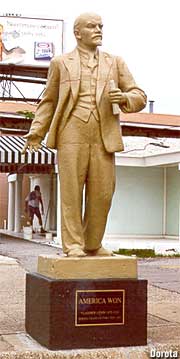
Lenin at Goff's Hamburgers, Dallas (2003)

Lenin does Dallas

No rational person would believe Texas Republicans would call for Marxist economics to be taught in Texas high schools, not even as a part of a “teach the controversy” movement.

The one-semester economics class does not lend itself to giving students backgrounds in economic models that compete with the consensus, free-market view, and even if it did, Marxism would be way down the list of what most Texans would think appropriate to teach. For illustration, consider that when the Soviet Union broke up, a Soviet-produced statute of Lenin was purchased by a Dallas hamburger magnate, placed outside one of his outlets with a plaque commemorating the Cold War, and noting: “America won.” (Alas, Goff’s is gone, as is the statue.)

So, either the Texas Republicans have gone non-rational, or they just were not thinking when they put in their party platform a requirement that alternative theories and their controversies be taught, in social studies.

Confused yet? Tony Whitson at Tony’s Curricublog explains:

But why is this provision regarding social studies tucked into the platform point on “Theories of Origins”? Apparently it reflects an agenda that includes teaching from a creationist standpoint not only in science, but in social studies and other subjects as well.

Someone who’s familiar with curriculum conflicts over recent years will recognize the entire education section of the platform as coming chapter and verse from Phyllis Schlafly’s Eagle Forum. The agenda they are pushing here is not something home-grown in Texas, but an agenda that we can expect to see being advanced all over the United States.

Well, Texas politics being what it is, the likelihood that a plank from any party’s platform could make it into law is a bit remote right now. And it seems clear that the intent was to go after science and evolution, not economics. Udall’s Law of Unintended Consequences says such efforts will produce unexpected and undesired results, and here we have a good case in point.

People are gearing up for fights on history and biology texts in Texas — economics, too? Ouch.


Revisionism of current history, 9/11/2001

September 17, 2006

There is a “carnival” of economics posts that I rarely link to because I find the topics often far out on the right wing end of the scale, offensively so to me, the Economics and Social Policy Carnival.

In the current issue of the Carnival there is this post from :textbook evaluator, discussing complaints about history texts and their treatment of the attack on the U.S. on September 11, 2001, and the aftermath. It is a serious, thought-provoking post. It raises deep questions about the purpose of a history text:

What dismays me most about the arguments over “what history should be covered” or “how it should be covered,” is that we never arrive at the thought that kids themselves should “do” history. We don’t trust our teachers or kids enough to give them many sides or perspectives on an issue, and let them try to make sense of it. We don’t teach them historical thinking skills: we instead argue over what “truths” to feed them.

Criticism of texts of such high quality is in short supply — and, considering the process for textbook approval in Texas, we need a lot more, high quality criticism of texts.

I may pay more attention to the Economics and Social Policy Carnival from now on.


Evangelism vs. scholarship: Bible study in public schools

September 15, 2006

Last year the Texas Freedom Network (TFN) published a revealing study showing that most curricula for Bible study in public schools promote Christian faith more than they study the Bible. The study was done by a witty and amusing professor of religion from Southern Methodist University, Dr. Mark Chancey.

This week they followed up that study with a detailed look at Bible studies courses in Texas public schools, as they are actually presented to students. It’s not pretty.

In their press release, TFN said:

Clergy, Parents Voice Concerns About Public School Bible Classes

New Report Reveals Poor Quality, Bias, Religious Agendas in Texas Courses

FOR IMMEDIATE RELEASE
September 13, 2006

AUSTIN – Clergy and parents are voicing serious concerns that Bible classes in Texas public schools are of poor quality and promote religious views that discriminate against children from a variety of faith backgrounds.

“The study of the Bible deserves the same respect as the study of Huck Finn, Shakespeare and the Constitution,” said the Rev. Dr. Roger Paynter, pastor of First Baptist Church of Austin. “But in some public schools, Bible courses are being used to promote an agenda rather than to enrich the education of our schoolchildren.”

Dr. Chancey is a solid scholar of the Bible. His criticisms are detailed and often understated, in a business where criticism is generally more hyperbole than substance. Especially if you live in Texas, you should read the report.

In the original study, Chancey noted that some nationally-promoted curricula for Bible studies had plagiarized some of their most important materials, in one case including the entire section on honesty as defined by the Ten Commandments. Dr. Chancey does not write drily — he really does a great job turning words. Both studies are well worth the reading.

First Amendment charlatans are fond of quoting the Supreme Court’s decisions in school-and-religion cases since World War II, in which the Court urges critical studies of scripture, saying such studies are legal and good. Then the charlatans go on to advocate Bible studies that are devotional, confusing a Sunday school class-style of scripture study with the critical literature study the Court actually urged. These reports leave little room for squirming by those advocates.

Last time around, TFN held a meeting here in Dallas featuring Dr. Chancey talking about the report and the reaction to it from the religious right (they were stunned into saying many really stupid things). It was a fun night, and I hope TFN will do it again.

Other coverage of the report:

If you see a particularly good story on the study, will you please send me a link?

Patriots and Christians don’t let children take crappy Bible studies courses:

Add to FacebookAdd to NewsvineAdd to DiggAdd to Del.icio.usAdd to StumbleuponAdd to RedditAdd to BlinklistAdd to TwitterAdd to TechnoratiAdd to Furl


Better history books — tell the story!

August 10, 2006

One of my chief complaints about the history textbooks available in Texas is that they are, ultimately, dull. They don’t sing. The narrative quality suffers. To meet Texas standards publishers make sure to pack the chapters with facts and factoids. But students have a difficult time figuring out what the story is, why the story is important, and why they should care. One way I know things are working in my class is when kids tell me “that’s not in the book, and that’s cool” (even though, yes, it is in the book). If the kids think it’s a good story, they let me know — and it sticks with them.

History is where we tell our cultural myths, and I use the word “myth” in the sense that a rhetorician or rhetorical critic would: Those stories around which we build our lives.

I hope to be able to present the Texas State Board of Education with serious criticism of the textbooks in the next round of approvals, to urge them to let the publishers loose to really tell the stories that make up the story of America — knowing about the de Llome letter might be part of an interesting narrative of the Spanish-American War, but the narrative should be the focus, not the letter itself (if you don’t know what that letter is, you’re in good company; it’s an interesting factoid, but not really critical to understanding the war, or the times).

I look around the web to see what other teachers see and think, too. At a blog called In the Trenches of Public Ed., a veteran and probably very good teacher addresses the same issue. Go see.

History is not a collection of dates memorized. History’s value is in the stories, told parable-like, that warn us from future error, or call us to keep on a steady path. George Washington’s story is impressive, for example; it’s more impressive when we recognize and understand that he fashioned his life around that of his hero, Cincinnatus, the Roman general who, given the powers of dictator in 458 B.C., vanquished the threatening armies of the barbarians, and then resigned the dictatorship to return to his plow. That story is not in the textbooks. More the pity.


World War II – Stick to the facts

August 9, 2006

Today (August 9, 2006) is the 61st anniversary of the dropping of an atomic bomb on the city of Nagasaki, Japan, by the United States. While we in the U.S. commemorate such events with full disclosure of information, sometimes to the discomfort of people who do not want a discussion on the use of such weapons, Japan itself is often reluctant to confront and acknowledge its actions in the war, actions which prompted President Truman to determine atomic bombs were the most humane solution to a quick end of the war.

High schools in Japan are using right-wing history textbooks that tend ot whitewash the role of Japan in World War II. Go see the brief article here, in China’s Peoples Daily On-Line.

Rational discourse and debate on the control of nuclear weapons in order to assure justice and peace depends on our understanding the truth about the use of nuclear weapons. Textbooks which distort the truth, either by omitting facts or selectively endorsing them, tend to keep us away from both justice and peace.

Also see this post, Atomic Anniversaries.


Textbook fight in Texas:Watch carefully!

July 17, 2006

Texas textbooks suffer from political wrangling by the state’s school board, which has little else to do with the texts but wrangle over what is in them and why. News suggests the board, recently fortified with primary election wins by extremely conservative, anti-public school forces, now will try to use the texts to change curricula statewide.

According to the Houston Chronicle, the Texas State Board of Education (Texas SBOE) will go after English literature in the next round of text approvals: http://www.chron.com/cs/CDA/printstory.mpl/metropolitan/4024620 Reporter Jane Elliott wrote:

“Many on the board want to replace a student-centered curriculum that calls on students to use their own attitudes and ethics to interpret texts with teacher-centered instruction that emphasizes the basics of spelling, grammar and punctuation.

“It was a fight social conservatives on the board lost in 1997, when moderates and liberals adopted the curriculum for all subjects. Now, with social conservatives expected to have a majority on the board for the first time after the November elections, the plan to rewrite the English standards is viewed by some as the opening shot in an effort to put a conservative imprint on the state’s curriculum.”

English does not lend itself much to political manipulation, generally. There is a set of classic literature that Texas teachers use, basically the same set teachers in other states use. It is possible that this change in process could help English instruction. Past experience suggests this is a stalking horse issue for the board to develop voting blocs and strategies to go after the content of U.S. history courses and biology courses later. Inherent dangers in these battles include the watering down of texts to the point that they are dishwater — deadly dull for students, and deadly to the teaching of the subjects.

Dr. Diane Ravitch, now of New York University, formerly the Assistant Secretary of Education for Research in the administration of George H. W. Bush, argues that both left and right share blame for bad textbooks as a result of these fights, in her book, The Language Police. I am most familiar with the Holt Rinehart Winston (HRW) series, The American Nation, from using it for three years (we were using an earlier edition of the book shown in the link).

The books must mention a broad range of specific topics and people. All of the approved history books suffer from a resulting dullness in their addressing the topics which makes history a real foot-slogging exercise for most Texas high school students. HRW offers significant additional products to help teachers — I made heavy use of the CD-ROM accompanying the text and especially its software to help generate tests. I found it necessary to use chunks from my extensive video library to supplement, and in critical areas for the Texas exit exam for seniors, the book did not inspire students to learn the material — for Wilson’s Fourteen Points, the Japanese internment during World War II, Truman’s decision to drop atomic bombs on Japan, Vietnam and the Cold War, for example. These specific areas do not stand out in the book, not as I wish they would, and not in a way that the average kid would understand the issues.

History should sing. The study of history should inspire students, as patriots, as citizens, as parents and as humans interested in real drama. Dull books put the burden on teachers to make the history sing, and too few teachers are up to the task, especially in a world dominated by state-mandated teaching to a test (Texas Assessment of Knowledge and Skills, or TAKS). I have a dream. I have high hopes that the Texas SBOE will make great new standards for English, standards that will lend themselves to helping teachers make the subject sing for the students so they will happily and well learn the topic.

I have a dream that this process will lead to a similar renaissance in U.S. history, and in biology, and in other topics. But I am dulled with the understanding of past history from the Texas SBOE.

Because Texas is a huge market for publishers, they will skew their books as Texas asks, often. You have a stake in the Texas curriculum regardless where you live. Watch that space!