Dirty play on PUMA blogs, and election history (1800)

September 1, 2008

Oh, it’s only a little dirty, sure.  With but with Democrats like the PUMAs, sometimes you wonder why we need Karl Rove.  With Hillary supporters like a few of the PUMAs, who needs Monica Lewinsky?

At the Confluence, anything that displeases the board moderators gets edited to say something completely trivial and, the board’s moderators appear to hope, embarrassing.  Even compliments from people they don’t like get edited.  So much for robust discussion and debate.  So much for fairness.

The Ghost of Goebbels smiles.  The Ghost of Alexander Hamilton paces nervously. Hamilton, you recall, paid editors and writers to put all sorts of scandal and calumny against Thomas Jefferson into their newspapers, in 1796 and 1800.  Dumas Malone wrote in his Pulitzer Prize-winning biography of Jefferson that fully half the American electorate was convinced that Jefferson was an atheist who hated religious freedom by election day, 1800.  Still, Americans voted overwhelmingly for the Jefferson/Burr ticket.  So Hamilton’s skullduggery didn’t pay off.

Alas, prior to the 12th Amendment, electors in the electoral college all had two votes, and the rule was that the winner became president, the 2nd place person became vice president.  The electors of the Democratic Republican Party (the modern-day Democrats) each cast a vote for Jefferson for President, and a vote for Burr.  In electoral votes, there was a tie for the presidency.  The election went to the House of Representatives (see the Constitution, Article II, Section 1, Clause 3).

The new Congress had not been sworn in yet, so the old, Federalist-controlled Congress got to make the decision between the two top electoral college vote getters (same as today — the old congress decides).  A history site at the City University of New York gives the short version:

Uneasy about both men, the Federalists in the House of Representatives took five days and 35 ballots to choose Jefferson over Burr. The deadlocked election between the two allies spawned the Twelfth Amendment to the U.S. Constitution in 1804, which led to separate Electoral College ballots for president and vice-president. Jefferson called the election the “Revolution of 1800.”

35 ballots in the House of Representatives, before Jefferson was chosen on the 36th! When an election goes to the House, each state gets one vote; the Representatives and Senators must decide how to cast that state’s vote.  34 times that ballot came up inconclusive between Jefferson and Burr, both men despised by the Federalists due to the poisoned waters from the campaign.

Alexander Hamilton knew both men well.  Hamilton and Jefferson both served in Washington’s cabinet.  He had been a friend of Jefferson and guest at Jefferson’s table for the great compromise that gave us the first U.S. bank and put the capital on the Potomac.   Hamilton had worked closely with James Madison on policy and speeches in the Washington administration, an on the conspiracy to get the Constitution before that — Madison was Jefferson’s “campaign manager” in the election.  Hamilton also had crossed paths with Aaron Burr in New York, where both men practiced law.  Eventually, Hamilton persuaded a few Federalists to vote for Jefferson over Burr, and persuaded a few others to abstain from voting in their state delegations, throwing those delegations to Jefferson, too.  Jefferson was thus elected president, and Burr became vice president. Alexander Hamilton had to eat crow to keep his worst enemy, Burr, from becoming president.

Hamilton’s agonies did not end there.  After engineering Burr’s defeat in New York’s gubernatorial election in 1804, Burr claimed Hamilton had insulted Burr’s reputation.  A string of letters failed to resolve the situation, and Burr challenged Hamilton to a duel.  On July 11, 1804, Burr mortally wounded Hamilton in a dawn duel at Weehawken, New Jersey (dueling being illegal in New York).

Alexander Hamilton, hero of the American Revolution, created much of the financial underpinnings of our modern economic system, with a central bank and a view looking toward promoting trade to benefit the citizens of the nation.  He worked with Madison and Washington to created the Constitution, and worked with Jay and Madison to compose what became the Federalist Papers, originally a set of essays to persuade New Yorkers to ratify the Constitution, now a legal and history backgrounder in what the Constitution is and how it is supposed to work. Few important events in international or domestic affairs did not feature work by Hamilton, from Washington’s inauguration in 1789 to Hamilton’s death in 1804.  When his country called, Hamilton responded.

Hamilton’s death creates one of the greatest “what if” questions in American history:  What if Hamilton had lived, perhaps to serve as president himself? Opportunities lost do not knock again.

Resources:

Alexander Hamiltons gravestone, in the courtyard of Trinity Church, close to the location of the former towers of the World Trade Center, New York. AmericanRevolution.com

Alexander Hamilton’s gravestone, in the courtyard of Trinity Church, close to the location of the former towers of the World Trade Center, New York. AmericanRevolution.com

Another version of the same photo, Alexander Hamilton’s grave.


Torturing children, the Constitution, and a teacher’s duty to protect children

June 23, 2008

This is the device Ohio teacher John Freshwater was using to shock students and brand them with crosses: A BD-10A high-frequency generator tester for leak detection, from Electro-Technic Products, Inc.:

   BD10ASV  OUTPUT: 10,000-50,000 volts at frequency of approx. 1/2 megahertz. Power 230 V, with a momentary ON/OFF switch

BD-10A high frequency generator tester leak detector, from Electro-Technic Products.  “BD10ASV OUTPUT: 10,000-50,000 volts at frequency of approx. 1/2 megahertz. Power 230 V, with a momentary ON/OFF switch”

As described at the company’s website:

  • Model BD-10A is the standard tester
  • Model BD-10AS features a momentary ON/OFF switch
  • OUTPUT: 10,000-50,000 volts at frequency of approx. 1/2 megahertz

The company also offers a line of instruments for teaching science — notably absent from that part of the catalog is this shocking device (literally).

Generally, this tester should not produce serious injury, even when misapplied. Standard middle school lab safety rules would suggest that it should never be used to “test” a human for leaks. Such voltages are designed to produce sparks. Sparks do not always behave as one expects, or hopes. High voltages may make cool looking sparks, but the effects of high voltage jolts differ from person to person. It may be harmful.

“We have instructions to warn people that it’s not a toy,” said Cuzelis, who owns Electro-Technic Products in Chicago. “If this device is directed for seconds (on the skin), that’s a clear misuse of the product.”

Cuzelis said he is not aware of anyone seriously hurt with the device and said that his company has never been sued for injuries.

What sort of lab safety rules did Freshwater have for other experiments?

If you discovered your child’s science teacher had this device, designed to produce high-voltage sparks to highlight holes in rubber and plastic liners of tanks, would you be concerned? If you know what should go on in a science class, you’d know there is probably little use for such a device in a classroom. It’s been described as a Tesla coil.

Tesla coils of extremely small voltages can be safe. They should be safe. But one occasionally finds a safety warning, such as this generalized note at Wikipedia:

Even lower power vacuum tube or solid state Tesla Coils can deliver RF currents that are capable of causing temporary internal tissue, nerve, or joint damage through Joule heating. In addition, an RF arc can carbonize flesh, causing a painful and dangerous bone-deep RF burn that may take months to heal. Because of these risks, knowledgeable experimenters avoid contact with streamers from all but the smallest systems. Professionals usually use other means of protection such as a Faraday cage or a chain mail suit to prevent dangerous currents from entering their body.

Freshwater was using a solid state Tesla coil, if I understand the news articles correctly. Knowing that these sparks can cause deep tissue and bone damage in extreme cases, I suspect that I would not allow students to experience shocks as a normal course of a science classroom, especially from an industrial device not designed with multiple safety escapes built in.

Freshwater had been zapping students for years.

Here is a classic photo of what a Tesla coil does, a much larger coil than that used by John Freshwater, and a photo not from any classroom; from Mega Volt:

Tesla coil in action, from Mike Tedesco

Tesla coil in action, from Mike Tedesco

There is nothing in the Ohio science standards to suggest regular use of a Tesla coil in contact with students performs any educational function.

I offer this background to suggest that the normal classroom procedures designed to ensure the safety of students were not well enforced in Freshwater’s classrooms, nor was there adequate attention paid to the material that should have been taught in the class.

The teacher, John Freshwater, has been dismissed by his local school board. Freshwater supporters argue that this is a case of religious discrimination, because Freshwater kept a Bible on his desk.

Among the complaints are that he burned crosses onto the arms of students with the high-voltage leak detector shown above. This gives an entirely new and ironic meaning to the phrase “cross to bear.”

Cafe Philos wrote the most succinct summary of the case I have found, “The Firing of John Freshwater.” Discussion at that site has been robust. Paul Sunstone included photos of one of the students’ arms showing injuries from the schocks. He also included links to news stories that will bring you up to date.

Amazingly, this misuse of an electrical device may not be the most controversial point. While you and I may think this physical abuse goes beyond the pale, Freshwater has defenders who claim he was just trying to instill Biblical morality in the kids, as if that would excuse any of these actions. Over at Cafe Philos, I’ve been trying to explain just why it is that Freshwater does not have a First Amendment right to teach religion in his science class. There is another commenter with the handle “Atheist” who acts for all the world like a sock puppet for anti-First Amendment forces, i.e., not exactly defending a rational atheist position.

Below the fold I reproduce one of my answers to questions Atheist posed. More resources at the end.

Read the rest of this entry »


I was working and I missed it: Happy Religious Freedom Day! (a little late)

January 18, 2008

January 16 was Religious Freedom Day. I missed it again.

But I celebrate it most days, and you can, too.

They just don’t make many like Thomas Jefferson any more.

Thomas Jefferson, in bas relief, in the chamber of the U.S. House of Representatives.  Architect of the Capitol photo.   C. Paul Jennewein, sculptor

Thomas Jefferson, in bas relief, in the chamber of the U.S. House of Representatives, a gallery of lawgivers who contributed to the heritage of U.S. law and freedom. Architect of the Capitol photo. C. Paul Jennewein, sculptor


Founders online, great interactive site

December 12, 2007

Our friends and benefactors at the Bill of Rights Institute put up a great branch of their site, Founders Online. A grant from the Shelby Cullom Davis Foundation made the project possible.

Bill of Rights Institute logo

Check it out:

John Adams | Samuel Adams | Alexander Hamilton | Patrick Henry
Thomas Jefferson | James Madison | GeorgeMason | Gouverneur Morris
James Otis | Thomas Paine | George Washington | John Witherspoon

This page should be a first stop for your students doing biographies on any of these people, and it should be a test review feature for your classes that they can do on the internet at home, or in class if you’re lucky enough to have access in your classroom.

Good on-line sources are still too rare. This is stuff you can trust to be accurate and appropriate for your students. Send a note of thanks to the Bill of Rights Institute, and send your students to the site.

Just in time for Bill of Rights Day, December 15 . . .


Texas was thankful first

November 22, 2007

Thanksgiving? Texas had it first. No kidding (unless you count the Vinlanders, who probably were grateful to be out of Greenland, but left no records that they ever actually had a feast to say so — but see the comments in the posts linked at various places).

Mrs. Bathtub is in the hospital. Nothing major, but it appears the staff who should have signed her out yesterday all headed off for Turkey Day and may not return until mid-December, so Mrs. Bathtub languishes at the expense of the insurance companies because security is tight and there are only enough sheets to get her down two stories, and she’s on the third floor (and the people-with-unknown-fathers at the hospital have sealed the door to the balcony anyway — that’s got to get you thinking). So Mr. Bathtub is frantically reading the back of the Libby’s Pumpkin can, and you can imagine what antics are up in the kitchen today. Blogging will be sparse.

So it’s reprise post stuff, mostly, today. If you need more, go here:

Google's Thanksgiving logo, 2007

Here’s the main reprise post, text below (there were some good comments last year); Margaritas and nachos do sound good, don’t they?
___________________________
Patricia Burroughs has the story — you New Englanders are way, way behind.

Palo Duro Canyon in a winter inversion

Palo Duro Canyon during inversion, Winter 2001, site in 1541 of the first Thanksgiving celebration in what would become the United States. Go here: www.visitamarillotx.com/Gallery/index3.html, and here: www.tpwd.state.tx.us/park/paloduro/

Update, 11/27/2006: Great post here, “Top 10 Myths About Thanksgiving.”

_______________________

Resources for 2007:


Jefferson, economics and history

August 15, 2007

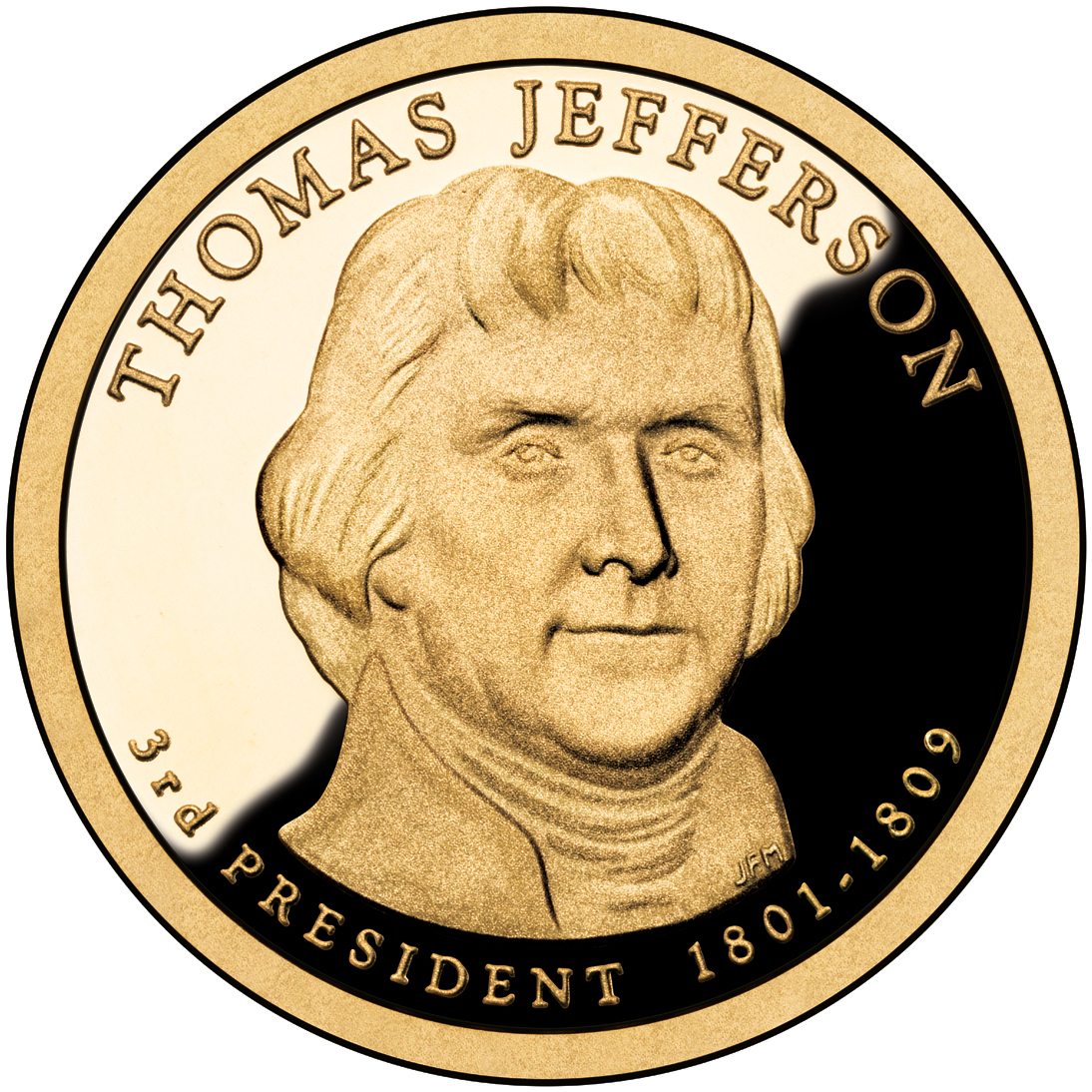
Jefferson dollars will be unveiled today in a ceremony at the Jefferson Memorial in Washington, D.C. They officially go into circulation tomorrow, August 16, 2007.

Jefferson dollar; U.S. Mint image via Associated Press

Jefferson dollars are the third in a series commemorating U.S. presidents. The series started with Washington and will proceed, three new coins a year, through all the presidents. (Quick: What’s the cheapest amount you can invest to get dollars representing all 43 administrations? Don’t forget Grover Cleveland’s anomaly . . .)

The Associated Press story notes three things of interest:

History: Fewer than a third of Americans know Jefferson was the third president. They did better with Washington as the first president. I had a few scary moments last year covering a Texas history course when kids kept answering either “George Washington” or “Abraham Lincoln” to the questions, “Who was the the Father of Texas?” (Stephen F. Austin) and “Who was the first president of the Republic of Texas?” (Sam Houston).

Economics: The vending machine industry loses about $1 billion each year when dollar bills jam in the machine’s vending mechanism. The U.S. Mint and vending machine operators hope the dollar coins catch on and help reduce those losses.

Dollar coins are unpopular: This is another in a series of efforts to “wean” people from paper dollars to coins — remember the Sacagawea dollar? The Eisenhower dollar? The Susan B. Anthony dollar? Just last week I got an Eisenhower dollar in change from our local Starbucks — they had mistakenly put it in the coin drawer for quarters. You can get dollar coins in change at the U.S. Post Office, but not at many other places. Our local post office occasionally sneaks a Euro into the dollar change mechanism. Bonus!

The Washington Post story carried more details of the poll, conducted by the Gallup organization for the U.S. Mint: Read the rest of this entry »


The story is the thing; tell the story in history

July 15, 2007

Son James and I spent July 4 in Taos, New Mexico, where we were working with Habitat for Humanity building homes (a project of the youth group at the church we attend, First Christian Church (Disciples of Christ) of Duncanville, Texas). We took that day off, saw Transformers, looked at the sights in Taos, and drove to Eagle Nest Lake to see fireworks.

Lincoln reading to son, Tad; LOC photo

At some point through the week I was discussing with others the stories that make history memorable, in my view, and we discovered that few others on the trip knew the story of the deaths of both John Adams and Thomas Jefferson on July 4, 1826, the 50th anniversary of the signing of the Declaration of Independence. It’s a story that is generally glossed over in U.S. history texts, but one that I make room for in U.S. history courses. My experience is that once kids get the story, that these two great men from such radically different backgrounds became great friends, then in presidential politics, great enemies, and then were reconciled, and then died on the exactly the same day which commemorated the event that both made them famous and that they made famous, kids don’t forget the story.

The story of their friendship is powerful and can be accompanied by readings from their letters in their later life (DBQ opportunity, teachers!). Generally, the story gets told in response to a question from a student. If I do it well, there will be sniffles from the class when we get to the part about Jefferson’s near-coma, awakening to ask whether it is the 4th of July, and then dying, and Adams’ death a few hours later, saying in error that “Jefferson still survives” (which is good that some students choke up, because it always gets me).

The story offers several mnemonic opportunities: 1826, the 50th year after the Declaration (1776); the presidencies of Adams and Jefferson, following one another; the fact that Adams and Jefferson were on the committee to write the Declaration, and that Adams nominated Jefferson as the better writer; the order of the terms of the presidency; the bitter politics at the end of Washington’s presidency (kids get interested in conflict, and the founding seems more vital to them when the controversies rear up); the reverence for law; Adams’ and Jefferson’s service as foreign ambassadors; and so on.

Once I’d told the story, others got the point. The story illustrates Mark Twain’s point about how much more difficult it is to write fiction. Fiction must stick with possibilities, Twain noted, while reality isn’t so constrained. If you wrote a screenplay with two heroes like Adams and Jefferson, and then had them die on the same day within a few hours of each other, hundreds of miles apart, you’d be criticized for being unrealistic. But it happened in history. It’s a true story, better than any lipsticked version Parson Weems could ever invent.

Study of history should never be a drudging trudge to memorize dates. The stories are what count, they are the things people remember. The stories tell people why history is important, and what mistakes to avoid, to satisfy Santayana’s ghost.

Such stories, especially about the founding of America, make history come alive and, often, grab students by the throat and make it memorable for them.  History is Elementary carries a nice story with the same message, though using Washington’s surprise attack on the Hessians from Trenton.  Teachers in need of such stories might do well to pick up a copy of David McCullough’s 1776, or Joseph Ellis’s Founding Brothers.

What other stories are there?  Well, the story about the scar on James Madison’s nose, and how it led to the cementing of the American Revolution (James Monroe, by the way, also died on July 4 — but in 1831).  The story of Lincoln’s trip to New Orleans; the story of Teddy Roosevelt’s capture of Mike Finnegan and two other outlaws, in the Dakotas; the story of Calvin Coolidge’s son’s death; the story of Robert Lincoln’s brushes with presidential assassinations; the story of the Civil War beginning in one man’s back-40 acres, and ending in his parlor; the story as Stephen Ambrose tells it of three men pinned down on a beach in Normandy on D-Day, and deciding the best course of action was to move forward to win the war; American history is rife with bizarre coincidences and seemingly minor events that go on to have great consequences.

I love to hear the story, especially told well.  Well told stories help students learn and retain history, and, I’ll wager, they boost the scores on standardized tests.


Quote of the moment: Jefferson on the 4th of July

July 4, 2007

Thomas Jefferson to Roger Weightman, declining to attend the 50th anniversary of the Declaration of Independence in the District of Columbia. This was the last letter written by Jefferson, who died 10 days later, on July 4, 1826. –LB

Monticello, June 24, 1826

Respected Sir –

The kind invitation I receive from you, on the part of the citizens of the city of Washington, to be present with them at their celebration of the fiftieth anniversary of American Independence, as one of the surviving signers of an instrument pregnant with our own, and the fate of the world, is most flattering to myself, and heightened by the honorable accompaniment proposed for the comfort of such a journey. It adds sensibly to the sufferings of sickness, to be deprived by it of a personal participation in the rejoicings of that day. But acquiescence is a duty, under circumstances not placed among those we are permitted to control. I should, indeed, with peculiar delight, have met and exch anged there congratulations personally with the small band, the remnant of that host of worthies, who joined with us on that day, in the bold and doubtful election we were to make for our country, between submission or the sword; and to have enjoyed with them the consolatory fact, that our fellow citizens, after half a century of experience and prosperity, continue to approve the choice we made. May it be to the world, what I believe it will be, (to some parts sooner, to others later, but finally to all,) the signal of arousing men to burst the chains under which monkish ignorance and superstition had persuaded them to bind themselves, and to assume the blessings and security of self-government. That form which we have substituted, restores the free right to the unbounded exercise of reason and freedom of opinion. All eyes are opened, or opening, to the rights of man.

The general spread of the light of science has already laid open to every view the palpable truth, that the mass of mankind has not been born with saddles on their backs, nor a favored few booted and spurred, ready to ride them legitimately, by the grace of God. These are grounds of hope for others. For ourselves, let the annual return of this day forever refresh our recollections of these rights, and an undiminished devotion to them.

I will ask permission here to express the pleasure with which I should have met my ancient neighbors of the city of Washington and its vicinities, with whom I passed so many years of a pleasing social intercourse; an intercourse which so much relieved the anxieties of the public cares, and left impressions so deeply engraved in my affections, as never to be forgotten. With my regret that ill health forbids me the gratification of an acceptance, be pleased to receive for yourself, and those for whom you write, the assurance of my highest respect and friendly attachments.

Th. Jefferson

Cribbed entirely from Counterpunch. Tip of the old scrub brush to Bernarda, in comments on the previous post.

Read the Declaration of Independence today.


We can honor Jefferson better than this

April 14, 2007

Jefferson, Paul Jennewein bas relief in U.S. House chamber

Jefferson, Paul Jennewein bas relief in U.S. House chamber

Jefferson’s birthday sneaked up on me this year. There is the constant tension between doing the Things that Keep the Wolf from the Door and following all the things we should follow; wolves have been on my mind more lately (notice the drop off in posts).

So all I had was a warning post last week, and the post yesterday wishing Tom a happy natal anniversary day. Hey it’s not my job.

But what about the rest of you? What about the president, Congress, public officials, educators and others everywhere?

Here is what I found of celebrations of Jefferson’s birthday:

Architectural Record reported that the Thomas Jefferson Medal in Architecture was won by Zaha Hadid.

The Daily Progress of Charlottesville, Virginia, Jefferson’s home town, reported that Alan Greenspan won the first Thomas Jefferson Medal in Citizen Leadership.

In the last paragraph of the story about Greenspan, The Daily Progress also noted that the Thomas Jefferson Medal in Law was awarded to Anne-Marie Slaughter.

The Thomas Jefferson Center for the Protection of Free Expression issued 16 “Jefferson Muzzle” awards to people who damaged free expression. The story I found was from the UPI wire, UPI now being owned by the Unification Church and probably sort of a muzzle itself. The story listed only one of 16 awardees.

In Washington, D.C., Secretary of Commerce Carlos M. Gutierrez noted the 200th anniversary of the science agencies that became the National Oceanic and Atmospheric Administration (NOAA), in a speech at the Jefferson Memorial. Jefferson had created the first science agency, the Survey of the Coast, during his presidency, in 1807.

President Bush declared April 13 “Thomas Jefferson Day,” on April 11. If any news agency picked up that press release, I’ve not been able to find it.

That’s about it for celebration. That’s not a lot. It’s not enough.

We can and should do better than that. In The Philadelphia Inquirer, education scholar Peter Gibbon of Boston University suggests we can and should honor Jefferson more overtly, despite Jefferson’s own refusal of letting the citizens of Boston make his birthday a holiday:

Jefferson was more than an eloquent espouser of democratic ideology, more than a patient and realistic secretary of state, and more than a president who doubled the size of America with the Louisiana Purchase. He was a scientist who analyzed climate change, studied mastodon bones, and championed small-pox inoculation; a farmer who invented a moldboard plough and brought fruit trees and upland rice to America; a lawyer who helped make Virginia laws more humane; and an architect who designed Monticello and the University of Virginia.

Only education, Jefferson believed, could end tyranny and preserve democratic values. Thus, he advocated universal primary education, colleges open to merit, and curriculum separate from theology. His thousands of books eventually became the beginning of the Library of Congress. Devoted to reason, he loved beauty, playing his violin, and marveling at the flowers and fruits of the Virginia countryside. In love with knowledge, he placed a higher priority on virtue.

Jefferson cultivated friends, treasured his wife (who died after only 10 years of marriage), and watched after his children. In 1804, Maria, his 26-year-old daughter, died. Against a background of war, political combat, and personal suffering, Jefferson struggled to retain his optimism.

Our celebration of Jefferson’s birthday today is more complicated than the adoration of Boston citizens in 1803. Now, we acknowledge a guilty, conflicted slaveholder who did not transcend his time, a tough politician who orchestrated attacks on his opponents and carefully shaped his reputation for posterity. We see a second presidential term marred by a misconceived embargo that backfired and caused an economic crisis. Still, we might also see a sweet-tempered, affectionate human being – a diplomat, architect, and idealist who believed in religious tolerance, rebuked tyrants, promoted civil rights, and wrote the words that justify the creation of America.

Some Americans are unhappy with Jefferson’s legacy. As with all real humans who achieve some level of hero-worship, some people are unhappy to discover that others who do heroic things are not heroic in all aspects of their lives. They need to get over it.

We should do more to celebrate Thomas Jefferson and his legacy. April 13 is a good day for such celebrations.

This is not a call for a hero cult, nor especially a religious-style cult. Honoring Jefferson honors his better nature, his calls for freedom for everyone, his calls for ending slavery (even if he did not free his own slaves), his call for universal education in order to make a republic work well and righteously, his calls for intellectual freedom, his celebration of the Common Man as an ideal, his work for libraries and learning, his work for good and beautiful architecture, his love of science, etc., etc., etc.

Honoring Jefferson honors America, and calls us to do better ourselves in working for a higher good. We should do that.


Happy birthday, Thomas Jefferson! (All Men Are Created Equal Day)

April 13, 2007

Thomas Jefferson was born to Jane Randolph and Peter Jefferson on April 13, 1743 (Gregorian calendar — at the time of his birth, most of the English-speaking world still used the Julian calendar, by whose calculation Jefferson was born April 4).

Happy birthday, Thomas Jefferson.

How will you celebrate?


Belated, or pending birthday? Thomas Jefferson

April 7, 2007

Shouldn’t we make a bigger fuss over Jefferson’s birthday? And didn’t we just miss it?

Thomas Jefferson was born April 2, 1743. Had he not died on July 4, 1826 — the famous day that both Jefferson and John Adams died, the 50th anniversary of the Declaration of Independence — he’d have been 264 years old this week. The republic he helped found, and whose second revolution his presidency cemented, is 218 years old. That the republic survived for more than 20 years without major changes, or violent revolution, was perhaps a surprise to Jefferson, who famously wrote to Madison that one generation could not write a contract to bind a future generation, even in the form of a constitutional government.

That the republic has survived for 200 years past one generation might strike him as some sort of miracle, evidence of the “hand of providence” that Franklin guy and the Washington guy often mentioned.

But wait a minute: Was he born April 2, or was he born April 13?

England and the English-speaking world were slow to adopt the Gregorian calendar, promoted by Pope Gregory in a reform of calculations for the dates of moveable feasts in the Catholic Church. When Jefferson was born, Virginia was still on the Julian calendar. When England, and the U.S., belatedly adopted the Gregorian calendar a few years later, some dates were shifted by up to 11 days. Jefferson’s birth date was one of those, as also, famously, was George Washington’s. 2005 Jefferson nickel, obverse

So, while his family’s Bible may have recorded April 2 as his birth date, in the new, Julian calendar, the date was April 13. We know this because the Wikipedia article notes the date as “N.S.,” or “New Style.

A warm-up exercise for high school students could involve the translation of dates of birth for patriots, from the Julian to the Gregorian calendars. This issue is not directly treated in the Texas Essential Knowledge and Skills (TEKS), but certainly the method of measuring the year is a major part of the march of technology, and worth spending a few minutes’ consideration for high school students in U.S. history.

Whew! That gives us most of a week to plan appropriate celebrations . . .

Good source: The Thomas Jefferson Digital Archive at the University of Virginia


Ninth Festival of the Trees

March 1, 2007

You are a social scientist?  You do not pay adequate attention to trees, in my view (with a few exceptions).  History is not only made with treaties signed under great trees, but history is made when forests move (ask Macbeth), or when orchards and forests are planted.  Economics would be nowhere without a building to do the economics in, and that building most likely owes much of its structure to trees — as does our entire economy (checked lumber prices lately?).  Don’t get me started on agriculture.

And then there are those trees that inspire (Isaac Newton, Joyce Kilmer), and those that simply give us beauty.

You have many good reasons to check out this compilation of posts, a web carnival, all about trees:  Festival of the Trees #9.  If you check carefully, you’ll even find some history involving Thomas Jefferson there.


Fisking Paszkiewicz — or virtual carnage in Kearny, N.J.

February 20, 2007

That kid in New Jersey whose town turned on him, on the town’s internet bulletin board, after he ratted out the history teacher who was preaching instead of teaching? He’s still under attack.

The teacher took some time out to defend his odd views in the local paper. His letter is several weeks old, and it’s been fisked by others, but I want my licks. I fisk the letter below the fold. Read the rest of this entry »


Tom Jefferson’s apples – for sale!

February 6, 2007

Moving to Utah (in the early Tertiary, if I recall correctly) took our family from the spud fields of southern Idaho, and plopped us in the middle of fruit orchards on the foothills of the Wasatch Front. There, protected from eastern winds and too-early sunlight by Mt. Timpanogos, farmers grew Bing cherries, pie cherries, peaches, apricots, and a lot of apples.

Our bus route to school was lined with orchards; missing the bus could make a wonderful experience wandering through the tended rows, finding the occasional clusters of wild asparagus (mark that down for next Sunday . . .), and discovering songbirds’ hiding places.

For a while our athletic fields abutted orchards. Late autumn football practices were sometimes made merrier when the migrant pickers took pity on us and tossed a few pippins over the fence.

In a perfect world that I imagine, orchards are close by many schools. Children get to see the blossom of the cherry trees heralding spring, and when they return to school in the fall they see the ripening apples, and then the harvesting of the apples. Time is measured, and history demonstrated, by the natural rhythms of agriculture.Newtown pippins, apples from Monticello

How about an apple from Thomas Jefferson’s farm? You can buy the trees from the foundation that runs Monticello. In that perfect world I imagine, the orchard near the school would feature at least one tree from Tom Jefferson’s orchard, one from George Washington’s, and several would be direct descendants of Ohio Valley apple trees planted by John Chapman, Johnny Appleseed himself. When teachers discuss the farms and actions of these men, even daydreaming kids could look out the window and see history staring back at them.

For the Albemarle (or Newtown) Pippin (malus cv.) pictured here, the Monticello catalog waxes freely:

In comparing the fruits of Europe to those of America, Jefferson wrote from Paris, “They have no apples here to compare with our Newtown pippin.” In 1759 Benjamin Franklin imported barrels of the fruit into London and, by 1807 it appeared on the Horticultural Society of London’s “Select List” of apples. England’s Queen Victoria once waived the import tariff for the pippin and it was said that, “they were eaten and praised by royal lips, and swallowed by many aristocratic throats. The name Albemarle Pippin first appeared on the editorial page of Richmond, Virginia’s The Southern Planter in 1843, saying “the very best pippin we know is grown in the county of Albemarle, ” which is where Monticello is located. The green-skinned, yellow-fleshed pippin is known as the Prince of Apples. It’s mouth-watering flavors actually improve with storage. This apple is self-pollinating, but planting more than one enhances production. Grows 14 to 16 feet in height. Early 1700’s.

Zones 5-9.

Trees begin shipping February 26; supplies are limited. Proceeds support the restoration and education programs at Monticello. One may purchase a part of history to come live in one’s yard.


National Separation of Church and State Day

January 16, 2007

Today, January 16, is the anniversary of Virginia’s enacting the Statute for Religious Freedom, in 1786. It deserves an international celebration.

After working with George Mason and the kid, James Madison, to craft Viriginia’s Bill of Rights in 1776, Thomas Jefferson was dispatched as a delegate to the Continental Congress in Philadelphia. Being assigned to Philadelphia was a bother to Jefferson — the real action, he thought, was in Virginia, where a new form of government was being crafted, where Virginians were working to determine what was the best government to assure the most freedom for free peoples. Jefferson was called on to draft what became the Declaration of Independence, a task and accomplishment he later grew to appreciate. Still, he wanted to go back to Virginia, and soon.

Jefferson portrait, Monticello imageWhen Jefferson got back to Virginia, he spent much of his time doing exactly what he thought was the good stuff: Crafting a good government for a good nation, Virginia. Among other things he served as governor, and he wrote about 150 model laws for the good government he so earnestly hoped to see. In 1779, he wrote a law to cement the religious freedom James Madison had persuaded Mason and Jefferson to include in the Virginia Bill of Rights. But the law languished in a busy legislature still working to win the right to make that government work, in a war with Britain. Jefferson wrote about his successes and failures, as a record for others (see Notes on the State of Virginia).

By 1785, Jefferson had been called to the post-war ambassadorship of the confederation of thirteen colonies to France. When Patrick Henry rose in the legislature in Williamsburg to proposed that Virginia rethink its disestablishment of religion, to at last consider paying clergy for teaching kids, Jefferson sat unaware on the other side of the Atlantic. James Madison saw the full import of Henry’s proposal, though. While noting that a country like Virginia should desire education for its youth and morality as part of the instruction, such an action as Henry proposed was tantamount to picking a religion — shouldn’t the people have a chance to weigh in on the issue? Madison proposed to put the issue over to the next session of the legislature, in 1786, and the Virginia Assembly approved Madison’s proposal. Read the rest of this entry »