Rep. Ellison and the Islamic roots of American law

January 3, 2007

U.S. Rep. Keith Ellison, D-Minn., delivered a lesson to critics today on the value of knowing history.

First, Los Angeles conservative radio host Dennis Prager embarrassed himself by calling on Ellison to use a Christian Bible to put his left hand on while being sworn in as a Member of Congress, the first Moslem to be a Member. Ellison pointed out that in the swearing-in ceremony, no book is used, and noted that other religious texts have been used by people of other faiths during the photo session afterward, when members re-enact the swearing in with the Speaker of the House. Prager compounded his history sins by refusing to back down. Ellison correctly stood his ground.

Then Virginia’s U.S. Rep. Virgil Goode pushed it farther, warning that unless we control immigration, Ellison will be the beachhead for a Moslem take-over of Congress. Ellison, defending the Bill of Rights, stood his ground and refused to get into a name-calling discussion.

Then Roy Moore of Alabama, who was rejected by voters for governor after having made a spectacle of himself and the Alabama Supreme Court over his efforts to install his own religious shrine in the Supreme Court Building, called for Ellison to be denied his seat. Ellison coolly ignored Moore, defending the First Amendment instead.

Now Ellison has acted, and his action comprises a neat, clean and witty rebuttal to the critics.

Read the rest of this entry »


Jefferson on religious freedom

August 1, 2006

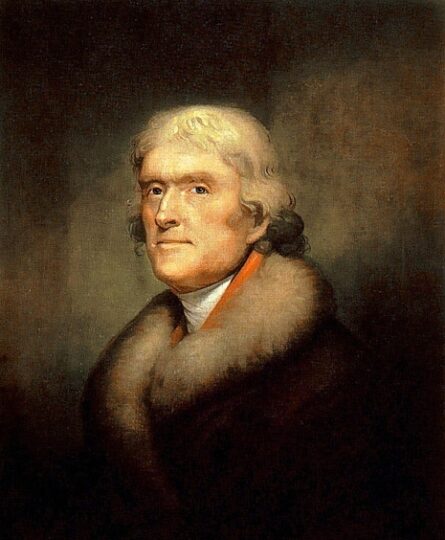
Thomas Jefferson *

In his Autobiography Jefferson recounted the 1786 passage of the law he proposed in 1779 to secure religious freedom in Virginia, the Statute for Religious Freedom:

The bill for establishing religious freedom, the principles of which had, to a certain degree, been enacted before, I had drawn in all the latitude of reason and right. It still met with opposition; but, with some mutilations in the preamble, it was finally passed; and a singular proposition proved that its protection of opinion was meant to be universal. Where the preamble declares, that coercion is a departure from the plan of the holy author of our religion, an amendment was proposed, by inserting the word “Jesus Christ,” so that it should read, “a departure from the plan of Jesus Christ, the holy author of our religion;” the insertion was rejected by a great majority, in proof that they meant to comprehend, within the mantle of its protection, the Jew and the Gentile, the Christian and the Mahometan, the Hindoo, and the Infidel of every denomination.

Life and Selected Writings of Thomas Jefferson, Modern Library 1993 edition, pp. 45 and 46.

* Image is a photo of detail from a painting of Jefferson by Rembrandt Peale, courtesy of the New York Historical Society by way of the Library of Congress.


Bartonizing Jefferson

July 30, 2006

Dictionaries of the future will feature “bartonizing,” after Texas mathematics teacher David Barton, with a reference to “bowdlerization.” Ed Brayton at Dispatches from the Culture Wars details a recent flurry of correcting a Barton misapprehension of history about one of Thomas Jefferson’s studies of the gospels, which resulted in a book called The Jefferson Bible.

The issue is a strange claim by Barton, repeated by Dr. D. James Kennedy at Coral Gables Ministries, that Jefferson wrote the thing in an attempt to convert Indians to Christianity. Students of Jefferson immediately recognize that claim as contrary to Jefferson’s character on several fronts.

The discussion is enlightened and enlightening; I noted the similar claim that Jefferson built a church and hired a priest for the Kaskaskias (in Illinois), with federal funds, is similarly in error. The fight against revisionist history — revising history to add errors — continues.

(One current edition of the Jefferson Bible on sale at Monticello features a forward by Rev. F. Forrester Church, minister at senior minister of the Unitarian Church of All Souls in New York City; that must frost Kennedy and Barton.)


False Quotes Department: Jefferson, Kerry, Tim and Josh

July 26, 2006

Catching false quotes is a key goal of this enterprise.

Back in April, Josh at The Everyday Economist linked to Tim Blair with an almost snarky catch of John Kerry citing a line from Jefferson that, alas, Jefferson didn’t write or say. Tim links to The Jefferson Library. It’s short; here’s the entirety of Tim’s post:

John Kerry:

No wonder Thomas Jefferson himself said: “Dissent is the greatest form of patriotism.”

The Jefferson Library:

There are a number of quotes that we do not find in Thomas Jefferson’s correspondence or other writings; in such cases, Jefferson should not be cited as the source. Among the most common of these spurious Jefferson quotes [is]:

* “Dissent is the highest form of patriotism.”

Jefferson could have said something like that (and did — posts for another time, perhaps). I don’t find this common error nearly so irritating as those where a founder is quoted saying quite the opposite of what he or she would have said, or did say. Read the rest of this entry »