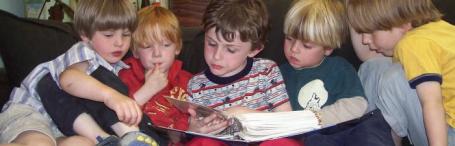
Got a manual typewriter you can donate?

August 19, 2007

Few of us use manual typewriters for business anymore. But there are a few people who use them.

From comments to a previous “typewriter of the moment” post:

It is so thrilling to see how the ‘little’ things such as our manual typewriter can connect people in far away places to real feelings! They are lucky kids indeed but how lucky are we that we get to be a part of it :) If you have a manual typewriter that you would like to see used and loved by “generation ?” feel free to send it to us. One just is not enough!
CSWS 9450 22nd Ave SW. Seattle. WA. 98106

With Love
Sarah Airhart
Founder of the Community School of West Seattle.

So, if you’ve got a working typewriter in your attic or basement, or in your office acting as a paperweight, now you know where to send it — I’ll wager Sarah will give you a receipt so you can deduct the value of the machine from your income taxes.

But even if there were no deduction, wouldn’t the interest of the kids be enough?

Kids at the Community School of West Seattle


Typewriter of the moment: Scottish poet Edwin Morgan

August 17, 2007

A poet's typewriter; Scottish poet Edwin Morgan

From the Learning and Teaching Scotland site:

“Edwin Morgan has written hundreds of poems and translations on countless subjects and in a dizzying variety of forms and styles from Glasgow Sonnets to Science Fiction, opera libretto to Concrete poetry, live performance with jazz saxophonist Tommy Smith to the Instamatic poems.

“Edwin is widely acclaimed as Scotland’s greatest living poet. In 2004 the title of ‘Scots Makar’ was formally bestowed on Edwin effectively creating the first ‘Poet Laureate’ of Scotland.

“Literacy and Numeracy Scotland is developing a new Edwin Morgan resource for schools. The resource will feature video clips of Liz Lochhead and Edwin in conversation about his life, inspirations and poetry, as well as audio performances of 27 of Edwin’s poems with accompanying teaching ideas and interactives.”

See and hear Edwin Morgan’s poems here.

Photo from Learning and Teaching Scotland


Typewriter of the moment: Faulkner, again

August 15, 2007

The previous photo showed Faulkner himself using the machine.

It was a desktop machine. This color shot shows Faulkner’s portable typewriter, a different machine from the one in the publicity still from 1954.

William Faulkner's typewriter, displayed at his home in Oxford, Mississippi; photo by Gary Bridgman

Photographer Gary Bridgman provided a thorough history and explanation, at the Wikipedia Media site, which I quote completely and directly — bless him for the story:

The “Faulkner portable”: American novelist William Faulkner’s (1897-1962) Underwood Universal Portable typewriter, resting on a tiny desk his stepson helped him build. This space at Rowan Oak, the author’s home, was part of the back porch until Faulkner spent part of a Random House advance to enclose it in 1952, long after he had written his seminal Compson and Sartoris family novels. He insisted that this room not be called his “study.” According to biographer Joseph Blotner, “he did not study in it, so there was no sense in calling it that. It was the ‘office,’ the traditional name for the room in the plantation houses where the business was transacted.” As to the typewriter itself, Underwood introduced its Universal Portable in the mid-1930s among a full line of portables such as Champion, Noiseless Portable and Junior. Faulkner had a habit of buying used portables locally, wearing them out, then trading them in on more used portables. This Underwood was one of at least three typewriters in Faulkner’s possession at the time of his death (the University of Virginia has one, too). So, this is no more “the” typewriter any more than those square carpenter’s pencils next to it are “the” pencils. Had Faulkner lived a few more years, this machine would have met the same fate as the rest. Still, the room has a resonance. BOOK magazine was publishing an article of mine on “Yoknapatourism,” and thinking (mistakenly) that the editors hadn’t already selected a photographer, I returned to Oxford on a rainy October afternoon to make my own pictures for submission. The travel piece was eventually illustrated with sunny-day brochure shots, but I was happy to keep this one for myself. There was no direct lighting within the office, so I let the film take its time, soaking up faint incandescent glow from the library and main hallway, which neatly balanced the cloudy daylight. I used the camera’s timer so my hand wouldn’t jostle the tripod, and I even backed out of the room–in part to let the scarce light do its work and, I think, because I wanted Faulkner’s office truly vacant.

Trivia: the book next to the typewriter is the 1939 edition of Writer’s Market. Thanks to Bill Griffith, curator of Rowan Oak, for letting me past the Lucite wall and to Milly Moorhead West for lending me the tripod. – Gary Bridgman

Photo by Gary Bridgman, southsideartgallery.com.


Typewriter of the moment: Langston Hughes

August 11, 2007

Langston Hughes at his typewriter

Langston Hughes at his typewriter. Photo from the Kennedy Center.

Manuscript of Langston Hughes' poem,

Manuscsript of “Harlem,” with correction marks. From Kennedy Center website – Harlem Renaissance


Typewriter of the moment: The Living Classroom

August 10, 2007

Typewriter donated by Anya to the Living Classroom, at the Community School of West Seattle, WashingtonSlight deviation from my usual practice of featuring the technological marvel of the writing machine of a well-known writer — these writers are not yet well known.

Someone brought in a vintage Smith-Corona typewriter to one of my favorite classrooms, at the Community School in West Seattle. Photographic evidence shows the machine is still in good working order (better than my Royal), and the students have already figured out how to make it work (see photo below).

My typing career began with my mother’s and father’s Royal, similar to the one I now own. It got me to ninth grade with no problems. I took typing classes on the classic, newsroom Underwoods, about the time that the IBM Selectric was making in-roads. In my senior year of high school I got an Underwood portable — brother Dwight was selling for Underwood-Olivetti. Later I got an old, junked Olivetti electric that was gray, would do line-and-a-half as well as double spacing, and which had a pitch somewhere between 10 and 12 pica. It was heavy and industrial, but the typeface was so readable that it was popular with my debater colleagues — we used to carry the machine with us to tournaments after I joined the college debate squad.

In my junior year at the University of Utah, on a Thomas J. Watson, Jr., Memorial scholarship from IBM, I purchased a Correcting Selectric II (no, IBM offered no discount). About 20 years later, tired of the massive repair bills and hoping word processors would forever banish it from our house, my wife donated that typewriter to the Salvation Army. I found another at a garage sale, and got it for $10.00. The mechanism on that one sprang out of the case about a year later, and we eventually donated it, too.

Perry W. Buffington found the Royal that graces my home office now, largely unused but full of sentiment. (I think Buff wanted me to write more.)

These kids in Washington — they don’t know the value of the tool they have. They can’t know.  Lucky kids.

Paper typed in the Living Classroom

Photo from the Living Classroom; work product from a student.


Encore post: Ernie Pyle’s typewriter

July 16, 2007


PBS’s series, “History Detectives,” featured a mystery involving a typewriter alleged to have belonged to World War II reporter-hero Ernie Pyle. This is an encore post from May 1, 2007, originally entitled “Typewriter of the moment: Ernie Pyle.” Extra links are posted at the end.

This typewriter, a Corona (before the merger made Smith-Corona), belonged to Ernie Pyle, the columnist famous for traveling with the the foot soldiers of all services in World War II. Pyle won a Pulitzer Prize in 1944 for his columns in 1943, published collectively in the books Here is Your War and Brave Men. Pyle was killed covering the end of World War II in the Pacific, on an island named Ie Shima, on April 18, 1945.

The typewriter rests in the Albuquerque Museum. It comes with a story.

Ernie Pyle's typewriter, rescued from a foxhole in Italy in 1944; Albuquerque Museum From the Albuquerque Museum’s exhibit, “America’s Most Loved Reporter”:

[Quote] Ernie Pyle interviewed Sergeant Don Bell, a rodeo rider, in June or July 1944 outside of St. Lo, France. Bell recalled that the foxhole they shared caved in during German shelling. Pyle said, “I have my notes, but my little portable typewriter is buried in that hole.” They hurriedly abandoned the foxhole, leaving the typewriter behind.

Sgt. Bell later salvaged it, kept it through the war, and donated it to the Museum in 1990. A photograph of Pyle in Normandy, typing on an Underwood, may have been taken after this event.

Bell recalled the interview as comforting. He wrote, “…Ernie had taken my ma’s wisdom and turned it into a soldier’s lesson: to find strength in battle you take hold of strength you’ve known at home…and of the faith that underlies it.” [End quote]


Additional on-line sources about Ernie Pyle and his typewriters, July 16, 2007:


Typewriter of the moment: William Faulkner

June 24, 2007

Faulkner at typewriter, Aug 12, 1954 - AP Photo, ShelfLife

William Faulkner at his typewriter, August 12, 1954, at his home in Oxford, Mississippi. Associated Press photo, via Eons website.

The photo was probably posed; the two books to the left of the typewriter are Faulkner books. Faulkner may have written in a pressed shirt and tie.

Faulkner won the Nobel Prize for Literature in 1950, and delivered a memorable speech about “the human condition” and the importance of art, especially poetry and prose, at his acceptance. His 1954 book, A Fable, won both the National Book Award and the Pulitzer Prize for Fiction, in 1955.

The typewriter is a Royal KHM.

Faulkner was born September 25, 1897 — 2007 marks the 110th anniversary of his birth.

“The past is never dead. It’s not even past.”

—Gavin Stevens

Act I, Scene III, Requiem for a Nun