U.S. history required – in college?

August 5, 2006

Third or fourth time is the charm, right?

In Arizona, where the legislature recently decreed a U.S. flag and a copy of the Constitution and Bill of Rights will be displayed in all college classrooms, the debate now turns to whether the legislature should require the study of U.S. history by undergraduates. I appears the legislators do not find college kids have enough appreciation for our nation’s history.

I’ll reproduce the entire story out of the Arizona Republic below the fold (Dan Quayle’s family’s newspaper!).

Is it just me, or is it that these pseudo-patriots who don’t think our kids are well-enough indoctrinated always stamp the life out of history when they start these tirades? I have yet to find a law that mandates that history be interesting. Instead we get standards that provide great, boring, history-crushing, mind-and-butt-numbing lists. In short, these requirements tend to make history not worth the study.

And, as with those who celebrate Fillmore’s bringing the bathtub to the White House, the advocates almost always get history wrong. [Millard Fillmore himself, never attended college; he apprenticed first in the cloth business, and then in law.]

Barry Goldwater will be coming out of his grave to stop this silliness. Maybe literally. If such standards don’t make high school students history literate, what makes anyone think the failed methods would work on college students? If the standards do work to make high school kids knowledgeable in history, why would the college standards be necessary?

This controversy smells. It has the earmarks of being one more way to issue diatribes against “librul college professors.” It’s one more way of flogging public education, while refusing to give educators the tools to solve the problems.

Article below the fold; please comment. Read the rest of this entry »


James Madison, go-to guy

July 31, 2006

School starts soon. History classes will study the founding of the United States. And especially under the topical restrictions imposed by standardized testing, many kids will get a short-form version of history that leaves out some of the most interesting stuff.

James Madison gets short shrift in the current canon, in my opinion. Madison was the fourth president, sure, and many textbooks note his role in the convention at Philadelphia that wrote the Constitution in 1787. But I think Madison’s larger career, especially his advocacy for freedom from 1776 to his death, is overlooked. Madison was the “essential man” in the founding of the nation, in many ways. He was able to collaborate with people as few others in order to get things done, including his work with George Mason on the Virginia Bill of Rights, with George Washington on the Constitution and national government structure, Thomas Jefferson on the structure and preservation of freedom, Alexander Hamilton on the Constitution and national bank, and James Monroe on continuing the American Revolution.

We need to look harder at the methods and philosophy, and life, of James Madison. This is an opinion I’ve held for a long time. Below the fold I reproduce a “sermon” I delivered to the North Texas Church of Freethought in November 2001. Read the rest of this entry »


Mayflower catechism, no.

July 26, 2006

Dispatches from the Culture Wars features a set of comments on an interview right-right-wing pundit John Lofton did with Roy Moore, the former chief justice of Alabama’s Supreme Court who lost his job when he illegally tried to force his religion on the court and on Alabama. This year Moore ran for governor of Alabama, losing in the primary election.

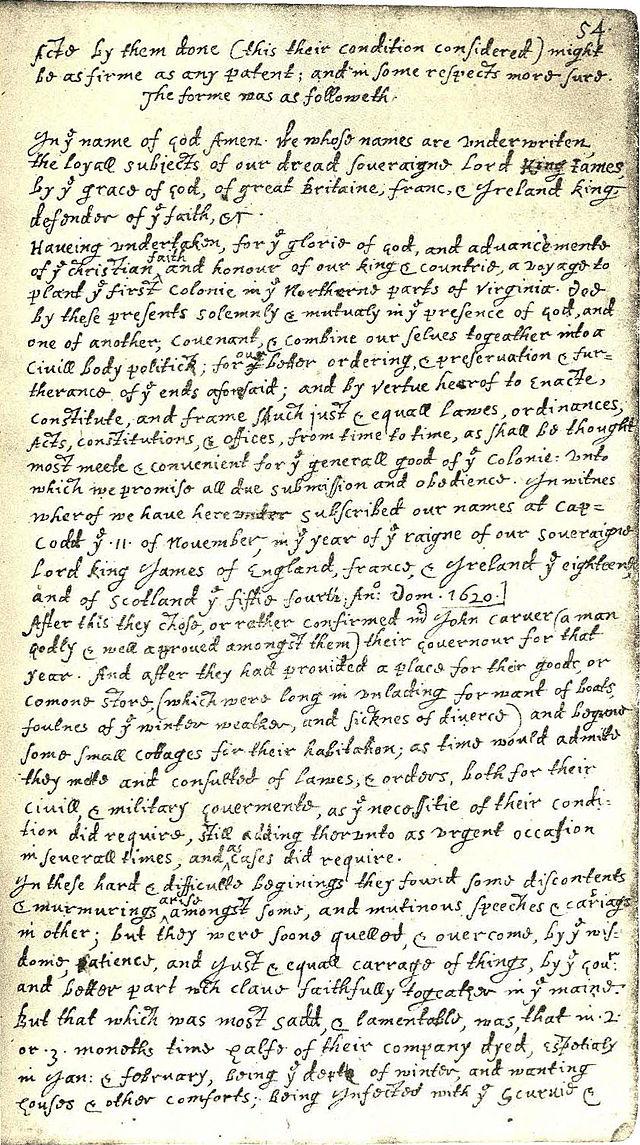
Mayflower Compact. It's a contract between people.  God is a witness, but not a party.

Mayflower Compact. It’s a contract between people. God is a witness, but not a party.

One of the grandest canards in current thought about U.S. history is that the Mayflower Compact set up a theocracy in Massachusetts. Lofton and Moore banter about it as if it were well established fact — or as if, as I suspect, neither of them has looked at the thing in a long time, and that neither of them has ever diagrammed the operative sentence in the thing.

The Mayflower Compact was an agreement between the people in two religiously disparate groups, that among them they would fairly establish a governing body to fairly make laws, and that they would abide by those laws. Quite the opposite of a theocracy, this was the first time Europeans set up in the New World a government by consent of the governed. That is something quite different from a theocracy. Read the rest of this entry »