Magician Marco Tempest pushes the boundaries on use of iPhones in magic tricks — is it magic, pure electronics, or what we want to see?
Tell us in comments how you could use this shorter-than-usual TEDS video as a bell-ringer, teachers — or as an ice-breaker, meeting facilitators and corporate trainers:
Tip of the old scrub brush to Michelle Gardiner, who suffered my bass playing with quiet equanimity.
Spread the word; friends don't allow friends to repeat history.
And that got me thinking: What if Edith Wharton had Facebooked? Had she lived in our time and communicated digitally, I wonder what her literature would be like. Looking at five days of cursive writing and personal letters made me realize that her compulsion to jot down her thoughts was no different than ours today when we tweet about what we had for lunch or share some fab link we just discovered. The difference between a letter written longhand and a Facebook post is that one takes a little bit longer (and leaves a more lasting trace), but the purpose is the same. Whether we live on a grand, Whartonian scale or a quieter, more ordinary one, we feel more significant when we share intimacies about ourselves with others.
There’s a good warm-up and/or journaling exercise in there for literature teachers.
Spread the word; friends don't allow friends to repeat history.
I know you think you know what you see; what you think you see may not be what you actually see. Your brain modifies what you think you see, in order to make it appear sensible, and in doing so, it sometimes makes you see things quite differently from what they are. Don’t forget that.
So, how do we know what we know? How do we know that what we know is correct?
Surely this could be made into a bell ringer/warmup. Check out the images for other geographic forms, and great photos of them. Nose around the ESA site, there are some great finds. Can you quickly identify this image, for example (without looking at the name of the photo file)?
Spread the word; friends don't allow friends to repeat history.
If a day goes by that I don’t get a question about one of these sites, it’s a very slow day.
Those questions tell me something else: Students have genuine interests in geography, and in mysteries. Students will pay attention to lesson plans that include one or more of these sites in them, especially if you refer to the mystery.
How about just a geography search: How close is the closest site to you? Can students visit these sites on their summer vacations? What airport is closest for tourists? What arrangements need to be made to visit the place?
Wired.com provides the video — your students have the questions. Can you provide the answers, or lead them to the answers? How about listing your answers in comments?
From the Deseret News: “Ben Lomond Peak towers above Ogden (Utah). The mountain is believed to have inspired the Paramount movie logo, below, in use since 1914. (Ravell Call, Deseret News)
It’s none of the above because one of Hollywood’s most familiar images — the famous Paramount Pictures logo — was inspired by Weber County’s Ben Lomond Peak.
As such, Ben Lomond — not even the highest summit in Weber County — may be the most famous mountain in the Beehive State.
The peak is given credit for prompting creation of the majestic but fictional mountain in the popular Paramount design, based on two histories of the motion-picture company.
According to Leslie Halliwell’s “Mountain of Dreams,” a biography of Paramount, founder William Hodkinson grew up in Ogden and the logo was “a memory of childhood in his home state of Utah.”
Compare it to the Paramount Pictures logo now:
Paramount Pictures logo
Teachers may want to hustle over to the Deseret News site to capture the story for classroom use — the online version includes a short set of slides of a hike to the top of the peak (it’s a climb most reasonably healthy people can make in a day – “reasonably healthy” to include acclimated to the altitude).
What other geographic features have become commercial logos? How do images of geography affect our culture?
For my money, I still like Timpanogos better, even if the Osmonds did use it.
See the 2012 update of this post; there is a bit more information available on the 100th anniversary of Paramount Pictures.
Spread the word; friends don't allow friends to repeat history.
School kids and people seeking naturalization as citizens of the U.S. should be able to tell you there are 13 stripes on the U.S. flag, one for each of the original 13 colonies. The top stripe is red, and the bottom stripe is red.
Oops. The U.S. Postal Service printed a stamp that features what looks like a flag with a 14th stripe.
Representations of the general usage, first class postal stamps issued by the U.S. Postal Service in April 2008 -- and, is that a 14th stripe on the flag in the lower right? The four original, correct paintings were done by Laura Stutzman of Mountain Lake Park, Maryland.
The error appears on the fourth of a four-stamp plate known as the “Flags 24/7 stamps.” The flag is portrayed flying at four different times of the day, sunrise, noon, sunset, and night. The night portrayal carries the last-minute art revision that looks like a 14th stripe, on the bottom of the flag.
Errors in stamps drive up collectors’ prices — USPS says it has no plans to change the stamp now, so it won’t become a rarity.
Please note that flags flown after sunset should be specially lighted to be flown; the U.S. flag code suggests flags should be retired at sunset, otherwise, except at a few locations where the flag may be flown 24 hours a day, by law. USPS said:
For more than 200 years, the American flag has been the symbol of our nation’s source of pride and inspiration for millions of citizens. In May of 1776, Betsy Ross reported that she sewed the first American flag.
Federal law stipulates many aspects of flag etiquette. In 1942, a code of flag etiquette was established. The code states in part that the American flag should be displayed from sunrise to sunset every day, weather permitting, but especially on days of national importance like Memorial Day, Independence Day, Labor Day, and Veterans Day. Also, federal law requires that “when a patriotic effect is desired,” the flag can be flown through the night if properly lit. Although compliance is voluntary, public observation of the code’s measures is widespread throughout the nation.
Teachers, can you use this for a warm-up/bell ringer exercise on flag history?
The Christian Science Monitor presented a series of eight different views of the world economy for 2008: 2008, a look ahead. Since the Monitor is one of the better newspapers on Earth, the series presents outstanding reporting with important insights into economics.
These are custom made for warm-ups and student projects:
Photo: “In high demand: A Chinese corn farmer in Guiyang. Maize prices rise as global demand goes up for its use as food – including such uses as corn syrup (soft drinks) – and fuel, such as ethanol.” Chinese Newsphoto/Reuters, via Christian Science Monitor
Spread the word; friends don't allow friends to repeat history.
It’s a good discussion of the impact one citizen’s vote really makes, a discussion leavened by the science background of Revere. The article would make a wonderful warm-up exercise for classes in civics, government, economics and U.S. history.
Voting is a privilege, but it’s also a duty of good citizenship. Should we require people to vote, by law, with criminal penalties for those who fail to make a choice at the polls?
What do you think?
Spread the word; friends don't allow friends to repeat history.
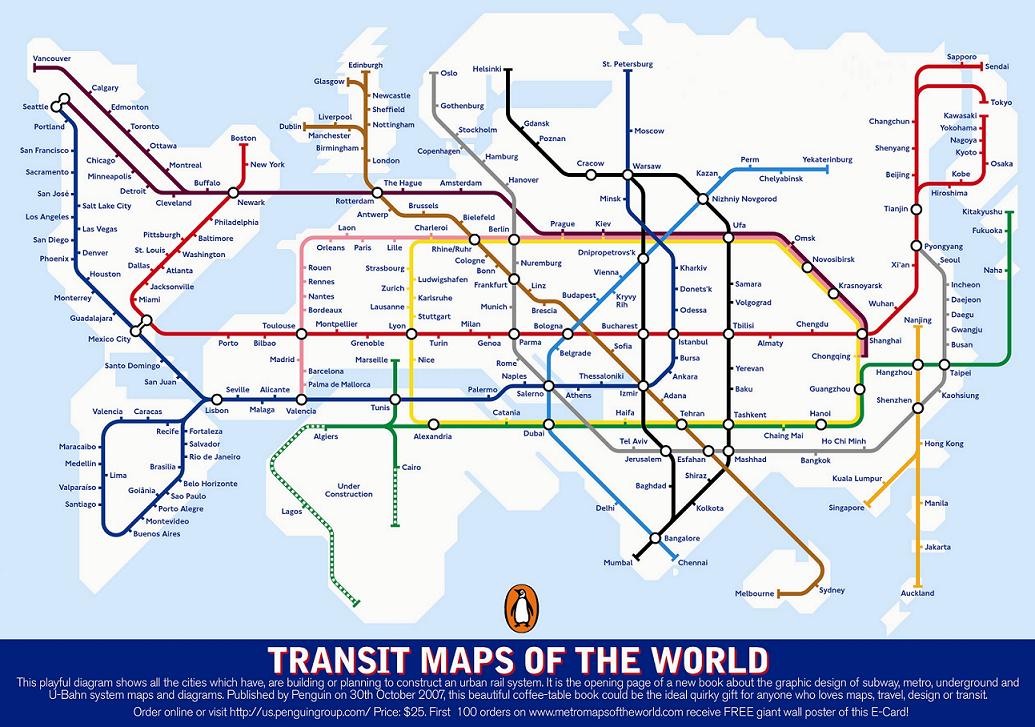
Fun map. Readers at Strange Maps noted lots of geographical challenges in these train routes. Wouldn’t this make a great warm-up/bell-ringer, to have students find the geographical difficulties, errors and impossibilities?
* Jack Rhodes was director of forensics at the University of Utah when I was an undergraduate there — my old debate coach. He was so familiar with bus and train schedules, as a hobbyist, that we frequently tried to stump him with questions about a passing train or bus we’d see driving around the nation. To my knowledge, he always got the name of the train right, and the bus’s scheduled next stop right. You sorta had to be there, but it was an amazing series of feats of memory.
Spread the word; friends don't allow friends to repeat history.
I always have trouble explaining the value of environmentally-sound policies in non-AP economics. Especially as presented in the texts, environmentalism looks like an externally imposed cost. The possibility that conserving resources might also conserve money — or make money, as one corporation I advised did — doesn’t jump out of the supply-demand equations.
So I admire anyone who can explain these issues in serious economic terms.
Common Tragedies explains why landlords and tenants miss great opportunities to save money, in explaining why a third party sees an business opportunity in getting office and warehouse landlords to make their buildings greener. Basically, it is an asymmetry of information, or lack of information on the part of the owners and lessees.
Market failures:
The first paragraph indicates that there is a knowledge problem, or asymmetric information: building owners don’t have the same specialized knowledge that the energy auditors presumably do.
The second paragraph makes it sound like building owners don’t have as ready access to capital as the investors. Although it isn’t clear from the article whether this is the case here, many times in building management the use of energy is troubled by principal-agent problems. A classic example is a landlord and tenant: the landlord has access to capital but lacks a day-to-day incentive to save energy, while the tenant would like to save energy but lacks a long-term incentive to make capital investments to do so.
Common Tragedies looks like a good source for real-world examples of economic problems. Don’t miss the “Friday Beer Post,” ripe with warm-up exercise possiblities all it’s own ( “Assume 40 million U.S. families keep a second fridge in the garage . . .”)
Over 100 million boys in the U.S. have repeated the Scout Law, “Trustworthy, Loyal, Helpful, Friendly, Courteous, Kind, Obedient, Cheerful, Thrifty, Brave, Clean, Reverent.”
“Everybody looked at it, started giggling and asked why I wasn’t already in Switzerland,” he said.
He admits to being tempted to deposit the money and draw a bit interest before the state asked for its return.
“That money would have gone a long way,” he said.
When a company comptroller complained to me once that the $4 million in refunds to our company would mess up his quarterly bookkeeping because he expected the money in the next quarter, I volunteered to park the money in an account for him. He quickly came to his senses. At low, passbook interest rates, the $4 million would have paid $141/hour, 24 hours a day — more than $3,300 a day. A few weeks of that and you’re talkin’ big money.
Because the check was state-issued, cashing it would probably have been easy, despite the large amount, Giani said.
“It was a valid check,” said Rick Beckstead, the state accounting operation manager whose signature is stamped on the check.
How honest are you, Dear Reader? How much of a temptation would it have been to cash that check? (I’ll wager this man is a former Boy Scout; how much does that account for his actions?)
Yellowstone National Park is just a cool place. If you’re not using it for anything in your geography and U.S. history courses, you’re missing out.
Here’s a ten-minute video that the producers hope you’ll show far and wide to encourage television stations to pick up the series. It’s a ten-minute pilot for “Travelers’ Tales,” featuring outdoor writer Tim Cahill, a founder of Outside magazine, and photographer Tom Murphy.
Here are some of the points you might use in class:
Yellowstone in winter, especially the wildlife, like bison, elk and coyotes (all shown), and wolves (not shown)
Volcanic geology — Yellowstone is the world’s largest caldera, after all
Diversity of landforms in the U.S., or in the world. More than half the hot water features on the planet are in Yellowstone
Travel and adventure
What makes good writing (travel writing in this case)
Western geography
Development of the west, especially after the Lewis and Clark Expedition
The video features a lot of snow, elk, bison and coyotes, hot springs flowing into a river making swimming in January feasible, Mammoth Hot Springs and the travertine pools, and the cold northern desert of sagebrush and juniper.
Questions you might consider to turn this into a warm-up exercise (bell ringer):
Geography, not answered in the video (map or internet exercise):
Yellowstone National Park covers parts of which three states?
Yellowstone National Park is mostly located in which state?
What is the most famous feature of Yellowstone National Park?
Ashfall Beds State Park features ancient mammals killed by an eruption in the Yellowstone Caldera. Where is Ashfall Beds State Park?
Thomas Moran played a key role in getting Congress to designate Yellowstone as a park. What did he do to help convince Congress to act?
Geography, answered in the video:
What year was Yellowstone designated a National Park by Congress?
What sort of volcanic feature is the entire Yellowstone area?
The Yellowstone Caldera explodes catastrophically about every 600,000 years, according to some geologists. How long has it been since the last such catastrophic explosion?
The wags say there are two seasons in Yellowstone, ______ and winter.
What is a “hot pot?”
Spread the word; friends don't allow friends to repeat history.
Or, until that account is unsuspended by the forces supporting Donald Trump: Follow @FillmoreWhite, the account of the Millard Fillmore White House Library
We've been soaking in the Bathtub for several months, long enough that some of the links we've used have gone to the Great Internet in the Sky.
If you find a dead link, please leave a comment to that post, and tell us what link has expired.
Thanks!
Retired teacher of law, economics, history, AP government, psychology and science. Former speechwriter, press guy and legislative aide in U.S. Senate. Former Department of Education. Former airline real estate, telecom towers, Big 6 (that old!) consultant. Lab and field research in air pollution control.
My blog, Millard Fillmore's Bathtub, is a continuing experiment to test how to use blogs to improve and speed up learning processes for students, perhaps by making some of the courses actually interesting. It is a blog for teachers, to see if we can use blogs. It is for people interested in social studies and social studies education, to see if we can learn to get it right. It's a blog for science fans, to promote good science and good science policy. It's a blog for people interested in good government and how to achieve it.
BS in Mass Communication, University of Utah
Graduate study in Rhetoric and Speech Communication, University of Arizona
JD from the National Law Center, George Washington University


 Posted by Ed Darrell







 Millard Fillmore's Bathtub

