Typewriter of the moment: William Saroyan (again)

September 28, 2011

On the 30th anniversary of the death of William Saroyan, we repeat an earlier post on his typewriter:

William Saroyan's typewriter, photo from the Bancroft Library, University of Caliornia - Berkeley

William Saroyan's typewriter, displayed at the Saroyan Museum at his home in San Francisco - photo from the Bancroft Library, University of California; Berkeley

William Saroyan’s niece, Jacqueline Kazarian, recently gifted the Bancroft Library with a significant part of the archives of Saroyan’s work. The press release on the gift included a photo of Saroyan’s Fox typewriter, which is displayed at the Saroyan museum in San Francisco.

Saroyan came from an Armenian American family, born in Fresno, California in 1908. His writings illuminated the experience of Californians and Armenian Americans, especially during the Great Depression.

In many ways Saroyan’s work symbolizes the uniqueness of the Armenian community in America, especially California. [You still out there, Ben Davidian?] Wikipedia strikes the right tone:

Saroyan’s stories celebrated optimism in the midst of the trials and tribulations of the Depression. Several of Saroyan’s works were drawn from his own experiences, although his approach to autobiographical fact contained a fair bit of poetic license.

His advice to a young writer was: “Try to learn to breathe deeply; really to taste food when you eat, and when you sleep really to sleep. Try as much as possible to be wholly alive with all your might, and when you laugh, laugh like hell.” Saroyan endeavored to create a prose style full of zest for life and seemingly impressionistic, that came to be called “Saroyanesque”.

The complete May 19, 2010, press release from the University of California is below.

a sketch "from a Turkish admirer," a photo of the author in his youth, and a framed sketch of Saroyan

The Bancroft Library's new archival material on William Saroyan includes (left to right) a sketch "from a Turkish admirer," a photo of the author in his youth, and a framed drawing of Saroyan with a passage of his writing on Armenia. (Images courtesy of the Bancroft Library)

The Bancroft Library accepts gift of William Saroyan archives

By Kathleen Maclay, Media Relations | 19 May 2010

William Saroyan

William Saroyan (Photo courtesy of The Bancroft Library)

BERKELEY — The Bancroft Library at the University of California, Berkeley, has received a spectacular gift of hundreds of books, drawings, correspondence and other personal communications to and from one of America’s best-known writers, the Armenian-American author and playwright William Saroyan.

The rich collection includes approximately 48 cartons with 1,200 books and other archival materials assembled by his niece, Jacqueline Kazarian, of San Francisco, who also is the founder of the William Saroyan Literary Foundation International. A celebration of the gift is set for noon on Friday (May 21) at The Faculty Club on campus.

“UC Berkeley is such an incredible place of learning and growing and intellectual exploration,” said Kazarian, who earned degrees in communication and decorative arts at UC Berkeley in the early 1950s. “I know that my uncle wanted his library, manuscripts and galleys to go to Berkeley. Students will be inspired by the collection.”

Apart from this gift, The Bancroft Library already retains significant holdings of Saroyan’s work that it collected over the course of his life and career, and it continues to add to that collection. Most of the latest materials come from Saroyan’s home on San Francisco’s 15th Avenue that is now a Saroyan museum directed by Kazarian. Those materials were supplemented by Kazarian’s extensive personal collection, as well as by items of Saroyan’s that she acquired through a prominent Boston archivist and via a Saroyan friend.

“Jacqueline Kazarian’s new gift is the largest and most substantial augmentation to the Saroyan collections at Bancroft that we have ever received,” said Peter Hanff, Bancroft’s deputy director.

The author’s classic manual typewriter, as displayed at his San Francisco home

The author’s classic Fox manual typewriter, as displayed at his San Francisco home. (Photo courtesy of The Bancroft Library)

Saroyan, born in Fresno, Calif., in 1908, drew extensively on his Armenian-American heritage and childhood experiences for his books, plays and short stories. Much of his writing was considered impressionistic and reflected a hearty optimism often hard to find during the gritty Great Depression. He died in 1981 at the age of 72, with his niece at his side.When Story magazine editors Martha Foley and Whit Burnett printed Saroyan’s “The Daring Young Man on the Flying Trapeze” in 1934, it was an immediate success, triggering Saroyan’s fame and standing as one of his many literary achievements.

“Uncle Bill’s writing revolutionized the short story,” said Kazarian, adding that she has always found his work “almost spiritual and fable-like.”

His five-act play, “The Time of Your Life,” is the only American play to have won both the New York Drama Critics’ Circle Award and the Pulitzer Prize. Saroyan’s work as a screenwriter with Hollywood director Louis B. Mayer on the film “The Human Comedy” won an Academy Award in 1943, and Saroyan later wrote a widely acclaimed book with the same title.

Kazarian’s gift to The Bancroft Library includes multiple first editions of Saroyan’s works, such as “The Daring Young Man on the Flying Trapeze,” “My Name is Aram” (1940), “The Human Comedy” and “Obituaries” (1979), and many materials personally inscribed by the writer. Also among the new items according to Steven Black, the head of acquisitions for Bancroft, are letters, telegrams and notes written by Saroyan to relatives and others close to him, mostly during the 1930s and 1940s.

antiquarian book dealer Peter Howard of Berkeley, shown here poring through Saroyan materials

Antiquarian book dealer Peter Howard of Berkeley, poring through Saroyan materials. (Photo courtesy of The Bancroft Library)

“He personalized a lot of what passed through his hands,” Black said, noting that much of the material features marginalia reflecting Saroyan’s thoughts and interests.

There also is a copy of Henry Miller’s “Aller Retour New York,” an 80-page journal about a 1935 visit by Miller to New York City and his journey aboard a Dutch ship back to Europe. It is inscribed by Miller to Saroyan.

And a Saroyan scrapbook in the collection contains press announcements about the Pulitzer Prize for his book, “The Time of Your Life.” He scoffed at the award, contending that the arts should not be judged by commerce.

The new Bancroft collection also contains a pre-publication proof of “Burnt Norton,” the first poem of T.S. Eliot’s “Four Quartets,” which Black said the publisher may have given to Saroyan “when he crossed the pond” on a trip from his temporary home in France to England.

There also is a wide range of magazines, including issues of Horizon and the Partisan Review, a leading publication of the Anglo-American intelligentsia during the 1930s and ’40s, Black said.

The first major deposit at The Bancroft Library of Saroyan’s papers was recorded in October 1980, and the library agreed to organize the collection and give Saroyan a general description and an index. After Saroyan died in 1981, the Saroyan Foundation paid the library to continue assembling the papers for official archives, which the foundation ultimately decided to place at Stanford University. That happened in 1996.

William Saroyan's niece, Jacqueline Kazarian, surveys materials at his San Francisco home

William Saroyan's niece, Jacqueline Kazarian, surveys materials in his home. (Photo courtesy of The Bancroft Library)

Kazarian’s donation is in honor of Berkeley antiquarian book dealer Peter Howard, who has provided appraisal assistance to Bancroft on Saroyan materials and other collections for decades. While director of The Bancroft Library, the late James D. Hart also developed strong professional and personal ties to Saroyan over the years, according to Kazarian and Black.

“Now, the Saroyan family materials come to a place that Saroyan himself would have been happy to see accepting them,” Black said, noting that Bancroft is proud to have so much of Saroyan’s “intellectual remains” to be able to share with the public.

Scheduled to speak about the acquisition at Friday’s event are Jacqueline Kazarian; David Calonne, vice president of education for the Saroyan Literary Foundation International and a Saroyan scholar; San Francisco novelist Herbert Gold; theater director Val Hendrickson reading Saroyan’s short story, “Common Prayer,” and the credo to “The Time of Your Life”; and Charles Faulhaber, director of The Bancroft Library.

UC Berkeley already is home to an Armenian Studies Program, which is focused on contemporary Armenian history, politics, language and culture. And Bancroft, a rich, special collections library containing historical and literary documents and other materials relating to California, the West, Mexico and Latin America, is known for its strong collections on California writers, including Jack London, Robinson Jeffers, Bret Harte, Frank Norris and others.

More information about The Bancroft Library is online. Bancroft is celebrating its 150th anniversary this year.

More:

William Saroyan commemorative stamps from the U.S., and U.S.S.R.

On commemorative stamps issued in both the U.S. and the U.S.S.R., Saroyan wears the Armenian-style moustache he wore through most of his later life. For a stamp to honor a man in both the U.S. and the Soviet Union was extremely rare -- maybe unique.


Shakespeare: Still viral after all these years

September 19, 2011

A little sketch in her notebook, an off-the-top-of-her-head list of common phrases.  Common today, but originating with William Shakespeare.

Becky's tumblr image:  Things we say that we owe to Shakepspeare

Becky's quick summary of some of the best-known phrases we use everyday, invented by Shakespeare. From Becky, age 20, in London.

Becky’s quick work caught a lot of eyes.  One of NPR’s blogs brought it to my attention.  English teachers, take notice (maybe someone at your school has a large format printer, and can make for you a poster . . .)

Someone could write a book explaining the original Shakespeare meaning of these phrases, the play, the context, and the value in the story. (Perhaps it’s already been done.)  It’s really quite stunning to consider how many phrases trace back to the Bard — surely he did not originate each and every one.  But Shakespeare’s works are rivaled perhaps only by scriptures in producing so many common phrases and aphorisms.

Is this graphic design of a sort that would meet with approval from Edward Tufte and his followers?


Boston University: Writing history, a guide

August 26, 2011

AP history classes worry about writing more than most history classes.  But we really should do more writing in history class, both as a tool to learn about history in the past, and as an exercise in actually writing history.

Searching for something else, I stumbled on a guide published by thBoston University’s Department of History.  It’s not dull at all, but lively, and therefore quite useful, even though it starts out in French:

Raison d’être

Good, clear writing is, for most historians and professional writers, more of a process than a God-given talent. It begins with a blank piece of paper (or computer screen) and ends with a clearly organized and persuasive argument
in the form of a research paper, a published article, or a book manuscript.

History as a discipline is in its essence the discovery and interpretation of signs of the past as well as conventions of how to cite such evidence. It thus combines research (the search for historical evidence) and the organization of data into a convincing argument. Historical writing is one variety of written expression which seeks to inform and persuade the reader through the use of evidence organized around a central thesis or argument.  Good historical writing is not merely description, though it may employ illustrations and appeals to the reader’s imagination.

AP history teachers may find it useful for their classes.  Students working on National History Day projects may find it useful.  You may find it fun to read.  Check it out:  Boston University Department of History Writing Guide (in .pdf).


Typewriter of the moment: Helen Keller (again)

February 21, 2011

Helen Keller at her typewriter, 1946 - Perkins School for the Blind

Helen Keller at her typewriter, circa 1946 – Perkins School for the Blind

Helen Keller at her typewriter, circa 1946

Helen Keller at her typewriter, circa 1946. Perkins School for the Blind caption: In 1902, Helen Keller became the first person who was deafblind to write a book. Her autobiography, The Story of My Life, was the first of 14 books she wrote in her lifetime.

Earlier at Millard Fillmore’s Bathtub:  “Typewriter of the Moment:  Helen Keller”


Typewriter of the moment: William Saroyan

December 19, 2010

William Saroyan's typewriter, photo from the Bancroft Library, University of Caliornia - Berkeley

William Saroyan's typewriter, displayed at the Saroyan Museum at his home in San Francisco - photo from the Bancroft Library, University of California; Berkeley

William Saroyan’s niece, Jacqueline Kazarian, recently gifted the Bancroft Library with a significant part of the archives of Saroyan’s work.  The press release on the gift included a photo of Saroyan’s Fox typewriter, which is displayed at the Saroyan museum in San Francisco.

Saroyan came from an Armenian American family, born in Fresno, California in 1908.  His writings illuminated the experience of Californians and Armenian Americans, especially during the Great Depression.

In many ways Saroyan’s work symbolizes the uniqueness of the Armenian community in America, especially California.  [You still out there, Ben Davidian?]   Wikipedia strikes the right tone:

Saroyan’s stories celebrated optimism in the midst of the trials and tribulations of the Depression. Several of Saroyan’s works were drawn from his own experiences, although his approach to autobiographical fact contained a fair bit of poetic license.

His advice to a young writer was: “Try to learn to breathe deeply; really to taste food when you eat, and when you sleep really to sleep. Try as much as possible to be wholly alive with all your might, and when you laugh, laugh like hell.” Saroyan endeavored to create a prose style full of zest for life and seemingly impressionistic, that came to be called “Saroyanesque”.

The complete May 19, 2010,  press release from the University of California is below.

a sketch "from a Turkish admirer," a photo of the author in his youth, and a framed sketch of Saroyan

The Bancroft Library's new archival material on William Saroyan includes (left to right) a sketch "from a Turkish admirer," a photo of the author in his youth, and a framed drawing of Saroyan with a passage of his writing on Armenia. (Images courtesy of the Bancroft Library)

The Bancroft Library accepts gift of William Saroyan archives

By Kathleen Maclay, Media Relations | 19 May 2010

William Saroyan

William Saroyan (Photo courtesy of The Bancroft Library)

BERKELEY — The Bancroft Library at the University of California, Berkeley, has received a spectacular gift of hundreds of books, drawings, correspondence and other personal communications to and from one of America’s best-known writers, the Armenian-American author and playwright William Saroyan.

The rich collection includes approximately 48 cartons with 1,200 books and other archival materials assembled by his niece, Jacqueline Kazarian, of San Francisco, who also is the founder of the William Saroyan Literary Foundation International. A celebration of the gift is set for noon on Friday (May 21) at The Faculty Club on campus.

“UC Berkeley is such an incredible place of learning and growing and intellectual exploration,” said Kazarian, who earned degrees in communication and decorative arts at UC Berkeley in the early 1950s. “I know that my uncle wanted his library, manuscripts and galleys to go to Berkeley. Students will be inspired by the collection.”

Apart from this gift, The Bancroft Library already retains significant holdings of Saroyan’s work that it collected over the course of his life and career, and it continues to add to that collection. Most of the latest materials come from Saroyan’s home on San Francisco’s 15th Avenue that is now a Saroyan museum directed by Kazarian. Those materials were supplemented by Kazarian’s extensive personal collection, as well as by items of Saroyan’s that she acquired through a prominent Boston archivist and via a Saroyan friend.

“Jacqueline Kazarian’s new gift is the largest and most substantial augmentation to the Saroyan collections at Bancroft that we have ever received,” said Peter Hanff, Bancroft’s deputy director.

The author’s classic manual typewriter, as displayed at his San Francisco home

The author’s classic Fox manual typewriter, as displayed at his San Francisco home. (Photo courtesy of The Bancroft Library)

Saroyan, born in Fresno, Calif., in 1908, drew extensively on his Armenian-American heritage and childhood experiences for his books, plays and short stories. Much of his writing was considered impressionistic and reflected a hearty optimism often hard to find during the gritty Great Depression. He died in 1981 at the age of 72, with his niece at his side.When Story magazine editors Martha Foley and Whit Burnett printed Saroyan’s “The Daring Young Man on the Flying Trapeze” in 1934, it was an immediate success, triggering Saroyan’s fame and standing as one of his many literary achievements.

“Uncle Bill’s writing revolutionized the short story,” said Kazarian, adding that she has always found his work “almost spiritual and fable-like.”

His five-act play, “The Time of Your Life,” is the only American play to have won both the New York Drama Critics’ Circle Award and the Pulitzer Prize. Saroyan’s work as a screenwriter with Hollywood director Louis B. Mayer on the film “The Human Comedy” won an Academy Award in 1943, and Saroyan later wrote a widely acclaimed book with the same title.

Kazarian’s gift to The Bancroft Library includes multiple first editions of Saroyan’s works, such as “The Daring Young Man on the Flying Trapeze,” “My Name is Aram” (1940), “The Human Comedy” and “Obituaries” (1979), and many materials personally inscribed by the writer. Also among the new items according to Steven Black, the head of acquisitions for Bancroft, are letters, telegrams and notes written by Saroyan to relatives and others close to him, mostly during the 1930s and 1940s.

antiquarian book dealer Peter Howard of Berkeley, shown here poring through Saroyan materials

Antiquarian book dealer Peter Howard of Berkeley, poring through Saroyan materials. (Photo courtesy of The Bancroft Library)

“He personalized a lot of what passed through his hands,” Black said, noting that much of the material features marginalia reflecting Saroyan’s thoughts and interests.

There also is a copy of Henry Miller’s “Aller Retour New York,” an 80-page journal about a 1935 visit by Miller to New York City and his journey aboard a Dutch ship back to Europe. It is inscribed by Miller to Saroyan.

And a Saroyan scrapbook in the collection contains press announcements about the Pulitzer Prize for his book, “The Time of Your Life.” He scoffed at the award, contending that the arts should not be judged by commerce.

The new Bancroft collection also contains a pre-publication proof of “Burnt Norton,” the first poem of T.S. Eliot’s “Four Quartets,” which Black said the publisher may have given to Saroyan “when he crossed the pond” on a trip from his temporary home in France to England.

There also is a wide range of magazines, including issues of Horizon and the Partisan Review, a leading publication of the Anglo-American intelligentsia during the 1930s and ’40s, Black said.

The first major deposit at The Bancroft Library of Saroyan’s papers was recorded in October 1980, and the library agreed to organize the collection and give Saroyan a general description and an index. After Saroyan died in 1981, the Saroyan Foundation paid the library to continue assembling the papers for official archives, which the foundation ultimately decided to place at Stanford University. That happened in 1996.

William Saroyan's niece, Jacqueline Kazarian, surveys materials at his San Francisco home

William Saroyan's niece, Jacqueline Kazarian, surveys materials in his home. (Photo courtesy of The Bancroft Library)

Kazarian’s donation is in honor of Berkeley antiquarian book dealer Peter Howard, who has provided appraisal assistance to Bancroft on Saroyan materials and other collections for decades. While director of The Bancroft Library, the late James D. Hart also developed strong professional and personal ties to Saroyan over the years, according to Kazarian and Black.

“Now, the Saroyan family materials come to a place that Saroyan himself would have been happy to see accepting them,” Black said, noting that Bancroft is proud to have so much of Saroyan’s “intellectual remains” to be able to share with the public.

Scheduled to speak about the acquisition at Friday’s event are Jacqueline Kazarian; David Calonne, vice president of education for the Saroyan Literary Foundation International and a Saroyan scholar; San Francisco novelist Herbert Gold; theater director Val Hendrickson reading Saroyan’s short story, “Common Prayer,” and the credo to “The Time of Your Life”; and Charles Faulhaber, director of The Bancroft Library.

UC Berkeley already is home to an Armenian Studies Program, which is focused on contemporary Armenian history, politics, language and culture. And Bancroft, a rich, special collections library containing historical and literary documents and other materials relating to California, the West, Mexico and Latin America, is known for its strong collections on California writers, including Jack London, Robinson Jeffers, Bret Harte, Frank Norris and others.

More information about The Bancroft Library is online. Bancroft is celebrating its 150th anniversary this year.

More:

William Saroyan commemorative stamps from the U.S., and U.S.S.R.

On commemorative stamps issued in both the U.S. and the U.S.S.R., Saroyan wears the Armenian-style moustache he wore through most of his later life. For a stamp to honor a man in both the U.S. and the Soviet Union was extremely rare -- maybe unique.


Typewriter of the moment: Harlan Ellison and his Olympia SG3

December 12, 2010

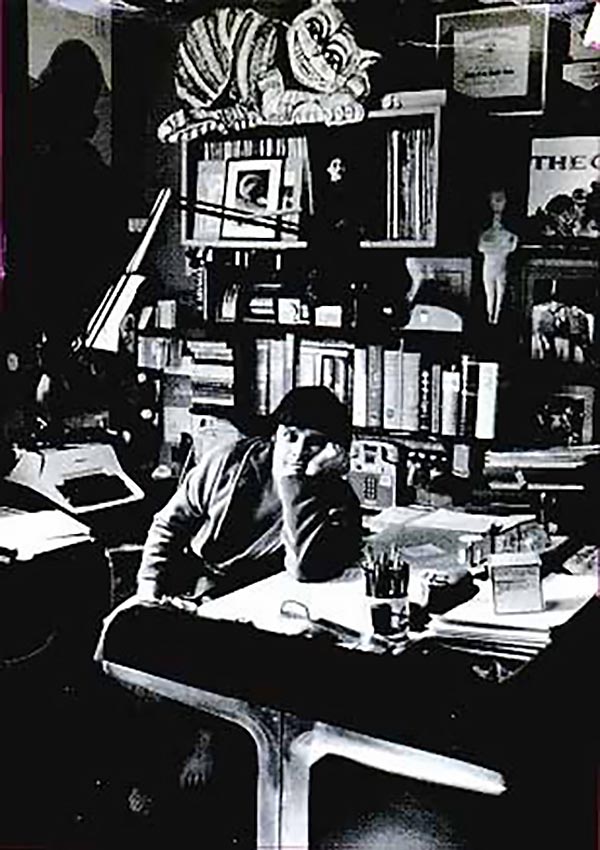
Harlan Ellison, his Olympia SG3, and other stuff - photo credit to MAX KATZ and KAREN FRIEDRICH
Harlan Ellison and his typewriter.  According to Richard Polt, the machine pictured is probably the Olympia SG3. Photo credit to Max Katz and Karen Friedrich.

Writers and their tools, in their workspaces.  We could probably date this photo by the stuff in Ellison’s office — the Cheshire Cat cutout?  Wasn’t that from an Edward Gorey-illustrated version of the Alice in Wonderland story?  What year was that?  The telephone on the wall, the desk scissors design . . . none of those fall into any expertise I have.  Someone else will have to date it.  My TinEye search didn’t shed any useful light.

I found the photo at Richard Polt’s fun site at Xavier University, The Classic Typewriter Page.  Polt is clearly working toward a MacArthur Foundation genius grant with this material.  Well, he would be, were I a judge.  (Who should get credit for the photo?  I don’t know — can you help identify who gets credit? See comment from Mr. Ellison:  ” . . .  image was captured for my 1974 STORY collection, APPROACHING OBLIVION, by MAX KATZ and KAREN FRIEDRICH.”  Credit for the photo gleefully acknowledged here.)

Oh, by the way, stay tuned:  Ellison is trying to sell his first typewriter.  That is a topic worthy of its own post.

Tip of the old scrub brush to the unfortunately moribund The Wit of the Staircase.


Dan Valentine – Wedding ring in the pawnshop window

November 20, 2010

I’m back and back is beautiful, to tweak a phrase. Where have I been? Taking care of business with the helping hand of a special-special life-long friend.

For now, I’ll simply say: Life is an adventure, a gift and a grand adventure, and more than just a mite irksome at times.

These many weeks, in what little spare time I’ve had, I’ve also been writing lyrics. Everyone needs a hobby. Mine is writing lyrics.

Thus, the following song regarding our times:

WEDDING RING
IN THE PAWNSHOP WINDOW
By Daniel Valentine
(c) 2010

The wedding ring
In the pawnshop window.
The price tag on a string,
Tied to the wedding ring,
Says it all, says ev’rything.
Life seldom ever goes as planned.

The wedding ring
In the pawnshop window.
To think the joy it must
Have brought once. Now it’s just
Sitting there collecting dust,
Pawned for a fast few bucks in hand.

That said, a future groom and bride,
Their savings on the meager side,
Stop to sneak a peak, beguiled and starry-eyed.

And what they see are tons and tons
Of rare old coins, guitars and guns,
One music box, two cuckoo clocks,
Plus a fly or three dead on the sill.
Then they see the ring and all is still.

The wedding ring
In the pawnshop window.
It glimmers and it gleams.
It’s ev’rything that dreams
Are made of, or so it seems,
And all for less than half a grand.

And so, like tens of times before,
The tiny bell above the door
Jingles as the lovers step inside the store.

And, oh, the sparkle in her eyes
When first she tries it on for size.
It fits just right and in the light,
When she holds her left hand out to show,
Like her heart, the diamond’s all aglow.

The wedding ring
In the pawnshop window.
The register ka-chings.
An angel gets its wings.
And a tweetie birdie sings.
All while a credit card is scanned.

The wedding ring
In the panwshop window.
A mom with bills to pay
In need without delay
Pawned the ring to save the day,
Such are the times in our fair land.


How many at Beck’s rally? Just listen . . .

August 31, 2010

All the professional crowd estimators put the number of people attending Glenn Beck’s rally at the Lincoln Memorial at over 50,000 people, but under 100,000 — most came out in the 85,000 to 90,000 range.

But — don’t you love the brevity of Twitter?

lizzwinstead

  • Michele Bachmann claims 1.6 million at Beck rally. That’s about right if you count the voices in her head. 18 minutes ago via TweetDeck

  • Beloit College’s list: E-mail already passé to freshmen

    August 18, 2010

    If they knew what “old hat” meant, they might say that e-mail is old hat — but today’s entering college class of 2014 doesn’t regard e-mail as modern enough, nor much of other technology as fast enough.

    Beloit College, in Beloit, Wisconsin, began to publish its profile of the cultural world of entering college freshmen in 1998.  The Mindset List originally aimed to help Beloit professors understand the views of incoming freshmen, with some hopes of bridging the ever-widening Generation Gaps between faculty and students.

    Among other things, the Mindset List highlights the importance of teaching patient scholarship methods to students who have astonishing access to electronic information, though not necessarily better access to real knowledge; students need to learn the difference between data and information, information and knowledge, and knowledge and wisdom.

    The newest Mindset List comes as one of the list’s creators will retire, an interesting footnote in historic attempts to understand rates of cultural change affecting college-bound kids.  Beloit’s public relations chief Ron Nief created the list with Prof. Tom McBride, who teaches modern students about Milton and Shakespeare.  It is unclear whether Nief will be able to retire from compiling or interpreting the annual Mindset List.  O tempora o mores!

    We might assume that Nief had a hand in writing the Beloit College press release on the 2014 list:

    Beloit, Wis. – Born when Ross Perot was warning about a giant sucking sound and Bill Clinton was apologizing for pain in his marriage, members of this fall’s entering college class of 2014 have emerged as a post-email generation for whom the digital world is routine and technology is just too slow.

    Each August since 1998, Beloit College has released the Beloit College Mindset List. It provides a look at the cultural touchstones that shape the lives of students entering college this fall. The creation of Beloit’s Keefer Professor of the Humanities Tom McBride and former Public Affairs Director Ron Nief, it was originally created as a reminder to faculty to be aware of dated references, and quickly became a catalog of the rapidly changing worldview of each new generation. The Mindset List website at http://www.beloit.edu/mindset, the Mediasite webcast and its Facebook page receive more than 400,000 hits annually.

    The class of 2014 has never found Korean-made cars unusual on the Interstate and five hundred cable channels, of which they will watch a handful, have always been the norm. Since “digital” has always been in the cultural DNA, they’ve never written in cursive and with cell phones to tell them the time, there is no need for a wrist watch. Dirty Harry (who’s that?) is to them a great Hollywood director. The America they have inherited is one of soaring American trade and budget deficits; Russia has presumably never aimed nukes at the United States and China has always posed an economic threat.

    Nonetheless, they plan to enjoy college. The males among them are likely to be a minority. They will be armed with iPhones and BlackBerries, on which making a phone call will be only one of many, many functions they will perform. They will now be awash with a computerized technology that will not distinguish information and knowledge. So it will be up to their professors to help them.  A generation accustomed to instant access will need to acquire the patience of scholarship. They will discover how to research information in books and journals and not just on-line. Their professors, who might be tempted to think that they are hip enough and therefore ready and relevant to teach the new generation, might remember that Kurt Cobain is now on the classic oldies station. The college class of 2014 reminds us, once again, that a generation comes and goes in the blink of our eyes, which are, like the rest of us, getting older and older.

    Here is the list of 75 touchstones of cultural change guaranteed to give you twinges of your own aging, even if you were in the class of 2010:

    The Beloit College Mindset List for the Class of 2014

    Most students entering college for the first time this fall—the Class of 2014—were born in 1992.

    For these students, Benny Hill, Sam Kinison, Sam Walton, Bert Parks and Tony Perkins have always been dead.

    1. Few in the class know how to write in cursive.

    2. Email is just too slow, and they seldom if ever use snail mail.

    3. “Go West, Young College Grad” has always implied “and don’t stop until you get to Asia…and learn Chinese along the way.”

    4. Al Gore has always been animated.

    5. Los Angelenos have always been trying to get along.

    6. Buffy has always been meeting her obligations to hunt down Lothos and the other blood-suckers at Hemery High.

    7. “Caramel macchiato” and “venti half-caf vanilla latte” have always been street corner lingo.

    8. With increasing numbers of ramps, Braille signs, and handicapped parking spaces, the world has always been trying harder to accommodate people with disabilities.

    9. Had it remained operational, the villainous computer HAL could be their college classmate this fall, but they have a better chance of running into Miley Cyrus’s folks on Parents’ Weekend.

    10. A quarter of the class has at least one immigrant parent, and the immigration debate is not a big priority…unless it involves “real” aliens from another planet.

    11. John McEnroe has never played professional tennis.

    12. Clint Eastwood is better known as a sensitive director than as Dirty Harry.

    13. Parents and teachers feared that Beavis and Butt-head might be the voice of a lost generation.

    14. Doctor Kevorkian has never been licensed to practice medicine.

    15. Colorful lapel ribbons have always been worn to indicate support for a cause.

    16. Korean cars have always been a staple on American highways.

    17. Trading Chocolate the Moose for Patti the Platypus helped build their Beanie Baby collection.

    18. Fergie is a pop singer, not a princess.

    19. They never twisted the coiled handset wire aimlessly around their wrists while chatting on the phone.

    20. DNA fingerprinting and maps of the human genome have always existed.

    21. Woody Allen, whose heart has wanted what it wanted, has always been with Soon-Yi Previn.

    22. Cross-burning has always been deemed protected speech.

    23. Leasing has always allowed the folks to upgrade their tastes in cars.

    24. “Cop Killer” by rapper Ice-T has never been available on a recording.

    25. Leno and Letterman have always been trading insults on opposing networks.

    26. Unless they found one in their grandparents’ closet, they have never seen a carousel of Kodachrome slides.

    27. Computers have never lacked a CD-ROM disk drive.

    28. They’ve never recognized that pointing to their wrists was a request for the time of day.

    29. Reggie Jackson has always been enshrined in Cooperstown.

    30. “Viewer Discretion” has always been an available warning on TV shows.

    31. The first computer they probably touched was an Apple II; it is now in a museum.

    32. Czechoslovakia has never existed.

    33. Second-hand smoke has always been an official carcinogen.

    34. “Assisted Living” has always been replacing nursing homes, while Hospice has always been an alternative to hospitals.

    35. Once they got through security, going to the airport has always resembled going to the mall.

    36. Adhesive strips have always been available in varying skin tones.

    37. Whatever their parents may have thought about the year they were born, Queen Elizabeth declared it an “Annus Horribilis.”

    38. Bud Selig has always been the Commissioner of Major League Baseball.

    39. Pizza jockeys from Domino’s have never killed themselves to get your pizza there in under 30 minutes.

    40. There have always been HIV positive athletes in the Olympics.

    41. American companies have always done business in Vietnam.

    42. Potato has always ended in an “e” in New Jersey per vice presidential edict.

    43. Russians and Americans have always been living together in space.

    44. The dominance of television news by the three networks passed while they were still in their cribs.

    45. They have always had a chance to do community service with local and federal programs to earn money for college.

    46. Nirvana is on the classic oldies station.

    47. Children have always been trying to divorce their parents.

    48. Someone has always gotten married in space.

    49. While they were babbling in strollers, there was already a female Poet Laureate of the United States.

    50. Toothpaste tubes have always stood up on their caps.

    51.  Food has always been irradiated.

    52. There have always been women priests in the Anglican Church.

    53. J.R. Ewing has always been dead and gone. Hasn’t he?

    54. The historic bridge at Mostar in Bosnia has always been a copy.

    55. Rock bands have always played at presidential inaugural parties.

    56. They may have assumed that parents’ complaints about Black Monday had to do with punk rockers from L.A., not Wall Street.

    57. A purple dinosaur has always supplanted Barney Google and Barney Fife.

    58. Beethoven has always been a dog.

    59. By the time their folks might have noticed Coca Cola’s new Tab Clear, it was gone.

    60. Walmart has never sold handguns over the counter in the lower 48.

    61. Presidential appointees have always been required to be more precise about paying their nannies’ withholding tax, or else.

    62. Having hundreds of cable channels but nothing to watch has always been routine.

    63. Their parents’ favorite TV sitcoms have always been showing up as movies.

    64. The U.S, Canada, and Mexico have always agreed to trade freely.

    65. They first met Michelangelo when he was just a computer virus.

    66. Galileo is forgiven and welcome back into the Roman Catholic Church.

    67. Ruth Bader Ginsburg has always sat on the Supreme Court.

    68. They have never worried about a Russian missile strike on the U.S.

    69. The Post Office has always been going broke.

    70. The artist formerly known as Snoop Doggy Dogg has always been rapping.

    71. The nation has never approved of the job Congress is doing.

    72. One way or another, “It’s the economy, stupid” and always has been.

    73. Silicone-gel breast implants have always been regulated.

    74. They’ve always been able to blast off with the Sci-Fi Channel.

    75. Honda has always been a major competitor on Memorial Day at Indianapolis.

    Beloit College ranks among the best small, liberal arts colleges in the U.S.  Beloit College is part of a consortium our family has some fondness for, the 40 colleges in the group Colleges That Change Lives (CTCL).  Every high school student should be aware of this group, and the methods developed to make application to several of these colleges easier (our son chose Lawrence University in Appleton, Wisconsin).

    This list highlights areas of potential ignorance teachers need to consider.  Notice there is little on the list about the Cold War, Vietnam, nor popular books.  The skew to technology includes an implicit skew away from some of the traditional ways we have transmitted culture to our children:  Newspapers, magazines, books, Broadway plays and musicals.  Even broadcast television is notable for the pop culture icons, and great changes in television viewing methods and habits.

    The class of 2014 graduates a complete century away from the outbreak of World War I.  Their parents may not have known the administrations of John Kennedy and Lyndon Johnson — Richard Nixon and Watergate may have been learned only from history books, by their parents.

    How much more distant is the class of 2018, who enter high school as freshmen this year — next Monday, in Texas?

    More:


    Typewriter of the moment: Tina Fey

    July 25, 2010

    Tina Fey mocks her writing chops

    Tina Fey mocks her writing chops (can someone find the origin of this photo? Bust Magazine? Really?)

    Tina Fey at her typewriter — an inspiration to writers everywhere.

    Tip of the old typewriter scrub brush to Mass Games.

    _____________

    Update: Um, wow, yeah, it’s Bust Magazine.  And, focusing on typewriters and otherwise cloistered in secondary education, I had missed the controversy.  You might do well to check out Shapely Prose.  Also here.  And Jezebel has something to say, too.

    Why does no one worry about the typewriter?


    Dan Valentine – Such goes life, part 1

    June 20, 2010

    By Dan Valentine

    SUCH GOES LIFE, PART ONE

    The manager of the Ensenada Backpacker Hostel is Gabriella. Everyone calls her Gabby. She lives upstairs. She also teaches school. One of her classes is creative writing.

    She once said to me, “You ‘used’ to be a writer.” Used-to-be! “What should I tell my students? What is most important thing about writing?”

    “Have something to say.”

    “Where to start?”

    “Write a million words and toss ‘em! You’re ready to begin.”

    Gabby works into the wee hours. Most think teaching is an easy way to make a living. Two or three classes a day, two or three times a week. Summers off. But for every hour spent in class teaching, four or more hours every night, including weekends and holidays, are spent preparing for lectures, grading papers and tests (and creating ‘em), answering e-mails, and so much more. Summers, if not spent teaching summer classes, are spent preparing for the Fall. All for little pay and little or no recognition.

    Add to that a full-time job managing a hostel–with me as one of the guests!

    Gabby calls me buddy. Good morning, buddy. Good afternoon, buddy. Once, she called me secretary. A trio of guests had arrived, looking to check-in. I told them, “Uno momento. I’ll get the manager.” Afterward, passing each other on the veranda, she said, “Hi, secretary.”

    She bid me goodnight one evening, as she walked upstairs to her living space, after locking up and making sure the place was secure, saying, “Goodnight, honey.”

    (Funny, she just walked by this very moment, as I’m writing, and said, “Hi, babe!” and went on her way. I like her.)

    Buddy. Secretary. Honey. Babe. She’s called me all four. She also calls me: to task. Not once, not twice, but three or four times now. And counting.

    As does Salzador, the young gentleman who works the mid-afternoon/night shift. He was born in Spain. Says it all. He’s a nice guy. Young. Handsome. Dark movie-star hair. Visiting women simply adore him. All the male visitors love him, too, because all the women simply adore him.

    I think he sees himself as a Latin Lover. If I were him, I would. Beats being a plumber. We all have a an inner view of ourselves. I look upon myself as a writer, not a used-to-be. My bestest friend looks upon herself as a swimmer, not a university professor. Dick Cheney, I’m sure, sees himself as the kindest, bravest, warmest, most wonderful human being you’ve ever known in your life. (Or was that Raymond Shaw? Google the name.)

    Upon checking in, Salzador asked me, “Do you drink?” I said, “I’ve had a sip or two in my life.” He smiled. “We go drinking tonight.” I told him, “Sorry, I drink for my health now. At home, far away from the bars. A beer, one night. A glass of wine, another.” Unless I’m under substantial stress.

    When I first arrived, Gabby got on my case for leaving half-filled cups of coffee, haphazardly, all around the hostel grounds–on the floor by the computer, by a chair on the veranda, on a counter top in the kitchen. Guilty as charged! When I’m writing, I drink cup after cup and if I’ve misplaced it while pacing, I pour myself another, without thinking, throughout the day and evening and midnight hours.

    I’ve stopped doing that. Here. For now.

    Another time, when I first arrived, I was standing outside the hostel, having a smoke (a package of Pall Malls is all of some two dollars and change down her below the border), when Gabby happened to walk out. She saw strewn butts on the ground below and around my feet and said, very politely, “Please pick up your cigarette butts!”

    My immediate first thought was: They’re not mine. Look-see. I smoke Pall Malls. White filters. The butts on the ground have light-brown filters. (I lived the last five years with a non-smoker and soon learned to douse my butts and place them in the garbage in the garage.) My second thought was: What the hell! I gathered up the butts and disposed of them.

    A few minutes later, I passed her in the hall. She said, “Hi, buddy!” Lesson learned: Don’t take everything personally. Carlos, the owner, is out of town, in Switzerland. Managing a hostel is a huge, demanding responsibility.

    But, then, again …

    Last night, she waved for me to follow her into the kitchen. She opened the fridge door and pointed to the spilled contents on the bottom shelf from an open Pepsi on the top shelf. “We would appreciate very much if you would wipe clean when you spill.” That’s a fair request. But I said, and it was the truth, “It’s not my Pepsi.” I drink Coke and, when I drink a Coke, I tend to finish it. I’m not in the habit of placing a half-filled can in the fridge, so as to take a later sip of flat soda.

    Still, it’s a hostel. It’s inexpensive. You get to meet the many, assorted peoples of the world. She’s a nice person. So, I wiped up the spilled soda. What the hell!

    Just the other morning, she said, “Were you the last to use the coffee pot?” In my hand was a coffee cup, but it was filled with Mango juice, with a shot of vodka in it. I’m feeling stressed. “Please,” she said, not waiting for a reply, “turn off the ‘on’ button.” And she demonstrated how. Tip of a finger. Click! She picked up the empty pot and showed me its scorched bottom. It had third-degree burns. But it’s not like the pot is brand-new. It is mucho in years. I think it first belonged to Pancho Villa. And it wasn’t the first time someone had left it percolating, empty, in the morning. And I may have been guilty of it in the past, but not this morning.

    Where am I going with this? I’m a guest here, for Christmas sakes!

    I think it’s because I’m not out cruising the strip bars or taking in the sites. So there must be something wrong with me. Keep an eye on him! And he’s old. What’s with that?!

    One mid-afternoon, I’m in the kitchen, spreading strawberry jam on a slice of bread, when Salzador sees my misdeed and says, “That is for breakfast only!”

    “I didn’t have breakfast!” I continued to spread the jam.

    It could be because, most of the time, I’m the only one in the hostel. So I must be the guilty party for whatever there is to be guilty of. The brochure advertises jam and bread for breakfast. So, your honor, I plead not guilty. Sort of. I was hungry. I hadn’t had breakfast, hadn’t had lunch.

    There’s nobody happier on the face of the earth or any other planet, for that matter, than Salzador when there are many, many guests in the hostel, the majority of ‘em women. He loves to escort the ladies at night. You can see it on his face. He beams! There is nobody sadder on the face of the earth or any other planet in the heavens than Salzador when the hostel has only one guest. And it’s me! You can see it on his face. He is down in the dumps.

    The only thing worst for him is having to wash the toilets. “I do not know how to wash toilets.” I have heard him say this many times, mumbling aloud to himself. I can feel for him. I had to scrub toilets and urinals my first year or so in the Navy. And Salzador is not too keen about mopping, either, another evening chore. I can sympathize. I had to sweep, swab, and buff corridors in the Navy, too, for a year or so. Mission accomplished, I would ask the boatswain’s mate, standing supervising (which consisted of taking a sip or two of coffee): “What now?” The boatswain’s mate would reply, “Sweep, swab, and buff it again!”

    One night, when I first arrived in Ensenada, Salzador had just mopped the floor to my room. I needed something. Can’t remember what. But I needed it right then and there. He said, “Twenty minutes.”

    So, I waited. One minute. Two minutes. Then: “I’m not waiting twenty goddamn minutes.” And I proceeded to tip-toe over his freshly mopped floor to get what I needed. When I returned, he said, “O-h-h-h, look what you have done?”–pointing to my toe-prints.

    “Gimme the mop!” I said.

    He refused.

    “Gimme the mop!!” I repeated.

    He refused.

    “GIMME THE GODDAMN MOP!!!”

    I grabbed it from him, walked to my room, and working backwards mopped the floor. I then handed the mop back, but he refused to take it. He was sulking, as only a Latin Lover can. I’m sure it works with a certain type of woman, with a hankering for Latin lovers. I let the handle drop to the floor and went on my way.

    Later that night I apologized. He accepted my apology. A little later, he said, “Dani’el”–he calls me Dani’el–”do you what a burrito? I bought three.” And he gave me one.

    Looking back, I don’t know what got into me. Another ugly-American story to be told and repeated and embellished on. And, for the life of me, I can’t remember what I so desperately needed that I couldn’t wait 20 minutes. No doubt, a cigarette or my lighter or both. Shame on you, Dani’el.

    Such goes life, ever-so-often.


    Dan Valentine – Lorelei call of the epistolary

    June 11, 2010

    By Dan Valentine

    Another in the “Dan Valentine – Where are you?” series

    I took a couple of days off from writing a piece or three here to ponder what I’m doing. What am I writing? A one-man show, a musical, first draft of a novel or an autobiography, scribblings for therapy, etc. Gods knows! I now believe She does.

    I’m writing an “epistolary”.

    Theodore Von Holst Frontispiece to Mary Shelley, Frankenstein published by Colburn and Bentley, London 1831 - Tate Gallery image

    Theodore Von Holst - Frontispiece to Mary Shelley, Frankenstein - published by Colburn and Bentley, London 1831 - Tate Gallery image

    Wikipedia: … a piece written as a series of documents. Letters, diary entries, newspaper clippings.

    Mary Shelley used the epistolary form for her novel “Frankenstein”.

    Bram Stoker used the form for “Dracula”, and is compiled entirely of letters, diary entries, newspaper clippings, telegrams, ship’s logs and the like.

    Frankenstein and Dracula. Both of ‘em horror stories. Both of ‘em epistolaries. (So, too, have the last year or so of my life, in large part. Sounds like a match made in heaven or hell.)

    So, the answer is: I’m writing an epistolary. Pieces written for this website, comments from readers, e-mails, Facebook messages, lyrics, notes for novels, sit-coms, plays, etc. – hoping some day down the road it will all come together and make some sort of sense.

    I’m calling it: “Dan Valentine–where are you?” (Don’t ask me how I came up with it, it just hit me in the middle of the night. It has a ring to it! And it says it all.

    Thanks for the title, Ed.

    My sister, Valerie, sent me a message through Facebook a few weeks ago. She wrote: “Danny, I know you like adventure but why Mexico?”

    I “do” like an adventure! I’ve followed the call of the Lorelei most all my life.

    Wikipedia: Lorelei is the name of one the beautiful Rhine maidens who, according to legend, sat upon a rock and lured sailors from passing ships to their doom with her alluring singing, much like the Sirens of ancient Greek myth.

    I’ve been lured many times by her call.

    As a result, all my cargo is strewn along the shores of a dump site outside Houston somewhere, seagulls peeking at a poem or two, I wrote, and giving his or her editorial comment with a plop of poop!

    A few follow the Siren’s call. Most don’t. They have homes, careers, possessions, families, friends. But all, I’m sure, have heard her call … in the middle of the night; at a business conference; on the shore of a beach, sunning …

    Why Mexico? ‘Cuz I don’t have the funds or fare to get myself to Katmandu!

    COME WITH ME, SAID SHE
    (c) 2010 Daniel Valentine

    COME WITH ME, SAID SHE,
    And we will stick decals on our suitcases
    From enchanted lands and places,
    Fabled and far-flung.

    COME WITH ME, SAID SHE,
    And we will barter with those selling vases,
    Tapestries, silks, beads, and laces–
    Tarry there among.

    And, though, he wanted to,
    Said he, I’ve crucial work to do–
    Faxes, stacked, to sort and shuffle;
    Packets, filled with things and stuff, ‘ll
    Never get to if I come with you.

    COME WITH ME, SAID SHE,
    And we will climb steps to stone Buddha faces,
    Mingle with the many races,
    Glean the native tongue.

    And, though, he wanted to,
    Said he, I’ve vital work to do–
    Post-it notes with folks to dial;
    Piles of files, a mile high, ‘ll
    Never get to if I come with you.

    So, one day without compass,
    GPS device, or chart,
    With little but a carry-
    On, her passport, and his heart–
    And oh yes! That little black dress!–
    She kissed him sweetly, waved goodbye.
    He watched her plane depart.

    Come to me, wrote she,
    Upon a postcard of some isle oasis,
    Signed: With love, with lipstick traces.
    P.S.: While you’re young.

    And, though, he wanted to,
    Wrote he, I’ve urgent work to do–
    Snakes in suits to slew in battle
    For a corner office that ‘ll
    Never sit in if I come to you.

    Now, with that corner office
    Overlooking Broad and Wall,
    Though, happy and now married
    With three kids, a dog, and all–
    And oh yes! That Park Ave. address!–
    He oftentimes, in dark of night,
    Will hear the Siren call:

    Come to me, says she,
    To Katmandu where, just a few short paces,
    Gurus chant in temple spaces,
    Golden gongs are rung.

    Come to me!
    Come to me!
    Come to me!
    Come to me!

    Sunset in Katmandu - RMI Guides photo

    Sunset in Katmandu - RMI Guides photo


    Progress run amok: No typewriters?

    May 22, 2010

    Pamela Bumsted sent the link to Boing! Boing!

    The Writers Room is kicking out the guy with the last typewriter.

    Writers Room logo on Facebook

    Writers Room logo on Facebook

    The Writers Room is a non-profit that offers cheap working space to writers.  In the old days, that meant a desk and a chair where a writer could use a legal pad and write longhand, or put a typewriter down to type a manuscript.

    In 2010, there was just one guy left using a typewriter.  Everyone else had switched to computers.  Boing Boing said:

    Greenwich Village’s Writers Room, a low-cost place for writers to rent workspace, has banned mechanical typewriters from its premises, giving Skye Ferrante, the sole remaining typewriter user the choice of switching to a laptop or going elsewhere. He’s not going to switch. Ferrante’s been using the Writers Room for six years, and is distressed at the news that he’s got to leave.

    Skye Ferrante at his typewriter - now banned from the Writers Room

    Skye Ferrante at his 1929 Royal typewriter - now banned from the Writers Room - photo by Hagen for New York Daily News

    What’s this world coming to?

    According to the New York Daily News (which probably has typewriters anymore only in its museum, if it has that):

    “I was told I was the unintended beneficiary of a policy to placate the elderly members who have all since died off,” said Ferrante, a Manhattan native who’s writing children’s books. “They offered me a choice to switch to a laptop or refund my money, which to me is no choice at all.”

    Ferrante was peeved, but not completely surprised.

    A growing number of scowls had replaced the smiles that once greeted the arrival of his black, glass-key typewriter.

    “The minute the sign came down, I realized there was antagonism from some of the new members,” he said. “They gave me an attitude when they saw me setting up the typewriter.”

    Ferrante’s connection to typewriters runs deep. He owns at least five of the old-school machines, his devices of choice since his teens.

    “There’s a different commitment when you know you’re making a mark on the page, when you strike a key and bleed ink on the page,” he said.

    After being contacted by the Daily News, Writers Room officials told Ferrante he can continue working on his typewriter until the end of his term on June 30.
    http://www.nydailynews.com/ny_local/2010/05/20/2010-05-20_untitled__typewriter20m.html?r=ny_local&utm_source=feedburner&utm_medium=feed&utm_campaign=Feed%3A+nydnrss%2Fny_local+%28NY+Local%29#ixzz0odMP9rdB

    Heck, they might as well ban pens, pencils and paper.
    Progress is okay.  This time, though, they’ve taken it too far.


    Why bother to learn spelling in an age of computerized spell-checkers?

    August 4, 2009

    As often, slam-poetry veteran (and former teacher) Taylor Mali has important advice for people who trust computers too much:  “The Impotence of Proofreading.”

    Um, this probably isn’t really safe for work, at least not in Texas or Alabama, and maybe not advisable for classroom use either.  But every English teacher in your school will have horror stories to add:

    Am I the only one who thinks that reading a lot is a great way to overcome these problems?


    Time to retire: “Drunk the Kool-Aid”

    July 13, 2009

    Here’s a cliché phrase whose time to retire has come:  “Drunk the Kool-Aid.”

    Once upon a time it may have been a culturally cool reference to the mass suicide at Jonestown, Guyana.  Following the charismatic and crazy minister Jim Jones, more than 900 people committed suicide, most by drinking cyanide in a Kool-Aid solution.  With some irony we should note that Kool-Aid may not have been used at Jonestown at all, but a similar product, Flav-R-Aid.

    Makers of Kool-Aid are probably not too happy about the common use of the phrase now, though it would be interesting to see what their marketing studies show — does the use of the phrase hurt sales or keep the name of the product in the public’s mind?

    No matter.  Use of the phrase to mean that an insult target is brainlessly following some concept is tired, decrepit, grating, and in need of retirement.

    Uses just in the past few days:

    • Daily Kos:  “Of course, the CoC crowd have drunk the kool-aid and blamed “liberal regulators” for their problem.”
    • Daily Green, by Marion Nestle:  “But before you decide that I must have drunk the Kool Aid on this one, hear me out. He really is a good choice for this job.”
    • In The Baltimore Sun, the Rev. Jason Poling:  “But I must have drunk the Kool-Aid back in civics class, because when I think about freedom, liberty, just government and all that good stuff, my thoughts fly to the Declaration of Independence.”
    • The Wall Street Journal, John Paul Newport:  “I remember pondering these issues back when I first started paying attention to golf as an adult, before I’d drunk the Kool-Aid.”
    • Michael Hirsh in Washington Monthly:  “Before long, Power says, she had ‘drunk the Kool-Aid‘ on Obama.”  [And this usage in an otherwise excellent story that you really should read.]
    • Bill King in the Atlanta Journal-Constitution:  “I still haven’t drunk the Kool-Aid when it comes to Big 12 teams, so while I recognize the Pokes have a high-powered offense that some expect to overpower the Dogs defense, and others question whether Georgia’s offense, minus last year’s star power, can keep up, I don’t believe that’s going to be the season’s biggest road challenge.”  [Longest sentence in this list?]
    • Todd Robberson in a blog of the Dallas Morning News: “Steve Salazar on the City Council has drunk the Kool-Aid on this subject, convinced that the online and phone-in survey conducted last year regarding possible names for Industrial somehow constituted a scientific poll with, as Salazar told us, a margin of error of plus or minus 3 percentage points.”
    • TPM, “Teamster blasting Rush Limbaugh”: “He’s drunk the Kool-Aid that unions are socialism and socialism is evil.”
    • Politics Daily:  “If you feel like forwarding this to those who are open minded and have not drunk the Kool-Aid, feel free.”
    • Newsbusters: “Back on Thursday, March 5 when Obama held a dog and pony show at the White House, CBS drunk the kool-aid.”  [When I used the phrase “drunk the Kool-Aid,” I thought I’d avoid incorrect grammar in use of the Kool-Aid phrase — clearly I was wrong.]
    • Frank Rich in The New York Times:  “Those Republicans who have not drunk the Palin Kool-Aid are apocalyptic for good reason.”  [This is the one that set me off, today — Rich is too good a writer to drink the Kool-Aid on using such clichés.]

    Can we just retire the phrase now?  Copy editor’s, make a note of Darrell’s Corollary:  When any writer uses the phrase “drunk the Kool-Aid” to mean something other than someone has drunk some Kool-Aid, the piece needs to be rewritten.

    Building in Hasting, Nebraska, where Kool-Aid was invented by Gerard and Edwin Perkins.  Wikimedia photo

    Building in Hasting, Nebraska, where Kool-Aid was invented by Gerard and Edwin Perkins. Wikimedia photo