2012 is an election year, a time when we make history together as a nation. Potential turning points in history often get tarred with false interpretations of history to sway an election, or worse, a completely false recounting of history. Especially in campaigns, we need to beware false claims of history, lest we be like the ignorants George Santayana warned about, doomed to repeat errors of history they do not know or understand. How to tell that a purported piece of history is bogus? This is mostly a repeat of a post that first appeared at Millard Fillmore’s Bathtub six years ago.
Robert Park provides a short e-mail newsletter every Friday, covering news in the world of physics. It’s called “What’s New.” Park makes an art of smoking out bogus science and frauds people try to perpetrate in the name of science, or for money. He wrote an opinion column for the Chronicle of Higher Education [now from Quack Watch; CHE put it behind a paywall] published January 31, 2003, in which he listed the “7 warning signs of bogus science.”
And it got me thinking about whether there are similar warning signs for bogus history? Are there clues that a biography of Howard Hughes is false that should pop out at any disinterested observer? Are there clues that the claimed quote from James Madison saying the U.S. government is founded on the Ten Commandments is pure buncombe? Should Oliver Stone have been able to to more readily separate fact from fantasy about the Kennedy assassination (assuming he wasn’t just going for the dramatic elements)? Can we generalize for such hoaxes, to inoculate ourselves and our history texts against error?
Perhaps some of the detection methods Park suggests would work for history. He wrote his opinion piece after the Supreme Court’s decision in Daubert v. Merrell Dow Pharmaceuticals, Inc., in which the Court laid out some rules lower courts should use to smoke out and eliminate false science. As Park described it, “The case involved Bendectin, the only morning-sickness medication ever approved by the Food and Drug Administration. It had been used by millions of women, and more than 30 published studies had found no evidence that it caused birth defects. Yet eight so-called experts were willing to testify, in exchange for a fee from the Daubert family, that Bendectin might indeed cause birth defects.” The Court said lower courts must act as gatekeepers against science buncombe — a difficult task for some judges who, in their training as attorneys, often spent little time studying science.
Some of the Daubert reasoning surfaced in another case recently, the opinion in Pennsylvania district federal court in which Federal District Judge John Jones struck down a school board’s order that intelligent design be introduced to high school biology students, Kitzmiller v. Dover Area School District.
Can we generalize to history, too? I’m going to try, below the fold.
Here are Park’s seven warning signs, boiled down:
Park wrote:
Justice Stephen G. Breyer encouraged trial judges to appoint independent experts to help them. He noted that courts can turn to scientific organizations, like the National Academy of Sciences and the American Association for the Advancement of Science, to identify neutral experts who could preview questionable scientific testimony and advise a judge on whether a jury should be exposed to it. Judges are still concerned about meeting their responsibilities under the Daubert decision, and a group of them asked me how to recognize questionable scientific claims. What are the warning signs?
I have identified seven indicators that a scientific claim lies well outside the bounds of rational scientific discourse. Of course, they are only warning signs — even a claim with several of the signs could be legitimate. [I have cut out the explanations. — E.D.]
The discoverer pitches the claim directly to the media.
The discoverer says that a powerful establishment is trying to suppress his or her work.
The scientific effect involved is always at the very limit of detection.
Evidence for a discovery is anecdotal.
The discoverer says a belief is credible because it has endured for centuries.
The discoverer has worked in isolation.
The discoverer must propose new laws of nature to explain an observation.
Voodoo history
Here, with thanks to Robert Park, is what I propose for the warning signs for bogus history, for voodoo history:
The author pitches the claim directly to the media or to organizations of non-historians, sometimes for pay.
The author says that a powerful establishment is trying to suppress his or her work. Bogus history relies more on invective than investigation; anyone with an opposing view is an “idiot,” or evil.
The sources that verify the new interpretation of history are obscure, or unavailable; if they involve a famous person, the sources are not those usually relied on by historians.
Evidence for the history is anecdotal.
The author says a belief is credible because it has endured for some time, or because many people believe it to be true.
The author has worked in isolation, and fails to incorporate or explain other, mainstream versions of the history of the incident, and especially the author fails to explain why they are in error.
The author must propose a new interpretation of history to explain an observation.
Any history account that shows one or more of those warning signs should be viewed skeptically.
In another post, I’ll flesh out the reasoning behind why they are warning signs.
Save
Spread the word; friends don't allow friends to repeat history.
James is scheduled to graduate from Lawrence University in early June; we’ll make the drive up to pick up his stuff. Lawrence is chiefly a residence campus, but even there are stories about sloppy roommates.
Roommates, hell. All college kids are sloppy as hell (except Ben Davidian — exceptions and pathologies are what they are). We’ll expect to have to do some cleaning to get the place up to the level that the cleaning crew from the University will touch it.
Now, James’s older brother, Kenny, DID have some legendarily messy apartments at the University of Texas – Dallas. But it got to him, and he became quite civilized on the cleaning front. Just this past week Kenny and I spoke of his search for living quarters, probably in Connecticut, though he would like, sometime, to live in New York City. One of his work assignments in in the Bronx, so it’s not totally ridiculous.
On the way to finding something else, I ran across a blog I used to read a lot, but haven’t lately, and found this story of legendarily sloppy apartments, and in New York City (yeah, I know — Queens ain’t the Bronx, but the whole five boroughs would fit in the footprint of DFW Airport, nearly).
Like all great souls, Tom loved a good joke even when the joke was on him. We hadn’t known him very long before he told us the story of when his Bayside, Queens apartment was burglarized (by which I learned that Tom and I grew up within a two or three miles of each other, back in the day). Tom and his roommate called the police to report the missing stereo, and when they arrived the officers were flabbergasted by the ransacked state of the apartment. “Wow, these guys really destroyed the place,” they said. “Do you have any enemies? This looks like a vendetta.” Tom didn’t admit to them—but cheerily admitted to us—that “this” was in fact the apartment’s natural state.
Yeah, well they grow up.
On sort of another topic, I was also reminded why I liked that blog, and Bérubé‘s writing in general. Go read the piece. You’ll lament the passing of Tom Buckley, too. The one story above is the least funny and least emotional of several told there. You’ll wish you’d known Tom. This piece meets the requirements for a good story posed by John Irving in The World According to Garp, as good a requirement as any I’ve ever seen.
Early voting for the twice-delayed* Texas primary elections opens this week. The election is set for May 29.
Happy to see the Texas Democratic Party sending out notices that voters won’t be turned away from the polls. It’s a clear effort to deflate the voting discouragement campaign of State Attorney General Greg Abbott, Gov. Rick Perry, and the Republicans of the Texas Lege.
On Monday, the polls will open for early voting for the May 29th Democratic Primary Election. We’ll be selecting the Democratic nominees who will lead the charge towards taking back our state in 2012.
Use the same documents that you’ve used in the past to vote.No photo ID is required! The photo voter id legislation is not in effect for this election. All you need is:
I’d be interested to see that the Republican Party in Texas is doing something similar. They keep booting me off their lists. Anybody got a similar letter from them, especially one showing how the Texas Voter Identification law does not apply to this primary election?
_____________
* The elections were delayed by federal court orders. Texas is a place that historically discriminated against minority voters, and so under the 1965 Voting Rights Act, reapportionments by the legislature must be approved by the Justice Department or a federal court as complying with the nondiscrimination laws. AG Abbott tried to do an end run around Justice, suing for approval as a first step. As part of its War on Democracy, the Texas Lege wrote a spectacularly Gerrymandered reapportionment plan, depriving Texas Hispanics from new representation despite the dramatic increase in their populations. Consequently the federal courts balked at quick approval. Instead, they asked for more information. In the delay, the Washington courts ordered the federal court in San Antonio to draw up a more fair plan, giving at least three new seats to districts where Hispanics hold broad sway.
Litigation against the Texas Jim Crow Voter Identification law is separate.
Perhaps one of the bigest and most listened to advocates of using infographics and data vis in the classroom is Diana Laufinberg, from The Science Leadership Academy. Diana, a History teacher, is a long time user of geographic information systems (GIS). She has recently, however, started helping her students to create their own infographics from complex issues that are part of her course of study and/or part of current events.
I’ve always believed that gay and lesbian Americans should be treated fairly and equally. I was reluctant to use the term marriage because of the very powerful traditions it evokes. And I thought civil union laws that conferred legal rights upon gay and lesbian couples were a solution.
But over the course of several years I’ve talked to friends and family about this. I’ve thought about members of my staff in long-term, committed, same-sex relationships who are raising kids together. Through our efforts to end the “Don’t Ask, Don’t Tell” policy, I’ve gotten to know some of the gay and lesbian troops who are serving our country with honor and distinction.
What I’ve come to realize is that for loving, same-sex couples, the denial of marriage equality means that, in their eyes and the eyes of their children, they are still considered less than full citizens.
Even at my own dinner table, when I look at Sasha and Malia, who have friends whose parents are same-sex couples, I know it wouldn’t dawn on them that their friends’ parents should be treated differently.
So I decided it was time to affirm my personal belief that same-sex couples should be allowed to marry.
I respect the beliefs of others, and the right of religious institutions to act in accordance with their own doctrines. But I believe that in the eyes of the law, all Americans should be treated equally. And where states enact same-sex marriage, no federal act should invalidate them.
Former Sen. Bill Bradley — Rhodes Scholar, All-American college basketball player, NBA Champion with the New York Knicks, and all-around good guy — has a book out, We Can All Do Better. I’m reading it now, and I hope thousands of others will read it before we vote in November.
Did you know Bradley is an Eagle Scout? If you didn’t know that, you should be able to tell from this excerpt from his book that he shares the values of Eagle Scouts, and works to practice them.
This is excerpted with express permission.
We Can All Do Better
Adapted excerpt from WE CAN ALL DO BETTER, by Bill Bradley. Published in May 2012 by Vanguard Press.
Just as no one guaranteed that the Greek, Roman, or Ottoman Empires would last forever, no one has guaranteed America its continued dominance in the world. If overreaching abroad and decay at home cause us to falter, the world will be a place with considerably less hope.
America’s idealism, optimism, and spirit of self-reliance — all these have created the unique American character, a character that has inspired people around the globe. But the America of today is in a state of confusion. We don’t see our problems clearly, or if we do, we often — out of inertia, fear, or greed — fail to deal with them. The federal government has amassed an enormous debt in just the last ten years. Many of our state and local governments, have pursued the “free lunch,” spending lavishly on pensions and health care and then handing on the bill to future state administrations. The corporate sector is consumed with the short term, trapped in a financial prison of stock buybacks and quarterly earnings reports, unable to invest or hire in its own long-term interest. Ten years ago, sixty-one U.S. companies had triple-A bond ratings; today there are four.
As long as you act a hair’s width within your lawyer’s definition of the law, you get a pass that exempts you from doing what is not just legal, but also right. I had a friend who worked at the highest levels in three major investment banks over twenty-five years. He told me that once when he refused to work on a deal because he didn’t think it was right, the head of the firm came to him and said, “I know what we’re doing is unethical, even immoral, but I can assure you it’s not illegal.”
Exacerbating these failings is a mass media that champions the superficial, sensational, and extreme view. Only a few major newspapers, all of them under relentless financial pressure and apparently unable to reinvent themselves in order to attain a level of profitability, still attempt to ferret out the truth, but reporting, the craft of going out to discover what isn’t known, too often gives way to opinion pieces.
The losers here are the people, who would like to know: What happened in the city council meeting? Or in the congressional committee room? How was the money for schools spent? How did that special-interest tax break make it into the tax code? Who agreed to the pensions that bankrupted our town? What did corporation X do for the ten thousand workers it just fired? How will the latest technological innovation affect jobs? These are the kinds of questions that rarely get answered, at least on television. If people in power are not held responsible for what they do, it will be easier for them to abuse that power. Without facts to challenge a government official or a CEO, the peoples’ questions and accusations are parried by elementary public relations tactics.
This is a busy, busy month for me. I hope to finish Bradley’s book and have more to say, soon. It’s in bookstores now, if you want to get a copy and beat me to it.
Scouts traveling to the new Summit Bechtel Reserve site in West Virginia in 2013 will have a much, much different experience. How many differences can a student find, just watching the film?
http://www.scoutinghotfinds.com (turn up the volume all the way!) This great video was shot by the Boy Scouts and was released as an old strip on 1″ magnetic film after the 1950 National Scout Jamboree. The original film was digitized by Scouter Rick Maples and he has given me permission to post it on YouTube for all to see. There are lots of great pieces of history here and any Scout who has had the Jamboree experience will appreciate this tale of American history. Watching this it makes you wonder how much have changed as the 2013 National Scout Jamboree at the Summit is coming up soon.
189
(This is labeled “Part 1.” Is there a Part 2?)
It’s almost 20 minutes of film, but fascinating to watch just to see how much is different. Trains? No sunscreen?
President Harry Truman appears about 13 minutes into the film. His speech would probably be considered too political by today’s standards, and it’s interesting to see the reaction of the Scouts and leaders Truman (who was awarded the Silver Buffalo, Scouting’s highest honor for a leader).
Interesting to see the re-enactment of the retreat of Washington’s forces to Valley Forge. Interesting way to learn history.
47,000 Scouts participated in the 1950 National Jamboree. 2013 will be a bit bigger, and in a more wild location.
Either that last post, or the one before it, was the 4,000th post at Millard Fillmore’s Bathtub. (Two different post counters give two different tallies.)
Kathryn and me. checking out local history at the Grassy Knoll , next door to the Sixth Floor Museum in Dealey Plaza, Dallas, in 2011; photo by Darrell Knowles. Really.
Thanks to gracious readers who have clicked 3.4 million times on those 4,000 posts. Great thanks to the one-in-a-thousand who leave a comment. We work for accuracy here, and comments pointing us to new information and better information always help.
Please tell your friends to come over and give us a piece of their mind. Surely they can find some topic here on which they have an opinion.
. . . and now they’ve figured out how to keep her from voting: A “voter I.D. law” in Pennsylvania. Viviette Applewhite is suing to keep her right to vote.
On May 1, 2012, the ACLU of Pennsylvania, the Advancement Project, the Public Interest Law Center of Philadelphia (PILCOP), and the Washington, DC law firm of Arnold & Porter LLP filed a lawsuit in the Commonwealth Court of Pennsylvania to overturn the voter ID law passed by the General Assembly in March 2012.
The lawsuit alleges that the state’s voter photo ID law violates the Pennsylvania Constitution by depriving citizens of their most fundamental constitutional right – the right to vote. The plaintiffs are asking the Commonwealth Court to issue an injunction blocking enforcement of the law before November’s election. If the law is not overturned, most of the plaintiffs will be unable to cast ballots in the fall, despite the fact that many of them have voted regularly for decades.
Voter identification laws passed through several legislatures in the past half decade frequently cause more voters to lose their voting privileges than frauds prevented. While there is no evidence of significant voter fraud caused by someone stealing another’s identity to vote — the only voter fraud voter identification laws is aimed at — there are thousands, or tens of thousands of people in every state where these laws are passed who cannot get suitable identification papers to vote.
Although these citizens often are long-time voters, good citizen parents who have raised outstanding children and performed their civic duties thr0ughout their lives, they often lack the technically picky identity documents to get a voter identification card. Their stories are not unique, but surprisingly common, shared by millions of Americans:
Many were born outside hospitals, and lack birth certificates. Though no one doubts their life history, the voter laws do not allow usual forms of identification to get a voter card. These people can get credit cards, can buy and sell property, and can cash checks in their towns. But the identification used to secure financial transactions do not satisfy the voter identification laws.
A significant portion of these people are simply elderly, and gave up driving. Consequently they lack a current drivers license. Clearly they cannot get a new drivers license, but they also cannot get a voter identification card without great effort, sometimes without great cost, and almost always, in time to vote in this year’s elections.
In Texas, the now-stayed-by-a-federal-court voter ID law allows a handgun license to be used as identification, but not a photo identification from a state college or university. Among other arguments the courts found convincing in staying the law, in 81 of Texas’s 254 counties, there is no office of any state agency that can issue an accepted voter identification card. In other words, in a third of Texas counties, it’s impossible to get a valid voter identification card if you don’t already have one.
(Updated; see comments) Young people — students, soldiers at basic training, high school graduates still living at home to save money while working to make money — frequently cannot produce the documentation the voter identification laws ask for, like a utility bill in their name. See the story at Radula, where Dorid discusses one state’s rejecting another state’s birth certificates (as if we hadn’t known that would happen . . .) and other problems; young voters don’t vote as they should, and now we know many who want to vote, will probably be denied.
Meanwhile, from time to time a real case of voter fraud shows up. I have yet to find one that could have been prevented by voter identification laws.
How many of the voter identification laws were drafted in the smoke-filled, alcohol-laced backrooms of ALEC conferences?
Former Sen. Alan Simpson told Charlie Rose that he’s grateful President Obama didn’t offer the Simpson-Bowles budget balancing plan, since Republicans would then have to oppose every part of it, reflexively, as part of their “hate Obama completely” policy.
Pat Bagley uncoded the formula, too.
Pat Bagley, Primordial gas politics, Salt Lake Tribune, May 3, 2012
The danger? The danger is Obama will propose something to save America, and the Republicans will oppose it in a knee-jerk fashion. Some say it’s happened already.
And all of a sudden, you find yourself naked, cold and wet, and stuck in a swamp. Can you console yourself that the flies are tasty?
Spread the word; friends don't allow friends to repeat history.
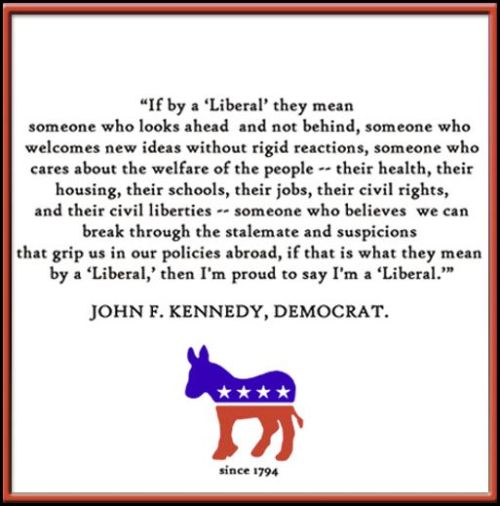
Quote from Sen. John F. Kennedy, September 14, 1960
You can read the entire original speech by Sen. John F. Kennedy here, at Millard Fillmore’s Bathtub. There’s more defense of his being considered a liberal, and the good that liberals do. It’s almost quaint the way he defends Adlai Stevenson.
Why do you wave the flag, help old ladies cross busy streets, keep children safe, and sing the “Star Spangled Banner?”
. . . but perhaps won’t. I swear it seems as if someone has a concession at Tea Party functions selling self-lobotomy kits, and they’re selling like $10 iPhones.
File this in the “Whom the gods destroy, they first make mad” department, with loss of sense of humor as a key symptom.
You may have seen this ad during the Super Bowl, and though you may have cringed a bit at the way it tweaks people who show concerns about the environment and who urge cleaning up pollution, you probably found it pretty humorous.
So some hoaxster with the apt handle The Rat at Club the Constitution Constitution Club dug up a dull, run-of-the-mill document out of the Department of Homeland Security that talks about DHS policies on working to implement the government’s environmental justice policies. “Environmental justice” is shorthand for “don’t dump garbage or toxic pollution in or close to the homes of poor people just because they are unlikely to have lawyers at the moment.”
Then The Rat flew off the handle, a truly head-exploding, insane Gish-Gallop rant about Homeland Security:
In its just-released Environmental Justice Strategy document, the DHS says the idea is to “include environmental justice practices in our larger mission efforts involving federal law enforcement and emergency response activities” and to incorporate environmental justice in “securing the homeland.” Roll that around in your head for awhile:
“Federal law enforcement” agents conducting “emergency response activities” in the name of “environmental justice” for the purpose of “securing the homeland.” The Green Police. Oh. My. God.
You couldn’t make up craziness like this guy, The Rat, could you? He clearly has no clue about the history of environmental justice (and is Google-challenged on top of that) — or he’s venally working to make people believe falsehoods. What’s the harm in including “environmental justice practices in our larger mission?”
Does this Rat, who appears to be a complete idiot, fail to understand that “emergency response activities” are commonplace, and occur whenever an 18-wheeler carrying a load of chemicals turns over on the freeway? Does The Rat fail to understand that spills need to be cleaned up? (Real rats are very clean creatures, actually. While they live in filthy, they do not prefer it, and they keep their dens very clean. This is one way a real rat, say Rattus Norvegicus, or Rattus rattus, is superior to this faux rat.)
As reported by Audi
HERNDON, Va.,– Green Police, the Audi Super Bowl ad, provides an uncommon avenue for green advocates, anteaters, Styrofoam, the legendary rock band Cheap Trick and the 2010 Green Car of the Year to find their inner connectivity.
How all of these rather disparate elements come together hasn’t been revealed yet by Audi. But in the end they will provide an entertaining look at how we all face a dizzying array of choices that can impact the environment. Some of these choices are easier than others. But, the Green Police ad will show, one of the best choices is driving the Audi A3 TDI, which won the prestigious 2010 Green Car of the Year award presented by Green Car Journal at the Los Angeles Auto Show in December.
The Audi Green Police ad will air Super Bowl Sunday in the fourth quarter of the largest television event of the year. But Super Bowl ad followers, Audi aficionados and others can get sneak peeks at what’s coming.
Audi released a teaser edit of the Green Police Super Bowl ad today, which highlights the crucial role anteaters can play in keeping the planet green. Think Styrofoam. One Super Bowl reviewer online is already betting the Audi Green Police ad will win top honors for “Best Use of an Unusual Animal in a Super Bowl Ad.” Audi disclaimer: No anteaters were harmed in the filming of the Green Police Super Bowl ad. To find that teaser video, go to www.facebook.com/audi.
Another preview of the Audi Green Police ad is the available download of the theme song of the spot. The legendary rock group Cheap Trick returned to the recording studio to remake their smash hit “Dream Police” into “Green Police.” Fans also can find that download by going to the Audi Facebook page.
For Audi, the Super Bowl has been a premium platform for promoting the performance and prestige of its cars the past three years. But underlying the fun of this year’s Green Police Super Bowl ad is a serious message: If 30% of Americans drove clean diesel cars like the Audi A3 TDI, the nation could reduce oil consumption by 1.5 million barrels a day. What’s more, clean diesel engines reduce CO2 emissions by 30%.
“Those are real-world benefits that the A3 TDI offers for today’s concerns about fuel consumption and greenhouse gas,” said Scott Keogh, Audi of America Chief Marketing Officer. “Super Bowl ads are all about fun, but the best ads point consumers to products that enrich their lives. That’s what we’ve done with the Green Police.”
Got that? It’s a straight up, funny-as-anything Super Bowl ad pushing Audi’s TDI Diesel engined cars.
Have the right-wingers genuinely lost their humor senses? Are they so shallow in their reading they didn’t catch the humor? Can’t they tell a joke from reality?
In contrast, environmental justice is, by now, a rather well-established movement to marry civil rights laws and anti-pollution laws to prevent poor neighborhoods from being unfairly burdened by pollution, in a drive to clean up pollution for the benefit of all. It’s an old enough concept that it goes by its initials, EJ. See Wikipedia’s quick and concise entry:
Environmental Justice is the fair treatment and meaningful involvement of all people regardless of race, color, national origin, or income with respect to the development, implementation, and enforcement of environmental laws, regulations, and policies. EPA has this goal for all communities and persons across this Nation [sic]. It will be achieved when everyone enjoys the same degree of protection from environmental and health hazards and equal access to the decision-making process to have a healthy environment in which to live, learn, and work.[5]
To avoid, minimize, or mitigate disproportionately high and adverse human health and environmental effects, including social and economic effects, on minority populations and low-income populations.
To ensure the full and fair participation by all potentially affected communities in the transportation decision-making process.
To prevent the denial of, reduction in, or significant delay in the receipt of benefits by minority and low-income populations.[6]
Could a serious-minded American citizen disagree with anything in those two definitions? That’s right out of the Boy Scout Manual, it’s Leave No Trace writ large — it’s been the policy of the U.S. government since the early 1970s, proposed by Republicans as a means to conserve our nation’s lands, waters, and other resources.
There is nothing in the DHS environmental justice policy statement to suggest the agency will do anything more than worry about whether the agency itself is environmentally friendly, and fair to minority populations in the dumping of its wastes.Actually, there is nothing in the document opposed to pollution — only statements outlining that every group in the agency is responsible for following policy. The document says, in too many words, that no one can use the excuse, “It was the custodian’s job to see the used fluorescent light tubes were disposed properly.”
That crazy right wing! They just get more and more distanced from reality the closer the election looms!
Links to the post at Club the Constitution Constitution Club, with the implied allegation that Obama will be sending cops out to fine you and your local gendarmerie for using Styrofoam cups, make up a new Anti-Green Wall of Shame, made by unthinking people spouting off about what they do not know:
The Mind, It Boggles, Short Little Rebel (Who complains at the next blog, “This was a strategy that Hitler bragged about it.” Hitler worried about dumping pollution on poor people? Bullfeathers; the woman knows nothing about the topic.)
The Mind, It Boggles, Western Rifle Shooters Association (Do you sense an astonishing echo chamber effect here, with no thought at all to what words are actually echoed?) (Note the discussion of shootingfederalagents in comments; they must think no one is watching, or cares.) (Ooh. Also see this astonishing claim by Mike, in comments: “Marx and Engels discussed using environmentalism to destroy the capitalist west.” Pretty good, since environmentalism didn’t exist before either Marx or Engels died; nor did they talk abut “destroying” the west, especially since “the west” didn’t become parlance for capitalism until after 1946; Marx died in 1883, Engels in 1895.)
More than a dozen blogs, operated by at least a dozen bloggers — all of whom conserved a great deal of energy by failing to use any of their gray matter neurons before parroting a hoax. Oy. (My experience is that most of those blogs are terrified that someone will leave an opposing opinion in comments — if you successfully post a comment at any of those blogs, will you let us know in comments? The Ghost of Stalin stalks heavily among the blogs of the unthinking right.)
How many people will be suckered by this hoax? More than a dozen so far, and counting.
Update, May 3: A few wags at the original site now claim it’s parody, that they know it’s not so. Alas, they don’t post that, and as you can see by the update above, other anti-American Clean Air types continue to pile on, not hesitating to attack our national government for fun.
Spread the word; friends don't allow friends to repeat history.
In the American Film Institute‘s polling to find the greatest hero in the movies, Atticus Finch finished first. Interesting that a class from Arlington, Virginia’s Washington-Lee High School found one of the best venues anywhere to watch the film to study it.
TO KILL A MOCKINGBIRD ranks 25th on AFI’s 100 Years…100 Movies list of greatest American films, and AFI named Atticus Finch the greatest hero in this history of American film when it announced its AFI’s 100 Years…100 Heroes and Villains list in 2003. AFI also recognized the film for its #1 ranking of Best Courtroom Dramas in AFI’s 10 Top 10 list and its #2 ranking on AFI’s 100 Years…100 Cheers America’s Most Inspiring Films list, just behind IT’S A WONDERFUL LIFE. The film, which premiered in Los Angeles on Christmas day in 1962 and opened wide in 1963, was directed by Robert Mulligan and produced by Alan J. Pakula. [Screenplay was by the great Texas playwright Horton Foote.]
From the White House YouTube site:
President Obama hosted a film screening of To Kill a Mockingbird in the Family Theater at The White House to commemorate its 50th anniversary with guests including local students from Washington-Lee High School, Mary Badham Wilt, the actress who played Scout, and Veronique Peck, widow of Gregory Peck who played Atticus Finch. The President also acknowledged the American Film Institute for their commitment to the fine arts and NBC Universal and USA Network for their efforts to commemorate this important film.
What venues could one use in Dallas? Check with the Sixth Floor Museum, to see if their 7th floor facility is available. Check to see if there is a room available at the Earl Cabell Federal Building, or the George L. Allen Court building. The old, renovated Texas Theater on Jefferson Boulevard might cut a deal. Surely there is a room big enough at the Belo Mansion, the home of the Dallas Bar Association — if it’s not totally booked up for other events. With the Horton Foote connection, perhaps the Wyly Theater could find a rehearsal room to throw up a screen. Odds are pretty good you could get an attorney to come talk law and civil rights at any of those locations.
How could a teacher sneak a viewing of this movie into the curriculum? Isn’t it tragic that we have to sneak in great classics?
Or, until that account is unsuspended by the forces supporting Donald Trump: Follow @FillmoreWhite, the account of the Millard Fillmore White House Library
We've been soaking in the Bathtub for several months, long enough that some of the links we've used have gone to the Great Internet in the Sky.
If you find a dead link, please leave a comment to that post, and tell us what link has expired.
Thanks!
Retired teacher of law, economics, history, AP government, psychology and science. Former speechwriter, press guy and legislative aide in U.S. Senate. Former Department of Education. Former airline real estate, telecom towers, Big 6 (that old!) consultant. Lab and field research in air pollution control.
My blog, Millard Fillmore's Bathtub, is a continuing experiment to test how to use blogs to improve and speed up learning processes for students, perhaps by making some of the courses actually interesting. It is a blog for teachers, to see if we can use blogs. It is for people interested in social studies and social studies education, to see if we can learn to get it right. It's a blog for science fans, to promote good science and good science policy. It's a blog for people interested in good government and how to achieve it.
BS in Mass Communication, University of Utah
Graduate study in Rhetoric and Speech Communication, University of Arizona
JD from the National Law Center, George Washington University


 Posted by Ed Darrell







 Millard Fillmore's Bathtub