Historical inquiries at Christmas: Who invented Santa Claus? Who really wrote “Account of a Visit from St. Nicholas?”

December 24, 2010

An encore post from 2007

Thomas Nast invented Santa Claus? Clement C. Moore didn’t write the famous poem that starts out, “‘Twas the night before Christmas, and all through the house . . . ?”

The murky waters of history from Millard Fillmore’s Bathtub soak even our most cherished ideas and traditions.

But isn’t that part of the fun of history?

Santa Claus delivers to Union soldiers, "Santa Claus in Camp" - Thomas Nast, Harper's Weekly, Jan 3, 1863

Thomas Nast’s first published drawing featuring Santa Claus; for Harper’s Weekly, “A Journal of Civilization,” January 3, 1863 Nast portrayed the elf distributing packages to Union troops: “Santa Claus in camp.” Nast (1840-1904) was 23 when he drew this image.

Yes, Virginia (and California, too)! Thomas Nast created the image of Santa Claus most of us in the U.S. know today. Perhaps even more significant than his campaign against the graft of Boss Tweed, Nast’s popularization of a fat, jolly elf who delivers good things to people for Christmas makes one of the great stories in commercial illustration. Nast’s cartoons, mostly for the popular news publication Harper’s Weekly, created many of the conventions of modern political cartooning and modeled the way in which an illustrator could campaign for good, with his campaign against the graft of Tammany Hall and Tweed. But Nast’s popular vision of Santa Claus can be said to be the foundation for the modern mercantile flurry around Christmas.

Nast is probably ensconced in a cartoonists’ hall of fame. Perhaps he should be in a business or sales hall of fame, too. [See also Bill Casselman’s page, “The Man Who Designed Santa Claus.]

Nast’s drawings probably drew some inspiration from the poem, “Account of a Visit from St. Nicholas,” traditionally attributed to Clement C. Moore, a New York City lawyer, published in 1822. The poem is among the earliest to describe the elf dressed in fur, and magically coming down a chimney to leave toys for children; the poem invented the reindeer-pulled sleigh.

Modern analysis suggests the poem was not the work of Moore, and many critics and historians now attribute it to Major Henry Livingston, Jr. (1748-1828) following sleuthing by Vassar College Prof. Don Foster in 2000. Fortunately for us, we do not need to be partisans in such a query to enjoy the poem (a complete copy of which is below the fold).

The Library of Congress still gives Moore the credit. When disputes arise over who wrote about the night before Christmas, is it any wonder more controversial topics produce bigger and louder disputes among historians?

Moore was not known for being a poet. The popular story is that he wrote it on the spur of the moment:

Moore is thought to have composed the tale, now popularly known as “The Night Before Christmas,” on December 24, 1822, while traveling home from Greenwich Village, where he had bought a turkey for his family’s Christmas dinner.

Inspired by the plump, bearded Dutchman who took him by sleigh on his errand through the snow-covered streets of New York City, Moore penned A Visit from St. Nicholas for the amusement of his six children, with whom he shared the poem that evening. His vision of St. Nicholas draws upon Dutch-American and Norwegian traditions of a magical, gift-giving figure who appears at Christmas time, as well as the German legend of a visitor who enters homes through chimneys.

Again from the Library of Congress, we get information that suggests that Moore was a minor celebrity from a well-known family with historical ties that would make a good “connections” exercise in a high school history class, perhaps (”the link from Aaron Burr’s treason to Santa Claus?”):

Clement Moore was born in 1779 into a prominent New York family. His father, Benjamin Moore, president of Columbia University, in his role as Episcopal Bishop of New York participated in the inauguration of George Washington as the nation’s first president. The elder Moore also administered last rites to Alexander Hamilton after he was mortally wounded in a tragic duel with Aaron Burr.

A graduate of Columbia, Clement Moore was a scholar of Hebrew and a professor of Oriental and Greek literature at the General Theological Seminary in Manhattan. [See comment from Pam Bumsted below for more on Moore.] He is said to have been embarrassed by the light-hearted verse, which was made public without his knowledge in December 1823. Moore did not publish it under his name until 1844.

Tonight, American children will be tucked in under their blankets and quilts and read this beloved poem as a last “sugarplum” before slipping into dreamland. Before they drift off, treat them to a message from Santa, recorded by the Thomas Edison Company in 1922.

Santa Claus Hides in Your Phonograph
By Arthur A. Penn, Performed by Harry E. Humphrey.
Edison, 1922.
Coupling date: 6/20/1922. Cutout date: 10/31/1929.
Inventing Entertainment: The Motion Pictures and Sound Recordings of the Edison Companies

Listen to this recording (RealAudio Format)

Listen to this recording (wav Format, 8,471 Kb)

But Henry Livingston was no less noble or historic. He hailed from the Livingtons of the Hudson Valley (one of whose farms is now occupied by Camp Rising Sun of the Louis August Jonas Foundation, a place where I spent four amazing summers teaching swimming and lifesaving). Livingston’s biography at the University of Toronto site offers another path for a connections exercise (”What connects the Declaration of Independence, the American invasion of Canada, the famous poem about a visit from St. Nick, and George W. Bush?”):

Henry Livingston Jr. was born in Poughkeepsie, New York, on Oct. 13, 1748. The Livingston family was one of the important colonial and revolutionary families of New York. The Poughkeepsie branch, descended from Gilbert, the youngest son of Robert Livingston, 1st Lord of Livingston Manor, was not as well off as the more well-known branches, descended from sons Robert and Philip. Two other descendants of Gilbert Livingston, President George Walker Herbert Bush and his son, President-Elect George W. Bush, though, have done their share to bring attention to this line. Henry’s brother, Rev. John Henry Livingston, entered Yale at the age of 12, and was able to unite the Dutch and American branches of the Dutch Reformed Church. At the time of his death, Rev. Livingston was president of Rutgers University. Henry’s father and brother Gilbert were involved in New York politics, and Henry’s granduncle was New York’s first Lt. Governor. But the law was the natural home for many of Henry’s family. His brother-in-law, Judge Jonas Platt, was an unsuccessful candidate for governor, as was his daughter Elizabeth’s husband, U.S. Supreme Court Justice Smith Thompson. Henry’s grandson, Sidney Breese, was Chief Justice of the Illinois Supreme Court.

Known for his encyclopedic knowledge and his love of literature, Henry Livingston was a farmer, surveyor and Justice of the Peace, a judicial position dealing with financially limited criminal and civil cases. One of the first New Yorkers to enlist in the Revolutionary Army in 1775, Major Henry Livingston accompanied his cousin’s husband, General Montgomery, in his campaign up the Hudson River to invade Canada, leaving behind his new wife, Sarah Welles, and their week-old baby, on his Poughkeepsie property, Locust Grove. Baby Catherine was the subject of the first poem currently known by Major Livingston. Following this campaign, Livingston was involved in the War as a Commissioner of Sequestration, appropriating lands owned by British loyalists and selling them for the revolutionary cause. It was in the period following Sarah’s early death in 1783, that Major Livingston published most of his poems and prose, anonymously or under the pseudonym of R. Ten years after the death of Sarah, Henry married Jane Patterson, the daughter of a Dutchess County politician and sister of his next-door neighbor. Between both wives, Henry fathered twelve children. He published his good-natured, often occasional verse from 1787 in many journals, including Political Barometer, Poughkeepsie Journal, and New-York Magazine. His most famous poem, “Account of a Visit from St. Nicholas,” was until 2000 thought to have been the work of Clement Clarke Moore (1779-1863), who published it with his collected poems in 1844. Livingston died Feb. 29, 1828.

More on Henry Livingston and his authorship of the Christmas poem here.
Thomas Nast, Merry Old Santa Claus, Harper's Weekly, Jan 1, 1881

Our views of Santa Claus owe a great deal also to the Coca-Cola advertising campaign. Coca-Cola first noted Santa’s use of the drink in a 1922 campaign to suggest Coke was a year-round drink (100 years after the publication of Livingston’s poem). The company’s on-line archives gives details:

In 1930, artist Fred Mizen painted a department store Santa in a crowd drinking a bottle of Coke. The ad featured the world’s largest soda fountain, which was located in the department store of Famous Barr Co. in St. Louis, Mo. Mizen’s painting was used in print ads that Christmas season, appearing in The Saturday Evening Post in December 1930.

1936 Coca-Cola Santa cardboard store display

1936 Coca-Cola Santa cardboard store display

  • 1936 Coca-Cola Santa cardboard store display
1942 original oil painting - 'They Remembered Me'

1942 original oil painting - ‘They Remembered Me’

Archie Lee, the D’Arcy Advertising Agency executive working with The Coca-Cola Company, wanted the next campaign to show a wholesome Santa as both realistic and symbolic. In 1931, The Coca-Cola Company commissioned Michigan-born illustrator Haddon Sundblom to develop advertising images using Santa Claus — showing Santa himself, not a man dressed as Santa, as Mizen’s work had portrayed him.

  • 1942 original oil painting – ‘They Remembered Me’

For inspiration, Sundblom turned to Clement Clark Moore’s 1822 poem “A Visit From St. Nicholas” (commonly called “‘Twas the Night Before Christmas”). Moore’s description of St. Nick led to an image of Santa that was warm, friendly, pleasantly plump and human. For the next 33 years, Sundblom painted portraits of Santa that helped to create the modern image of Santa — an interpretation that today lives on in the minds of people of all ages, all over the world.

Santa Claus is a controversial figure. Debates still rage among parents about the wisdom of allowing the elf into the family’s home, and under what conditions. Theologians worry that the celebration of Christmas is diluted by the imagery. Other faiths worry that the secular, cultural impact of Santa Claus damages their own faiths (few other faiths have such a popular figure, and even atheists generally give gifts and participate in Christmas rituals such as putting up a decorated tree).

For over 100 years, Santa Claus has been a popular part of commercial, cultural and religious life in America. Has any other icon endured so long, or so well?

________________________
Below:
From the University of Toronto Library’s Representative Poetry Online

Major Henry Livingston, Jr. (1748-1828)

Account of a Visit from St. Nicholas

1 ‘Twas the night before Christmas, when all thro’ the house,
2 Not a creature was stirring, not even a mouse;
3 The stockings were hung by the chimney with care,
4 In hopes that St. Nicholas soon would be there;
5 The children were nestled all snug in their beds,
6 While visions of sugar plums danc’d in their heads,
7 And Mama in her ‘kerchief, and I in my cap,
8 Had just settled our brains for a long winter’s nap –
9 When out on the lawn there arose such a clatter,
10 I sprang from the bed to see what was the matter.
11 Away to the window I flew like a flash,
12 Tore open the shutters, and threw up the sash.
13 The moon on the breast of the new fallen snow,
14 Gave the lustre of mid-day to objects below;
15 When, what to my wondering eyes should appear,
16 But a miniature sleigh, and eight tiny rein-deer,
17 With a little old driver, so lively and quick,
18 I knew in a moment it must be St. Nick.
19 More rapid than eagles his coursers they came,
20 And he whistled, and shouted, and call’d them by name:
21 “Now! Dasher, now! Dancer, now! Prancer, and Vixen,
22 “On! Comet, on! Cupid, on! Dunder and Blixem;
23 “To the top of the porch! to the top of the wall!
24 “Now dash away! dash away! dash away all!”
25 As dry leaves before the wild hurricane fly,
26 When they meet with an obstacle, mount to the sky;
27 So up to the house-top the coursers they flew,
28 With the sleigh full of Toys — and St. Nicholas too:
29 And then in a twinkling, I heard on the roof
30 The prancing and pawing of each little hoof.
31 As I drew in my head, and was turning around,
32 Down the chimney St. Nicholas came with a bound:
33 He was dress’d all in fur, from his head to his foot,
34 And his clothes were all tarnish’d with ashes and soot;
35 A bundle of toys was flung on his back,
36 And he look’d like a peddler just opening his pack:
37 His eyes — how they twinkled! his dimples how merry,
38 His cheeks were like roses, his nose like a cherry;
39 His droll little mouth was drawn up like a bow.
40 And the beard of his chin was as white as the snow;
41 The stump of a pipe he held tight in his teeth,
42 And the smoke it encircled his head like a wreath.
43 He had a broad face, and a little round belly
44 That shook when he laugh’d, like a bowl full of jelly:
45 He was chubby and plump, a right jolly old elf,
46 And I laugh’d when I saw him in spite of myself;
47 A wink of his eye and a twist of his head
48 Soon gave me to know I had nothing to dread.
49 He spoke not a word, but went straight to his work,
50 And fill’d all the stockings; then turn’d with a jerk,
51 And laying his finger aside of his nose
52 And giving a nod, up the chimney he rose.
53 He sprung to his sleigh, to his team gave a whistle,
54 And away they all flew, like the down of a thistle:
55 But I heard him exclaim, ere he drove out of sight –
56 Happy Christmas to all, and to all a good night.

Online text copyright © 2005, Ian Lancashire for the Department of English, University of Toronto. Published by the Web Development Group, Information Technology Services, University of Toronto Libraries. Be sure to visit this site for more information on this poem, on Maj. Livingston, and on poetry in general.

Nota bene: By no means should readers assume that I’m saying the authorship of  “A Visit from St. Nicholas” is settled.  There remains much controversy, and many people convinced that Moore was, indeed, the author.  See this comment from an earlier posting, for example.


Tuba Christmas in Dallas, today at noon

December 24, 2010

Tuba Christmas!  Today, in Dallas!

DALLAS – FRIDAY, DECEMBER 24 – TIME: 12:00 noon [2010]
LOCATION: Thanks-Giving Square, corner of Bryan, Ervay & Pacific Streets, Downtown
NOTE: Local sponsorship provided by Brook Mays Music, McKay Music, Mr.E’s Music and Houghton Music.
GUEST CONDUCTOR: Donald Little

It’s cold and looking like rain — dress warmly.

Tuba Christmas, by Stephen Ferris, stephenferris-art.com

Tuba Christmas, by Stephen Ferris. You can own this print: stephenferris-art.com; click on the picture to go to his gallery

Tip of the old scrub brush for the artwork to Donald Miller.  Yes, that Donald Miller.

[Donald Miller said, at his blog, way back in 2008:

*Stephen Ferris’ artwork, “Tuba Christmas” is significant because it is a painting of the Portland site. The tent, under which the tubas are organized, is a staple. And the man in the hat is Dr. John Richards, who played in the Oregon Symphony for many years. He actually wears that hat each year because he also drives a submarine.]


As long as you’re in Nevada, see Fly Geyser

December 24, 2010

Way more than half the geysers in the world are in Yellowstone National Park.  There’s another big cluster in Iceland, and then a few in California.

But there are stragglers throughout the world, including this spectacular, nearly-man-made thing in Nevada:  Fly Geyser.

Nevada's Fly Geyser, Wikimedia image

Nevada's Fly Geyser, Wikimedia image, from Jeremy C. Munns; it's on private land, not open for tourists. Have you ever heard about it?

Lots of photos of the geyser at Kuriositas, where I learned of the thing.

It’s on private land, on Fly Ranch (from which the geyser and a nearby reservoir get their names), but visible from a public road.  You can find it about 20 miles north of Gerlach, on former State Route 34 (now County CR34) – in Washoe County in the northwest of the state.  From Interstate 80, one would need to drive west from Winnemucca on Nevada State Road 49(?), or north from Wadsworth on state highway 447, to Gerlach.

Locals drilled a well at the site in 1916.  For more than 40 years the well produced water with no problem.  But in 1960, the well blew out.  Hypothesis is that the well passed through heated rocks that contained water, and this heated, pressurized water blew out the well casing.  The geyser has been erupting since 1960, building the impressive mineral mountain seen in the photo.

More:


Christmas greetings, unapproved by Dallas First Baptist Grinchlist

December 23, 2010

This video does NOT have the seal of approval from Dallas First Baptist Church.  Also, the composer of the song was Jewish.  Reasoning Person discretion advised:

A 2007 post on YouTube, with these details:

Sung by The Drifters. Cartoon by Joshua Held.
Featuring Bill Pinkney on lead bass and Clyde McPhatter on tenor.
An animated Christmas Card, and a homage to a great song, a great band, and a great Holiday.

More me on: http://www.joshuaheld.com

Tip of the old scrub brush to Oh,  For Goodness Sake.

__________

Some guy, Melvin Rose,  posted this comment on a Dallas Morning News blog about First Baptist’s Grinchiness:

Pastor Jeffress, Dallas's Chief Grinch

Pastor Jeffress, in his deepest Grinch voice, orders the Whos in Whoville to toe the Christmas line. If you're not "religiously correct," you'd better watch out!

Imagine if a guy had a really primo parking space at the mall, right by the door, and you were circling round and round looking for a space, and he said to you, “Happy Holidays! I’m leaving. Would you like my space?”

Who amongst us, no matter what flavor of religion they choose, would turn the guy down?

Two people complained about it. I kid you not.

It’s not the War on Christmas we need to worry about — it’s the War for Fundamentalist Correctness that threatens us more.


Nuclear weapons: History and policy, in a poster

December 23, 2010

Wish I knew who created this poster, and how.  Some minor inaccuracies — can you find them?  Could you prevail on the Big Format Printer person at your school to print one of these full size for your U.S. history, world history or government class?

Nuclear Weapons, a poster

Nuclear Weapons, a poster

How about a similar poster for the Cold War?  Vietnam War?  Civil Rights Movement?  Gilded Age?

Tip of the old scrub brush to Kenny, cold in Pinggu.


A president who knows what he’s doing

December 23, 2010

Barack Obama, photo collage by Charis Tsevis, copyright 2008

Barack Obama, photo collage by Charis Tsevis, copyright 2008

Gail Collins, in the New York Times:

Good work, Senate Majority Leader Harry Reid. Unlike your hapless predecessor, Senate Majority Leader Harry Reid, you’ve had legislation shooting off to the White House like angry birds in that video game. Unemployment compensation! Gay rights! Food safety! Judicial appointments! Arms control! Health care for 9/11 responders!

But let’s admit it. Nothing would have gotten done if Obama hadn’t swallowed that loathsome compromise on tax cuts for the wealthy.

If he’d taken the high road, Congress would be in a holiday war. The long-term unemployed would be staggering into the new year without benefits. The rest of the world would look upon the United States as a country so dysfunctional that it can’t even ratify a treaty to help keep nuclear weapons out of the hands of terrorists. The people who worked at ground zero would still be uncertain about their future, and our gay and lesbian soldiers would still be living in fear.

It’s depressing to think that there was no way to win that would not have involved giving away billions of dollars to people who don’t need it. But it’s kind of cheery to think we have a president who actually does know what he’s doing.

Merry Christmas!  Ho! Ho! Ho!

What a difference a few weeks makes.


60-second climate skeptic: A 20-second refutation (in about a minute)

December 22, 2010

Back in the life as a corporate consultant and occasional (too-seldom) lecturer, Perry W. Buffington and I got some good mileage out of our observation that, were you in need of delicate brain surgery, you’d probably cross off your list of potential surgeons the guy who had a copy of The One-Minute Brain Surgeon on his desk.  You wouldn’t trust your future to anyone who displayed The One-Minute Financial Planner.

Why in the world would you be ecstatic when your boss read a copy of The One-Minute Manager?

My recollection is that the first time I actually heard Buff use the line, he got an immediate standing ovation from the very large assembly of workers and middle managers (hey, he’s good — audiences really like his stuff). Someone whose study of their profession is limited to one-minute bon mots, should be regarded with great skepticism, or perhaps be ignored completely,  no matter how bon the motsOne-Minute [insert your profession here] makes a catchy title, and may even carry some good value in new ideas and good ideas reduced to readable length.  Ken Blanchard, the lead author of the One-Minute Manager series, did not intend his book to be the only text anyone used on a path to an MBA.  It’s frosting, it’s not the cake.  It’s quip, not quote, not prose.  Remember that.

One-minute experts do not exist.  (Some experts may refresh themselves with one-minute reviews of material — but you won’t take pharmaceuticals from the “One-Minute Pharmacist,” if you’re wise.)

Now comes Coyote Blog with a post, “The 60-second Climate Skeptic.”

One minute climate expert?  No.  That dog won’t hunt.

And here’s why, in 20 seconds:  Our concern for global warming is not produced by charts that show rising temperatures, but by two centuries of observations that natural plants and animals, and ice and weather, show effects from climate warming, and the thermometer measurements confirm that the planet is warming.  The Earth still warms, regardless what any chart says.

Here’s the 60 second explanation for the 20-second rebuttal.  Coyote blog makes eight statements or observations, all of them based on the science of carbon dioxide, a science which the author himself appears not to have mastered (he argues that additional carbon dioxide molecules in the atmosphere are immune from absorbing energy, if there are a lot of carbon dioxide molecules already present, apparently due to some magic mechanism he never mentions)

For 200 years scientists have measured carbon dioxide in the atmosphere — since at least 1960, with special concern for getting the measurements done accurately and right, because our industrial cultures dump a lot of CO2 waste into the air and any scientist understands that wastes cannot be absorbed without effect forever.  (Newton, Coyote.  You’ve heard of Newton?)  These measurements show increasing CO2.

Separately, botanists, zoologists, other biologists and especially those practicing ecology observed that plants and animals migrate north in the Northern Hemisphere, and south in the Southern Hemisphere, plus up mountain slopes where mountains exist, as if climate were warming, and it this warming were changing their climates, and hence, their habitat.

Beginning about 1965, atmospheric scientists have discussed what might be causing this warming.  At great length, after having eliminated every other known explanation (in true science and Sherlock Holmes fashion), CO2 is left as the likely culprit, the one changing thing that best explains the rise in global temperatures well past the time that paleoclimatologists rather expected a turn toward the cooler.

In short, the charts are used to try to explain the actual observations and measurements, and no matter how badly those charts may have been botched, the plants and animals have really moved, and the measured temperatures have really risen.

Coyote Blog tries to explain away reality as a figment of a scientist’s imagination.  But the Earth is still here.  As Galileo is reputed to have observed, regardless your religious views on heliocentricity, the Earth, she still moves.  Similarly, regardless one’s views on the dastardliness of scientists who carp in e-mails about unfair attacks on them, regardless how  badly one misunderstands CO2 chemistry, regardless any errors in creating charts for a UN agency, the Earth, she still warms.

Coyote Blog fails to discuss any of the effects or observations which lead to the charts on CO2.

“One-minute climate skeptics” can make a great contribution to science:  They are models of the Dunning-Kruger effect, and may be studied to understand that science.


Christopher Monckton out of focus

A dictionary could save space, using the same photo for definitions of "climate warming skeptic" and "Dunning-Kruger Effect." In the photo, Monckton is not quite so out-of-focus as usual.


Secession? Matthews sounds off, appropriately

December 22, 2010

All that talk about secession, and nullification, and states’ rights? Matthews calls it for what it is.

Maybe we should say he calls it out for what it is.

Vodpod videos no longer available.

Secession? Matthews sounds off, appropriately, posted with vodpod

It’s time to stop the talk of tearing our nation apart. If you’ve been talking this smack, stop it.

Santayana’s Ghost keeps a wary eye on all such discussion.

Tip of the old scrub brush to Mike Heath sitting in for Ed Brayton at Dispatches from the Culture Wars.


Fifth column in the War on Christmas

December 22, 2010

War on Christmas?  There are those who complain that failing to put “Christ” into every missive during this season is, somehow, a threat to Christianity and western culture.

War on Christmas comic book

From Yoism.com

Here in Dallas, First Baptist Church, the big one downtown, put up a site tracking businesses (GrinchAlert.com) they deem not sufficiently saved, who manifest their imagined antipathy to Christianity by failing to say “Merry Christmas” at every turn.  Some businesses substitute what these busy-body Baptists regard as near pagan rite:  “Happy Holidays!”  (Sample complaints:  “No Christmas Tree, No mangerscene” (sic); “Excessive use of ‘holiday’, no mention of Christmas. With a name like American Airlines, come on.”)

You may roll your eyes now.

Renowned preacher Fred Craddock, in a column in Christian Century, inadvertently reports that it is the self-appointed defenders of overweening Christian-ness themselves who do damage to the cause of Christianity. Everybody is so busy having Christmas, they forget about the Christian tradition, the necessity of Advent.  “Forget Advent,” they appear to say, “Have a ‘Merry Christmas,’ or else!”   Craddock’s words come here through the bulletin of the Church of the Saviour:

Inward/Outward from Church of the Saviour

We Wait

Fred Craddock

Every year for four weeks we wait. Ours is not a passive waiting; we wonder as we wait. We wait in the heavy joy of repentance, which cleanses us to be ready to receive the One Who Comes. We renew baptismal vows. We encourage one another in order to be a community of fresh expectancy.

And we pray, “O Come, O Come, Emmanuel” and “Come, O Long Expected Jesus.” At times we fuss at God: “How long, O Lord? How long will you tarry?”

Our generation is impatient. Advent lasts too long. Nasty notes are passed to the choirmaster: “We don’t know these Advent songs. Why don’t we sing some carols?” Everybody is already having Christmas except the church.

Source: The Christian Century (Dec. 14 2010)


Eclipse! Fun watching, little success photographing

December 21, 2010

Joni Mitchell warned us:  Clouds get in the way:

Lunar eclipse 12-21-2010 - beginning, with clouds - Photo by Ed Darrell - IMGP5738

A clouded view for openers

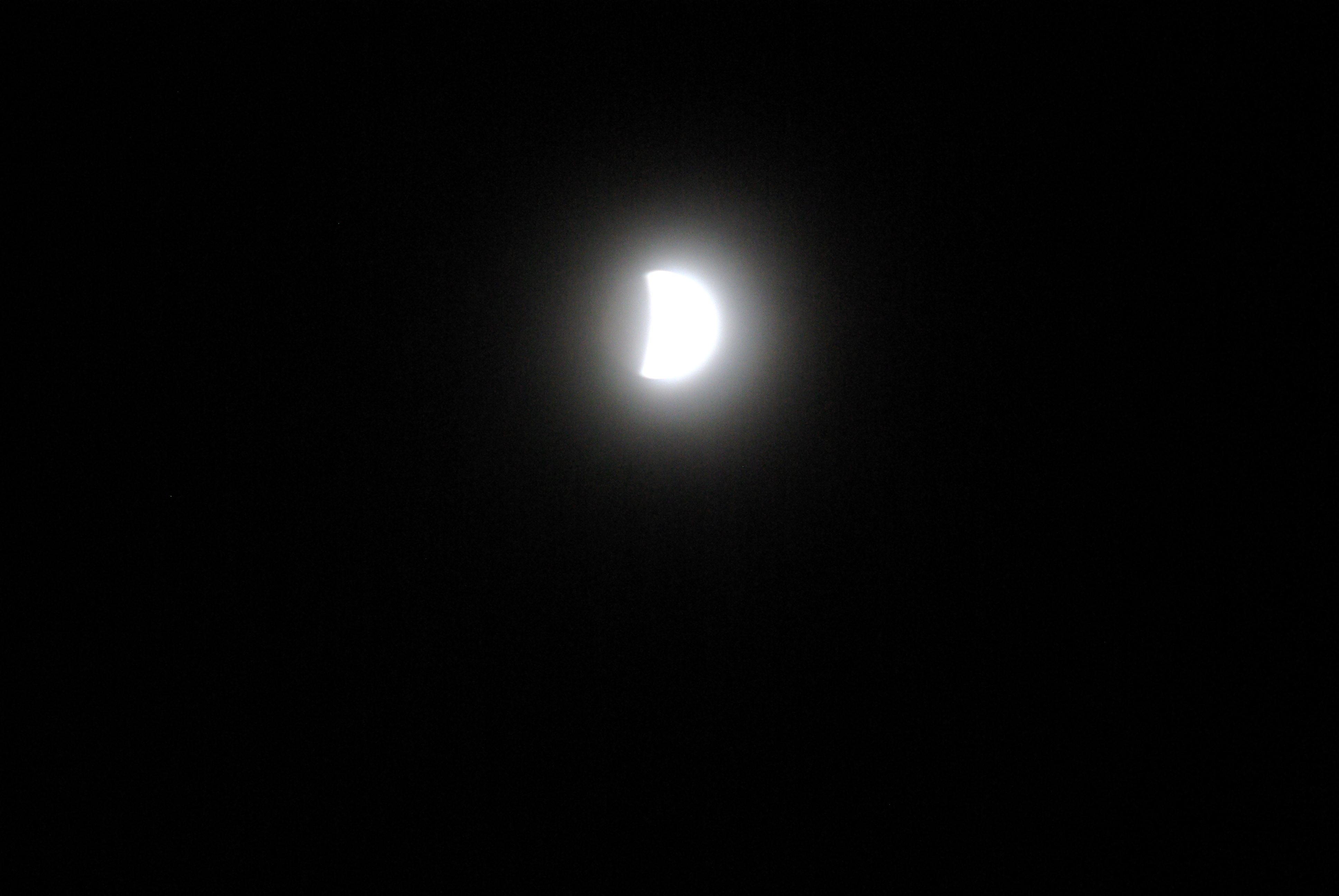
A long eclipse — more than an hour of almost-total coverage of the Moon’s disk.  Clouds came and went, with a few good viewing times.  With the naked eye, the view was spectacular.  Through the 200 mm Pentax zoom, not quite as spectacular, even with the tripod mount.  Photographing eclipses takes some skill that I don’t yet possess.

Solstice eclipse - clouds took a break IMGP5760 - Photo by Ed Darrell

Clouds took a break

Eclipse totality, with clouds - IMGP5778 - Photo by Ed Darrell

Eclipse totality

A better shot, near the end - IMGP5798 - photo by Ed Darrell

Eclipse nearing its end

Near the end of totality, where the shadow slips away from the full Moon, a bright white light provides a dazzlying view that confounds the light meters.

Bright sliver as eclipse totality ends - IMGP5813 - Ed Darrell photo

Celestial orange, tinged in silver

Ending eclipse with more of the sky - IMGP5822 - Ed Darrell photo

Step back, see a few of the starts, even from inside Dallas city limits

Bright light at the edge of Earth's shadow - IMGP5844 Ed Darrell photo

To every Earth shadow, there's a silver lining to confuse the built-in light meter

Blood-tinge gone, Earth's shadow retreats - IMGP5881 Ed Darrell photo

Blood-tinge gone, Earth's shadow retreats (all photos by Ed Darrell)

Eclipse over, clouds again fog the view - IMGP5884 - Ed Darrell photo

Eclipse nearly over, clouds again fog the view

Longer lens, better tripod next time.  (Heh.  We should live so long.)


Monkey Day 4 Stone Hearth

December 21, 2010

What the heck is Monkey Day?

The 108th edition of 4 Stone Hearth is up at This is Serious Monkey Business.

A sample:

Over at her blog, Barbara J. King writes about The Cognitive Watershed and Nut-Cracking Monkey Pushback wherein she explains one of the finer (and, in my personal opinion, coolest) aspects of primatology, nut-cracking, and uses bearded capuchin monkeys (Cebus libidosus) to exemplify these foraging techniques. Pretty timely as the holidays approach, eh?

DNApes has also got a fantastic article that’s been hitting the news recently about Monitoring the Health of Endangered, Wild Chimpanzees. I’m particularly interested in disease ecology in primates, so this article was a special treat for me given that it looks at the potential for retroviral diseases in chimpanzees and the risks posed to hunters as a result.

How did humans get HIV, anyway?

Does it seem to you we have fewer blog carnivals coming to town these days?


Best law firm holiday card, from Manatt, Phelps & Phillips, LLP

December 20, 2010

Forget the imaginary War on Christmas and all the Fa-la-olderal surrounding that fight.What about the greeting from your company’s law firm? I understand this card, from Manatt, Phelps & Phillips, won the Wall Street Journal’s designation as best law firm card of 2010. Yes?

Apologies — it will play when you open the thing — I’ve put it below the fold so you don’t get surprised.

Read the rest of this entry »


The view from the seat of the pilot of the Enola Gay / Smithsonian National Air and Space Museum

December 19, 2010

Old friend and thorn in the side Gil Brassard in Baton Rouge alerted us to this wonderful marriage of modern technology and history from David Palermo Photography — an interactive, panoramic view of the cockpit of the Enola Gay, the B-29 from which the first atomic bomb used in war was dropped.

How can you use this in class, teachers?  Got a lesson plan that puts a student in the seat of the pilot?

Vodpod videos no longer available.

Enola Gay / Smithsonian National Air and Space …, posted with vodpod

For technical reasons beyond my ken, one may not make this a full screen image. No problem. Go to David Palermo’s site, and see this as big as your computer monitor. I recommend viewing it there — it’s better, really.

Palermo has a portfolio of cockpits he’s shot at the Smithsonian, including the French Concorde, Gemini VII, a Bell Huey helicopter, Mercury Friendship VII, and a Lockheed Martin X-35 — with spherical panoramas available of those and more (look for the link that says “HD360°” and look at the drop-down menu).  He sells massive prints of the cockpits — something special for aviation and space buffs.


Sherffius cartoon on DADT repeal

December 19, 2010

Sherffius cartoon on repeal of Don't Ask/Don't Tell

When does Sherffius get the Pulitzer?

Sherffius, cartooning in the Boulder (Colorado) Daily Camera.  When does he get a Pulitzer?


Typewriter of the moment: William Saroyan

December 19, 2010

William Saroyan's typewriter, photo from the Bancroft Library, University of Caliornia - Berkeley

William Saroyan's typewriter, displayed at the Saroyan Museum at his home in San Francisco - photo from the Bancroft Library, University of California; Berkeley

William Saroyan’s niece, Jacqueline Kazarian, recently gifted the Bancroft Library with a significant part of the archives of Saroyan’s work.  The press release on the gift included a photo of Saroyan’s Fox typewriter, which is displayed at the Saroyan museum in San Francisco.

Saroyan came from an Armenian American family, born in Fresno, California in 1908.  His writings illuminated the experience of Californians and Armenian Americans, especially during the Great Depression.

In many ways Saroyan’s work symbolizes the uniqueness of the Armenian community in America, especially California.  [You still out there, Ben Davidian?]   Wikipedia strikes the right tone:

Saroyan’s stories celebrated optimism in the midst of the trials and tribulations of the Depression. Several of Saroyan’s works were drawn from his own experiences, although his approach to autobiographical fact contained a fair bit of poetic license.

His advice to a young writer was: “Try to learn to breathe deeply; really to taste food when you eat, and when you sleep really to sleep. Try as much as possible to be wholly alive with all your might, and when you laugh, laugh like hell.” Saroyan endeavored to create a prose style full of zest for life and seemingly impressionistic, that came to be called “Saroyanesque”.

The complete May 19, 2010,  press release from the University of California is below.

a sketch "from a Turkish admirer," a photo of the author in his youth, and a framed sketch of Saroyan

The Bancroft Library's new archival material on William Saroyan includes (left to right) a sketch "from a Turkish admirer," a photo of the author in his youth, and a framed drawing of Saroyan with a passage of his writing on Armenia. (Images courtesy of the Bancroft Library)

The Bancroft Library accepts gift of William Saroyan archives

By Kathleen Maclay, Media Relations | 19 May 2010

William Saroyan

William Saroyan (Photo courtesy of The Bancroft Library)

BERKELEY — The Bancroft Library at the University of California, Berkeley, has received a spectacular gift of hundreds of books, drawings, correspondence and other personal communications to and from one of America’s best-known writers, the Armenian-American author and playwright William Saroyan.

The rich collection includes approximately 48 cartons with 1,200 books and other archival materials assembled by his niece, Jacqueline Kazarian, of San Francisco, who also is the founder of the William Saroyan Literary Foundation International. A celebration of the gift is set for noon on Friday (May 21) at The Faculty Club on campus.

“UC Berkeley is such an incredible place of learning and growing and intellectual exploration,” said Kazarian, who earned degrees in communication and decorative arts at UC Berkeley in the early 1950s. “I know that my uncle wanted his library, manuscripts and galleys to go to Berkeley. Students will be inspired by the collection.”

Apart from this gift, The Bancroft Library already retains significant holdings of Saroyan’s work that it collected over the course of his life and career, and it continues to add to that collection. Most of the latest materials come from Saroyan’s home on San Francisco’s 15th Avenue that is now a Saroyan museum directed by Kazarian. Those materials were supplemented by Kazarian’s extensive personal collection, as well as by items of Saroyan’s that she acquired through a prominent Boston archivist and via a Saroyan friend.

“Jacqueline Kazarian’s new gift is the largest and most substantial augmentation to the Saroyan collections at Bancroft that we have ever received,” said Peter Hanff, Bancroft’s deputy director.

The author’s classic manual typewriter, as displayed at his San Francisco home

The author’s classic Fox manual typewriter, as displayed at his San Francisco home. (Photo courtesy of The Bancroft Library)

Saroyan, born in Fresno, Calif., in 1908, drew extensively on his Armenian-American heritage and childhood experiences for his books, plays and short stories. Much of his writing was considered impressionistic and reflected a hearty optimism often hard to find during the gritty Great Depression. He died in 1981 at the age of 72, with his niece at his side.When Story magazine editors Martha Foley and Whit Burnett printed Saroyan’s “The Daring Young Man on the Flying Trapeze” in 1934, it was an immediate success, triggering Saroyan’s fame and standing as one of his many literary achievements.

“Uncle Bill’s writing revolutionized the short story,” said Kazarian, adding that she has always found his work “almost spiritual and fable-like.”

His five-act play, “The Time of Your Life,” is the only American play to have won both the New York Drama Critics’ Circle Award and the Pulitzer Prize. Saroyan’s work as a screenwriter with Hollywood director Louis B. Mayer on the film “The Human Comedy” won an Academy Award in 1943, and Saroyan later wrote a widely acclaimed book with the same title.

Kazarian’s gift to The Bancroft Library includes multiple first editions of Saroyan’s works, such as “The Daring Young Man on the Flying Trapeze,” “My Name is Aram” (1940), “The Human Comedy” and “Obituaries” (1979), and many materials personally inscribed by the writer. Also among the new items according to Steven Black, the head of acquisitions for Bancroft, are letters, telegrams and notes written by Saroyan to relatives and others close to him, mostly during the 1930s and 1940s.

antiquarian book dealer Peter Howard of Berkeley, shown here poring through Saroyan materials

Antiquarian book dealer Peter Howard of Berkeley, poring through Saroyan materials. (Photo courtesy of The Bancroft Library)

“He personalized a lot of what passed through his hands,” Black said, noting that much of the material features marginalia reflecting Saroyan’s thoughts and interests.

There also is a copy of Henry Miller’s “Aller Retour New York,” an 80-page journal about a 1935 visit by Miller to New York City and his journey aboard a Dutch ship back to Europe. It is inscribed by Miller to Saroyan.

And a Saroyan scrapbook in the collection contains press announcements about the Pulitzer Prize for his book, “The Time of Your Life.” He scoffed at the award, contending that the arts should not be judged by commerce.

The new Bancroft collection also contains a pre-publication proof of “Burnt Norton,” the first poem of T.S. Eliot’s “Four Quartets,” which Black said the publisher may have given to Saroyan “when he crossed the pond” on a trip from his temporary home in France to England.

There also is a wide range of magazines, including issues of Horizon and the Partisan Review, a leading publication of the Anglo-American intelligentsia during the 1930s and ’40s, Black said.

The first major deposit at The Bancroft Library of Saroyan’s papers was recorded in October 1980, and the library agreed to organize the collection and give Saroyan a general description and an index. After Saroyan died in 1981, the Saroyan Foundation paid the library to continue assembling the papers for official archives, which the foundation ultimately decided to place at Stanford University. That happened in 1996.

William Saroyan's niece, Jacqueline Kazarian, surveys materials at his San Francisco home

William Saroyan's niece, Jacqueline Kazarian, surveys materials in his home. (Photo courtesy of The Bancroft Library)

Kazarian’s donation is in honor of Berkeley antiquarian book dealer Peter Howard, who has provided appraisal assistance to Bancroft on Saroyan materials and other collections for decades. While director of The Bancroft Library, the late James D. Hart also developed strong professional and personal ties to Saroyan over the years, according to Kazarian and Black.

“Now, the Saroyan family materials come to a place that Saroyan himself would have been happy to see accepting them,” Black said, noting that Bancroft is proud to have so much of Saroyan’s “intellectual remains” to be able to share with the public.

Scheduled to speak about the acquisition at Friday’s event are Jacqueline Kazarian; David Calonne, vice president of education for the Saroyan Literary Foundation International and a Saroyan scholar; San Francisco novelist Herbert Gold; theater director Val Hendrickson reading Saroyan’s short story, “Common Prayer,” and the credo to “The Time of Your Life”; and Charles Faulhaber, director of The Bancroft Library.

UC Berkeley already is home to an Armenian Studies Program, which is focused on contemporary Armenian history, politics, language and culture. And Bancroft, a rich, special collections library containing historical and literary documents and other materials relating to California, the West, Mexico and Latin America, is known for its strong collections on California writers, including Jack London, Robinson Jeffers, Bret Harte, Frank Norris and others.

More information about The Bancroft Library is online. Bancroft is celebrating its 150th anniversary this year.

More:

William Saroyan commemorative stamps from the U.S., and U.S.S.R.

On commemorative stamps issued in both the U.S. and the U.S.S.R., Saroyan wears the Armenian-style moustache he wore through most of his later life. For a stamp to honor a man in both the U.S. and the Soviet Union was extremely rare -- maybe unique.