January 19, 2008

Pictured at left is the statue of Po’pay, one of two statues of heroes from the history of New Mexico featured in the National Statuary Hall, a collection in the U.S. Capitol. Po’pay’s statue was added to the collection in 2005, one of the two latest additions.
Po’pay was a leader of the revolt against oppressive Spanish rule over New Mexico’s native inhabitants between 1675 and 1681, a century before the American Revolution.
In 1997, the New Mexico Legislature selected Po’pay as the subject of the state’s second statue for the National Statuary Hall Collection and created the New Mexico Statuary Hall Commission, whose members were appointed by Governor Gary Johnson. Four sculptors were selected to create maquettes, and Cliff Fragua was awarded the commission in December 1999. It will be the seventh statue of a Native American in the collection; the others are King Kamehameha I, Will Rogers (who had Cherokee ancestors), Sakakawea, Sequoyah, Washakie, and Sarah Winnemucca.
The seven-foot-high statue was carved from pink Tennessee marble (making it the only colored marble statue in the collection) and stands on a three-foot-high pedestal comprised of a steel frame clad in black granite. It is the first marble statue contributed to the collection since that of South Dakota’s Joseph Ward, which was given in 1963; the other statues given since that time have been bronze. Its acceptance marked the first time at which every state in the Union has been represented by two statues in the collection. In addition, Po’pay is historically the first person represented in the collection to be born on what would become American soil.
No image or written description of Po’pay is known to exist. Sculptor Cliff Fragua describes the statue thus:
In my rendition, he holds in his hands items that will determine the future existence of the Pueblo people. The knotted cord in his left hand was used to determine when the Revolt would begin. As to how many knots were used is debatable, but I feel that it must have taken many days to plan and notify most of the Pueblos. The bear fetish in his right hand symbolizes the center of the Pueblo world, the Pueblo religion. The pot behind him symbolizes the Pueblo culture, and the deerskin he wears is a humble symbol of his status as a provider. The necklace that he wears is a constant reminder of where life began, and his clothing consists of a loin cloth and moccasins in Pueblo fashion. His hair is cut in Pueblo tradition and bound in a chongo. On his back are the scars that remain from the whipping he received for his participation and faith in the Pueblo ceremonies and religion.
Fragua, an Indian from Jemez Pueblo, studied sculpture in Italy, California, and New Mexico; he created his first stone sculpture in 1974.
The other 2005 addition to the collection was Sarah Winnemucca, heroine from Nevada (pictured below, right).

Sarah Winnemucca
[facsimile of her signature, “Sarah Winnemucca Hopkins”]
1844–1891
Nevada
Defender of Human rights
Educator
Author of first book by a Native woman
Each state may have two statues in the collection.
My work on the Senate staff often required that I walk the Capitol, especially between the Senate and House Press Galleries. I often lamented that it was not available or accessible to students. This collection of statues is one of the better unsung galleries of history in Washington, D.C. It is heavily influenced by politics and current fashion. Selections illustrate how state legislatures try to make their state’s reputation, and can be very quirky. For example, Pennsylvania’s statues include Robert Fulton, an inventor of the steamboat, and John Peter Gabriel Muhlenberg — but not Ben Franklin or William Penn. Why? There could be a paper done on the politics of the choices of each of the 50 states.
Read the rest of this entry »
Spread the word; friends don't allow friends to repeat history.
 1 Comment |
  Art, History, History and art, History images, History museums, U.S. Capitol | Tagged: Art, History, Media, Native Americans, women's history |
  Permalink
 Posted by Ed Darrell
January 19, 2008
Adnan Oktar’s mean-spirited campaign against knowledge, science and evolution still makes headlines — this time in the blog of Die Zeit, the most widely-read newspaper in Germany.
I’m flattered at the mention. I’d be happier if I knew Turkey’s ban on blogs had been lifted. I’d be happier if Die Zeit’s view leaned much more toward protecting freedom of the press, and much less toward general xenophobia against Moslems. Perhaps I’m reading too much into the comments.
Millard Fillmore’s Bathtub is banned in Turkey, China, and blocked in the Duncanville, Texas, school system. What does that mean?
Spread the word; friends don't allow friends to repeat history.
1 Comment | Adnan Oktar, Creationism, Freedom of the Press, Law, Technology, Weblogs | Tagged: Adnan Oktar, Creationism, First Amendment, Freedom of the Press, Law, Politics, Technology | Permalink
Posted by Ed Darrell
January 18, 2008
January 16 was Religious Freedom Day. I missed it again.
But I celebrate it most days, and you can, too.
They just don’t make many like Thomas Jefferson any more.

Thomas Jefferson, in bas relief, in the chamber of the U.S. House of Representatives, a gallery of lawgivers who contributed to the heritage of U.S. law and freedom. Architect of the Capitol photo. C. Paul Jennewein, sculptor
Spread the word; friends don't allow friends to repeat history.
Leave a Comment » | History, Religious Freedom, Thomas Jefferson | Tagged: freedom, Religion, Thomas Jefferson | Permalink
Posted by Ed Darrell
January 18, 2008
Without the fanfare the act deserves, Elektratig has been revealing secrets of the history of Millard Fillmore, including this one, “Millard Fillmore, fulcrum of history.
Fillmore’s role in the creation and passage of the Compromise of 1850 may be more substantial than most accounts of the time allow.
In any case, for our much-overlooked 13th president, Electratig points researchers to more information to tell the story. He’s got several posts on Fillmore, more than a dozen in the recent past; noodle around and find all of them. For example:
Spread the word; friends don't allow friends to repeat history.
5 Comments | Civil War, Historic documents, History, History blogs, Millard Fillmore, Politics | Tagged: Civil War, History, Know-Nothings, Millard Fillmore, Politics | Permalink
Posted by Ed Darrell
January 17, 2008
Today is the 302nd anniversary of the birth of Ben Franklin (1706-1790).
At one time, this was the only day of the year on which a tornado had not been recorded in the U.S. Does anyone know: Is that still so?
Happy birthday, Ben. And, happy Ben’s birthday, America. We were lucky to have him.
Image and Quicktime Movie from Franklin Institute
Spread the word; friends don't allow friends to repeat history.
1 Comment | Ben Franklin, Heroes, History | Tagged: Ben Franklin, Heroes, History | Permalink
Posted by Ed Darrell
January 17, 2008
Beautiful, indeed!
I’ve often recommended students diagram the Preamble to the Constitution, to better understand the source of authority in our government (“We, the People”).
Betsy (I have no surname) sent me a link to this:

Preamble to the Constitution as your English teacher wishes you would have diagrammed it.

Sentence diagram of the Preamble to the Constitution. GIF version
The work is done at a the site of Capital Community College, their “Guide to Grammar and Writing.”
Here’s the Preamble as it usually appears:
We the People of the United States, in Order to form a more perfect Union, establish Justice, insure domestic Tranquility, provide for the common defence, promote the general Welfare, and secure the Blessings of Liberty to ourselves and our Posterity, do ordain and establish this Constitution for the United States of America.
I wonder: Has anyone diagrammed the Mayflower Compact?
Tip of the old scrub brush to Betsy at The Reality Based News Feed, and to Boing Boing.
Spread the word; friends don't allow friends to repeat history.
5 Comments | Historic documents, History, History images, U.S. Constitution | Tagged: Grammar, History, Law, Preamble, U.S. Constitution | Permalink
Posted by Ed Darrell
January 17, 2008
Earlier than I expected, in the wee hours of this morning this blog slipped over 400,000 clicks, 400,000 page views.
To the core fans of the site: Thank you. To random visitors: Thank you, and come back.
The spam-to-comment ratio is horrendous, but WordPress’s Akismet makes that very manageable. The comment to visit rate is too low, too, but I suppose that means I’m avoiding some of the needless controveries that build comment traffic.
Gee, I wish I had a nickle for every visit . . .
Spread the word; friends don't allow friends to repeat history.
2 Comments | Administrivia | Tagged: Administrivia, Weblogs | Permalink
Posted by Ed Darrell
January 16, 2008
January’s meeting still has the item on the agenda, officially, but the actual vote won’t come without considerably more study.
The Texas Higher Education Coordinating Board had been scheduled to consider the proposal by the Dallas-based Institute for Creation Research at a meeting Jan. 24.But Eddy Miller, dean of the institute’s graduate school, said in an e-mail to the coordinating board Monday that the school needs more time “to do justice to the concerns you raised,” according to a news release issued by the coordinating board. Miller asked the board to delay consideration of the matter until its April meeting.
Texas’s science community panned the motion. Rumors say many of Texas’s top scientists wrote or called to urge disapproval of the motion.
There’s still time to send a letter calling for a stand for good, hard science. Details, as always, at the Texas Citizens for Science page.
Spread the word; friends don't allow friends to repeat history.
3 Comments | Creationism, Education, Education quality, Higher education, Religion, Science, Texas, Texas Citizens for Science | Tagged: Creationism, education standards, Religion, Science, Texas | Permalink
Posted by Ed Darrell
January 15, 2008
Utah’s Cache Valley is home to the city of Logan, and to Utah State University, the land-grant college for the state. For several humorous reasons, some of them good, the place sometimes is called Happy Valley.
Small county in a beautiful setting + good university with a good school of education = good conditions for teacher recruiting. Logan’s schools have been very good over the years, in academics and all forms of competition.
As we discovered with the voucher fiasco in 2007, Utah’s education situation is not completely happy any more. Classrooms are crowded, teachers are overworked, and for the first time since the Mormon pioneers first settled Utah, educational achievement is declining.
The editorial board at Logan’s Herald-Journal noticed the problems. It’s tough to recruit teachers. If Milton Friedman were alive, we’d look for a classic free-market economics solution, something like raising teacher pay to stop the exodus from the profession.
Milton Friedman is dead. His ghost doesn’t seem to have much clout in Logan, Utah, either. What does the Herald-Journal propose? Loosen standards, look for uncertified people to teach.
When people leave the job they worked hard to earn certification for, what will happen with people who are not certified and are untrained in classroom management?
Why not just raise teacher pay, and attract more well-trained teachers?
Let me ask the key question, more slowly this time so I’m sure it’s caught: Why not just raise teacher pay?
Fishing for teachers? Bait the hook with money.
(Full Herald-Journal opinion below the fold.)
Read the rest of this entry »
Spread the word; friends don't allow friends to repeat history.
2 Comments | Economics, Education, Education quality, Education reform, Teacher Pay, Teaching | Tagged: Education, Politics, Teacher Pay, Utah | Permalink
Posted by Ed Darrell
January 15, 2008
A few days ago, via Peoples Geography, I discovered the work of graffiti artist Banksy — rather behind the curve, judging from his history. I posted a particularly provocative work of his in this post within the past week.
Today CBS Evening News and other outlets report some enterprising building owner in London who recognized Banksy’s work, preserved it, and has auctioned it away on eBay. It fetched $407,000 US. (CBS video here)
The work, depicting an artist in old-fashioned clothes putting the finishing touches on the word “BANKSY” spray-painted in red, was scrawled on a wall on the Portobello Road in the west London district of Notting Hill.
It was offered for sale on the e-Bay auction site and went for 208,100 pounds after attracting 69 bids.
The winner of the auction may well get the painting and the wall it is on, but they will have to calculate how to get the whole work delivered and pay to replace the wall.
“I am selling the wall because I can’t really justify owning a piece of art worth as much as it is,” said Luti Fagbenle, the owner of the property on which the graffiti is sprayed.
A political cartoon changed the life of one London building owner.
Spread the word; friends don't allow friends to repeat history.
Leave a Comment » | Art, Cartoons, Dissent, Political cartoons, Travel | Tagged: Art, Banksy, Dissent, eBay, Media | Permalink
Posted by Ed Darrell
January 15, 2008
Is this a state school board member urging teacher unions and — heavens to Betsy! — a strike? Tim Beagley, at Educating Utah:
In very real terms, I’m afraid that the reason the teaching profession has fallen so far is that teachers have allowed it to happen. In the face of ridiculously low wages and poor academic environments, teachers keep showing up and going through the motions of their job. That must change if the system is going to improve. We need (and I believe would ALL be well served) for teachers to be more forceful with their demands for respect and dignity. The standards that our accountability plans are based upon should be high and the expectations teachers have of us need to be just as high and stringent. There was a time when the teacher was known to be one of the most respected and strongest members of society. We need to get back to that. Respect and dignity are likely products of strength.
His post reminds one of Bill Bennett’s old “$50,000 solution” — hire a good principal, which in 1986 and 1987, would run about $50,000 (it’s higher now).
When will legislators and school boards really get the message that to make our schools competitive, we have to hire people who can make them compete, which means we need to compete against other hiring authorities to get the best?
Beagley is a member of the Utah State Board of Education, and a biology professor at Salt Lake Community College.
Spread the word; friends don't allow friends to repeat history.
3 Comments | Education quality, Education reform, Education spending, Labor and unions, Teacher Pay | Tagged: Education, Teacher Pay, teacher unions | Permalink
Posted by Ed Darrell
January 14, 2008
State legislatures shouldn’t micromanage the classroom, parents should monitor student progress, and students should take difficult classes, to get a better education. Utah math teacher Allen Barney lists inexpensive — and unlikely — methods for improving education, in Salt Lake City’s Deseret Morning News.
Read the rest of this entry »
Spread the word; friends don't allow friends to repeat history.
4 Comments | Education, Education quality, Education reform, Teacher Pay, Teaching | Permalink
Posted by Ed Darrell
January 14, 2008
Florida may be ahead in the race to see which state can get slapped down first for illegally denying science to students in public school science classes. The problem in national, however.
It’s not always a question of setting standards. Sometimes teachers are told to dumb down classes, regardless the standards. Fort Bend County, Texas, offers an example: “Religious Beliefs Trump Thinking In Our Schools.”
No, Fort Bend County is not in rural, far west Texas. It’s just southeast of Houston, Texas’ biggest city.
Be sure to scan the comments, too.
Belated tip of the old scrub brush to Ed Brayton at Dispatches from the Culture Wars.
Read the rest of this entry »
Spread the word; friends don't allow friends to repeat history.
2 Comments | Biology, Creationism, Religion, Science, State school boards, Teaching, TEKS, Texas | Tagged: Creationism, Education, Evolution, Religion, Science, Texas | Permalink
Posted by Ed Darrell
January 13, 2008
Thomas Nast helped bring down the crooks at Tammany Hall with cartoons. Boss Tweed, the chief antagonist of Nast, crook and leader of the Tammany Gang, understood that Nast’s drawings could do him in better than just hard hitting reporting — the pictures were clear to people who couldn’t read.
But a cartoon has to get to an audience to have an effect.
Here’s one below, a comment on the security wall being built in Israel, that got very little circulation in the west at Christmas time. Can you imagine the impact had this drawing run in newspapers in Europe, the U.S., and Canada?
It’s a mashup of a famous oil painting related to the Christian Nativity, from a London-based artist who goes by the name Banksy. (Warning: Banksy pulls no punches; views shown are quite strong, often very funny, always provocative, generally safe for work unless you work for an authoritarian like Dick Cheney who wants no counter opinions.)
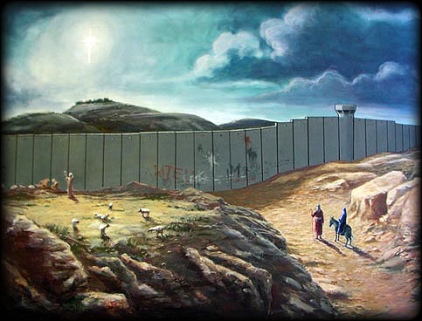
Tip of the old scrub brush to Peoples Geography.


Spread the word; friends don't allow friends to repeat history.
3 Comments | Art, Cartoons, Dissent, History, Palestine, Political cartoons | Tagged: Art, Banksy, Cartoons, Dissent, Israel's Wall, Mary and Joseph, Media, Palestine, Political cartoons, Politics | Permalink
Posted by Ed Darrell
January 13, 2008
January 13, 1794, President George Washington signed the law adding two stars and two stripes to the U.S. flag, after Vermont and Kentucky joined the union.
This was the only U.S. flag ever officially to have more than 13 stripes.

Replica of the flag flown during the War of 1812, with 15 stripes and 15 stars. Very few examples of a 15-stripe flag remain. The flag that flew over Ft. McHenry, the original “Star-spangled Banner,” is one. This replica flies in the peace garden in Oswego, New York.
The “Star-spangled Banner” that flew over Ft. McHenry, near Baltimore, which inspired Francis Scott Key to write the poem which was put to music to form our national anthem, had 15 stripes. President James Monroe signed a law in 1818 that specified 13 stripes, with a new star to be added on July 4 of any year after a new state was added, a practice which has held through our current 50-star, 13-stripe flag.
Tennessee was the 16th state. I have been unable to clarify what happened with the number of stripes between Tennessee’s admission to the union on June 1, 1796, and the law passed in the Monroe administration in 1818. Does anyone know? Got links?
More (added after August 2013):
Spread the word; friends don't allow friends to repeat history.
20 Comments | Flag etiquette, History, Patriotism | Tagged: flag, History, Patriotism | Permalink
Posted by Ed Darrell





