Respect for our soldiers, respect for our flag

August 17, 2007

Michigan Gov. Jennifer Granholm issued an executive order that flags across Michigan would be flown at half-staff to honor Michigan soldiers who die in service to the nation in Afghanistan and Iraq. In order to make the order work, her office issues a press release designating the day, and the governor’s website makes note, too. I get an e-mail notification; you may sign up for e-mails at the governor’s website.

Are other states making it as easy to know when to fly flags at half-staff?

Here is Gov. Granholm’s latest press release, on Friday, August 17, 2007:

Flags to be Flown Half-Staff Friday for Army Private First Class Jordan E. Goode

LANSING – Governor Jennifer M. Granholm today ordered United States flags throughout the state of Michigan and on Michigan waters lowered for one day on Tuesday, August 21, 2007, in honor of Army Private First Class Jordan E. Goode, of Kalamazoo, who died August 11 while on active duty in Afghanistan. Flags should return to full-staff on Wednesday, August 22.

Pfc. Goode, age 21, died in Zormont, Afghanistan, from wounds suffered from an improvised explosive device. He was assigned to the 4th Squadron, 73rd Cavalry Regiment, 4th Brigade Combat Team, 82nd Airborne Division, Fort Bragg, North Carolina.

Under Section 7 of Chapter 1 of Title 4 of the United States Code, 4 USC 7, Governor Granholm, in December 2003, issued a proclamation requiring United States flags lowered to half-staff throughout the state of Michigan and on Michigan waters to honor Michigan servicemen and servicewomen killed in the line of duty. Procedures for flag lowering were detailed by Governor Granholm in Executive Order 2006-10.

When flown at half-staff or half-mast, the United States flag should be hoisted first to the peak for an instant and then lowered to the half-staff or half-mast position. The flag should again be raised to the peak before it is lowered for the day.

When a member of the armed services from Michigan is killed in action, the governor will issue a press release with information about the individual(s) and the day that has been designated for flags to be lowered in his or her honor. The information will also be posted on Governor Granholm’s website at www.michigan.gov/gov in the section titled “Spotlight.”

# # #

Our condolences go out to the family of Pvt. Jordan Goode.

And our compliments for helping people with flag etiquette go to Gov. Granholm.


Nightmare at 1600 Pennsylvania Ave: Socialized medicine! (it works well)

August 16, 2007

Rep. Ron Paul, who wants to be president, made a speech recently on the floor of the House of Representatives where he suggested that Americans are mad at their government because the government tries to do stuff for them that they’d rather do themselves. Having recently spent two nights in the medical brig, I immediately thought that Paul is completely out of his mind — who in their right mind would want to do their own health care?

(Old joke: You know what they told the guy who wanted to do his own appendectomy? His doctor said, “Whatever! Suture self!”)

It seems to me people are upset because they can’t get health care at reasonable cost, and the government is doing absolutely nothing to fix most of those problems.

Then I read somewhere that Karl Rove urged his clients to bring up the bogey word “socialized” to describe programs their opponents advocate, since everybody hates anything that is socialized? Oh, yeah? You mean like people hate socialized roads, socialized water delivery systems, socialized sewer systems, and socialized airports?

So I was ready when Jim Wallis’s e-mail hit my in box this morning. His story about his experience with “socialized medicine” in London — a horror story that George Bush will use in his next State of the Union?

It’s a nightmare for sure — for the critics of “socialized medicine.” Read it for yourself, below the fold.

Here’s the usual, Republican view of “socialized medicine” (click on thumbnail for a larger view:

Government Optical

Pretty funny, eh? It’s totally groundless. Think about the government’s program of eye care for soldiers. Pilots and sharpshooters need great eye care. They get the best. They also get stylish glasses. And, though budgeted, you can get some style on Medicare and Medicaid, too — lots of styles, not just one. Our government operated eye care is socialized almost not at all in the classic, socialism definition of its being a planned output and planned outcomes system. Neither output nor outcomes are planned.

Socialized medicine really works. It’s a nightmare for the crowd that thinks bad health care or no health care is cheap, and the socialized medicine can’t work. Read Jim Wallis’s story, below the fold:

Read the rest of this entry »


What Churchill did NOT say

August 16, 2007

Winston Churchill often gets credit, or blame, for “famous quotations” that he did not say.

Cartoon of Churchill speaking (frustrated?)

Misattribution is a common problem in speeches, press releases, DeathbyPowerPoint, and in all other human interaction. I believe the third or fourth most powerful human instinct is to misattribute aphorisms to admired, famous people. So in business presentations across the world today, someone will quote Lincoln, Jefferson, Madison, Washington, Franklin, Einstein and Churchill, as saying things they never uttered.

Below the fold, from the Churchill Centre in London, here is a collection of famous things often attributed to Winston Churchill that he did not actually say: Read the rest of this entry »


Toad mapping – another cool tool

August 16, 2007

What amphibians can be found in your local biome? Great Plains toad, Bufo cognatusWhat is the range of a particular amphibian, say the Great Plains toad? What does that toad look like? How does it sing?

hear call (10337.1K WAV file)

Great source to supplement geography lessons: Amphibiaweb, a special project at the University of California – Berkeley.

Quite student friendly — get to the world map, click on your continent (ooh! kids gotta know what continent they’re on! see social studies TEKS, World geography 4.C, U.S. history 8, World history 11), click on your country, if you’re in the U.S., click on your state. Photos, maps of the range, scientific names, sound recordings of their calls, description, conservation status.

Read the rest of this entry »


Cheney too racy for children

August 16, 2007

 PG-13 rating for this blog

One of those silly internet things:  Mingle2 rates blogs as if they were movies, and issues a rating like the MPAA ratings.  Millard Fillmore’s Bathtub?  We’re PG-13 here.  Why?

This rating was determined based on the presence of the following words:

  • dead (3x)
  • dick (2x)
  • shoot (1x)

In discussions of casualties in war, a history blog might use the word “dead” a few times.  Considering how often I’ve posted about World War I, World War II, the Civil War, atomic bombs, etc., it’s amazing that the word “dead” only shows up three times.

And “shoot?”  Well, shoot, it might appear as a mild oath.

I try to police even the comments to keep profanity down, to keep the blog from being banned by bot programs in junior high schools.  So, how did the word “dick” sneak in there twice?

Dick Cheney.  It’s all his fault.  You can search just like I did, in the right column of the main page.  The search also turns up a post mentioning Charles Dickens, but that would have been a third mention.

It almost makes one yearn for the last year of the Nixon administration after the firing of special prosecutor Archibald Cox, when bumper stickers quickly appeared urging Congress to “Impeach the Cox Sacker.”

Saying Vice President Cheney’s first name is profanity?  Who knew?


Typewriter of the moment: Faulkner, again

August 15, 2007

The previous photo showed Faulkner himself using the machine.

It was a desktop machine. This color shot shows Faulkner’s portable typewriter, a different machine from the one in the publicity still from 1954.

William Faulkner's typewriter, displayed at his home in Oxford, Mississippi; photo by Gary Bridgman

Photographer Gary Bridgman provided a thorough history and explanation, at the Wikipedia Media site, which I quote completely and directly — bless him for the story:

The “Faulkner portable”: American novelist William Faulkner’s (1897-1962) Underwood Universal Portable typewriter, resting on a tiny desk his stepson helped him build. This space at Rowan Oak, the author’s home, was part of the back porch until Faulkner spent part of a Random House advance to enclose it in 1952, long after he had written his seminal Compson and Sartoris family novels. He insisted that this room not be called his “study.” According to biographer Joseph Blotner, “he did not study in it, so there was no sense in calling it that. It was the ‘office,’ the traditional name for the room in the plantation houses where the business was transacted.” As to the typewriter itself, Underwood introduced its Universal Portable in the mid-1930s among a full line of portables such as Champion, Noiseless Portable and Junior. Faulkner had a habit of buying used portables locally, wearing them out, then trading them in on more used portables. This Underwood was one of at least three typewriters in Faulkner’s possession at the time of his death (the University of Virginia has one, too). So, this is no more “the” typewriter any more than those square carpenter’s pencils next to it are “the” pencils. Had Faulkner lived a few more years, this machine would have met the same fate as the rest. Still, the room has a resonance. BOOK magazine was publishing an article of mine on “Yoknapatourism,” and thinking (mistakenly) that the editors hadn’t already selected a photographer, I returned to Oxford on a rainy October afternoon to make my own pictures for submission. The travel piece was eventually illustrated with sunny-day brochure shots, but I was happy to keep this one for myself. There was no direct lighting within the office, so I let the film take its time, soaking up faint incandescent glow from the library and main hallway, which neatly balanced the cloudy daylight. I used the camera’s timer so my hand wouldn’t jostle the tripod, and I even backed out of the room–in part to let the scarce light do its work and, I think, because I wanted Faulkner’s office truly vacant.

Trivia: the book next to the typewriter is the 1939 edition of Writer’s Market. Thanks to Bill Griffith, curator of Rowan Oak, for letting me past the Lucite wall and to Milly Moorhead West for lending me the tripod. – Gary Bridgman

Photo by Gary Bridgman, southsideartgallery.com.


Cincinnati Enquirer coverage of Creation Museum

August 15, 2007

For a while, at least, the Cincinnati Enquirer’s coverage of Ken Ham’s Creation Museum in Northern Kentucky is all neatly assembled online: http://news.nky.com/apps/pbcs.dll/section?Category=creationmuseum


Jefferson, economics and history

August 15, 2007

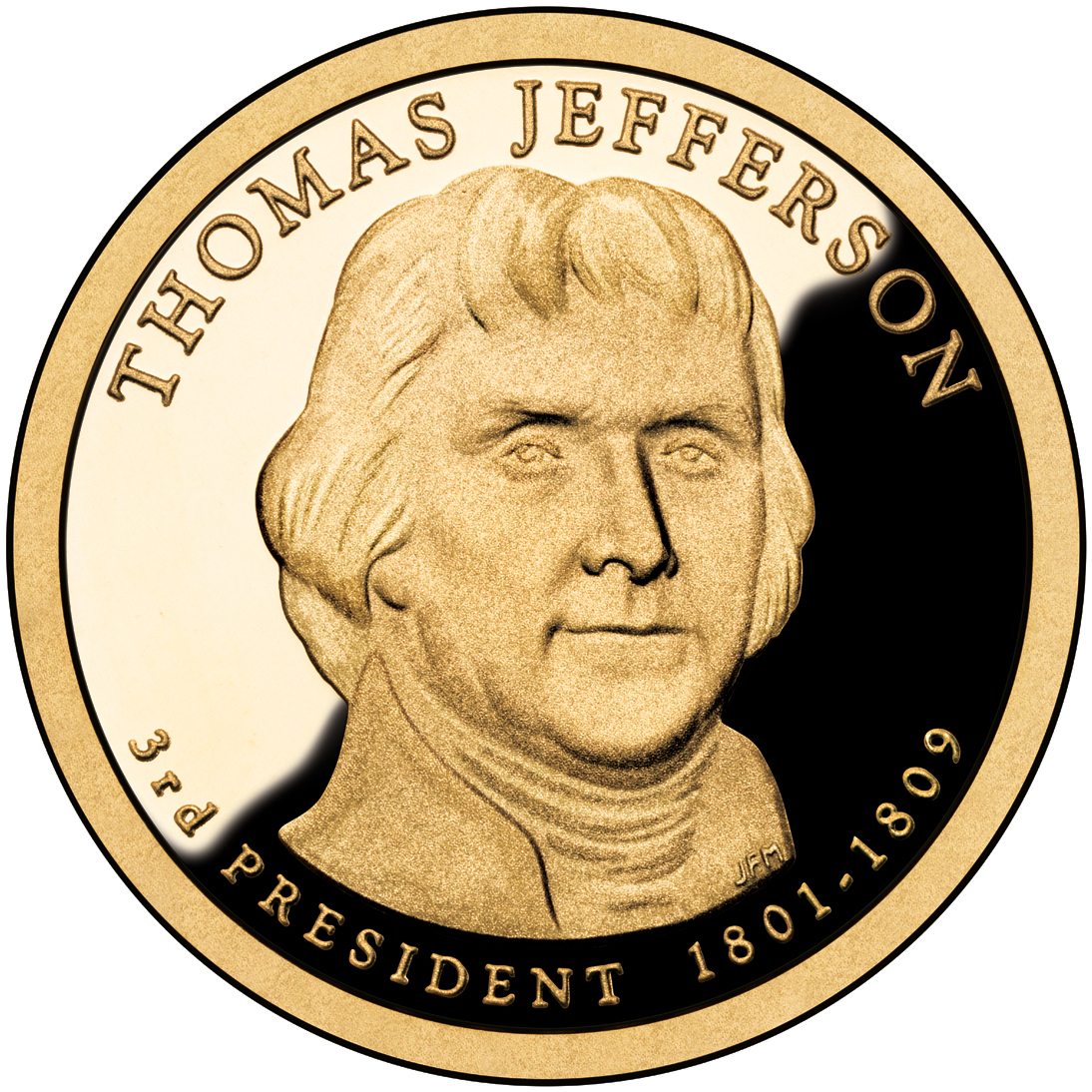
Jefferson dollars will be unveiled today in a ceremony at the Jefferson Memorial in Washington, D.C. They officially go into circulation tomorrow, August 16, 2007.

Jefferson dollar; U.S. Mint image via Associated Press

Jefferson dollars are the third in a series commemorating U.S. presidents. The series started with Washington and will proceed, three new coins a year, through all the presidents. (Quick: What’s the cheapest amount you can invest to get dollars representing all 43 administrations? Don’t forget Grover Cleveland’s anomaly . . .)

The Associated Press story notes three things of interest:

History: Fewer than a third of Americans know Jefferson was the third president. They did better with Washington as the first president. I had a few scary moments last year covering a Texas history course when kids kept answering either “George Washington” or “Abraham Lincoln” to the questions, “Who was the the Father of Texas?” (Stephen F. Austin) and “Who was the first president of the Republic of Texas?” (Sam Houston).

Economics: The vending machine industry loses about $1 billion each year when dollar bills jam in the machine’s vending mechanism. The U.S. Mint and vending machine operators hope the dollar coins catch on and help reduce those losses.

Dollar coins are unpopular: This is another in a series of efforts to “wean” people from paper dollars to coins — remember the Sacagawea dollar? The Eisenhower dollar? The Susan B. Anthony dollar? Just last week I got an Eisenhower dollar in change from our local Starbucks — they had mistakenly put it in the coin drawer for quarters. You can get dollar coins in change at the U.S. Post Office, but not at many other places. Our local post office occasionally sneaks a Euro into the dollar change mechanism. Bonus!

The Washington Post story carried more details of the poll, conducted by the Gallup organization for the U.S. Mint: Read the rest of this entry »


Key images for VJ Day, August 15

August 15, 2007

August 15, 1945, was VJ Day — the day that World War II ended in the Pacific Theatre. VJ is an acronym for Victory Japan. Victory in Europe, VE Day, was declared the previous April.

VJ Day is affiliated with a series of images that students of U.S. history should recognize; these images tell much of the story of the day and the events of the weeks leading up to it.

The most famous image is Alfred Eisenstadt’s photograph of an exuberant sailor kissing a swept-off-her-feet- for-the-moment nurse in Times Square, New York City. This is one of the most famous photographs from the most famous photographer from Life Magazine:

The Smack Seen 'Round the World, photo by Alfred Eisenstadt, Life Magazine, 8-15-1945 Eisenstadt coolly titled his photo “VJ Day, Times Square.” It came to be known as The Smack Seen ‘Round the World. It was fitting that the photo would be taken by Eisenstadt, since his work came to be a symbol of Henry Luce’s Life Magazine in a pre-television era when photography magazines like Life and Look were key news organs for the nation.

In a fun and continuing mystery, several people have claimed to be the sailor, or the nurse, through the years.

Before the victory celebration, there had to be a victory. Japan asked for conditional surrender discussions, but the Allied forces insisted on unconditional surrender. Japanese military officials were rather certain that, if the Soviet Union entered the Pacific War, Allied victory would be assured. Japan hoped to either get a conditional surrender agreement, according to some sources, or inflict heavy losses on Allied forces to get better surrender conditions, but before Russia entered the war. Russia and Japan had long-standing grudges against one another dating from before their earlier war in the first decade of the 20th century.

Read the rest of this entry »


Good Vibrations

August 15, 2007

August 15 is Leon Theremin’s birthday (b. 1896).

Leon Theramin and his instrument, the Theramin Without Leon Theremin, musical scores to horror movies would be nearly impossible, at least for everyone except Henry Mancini and John Williams.

His life would make a great movie. He invented the Theremin in the midst of World War I in Russia; after the war he toured Europe, and then the U.S. He played Carnegie Hall, he collaborated with Albert Einstein, and he married a young African-American ballerina, Lavinia Williams. In 1938 he was kidnapped by the Soviet KGB and forced to return to Russia, in the Union of Soviet Socialist Republics (USSR).

Sent to a work camp, he worked alongside Andrei Tupelov and a host of other famous Soviet scientists. Theremin was “rehabilitated” in 1956. He returned to invention, and invented bugging devices, including the famous microphone that was placed in the Great Seal of the United States in the U.S. Embassy in Moscow. The bug had no moving or active parts, and no power supply, but could transmit when hit with a microwave transmission. The bug spied on U.S. diplomats from 1945 until its accidental discovery in 1952.

Later Theremin turned to inventions of devices to open doors, and to burglar alarms. He trained his niece, Lydia Kavina, on the Theremin — she is considered a virtuoso at the instrument today. In 1991 he returned to the U.S., reunited with some of the artists he’d worked with 50 years earlier for several concerts. He died in Russia in 1993, at the age of 97.

And if you’ve ever heard the Beach Boys’ recording of “Good Vibrations,” you know what a Theremin sounds like.


Listen to a voice of experience

August 14, 2007

Quoting from Second Drafts, verbatim:

My mother, Charlotte, just retired in May after 30+ years teaching high school English. As this will be her first August without having to prep for school, I thought I’d better ask for her top ten teaching suggestions before she forgot them all. Here’s what she emailed me:

  1. Establish a seating chart at the beginning, but allow time for schedule changes. Some of my colleagues would allow students to sit where they wanted, and they all would end up at the back of the room. I always wanted them under my nose!
  2. Greet students cheerfully. You may be the only one to do this in their day.
  3. Have high expectations, but be realistic.
  4. Dress professionally, even though others don’t.
  5. Be alert to students whose eyes are focused on their laps – they’re probably texting!
  6. You gotta have a gimmick – a daily trivia question written on the board works well here. I always used the question cards from the Trivial Pursuit game. The first person to answer as the students come into the room gets a piece of peppermint candy, which enhances higher level thinking skills.
  7. Surprise the kids once in a while by diverting from the syllabus (Thoreau would love you for this).
  8. Be consistent in routine and discipline.
  9. Take care of discipline problems yourself, as much as you can.
  10. Be real and enjoy your students.

School starts tomorrow. Anybody else got any counsel you’d like to share?


Teacher pay, Teacher unions — What teacher would switch places with Richard Cohen?

August 14, 2007

Richard Cohen, whom I regarded a good columnist when we lived in Washington, D.C., had made an odd turn in the past decade or so. Where normally he’d stand up for public institutions and the people who run them, he just sounds cranky lately. In short, he’s turned into a person who likes Bush Republicans. Oh, my, it erupted in his recent column which is just grousing about how much education costs in the District of Columbia, with an ambiguous, implicit claim that maybe there’s too much money going into education there.

(Well, maybe too much for the results gotten compared with a few suburban districts; not enough to boost performance on the tests.)

Jason Rosenhouse at Evolutionblog Fisks the column, Fisks Cohen, and generally supports teachers — it’s worth a read.

It’s worth a read especially if you’re one of those who, like Richard Cohen, think we should suppress the pay for teachers until they improve, ignoring all the lessons you might ever have learned about getting what you pay for, and about the economics of hiring the best, the brightest, or just the heroes necessary to make a change. Here’s part of Rosenhouse’s commentary:

But that is not the main subject of this post. Instead it’s that gratuitous slap at the unions that struck me. Cohen, like a trained seal, has learned that mindlessly bashing teacher’s unions will never get you into trouble. That is why he feels no need to provide any specifics about what, exactly, the unions are doing wrong. Instead, when it comes time to reveal those subtleties of the education problem about which Democrats need to be instructed, Cohen only produces this:

Only one candidate, Barack Obama, suggested that maybe money was not all that was lacking when it comes to educating America’s poor and minority children. Parents had a role to play, too. “It is absolutely critical for us to recognize that there are going to be responsibilities on the part of African American and other groups to take personal responsibility to rise up out of the problems we face,” he said. What? It’s not just a question of funding?

Parents! Of course! How could those money grubbing teacher’s unions and their slavish Democratic puppets have overlooked such a thing? All this focus on making sure schools have the funds to heat their buildings in the winter and patch the roof when it leaks, this crazy idea that a school using twenty year old textbooks needs money if they are to procure new ones or that science labs are not exactly inexpensive, and they simply overlooked that parents have a role to play in their children’s education. One can only hope the Democrat’s pay attention to someone as perceptive as Cohen.

::heavy sigh::

The U.S. is not alone.  Australia has some teacher pay and facility issues, too, according to Matt’s Notepad.  Another interesting read.


Sacrificing accuracy and children for art

August 14, 2007

Cartoon Brew has an upload of an animated ad for the abominable Creation Museum in Kentucky, Ken Ham’s monument to denial of reality and campaign against science. (I wish I knew how to upload a link here . . . if you have suggestions, pass them along.) Here’s Youtube version:

Yes, it’s nice animation. As art, it functions rather as the opposite of Picasso’s Guernica, though, doesn’t it? Instead of revealing a truth, even a horrific truth, it is art aiding a campaign of deception.

What do you think?

Does biology need to recruit the ghosts of Tex Avery and Chuck Jones to keep pace? Or is this just one more demonstration of the scientific and moral vacuity of creationism?

We still can’t get legal copies of that brilliant Civil War animation from the Abraham Lincoln Presidential Library and Museum, but we can get crap on television from Ken Ham. It’s just a matter of time before Ham has a slick DVD promo for his museum, mailed to 40,000 high school biology teachers . . . what’s the hurry, and why are we in this handbasket? Going where?

Update: Soyeon Kim, the animator/designer for the commercial, notes in comments that the creators of the ad did not realize it was a creationism museum, since they’d never heard of anything other than legitimate natural history museums. Think of the moral dilemmas: A paying client, versus accurate information. The poorly-paid biology teachers in Dover, Pennsylvania defied their employers and refused to teach creationism. At what point should one simply refuse to go along, even for pay?


Berlin Wall’s 46th

August 13, 2007

Today is the 46th anniversary of the beginning of the Berlin Wall. The post I wrote last year on this topic continues to be popular, day in and day out, but especially when high school curricula get to the Cold War, the Berlin Airlift, the 1960s, and the collapse of the Soviet empire, best exemplified by the destruction of the Berlin Wall itself and the reunification of Germany.

Go read my post of last year, “Berlin Wall’s 45th.”

The photograph I used to illustrate that post has become one of the more popular photos of the Berlin Wall on the internet. It is from a small, too-little used collection posted by Corey Hatch at the University of Utah.

Here is another photo from his collection. It comes without caption; from the barbed wire and the uniform and helmet, I would say This is cropped version of a photo of an East German soldier,  Conrad Schumann , assigned to shoot people trying to breach the wall to escape to West Germany, who instead decided to leap to freedom himself, probably at Checkpoint Charlie, one of three gates between East and West Berlin. I regret I have no further credit information on the photo on August 15, 1961.  The photo is by West German photographer Peter Leibing, then working for Contiepress, in Hamburg.

East German soldier leaping barbed wire of the Berlin Wall, to freedom.

German authorities announced the Wall was open for travel between the two entities of divided Germany on November 9, 1989. Jubilant Germans on both sides of the wall tore down sections, poked holes in the concrete barriers, and generally vandalized the wall over the next few weeks. Negotiations then led the way for the Reunification of Germany on October 3, 1990.

Read the rest of this entry »


Interactive panoramic images of World War II sites

August 13, 2007

Spectacular images of World War II historical sites are available at two websites every history or geography teacher should have bookmarked, and use frequently.

The first is D-Day spots, which features satellite photo/map hybrids, and dozens of Quicktime interactive panoramas of dozens of sites all along the beaches of Normandy.

D-Day Spots image of Utah Beach

The panoramic images are made up of digital photos, usually very high quality, which would be useful images even were they not part of the interactive, panoramic feature; see the image of the West Pointe du Hoc cliffs at right.

West Utah Beach Many beach shots are there, of course — the panoramic images also include a few other sites around the beaches, and some of those images are spectacular all on their own, such as the interior of a local church, Sainte Mére-Eglise.

Sainte Mere-Eglise Church interior, D-Day Panoramas

The second site is Panoramas of World War II Landmarks 1945-2007.

These landmarks feature many battlefield sites, and they offer interactive, Quicktime panoramas of some sites that are not so well known as they ought to be, such as the graveyard at Al Alamein in Egypt (see photo below). To U.S. audiences, some of these sites may be relatively unknown — it’s a good excuse to explore the sites and get more familiar with the European view of World War II.

Al Alamein War Memorial, Egypt

This site also features photos of the war in the Pacific, with a series of photos from Hiroshima (see below), Nagasaki and Tokyo, but also including Pearl Harbor and Okinawa.

Integrating these sites into directed teaching should be easy, if you have a computer and projector. At the D-Day site, many of the panoramas are downloadable. For the Landmarks site, an active internet connection may be required.


Hiroshima, under the dome