Ardeatine Massacre: Bombers were soldiers, not terrorists

August 13, 2007

Our Italian physicist friend, Dorigo, at A Quantum Diaries Survivor reports that an Italian court ruled against a newspaper that started a campaign to deny the history of the Ardeatine Massacre.

Good news today. The supreme court of Cassazione in Italy has ruled that the press campaign labeling “terrorists” the GAP partisans who organized the bombing of Via Rasella in nazi-occupied Rome in 1944, launched by the national newspaper “Il Giornale”, was a striking example of manipulation of historic truth for political means. The newspaper is owned by Paolo Berlusconi (brother of Silvio, formerly premier of Italy in 1994 and 2001-2006), and was directed by Vittorio Feltri . . . a journalist who never hid his sympathy for the extreme right.

What was the Ardeatine Massacre?

Statue memorial to the victims of the Ardeatine Massacre, Italy Wikipedia:

The massacre of Fosse Ardeatine (Italian: Eccidio delle Fosse Ardeatine) took place in Rome, Italy during World War II. On 23 March 1944, 2 German soldiers, 31 Italian soldiers of Battaglione Bozen and a few Italian civilians passing along the road, were killed when members of the Italian Resistance set off a bomb close to a column of German soldiers who were marching on via Rasella[1]. This terrorist attack was led by the Gruppi di Azione Patriottica, of Rosario Bentivegna, Carla Capponi, Antonello Trombadori (Head of GAP in Roma) and the approval of Sandro Pertini (later President of Italian Republic), in order to provocate the reaction of SS troops.

Adolf Hitler is reported but never confirmed to have ordered that within 24 hours, one-hundred Italians were to be shot for each dead German. Commander Herbert Kappler in Rome concluded that ten Italians for each dead German would be sufficient and quickly compiled a list of 320 civilians who were to be killed. Kappler voluntarily added ten more names to the list when the 33rd German/Italian died after the Partisan attack. The total number of people murdered at the Fosse Ardeatine was 335, most Italians. The largest cohesive group among the murdered were the members of Bandiera Rossa, a Communist military Resistance group.

Why is there controversy 60 years later? Read the rest of this entry »


Cheney calls Iraq “quagmire”

August 12, 2007

Santayana’s ghost* e-mailed to call attention to this interview with Vice President Dick Cheney, in which he tells the errors of invading Iraq and deposing Saddam Hussein.

Unfortunately, the interview was with Dick Cheney in 1994, when he was ex-Secretary of Defense, hanging out with the American Enterprise Institute.

Talk about condemned to repeat the errors of history!

* In this case, in the guise of son, Kenny.


Power of a community with common purpose

August 12, 2007

There is a lesson in here about common purpose, maybe even one about democratic action as opposed to a rigid patriarchy (though I confess, I don’t know that water cape buffalo don’t also have a rigid patriarchy).

In any case, the large, gentle creatures beat out two competing, sharp-toothed predators, to save a calf. Parents uniting can do great things.

Amazing video, really:

Tip of the old scrub brush to Telic Thoughts — the most thoughtful post they’ve had there in some time.


DDT’s disruption of hormone activities

August 12, 2007

Critics of Rachel Carson and sponsors of the anti-science, anti-environmentalist campaign to bring back DDT as a major killer, frequently misinform in very selective ways. For example, they like to mention DDT’s role in causing human cancers, because, they claim Rachel Carson was dead wrong about that link. Therefore, they say, DDT is a nice chemical and bans should be lifted.

In reality, carcinogenicity played a very small role in banning DDT. DDT was banned because it kills indiscriminately, killing beneficial insects along with the bad, killing untargeted species, like songbirds, along with the insect targets; and DDT was banned because once released into the wild, it is very long-lived, and its ultimate destructive effects cannot be known or controlled — though some harms, such as the devestation of America’s birds of prey, are extremely well documented.

Similarly, the anti-science crowd doesn’t like to talk about the third big area where DDT produces harms: Hormone disruption. In fact, Steven Milloy’s “100 things you should know about DDT” at the site that peddles junk science, JunkScience.com, does not even contain the word “hormone.”

They play down the fact that DDT and its by-products disrupt reproductive processes, and sometimes disrupt and deform reproductive organs, of nearly every animal it touches. They don’t want you to know about the hormonal effects of DDT and its breakdown products.

So, they never mention books like the National Academy of Sciences’ compilation of the harms of such chemicals, Hormonally Active Agents in the Environment.

Milloy will misquote the NAS when NAS mentions slightly the benefits of DDT; Milloy will not quote NAS when they cite the dangers of DDT. So this book on hormonally active agents, which mentions DDT specifically in 16 chapters for a total of 309 times, will never be mentioned in a discussion of DDT’s dangers — unless you bring it up.

Go see what the book says in the Executive Summary. If you debate the anti-Rachel Carson crowd, use this book frequently — they will have no answers.

And, Sen. Tom Coburn, are you listening? Since when do your constituents want you to defend a chemical which will ruin their farm animals, and especially the ducks they want to hunt? It’s time to quit trying to tarnish the memory of Rachel Carson, Sen. Coburn, and let that post office in Pennsylvania be named after her.


Original Documents: Long history of DDT trouble, from U.S. Fish and Wildlife Service, 1945 and later

August 12, 2007

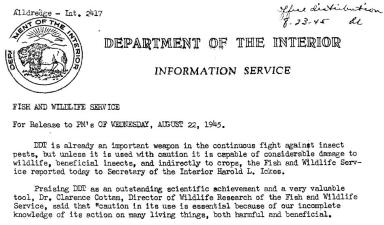
Header of FWS press release, Aug 22 1945

Archives of the U.S. Fish and Wildlife Service (FWS) reveal a long history of trouble with DDT, almost from the first uses of the chemical as an insecticide during World War II. You’ll find extensive links to historic press releases from FWS below the fold.

Critics of the various restrictions on DDT use often claim that DDT is a God-sent chemical that nearly eradicated malaria from the world (absolutely untrue) and which was banned only because of hysteria caused by Rachel Carson’s 1962 book, Silent Spring (untrue at both ends, hysteria and the power of Carson’s book). This is history revisionism at its worst, it is bogus history.

A careful study of the history of the use of DDT shows that scientists were concerned about its dangers from the first uses as a pesticide. The U.S. Fish and Wildlife Service reported dangers in a press release on August 22, 1945, just a week after the surrender of Japan ended World War II (VJ Day was August 15 in Tokyo, August 14 in Washington). In that release FWS noted the beneficial uses of DDT to fight insect and lice infestations that threatened troops and civilians with typhus and other diseases, but cautioned that such use should not become common, that more study was needed: Read the rest of this entry »


Typewriter of the moment: Langston Hughes

August 11, 2007

Langston Hughes at his typewriter

Langston Hughes at his typewriter. Photo from the Kennedy Center.

Manuscript of Langston Hughes' poem,

Manuscsript of “Harlem,” with correction marks. From Kennedy Center website – Harlem Renaissance


Bubba, we’re not in Texas anymore . . .

August 11, 2007

Among other reasons people shouldn’t inject religion into biology is that knowledge of biology can protect one from harm. From Dorigo, at A Quantum Diaries Survivor, in this case, a little mycological knowledge is not only useful to prevent illness, it allows appreciation of beauty:

This morning while following the trail to Malga Nemes, above Passo di Montecroce Comelico, we found a spot of the woods very densely populated with specimens of Amanita Muscaria, a venomous mushroom which has a very esthetic appearance. The intense red color of the cap, covered with white warts, is very distinctive.
Here is a trio which was particularly good looking:

Definitely NOT Texas.

Dorigo is a physicist, and usually very interesting. Don’t take my word for it — go check out his blog.


Henry F. Phillips — when do we celebrate?

August 10, 2007

Herny Phillips' patent for the Phillips screw and screwdriver (Google Patents)

Patent drawings for the Phillips screw and screwdriver, 1936

Only Crook in Town was alerted to the work of Henry F. Phillips by an alert and helpful librarian (well — aren’t they all?). She worries –January 15 is Martin Luther King, Jr., Day, and July 7 is the middle of the summer — what day would be appropriate to celebrate the invention and patenting of the Phillips Screwdriver? (If image above does not display, click the thumbnail picture at the end of the post.)

Ah, history teachers, you noticed that the drawing comes from Google’s files of patent applications. And now you wonder: What other wonderful illustrations can we legally rip off to use in class? Wonderful question — what do you find?

The Phillips screwdriver came along in time for World War II and the mass assembly of aircraft, and aircraft instrument panels. The Phillips screw head helped aircraft assemblers keep from scratching the black metal of the rest of the panel while securing instruments into the forms.

Read the rest of this entry »


Disturbed congressman

August 10, 2007

Idaho’s Rep. Bill Sali is disturbed. But will he seek treatment?

Idaho Rep. Bill Sali - photo from Spokane Spokesman-Review

Better, might he read the Constitution if we give him the link?

Tip of the old scrub brush to Pharyngula, and to Dispatches on the Culture Wars.

Photo probably from the Spokane, Washington, Spokesman-Review


A religious bias against good higher education — in theology!

August 10, 2007

Some religious primary and secondary schools stand on the same, treacherous ground when it comes to curricula which deserve challenging. Castle Hills First Baptist School is not the only educational institution damning children with fool ideas.

Douglas Groothuis teaches at Denver Seminary. In his blog, Constructive Curmudgeon, he lists a set of “imperatives” that he presents annually to his class in “Christian Ethics and Modern Culture.”

Despite his imperative #9:

9. The biblical concept of truth is that a true statement corresponds with or matches objective reality. While human knowing is corrupted by sin, knowledge of the things that matters most—divine and human—is possible, desirable, and pertinent.

Groothuis continues to support and defend intelligent design, a position I find both contrary to his imperative #9, and unethical for anyone, especially Christians, in imperative #17:

17. The Intelligent Design movement is thrusting a wedge between empirical science and philosophical materialism such that the evidence for design in nature may emerge apart from dogmatic and a priori restrictions. Learn about, teach about, and support this movement. See William Dembski, The Design Revolution (IVP, 2004).

Groothuis is a genuine fan of Dembski and Jonathan Wells and all the folderol they can produce. Urging students who claim to be Christian to promote the falsehoods of intelligent design is not a major sin; it’s not so severe as coaching them on racism, genocide, murder, sexism, or disowning the poor. I fear, however, it is the seed of those greater sins. (Here’s a clue: Inter-Varsity Press (IVP) is not known for high standards on science, nor on theology, to some of us; but they are probably more reputable than Regnery publishing.) Intelligent design ideas trend to the fantastic, undesirable, and not relevant.

Shakespeare put the words in Hamlet’s mouth; if only philosophers today would pay them more attention:

There are more things in heaven and earth, Horatio,
Than are dreamt of in your philosophy.

More things like: science, biology, real facts, and honesty and good faith.

What is it about philosophers (Dembski, Groothuis, others at DI)? Are they competing to become to literature and social sciences what engineers are to the sciences, with regard to creationism?


Typewriter of the moment: The Living Classroom

August 10, 2007

Typewriter donated by Anya to the Living Classroom, at the Community School of West Seattle, WashingtonSlight deviation from my usual practice of featuring the technological marvel of the writing machine of a well-known writer — these writers are not yet well known.

Someone brought in a vintage Smith-Corona typewriter to one of my favorite classrooms, at the Community School in West Seattle. Photographic evidence shows the machine is still in good working order (better than my Royal), and the students have already figured out how to make it work (see photo below).

My typing career began with my mother’s and father’s Royal, similar to the one I now own. It got me to ninth grade with no problems. I took typing classes on the classic, newsroom Underwoods, about the time that the IBM Selectric was making in-roads. In my senior year of high school I got an Underwood portable — brother Dwight was selling for Underwood-Olivetti. Later I got an old, junked Olivetti electric that was gray, would do line-and-a-half as well as double spacing, and which had a pitch somewhere between 10 and 12 pica. It was heavy and industrial, but the typeface was so readable that it was popular with my debater colleagues — we used to carry the machine with us to tournaments after I joined the college debate squad.

In my junior year at the University of Utah, on a Thomas J. Watson, Jr., Memorial scholarship from IBM, I purchased a Correcting Selectric II (no, IBM offered no discount). About 20 years later, tired of the massive repair bills and hoping word processors would forever banish it from our house, my wife donated that typewriter to the Salvation Army. I found another at a garage sale, and got it for $10.00. The mechanism on that one sprang out of the case about a year later, and we eventually donated it, too.

Perry W. Buffington found the Royal that graces my home office now, largely unused but full of sentiment. (I think Buff wanted me to write more.)

These kids in Washington — they don’t know the value of the tool they have. They can’t know.  Lucky kids.

Paper typed in the Living Classroom

Photo from the Living Classroom; work product from a student.


Harry Potter fan suicide? No, it’s still a hoax

August 9, 2007

It was a hoax then, two weeks later, it’s still a hoax.

Why doesn’t anybody call this guy on this grotesque disinformation? Hoaxes about suicide are not funny. The post continues to rank in the top 100 posts for WordPress’s 1 million+ blogs, as of August 9.

Do people really prefer a grisly hoax to the truth?


August 9, 1945: Nagasaki, Japan

August 9, 2007

Continuing the week of contemplation of atomic bombs: Remember today is the anniversary of the destruction of Nagasaki, with a U.S. atomic bomb.

Nagasaki after the atomic bomb - Infoplease.com

Japan surrendered unconditionally a short while later. See the earlier posts for more links.

Nagasaki National Peace Memorial Hall - Architectural Record

Top photo: Nagasaki after the bomb. Bottom photo, Nagasaki National Peace Memorial Hall, photo by Toshio Kaneko, Architectural Record.


Can China sink the U.S. economy quickly?

August 9, 2007

Don’t panic. But pay attention.

Here’s something students in economics courses should be discussing, from London’s Telegraph.com:

The Chinese government has begun a concerted campaign of economic threats against the United States, hinting that it may liquidate its vast holding of US treasuries if Washington imposes trade sanctions to force a yuan revaluation.

On so many levels, that discussion offers opportunities for students of economics to understand how markets, finance, and borrowing work. This news report alone could be the foundation for a couple of weeks of lesson plans on international finance, the Federal Reserve system, government spending, and general operation of markets.

Two officials at leading Communist Party bodies have given interviews in recent days warning – for the first time – that Beijing may use its $1.33 trillion (£658bn) of foreign reserves as a political weapon to counter pressure from the US Congress.

Shifts in Chinese policy are often announced through key think tanks and academies.

Described as China’s “nuclear option” in the state media, such action could trigger a dollar crash at a time when the US currency is already breaking down through historic support levels.

It would also cause a spike in US bond yields, hammering the US housing market and perhaps tipping the economy into recession. It is estimated that China holds over $900bn in a mix of US bonds.

Xia Bin, finance chief at the Development Research Centre (which has cabinet rank), kicked off what now appears to be government policy with a comment last week that Beijing’s foreign reserves should be used as a “bargaining chip” in talks with the US.

Could China afford to try such a move? Would it sink their economy, too? How could the U.S. try to mitigate such a move? Does this mean the U.S. needs to seriously control trade with China, or would that kind of interference in free markets do more damage by itself?

The Dow dropped 387 points in trading on the New York Stock Exchange today. News analysts ascribe it to concerns over sub-prime mortgage lender troubles, which caused a panic in French markets today. The credit-crunch “ripples around the world,” according to a PBS reporter.

One blogger at Telegraph.com says not to worry; Ambrose Evans-Pritchard says the dollar will not collapse:

Disregard all hysteria. The ailing Greenback will not collapse this year, not in ten years, not in twenty years, not in half a century. There is no credible currency against which it can collapse. (Unless you count gold). None of the world’s rival power blocs have the economic and demographic depth to challenge American dominance.

That view is shared by a lot of the more pragmatic and successful investment advisors.

What do your local newspapers say? How can you use this to weave together a coherent narrative for your economics curriculum, starting in a week or two?

Sources to beef up your classroom presentations:


Fisking “Junk Science’s” campaign for DDT: Point #6

August 9, 2007

Another in a continuing series, showing the errors in JunkScience.com’s list of “100 things you should know about DDT.” (No, these are not in order.)

Steven Milloy and the ghost of entomologist J. Gordon Edwards listed this as point six in their list of “100 things you should know about DDT “[did Edwards really have anything to do with the list before he died?]:

6. “To only a few chemicals does man owe as great a debt as to DDT… In little more than two decades, DDT has prevented 500 million human deaths, due to malaria, that otherwise would have been inevitable.”

[National Academy of Sciences, Committee on Research in the Life Sciences of the Committee on Science and Public Policy. 1970. The Life Sciences; Recent Progress and Application to Human Affairs; The World of Biological Research; Requirements for the Future.]

In contrast to their citation for the Sweeney hearing record, which leads one away from the actual hearing record, for this citation, the publication actually exists, though it is no longer available in print. It’s available on-line, in an easily searchable format. [I urge you to check these sources out for yourself; I won’t jive you, but you should see for yourself how the critics of Rachel Carson and WHO distort the data — I think you’ll be concerned, if not outraged.] The quote, though troubled by the tell-tale ellipses of the science liar, is accurately stated so far as it goes.

The problems? It’s only part of the story as told in that publication.  The National Academy of Science calls for DDT to be replaced in that book; NAS is NOT calling for a rollback of any ban, nor is NAS defending DDT against the claims of harm.  The book documents and agrees with the harms Rachel Carson wrote about eight years earlier.

Cover of the electronic version of Life Sciences, the 1970 book looking to future needs in biology and agriculture.

Cover of the electronic version of Life Sciences, the 1970 book looking to future needs in biology and agriculture.

Milloy (and Edwards, he claims), are trying to make a case that the National Academy of Sciences, one of the more reputable and authoritative groups of distinguished scientists in the world, thinks that DDT is just dandy, in contrast to the views of Rachel Carson and environmentalists (who are always cast as stupid and venal in Milloy’s accounts) who asked that DDT use be reduced to save eagles, robins and other songbirds, fish, and other wildlife, and to keep DDT useful against malaria.

First, there is no way that a ban on DDT could have been responsible for 500 million deaths due to malaria.  Calculate it yourself, the mathematics are simply impossible: At about 1 million deaths per year, if we assume DDT could have prevented all of the deaths (which is not so), and had we assumed usage started in 1939 instead of 1946 (a spot of 7 years and 7 million deaths), we would have 69 million deaths prevented by 2008. As best I can determine, the 500 million death figure is a misreading from an early WHO report that noted about 500 million people are annually exposed to malaria, I’m guessing a bit at that conclusion — that’s the nicest way to attribute it to simple error and not malicious lie. It was 500 million exposures to malaria, not 500 million deaths. It’s unfortunate that this erroneous figure found its way into a publication of the NAS — I suppose it’s the proof that anyone can err.

Read the rest of this entry »