December 2015, flag-flying days

November 28, 2015

Mural of Alexander Henson planting the American flag at North Pole, by Austin Mecklem, at the Recorder of Deeds building, built in 1943. 515 D St., NW, Washington, D.C. Library of Congress image

Mural of Alexander Henson planting the American flag at North Pole, by Austin Mecklem, at the Recorder of Deeds building, built in 1943. 515 D St., NW, Washington, D.C. Library of Congress image. Santa Claus may have been out of town when Henson was there.

November offers several flag flying days, especially in years when there is an election.

But December may be the month with the most flag-flying dates, when we include statehood days.

December 7 is Pearl Harbor Remembrance Day.  It’s not in the Flag Code, but public law (P.L. 103-308) urges that the president should issue a proclamation asking Americans to fly flags.

December 25 is Christmas Day, a federal holiday, and one of the score of dates designated in the Flag Code. If you watch your neighborhood closely, you’ll note even some of the most ardent flag wavers miss posting the colors on this day, as they do on Thanksgiving and New Years.

Other dates?

Nine states attained statehood in December, so people in those states should fly their flags (and you may join them).  Included in this group is Delaware, traditionally the “First State,” as it was the first colony to ratify the U.S. Constitution:

  • Illinois, December 3 (1818, 21st state)
  • Delaware, December 7 (1787, 1st state)
  • Mississippi, December 10 (1817, 20th state)
  • Indiana, December 11 (1816, 19th state)
  • Pennsylvania, December 12 (1787, 2nd state)
  • Alabama, December 14 (1819, 22nd state)
  • New Jersey, December 18 (1787, 3rd state)
  • Iowa, December 28 (1846, 29th state)
  • Texas, December 29 (1845, 28th state)

December 15 is Bill of Rights Day, marking the day in 1791 when the Bill of Rights was declared ratified; but though this event generally gets a presidential proclamation, there is no law or executive action that requires flags to fly on that date, for that occasion.

Eleven flag-flying dates in December.  Does any other month have as many flag flying opportunities?

Have I missed any December flag-flying dates?  11 events on 10 days (Delaware’s statehood falls on the anniversary of the Pearl Harbor attack).

Here’s a list of the days to fly the flag, under national law, in chronological order:

  1. Illinois, December 3 (1818, 21st state)
  2. Pearl Harbor Remembrance Day, December 7
  3. Delaware, December 7 (1787, 1st state) (shared with Pearl Harbor Remembrance Day)
  4. Mississippi, December 10 (1817, 20th state)
  5. Indiana, December 11 (1816, 19th state)
  6. Pennsylvania, December 12 (1787, 2nd state)
  7. Alabama, December 14 (1819, 22nd state)
  8. New Jersey, December 18 (1787, 3rd state)
  9. Christmas Day, December 25
  10. Iowa, December 28 (1846, 29th state)
  11. Texas, December 29 (1845, 28th state)

Fly your flag with respect to the flag, for the republic it represents, and for all those who sacrificed that it may wave on your residence.

Appropriate to a snowy December.

Appropriate to a snowy December. “The Barn on Grayson-New Hope Road. This barn with its old truck and ever-present American flag, is often the subject of photographs and paintings by the locals.” Photo and copyright by Melinda Anderson


Thanksgiving 2015 – Fly your flag today!

November 26, 2015

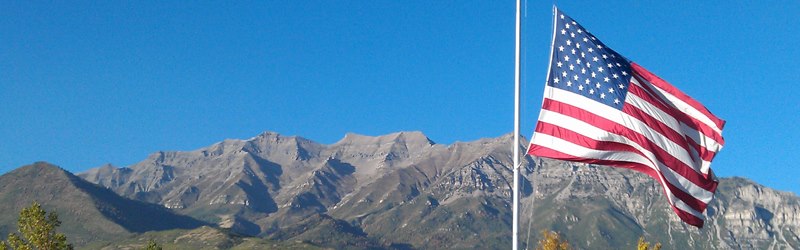
Mt. Timpanogos and the U.S. flag. Photo by Bob Walker of Orem, Utah; from Orem, circa September 2012. That's Mt. Baldy on the left. This site is about six miles from our old home in Pleasant Grove, Utah.

Mt. Timpanogos and the U.S. flag. Photo by Bob Walker of Orem, Utah; from Orem, circa September 2012. That’s Mt. Baldy on the left. This site is about six miles from our old home in Pleasant Grove, Utah, where we celebrated a few dozen Thanksgivings.

Fly  your flag on Thanksgiving — it’s one of those dates Congress designated specially to fly the flag, in the U.S. flag code.

Americans load up this particular holiday with significance, often for no particular reason.  As a holiday, it is really rather uniquely American.  There were feasts of thanksgiving from time to time throughout recorded history, but most often they were one-shot affairs, after a particular event. Some of the first thanksgivings in America, by Europeans, predated the New England celebrations by a century or more (nachos and margaritas at Palo Duro!).

In America, Americans eagerly seized on the idea of one day set aside “to give thanks,” both with the religious overtones some wanted to see, and with the commercial overtones others wanted, especially during the Great Depression.  In our 239th year since the Declaration of Independence, the 226th year since the Constitution was enacted, we come to Thanksgiving as a major period of travel to old family homesteads, to Thanksgiving as a period of genuine thanks to American troops fighting in foreign lands half a world away, and as a commercial celebration that sucks the sobriety and spirituality out of all but the most dedicated of profiteers, or bargain hunters.

Vintage Thanksgiving greeting card, from HubPages

In the early 20th century, some people sent greeting cards for Thanksgiving; this is a tradition overtaken by Christmas, Hanukkah and New Years cards, today. (Image from HubPages, unknown year — credit for cards, “Images courtesy VintageHolidayCrafts.com

Thanksgiving often stumbled into controversy.  George Washington issued proclamations calling for a day of thanks, but struck out all references to Christianity.  Some president’s issued similar proclamations up to the Civil War, When Abraham Lincoln used the holiday as a time to remind  Americans that they had a lot to be thankful for, partly as a means to keep Americans focused on the war to be won, and keep supporting troops in the field.  During the Great Depression, Franklin D. Roosevelt juggled dates for Thanksgiving, moving it earlier in November to create a longer Christmas shopping season, hoping to stimulate sales, and thereby push America further out of the Depression.

In 2001 George W. Bush urged Americans to go shopping so terrorists would know America was not defeated by the attack on the World Trade Center, knowing that a stimulus to the economy would help garner support for other policies.

Vintage thanksgiving card, Boy riding turkey with American flag, from HubPages, original date unknown

Children riding large turkeys, waving American flags, made popular images in several years of the early 20th century.

2012 saw controversy over Big Box stores and other major, national retailers pushing their post- Thanksgiving, Christmas sales, into Thanksgiving day itself.  Is this fair to employees?  Is this too much emphasis on purchasing, and too little emphasis on family and giving thanks?

In 2014, we had the same arguments about Big Box stores pushing “Black Friday” into the holiday, and even more arguments about Christmas creep reducing the importance of Thanksgiving to Americans. In 2015, REI announced their stores would be closed on Black Friday, and urged Americans to go outdoors for recreation. “Ditch the malls and head for the hills,” Time Magazine said.  REI is on to somehitng.

You can be sure of one thing:  It’s safe to fly your American flag on Thanksgiving, as Congress suggested.  It won’t make your turkey more moist  or your pumpkin pie taste any better.  It won’t boost your sales, if you’re a retailer, nor find you a bargain, if you’re a shopper.

If you have the flag, it costs nothing.  Flying the flag makes no particular religious statement, supports no particular political party, supports no one’s favorite football team.  Flying the flag earns you nothing, usually.

But as a free act of patriotism, support for our nation, and our troops, and a demonstration that even after a divisive election, we’re all one nation, it’s a pretty good deal.

Fly your flag today.

More:

Yes, this is mostly an encore post. Fighting ignorance requires patience.

Yes, this is mostly an encore post. Fighting ignorance requires patience.


With fondness, wishing it were true in 2015: Remembering “Uncle Sam’s Thanksgiving” by Thomas Nast, 1869

November 25, 2015

November 1869, in the first year of the Grant administration — and Nast put aside his own prejudices enough to invite the Irish guy to dinner, along with many others.

With a nation whose emotions are raw from events in Ferguson, Missouri, and Paris, France, and rejections of desperate refugees from was being rejected in their calls for asylum, could there be a better, more timely reminder of what we’re supposed to be doing?

(Click for a larger image — it’s well worth it.)

Thomas Nast's "Uncle Sam's Thanksgiving," 1869 - Ohio State University's cartoon collection

Thomas Nast’s “Uncle Sam’s Thanksgiving,” 1869 – Ohio State University’s cartoon collection, and HarpWeek

As described at the Ohio State site:

“Uncle Sam’s Thanksgiving Dinner” marks the highpoint of Nast’s Reconstruction-era idealism. By November 1869 the Fourteenth Amendment, which secures equal rights and citizenship to all Americans, was ratified. Congress had sent the Fifteenth Amendment, which forbade racial discrimination in voting rights, to the states and its ratification appeared certain. Although the Republican Party had absorbed a strong nativist element in the 1850s, its commitment to equality seemed to overshadow lingering nativism, a policy of protecting the interests of indigenous residents against immigrants. Two national symbols, Uncle Sam and Columbia, host all the peoples of the world who have been attracted to the United States by its promise of self-government and democracy. Germans, African Americans, Chinese, Native Americans, Germans, French, Spaniards: “Come one, come all,” Nast cheers at the lower left corner.

One of my Chinese students identified the Oriental woman as Japanese, saying it was “obvious.” Other friends say both are Chinese.  Regional differences.  The figure at the farthest right is a slightly cleaned-up version of the near-ape portrayal Nast typically gave Irishmen.

If Nast could put aside his biases to celebrate the potential of unbiased immigration to the U.S. and the society that emerges, maybe we can, too.

Hope your day is good; hope you have good company and good cheer, turkey or not. Happy Thanksgiving.  And of course, remember to fly your flag!

More: Earlier posts from Millard Fillmore’s Bathtub

And in 2013:

Yes, if you’re a faithful reader here, you’ve seen it before.


WordPress glitches

November 25, 2015

Apologies, Dear Reader: WordPress is glitching. The usual list of important articles, just below the masthead, has disappeared.  I’ve got no notice on it, and it appears the WordPress “help” button may also be missing from some editing screens.

See the blank line below the masthead? It's supposed to list important articles for first-time visitors, and for me.

Something’s missing. See the blank line below the masthead? It’s supposed to list important articles for first-time visitors, and for me.

Stick with us while we try to track down some solution.

WordPress is an admirable host, and easy to use for blogging. I have no reason to complain often — but I wish I could figure out how to fix this.


Muslims carrying special IDs challenge Trump to show his

November 22, 2015

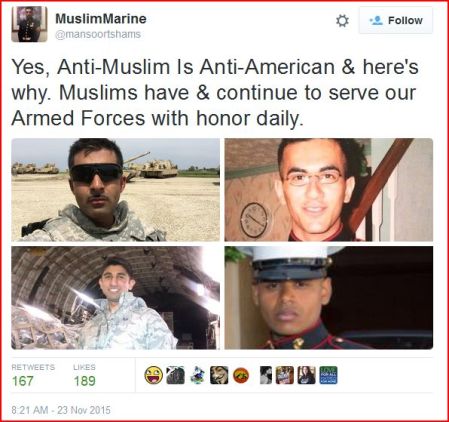
Tweet showing several Muslims serving in U.S. military, in response to calls for Muslims to get "special ID" or be tracked on a "special registry."

Tweet showing several Muslims serving in U.S. military, in response to calls for Muslims to get “special ID” or be tracked on a “special registry.”

Donald Trump keeps talking about a “registry” of Muslims, and forcing them to carry “special identification.”

Several Muslims have taken to Twitter and other social media to note they ALREADY DO carry special ID, and wondering, where is Trump’s?

According to Trump, he performed his military service at a special facility along the Hudson River, before he was 18 — pranking people.

Ouch.

See also:

https://twitter.com/intricateizzy/status/667461728372924416

And be sure you see this:


Wisdom: How to tell your classroom technology helps

November 21, 2015

This is much an encore post from a couple of years ago.

Wise man Alfie Kohn Tweeted a photo of this list by Bill Ferriter. I’d blogged about it before.

It’s still solid, and most school administrators still miss the point. Teachers get sent to courses to “learn to do a PowerPoint,” but rarely can anyone leading those courses tell when to use a PowerPoint, or Keynote, and when a simple list on a chalkboard/whiteboard is more effective, or perhaps when having students copy a list would be more effective, or when students making a poem/song/poster of a point would be more effective.

An international law firm recently directed that it’s army of a couple thousand lawyers would, henceforth, use Prezi instead of PowerPoint.  Nevermind that the lawyers hadn’t mastered PowerPoint and don’t have a clue what to do with Prezi: Some “managing co-partner” was taken in by the swoops of Prezi.  More than four years ago I learned Prezi at a technology course for technologies my district later decided not to support (money, use, lack of internet connections, etc., etc. — I suspected a lack of planning and thinking about how technology could be used).  In the course, I asked the instructor how to tell when to use Prezi instead of PowerPoint — and how to embed YouTube videos for classroom use of a Prezi.  After working for too long, we decided we couldn’t figure out how to embed videos, and so PowerPoint might be more useful.  Then the instructor confessed he didn’t know how to embed videos in PowerPoint, either.

Let alone, when does a video work better than other instructional methods?  Long or short? Notes, quiz, or oral feedback?

Many Texas districts struggle to teach “keyboarding” to students who have difficulty printing notes, letter by letter, because they don’t know cursive writing (and therefore, cannot read their teachers’ comments on their written work).

Is “integrating technology” really the problem?

Anyway, here’s Mr. Ferriter’s list, a checklist to tell whether you’re getting close to actually using technology, or whether you’re just ringing the bells and tooting the whistles of machines on the desks.

Cheat Sheet: What do you want kids to do with technology? By Bill Ferriter

Cheat Sheet: What do you want kids to do with technology? By Bill Ferriter The Tempered Radical blog.williamferriter.com @plugusin

_________________________________

What do you want kids to do with technology?

Wrong answers Right answers
·         Make Prezis ·         Raise awareness
·         Start blogs ·         Start conversations
·         Create Wordles ·         Find answers
·         Publish Animotos ·         (Answers to
THEIR questions)
·         Design flipcharts ·         Join partners
·         Post to EdModo ·         Make a difference
·         Use Whiteboard ·         Take action
·         Develop apps ·         Drive change

Technology is a tool,
NOT a learning outcome

_________________________________

“Technology is a tool, not a learning outcome,” Bill Ferriter says.  He’s right, of course.

Tip of the old scrub brush to April Niemela@AprilJNiemela.

Alfie Kohn’s Tweet:

More, generally:

Yes, this is mostly an encore post. Fighting ignorance requires patience.

Yes, this is mostly an encore post. Fighting ignorance requires patience.


Strange crossings: Booth asked the president for an umbrella

November 17, 2015

This is just so odd that it merits our attention, something I found a while ago researching about presidents and umbrellas.

On November 17, 1864, John Wilkes Booth wrote to President Abraham Lincoln asking for money to purchase an umbrella.

Yes, Booth, the man who would eventually assassinate that same Abraham Lincoln.

Page 1 of John Wilkes Booth's 1864 letter to President Abraham Lincoln

Page 1 of John Wilkes Booth’s 1864 letter to President Abraham Lincoln

Booth to Lincoln, page 2

Booth to Lincoln, page 2

Booth to Lincoln, page 3

Booth to Lincoln, page 3

Booth to Lincoln, page 4

Booth to Lincoln, page 4

Booth to Lincoln, page 5

Booth to Lincoln, page 5

Booth to Lincoln, page 6

Booth to Lincoln, page 6

The letter is in the collection of Lincoln papers at the Library of Congress, described as “John Wilkes to Abraham Lincoln, Thursday, November 17, 1864 (Congratulations; request that Lincoln send him money to buy an umbrella).”

I have found no official transcript of the letter.

Of all the richochets of umbrellas in the history of the American presidency, this must be the strangest.

Tinfoil hatters, conspiracy nuts, historical psychanalyzers, and the rest of us, might wonder if this played any role in the sad crossing of these two people almost exactly six months later, in Ford’s Theatre.

More:

Yes, this is mostly an encore post. Fighting ignorance requires patience.

Yes, this is mostly an encore post. Fighting ignorance requires patience.


President Obama’s Veterans Day Proclamation, 2015

November 11, 2015

A message written by First Lady is seen on a U.S. Marine Corps flag at Walter Reed National Military Medical Center in Bethesda, Md., April 4, 2012.

A message written by First Lady is seen on a U.S. Marine Corps flag at Walter Reed National Military Medical Center in Bethesda, Md., April 4, 2012. From a White House blog post, “5 Ways You Can Thank a Veteran.”


From the office of the Press Secretary of the White House:

November 05, 2015

Presidential Proclamation — Veterans Day, 2015

VETERANS DAY, 2015

– – – – – – –

BY THE PRESIDENT OF THE UNITED STATES OF AMERICA

A PROCLAMATION

The United States military is the strongest, most capable fighting force the world has ever known.  The brave men and women of our Army, Navy, Air Force, Marine Corps, and Coast Guard demonstrate a resolute spirit and unmatched selflessness, and their service reminds us there are few things more American than giving of ourselves to make a difference in the lives of others.  On Veterans Day, we reflect on the immeasurable burdens borne by so few in the name of so many, and we rededicate ourselves to supporting those who have worn America’s uniform and the families who stand alongside them.

Our true strength as a Nation is measured by how we take care of our veterans when they return home, and my Administration is committed to ensuring our heroes and their loved ones have every chance to share in the promise they risked their lives to defend.  We have made it easier for veterans to convert their military skills to the civilian workforce, enabled more veterans and their family members to attain Federal education benefits, and expanded access to timely, quality health care for all veterans.  Just as every veteran deserves the support and benefits they have earned, those who have given everything to defend our homeland deserve a place of their own to call home.  To uphold this ideal, First Lady Michelle Obama and Dr. Jill Biden’s Joining Forces initiative has forged partnerships with local leaders across America to uphold the dignity of every veteran and work to end veterans’ homelessness.  No one who fights for our country should have to fight for the care they deserve.  Earlier this year, I was proud to sign the Clay Hunt Suicide Prevention for American Veterans Act, which fills critical gaps in mental health care by raising awareness and taking steps to improve access to care for those suffering from the invisible wounds of war.

Our veterans left everything they knew and loved and served with exemplary dedication and courage so we could all know a safer America and a more just world.  They have been tested in ways the rest of us may never fully understand, and it is our duty to fulfill our sacred obligation to our veterans and their families.  On Veterans Day, and every day, let us show them the extraordinary gratitude they so rightly deserve, and let us recommit to pledging our full support for them in all they do.

With respect for, and in recognition of, the contributions our service members have made to the cause of peace and freedom around the world, the Congress has provided (5 U.S.C. 6103(a)) that November 11 of each year shall be set aside as a legal public holiday to honor our Nation’s veterans.

NOW, THEREFORE, I, BARACK OBAMA, President of the United States of America, do hereby proclaim November 11, 2015, as Veterans Day.  I encourage all Americans to recognize the valor and sacrifice of our veterans through appropriate public ceremonies and private prayers.  I call upon Federal, State, and local officials to display the flag of the United States and to participate in patriotic activities in their communities.  I call on all Americans, including civic and fraternal organizations, places of worship, schools, and communities to support this day with commemorative expressions and programs.

IN WITNESS WHEREOF, I have hereunto set my hand this fifth day of November, in the year of our Lord two thousand fifteen, and of the Independence of the United States of America the two hundred and fortieth.

BARACK OBAMA

First Lady Michelle Obama, in support of the Joining Forces initiative, greets members of the military following remarks at Al Udeid Air Base in Qatar, Nov. 3, 2015. (Official White House Photo by Amanda Lucidon)

First Lady Michelle Obama, in support of the Joining Forces initiative, greets members of the military following remarks at Al Udeid Air Base in Qatar, Nov. 3, 2015. (Official White House Photo by Amanda Lucidon)


Tearing down historic Chipman’s Department Store, American Fork Utah, 1992

November 11, 2015

Caption on photo from American Fork Public Library:

Caption on photo from American Fork Public Library: “This photo was taken February, 1992, just before final demolition of the Chipman store. The last thing to fall was the front part, with the C H I P M A N name still intact.”

In 1962, a position for my father heading the furniture department at Chipman’s Mercantile in American Fork, Utah, prompted our family’s move from Burley, Idaho. We found a home in Pleasant Grove, about five miles south and east of American Fork.

I was rather surprised to find this photo in digital collections I was searching through the Provo, Utah, public library.

Description of the photo:

Title Partial demolition of Chipman’s, formerly Chipman’s Mercantile, on the corner of Main Street, Merchant Street and Center Street. Built in 1884, demolished in 1992.
Description Partial demolition of Chipman’s, formerly Chipman’s Mercantile, on the corner of Main Street, Merchant Street and Center Street. Built in 1884 by James and Stephen L. Chipman. The store was once the biggest department store in Utah County. It was demolished in 1992.
Subject American Fork, (Utah); Business enterprises; Department stores; Wrecking;
Date 1992-02-01
Photographer Peterson, Wanda S.
Rights Copyright 1992 American Fork City. This work is licensed under a Creative Commons Attribution-NonCommercial-NoDerivatives 4.0 International License, http://creativecommons.org/licenses/by-nc-nd/4.0/
Publisher Published by American Fork Public Library; Digitized and hosted by Utah Valley University

It’s symbolic of the history of places we lose all too easily.

Plus, it brings back so many memories of the small towns in which I grew up.

Chipman’s played a big role in the development of American Fork, and northern Utah County. The store was an early success, and the Chipman family became locally prominent, and played an interesting role in the development of science education at two Utah universities.

Two Chipman sisters (daughters of James or Stephen Chipman?) married scientists. One married the great chemist, Henry Eyring, who took a position at the University of Utah to stay close to his wife’s family. The other married the great physicist Harvey Fletcher, who took a position at Brigham Young University, again to stay close to his wife’s family.  Harvey Fletcher served on the board of Chipman’s for a time, and bought furniture there. My father asked me to accompany him on a delivery to the Fletcher’s Provo home, probably trying to prompt an interest in science in me. A few years later in Chipman’s store, my father introduced me to the Fletchers’ son, James C. Fletcher, who would later become president of the University of Utah, and then twice head NASA.

Mrs. Fletcher made great cookies. I wasn’t prescient enough to get even autographs from any of them.

On a July day, probably about 1968, during a street fair, the band I played in performed from the back of a flatbed truck on the street to the right of the photo. We discovered Dick Gardiner’s Farfisa organ lost its tuning in the sun.

The site of the store was turned into a parking lot. The Bank of American Fork put up some drive-up tellers on the site later.


Veterans Day 2015: Honor veterans, fly your flag

November 11, 2015

OKINAWA, Japan (Nov. 11, 2009) Sailors raise an American flag during Veterans Day morning colors aboard the amphibious dock landing ship USS Harpers Ferry (LSD 49). (U.S. Navy photo by Mass Communication Specialist 2nd Class Joshua J. Wahl/Released)

OKINAWA, Japan (Nov. 11, 2009) Sailors raise an American flag during Veterans Day morning colors aboard the amphibious dock landing ship USS Harpers Ferry (LSD 49). (U.S. Navy photo by Mass Communication Specialist 2nd Class Joshua J. Wahl/Released). Wikipedia photo and caption.

Fly your U.S. flags today in honor of America’s veterans, and the veterans of our allies.

More:

In the Classroom
Celebrate Veterans Day in your classroom with these lesson plans and activities! Resources include the Stories from Soldiers and Photography and Painting in War Art lesson plans as well as Thank-A-Vet postcards and patriotic poppy wreaths.

Poster for Veterans Day 2015

November 10, 2015

2015’s poster from the Veterans Administration, for Veterans Day — tomorrow!

2015 Veterans Day poster from the Veterans Administration. Veterans Day always falls on November 11, this year on a Wednesday.

2015 Veterans Day poster from the Veterans Administration. Veterans Day always falls on November 11, this year on a Wednesday.

Both high-res and low-res versions are available from the VA’s poster site.

Teachers, several good sites with a history of Veterans Day, and suggested ways of honoring veterans, have material for your classrooms and students. VA’s history of Veterans Day is below:

History of Veterans Day

World War I – known at the time as “The Great War” – officially ended when the Treaty of Versailles was signed on June 28, 1919, in the Palace of Versailles outside the town of Versailles, France. However, fighting ceased seven months earlier when an armistice, or temporary cessation of hostilities, between the Allied nations and Germany went into effect on the eleventh hour of the eleventh day of the eleventh month. For that reason, November 11, 1918, is generally regarded as the end of “the war to end all wars.”

Soldiers of the 353rd Infantry near a church at Stenay, Meuse in France.

Soldiers of the 353rd Infantry near a church at Stenay, Meuse in France, wait for the end of hostilities. This photo was taken at 10:58 a.m., on November 11, 1918, two minutes before the armistice ending World War I went into effect

In November 1919, President Wilson proclaimed November 11 as the first commemoration of Armistice Day with the following words: “To us in America, the reflections of Armistice Day will be filled with solemn pride in the heroism of those who died in the country’s service and with gratitude for the victory, both because of the thing from which it has freed us and because of the opportunity it has given America to show her sympathy with peace and justice in the councils of the nations…”

The original concept for the celebration was for a day observed with parades and public meetings and a brief suspension of business beginning at 11:00 a.m.

The United States Congress officially recognized the end of World War I when it passed a concurrent resolution on June 4, 1926, with these words:

Whereas the 11th of November 1918, marked the cessation of the most destructive, sanguinary, and far reaching war in human annals and the resumption by the people of the United States of peaceful relations with other nations, which we hope may never again be severed, and

Whereas it is fitting that the recurring anniversary of this date should be commemorated with thanksgiving and prayer and exercises designed to perpetuate peace through good will and mutual understanding between nations; and

Whereas the legislatures of twenty-seven of our States have already declared November 11 to be a legal holiday: Therefore be it Resolved by the Senate (the House of Representatives concurring), that the President of the United States is requested to issue a proclamation calling upon the officials to display the flag of the United States on all Government buildings on November 11 and inviting the people of the United States to observe the day in schools and churches, or other suitable places, with appropriate ceremonies of friendly relations with all other peoples.

An Act (52 Stat. 351; 5 U. S. Code, Sec. 87a) approved May 13, 1938, made the 11th of November in each year a legal holiday—a day to be dedicated to the cause of world peace and to be thereafter celebrated and known as “Armistice Day.” Armistice Day was primarily a day set aside to honor veterans of World War I, but in 1954, after World War II had required the greatest mobilization of soldiers, sailors, Marines and airmen in the Nation’s history; after American forces had fought aggression in Korea, the 83rd Congress, at the urging of the veterans service organizations, amended the Act of 1938 by striking out the word “Armistice” and inserting in its place the word “Veterans.” With the approval of this legislation (Public Law 380) on June 1, 1954, November 11th became a day to honor American veterans of all wars.

Later that same year, on October 8th, President Dwight D. Eisenhower issued the first “Veterans Day Proclamation” which stated: “In order to insure proper and widespread observance of this anniversary, all veterans, all veterans’ organizations, and the entire citizenry will wish to join hands in the common purpose. Toward this end, I am designating the Administrator of Veterans’ Affairs as Chairman of a Veterans Day National Committee, which shall include such other persons as the Chairman may select, and which will coordinate at the national level necessary planning for the observance. I am also requesting the heads of all departments and agencies of the Executive branch of the Government to assist the National Committee in every way possible.”

President Eisenhower signing HR7786, changing Armistice Day to Veterans Day.

President Eisenhower signing HR7786, changing Armistice Day to Veterans Day. From left: Alvin J. King, Wayne Richards, Arthur J. Connell, John T. Nation, Edward Rees, Richard L. Trombla, Howard W. Watts

On that same day, President Eisenhower sent a letter to the Honorable Harvey V. Higley, Administrator of Veterans’ Affairs (VA), designating him as Chairman of the Veterans Day National Committee.

In 1958, the White House advised VA’s General Counsel that the 1954 designation of the VA Administrator as Chairman of the Veterans Day National Committee applied to all subsequent VA Administrators. Since March 1989 when VA was elevated to a cabinet level department, the Secretary of Veterans Affairs has served as the committee’s chairman.

The Uniform Holiday Bill (Public Law 90-363 (82 Stat. 250)) was signed on June 28, 1968, and was intended to ensure three-day weekends for Federal employees by celebrating four national holidays on Mondays: Washington’s Birthday, Memorial Day, Veterans Day, and Columbus Day. It was thought that these extended weekends would encourage travel, recreational and cultural activities and stimulate greater industrial and commercial production. Many states did not agree with this decision and continued to celebrate the holidays on their original dates.

The first Veterans Day under the new law was observed with much confusion on October 25, 1971. It was quite apparent that the commemoration of this day was a matter of historic and patriotic significance to a great number of our citizens, and so on September 20th, 1975, President Gerald R. Ford signed Public Law 94-97 (89 Stat. 479), which returned the annual observance of Veterans Day to its original date of November 11, beginning in 1978. This action supported the desires of the overwhelming majority of state legislatures, all major veterans service organizations and the American people.

Veterans Day continues to be observed on November 11, regardless of what day of the week on which it falls. The restoration of the observance of Veterans Day to November 11 not only preserves the historical significance of the date, but helps focus attention on the important purpose of Veterans Day: A celebration to honor America’s veterans for their patriotism, love of country, and willingness to serve and sacrifice for the common good.

Remember to fly your U.S. flag tomorrow, to honor veterans.


Kristallnacht survivor begs us to remember

November 10, 2015

USHMM: Shattered storefront of a Jewish-owned shop destroyed during Kristallnacht (the

USHMM: Shattered storefront of a Jewish-owned shop destroyed during Kristallnacht (the “Night of Broken Glass”). Berlin, Germany, November 10, 1938. — National Archives and Records Administration, College Park, Md.

I get e-mail from time to time from the U.S. Holocaust Memorial Museum (USHMM) in Washington, D.C.

Tonight, November 9, is the anniversary of Kristallnacht in 1938. Jill Pauly lived through it. She tells her story so that we will remember, that we will never forget. “Kristallnacht” is German for “night of crystal.” But in this case, the crystal was broken glass, the broken windows of Jewish shops and homes.  Kristallnacht was the “Night of Broken Glass.”

Dear friend,

I’ll never forget how scared I was 77 years ago on Kristallnacht.

This wave of antisemitic attacks throughout Germany and Austria caused my family to flee our small German town. We drove to a relative’s apartment in Cologne, and my grandparents forced my sister and me to sit on the car floor so we wouldn’t see the violence on the streets.

That evening and for many following it, the men in my family drove all night to evade German officers and avoid becoming some of the 30,000 men who were arrested just for being Jewish.

This was a major turning point for my family, when our lives became dangerous and our future uncertain. Learn more about experiences of families like mine, as well as the origins and aftermath of Kristallnacht.

LEARN MORE

Jill Pauly speaks with Museum visitors. US Holocaust Memorial Museum

LEARN MORE

Kristallnacht was a watershed moment in Nazi Germany’s persecution of Jews, indicating an increase in radical, violent antisemitism. Many Jews tried to emigrate as soon as possible after the pogroms.

Today, Kristallnacht is seen as a warning sign of the Holocaust—an indicator of the horrors to come that far too many people ignored.

The Museum strives to learn from this history in order to prevent atrocities in the future. This is why we recently launched, in partnership with Dartmouth College, the Early Warning Project. It aims to give leaders from around the world more reliable information on the risk of mass atrocities to inspire action and help save lives.

On this anniversary, I encourage you to learn more about Kristallnacht and reflect on how we can respond to threats of genocide today.

Sincerely,

Jill Pauly
Holocaust Survivor and Museum Volunteer

Photo: Jill Pauly speaks with Museum visitors. US Holocaust Memorial Museum

“Never again” starts now, if we start it.


Dakotans fly your flags today, celebrate 126 years of statehood

November 2, 2015

56 flags from all U.S. states and territories fly at Mount Rushmore National Monument, South Dakota. This photo of Mount Rushmore National Memorial is courtesy of TripAdvisor.

56 flags from all U.S. states and territories fly at Mount Rushmore National Monument, South Dakota. This photo of Mount Rushmore National Memorial is courtesy of TripAdvisor.

Residents of North Dakota and South Dakota should fly their U.S. flags today in honor of your state’s being admitted to the union, on November 2, 1889.

Most sites note simply that both states were admitted on the same day; some sites, especially those that lean toward North Dakota, claim that state is Number 39, because President Harrison signed their papers first, after shuffling to avoid playing favorites.

Does anyone really care?

More:


8 events on 6 days to fly the U.S. flag in November 2015

November 1, 2015

Voice of America caption from November 16, 2012:

The U.S. flag is popular the world over, especially when the president visits a foreign nation, as President Barack Obama visited Burma (Myanmar) in November 2012. Voice of America caption from November 16, 2012: “A shopkeeper waves an American flag at a roadside shop in Rangoon, Burma. U.S. President Barack Obama will visit Burma on Monday, becoming the first U.S. president to visit the country. (AP)”

Eight events spread over six different days come with urgings to fly the U.S. flag in November:  Six states celebrate statehood, Veterans Day falls as always on November 11, and Thanksgiving Day on November 26.

Two states, North Dakota and South Dakota, celebrate their statehood on the same date. Washington’s statehood day falls on Veterans Day, November 11 — so there are only six days covering eight events.

In calendar order for 2015, these are the seven days:

  • North Dakota statehood day, November 2 (1889, 39th or 40th state)
  • South Dakota statehood day, November 2 (1889, 39th or 40th state) (shared with North Dakota)
  • Montana statehood day, November 8 (1889, 41st state)
  • Veterans Day, November 11
  • Washington statehood day, November 11 (1889, 42nd state) (shared with Veterans Day)
  • Oklahoma statehood day, November 16 (1907, 46th state)
  • North Carolina statehood day, November 21 (1789, 12th state)
  • Thanksgiving Day, fourth Thursday in November (November 26 in 2015)

Most Americans will concern themselves only with Veterans Day and Thanksgiving Day. Is flying the U.S. flag for statehood day a dying tradition?

More:


Why not a price on carbon, a tax with cap-and-trade capabilities?

October 29, 2015

Tax on air pollutants with a cap-and-trade process worked wonders cleaning up acid rain in the U.S.  Is there any rational reason to oppose such a plan, in the U.S. or anywhere else, to help clean up carbon air pollution to slow or stop global warming?

Germany’s Chancellor Angela Merkel issued a call for a carbon pricing system. Who will listen?

It’s a feature story from World Bank, who seems to have figured out that global warming poses great threats to commerce and growing the world’s economies.

Heads of State, City, Regional and Business Leaders Unite to Call for Price on Carbon

October 19, 2015

For the first time Heads of State, city and provincial leaders have come together with the support of leading companies to urge countries and companies around the world to put a price on carbon pollution.

For the first time Heads of State, city and provincial leaders have come together with the support of leading companies to urge countries and companies around the world to put a price on carbon pollution.


STORY HIGHLIGHTS
  • Carbon pricing is a key building block to tackle climate change and drive investment in a low carbon future.
  • Launched today, the Carbon Pricing Panel is an unprecedented alliance of Global Leaders united to put a price on carbon pollution.
  • The number of implemented or scheduled carbon pricing instruments has nearly doubled since 2012, reaching an aggregate market value of about $50 billion.

What can be done to reduce greenhouse gas emissions, protect our environment, and help support people most vulnerable to climate change?

The answer is simple: A key element for any strategy to tackle climate change must be to put a price on carbon pollution. The transition to a cleaner future requires government action and the right incentives. Carbon pricing is a key building block to help cut pollution and drive investment in a low carbon future.

It’s a point recognized by leaders from Europe, across to Africa and Asia, who have today – for the first time – come together with the support of leading private companies to urge countries and businesses around the world to put a price on carbon.

Convened by World Bank Group President Jim Yong Kim and the International Monetary Fund’s Managing Director Christine Lagarde, the high-level Carbon Pricing Panel is calling on their peers to follow their lead and put a price on carbon. They are joined in this effort by OECD Secretary General Angel Gurria.

The call by the leaders comes on the first day of the last round of negotiations ahead of the Paris climate talks in December. The leaders aim to seize the momentum generated by the Paris talks to spur further, faster action towards carbon pricing, as a necessary path to a low carbon, productive, competitive economy of the future.

Members of the Carbon Pricing Panel include German Chancellor Angela Merkel, Chilean President Michelle Bachelet, French President François Hollande, Ethiopian Prime Minister Hailemariam Desalegn, Philippines President Benigno Aquino III, Mexican President Enrique Peña Nieto, Governor Jerry Brown of California, and Mayor Eduardo Paes of Rio de Janeiro.

Private sector support is spearheaded by Anne Stausboll, CEO of US Institutional Investor CalPERS, Gérard Mestrallet, CEO of ENGIE of France, Anand Mahindra, Chairman and Managing Director of Mahindra Group of India, and Feike Sijbesma, Chairman and CEO of Netherlands-based Royal DSM.


” There has never been a global movement to put a price on carbon at this level and with this degree of unison. It marks a turning point from the debate on the economic systems needed for low carbon growth to the implementation of policies and pricing mechanisms to deliver jobs, clean growth and prosperity. The science is clear, the economics compelling and we now see political leadership emerging to take green investment to scale at a speed commensurate with the climate challenge. “

ImageJim Yong Kim
World Bank Group President

Summary map of existing, emerging and potential regional, national and sub-national carbon pricing instruments (ETS and tax)

Summary map of existing, emerging and potential regional, national and sub-national carbon pricing instruments (ETS and tax)


Around the world, about 40 nations and 23 cities, states and regions have implemented or are putting a price on carbon with programs and mechanisms covering about 12 percent of global greenhouse gas emissions.

The number of implemented or scheduled carbon pricing instruments has nearly doubled since 2012, reaching an aggregate market value of about $50 billion.

And already more than 400 businesses around the world are using a voluntary, internal price on carbon as part of their investment strategies, with prices ranging from US$4 to over US$100 per ton of CO2. This is a tripling in the number of companies compared with last year reporting that they price their emissions.

Carbon pricing delivers a triple dividend.

Firstly, it is good for the environment and it reduces emissions – lowering social costs of health impacts on people, as well as tackling the global warming.  A price on carbon can help alleviate health and environmental problems like premature deaths from exposure to outdoor air pollution. According to the World health Organization, an estimated 3.7 million people die prematurely from outdoor air pollution.

Secondly, carbon pricing is an essential part of getting prices right for the move to a low carbon more resilient growth. It raises revenue efficiently, making it possible to reduce more distortionary taxes, and it allows for targeted support for clean energy solutions rather than harmful subsidies that do little for poor people or the environment.

And thirdly, it drives innovation and critically needed investments in low-carbon solutions, boosting private sector investment in clean tech research and development, and offering the prospect of job creation in the sectors of the future.

Why is is it important to act now on carbon pricing? Because strong public policy gives the private sector the certainty and predictability to make the necessary long-term investments in climate-smart development and prevent catastrophic impacts from climate change. Carbon pricing is the cornerstone of a package of policy measures designed to achieve emission reductions at lowest cost.

Today, countries and regions are learning from one another and creating a set of successful approaches to pricing carbon. Some early lessons are described in the World Bank Group publication The FASTER Principles for Successful Carbon Pricing – which lays out principles for effective, efficient and fair pricing of carbon.

Some examples include:

  • The Canadian province of British Columbia was an early mover on carbon pricing, with the creation of a carbon tax in 2008, with the tax used to cut income taxes and fund tax credits. Also, British Columbia is home to a growing clean technology sector, with more than 150 firms in 2013, accounting for 22% of Canada’s clean tech presence in a province with only 12% of Canada’s GDP. Several experts attribute this growth to the carbon tax.
  • California, Quebec and the European Union allocate a portion of their emissions trading scheme (ETS) auction revenues to designated green technology funds and innovation, to support sectors affected directly or indirectly by higher carbon costs.
  • In Chile, the government has passed legislation on a carbon tax – effective as of 2017 – as part of a much larger tax reform package with the explicit aim of providing additional resources for education and other social protection programs.
  • In Northeastern United States, the Regional Greenhouse Gas Initiative is expected to save people money on energy bills. The RGGI states have invested over $1 billion from ETS proceeds in energy-efficiency program, which are expected to return more than $2.3 billion in lifetime energy bills savings to 1.2 million participating households. Also, from 2008-2012, RGGI invested more than $130 million to help energy and electricity customers in need.

The high level panel provides political momentum to complement the voices of government and industry leaders in the Carbon Pricing Leadership Coalition (CPLC), a working coalition that is being formed on the back of support for carbon pricing from 74 countries and 1,000 companies, at the 20014 UN summit on climate change.

Putting a price on carbon can be done in many ways: using an emissions trading system (ETS), like the one in Europe, or introducing carbon taxes and fees, like in Sweden and Norway. Most importantly, the “polluter pays” principle applies – those who are responsible for the pollution face the cost of it.