Happy birthday, Albert Einstein! 136 years, today

March 14, 2015

How many ways can we say happy birthday to a great scientist born on Pi Day?  So, an encore post.
E=mcc - logo from AIP

E=energy; m=mass; c=speed of light

Happy Einstein Day! to us.  Albert’s been dead since 1955 — sadly for us.  Our celebrations now are more for our own satisfaction and curiosity, and to honor the great man — he’s beyond caring.

Almost fitting that he was born on π Day, no? I mean, is there an E=mc² Day?

Albert Einstein was born on March 14, 1879, in Ulm, Germany, to Hermann and Pauline Einstein.

26 years later, three days after his birthday, he sent off the paper on the photo-electric effect; that paper would win him the Nobel Prize in Physics in another five years, in 1921.

In that same year of 1905, he published three other papers, solving the mystery of Brownian motion, describing what became known as the Special Theory of Relativity and solving the mystery of why measurements of the light did not show any effects of motion as Maxwell had predicted, and a final paper that noted a particle emitting light energy loses mass. This final paper amused Einstein because it seemed so ludicrous in its logical extension that energy and matter are really the same stuff at some fundamental point, as expressed in the equation demonstrating an enormous amount of energy stored in atoms, E=mc².

Albert Einstein as a younger man - Nobel Foundation image

Albert Einstein as a younger man – Nobel Foundation image

Any one of the papers would have been a career-capper for any physicist. Einstein dashed them off in just a few months, forever changing the fields of physics. And, you noticed: Einstein did not win a Nobel for the Special Theory of Relativity, nor for E=mc². He won it for the photo electric effect. Irony in history.

106 years later Einstein’s work affects us every day. Relativity theory at some level I don’t understand makes possible the use Global Positioning Systems (GPS), which revolutionized navigation and mundane things like land surveying and microwave dish placement. Development of nuclear power both gives us hope for an energy-rich future, and gives us fear of nuclear war. Sometimes, even the hope of the energy rich future gives us fear, as we watch and hope nuclear engineers can control the piles in nuclear power plants damaged by earthquakes and tsunami in Japan.

English: Albert Einstein on a 1966 US stamp

Albert Einstein on a 1966 US stamp (Photo credit: Wikipedia)

If Albert Einstein was a genius at physics, he was more dedicated to pacifism. He resigned his German citizenship to avoid military conscription. His pacifism made the German Nazis nervous; Einstein fled Germany in the 1930s, eventually settling in the United States. In the U.S., he was persuaded by Leo Szilard to write to President Franklin Roosevelt to suggest the U.S. start a program to develop an atomic weapon, because Germany most certainly was doing exactly that. But while urging FDR to keep up with the Germans, Einstein refused to participate in the program himself, sticking to his pacifist views. Others could, and would, design and build atomic bombs. (Maybe it’s a virus among nuclear physicists — several of those working on the Manhattan Project were pacifists, and had great difficulty reconciling the idea that the weapon they worked on to beat Germany, was deployed on Japan, which did not have a nuclear weapons program.)

English: USSR stamp dedicated to Albert Einste...

Everybody wanted to claim, and honor Einstein; USSR issued this stamp dedicated to Albert Einstein Русский: Почтовая марка СССР, посвящённая Альберту Эйнштейну (Photo credit: Wikipedia)

Einstein was a not-great father, and probably not a terribly faithful husband at first — though he did think to give his first wife, in the divorce settlement, a share of a Nobel Prize should he win it. Einstein was a good violinist, a competent sailor, an incompetent dresser, and a great character. His sister suffered a paralyzing stroke. For many months Albert spent hours a day reading to her the newspapers and books of the day, convinced that though mute and appearing unconscious, she would benefit from hearing the words. He said he did not hold to orthodox religions, but could there be a greater show of faith in human spirit?

Einstein in 1950, five years before his death

Einstein in 1950, five years before his death

When people hear clever sayings, but forget to whom the bon mots should be attributed, Einstein is one of about five candidates to whom all sorts of things are attributed, though he never said them. (Others include Lincoln, Jefferson, Mark Twain and Will Rogers). Einstein is the only scientist in that group. So, for example, we can be quite sure Einstein never claimed that compound interest was the best idea of the 20th century. This phenomenon is symbolic of the high regard people have for the man, even though so few understand what his work was, or meant.

A most interesting man. A most important body of work. He deserves more study and regard than he gets.

More, Resources:


Saguaro cactus and the Milky Way

March 12, 2015

Somewhere in Arizona?

Saguaro cactus and the Milky Way; photo by Bob Wick, U.S. Bureau of Land Management. Via Wilderness Society on Twitter, and flickr.

Saguaro cactus and the Milky Way; photo by Bob Wick, U.S. Bureau of Land Management. Via Wilderness Society on Twitter, and flickr.

The Wilderness Society added a quote:

“I wish to know an entire heaven and an entire earth.” – Henry David Thoreau

If I had to guess, I’d say somewhere between Phoenix and Tucson, but I don’t know.  Mr. Wick managed to get a good exposure without distorting the shapes of the stars.  Somewhere far away from city lights.

Anyone have more details? Gotta track down the quote, too.

More:


Chess games of the rich and Famous: Marcel Duchamp and John Cage make music together

March 11, 2015

Duchamp was a chess-playing fool.

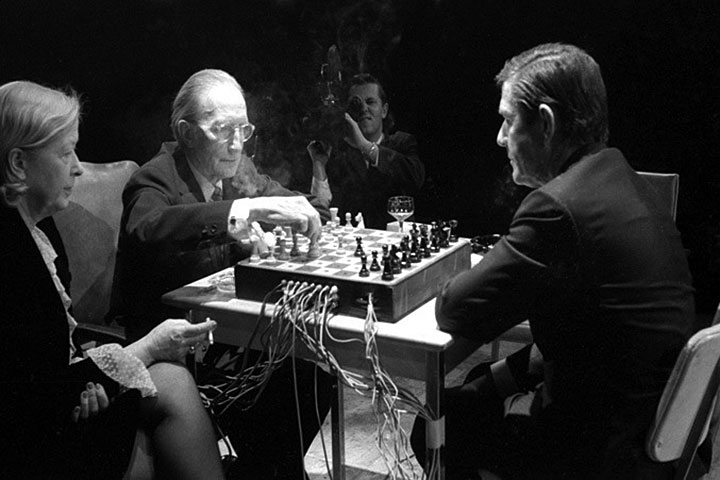
Marcel Duchamp plays white, John Cage plays black, on a chessboard modified to generate tones depending on where the chess pieces are. Toronto, 1968. Teeny Duchamp at far left, cameraman in the background.  This was a performance.

Marcel Duchamp plays white, John Cage plays black, on a chessboard modified to generate tones depending on where the chess pieces are. Toronto, 1968. Teeny Duchamp at far left, cameraman in the background. This was a performance.

Composer John Cage sought him out in Duchamp’s last years, and made a point of meeting with the artist at least once a week. Cage experimented with a chessboard designed to generate music depending on the positions of the chess pieces on the board (hence, the wires).  This photo came from a performance at a festival in Toronto in 1968.

More:


Rachel Carson sketch

March 4, 2015

A Canadian artist posted a nice sketch of Rachel Carson on Twitter:

Rachel Carson sketch, by artist @moietymouse

Rachel Carson sketch, by artist @moietymouse

I’m often frustrated at how few good images of Ms. Carson exist on the internet, probably because I see them over and over again in working to stamp out the hoax claims about Carson, DDT and malaria, and environmental protection.

Maybe we can get @moietymouse to make some more? Check out her Twitter feed; maybe she’s got images for sale, and you can encourage her while improving the look of your walls.

Read the rest of this entry »


Millard Fillmore, live on Peachtree Street, 1854

March 4, 2015

Lower Peachtree Street, Atlanta, in 1910, 56 years after ex-President Millard Fillmore visited. Library of Congress photo via Chamblee54

Lower Peachtree Street, Atlanta, in 1910, 56 years after ex-President Millard Fillmore visited. Library of Congress photo via Chamblee54

Chamblee54, in a history of Peachtree Street studded with interesting photographs, notes Atlanta’s first-time brush with any ex-president:

In 1854, Atlanta entertained, for the first time, a man who had been President. On May 2, Millard Fillmore arrived from Augusta on a private rail car.

Two years after the Whigs refused to nominate Fillmore for a term of his own, he was out touring the country?

Several accounts explain that Fillmore and his wife Abigail wanted to tour the U.S. after his presidency.  Unfortunately, she died shortly after he left office.  He pined through the rest of 1853, but by February 1854 had decided to tour by himself, without his children, accompanied by friends he could persuade to join him.

That same month, Fillmore decided to take the trip southward that he and Abigail had not been able to take. Given the timing, some observers believed that Fillmore had a political motive in making the journey.  They suspected that he might be planning to speak out against the Nebraska Bill [proposed by Illinois’s U.S. Senator Stephen A. Douglas]. Others were convinced that it was a leisure tour.  But whatever Fillmore’s intentions may have been, his speeches to southern audiences were relatively neutral.  He restated his faith in the [Missouri] Compromise, but he spent mos tof his time enjoying a series of receptions, dinners, and parades in his honor throughout the region.  A marching band escorted him through the streets of Louisville, Kentucky.  Girls scattered his path with flowers in Montgomery, Alabama.  A row of trains blew their whistles in greeting in Atlanta, Georgia.  Fillmore returned home refreshed and with renewed faith in his fellow Americans.

Alison Behnke, Millard Fillmore (a child’s history of the man), 2005, page 92.

A longer description came out of Robert J. Scarry’s 1982 biography:

By late February 1854 Fillmore had resumed his plans to travel.  He perceived that a southern trip would do him good and that the journey would divert his mind from the loss of Abigail.

*******

Fillmore hoped Francis Granger, John P. Kennedy, and Washington Irving would go with him on the trip. Granger lost interest, and Irving, who had been asked by his friend Kennedy, was in no mood for politics.

*******

En route to Atlanta from Augusta on the Georgia Railroad, they stopped at Greensboro where a large crowd of teachers and students of the Female College greeted Fillmore and Kennedy.  They dined at Madison.  At Stone Mountain an escort committee from Atlanta met them.

At the Atlanta Depot a novel reception welcomed them.  A large number of locomotives were present with their steam up.  When the Augusta engineer signalled their arrival they all opened up their valves and whistled out a welcome the like of which, reported a newspaper, “no mortal man had heard before.” The shouts from the crowd and locomotive whistles were deafening to one reporter.  By carriage the party went from the depot to the Atlanta Hotel where a reception was held.

Fillmore had become hoarse. Nonetheless, he managed to say that he was impressed by the large population and that he had heard that it was a beautiful village in the center of the state. He also admonished the state legislature to to take note “of the array of female loveliness before me” seated at the reception.  If they did so, he joked, they wouldn’t hesitate to locate the state capital at Atlanta.  At that time the capital was at Milledgeville.  Atlanta became the capital in 1877.  In the evening, after dinner, a ball was held.  Fifty young ladies dressed in white with bouquets of flowers were a highlight of the occasion.

Robert J. Scarry, Millard Fillmore, 1982, pages 247-252 variously.

Any photos of Fillmore in Atlanta?

Millard Fillmore is in some ways the ultimate exemplar of American civic boosterism.  These accounts tend to be softball, even when the potential political effects of his trip to Atlanta are discussed.  One gets a sense that contemporary accounts of the trip were equally bland and uncontroversial.  Fillmore’s trip offered a lot of local chamber of commerce precursors a chance to plug their local industry, development and pride.  Fillmore seems incapable of not offering pride-stoking flattery to these group of people.  That’s not necessarily bad.

Within a dozen years the nation would be engulfed in the Civil War.  Atlanta would be burned.  The railroads Fillmore rode would be torn up by Union armies.

What a snapshot, even without photos.

A not-often seen image of Millard Fillmore.  Via Accessible Archives.

A not-often seen image of Millard Fillmore. Via Accessible Archives.


Quote of the moment: Calvin Coolidge, on building America: “Look to service, not selfishness”

March 3, 2015

Calvin Coolidge, 30th president of the United States (elected vice president in 1920, and succeeding to the presidency upon the death of Warren G. Harding).  History.com image

Calvin Coolidge, 30th president of the United States (elected vice president in 1920, and succeeding to the presidency upon the death of Warren G. Harding). History.com image

Referring to progress in the U.S. after World War I, Coolidge said:

With peace has come prosperity. Burdens have been great, but the strength to bear them has been greater. The condition of those who toil is higher, better, more secure than in all the ages past. Out of the darkness of a great conflict has appeared the vision, nearer, clearer than ever before, of a life on earth less and less under the deadening restraint of force, more and more under the vitalizing influence of reason. Moral power has been triumphing over physical power. With peace has come prosperity. Burdens have been great, but the strength to bear them has been greater. The condition of those who toil is higher, better, more secure than in all the ages past. Out of the darkness of a great conflict has appeared the vision of a nearer, clearer than ever before, the  [of] life on earth less and less under the deadening restraint of force, more and more under the vitalizing influence of reason. Moral power has been triumphing over physical power. Education will tend to bring reason and experience of the past into the solution of the problems of the future. We must look to service and not selfishness, for service is the foundation of progress. The greatest lesson that we have to learn is to seek ever the public welfare, to build up, to maintain our American heritage.

Candidate for vice president Calvin Coolidge, “America and the War,” 1920

Digging a little deeper, I discover that the first part of this quote also appeared in Coolidge’s Thanksgiving Proclamation on November 27, 1919, when he was  Governor of Massachusetts.  Knowing a good turn of words when he wrote it (I’m assuming he didn’t have ghost writers then), he used the same words in making phonograph recordings of speeches to be distributed in the election campaign of 1920, before radio was available to carry speeches to voters.  I have made minor corrections in the transcript, from the earlier text and the audio delivery.

According to Talking History, the 78 rpm record and audio version were saved and made available by the Library of Congress.

You may want to listen to Coolidge say the words himself. Mp3  RealPlayer


Snow Friday

February 27, 2015

It was clear this morning, but the snow started just before 9. It’s predicted to warm up enough that the stuff from the skies will be wet, but the ground will be stay frozen. Ice storm.

Businesses and schools shut down about noon.

Two male house finches, probably in their first year, try to eat enough to stay warm on a snowy day in Dallas. Photo by Ed Darrell

Two male house finches, probably in their first year, try to eat enough to stay warm on a snowy day in Dallas. Photo by Ed Darrell

Something about snow makes the birds hungry.  A tube feeder we filled last night emptied by noon.

At home we refill the feeders as best we can.

Rewards are high.  We’ve had six species in the yard at any time, all morning, and at least eight species total.

  • Blue jays

    A sparrow -- a chipping sparrow juvenile? -- acting as scout to find food; it was joined by at least two companions after dusting snow off of seeds in the feeder, and finding them suitable.

    A sparrow — a chipping sparrow juvenile? — acting as scout to find food; it was joined by at least two companions after dusting snow off of seeds in the feeder, and finding them suitable.

  • Cardinals
  • Two species of junco
  • House finches
  • Gold finches
  • White-winged doves
  • A sparrow (juvenile chipping sparrow?)
  • Chickadees
  • Wrens (probably Carolina, but they won’t come close to the house)

It would be nice if our downy woodpecker friends would visit, but they’ve been scarce most of the fall.

Where are the titmice?

As usual, we have some vireo or other (Bell’s, I think), but it knows us well enough to be able to sing to get us excited, but appear only when humans are not looking.

How are things in your yard?

We get the goldfinches in winter, with their winter colors; some of the males may be anticipating spring a bit.

We get the goldfinches in winter, with their winter colors; some of the males may be anticipating spring a bit.

Female cardinal and male house finch await their turn at the small bird feeder.

Female cardinal and male house finch await their turn at the small bird feeder.


Founders on education standards: James Madison

February 25, 2015

Photo of inscription to the left (north) of the main entrance on Independence Ave., of the James Madison Building, Library of Congress, Washington, D.C.; Library of Congress photo

Photo of inscription to the left (north) of the main entrance on Independence Ave., of the James Madison Building, Library of Congress, Washington, D.C.; Library of Congress photo

Madison said nothing against a federal role, but much which supports Common Core standards, and everything in support of public schooling (spellings and other longhand affectations of Mr. Madison left as they were in the letter; emphases added here):

Letter to William Taylor Barry

James Madison (Aug. 4, 1822)

Dear Sir, I received some days ago your letter of June 30, and the printed Circular to which it refers.

The liberal appropriations made by the Legislature of Kentucky for a general system of Education cannot be too much applauded. A popular Government, without popular information, or the means of acquiring it, is but a Prologue to a Farce or a Tragedy; or, perhaps both. Knowledge will forever govern ignorance: And a people who mean to be their own Governors, must arm themselves with the power which knowledge gives.*

William Taylor Barry was, in 1822, Lt. Governor of Kentucky (one of many posts he held in his lifetime of public service), and the author of the Barry Report, which proposed a system of free public education for Kentucky. Image from Kentucky Secretary of State, at Kentucky.gov

William Taylor Barry was, in 1822, Lt. Governor of Kentucky (one of many posts he held in his lifetime of public service), and the author of the Barry Report, which proposed a system of free public education for Kentucky. Image from Kentucky Secretary of State, at Kentucky.gov

I have always felt a more than ordinary interest in the destinies of Kentucky. Among her earliest settlers were some of my particular friends and Neighbors. And I was myself among the foremost advocates for submitting to the Will of the “District” the question and the time of its becoming a separate member of the American family. Its rapid growth & signal prosperity in this character have afforded me much pleasure; which is not a little enhanced by the enlightened patriotism which is now providing for the State a Plan of Education embracing every class of Citizens, and every grade & department of Knowledge. No error is more certain than the one proceeding from a hasty & superficial view of the subject: that the people at large have no interest in the establishment of Academies, Colleges, and Universities, where a few only, and those not of the poorer classes can obtain for their sons the advantages of superior education. It is thought to be unjust that all should be taxed for the benefit of a part, and that too the part least needing it.

If provision were not made at the same time for every part, the objection would be a natural one. But, besides the consideration when the higher Seminaries belong to a plan of general education, that it is better for the poorer classes to have the aid of the richer by a general tax on property, than that every parent should provide at his own expence for the education of his children, it is certain that every Class is interested in establishments which give to the human mind its highest improvements, and to every Country its truest and most durable celebrity.

Learned Institutions ought to be favorite objects with every free people. They throw that light over the public mind which is the best security against crafty & dangerous encroachments on the public liberty. They are the nurseries of skilful Teachers for the schools distributed throughout the Community. They are themselves schools for the particular talents required for some of the Public Trusts, on the able execution of which the welfare of the people depends. They multiply the educated individuals from among whom the people may elect a due portion of their public Agents of every description; more especially of those who are to frame the laws; by the perspicuity, the consistency, and the stability, as well as by the just & equal spirit of which the great social purposes are to be answered.

Without such Institutions, the more costly of which can scarcely be provided by individual means, none but the few whose wealth enables them to support their sons abroad can give them the fullest education; and in proportion as this is done, the influence is monopolized which superior information everywhere possesses. At cheaper & nearer seats of Learning parents with slender incomes may place their sons in a course of education putting them on a level with the sons of the Richest. Whilst those who are without property, or with but little, must be peculiarly interested in a System which unites with the more Learned Institutions, a provision for diffusing through the entire Society the education needed for the common purposes of life. A system comprizing the Learned Institutions may be still further recommended to the more indigent class of Citizens by such an arrangement as was reported to the General Assembly of Virginia, in the year 1779, by a Committee appointed to revise laws in order to adapt them to the genius of Republican Government. It made part of a “Bill for the more general diffusion of knowledge” that wherever a youth was ascertained to possess talents meriting an education which his parents could not afford, he should be carried forward at the public expence, from seminary to seminary, to the completion of his studies at the highest.

But why should it be necessary in this case, to distinguish the Society into classes according to their property? When it is considered that the establishment and endowment of Academies, Colleges, and Universities are a provision, not merely for the existing generation, but for succeeding ones also; that in Governments like ours a constant rotation of property results from the free scope to industry, and from the laws of inheritance, and when it is considered moreover, how much of the exertions and privations of all are meant not for themselves, but for their posterity, there can be little ground for objections from any class, to plans of which every class must have its turn of benefits. The rich man, when contributing to a permanent plan for the education of the poor, ought to reflect that he is providing for that of his own descendants; and the poor man who concurs in a provision for those who are not poor that at no distant day it may be enjoyed by descendants from himself. It does not require a long life to witness these vicissitudes of fortune.

It is among the happy peculiarities of our Union, that the States composing it derive from their relation to each other and to the whole, a salutary emulation, without the enmity involved in competitions among States alien to each other. This emulation, we may perceive, is not without its influence in several important respects; and in none ought it to be more felt than in the merit of diffusing the light and the advantages of Public Instruction. In the example therefore which Kentucky is presenting, she not only consults her own welfare, but is giving an impulse to any of her sisters who may be behind her in the noble career.

Throughout the Civilized World, nations are courting the praise of fostering Science and the useful Arts, and are opening their eyes to the principles and the blessings of Representative Government. The American people owe it to themselves, and to the cause of free Government, to prove by their establishments for the advancement and diffusion of Knowledge, that their political Institutions, which are attracting observation from every quarter, and are respected as Models, by the newborn States in our own Hemisphere, are as favorable to the intellectual and moral improvement of Man as they are conformable to his individual & social Rights. What spectacle can be more edifying or more seasonable, than that of Liberty & Learning, each leaning on the other for their mutual & surest support?

The Committee, of which your name is the first, have taken a very judicious course in endeavouring to avail Kentucky of the experience of elder States, in modifying her Schools. I enclose extracts from the laws of Virginia on that subject; though I presume they will give little aid; the less as they have as yet been imperfectly carried into execution. The States where such systems have been long in operation will furnish much better answers to many of the enquiries stated in your Circular. But after all, such is the diversity of local circumstances, more particularly as the population varies in density & sparseness, that the details suited to some may be little so to others. As the population however, is becoming less & less sparse, and it will be well in laying the foundation of a Good System, to have a view to this progressive change, much attention seems due to examples in the Eastern States, where the people are most compact, & where there has been the longest experience in plans of popular education.

I know not that I can offer on the occasion any suggestions not likely to occur to the Committee. Were I to hazard one, it would be in favour of adding to Reading, Writing, & Arithmetic, to which the instruction of the poor, is commonly limited, some knowledge of Geography; such as can easily be conveyed by a Globe & Maps, and a concise Geographical Grammar. And how easily & quickly might a general idea even, be conveyed of the Solar System, by the aid of a Planatarium of the Cheapest construction. No information seems better calculated to expand the mind and gratify curiosity than what would thus be imparted. This is especially the case, with what relates to the Globe we inhabit, the Nations among which it is divided, and the characters and customs which distinguish them. An acquaintance with foreign Countries in this mode, has a kindred effect with that of seeing them as travellers, which never fails, in uncorrupted minds, to weaken local prejudices, and enlarge the sphere of benevolent feelings. A knowledge of the Globe & its various inhabitants, however slight, might moreover, create a taste for Books of Travels and Voyages; out of which might grow a general taste for History, an inexhaustible fund of entertainment & instruction. Any reading not of a vicious species must be a good substitute for the amusements too apt to fill up the leisure of the labouring classes.

I feel myself much obliged Sir by your expressions of personal kindness, and pray you to accept a return of my good wishes, with assurances of my great esteem & respect.

Careful readers will note Madison assumed public schools; he had been one of those who contributed to the Northwest Ordinances, which set aside pieces of every township, which land was to be used to create public schooling on the frontiers of America.  If you think Madison’s description of what was to be taught and how sounds an awful lot like Advanced Placement (AP) courses, or the International Baccalaureate curriculum (IB), you’d be in good company.  As opposed to those yahoos who oppose AP or question IB.

_____________
* This line was a favorite quote of Education Secretary Bill Bennett when I published his works in the area. I cannot say whether he still favors Madison’s view, but once upon a time Bennett was rational on these issues.

More:


Quote of the moment: FDR on government shutdowns

February 24, 2015

One wag, who didn’t want to discuss things after all, referred me to President Franklin Roosevelt’s message to the National Federal of Federal Employees (NFFE), of August 16, 1937 (from the American Presidency Project at the University of California – Santa Barbara (UCSB)).  The wag asked me to confess that FDR was anti-union, and that Wisconsin Gov. Scott “Ahab” Walker had acted in Roosevelt’s path in Walker’s assaults on the unions of policemen, firefighters and teachers in Wisconsin.

I demurred, and pointed out instead that Walker went after the unions despite their having NOT struck, that Walker refused to bargain in good faith, or bargain at all.  I pointed out that Walker had failed in his duty, in the view of FDR.

President Franklin Delano Roosevelt

President Franklin Delano Roosevelt, in 1936 (Checking to see whether, when and where FDR said that; Robert Reich says he did.)

It’s a good way to send wags packing on Twitter, I’ve learned.  They don’t like to read or think, and they certainly don’t want anyone pointing out that they may have misinterpreted something. Anything.

NFFE had invited Roosevelt to speak at their Twentieth Jubilee Convention; Roosevelt sent a letter declining the invitation. In declining, Roosevelt noted he opposed strikes by government employees.  No doubt there is more history there that deserves our attention.  We can get to it later.

Here’s the meat of FDR’s letter:

Particularly, I want to emphasize my conviction that militant tactics have no place in the functions of any organization of Government employees. Upon employees in the Federal service rests the obligation to serve the whole people, whose interests and welfare require orderliness and continuity in the conduct of Government activities. This obligation is paramount. Since their own services have to do with the functioning of the Government, a strike of public employees manifests nothing less than an intent on their part to prevent or obstruct the operations of Government until their demands are satisfied. Such action, looking toward the paralysis of Government by those who have sworn to support it, is unthinkable and intolerable. It is, therefore, with a feeling of gratification that I have noted in the constitution of the National Federation of Federal Employees the provision that “under no circumstances shall this Federation engage in or support strikes against the United States Government.”

What do you think Roosevelt would have made of the current and last “do nothing” GOP blocs in Congress?  (Or should we say “blocks?”)

Doesn’t this describe Republicans in Congress today?

” . . . intent on their part to prevent or obstruct the operations of government until their demands are satisfied. Such action, looking toward the paralysis of Government by those who have sworn to support it, is unthinkable and intolerable.”

Is it too much to ask Republicans in Congress to be at least as loyal to the U.S. as the unionized government employees who pledged not to shut down the government?

More:


70 years ago today, U.S. flags rose on Mt. Suribachi, Iwo Jima

February 23, 2015

February 23, 1945. It’s a date that will live in famous heroics, war brutality, photography, and bronze.

On the morning of February 23, U.S. troops raised the U.S. flag on a hill known as Mt. Suribachi, on the island of Iwo Jima — a visual signal to U.S. troops that the high ground had been taken, and the battle turned for the U.S.

First flag-raising on Mt. Suribachi, Iwo Jima, on February 23, 1945.  Photograph for Leatherneck Magazine by Sgt. Lou Lowery.

First flag-raising on Mt. Suribachi, Iwo Jima, on February 23, 1945. Photograph for Leatherneck Magazine by Sgt. Lou Lowery.

Later in the day, an officer ordered a larger flag to be posted, to be more visible. AP photographer Joe Rosenthal caught that raising on film.

Is this the most iconic photo ever?  Wikimedia caption: Raising the Flag on Iwo Jima, Joe Rosenthal's historic photo depicts five United States Marines and one sailor raising an American flag over Mount Suribachi during the Battle of Iwo Jima. The image above is an Associated Press photograph that won the Pulitzer Prize for Photography. It was taken by Joe Rosenthal on February 23, 1945.

Is this the most iconic photo ever? Wikimedia caption: Raising the Flag on Iwo Jima, Joe Rosenthal’s historic photo depicts five United States Marines and one sailor raising an American flag over Mount Suribachi during the Battle of Iwo Jima. The image above is an Associated Press photograph that won the Pulitzer Prize for Photography. It was taken by Joe Rosenthal on February 23, 1945.

February 23 does not appear in the list of dates by law recommended for Americans to fly the U.S. flag.  You may want to fly yours today, anyway.

More:

Iwo Jima Memorial, near Washington, D.C.

Iwo Jima Memorial, near Washington, D.C.

Mt. Suribachi's prominence is clear in this photo of the island of Iwo To, as it is known in Japan.

Mt. Suribachi’s prominence is clear in this photo of the island of Iwo To, as it is known in Japan. Suribachi is a 546-foot (166 m) dormant volcanic cone, on the southern tip of the island. Wikipedia image


Misquote of the moment: Magellan didn’t say it, but it’s still brilliant, “shadow on the Moon”

February 21, 2015

An anonymous portrait of Ferdinand Magellan, 16th or 17th century (The Mariner's Museum Collection, Newport News, VA) Legend:

An anonymous portrait of Ferdinand Magellan, 16th or 17th century (The Mariner’s Museum Collection, Newport News, VA) Legend: “Ferdinan[dus] Magellanus superatis antarctici freti angustiis clariss.” (Fedinand Magellan, you overcame the famous, narrow, southern straits.)

From Wikiquote:

  • The Church says that the Earth is flat, but I know that it is round. For I have seen the shadow of the earth on the moon and I have more faith in the Shadow than in the Church.
    • This quotation is often found on the internet attributed to Magellan, but never with a source, and no English occurrence prior to its use by Robert Green Ingersoll in his essay “Individuality” (1873) has been located. Thus, it it most likely spurious. In that essay Ingersoll states:

It is a blessed thing that in every age some one has had individuality enough and courage enough to stand by his own convictions, — some one who had the grandeur to say his say. I believe it was Magellan who said, “The church says the earth is flat; but I have seen its shadow on the moon, and I have more confidence even in a shadow than in the church.” On the prow of his ship were disobedience, defiance, scorn, and success.

Where did Ingersoll get that thought? Wouldn’t he claim it as his own, had he invented it?

And, is it true? Can we tell anything by the Earth’s shadow on the Moon?  EarthSky.org discusses the reality, when can we really see the Earth’s shadow?  Turns out, we don’t have to wait for a lunar eclipse. More, is this false attributing perhaps the source of the old, incorrect claim that many in the days of Columbus thought the Earth to be flat, and not spherical?

Wikiquote, and the rest of us, need more sleuthing on this one.

More:


How is DDT used to fight malaria?

February 20, 2015

Can we dispel common misapprehensions about fighting malaria?

In fighting malaria, DDT is not used outdoors.  Spraying swamps with insecticide does little to combat malaria because malaria-carrying mosquitoes don’t usually breed or rest there, and collateral damage from DDT reduces mosquito predators.

USAID-paid workers conducting Indoor Residual Spraying (IRS) campaign. (Where? When?) USAID photo, via Stanford University, Human Biology 153

USAID-paid workers conducting Indoor Residual Spraying (IRS) campaign. (Where? When?) USAID photo, via Stanford University, Human Biology 153

DDT’s utility in fighting malaria comes from its persistence when used close by humans bitten by those species of mosquito that carry malaria. Malaria is a parasitic disease.  Malaria parasites complete their life cycle in a human host (victim), and any insect taking blood from an infected human gets some of those parasites.  The parasite completes another phase of its life cycle in certain species of mosquito — not flies nor other biting insects — and after about two weeks, mosquitoes can infect humans with newly-ready parasites.

Those species that carry malaria are usually active from about dusk until after midnight.  Consequently, they bite people usually as they sleep.  Because the “blood meal” is heavy, newly-fed mosquitoes usually fly to a nearby wall of the home to excrete water from the meal, so they fly with a lighter load.  If DDT, or some other pesticide, coats that wall, the mosquito will die before being able to pass new parasites on to new victims.

DDT is NOT used to spray outdoors, to fight malaria.  Among other things, outdoor spraying threatens domestic animals and any creature that preys on the malaria-carrying mosquito; as a pragmatic matter, outdoor use affects only a tiny percentage of malaria-carrying mosquitoes. Malaria-carriers tend to breed in small, temporary pools of water from rain; this transience makes outdoor fighting difficult.  Many people fail to understand this crucial point: DDT outdoors doesn’t help in the fight against malaria.  (Other outdoor campaigns can provide relief, such as elimination of old tires, filling potholes in roads, draining raingutters, and generally eliminating the mosquito breeding areas close to human homes, since mosquitoes rarely move more than about 50 yards in their lifetime.)

It’s important to realize that DDT in IRS allows a mosquito a free first bite.  The hope is that bite is from an uninfected mosquito, who will then land on the treated wall of the home and get a fatal dose of pesticide, so that spreading malaria it may have picked up from its victim, is stopped.  Bednets, which form a physical barrier, prevent even the first bite.  Bednets gain effectiveness from treatment with impregnated insecticides.

The U.S. Centers for Disease Control, the lead agency in the campaign to eradicate malaria from the U.S. after World War II, explains this use of DDT in Indoor Residual Spraying, or IRS:

Indoor Residual Spraying

Many malaria vectors are considered “endophilic”; that is, the mosquito vectors rest inside houses after taking a blood meal. These mosquitoes are particularly susceptible to control through indoor residual spraying (IRS).

What Is Indoor Residual Spraying?

As its name implies, IRS involves coating the walls and other surfaces of a house with a residual insecticide. For several months, the insecticide will kill mosquitoes and other insects that come in contact with these surfaces. IRS does not directly prevent people from being bitten by mosquitoes. Rather, it usually kills mosquitoes after they have fed if they come to rest on the sprayed surface. IRS thus prevents transmission of infection to other persons. To be effective, IRS must be applied to a very high proportion of households in an area (usually >80%).

Health workers sparying insecticide on the walls of a wood and adobe dwelling.

Health worker spraying insecticide on the walls of a wood and adobe dwelling, in Indoor Residual Spraying (IRS). CDC image

History of IRS

IRS with DDT was the primary malaria control method used during the Global Malaria Eradication Campaign (1955-1969). The campaign did not achieve its stated objective but it did eliminate malaria from several areas and sharply reduced the burden of malaria disease in others.

Concern over the environmental impact of DDT led to the introduction of other, more expensive insecticides. As the eradication campaign wore on, the responsibility for maintaining it was shifted to endemic countries that were not able to shoulder the financial burden. The campaign collapsed and in many areas, malaria soon returned to pre-campaign levels.

As a result of the cost of IRS, the negative publicity due to the failure of the Malaria Eradication Campaign, and environmental concerns about residual insecticides, IRS programs were largely disbanded other than in a few countries with resources to continue them. However, the recent success of IRS in reducing malaria cases in South Africa by more than 80% has revived interest in this malaria prevention tool.

Rachel Carson understood this use of DDT, and she understood that outdoor use of DDT, such as crop spraying, or fighting insects affecting trees, could induce insects to evolve resistance and immunity to DDT.  In Silent Spring Carson warned that unless outdoor uses were greatly curtailed, DDT would be rendered ineffective to fight diseases.  Fred Soper, the super-mosquito killer from the Rockefeller Foundation who organized and led the UN’s malaria eradication effort, also understood the race against evolution of DDT resistance.  He had hoped resistance would not show up in tropical areas until the 1970s — malaria campaigns around the Mediterranean produced DDT resistance as early as 1948.  Sadly, resistance to DDT was already established in many mosquito populations in tropical Africa before Soper could take the UN’s program to them.  The UN had to abandon the campaign, as CDC’s explanation indicates.

Today, every mosquito on Earth carries some of the alleles of resistance to DDT, and many are immune to it.


Popular music as music history, or just plain history

February 20, 2015

Old Jules rambled on about Johnny Cash and Loudon Wainright III, and their differing versions, in different eras, of “The Man Who Couldn’t Cry.” Then discussion got into Johnny Horton.

Old Jules’s blog is always a good read.  Go see for yourself.

Cover of Jimmy Driftwood's

Cover of Jimmy Driftwood’s “Wilderness Road,” the first bluegrass and/or country album I owned; my father bought it from the remainder pile at a record distributor in the 1960s. He didn’t much like it, and it took a while to grow on me. Driftwood’s music is preserved by historians in Arkansas, now.

It got me thinking.  I posted in comments there:

Nice to find someone who remembers Johnny Horton.

My oldest brother went drinking with Horton in Twin Falls, Idaho, my brother claimed, after a performance. He was a great fan ever after.

I liked Horton’s performance on “Battle of New Orleans.” Wasn’t until the 21st century that I learned that song was written by Jimmy Driftwood, who taught 8th grade history before he turned to songwriting full time. Worse, Driftwood wrote it in the 1930s.

Thank God libraries keep old music around.

Ever hear Moby’s “Natural Blues?” Turns out he cribbed (“sampled”) the vocals from tracks Alan Lomax recorded somewhere in the South much earlier, “Trouble So Hard,” by Vera Hall.

Well, there you go.

Here’s the audio from which Moby sampled, Vera Hall singing “Trouble So Hard.”

And for the record, Jimmy Driftwood’s version of “The Battle of New Orleans.”  History teachers, do you find it accurate?  Do you use it in class?

Johnny Horton’s version, done for an 8th grade history class:


Malaria fight, February 2015

February 20, 2015

Timely infographic from Agence France Presse.

Some background:  The newly-formed World Health Organization (WHO) estimated worldwide malaria deaths at more than 5 million per year, when it kicked off the ambitious but ultimately unsuccessful malaria eradication program in 1955.  Eradication hopes hung on the use of DDT, sprayed on the walls of homes in affected areas (Indoor Residual Spraying, or IRS), to temporarily knock down mosquito populations so that humans infected with malaria could be cured.  After early successes in temperate zones, malaria fighters took the fight to tropical Africa in 1963.  There they discovered that overuse and abuse of DDT had already bred mosquitoes resistant to the pesticide.  With no substitute for DDT available, WHO wound down the campaign on the ground by 1965, and officially abandoned it in 1969.

Nations who had pledged money for the fight early, cut back when DDT failed.  In 1963, about 4 million people died from malaria, worldwide.

Despite the lack of an international, worldwide fight against malaria, malaria fighters soldiered on.  Better housing and better medicines made gains.  By the time the U.S. banned DDT use on crops in 1972, pledging all U.S. production of DDT to fight disease elsewhere, annual malaria deaths had fallen to just over 2 million per year. By 1990, the annual death toll was cut to about a million per year.  Through the 1980s, malaria parasites themselves developed resistance to the main pharmaceuticals used to cure humans.

By the end of the 1990s, international agencies and especially NGOs like the Bill and Melinda Gates Foundation brought new funding and new urgency to the fight against malaria.  Expansion of production of artemisinin-based pharmaceuticals provided a new tool for health workers.  Funding from the U.S., through the President’s Malaria Initiative, helped a lot.  In 2000, about a million people died from malaria.  By 2014, malaria deaths fell to under 600,000.

Parasite resistance to the new pharmaceuticals poses a new threat to continued progress.  Funding is still far short of what experts estimate to be needed, and short of pledges from developed nations.  Mosquitoes that carry malaria parasites from human to human (after a step of the life cycle in infected mosquitoes) quickly evolve resistance to pesticides; malaria parasites develop resistance to pharmaceuticals used to treat humans.  Funding to rotate pesticides and drugs falls short, causing improper use of both, and quicker evolution of resistance in mosquitoes, and parasites.

Infgraphic from Agence France Presse, on the fight against malaria, February 2015.

Infgraphic from Agence France Presse, on the fight against malaria, February 2015.


Quote of the moment: Gen. Patton’s oddly non-profane explanation of profanity

February 18, 2015

Lt. Gen. George Patton with the signal corps, July 11th 1943, Sicily. (General George Patton Museum) - See more at: http://ww2today.com/10th-august-1943-general-george-s-patton-slaps-another-soldier#sthash.dVuHaPeg.dpuf

Lt. Gen. George Patton with the signal corps, July 11th 1943, Sicily. (General George Patton Museum) – See more at: http://ww2today.com/10th-august-1943-general-george-s-patton-slaps-another-soldier#sthash.dVuHaPeg.dpuf

  • When I want my men to remember something important, to really make it stick, I give it to them double dirty. It may not sound nice to some bunch of little old ladies at an afternoon tea party, but it helps my soldiers to remember. You can’t run an army without profanity; and it has to be eloquent profanity. An army without profanity couldn’t fight its way out of a piss-soaked paper bag. … As for the types of comments I make, sometimes I just, By God, get carried away with my own eloquence.
    • Remark to his nephew about his copious profanity, quoted in “The Unknown Patton” (1983) by Charles M. Province, p. 184 (here, via Wikiquote)

One:

One glorious summer, after a couple of months of Scouting, I signed on to do air pollution research for several weeks in the field, in and around Farmington, New Mexico.  Hours were long, and the driving between sampling sites was more than 120 miles a day, between Farmington and Teec Nos Pos, Arizona.  Driving through the desert, passing the Shiprock every day, is rough duty, but somebody had to do it.

My mother’s brother, Harry Stewart, lived in Farmington.  Weekends I was royally dined and liquored, and got the opportunity to meet Uncle Harry’s friends, who included C. M. Woodbury, then city manager of Farmington.  Woodbury’s exploits on the golf course provided constant entertainment.  His opinions about having to measure air pollution from the Four Corners Power Plant and the then-under-construction San Juan Generating Station gave me great insight into local views on regional and national issues, as the Clean Air Act wended its way through Congress.

Woodbury had been an aide of some sort to General George Patton in Europe, as I understood it.  Sadly, I never did get back to Farmington to debrief him in detail about World War II, a loss of information that still stings from time to time.  I think he was with the 752nd Tank BattalionWoodbury retired in 1976.

The movie, Patton, still played in theaters, and one Sunday, over dinner, conversation turned to great leadership and whether I thought Patton was such a leader.  I hadn’t seen the movie.  I didn’t know much about Patton.  I asked what a definition of a good leader might be.  Uncle Harry and Woodbury settled on this criterion:  A good leader is someone whose followers will go to hell and back for her, or him.  Why did Patton inspire that sort of followership, I asked.

Woodbury rambled on about Patton getting gasoline for his tanks and trucks on a run through German lines that became legendary, and was portrayed in the movie.  He talked about how Patton’s troops always could count on a good, warm meal when they got a break from battle.  He talked about how proud every soldier was to be a part of that unit under Patton’s command.  He stopped, his eyes welled up and a tear, or maybe more, rolled down his cheek.

“We would have gone to hell for Patton because we knew he would have gone to hell for us. And he did.”

William Manchester once noted that, in battle, soldiers don’t die for great causes.  They fight to defend and save the friend to the right and the friend to the left.

It would have been interesting to know Patton.

Two:

We moved to Texas in 1987. Texas is a culture shock, I think, regardless where one comes from, even sometimes if one comes from Texas.  We moved directly from Cheverly, Maryland, outside of Washington, D.C.

Describing the conservative, goody-two-shoes aspects of Texas culture of that time can’t be done in shorthand.  A couple of examples:  Duncanville at the time had about 35,000 residents, and 44 churches.  Bordering Duncanville were three or five megachurches, among the largest in the nation, which drew heavily from Duncanville residents.  It was rare to meet someone who wouldn’t ask early in any conversation, “And where do you go to church?” A great, personal and close relationship to Jesus is expected to be a feature of any “normal” person’s life in Texas.  The day I drove out of Utah, I remember thinking as I rose above the fog heading up Parley’s Canyon that I would probably never again live in a place where it was so difficult to get a drink with dinner.  Then we moved to Texas.  On the surface, and often below the surface, Texans worked hard (and still do) to demonstrate that they are straighter than Mormons, and blessed because of their lack of sinning.  We don’t need to get into the ironies and incongruities of country music, Dallas culture and other now-well-identified sins of the Bible Belt.

Let’s just say, profanity was not something one publicly assented to.

I came down here to work with American Airlines, which was headed at the time by Robert Crandall.  Crandall’s use of profanity was legendary among AA executives and workers — executives, especially.  Crandall ran a tight operation with high expectations of worker achievement, especially in competition with other airlines.  “Competitive anger,” Crandall called it — and he expected all employees to demonstrate that, in appropriate, customer-serving, money-making ways.  Failures were noted, and often enough one might expect to be in a meeting with Crandall where an explanation of how and why things went wrong would be cut off with an expletive-filled dressing down that both made the victim subject understand the nature and severity of the error and pledge never to make that nor any other error ever again.

Talking about these events later, witnesses almost never said anything about the profanity.  Living in Texas where profanity was thought to make even strong men faint and swoon, Crandall’s expletives were considered instead indications of the importance of his thought, and speech, and markers that he was to be listened to.  I remember one young MBA rattled by the profanity; he left the company within a few weeks, and he wasn’t even the subject of the discussion.  But among others, especially successful managers and executives, discussion of content of meetings focused on the subject of the meetings, what was said about that subject, with unconscious excising of the profanity.

One famous meeting involved cutting costs, and the subject was security for a warehouse in San Juan, Puerto Rico.  Complaints about the cost for security the previous year led the local manager to beef up fences, get rid of the security company, and get dogs to roam the area at night.  Crandall pushed harder, and discussion turned to whether it would be even cheaper than dog food to get a sound system that would randomly play the sounds of big, vicious dogs’ barking instead.  I wasn’t in that meeting, but I heard several different accounts, all of them noting the boss’s exploration of options others might not think of, and how hard it was to please him — but not one story that included any comment about profanity, which I learned had laced the entire episode and probably made it memorable to everyone within earshot. And so they’d retell it. A remarkable piece of effective corporate communication.

How does one gauge when and whether profanity is necessary, or effective, in communication?

In one project, we videotaped Crandall talking on company issues and what he expected in the leaders the company hired as managers.  In several hours of video, I don’t recall a single time we had to retape, or edit, any profanity out.  Crandall turned off the profanity when it might pose a problem.  People who know him outside the company often express surprise that he’d ever use such language.

I sometimes wondered if Crandall was a reincarnation of Patton in at least some small way.  But Crandall was born in 1935, and Patton died in 1945.  Reincarnation is not the answer.

More: