May 23, 2007
It’s a delightful story I’ve heard dozens of times, and retold a few times myself: Abraham Lincoln faced with some thorny issue that could be settled by a twist of language, or a slight abuse of power, asks his questioner how many legs would a dog have, if we called the dog’s tail, a leg. “Five,” the questioner responds confident in his mathematical ability to do simple addition.

Sunrise at the Lincoln Memorial. National Park Service photo.
“No,” Lincoln says. “Calling a dog’s tail a leg, doesn’t make it a leg.”
But there is always the doubt: Is the story accurate? Is this just another of the dozens of quotes that are misattributed to Lincoln in order to lend credence to them?
I have a source for the quote: Reminiscences of Abraham Lincoln by distinguished men of his time / collected and edited by Allen Thorndike Rice (1853-1889). New York: Harper & Brothers Publishers, 1909. This story is found on page 242. Remarkably, the book is still available in an edition from the University of Michigan Press. More convenient for us, the University of Michigan has the entire text on-line, in the Collected Works of Abraham Lincoln, an on-line source whose whole text is searchable.
However, Lincoln does not tell the story about a dog — he uses a calf. Read the rest of this entry »
Spread the word; friends don't allow friends to repeat history.
 46 Comments |
  Abraham Lincoln, Accuracy, Famous quotes, Good Quotes, History, On-line education, Quotes | Tagged: Abraham Lincoln, Accuracy, Aphorisms, Famous quotes, History, On-line education, Quotes |
  Permalink
 Posted by Ed Darrell
March 19, 2007

Winston Churchill delivering the “Iron Curtain” speech, Westminster College, Fulton, Missouri, March 5, 1946 – Photo by George Skadding
“From Stettin in the Baltic to Trieste in the Adriatic, an iron curtain has descended across the Continent. Behind that line lie all the capitals of the ancient states of Central and Eastern Europe. Warsaw, Berlin, Prague, Vienna, Budapest, Belgrade, Bucharest and Sofia, all these famous cities and the populations around them lie in what I must call the Soviet sphere, and all are subject in one form or another, not only to Soviet influence but to a very high and, in many cases, increasing measure of control from Moscow.”
Sir Winston S. Churchill, in a speech at Westminster College, Fulton, Missouri, on March 5, 1946, titled “The Sinews of Peace.”
Some historians mark the beginning of the Cold War from this speech, in which a respected world leader first spelled out the enormous stakes at issue, and also pointed out that Russian, communist totalitarian governments were replacing more democratic governments in nations only recently freed from the spectre of Nazi rule, in World War II.
Oh, why not: Below the fold is the speech in its entirety, from the transcript at the Churchill Centre. Read the rest of this entry »
Spread the word; friends don't allow friends to repeat history.
5 Comments | Accuracy, Cold War, Democracy, Freedom - Economic, Freedom - Political, Quotes, Winston Churchill | Tagged: Accura, Accuracy, Cold War, Democracy, Famous quotes, freedom, Quotes, Westminster College, Winston Churchill | Permalink
Posted by Ed Darrell
March 14, 2007
The DVD release of the Texas Chainsaw Massacre’s latest cinema episode is probably driving the traffic to the post I did a while ago noting that the movies are not based on any Texas incidents (see “Based on a true story, except . . .). The original movie, in 1974, was billed as “based on a true story.” “The film which you are about to see is an account of the tragedy which befell a group of five youths, in particular Sally Hardesty and her invalid brother, Franklin,” the Narrator says opening the film.
The latest enfilmations apparently carry the same claim (I say apparently because I have never seen any of them through, and only a few snippets on television of any of them — I go by what I hear and see from others).
We have the testimony of the author of the original screenplay that it is fiction, loosely based on a famous case in Wisconsin which was also, very loosely, the basis for Alfred Hitchcock’s Psycho and the later, more horrifying Silence of the Lambs. Other internet sites say it’s fiction, such as Snopes.com (a favorite and very good hoax and error debunking site).
Still, the kids ask.
Why not turn this into a geography and/or history exercise? Read the rest of this entry »
Spread the word; friends don't allow friends to repeat history.
34 Comments | 100 Milestone Documents of U.S. History, Accuracy, Bogus history, Geography - Physical, History, Lesson plans, Movies, Texas | Tagged: Accuracy, Bogus history, geography, Hewitt Texas, Hoaxes, Lesson plans, Movies, Texas Chainsaw Massacre, Thomas Hewitt | Permalink
Posted by Ed Darrell
January 14, 2007
A good guide to flag etiquette from the U.S. Congress is on-line now. Our Flag is a traditional publication Congress passes out in efforts to help education in history and patriotism (H.Doc 108-97).
Interest in proper etiquette for flag display increased recently — not enough by my calculation, but any increase is welcomed. Where is good information available?
This Congressionally-sponsored guide is basic and accurate. As a classroom resource or a piece of a Scout troop library, it’s a useful reference guide. It can be downloaded (it’s a .pdf), and printed out in color (56 pages).
The book includes many illustrations showing proper flag display. It also covers the history of the U.S. flag in good enough detail to get through most high school reports, and it features illustrations of flags of each of the states.
Congress in the past provided many publications on such topics for general public consumption and use in classrooms, but has cut back on free distribution of printed information since the early 1980s. One might be able to get a printed copy with a request to one’s local Member of the House of Representatives, or U.S. Senator.
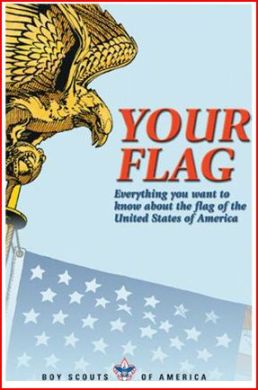
Boy Scouts of America version of the flag etiquette guide, Your Flag
Another book I’ve found very useful is an official Boys Scouts of America publication of the almost the same name, Your Flag. It’s a graphic-novel type of publication — cartoons for every point to be made. It features deeper information on proper flag display. The book can be purchased at any local Boy Scout Council supply shop, or any other shop that stocks Scout literature. It can also be ordered from BSA’s national catalog, or online at Scoutstuff.org, for $7.9910.99plus shipping. Every Scout troop should have one of these, and it is also very useful for classroom libraries, for history and civics.
In either publication, one learns that there are not many ways to display a flag properly from a vehicle — improper displays include decals on windows, bumper stickers, flying them from the radio antenna, or attaching them to a window pole to be battered in freeway-speed winds.
One might hope these books get much broader circulation.
Spread the word; friends don't allow friends to repeat history.
22 Comments | Accuracy, Boy Scouts of America, Flag etiquette, Patriotism | Tagged: Accuracy, Boy Scouts of America, Flag etiquette, History, Patriotism, U.S. Flag | Permalink
Posted by Ed Darrell
November 6, 2006

Inside the Thunderbirds Hangar at Nellis AFB, Airman 1st Class Michael Thayer, left, and Senior Airman David Prye demonstrate how to fold a U.S. flag. Photo by John Gurzinski, Las Vegas Review-Journal [Replacement photo]


Airman First Class Michael D’Ancona and Senior Airman Assad Pharr demonstrated how to properly fold an American flag during a special visit to Robbins Lane Elementary School in Syosset on May 23. (Syosset-Jericho Tribune, June 19, 2014; photo added here October 2014)
How did I miss this? The Las Vegas (Nevada) Review-Journal carried a story on July 4, 2006, on the Air Force’s efforts to replace the old, unofficial and misleading flag folding ceremony, with a new one. It has the script for the new ceremony.
The newspaper said:
Capt. Isham Barrett, Air Force action officer on Honor Guard policy, said the new script was developed because reference to the flag in the U.S. code “does not associate anything with any fold of the flag.”
“We don’t want to force a belief on somebody,” he said.
Barrett said the decision to develop a standardized script wasn’t prompted by someone complaining about religious connotations. “We can’t find anything in our files with regard to complaints,” he said.
Nevertheless, Christopher J. Andersen, an Army sergeant and member of the Military Association of Atheists and Freethinkers, wrote a letter in 2003, asking the U.S. Air Force Academy to remove the unofficial script from its Web site.
“In order to ensure this religious flag-folding ceremony is not portrayed as an official, government-sponsored flag-folding ceremony, I ask you to remove it from your .gov site,” wrote Andersen.
Andersen, who could not be reached last week, noted in his letter that the Air Force Academy removed the old script from its Web site after he complained.
Air Force leaders later set out to develop a script based on history rather than one that could be interpreted as contrary to the Establishment Clause of the First Amendment of the U.S. Constitution: “Congress shall make no law respecting an establishment of religion.”
Combined with the Free Exercise Clause — “or prohibiting the free exercise thereof” — they prohibit endorsement of a national religion or a preference for one over another. They also preclude dominance of religion over nonreligious philosophies, according to a 1994 Supreme Court majority opinion.
The new standardized script based on history was approved by Air Force leaders in July 2005 and first appeared in revised Honor Guard protocol manuals in January.
Three cheers for the Air Force (yes, I’m biased, for family reasons).
Tip of the old scrub brush to Linda Case.
Update October 22, 2014: The new, Air Force-approved script for a flag folding ceremony is at the Betsy Ross site. Use it in good patriotic spirit, and in the spirit of accurate history.
Spread the word; friends don't allow friends to repeat history.
9 Comments | Accuracy, Flag etiquette, History, Patriotism | Tagged: Accuracy, Flag etiquette, History, Patriotism, US Air Force | Permalink
Posted by Ed Darrell
October 9, 2006
We’re talking past each other now over at Right Reason[*], on a thread that started out lamenting Baylor’s initial decision to deny Dr. Francis Beckwith tenure last year, but quickly changed once news got out that Beckwith’s appeal of the decision was successful.
I noted that Beckwith’s getting tenure denies ID advocates of an argument that Beckwith is being persecuted for his ID views (wholly apart from the fact that there is zero indication his views on this issue had anything to do with his tenure discussions). Of course, I was wrong there — ID advocates have since continued to claim persecution where none exists. Never let the facts get in the way of a creationism rant, is the first rule of creationism.

Steve Sack cartoon in the Minneapolis Star-Tribune
Discussion has since turned to the legality of teaching intelligent design in a public school science class. This is well settled law — it’s not legal, not so long as there remains no undisproven science to back ID or any other form of creationism.
Read the rest of this entry »
Spread the word; friends don't allow friends to repeat history.
10 Comments | Accuracy, Charles Darwin, Creationism, denialism, Evolution, Intelligent Design, Junk science, Law, Voodoo history, Voodoo science | Tagged: Accuracy, Charles Darwin, Creationism, denialism, Evolution, Intelligent Design, Junk science, Law, Voodoo history, Voodoo science | Permalink
Posted by Ed Darrell
October 8, 2006
Nota bene: Be sure to see update, here.
First, there was the woman who squealed in class when I mentioned Travis County, the Texas county in which resides Texas’s capital city, Austin. She said later she had thought it was a fictional county. By the way, she asked, was the rest of the “Texas chainsaw massacre” story true, too? (I have never seen any of these movies; I understand the 2003 version was set in Hewitt, Texas, which is a real, small Texas town near Waco, between Dallas and Austin — but not in Travis County. I’m not sure what Travis County has to do with any of the movies.)

Victims of a real Texas chainsaw massacre: Victims await “processing” at a sawmill in Nacogdoches County. Photo by Ron Billings, Texas Forest Service.
Since then, in the last couple of weeks I have had at least a dozen requests to teach the history behind the movie, the “true story.” The movies are all highly fictionalized, I note. Perhaps I should plan a day to discuss real Texas murders, and just what fiction is, especially from Hollywood.
According to Snopes.com, one of my favorite debunking sites, there was never a Texas chainsaw massacre. There was a Wisconsin farmer who stole corpses from the local cemetery, and upon whom was based the earlier Alfred Hitchcock movie, Psycho. There was the chainsaw exhibit at Montgomery Ward seen by writer/director Toby Hooper, when he needed inspiration to finish a screen treatment. That’s about it.
But it’s nearing Halloween, and the studios in Hollywood hope to make money.
There are real Texas crimes that would be good fodder for movies, in the hands of intelligent and creative people. One wonders why more movies aren’t done on the real stories. Read the rest of this entry »
Spread the word; friends don't allow friends to repeat history.
120 Comments | Accuracy, Bogus history, History, How do we know what we know, Movies, Texas | Tagged: Accuracy, Bogus history, Hewitt Texas, History, Kent Biffle, Movies, Texas, Texas Chainsaw Massacre, Texas Mass Murders, Thomas Hewitt | Permalink
Posted by Ed Darrell
October 4, 2006
4 Comments | Accuracy, Creationism, Darwin, Evolution, World War II | Tagged: Accuracy, Book Burning, Creationism, Darwin, Evolution, World War II | Permalink
Posted by Ed Darrell
September 23, 2006

In times of crisis and turmoil, Americans often turn to patriotic symbols for inspiration. Caption from the National Museum of American History (Smithosonian): Elmira Cornet Band, Civil War The song’s popularity increased enormously during the Civil War. Because the song extolled the national flag—a symbol of loyalty to the Union—Northerners enthusiastically embraced it as a patriotic anthem.
The scientist, science and science fiction writer Isaac Asimov at one time held the title for the most published human being ever. There were few topics he didn’t have a learned opinion on, and there were many areas of ignorance where a well-trained scientist with a drive to get at the facts could shed a lot of light. His path lighting was not always appreciated. He wrote a guide to the Bible that has earned disdain from many a Christian conservative, thought I suspect that their disdain is really a disguise for the fear that a secular Jew could know the text so well and challenge so many unwarranted, but common, assumptions.
To the surprise of some, Asimov was quite a patriot. His short piece on the four stanzas of the “Star-spangled Banner” demonstrate his patriotism and his love of history, while offering a bit of humor to make it all stick in your mind. I post a complete copy below the fold.
I have not yet found the original publication source for Asimov’s piece; if you know it, or find it, please let me know. I suspect there is copyright attribution to be made, too. I borrowed the text from an on-line source called The Purewater Gazette. Read the rest of this entry »
Spread the word; friends don't allow friends to repeat history.
11 Comments | 4th of July, Flag etiquette, History, Patriotism | Tagged: 4th of July, Accuracy, Flag etiquette, History, Isaac Asimov, Jingoism, Patriotism, Star-spangled Banner | Permalink
Posted by Ed Darrell
July 29, 2006

Navy caption: SAN DIEGO (April 2, 2007) – Aviation Support Equipment Technician 3rd Class Danny Ly, Storekeeper Seaman Joe Jackson and Electronics Technician Timothy Swartz fold the American flag on the flight deck aboard nuclear-powered aircraft carrier USS Nimitz (CVN 68). Nimitz Carrier Strike Group (CSG), embarked Carrier Air Wing (CVW) 11 and Destroyer Squadron Group (DESRON) 23 are deploying to support operations in U.S. Central Command area of responsibility. U.S. Navy photo by Mass Communication Specialist 2nd Class Jeremiah Sholtis (RELEASED) – Wikimedia image
Earlier I wrote about a flag-folding ceremony that is making the internet rounds. I noted that much of the claimed mythology is, um, ahistoric.
There is no particular meaning attached to folding the flag. Comments noted that the ceremony making the internet rounds is posted at the website of the American Legion. I wrote to the Legion’s public relations department, but have heard nothing back. Generally, the information on flag etiquette at that site is solid. Only the flag-folding ceremony material is not top-notch. I would be happy were the Legion to add a note that the ceremony is a sample ceremony. Several sites mention that the ceremony comes “from the U.S. Air Force Academy.” One site even had a link, but the link was dead. I did find a few sources that explained further. The Air Force Academy web site may have featured a flag-folding ceremony at one point, perhaps even the one being passed around. One of the more popular ceremonies featured had been written by one of the chaplains at USAFA. As happens in the military, someone got concerned about the accuracy of the claims, and the ceremony was pulled. However, Air Force color guards had used the ceremony, and there was demand for something to say during the folding of the U.S. flag, at some ceremonies.
Below the fold, at some length, I reprint the “official” story.
Read the rest of this entry »
Spread the word; friends don't allow friends to repeat history.
19 Comments | Accuracy, Bad Quotes, Flag etiquette, History, Patriotism | Tagged: Accuracy, Bad Quotes, Flag etiquette, History, Patriotism, USS Nimitz | Permalink
Posted by Ed Darrell
July 19, 2006
Update, March 24, 2007: Be sure to see the updated flag ceremony, which you can find through this post on the news of the its release.
Yes, the flag amendment is dead, again. Yes, the Fourth of July is past. False history continues to plague the U.S. flag, however. When my wife forwarded to me the post below, it was the fourth time I had gotten it, recently. Bad history travels fast and far. Let’s see if we can steer people in a better direction with real facts.

A flag folding at a funeral for a military person carries great weight, without any script at all. Wikimedia image from DOD release: Members of the U.S. Navy Ceremonial Guard fold the American flag over the casket bearing the remains of sailors killed in the Vietnam War during a graveside interment ceremony at Arlington National Cemetery on May 2, 2013. Lt. Dennis Peterson, from Huntington Park, Calif.; Ensign Donald Frye, from Los Angeles; and Petty Officers 2nd Class William Jackson, from Stockdale, Texas, and Donald McGrane, from Waverly, Iowa, were killed when their SH-3A Sea King helicopter was shot down on July 19, 1967, over Ha Nam Province, North Vietnam. All four crewmembers were assigned to Helicopter Squadron 2.
Here is the post as it came to me each time — I’ve stripped it of the sappy photos that are occasionally added; note that this is mostly whole cloth invention:
Did You Know This About Our Flag
Meaning of Flag Draped Coffin.
All Americans should be given this lesson. Those who think that America is an arrogant nation should really reconsider that thought. Our founding fathers used God’s word and teachings to establish our Great Nation and I think it’s high time Americans get re-educated about this Nation’s history. Pass it along and be proud of the country we live in and even more proud of those who serve to protect our “GOD GIVEN” rights and freedoms.
To understand what the flag draped coffin really means……
Read the rest of this entry »
Spread the word; friends don't allow friends to repeat history.
28 Comments | 1776, 4th of July, Accuracy, Bogus history, Boy Scouts of America, Flag ceremony, Flag etiquette, Freedom - Political, History, Patriotism | Tagged: 1776, Accuracy, Bogus history, Boy Scouts of America, Flag etiquette, Flag Folding, Flage Ceremony, Fourth of July, History, Hoaxes, Patriotism, U.S. Flag | Permalink
Posted by Ed Darrell
July 3, 2006
History is a study of what happened and why. Often, high school and college studies of history are ruined by rote memorization of a long list of dates with a couple of words describing an event. That is not history. Often, studies of history are ruined through unreliable sources.
H. L. Mencken, the famous newspaper columnist from Baltimore, wrote a column published December 28, 1917, about the history of the bathtub, specifically that it was rare in the U.S., and how President Millard Fillmore introduced it to the White House, thereby making bathtubs and bathing popular. The column was brilliant, and it was a complete fabrication, a hoax. Within two years, however, Mencken’s column had found its way to reference books, encyclopedias, and bad history books. Here is Mencken’s original column: “A Neglected Anniversary.” [3/19/2009 – that link is dead; see Mencken’s column here.] You can read a history of the hoax and its spread at this site, Millard Fillmore’s Bathtub.
It’s a great story, about a do-nothing president, the press, and errors of history. To know the story, dates are unimportant. No one cares what years Fillmore was actually in office, no one cares exactly when Mencken’s column was published. Knowing lists of dates has never stopped a bad historian from reciting the erroneous claim that Millard Fillmore introduced the concept of bathing in a bathtub to the White House.
But now you know better.
This site is dedicated to knowing history, especially U.S. history, better.
Thank you for visiting. Noodle around, see what articles are here, leave some comments if you care to. Especially, if you find errors, leave a note of correction.
Spread the word; friends don't allow friends to repeat history.
23 Comments | Bogus history, Fillmore's bathtub, Hoaxes, Journalism, Millard Fillmore, Presidents | Tagged: Accuracy, bathtub, Bogus history, H. L. Mencken, History, Hoaxes, Journalism, Millard Fillmore | Permalink
Posted by Ed Darrell





 Millard Fillmore's Bathtub