Box of surprises

January 29, 2009

HistoryBox.com?

Check it out — there be good stuff.

For example, abundant sources of information and especially images on the history of New York City can be found here.  It’s in directory form, so you may need to click once more to get what you need — but so far, everything I’ve clicked works, and it always seems to go to a good site.

New York state resources, here.

The U.S. history portion is not working yet.


Who invented Santa Claus, and the Night Before Christmas?

December 24, 2008

An encore post from 2007

Thomas Nast invented Santa Claus? Clement C. Moore didn’t write the famous poem that starts out, “‘Twas the night before Christmas, and all through the house . . . ?”

The murky waters of history from Millard Fillmore’s Bathtub soak even our most cherished ideas and traditions.

But isn’t that part of the fun of history?

Santa Claus delivers to Union soldiers, "Santa Claus in Camp" - Thomas Nast, Harper's Weekly, Jan 3, 1863

Thomas Nast’s first published drawing featuring Santa Claus; for Harper’s Weekly, “A Journal of Civilization,” January 3, 1863 Nast portrayed the elf distributing packages to Union troops: “Santa Claus in camp.” Nast (1840-1904) was 23 when he drew this image.

Yes, Virginia (and California, too)! Thomas Nast created the image of Santa Claus most of us in the U.S. know today. Perhaps even more significant than his campaign against the graft of Boss Tweed, Nast’s popularization of a fat, jolly elf who delivers good things to people for Christmas makes one of the great stories in commercial illustration. Nast’s cartoons, mostly for the popular news publication Harper’s Weekly, created many of the conventions of modern political cartooning and modeled the way in which an illustrator could campaign for good, with his campaign against the graft of Tammany Hall and Tweed. But Nast’s popular vision of Santa Claus can be said to be the foundation for the modern mercantile flurry around Christmas.

Nast is probably ensconced in a cartoonists’ hall of fame. Perhaps he should be in a business or sales hall of fame, too.  [See also Bill Casselman’s page, “The Man Who Designed Santa Claus.]

Nast’s drawings probably drew some inspiration from the poem, “Account of a Visit from St. Nicholas,” traditionally attributed to Clement C. Moore, a New York City lawyer, published in 1822. The poem is among the earliest to describe the elf dressed in fur, and magically coming down a chimney to leave toys for children; the poem invented the reindeer-pulled sleigh.

Modern analysis suggests the poem was not the work of Moore, and many critics and historians now attribute it to Major Henry Livingston, Jr. (1748-1828) following sleuthing by Vassar College Prof. Don Foster in 2000. Fortunately for us, we do not need to be partisans in such a query to enjoy the poem (a complete copy of which is below the fold).

The Library of Congress still gives Moore the credit. When disputes arise over who wrote about the night before Christmas, is it any wonder more controversial topics produce bigger and louder disputes among historians?

Moore was not known for being a poet. The popular story is that he wrote it on the spur of the moment:

Moore is thought to have composed the tale, now popularly known as “The Night Before Christmas,” on December 24, 1822, while traveling home from Greenwich Village, where he had bought a turkey for his family’s Christmas dinner.

Inspired by the plump, bearded Dutchman who took him by sleigh on his errand through the snow-covered streets of New York City, Moore penned A Visit from St. Nicholas for the amusement of his six children, with whom he shared the poem that evening. His vision of St. Nicholas draws upon Dutch-American and Norwegian traditions of a magical, gift-giving figure who appears at Christmas time, as well as the German legend of a visitor who enters homes through chimneys.

Again from the Library of Congress, we get information that suggests that Moore was a minor celebrity from a well-known family with historical ties that would make a good “connections” exercise in a high school history class, perhaps (”the link from Aaron Burr’s treason to Santa Claus?”): (read more, below the fold)

Clement Moore was born in 1779 into a prominent New York family. His father, Benjamin Moore, president of Columbia University, in his role as Episcopal Bishop of New York participated in the inauguration of George Washington as the nation’s first president. The elder Moore also administered last rites to Alexander Hamilton after he was mortally wounded in a tragic duel with Aaron Burr.

A graduate of Columbia, Clement Moore was a scholar of Hebrew and a professor of Oriental and Greek literature at the General Theological Seminary in Manhattan. [See comment from Pam Bumsted below for more on Moore.] He is said to have been embarrassed by the light-hearted verse, which was made public without his knowledge in December 1823. Moore did not publish it under his name until 1844.

Tonight, American children will be tucked in under their blankets and quilts and read this beloved poem as a last “sugarplum” before slipping into dreamland. Before they drift off, treat them to a message from Santa, recorded by the Thomas Edison Company in 1922.

Santa Claus Hides in Your Phonograph
By Arthur A. Penn, Performed by Harry E. Humphrey.
Edison, 1922.
Coupling date: 6/20/1922. Cutout date: 10/31/1929.
Inventing Entertainment: The Motion Pictures and Sound Recordings of the Edison Companies

Listen to this recording (RealAudio Format)

Listen to this recording (wav Format, 8,471 Kb)

But Henry Livingston was no less noble or historic. He hailed from the Livingtons of the Hudson Valley (one of whose farms is now occupied by Camp Rising Sun of the Louis August Jonas Foundation, a place where I spent four amazing summers teaching swimming and lifesaving). Livingston’s biography at the University of Toronto site offers another path for a connections exercise (”What connects the Declaration of Independence, the American invasion of Canada, the famous poem about a visit from St. Nick, and George W. Bush?”):

Henry Livingston Jr. was born in Poughkeepsie, New York, on Oct. 13, 1748. The Livingston family was one of the important colonial and revolutionary families of New York. The Poughkeepsie branch, descended from Gilbert, the youngest son of Robert Livingston, 1st Lord of Livingston Manor, was not as well off as the more well-known branches, descended from sons Robert and Philip. Two other descendants of Gilbert Livingston, President George Walker Herbert Bush and his son, President-Elect George W. Bush, though, have done their share to bring attention to this line. Henry’s brother, Rev. John Henry Livingston, entered Yale at the age of 12, and was able to unite the Dutch and American branches of the Dutch Reformed Church. At the time of his death, Rev. Livingston was president of Rutgers University. Henry’s father and brother Gilbert were involved in New York politics, and Henry’s granduncle was New York’s first Lt. Governor. But the law was the natural home for many of Henry’s family. His brother-in-law, Judge Jonas Platt, was an unsuccessful candidate for governor, as was his daughter Elizabeth’s husband, U.S. Supreme Court Justice Smith Thompson. Henry’s grandson, Sidney Breese, was Chief Justice of the Illinois Supreme Court.

Known for his encyclopedic knowledge and his love of literature, Henry Livingston was a farmer, surveyor and Justice of the Peace, a judicial position dealing with financially limited criminal and civil cases. One of the first New Yorkers to enlist in the Revolutionary Army in 1775, Major Henry Livingston accompanied his cousin’s husband, General Montgomery, in his campaign up the Hudson River to invade Canada, leaving behind his new wife, Sarah Welles, and their week-old baby, on his Poughkeepsie property, Locust Grove. Baby Catherine was the subject of the first poem currently known by Major Livingston. Following this campaign, Livingston was involved in the War as a Commissioner of Sequestration, appropriating lands owned by British loyalists and selling them for the revolutionary cause. It was in the period following Sarah’s early death in 1783, that Major Livingston published most of his poems and prose, anonymously or under the pseudonym of R. Ten years after the death of Sarah, Henry married Jane Patterson, the daughter of a Dutchess County politician and sister of his next-door neighbor. Between both wives, Henry fathered twelve children. He published his good-natured, often occasional verse from 1787 in many journals, including Political Barometer, Poughkeepsie Journal, and New-York Magazine. His most famous poem, “Account of a Visit from St. Nicholas,” was until 2000 thought to have been the work of Clement Clarke Moore (1779-1863), who published it with his collected poems in 1844. Livingston died Feb. 29, 1828.

More on Henry Livingston and his authorship of the Christmas poem here.

Thomas Nast, Merry Old Santa Claus, Harper's Weekly, Jan 1, 1881


Our views of Santa Claus owe a great deal also to the Coca-Cola advertising campaign. Coca-Cola first noted Santa’s use of the drink in a 1922 campaign to suggest Coke was a year-round drink (100 years after the publication of Livingston’s poem). The company’s on-line archives gives details:

In 1930, artist Fred Mizen painted a department store Santa in a crowd drinking a bottle of Coke. The ad featured the world’s largest soda fountain, which was located in the department store of Famous Barr Co. in St. Louis, Mo. Mizen’s painting was used in print ads that Christmas season, appearing in The Saturday Evening Post in December 1930.

1936 Coca-Cola Santa cardboard store display

  • 1936 Coca-Cola Santa cardboard store display

Archie Lee, the D’Arcy Advertising Agency executive working with The Coca-Cola Company, wanted the next campaign to show a wholesome Santa as both realistic and symbolic. In 1931, The Coca-Cola Company commissioned Michigan-born illustrator Haddon Sundblom to develop advertising images using Santa Claus — showing Santa himself, not a man dressed as Santa, as Mizen’s work had portrayed him.
1942 original oil painting - 'They Remembered Me'

  • 1942 original oil painting – ‘They Remembered Me’

For inspiration, Sundblom turned to Clement Clark Moore’s 1822 poem “A Visit From St. Nicholas” (commonly called “‘Twas the Night Before Christmas”). Moore’s description of St. Nick led to an image of Santa that was warm, friendly, pleasantly plump and human. For the next 33 years, Sundblom painted portraits of Santa that helped to create the modern image of Santa — an interpretation that today lives on in the minds of people of all ages, all over the world.

Santa Claus is a controversial figure. Debates still rage among parents about the wisdom of allowing the elf into the family’s home, and under what conditions. Theologians worry that the celebration of Christmas is diluted by the imagery. Other faiths worry that the secular, cultural impact of Santa Claus damages their own faiths (few other faiths have such a popular figure, and even atheists generally give gifts and participate in Christmas rituals such as putting up a decorated tree).

For over 100 years, Santa Claus has been a popular part of commercial, cultural and religious life in America. Has any other icon endured so long, or so well?

Add to FacebookAdd to NewsvineAdd to DiggAdd to Del.icio.usAdd to StumbleuponAdd to RedditAdd to BlinklistAdd to TwitterAdd to TechnoratiAdd to Furl

________________________
Below:
From the University of Toronto Library’s Representative Poetry Online

Major Henry Livingston, Jr. (1748-1828)

Account of a Visit from St. Nicholas

1 ‘Twas the night before Christmas, when all thro’ the house,
2 Not a creature was stirring, not even a mouse;
3 The stockings were hung by the chimney with care,
4 In hopes that St. Nicholas soon would be there;
5 The children were nestled all snug in their beds,
6 While visions of sugar plums danc’d in their heads,
7 And Mama in her ‘kerchief, and I in my cap,
8 Had just settled our brains for a long winter’s nap –
9 When out on the lawn there arose such a clatter,
10 I sprang from the bed to see what was the matter.
11 Away to the window I flew like a flash,
12 Tore open the shutters, and threw up the sash.
13 The moon on the breast of the new fallen snow,
14 Gave the lustre of mid-day to objects below;
15 When, what to my wondering eyes should appear,
16 But a miniature sleigh, and eight tiny rein-deer,
17 With a little old driver, so lively and quick,
18 I knew in a moment it must be St. Nick.
19 More rapid than eagles his coursers they came,
20 And he whistled, and shouted, and call’d them by name:
21 “Now! Dasher, now! Dancer, now! Prancer, and Vixen,
22 “On! Comet, on! Cupid, on! Dunder and Blixem;
23 “To the top of the porch! to the top of the wall!
24 “Now dash away! dash away! dash away all!”
25 As dry leaves before the wild hurricane fly,
26 When they meet with an obstacle, mount to the sky;
27 So up to the house-top the coursers they flew,
28 With the sleigh full of Toys — and St. Nicholas too:
29 And then in a twinkling, I heard on the roof
30 The prancing and pawing of each little hoof.
31 As I drew in my head, and was turning around,
32 Down the chimney St. Nicholas came with a bound:
33 He was dress’d all in fur, from his head to his foot,
34 And his clothes were all tarnish’d with ashes and soot;
35 A bundle of toys was flung on his back,
36 And he look’d like a peddler just opening his pack:
37 His eyes — how they twinkled! his dimples how merry,
38 His cheeks were like roses, his nose like a cherry;
39 His droll little mouth was drawn up like a bow.
40 And the beard of his chin was as white as the snow;
41 The stump of a pipe he held tight in his teeth,
42 And the smoke it encircled his head like a wreath.
43 He had a broad face, and a little round belly
44 That shook when he laugh’d, like a bowl full of jelly:
45 He was chubby and plump, a right jolly old elf,
46 And I laugh’d when I saw him in spite of myself;
47 A wink of his eye and a twist of his head
48 Soon gave me to know I had nothing to dread.
49 He spoke not a word, but went straight to his work,
50 And fill’d all the stockings; then turn’d with a jerk,
51 And laying his finger aside of his nose
52 And giving a nod, up the chimney he rose.
53 He sprung to his sleigh, to his team gave a whistle,
54 And away they all flew, like the down of a thistle:
55 But I heard him exclaim, ere he drove out of sight –
56 Happy Christmas to all, and to all a good night.

Election Day 2008: Fly the flag, vote

November 4, 2008

Saint Louis Art Museum, St. Louis, Missouri George Caleb Bingham (American, 1811–1879). The County Election, 1852. Oil on canvas. 38 x 52 in. (96.5 x 132.1 cm). Gift of Bank of America.

Saint Louis Art Museum, St. Louis, Missouri George Caleb Bingham (American, 1811–1879). The County Election, 1852. Oil on canvas. 38 x 52 in. (96.5 x 132.1 cm). Gift of Bank of America.

Every polling place should be flying the U.S. flag today.  You may fly yours, too.  In any case, if you have not voted already, go vote today as if our future depends upon it, as if our nation expects every voter to do her or his duty.

Today the nation and world listen to the most humble of citizens.  Speak up, at the ballot box.

The whole world is watching.


Music about America, for the road, for the classroom

July 16, 2008

NPR’s series, “Road Trip: Songs to Drive By,” featured five classical and jazz tunes about specific places in the U.S., some from larger works, in the June 10 program. Each of these works should be featured in U.S. history classes, at least. They represent music forms and tunes students should be familiar with.

How can you use this music in your classes?

Programming and descriptions below from Naomi Lewin at WGUC – Cincinnati. Go to the NPR site of the program to listen to the music she notes, or to purchase the music. Perhaps your library or media center would have some of this music available?

Orchestral Works

“On the Trail”

Artist: Various

Album: Grofé: Orchestral Works

Song: Grand Canyon Suite, for orchestra

At this time of year, you have to get up around 4 a.m. to experience the full effect of sunrise over the Grand Canyon. When Ferde Grofé saw it as a young musician on the road, he was so bowled over that he sat down and wrote “Sunrise,” the first movement of what turned into his “Grand Canyon Suite.” Grofé had something interesting in common with Aaron Copland — both of them were New York City natives who became famous for composing music about the American West. The best-known movement of Grofé’s Grand Canyon Suite, “On the Trail,” is a different kind of road trip: The loping gait of the music describes the ride down to the bottom of the Canyon on the back of a mule.

The Plow that Broke the Plains

“Cattle” & “The Homesteader”

Artist: Angel Gil-Ordóñez

Album: Virgil Thompson: The Plow that Broke the Plains; The River

Song: The Plow That Broke the Plains, film score

Nothing brings home how vast this country is quite like driving across the Great Plains, an area that was devastated during the Great Depression. In the middle of the Depression, the U.S. Department of Agriculture put out a half-hour documentary about the dust bowl called “The Plow That Broke the Plains” — the first government film produced for commercial release. Director Pare Lorentz shot footage in Montana, Wyoming, Colorado, Texas, and Kansas, and he got a suitable composer to write the score for the film: Virgil Thomson, who was born in Kansas City, Mo.

Piano Works

A Breeze from Alabama, march & ragtime two-step for piano

Artist: Dick Hyman

Album: Joplin:Piano Works

Song: A Breeze from Alabama

No one’s exactly sure where Scott Joplin was born. It was probably in northeast Texas, but Texas wasn’t a state back then. After Joplin became a pianist, he started traveling, mostly around the Midwest, as far north as Chicago — and eventually even to New York. “A Breeze from Alabama” is one of Joplin’s quieter rags. You can practically smell the camellias.

World Premieres and First Editions

“Putnam’s Camp”

Artist: Various

Album: The Orchestral Music of Charles Ives: World Premieres and First Editions

Song: Orchestral Set No. 1: Three Places in New England, for orchestra, S. 7 (K. 1A5)

Charles Ives was the quintessential New Englander, growing up in Danbury, Conn., in the late 1800s, when Danbury was the hat-making capitol of the country. In this piece, Ives paints three unique musical portraits of a spot in Connecticut, and two in neighboring Massachusetts. The middle portrait, “Putnam’s Camp, Redding,” describes a Fourth of July picnic in Redding, Conn., where General Israel Putnam and his men made camp during the American Revolution — and where Ives had a summer home. It’s full of raucous quotations, including Ives’ own “Country Band March” and his “Overture and March 1776.”

Serenade after Plato's Symposium; Fancy Free; On the Town Dance Episodes

On the Town–“Times Square”

Artist: Leonard Bernstein

Album: Bernstein: Serenade after Plato’s Symposium; Fancy Free; On the Town Dance Episodes

Song: On the Town: “Times Square”

Leonard Bernstein may have been born in New England, but it didn’t take him long to move to New York. No one epitomized the energy of the City — or captured it in his music — more than he did. Bernstein’s ballet Fancy Free, about three sailors on shore leave in New York, became the Broadway Musical On the Town. If New York is the pulse of the East Coast, then Times Square is the pulse of New York, and you can hear all the madness of midtown Manhattan in “Times Square,” the last of Bernstein’s Three Dance Episodes from On the Town.


Typewriter of the moment: Blythe Church embroiders on the theme

July 6, 2008

typewriter, originally uploaded by blueblythemonster.

Don’t have an antique Underwood? Make your own. That’s what Blythe Church did.

Her typewriter will never be used to write a novel, but it’s novel enough on its own to merit a look. It’s made from custom-dyed felt, and embroidery.

A soft answer turneth away wrath? Here’s your source of soft words, then, eh?

You can see other works by Ms. Church at her website.

Tip of the old scrub brush to boing-boing.


From the basest of things, art: Scott Wade

June 27, 2008

A generalization:  Many creationists complain that evolution “can’t be true” because it doesn’t exalt humans enough.  This is the old Bishop Wilberforce whine, about whether you are related to the monkeys on your mother’s side or father’s side.

Nothing good can come from humble beginnings” is the thrust of the creationist argument, apparently with the creationists who make the claim losing every neuron they ever had that held the story of Jesus in their memory.

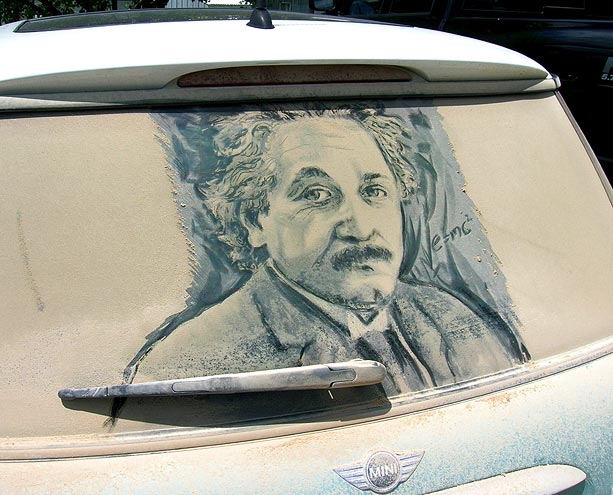
Nature, art, and life, keep pounding home the fact that the creationist argument is seriously in error.  But as Robert Frost wondered, how many times did the apple have to fall before Newton took the hint?  Scott Wade has taken the rebuttal to the creationists’ argument to new heights, and made art out of it.  From dust, is art:

Einstein, by Scott Wade

Credit Barcroft Media via The Daily Telegraph.

Click the thumbnail picture for a larger view:  Scott Wade creates Albert Einstein out of dust

Britain’s Daily Telegraph has a slide show with seven of Wade’s works.

Mr. Wade’s own website features a slide show demonstrating the creation of artworks, step by step.  Wade lives on a dirt road, a  half-mile from pavement.  In the course of coming and going, he gets a lot of material to work with.

If life gives you lemons, make lemonade.  If life gives you dust, make art.  If life gives you limes, make margaritas.

Tip of the old scrub brush to Science Notes.


What Lucy will see, leaving Houston . . .

June 22, 2008

What Lucy saw will see, leaving Houston . . .

[The exhibit on Lucy, our Australopithecus afarensis ancestor, has been extended at the Houston Museum of Natural Science, through September 1, 2008. Go. Go see the exhibit. Don’t put it off.]

Coming out of the display on Lucy at the Houston Museum of Natural Science, coming back down the staircase, this is the painting on the wall. In my imagination, this is what Lucy saw will see as they carried carry her, crated up, out of the building. In reality they probably took will carry her down a freight elevator.

This one’s for you, P.Z. — drop into the Houston museum next time you’re down there:

Whale and Squid mural at Houston MNH


School of Wow

June 7, 2008

A river of real learning, a rising tide of excellence.

Art from students at the school I’d like to attend many days:

Art on the beach, The Living Classroom

Wouldn’t you like to do what those students at the Community School of West Seattle do?

See also Andy Goldsworthy.


Renaissance shadow over contemporary art: Penultimate suppers

April 11, 2008

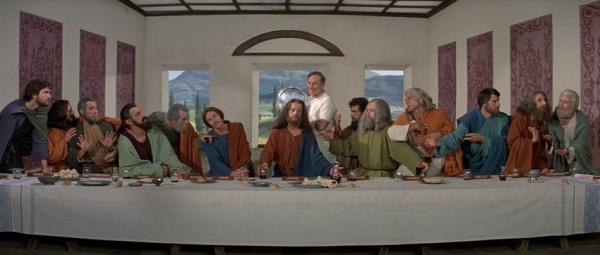
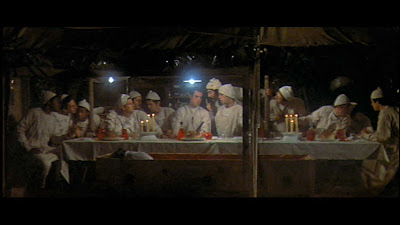
Jeremy Barker at Popped Culture assembled more than 30 versions of contemporary recastings of DaVinci’s painting of “The Last Supper.” There’s the Simpsons version, the cartoon version with Disney and Warner Bros. characters. There’s the Sopranos version, and the Battlestar Galactica version.

For example, the Robert Altman version, from M*A*S*H:

If you need a 20 minute lesson on the influence of Renaissance art on contemporary art, this is one many high school kids may find interesting, if not amazingly historically informative. I suspect there is a great lesson plan hiding in there about 20th century history as reflected in parody art.

It’s a brilliant and subtle demonstration of the power of DaVinci’s art that there are so many copy cat pictures, don’t you think?

I did notice, however, that Barker left out the Mel Brooks version, from “History of the World, Part I.” It may not fit the meme.

Mel Brooks'

Resources:


State of museums

March 12, 2008

Teachers: Run out to your local Starbucks, or newsstand if you’re luckier, and get today’s New York Times. Check out the special section on museums.

Science, arts and social studies teachers especially, go look. What local museums are you overlooking? Which museums should you plan a long-distance trip to see?

Duncanville ISD teachers sometimes require “field experience” for students, including visits to local museums. I doubt we’d have gotten our kids into the African American Museum otherwise; I think too few kids bother with the Frontiers of Flight Museum (or the C. R. Smith Museum closer to DFW Airport), and I know way too few bother with the Jack Harbin Museum of Scouting, a great shining gem obscured by its working class, Scout camp location and the proximity of the National Scouting Museum in Irving, Texas.

Our family plans to visit Lucy at the Houston Museum of Natural Science this weekend. I had a great time with Abe in Springfield last month, courtesy of the Bill of Rights Institute and the Liberty Fund (and I have not written about it, bad boy that I am).

The Times’s section makes me lust for Star Trek™-style transporters that take a whole classroom of kids, cheaply, to see the real stuff.  Be sure to check out the on-line videos and slide shows, too.


National Statuary Hall’s newest residents

January 19, 2008

Po'pay, statue in the Capitol, photo from Architect of the Capital

Pictured at left is the statue of Po’pay, one of two statues of heroes from the history of New Mexico featured in the National Statuary Hall, a collection in the U.S. Capitol. Po’pay’s statue was added to the collection in 2005, one of the two latest additions.

Po’pay was a leader of the revolt against oppressive Spanish rule over New Mexico’s native inhabitants between 1675 and 1681, a century before the American Revolution.

In 1997, the New Mexico Legislature selected Po’pay as the subject of the state’s second statue for the National Statuary Hall Collection and created the New Mexico Statuary Hall Commission, whose members were appointed by Governor Gary Johnson. Four sculptors were selected to create maquettes, and Cliff Fragua was awarded the commission in December 1999. It will be the seventh statue of a Native American in the collection; the others are King Kamehameha I, Will Rogers (who had Cherokee ancestors), Sakakawea, Sequoyah, Washakie, and Sarah Winnemucca.

The seven-foot-high statue was carved from pink Tennessee marble (making it the only colored marble statue in the collection) and stands on a three-foot-high pedestal comprised of a steel frame clad in black granite. It is the first marble statue contributed to the collection since that of South Dakota’s Joseph Ward, which was given in 1963; the other statues given since that time have been bronze. Its acceptance marked the first time at which every state in the Union has been represented by two statues in the collection. In addition, Po’pay is historically the first person represented in the collection to be born on what would become American soil.

No image or written description of Po’pay is known to exist. Sculptor Cliff Fragua describes the statue thus:

In my rendition, he holds in his hands items that will determine the future existence of the Pueblo people. The knotted cord in his left hand was used to determine when the Revolt would begin. As to how many knots were used is debatable, but I feel that it must have taken many days to plan and notify most of the Pueblos. The bear fetish in his right hand symbolizes the center of the Pueblo world, the Pueblo religion. The pot behind him symbolizes the Pueblo culture, and the deerskin he wears is a humble symbol of his status as a provider. The necklace that he wears is a constant reminder of where life began, and his clothing consists of a loin cloth and moccasins in Pueblo fashion. His hair is cut in Pueblo tradition and bound in a chongo. On his back are the scars that remain from the whipping he received for his participation and faith in the Pueblo ceremonies and religion.

Fragua, an Indian from Jemez Pueblo, studied sculpture in Italy, California, and New Mexico; he created his first stone sculpture in 1974.

The other 2005 addition to the collection was Sarah Winnemucca, heroine from Nevada (pictured below, right).

Sarah Winnemucca, in the National Statuary Hall, Architect of the Capitol photo

Sarah Winnemucca
[facsimile of her signature, “Sarah Winnemucca Hopkins”]
1844–1891
Nevada
Defender of Human rights
Educator
Author of first book by a Native woman

Each state may have two statues in the collection.

My work on the Senate staff often required that I walk the Capitol, especially between the Senate and House Press Galleries. I often lamented that it was not available or accessible to students.  This collection of statues is one of the better unsung galleries of history in Washington, D.C. It is heavily influenced by politics and current fashion. Selections illustrate how state legislatures try to make their state’s reputation, and can be very quirky. For example, Pennsylvania’s statues include Robert Fulton, an inventor of the steamboat, and John Peter Gabriel Muhlenberg — but not Ben Franklin or William Penn.  Why?  There could be a paper done on the politics of the choices of each of the 50 states.

Read the rest of this entry »


Banksy’s graffiti sells: $407,000

January 15, 2008

A few days ago, via Peoples Geography, I discovered the work of graffiti artist Banksy — rather behind the curve, judging from his history. I posted a particularly provocative work of his in this post within the past week.

Today CBS Evening News and other outlets report some enterprising building owner in London who recognized Banksy’s work, preserved it, and has auctioned it away on eBay. It fetched $407,000 US. (CBS video here)

Banksy art from a London wall

The work, depicting an artist in old-fashioned clothes putting the finishing touches on the word “BANKSY” spray-painted in red, was scrawled on a wall on the Portobello Road in the west London district of Notting Hill.

It was offered for sale on the e-Bay auction site and went for 208,100 pounds after attracting 69 bids.

The winner of the auction may well get the painting and the wall it is on, but they will have to calculate how to get the whole work delivered and pay to replace the wall.

“I am selling the wall because I can’t really justify owning a piece of art worth as much as it is,” said Luti Fagbenle, the owner of the property on which the graffiti is sprayed.

A political cartoon changed the life of one London building owner.


Political cartoons: Powerful if they hit the audience

January 13, 2008

Thomas Nast helped bring down the crooks at Tammany Hall with cartoons. Boss Tweed, the chief antagonist of Nast, crook and leader of the Tammany Gang, understood that Nast’s drawings could do him in better than just hard hitting reporting — the pictures were clear to people who couldn’t read.

But a cartoon has to get to an audience to have an effect.

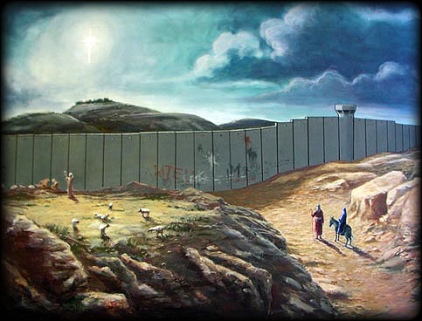
Here’s one below, a comment on the security wall being built in Israel, that got very little circulation in the west at Christmas time. Can you imagine the impact had this drawing run in newspapers in Europe, the U.S., and Canada?

It’s a mashup of a famous oil painting related to the Christian Nativity, from a London-based artist who goes by the name Banksy. (Warning: Banksy pulls no punches; views shown are quite strong, often very funny, always provocative, generally safe for work unless you work for an authoritarian like Dick Cheney who wants no counter opinions.)

banksy-israels-wall-77721975_fda236f91a.jpg

Tip of the old scrub brush to Peoples Geography.

Add to FacebookAdd to NewsvineAdd to DiggAdd to Del.icio.usAdd to StumbleuponAdd to RedditAdd to BlinklistAdd to TwitterAdd to TechnoratiAdd to Furl


On the night before Christmas: Untangling the history of a visit from St. Nick

December 24, 2007

Thomas Nast invented Santa Claus? Clement C. Moore didn’t write the famous poem that starts out, “‘Twas the night before Christmas, and all through the house . . . ?”

The murky waters of history from Millard Fillmore’s Bathtub soak even our most cherished ideas and traditions.

But isn’t that part of the fun of history?

  • Below: Thomas Nast’s first published drawing featuring Santa Claus; for Harper’s Weekly, “A Journal of Civilization,” January 3, 1863 Nast portrayed the elf distributing packages to Union troops: “Santa Claus in camp.” Nast (1840-1904) was 23 when he drew this image.

Santa Claus delivers to Union soldiers, "Santa Claus in Camp" - Thomas Nast, Harper's Weekly, Jan 3, 1863 Yes, Virginia (and California, too)! Thomas Nast created the image of Santa Claus most of us in the U.S. know today. Perhaps even more significant than his campaign against the graft of Boss Tweed, Nast’s popularization of a fat, jolly elf who delivers good things to people for Christmas makes one of the great stories in commercial illustration. Nast’s cartoons, mostly for the popular news publication Harper’s Weekly, created many of the conventions of modern political cartooning and modeled the way in which an illustrator could campaign for good, with his campaign against the graft of Tammany Hall and Tweed. But Nast’s popular vision of Santa Claus can be said to be the foundation for the modern mercantile flurry around Christmas.

Nast is probably ensconced in a cartoonists’ hall of fame. Perhaps he should be in a business or sales hall of fame, too.  [See also Bill Casselman’s page, “The Man Who Designed Santa Claus.]

Nast’s drawings probably drew some inspiration from the poem, “Account of a Visit from St. Nicholas,” traditionally attributed to Clement C. Moore, a New York City lawyer, published in 1822. The poem is among the earliest to describe the elf dressed in fur, and magically coming down a chimney to leave toys for children; the poem invented the reindeer-pulled sleigh.

Modern analysis suggests the poem was not the work of Moore, and many critics and historians now attribute it to Major Henry Livingston, Jr. (1748-1828) following sleuthing by Vassar College Prof. Don Foster in 2000. Fortunately for us, we do not need to be partisans in such a query to enjoy the poem (a complete copy of which is below the fold).

The Library of Congress still gives Moore the credit. When disputes arise over who wrote about the night before Christmas, is it any wonder more controversial topics produce bigger and louder disputes among historians?

Moore was not known for being a poet. The popular story is that he wrote it on the spur of the moment:

Moore is thought to have composed the tale, now popularly known as “The Night Before Christmas,” on December 24, 1822, while traveling home from Greenwich Village, where he had bought a turkey for his family’s Christmas dinner.

Inspired by the plump, bearded Dutchman who took him by sleigh on his errand through the snow-covered streets of New York City, Moore penned A Visit from St. Nicholas for the amusement of his six children, with whom he shared the poem that evening. His vision of St. Nicholas draws upon Dutch-American and Norwegian traditions of a magical, gift-giving figure who appears at Christmas time, as well as the German legend of a visitor who enters homes through chimneys.

Again from the Library of Congress, we get information that suggests that Moore was a minor celebrity from a well-known family with historical ties that would make a good “connections” exercise in a high school history class, perhaps (“the link from Aaron Burr’s treason to Santa Claus?”): (read more, below the fold)

Read the rest of this entry »


Human Liberty Bell: Tribute to photos of Mole & Thomas

December 12, 2007

Surely you’ve seen some of these photos; if you’re a photographer, you’ve marveled over the ability of the photographer to get all those people to their proper positions, and you’ve wondered at the sheer creative genius required to set the photos up.

Like this one, a depiction of the Liberty Bell — composed of 25,000 officers and men at Fort Dix, New Jersey. The photo was taken in 1918.

Mole & Thomas photo, Human Liberty Bell The Carl Hammer Gallery in Chicago featured an exhibit of these monumental photos in April and May, 2007:
The outbreak of World War I and its inherent violence engendered a new commitment by the world’s photographers to document every aspect of the fighting, ending an era of In A Patriotic Mole, A Living Photograph, Louis Kaplan, of Southern Illinois University, writes, “The so-called living photographs and living insignia of Arthur Mole [and John Thomas] are photo-literal attempts to recover the old image of national identity at the very moment when the United States entered the Great War in 1917.

Mole’s [and Thomas’s] photos assert, bolster, and recover the image of American national identity via photographic imaging. Moreover, these military formations serve as rallying points to support U.S. involvement in the war and to ward off any isolationist tendencies. In life during wartime, [their] patriotic images function as “nationalist propaganda” and instantiate photo cultural formations of citizenship for both the participants and the consumers of these group photographs.”

The monumentality of this project somewhat overshadows the philanthropic magnanimity of the artists themselves.Instead of prospering from the sale of the images produced, the artists donated the entire income derived to the families of the returning soldiers and to this country’s efforts to re-build their lives as a part of the re-entry process.

Eventually, other photographers, appeared on the scene, a bit later in time than the activity conducted by Mole and Thomas, but all were very clearly inspired by the creativity and monumentality of the duo’s production of the “Living” photograph.

One of the most notable of those artists was Eugene Omar Goldbeck. He specialized in the large scale group portrait and photographed important people (Albert Einstein), events, and scenes (Babe Ruth’s New York Yankees in his home town, San Antonio) both locally and around the world (Mt. McKinley). Among his military photographs, the Living Insignia projects are of particular significance as to how he is remembered.

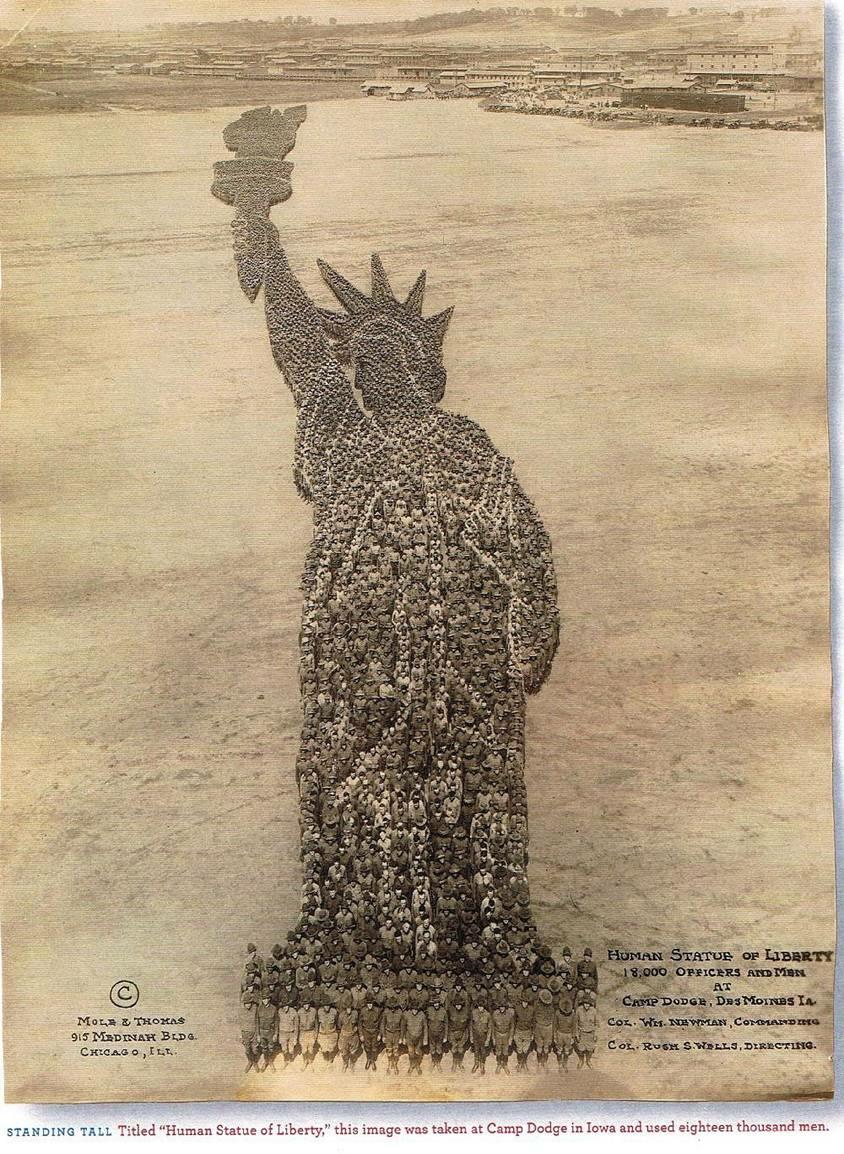
Using a camera as an artist’s tool, using a literal army as a palette, using a parade ground as a sort of canvas, these photographers made some very interesting pictures. The Human Statue of Liberty, with 18,000 men at Camp Dodge, Iowa?


statue-of-liberty-human-camp-dodge-from-snopes.jpg

Most of these pictures were taken prior to 1930. Veterans who posed as part of these photos would be between 80 and 100 years old now. Are there veterans in your town who posed for one of these photos?


Good photographic copies of some of these pictures are available from galleries. They are discussion starters, that’s for sure.

Some questions for discussion:

  1. Considering the years of the photos, do you think many of these men saw duty overseas in World War I.
  2. Look at the camps, and do an internet search for influenza outbreaks in that era. Were any of these camps focal points for influenza?
  3. Considering the toll influenza took on these men, about how many out of each photo would have survived the influenza, on average?
  4. Considering the time, assume these men were between the ages of 18 and 25. What was their fate after the Stock Market Crash of 1929? Where were they during World War II?
  5. Do a search: Do these camps still exist? Can you find their locations on a map, whether they exist or not?
  6. Why do the critics say these photos might have been used to build national unity, and to cement national identity and will in time of war?
  7. What is it about making these photos that would build patriotism? Are these photos patriotic now?

These quirky photos are true snapshots in time. They can be used for warm-ups/bell ringers, or to construct lesson plans around.

Tip of the old scrub brush to Gil Brassard, a native, patriotic and corporate historian hiding in Baton Rouge, Louisiana.