Mostly an encore post; some links added in quoted text, for ease of reference.
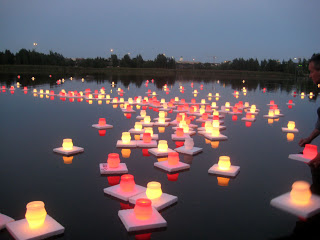
Hiroshima residents float lanterns in the river to remember the dead after a traditional Hiroshima Day concert (2008?); the concert and lantern floating are annual events
67 years ago, U.S. military action brought a quick close to hostilities without an invasion of Japan, with the detonation of two atomic bombs, one over Hiroshima on August 6, 1945, and one over Nagasaki on August 9.
Daily Yomiuri Online carried a description of memorial events in Hiroshima in 2008, from Yomiuri Shimbun:
NAGASAKI–The Nagasaki municipal government held a ceremony Saturday marking the 63rd anniversary of the atomic bombing of the city, at which participants called for the abolition of all nuclear weapons.
A total of 5,650 A-bomb survivors, representatives of victims’ families from around the nation and Nagasaki citizens participated in the ceremony. Prime Minister Yasuo Fukuda also attended the ceremony, which was held in Nagasaki Peace Park near ground zero.
Nagasaki Mayor Tomihisa Taue read out the Nagasaki Peace Declaration, which urges the worldwide abolition of nuclear weapons.
“Human beings have no future unless nuclear weapons are eliminated. We shall clearly say no to nuclear weapons,” Taue said.
The ceremony started at 10:40 a.m. Three books listing the names of 3,058 people confirmed to have died as a result of the bombing in the past year were placed inside a memorial box in front of the Peace Statue.
The total number of books listing the names of the deceased is 147, and the number of names is 145,984.
Representatives of surviving victims, bereaved families, the prime minister and Hiroshima Mayor Tadatoshi Akiba placed flowers at the site.
At 11:02 a.m., the time the atomic bomb struck, ceremony participants offered a silent prayer. At the same time, local high school students rang the Bells of Nagasaki.
In the peace declaration, Taue read from an academic paper written by four people, including a former U.S. secretary of state, which promoted a new policy for developing nuclear weapons. The proposal encouraged countries to ratify the Comprehensive Test Ban Treaty. The mayor said world nuclear powers “should sincerely fulfill their responsibility of nuclear disarmament,” and urged the government to pass the three nonnuclear principles into law.
This year also marks the 100th anniversary of the birth of Takashi Nagai, a medical doctor who helped rescue of victims after the bombing.
The mayor referenced one of the doctor’s remarks, saying: “There are no winners or losers in a war. There is only destruction.”
Shigeko Mori, 72, representing survivors of the bombing, read out an oath for peace that said Japan should promote its Constitution and the three nonnuclear principles to the rest of the world to prevent nuclear proliferation.
Fukuda gave a speech, saying, “Japan should play a responsible role in the international community as a nation cooperating for peace.”
Calgary Herald, Canadian former POW remembers Nagasaki bomb and aftermath;
Still, Ford said, if Nagasaki had not not been bombed, he likely would not have survived much longer. His citation called him a “man who recognizes the incongruity of having welcomed the Nagasaki bomb while condemning nuclear warfare.”
It said that “paradox reflects our collective failure to understand warfare, which has, like Job’s torment, an illogic that is purposefully inexplicable.”
Remembering that U.S. involvement in World War II as a combatant came after the Japanese sneak attack on Pearl Harbor on December 7, 1941, one may respect and appreciate the Japanese national desire to commemorate the brutal end of the war with conversations about peace and how to achieve it. The film below is a short, touching introduction to the Hiroshima Peace Museum website:
Rare color photograph of the first nuclear test at Trinity site, July 16, 1945. Blurriness is in the original photograph (done when color photography was still fairly new). (Photo credit: Wikipedia)
Spread the word; friends don't allow friends to repeat history.
Einstein’s famous formula. “E” is energy. “m” is mass of the particle or particles; “c” is the speed of light, or a fantastically large number. Energy equals the mass multiplied by the speed of light squared. Accidentally very accurate, the equation notes the idea that matter and energy are the same thing, and can be converted one to the other. (Image from PBS)
Happy Einstein Day (a day late)! Almost fitting that he was born on π Day, no? I mean, is there an E=mc² Day?
Albert Einstein was born on March 14, 1879, in Ulm, Germany, to Hermann and Pauline Einstein. 26 years later, three days after his birthday, he sent off the paper on the photo-electric effect; that paper would win him the Nobel Prize in Physics in another five years, in 1921. In that same year of 1905, he published three other papers, solving the mystery of Brownian motion, describing what became known as the Special Theory of Relativity and solving the mystery of why measurements of the light did not show any effects of motion as Maxwell had predicted, and a final paper that noted a particle emitting light energy loses mass. This final paper amused Einstein because it seemed so ludicrous in its logical extension that energy and matter are really the same stuff at some fundamental point, as expressed in the equation demonstrating an enormous amount of energy stored in atoms, E=mc².
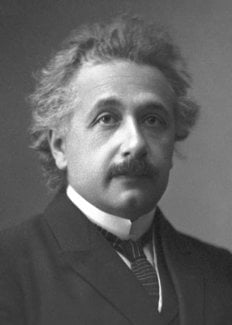
Einstein in 1921, the year he was awarded the Nobel Prize in Physics for the photoelectric effect.
Any one of the papers would have been a career-capper for any physicist. Einstein dashed them off in just a few months, forever changing the field of physics. And, you noticed: Einstein did not win a Nobel for the Special Theory of Relativity, nor for E=mc². He won it for the photo electric effect. Irony in history.
106 years later Einstein’s work affects us every day. Relativity theory at some level I don’t understand makes possible the use Global Positioning Systems (GPS), which revolutionized navigation and mundane things like land surveying and microwave dish placement. Development of nuclear power both gives us hope for an energy-rich future, and gives us fear of nuclear war. Sometimes, even the hope of the energy rich future gives us fear, as we watch and hope nuclear engineers can control the piles in nuclear power plants damaged by earthquakes and tsunami in Japan.
If Albert Einstein was a genius at physics, he was more dedicated to pacifism. He resigned his German citizenship to avoid military conscription. His pacifism made the German Nazis nervous; Einstein fled Germany in the 1930s, eventually settling in the United States. In the U.S., he was persuaded by Leo Szilard to write to President Franklin Roosevelt to suggest the U.S. start a program to develop an atomic weapon, because Germany most certainly was doing exactly that. But Einstein refused to participate in the program himself, sticking to his pacifist views. Others could, and would, design and build atomic bombs. (Maybe it’s a virus among nuclear physicists — several of those working on the Manhattan Project were pacifists, and had great difficulty reconciling the idea that the weapon they worked on to beat Germany, was deployed on Japan, which did not have a nuclear weapons program.)
Einstein was a not-great father, and probably not a terribly faithful husband at first — though he did think to give his first wife a share of a Nobel Prize should he win it in the divorce settlement. Einstein was a good violinist, a competent sailor, an incompetent dresser, and a great character. His sister suffered a paralyzing stroke. For many months Albert spent hours a day reading to her the newspapers and books of the day, convinced that mute and appearing unconscious, she would benefit from hearing the words. He said he did not hold to orthodox religions, but could there be a greater show of faith in human spirit?
Einstein in 1950, five years before his death.
When people hear clever sayings, but forget to whom the bon mots should be attributed, Einstein is one of about five candidates to whom all sorts of things are attributed, though he never said them. (Others include Lincoln, Jefferson, Mark Twain and Will Rogers). Einstein is the only scientist in that group. So, for example, we can be quite sure Einstein never claimed that compound interest was the best idea of the 20th century. This phenomenon is symbolic of the high regard people have for the man, even though so few understand what his work was, or meant.
A most interesting man. A most important body of work. He deserves more study and regard than he gets.
A memorial service was held at the Nagasaki Peace Park on Aug. 9, 2011, the 66th anniversary of the atomic bomb being dropped on the city at the tail end of World War II. The ceremony was attended by dignitaries from 44 countries – including an envoy from the United States – to honor the more than 155,000 people who were claimed by the bomb, including the 80,000 killed instantly.
The service came three days after one similar in Hiroshima, and marked the first time in history that an envoy from the United States attended both services.
In the wake of the March 11 disaster, Japanese officials called for the abolition of nuclear weapons and also for renewable sources of energy to replace nuclear power.
Nuclear anniversaries have been ignored this year, it seems to me.
Ceremony in Nagasaki marked the remembrance of the victims of the second atomic weapon used in war, which was detonated over Nagasaki on August 9, 1945. Agence France Press reported (in 2009):
Nagasaki’s mayor, marking the 64th anniversary [66th in 2011] of his city’s atomic bombing by the United States, called on Sunday on the leaders of nuclear-armed powers to visit the site and build a nuclear-free world.
Hiroshima and Nagasaki, map by CNN
Tomihisa Tanoue urged world leaders from both declared nuclear powers and others such as Iran, Israel and North Korea to visit the city in southwestern Japan.
“I am sure anyone who visits here would feel the sorrow of the victims and be shaken by it,” the mayor said in an address at an annual ceremony commemorating the 1945 bombing.
A minute of silence was observed at 11:02 am (0202 GMT), when the US bomb exploded above the city, killing roughly 74,000 people. The bombing followed one a week before in Hiroshima and hastened Japan’s surrender in World War II.
Tanoue said an April speech by US President Barack Obama in Prague, where Obama pledged to build a world with no nuclear weapons, “impressed” the residents of Nagasaki.
“The Japanese government must support the Prague speech. As a nation that has come under nuclear attack, Japan must lead the international community” in abolishing the weapons, he said.
Similar appeals were made Thursday when Hiroshima marked the anniversary of its bombing, which killed 140,000 people.
At the Nagasaki ceremony, Prime Minister Taro Aso reiterated the Japanese government’s anti-nuclear stance, three weeks ahead of national elections that he is tipped to lose.
Aso raised eyebrows at the Hiroshima ceremony, when he pledged to work toward abolishing nuclear weapons but later told reporters that he thought it was “unimaginable” to attain a nuclear-free world.
Similar ceremonies, and similar pleas for nuclear non-proliferation marked the August 6 anniversary of the atomic bomb drop on Hiroshima. The Chinese news agency Xinhua reported:
Some 50,000 people gathered Thursday at the peace park in Hiroshima to mourn the 64th anniversary of the atomic bombing of the city by U.S. forces during the World War II.
Hiroshima Mayor Tadatoshi Akiba delivered a peace declaration, calling for the abolition of nuclear weapons by 2020.
“The hibakusha still suffer a hell that continues,” said Akiba.
“The Japanese government should support hibakusha, including those who were victims of black rain and those who live overseas,” he said.
"Japanese Prime Minister Taro Aso delivers a speech in front of the Memorial Cenotaph during the Hiroshima Peace Memorial Ceremony in Hiroshima, western Japan on Aug. 6, 2009. Hiroshima on Thursday mourned the 64th anniversary of the atomic bombing of the city by U.S. forces during the World War II. (Xinhua/Ren Zhenglai)"
It was reported Wednesday that the Japanese government aims to come to an agreement with all atomic bomb survivors who have sued the government for financial support to help them pay medical bills for illnesses related to the bombings of Hiroshima and Nagasaki.
Akiba also said “The year 2020 is important as we want to enter a world without nuclear weapons with as many hibakusha as possible. We call on the world to join forces with us to eliminate all nuclear weapons by 2020.”
Referring to the movements such as the environmentalists, Akibasaid, “Global democracy that respects the will of the world and respects the power of the people has begun to grow.”
“We have the power. We have the responsibility. We are the Obamajority. And we can abolish nuclear weapons. Yes we can,” said the mayor.
On Wednesday, Akiba urged the people around the world to join the city’s efforts to abolish nuclear weapons in response to U.S. President Barack Obama’ s appeal for a world free of nuclear weapons.
During the 50-minute memorial ceremony, a moment of silence was observed at 8:15 a.m., the time the atomic bomb detonated over Hiroshima 64 years ago, killing nearly 100,000 people in a blink.
This in a week when two burgeoning new nuclear powers, Iran and North Korea, continue to claim they will flout non-proliferation agreements for their own self defense. [Still true in 2011, alas.]
The question obtains on nuclear issues as well as genocides: When does “never again” start?
Other related posts at Millard Fillmore’s Bathtub:
Hiroshima residents float lanterns in the river to remember the dead after a traditional Hiroshima Day concert, 2008; the concert and lantern floating are annual events
66 years ago, U.S. military action brought a quick close to hostilities without an invasion of Japan, with the detonation of two atomic bombs, one over Hiroshima on August 6, 1945, and one over Nagasaki on August 9.
Daily Yomiuri Online carried a description of memorial events in Hiroshima in 2008, from Yomiuri Shimbun:
NAGASAKI–The Nagasaki municipal government held a ceremony Saturday marking the 63rd anniversary of the atomic bombing of the city, at which participants called for the abolition of all nuclear weapons.
A total of 5,650 A-bomb survivors, representatives of victims’ families from around the nation and Nagasaki citizens participated in the ceremony. Prime Minister Yasuo Fukuda also attended the ceremony, which was held in Nagasaki Peace Park near ground zero.
Nagasaki Mayor Tomihisa Taue read out the Nagasaki Peace Declaration, which urges the worldwide abolition of nuclear weapons.
“Human beings have no future unless nuclear weapons are eliminated. We shall clearly say no to nuclear weapons,” Taue said.
The ceremony started at 10:40 a.m. Three books listing the names of 3,058 people confirmed to have died as a result of the bombing in the past year were placed inside a memorial box in front of the Peace Statue.
The total number of books listing the names of the deceased is 147, and the number of names is 145,984.
Representatives of surviving victims, bereaved families, the prime minister and Hiroshima Mayor Tadatoshi Akiba placed flowers at the site.
At 11:02 a.m., the time the atomic bomb struck, ceremony participants offered a silent prayer. At the same time, local high school students rang the Bells of Nagasaki.
In the peace declaration, Taue read from an academic paper written by four people, including a former U.S. secretary of state, which promoted a new policy for developing nuclear weapons. The proposal encouraged countries to ratify the Comprehensive Test Ban Treaty. The mayor said world nuclear powers “should sincerely fulfill their responsibility of nuclear disarmament,” and urged the government to pass the three nonnuclear principles into law.
This year also marks the 100th anniversary of the birth of Takashi Nagai, a medical doctor who helped rescue of victims after the bombing.
The mayor referenced one of the doctor’s remarks, saying: “There are no winners or losers in a war. There is only destruction.”
Shigeko Mori, 72, representing survivors of the bombing, read out an oath for peace that said Japan should promote its Constitution and the three nonnuclear principles to the rest of the world to prevent nuclear proliferation.
Fukuda gave a speech, saying, “Japan should play a responsible role in the international community as a nation cooperating for peace.”
Calgary Herald, Canadian former POW remembers Nagasaki bomb and aftermath;
Still, Ford said, if Nagasaki had not not been bombed, he likely would not have survived much longer. His citation called him a “man who recognizes the incongruity of having welcomed the Nagasaki bomb while condemning nuclear warfare.”
It said that “paradox reflects our collective failure to understand warfare, which has, like Job’s torment, an illogic that is purposefully inexplicable.”
Remembering that U.S. involvement in World War II as a combatant came after the Japanese sneak attack on Pearl Harbor on December 7, 1941, one may respect and appreciate the Japanese national desire to commemorate the brutal end of the war with conversations about peace and how to achieve it. The film below is a short, touching introduction to the Hiroshima Peace Museum website:
Spread the word; friends don't allow friends to repeat history.
Happy Einstein Day! Almost fitting that he was born on π Day, no? I mean, is there an E=mc² Day?
Albert Einstein was born on March 14, 1879, in Ulm, Germany, to Hermann and Pauline Einstein. 26 years later, three days after his birthday, he sent off the paper on the photo-electric effect, the paper that would win him the Nobel Prize in Physics five years later, in 1921. In that same year of 1905, he published three other papers, solving the mystery of Brownian motion, describing what became known as the Special Theory of Relativity and solving the mystery of why measurements of the light did not show any effects of motion as Maxwell had predicted, and a final paper that noted a particle emitting light energy loses mass. This final paper amused Einstein because it seemed so ludicrous in its logical extension that energy and matter are really the same stuff at some fundamental point, as expressed in the equation demonstrating an enormous amount of energy stored in atoms, E=mc².
Albert Einstein as a younger man - Nobel Foundation image
Any one of the papers would have been a career-capper for any physicist. Einstein dashed them off in just a few months, forever changing the field of physics. And, you noticed: Einstein did not win a Nobel for the Special Theory of Relativity, nor for E=mc². He won it for the photo electric effect. Irony in history.
106 years later Einstein’s work affects us every day. Relativity theory at some level I don’t understand makes possible the use Global Positioning Systems (GPS), which revolutionized navigation and mundane things like land surveying and microwave dish placement. Development of nuclear power both gives us hope for an energy-rich future, and gives us fear of nuclear war. Sometimes, even the hope of the energy rich future gives us fear, as we watch and hope nuclear engineers can control the piles in nuclear power plants damaged by earthquakes and tsunami in Japan.
If Albert Einstein was a genius at physics, he was more dedicated to pacifism. He resigned his German citizenship to avoid military conscription. His pacifism made the German Nazis nervous; Einstein fled Germany in the 1930s, eventually settling in the United States. In the U.S., he was persuaded by Leo Szilard to write to President Franklin Roosevelt to suggest the U.S. start a program to develop an atomic weapon, because Germany most certainly was doing exactly that. But Einstein refused to participate in the program himself, sticking to his pacifist views. Others could, and would, design and build atomic bombs. (Maybe it’s a virus among nuclear physicists — several of those working on the Manhattan Project were pacifists, and had great difficulty reconciling the idea that the weapon they worked on to beat Germany, was deployed on Japan, which did not have a nuclear weapons program.)
Einstein was a not-great father, and probably not a terribly faithful husband at first — though he did think to give his first wife a share of a Nobel Prize should he win it in the divorce settlement. Einstein was a good violinist, a competent sailor, an incompetent dresser, and a great character. His sister suffered a paralyzing stroke. For many months Albert spent hours a day reading to her the newspapers and books of the day, convinced that mute and appearing unconscious, she would benefit from hearing the words. He said he did not hold to orthodox religions, but could there be a greater show of faith in human spirit?
Einstein in 1950, five years before his death
When people hear clever sayings, but forget to whom the bon mots should be attributed, Einstein is one of about five candidates to whom all sorts of things are attributed, though he never said them. (Others include Lincoln, Jefferson, Mark Twain and Will Rogers). Einstein is the only scientist in that group. So, for example, we can be quite sure Einstein never claimed that compound interest was the best idea of the 20th century. This phenomenon is symbolic of the high regard people have for the man, even though so few understand what his work was, or meant.
A most interesting man. A most important body of work. He deserves more study and regard than he gets.
Wish I knew who created this poster, and how. Some minor inaccuracies — can you find them? Could you prevail on the Big Format Printer person at your school to print one of these full size for your U.S. history, world history or government class?
Nuclear Weapons, a poster
How about a similar poster for the Cold War? Vietnam War? Civil Rights Movement? Gilded Age?
Old friend and thorn in the side Gil Brassard in Baton Rouge alerted us to this wonderful marriage of modern technology and history from David Palermo Photography — an interactive, panoramic view of the cockpit of the Enola Gay, the B-29 from which the first atomic bomb used in war was dropped.
How can you use this in class, teachers? Got a lesson plan that puts a student in the seat of the pilot?
For technical reasons beyond my ken, one may not make this a full screen image. No problem. Go to David Palermo’s site, and see this as big as your computer monitor. I recommend viewing it there — it’s better, really.
Palermo has a portfolio of cockpits he’s shot at the Smithsonian, including the French Concorde, Gemini VII, a Bell Huey helicopter, Mercury Friendship VII, and a Lockheed Martin X-35 — with spherical panoramas available of those and more (look for the link that says “HD360°” and look at the drop-down menu). He sells massive prints of the cockpits — something special for aviation and space buffs.
Spread the word; friends don't allow friends to repeat history.
When we speak of Ground Zero as hallowed ground, what we mean is that it belongs to those who suffered and died there — and that such ownership obliges us, the living, to preserve the dignity and memory of the place, never allowing it to be forgotten, trivialized or misappropriated.
That’s why Disney’s 1993 proposal to build an American history theme park near Manassas Battlefield was defeated by a broad coalition that feared vulgarization of the Civil War (and that was wiser than me; at the time I obtusely saw little harm in the venture). It’s why the commercial viewing tower built right on the border of Gettysburg was taken down by the Park Service. It’s why, while no one objects to Japanese cultural centers, the idea of putting one up at Pearl Harbor would be offensive.
We noted on another thread that there is, in fact, a Japanese Cultural Center at Pearl Harbor. Hanley wonders how the Japanese deal with reminders of the being the victims of the first atomic bomb used in warfare — a topic upon which the Japanese are understandably extremely sensitive.
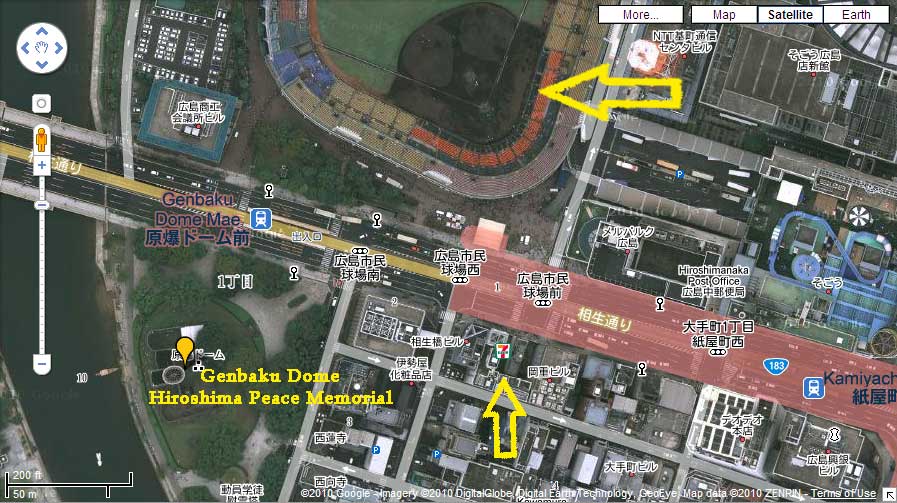
Baseball and 7-Eleven, symbols of American cultural imperialism at the site of the world’s first nuclear assault. McDonald’s, by contrast, maintains a discreet 2000′ distance across the river.
This campaign against a Moslem cultural center in lower Manhattan is the prototypical example of where the “Ugly American” myth gets its roots. Hanley’s analysis is incredibly simple, no?
Spread the word; friends don't allow friends to repeat history.
Nuclear anniversaries have been ignored this year, it seems to me.
Ceremony in Nagasaki marked the remembrance of the victims of the second atomic weapon used in war, which was detonated over Nagasaki on August 9, 1945. Agence France Press reports:
Nagasaki’s mayor, marking the 64th anniversary of his city’s atomic bombing by the United States, called on Sunday on the leaders of nuclear-armed powers to visit the site and build a nuclear-free world.
Hiroshima and Nagasaki, map by CNN
Tomihisa Tanoue urged world leaders from both declared nuclear powers and others such as Iran, Israel and North Korea to visit the city in southwestern Japan.
“I am sure anyone who visits here would feel the sorrow of the victims and be shaken by it,” the mayor said in an address at an annual ceremony commemorating the 1945 bombing.
A minute of silence was observed at 11:02 am (0202 GMT), when the US bomb exploded above the city, killing roughly 74,000 people. The bombing followed one a week before in Hiroshima and hastened Japan’s surrender in World War II.
Tanoue said an April speech by US President Barack Obama in Prague, where Obama pledged to build a world with no nuclear weapons, “impressed” the residents of Nagasaki.
“The Japanese government must support the Prague speech. As a nation that has come under nuclear attack, Japan must lead the international community” in abolishing the weapons, he said.
Similar appeals were made Thursday when Hiroshima marked the anniversary of its bombing, which killed 140,000 people.
At the Nagasaki ceremony, Prime Minister Taro Aso reiterated the Japanese government’s anti-nuclear stance, three weeks ahead of national elections that he is tipped to lose.
Aso raised eyebrows at the Hiroshima ceremony, when he pledged to work toward abolishing nuclear weapons but later told reporters that he thought it was “unimaginable” to attain a nuclear-free world.
Similar ceremonies, and similar pleas for nuclear non-proliferation marked the August 6 anniversary of the atomic bomb drop on Hiroshima. The Chinese news agency Xinhua reported:
Some 50,000 people gathered Thursday at the peace park in Hiroshima to mourn the 64th anniversary of the atomic bombing of the city by U.S. forces during the World War II.
Hiroshima Mayor Tadatoshi Akiba delivered a peace declaration, calling for the abolition of nuclear weapons by 2020.
“The hibakusha still suffer a hell that continues,” said Akiba.
“The Japanese government should support hibakusha, including those who were victims of black rain and those who live overseas,” he said.
"Japanese Prime Minister Taro Aso delivers a speech in front of the Memorial Cenotaph during the Hiroshima Peace Memorial Ceremony in Hiroshima, western Japan on Aug. 6, 2009. Hiroshima on Thursday mourned the 64th anniversary of the atomic bombing of the city by U.S. forces during the World War II. (Xinhua/Ren Zhenglai)"
It was reported Wednesday that the Japanese government aims to come to an agreement with all atomic bomb survivors who have sued the government for financial support to help them pay medical bills for illnesses related to the bombings of Hiroshima and Nagasaki.
Akiba also said “The year 2020 is important as we want to enter a world without nuclear weapons with as many hibakusha as possible. We call on the world to join forces with us to eliminate all nuclear weapons by 2020.”
Referring to the movements such as the environmentalists, Akibasaid, “Global democracy that respects the will of the world and respects the power of the people has begun to grow.”
“We have the power. We have the responsibility. We are the Obamajority. And we can abolish nuclear weapons. Yes we can,” said the mayor.
On Wednesday, Akiba urged the people around the world to join the city’s efforts to abolish nuclear weapons in response to U.S. President Barack Obama’ s appeal for a world free of nuclear weapons.
During the 50-minute memorial ceremony, a moment of silence was observed at 8:15 a.m., the time the atomic bomb detonated over Hiroshima 64 years ago, killing nearly 100,000 people in a blink.
This in a week when two burgeoning new nuclear powers, Iran and North Korea, continue to claim they will flout non-proliferation agreements for their own self defense.
The question obtains on nuclear issues as well as genocides: When does “never again” start?
Other related posts at Millard Fillmore’s Bathtub:
[This is an Encore Post, from August 2007 — just as it appeared then. See especially the links on textbook selection processes, and “cargo cult” science, at the bottom.]
NOVA had a couple of good programs on Richard Feynman that I wish I had — it had never occurred to me to look at YouTube to see what people might have uploaded.
By then, of course, Feynman was one of my heroes. His stories are useful in dozens of situations — his story of joining the samba bands in Rio testify to the joy of living, and the need for doing new things. Brazil was also the place he confronted the dangers of rote learning, when students could work equations perfectly for examples in the book — which they had memorized — but they couldn’t understand real world applications, such as describing how the sunlight coming off the ocean at Ipanema was so beautiful.
Feynman wrote about creationism, and about the dangers of voodoo science, in his now-famous essay on “Cargo cult science” — it’s so famous one has difficulty tracking down the facts to confirm the story.
Feynman’s stories of his wife, and her illness, and his love for her, were also great inspirations. Romance always gets me.
I failed to track him closely enough. During the run of the President’s Commission on Americans Outdoors, we had the misfortune of having scheduled a hearing in Orlando on January 30 (or maybe 29), 1986. We had hoped that the coincidental launch of the Space Shuttle Challenger on January 28 might boost our press response. Of course, the Challenger exploded. Our hearing went on as planned (we had a tough schedule to meet). The disaster affected our staff a lot, those who were in Florida, and the rest of us in Washington where many of us had been on the phone to Florida when the disaster occurred.
Feynman’s appointment to the commission studying the disaster was a brilliant move, I thought. Our schedule, unfortunately, kept me tied up on almost every day the Challenger commission met. So I never did walk the three blocks down the street to meet Feynman, thinking there would be other opportunities. He was already fatally ill. He died on February 15, 1988. I missed a chance of a lifetime.
We still have Feynman’s writings. We read the book aloud to our kids when they were younger. James, our youngest and a senior this year, read Surely You’re Joking again this summer, sort of a warmup to AP physics and his search for a college. [2009 Update: James is studying physics in the wilds of Wisconsin, finals week at Lawrence University next week — study hard, and good luck, James!]
BBC made portions of The Pleasure of Finding Things Out available for free online. These interviews include a short video of his explaining how a scientist can perceive the beauty of a flower at many different levels, beyond the artist’s view — a testament to science as a way of knowing AND appreciating life.
Today is the 63rd anniversary of “Victory Japan” Day, or VJ Day. On that day Japan announced it would surrender unconditionally.
President Harry Truman warned Japan to surrender, unconditionally, from the Potsdam Conference, in July. Truman warned that the U.S. had a new, horrible weapon. Japan did not accept the invitation to surrender. The announced surrender came nine days after the U.S. dropped an atomic bomb on Hiroshima, and six days after a second bomb was dropped on Nagasaki. The actual surrender occurred on September 2, 1945, aboard the battleship U.S.S. Missouri, anchored in Tokyo Harbor.
Celebrations broke out around the world, wherever U.S. military people were, and especially across the U.S., which had been hunkered down in fighting mode for the previous four years, since the attack on Pearl Harbor by the Japanese on December 7, 1941.
63 years ago, U.S. military action brought a quick close to hostilities without an invasion of Japan, with the detonation of two atomic bombs, one over Hiroshima on August 6, 1945, and one over Nagasaki on August 9.
Daily Yomiuri Online carried a description of memorial events in Hiroshima today, from Yomiuri Shimbun:
NAGASAKI–The Nagasaki municipal government held a ceremony Saturday marking the 63rd anniversary of the atomic bombing of the city, at which participants called for the abolition of all nuclear weapons.
A total of 5,650 A-bomb survivors, representatives of victims’ families from around the nation and Nagasaki citizens participated in the ceremony. Prime Minister Yasuo Fukuda also attended the ceremony, which was held in Nagasaki Peace Park near ground zero.
Nagasaki Mayor Tomihisa Taue read out the Nagasaki Peace Declaration, which urges the worldwide abolition of nuclear weapons.
“Human beings have no future unless nuclear weapons are eliminated. We shall clearly say no to nuclear weapons,” Taue said.
The ceremony started at 10:40 a.m. Three books listing the names of 3,058 people confirmed to have died as a result of the bombing in the past year were placed inside a memorial box in front of the Peace Statue.
The total number of books listing the names of the deceased is 147, and the number of names is 145,984.
Representatives of surviving victims, bereaved families, the prime minister and Hiroshima Mayor Tadatoshi Akiba placed flowers at the site.
At 11:02 a.m., the time the atomic bomb struck, ceremony participants offered a silent prayer. At the same time, local high school students rang the Bells of Nagasaki.
In the peace declaration, Taue read from an academic paper written by four people, including a former U.S. secretary of state, which promoted a new policy for developing nuclear weapons. The proposal encouraged countries to ratify the Comprehensive Test Ban Treaty. The mayor said world nuclear powers “should sincerely fulfill their responsibility of nuclear disarmament,” and urged the government to pass the three nonnuclear principles into law.
This year also marks the 100th anniversary of the birth of Takashi Nagai, a medical doctor who helped rescue of victims after the bombing.
The mayor referenced one of the doctor’s remarks, saying: “There are no winners or losers in a war. There is only destruction.”
Shigeko Mori, 72, representing survivors of the bombing, read out an oath for peace that said Japan should promote its Constitution and the three nonnuclear principles to the rest of the world to prevent nuclear proliferation.
Fukuda gave a speech, saying, “Japan should play a responsible role in the international community as a nation cooperating for peace.”
Calgary Herald, Canadian former POW remembers Nagasaki bomb and aftermath;
Still, Ford said, if Nagasaki had not not been bombed, he likely would not have survived much longer. His citation called him a “man who recognizes the incongruity of having welcomed the Nagasaki bomb while condemning nuclear warfare.”
It said that “paradox reflects our collective failure to understand warfare, which has, like Job’s torment, an illogic that is purposefully inexplicable.”
President Lyndon B. Johnson looks on as U.S. Secretary of State Dean Rusk prepares to join foreign ministers from more than 50 other nations in signing the Nuclear Nonproliferation Treaty, July 1, 1968. Photo from the LBJ Presidential Library, Austin, Texas, via the Nuclear Archive.
Another missed anniversary — but a found archive of original documents on a key issue of our time which has flared up into worldwide controversy in the past year: On July 1, 1968, nations that had nuclear weapons and nations capable of making such weapons — more than 50 nations total — joined in the Nuclear Nonproliferation Treaty (NPT) designed to discourage anyone else from getting “the bomb.” In the past 40 years, few other arms treaties, or any treaties, have worked so well, reducing by two-thirds the potential growth of “the Nuclear Club.”
Signed into law on July 1, 1968, the historic Nuclear Nonproliferation Treaty (NPT) was a major step towards creating a world that had the potential to be a bit safer from the threat of nuclear annihilation. This particular collection of documents related to the NPT was brought together through the diligence of staff members at the Archive’s Nuclear Documentation Project and released to the public in July 2008. The site starts off with a narrative essay which describes the backdrop to the signing of the NPT in 1968, along with offering a bit of additional context about the international political climate at the time. The site’s real gems are the 34 documents which include State Department cables, internal planning documents, and other items that reveal the nature of the political machinations involved with this process. [KMG]
Nuclear Archive does a good job itself — eminently readable, suitable for high school and maybe junior high:
Near the end of the protracted negotiations that produced the historic Nuclear Nonproliferation Treaty (NPT) 40 years ago, U.S. government officials warned that countries could legally reach “nuclear pregnancy” under the Treaty and then withdraw and quickly acquire nukes, according to declassified U.S. government documents published on the Web today by the National Security Archive (www.nsarchive.org).
The documents detail the well-known resistance to the NPT from countries like India (“China at her back, and Pakistan lurking on the sidelines”) but also from more unusual objectors such as Australia (concerned that the Western Pacific security situation might worsen) and Italy (unhappy about the “second-class status” of non-nuclear states). The documents suggest that the current crisis in the NPT system has deep historical roots, but also that current headlines overlook the long-term achievements of the NPT regime.
During the mid-1960s, prior to the NPT, U.S. intelligence had warned that as many as 15 countries had incentives to become nuclear weapons states but after the Treaty was signed, only five additional countries have developed such weapons (Israel, India, Pakistan, South Africa, and North Korea, while South Africa has renounced them). How much of an impact the Treaty had on keeping the numbers low can be debated, but the non-nuclear standard that it set remains a central goal of the world community to this date.
This is a fantastic source for student projects, for reports, for teachers putting together presentations, for students to read on the Cold War, on 1968, on nuclear weapons, on the Johnson administration, on foreign affairs and how treaties work and are negotiated.
Truly the lazy days of summer — I missed the anniversary of the Trinity Project, the first atomic bomb ever exploded, at White Sands, New Mexico, early on the morning of July 16, 1945. That was 63 years ago.
The Trinity atomic bomb test, culmination of the Manhattan Project, July 16, 1945
The Potsdam Conference, July 1945 – Churchill, Stalin, and Truman at the table – Photo from the Truman
Truman hoped to avoid a land invasion of Japan, which experts said would leave at least a million dead U.S. soldiers and five million dead Japanese. Truman was a soldier in World War I, who saw the trenches close up. He hoped to avoid anything similar for soldiers, and civilians. From Potsdam, Truman, Churchill and Stalin issued the Potsdam Declaration, ending with an ultimatum to Japan to surrender unconditionally or face terrible consequences.
Japan did not surrender. On August 6, 1945, the U.S. detonated the first atomic bomb used in warfare over Hiroshima, Japan, a city with large military support facilities. Within a few minutes, nearly 100,000 people were dead. When Japan failed to offer unconditional surrender even then, a second atomic device was detonated over Nagasaki, Japan, on August 9. (Had Japan not surrendered then a scramble would have been on — the U.S. had materials for about four more bombs, but they were not ready to go.)
1945 launched the world into the Atomic Age, by many accounts. The existence of atomic weaponry added to tensions on the planet played out during the Cold War. The creation of thermonuclear weapons, many times as powerful as a simple atomic bomb, only added to the tension. Perhaps we should call it the Atomic Angst Age.
Does that explain the fascination with photos of atomic blasts in recent days?
Then this post, from a blog named Picdit — “8 Insane Nuclear Explosions” rode the top of the popularity index of WordPress for the past couple of days. I’m not sure why these photos or the events they portray deserve to be called “insane.” I’m perplexed about why they are so popular.
These events around the creation, testing and use of nuclear arsenals resonate deeply with those of us who lived through any of these times. High school students have tested poorly on these issues during the past five years, however. Many of my history students do not know the significance of the classic mushroom cloud that marks an atomic blast.
I hope the curiosity is genuine curiosity for the historic events, that this curiosity leads to understanding of the destructive power of nuclear weapons, and that those tens of thousands who clicked on those images achieved an iota of understanding. I hope.
The First Bomb at Bikini, Charles Bittinger, 1946 – “Captured at the peak of formation, this painting illustrates the classic mushroom cloud shape. The pink color of the cloud is due to the oxidation of nitrogen caused by high heat and radiation from the explosion. The rapidly cooling fireball is the cause of the red glow seen deep within the cloud. The blast wave created the massive waves and steam that engulfed the target fleet at the bottom.” From the Naval Historical Center Art Collection.
Check out:
U.S. Naval Historical Center’s paintings of test events at Bikini Atoll, including the sinking of the U.S.S. Saratoga. One might get the idea from this series of paintings that military did not fully appreciate the power and potential dangers of the weapons it was testing — and that would be correct. These images may be used for classroom presentations as best I can figure the rights — give attribution, give the artists a plug.
Or, until that account is unsuspended by the forces supporting Donald Trump: Follow @FillmoreWhite, the account of the Millard Fillmore White House Library
We've been soaking in the Bathtub for several months, long enough that some of the links we've used have gone to the Great Internet in the Sky.
If you find a dead link, please leave a comment to that post, and tell us what link has expired.
Thanks!
Retired teacher of law, economics, history, AP government, psychology and science. Former speechwriter, press guy and legislative aide in U.S. Senate. Former Department of Education. Former airline real estate, telecom towers, Big 6 (that old!) consultant. Lab and field research in air pollution control.
My blog, Millard Fillmore's Bathtub, is a continuing experiment to test how to use blogs to improve and speed up learning processes for students, perhaps by making some of the courses actually interesting. It is a blog for teachers, to see if we can use blogs. It is for people interested in social studies and social studies education, to see if we can learn to get it right. It's a blog for science fans, to promote good science and good science policy. It's a blog for people interested in good government and how to achieve it.
BS in Mass Communication, University of Utah
Graduate study in Rhetoric and Speech Communication, University of Arizona
JD from the National Law Center, George Washington University


 Posted by Ed Darrell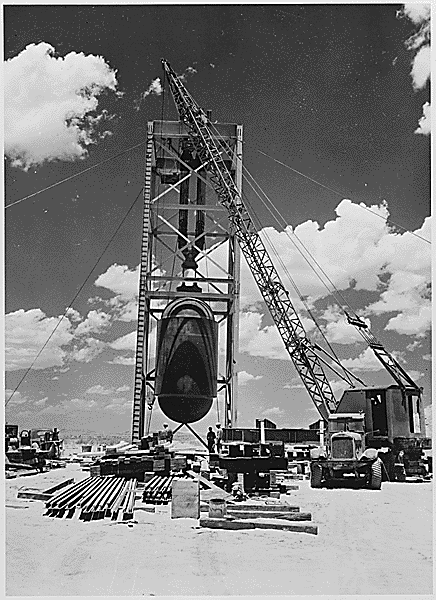









 Millard Fillmore's Bathtub