Civil War Sesquicentennial: 26 free books on the Civil War

June 22, 2011

Our librarian friend, Judy Crook, sent a link to the National Park Service website where you can download, free, 26 books on the Civil War.

150th Anniversary Civil War

Logo for 150th Anniversary Civil War - Copyright ©2010 Eastern National. All rights reserved.

Eastern National is celebrating the 150th Anniversary of the Civil War with electronic editions of eParks’ National Park Civil War Series of books. Read them online or own your own paper edition by visiting our Civil War Series store.

With a color printer, a teacher could assemble 26 readers for use in the classroom, or for homework assignments.  The books sell for $8.95 through the NPS bookstore.  The first listed volume, A Concise History of the Civil War, provides a good, brief summary, with some features in the .pdf version teachers should be happy to find:  A list of 25 battles of significance, and black-and-white maps of battle locations and the Confederacy, for examples.

Great idea to make this stuff available for free, online.  I wonder, how many people will really take advantage of the opportunity?

Buy paper copies here, at the eParks Store; here are links to the .pdfs of the 26 volumes, below:

book cover

Cover for A Concise History of THE CIVIL WAR


Have a great Bloomsday

June 16, 2011

James Joyce fans, and other literati fans:  Happy Bloomsday, June 16.

Is anyone reading Ulysses in your town?  Public performance?

(We’re at the Clinton Library today; no Joyce, I’ll bet.)

Bloomsday:


Quote of the moment, on shaping lives: Lord of the Rings or Atlas Shrugged

May 13, 2011

Good donkey quote of the day candidate:

Atlas Shrugged, by Ayn Rand

Atlas Shrugged, by Ayn Rand

There are two novels that can change a bookish fourteen-year old’s life: The Lord of the Rings and Atlas Shrugged. One is a childish fantasy that often engenders a lifelong obsession with its unbelievable heroes, leading to an emotionally stunted, socially crippled adulthood unable to deal with the real world. The other, of course, involves hobbits orcs.

Attributed to John Rogers, whoever that is. (Got a better source?  Let us know in comments.)

Tip of the old scrub brush to Kent commenting at PennLive.com.

Lord of the Rings trilogy

Lord of the Rings trilogy, by J. R. R. Tolkien


Boston Tea Party: An anti-corporation protest?

April 3, 2011

Thom Hartmann said so.  In Hartmann’s reading, the 1773 Boston Tea Party was as much a protest against corporate oligarchy as a protest against government — quite the opposite of the way most Neo Tea Partiers see things.   Is he right?  Historians, what say you?

Hartmann relies on his copy of George R. T. Hewes’ book, A retrospect of the Boston tea-party, with a memoir of George R. T. Hewes, a survivor of the little band of patriots who drowned the tea in Boston harbour in 1773 (1834). Are you familiar with the book?

George R. T. Hewes in 1835, a veteran of the 1773 Boston Tea Party - CUNY image

George Robert Twelves Hewes in 1835 at age 93, a veteran of the 1773 Boston Tea Party. Painting by Joseph G. Cole. CUNY image

More, and resources:


Quote of the moment: Robert C. Lieberman, “Why the Rich Are Getting Richer: American Politics and the Second Gilded Age”

February 20, 2011

The U.S. economy appears to be coming apart at the seams.  Unemployment remains at nearly ten percent, the highest level in almost 30 years; foreclosures have forced millions of Americans out of their homes; and real incomes have fallen faster and further than at any time since the Great Depression.  Many of those laid off fear that the jobs they have lost — the secure, often unionized, industrial jobs that provided wealth, security and opportunity — will never return.  They are probably right.

Cover of Winner-Take-All Politics, by Jacob Hacker and Paul Pierson

Cover of Winner-Take-All Politics, by Jacob Hacker and Paul Pierson

And yet a curious thing has happened in the midst of all this misery.  The wealthiest Americans, among them presumably the very titans of global finance whose misadventures brought about the financial meltdown, got richer.  And not just a little bit richer; a lot richer.  In 2009, the average income of the top five percent of earners went up, while on average everyone else’s income went down.  This was not an anomaly but rather a continuation of a 40-year trend of ballooning incomes at the very top and stagnant incomes in the middle and at the bottom.  The share of total income going to the top one percent has increased from roughly eight percent in the 1960s to more than 20 percent today.

This what the political scientists Jacob Hacker and Paul Pierson call the “winner-take-all economy.”  It is not a picture of a healthy society.  Such a level of economic inequality, not seen in the United States since the eve of the Great Depression, bespeaks a political economy in which the financial rewards are increasingly concentrated among a tiny elite and whose risks are borne by an increasingly exposed and unprotected middle class.  Income inequality in the United States is higher than in any other advanced democracy and by conventional measures comparable to that in countries such as Ghana, Nicaragua, and Turkmenistan.

Robert C. Lieberman, reviewing the book Winner-Take-All Politics:  How Washington Made the Rich Richer — and Turned Its Back on the Middle Class, by Jacob S. Hacker and Paul Pierson, Simon and Schuster, 2010, 368 pages.  $27.00.; review appears in Foreign Affairs, January/February 2011, pp. 154-158.

More:


Bathtub reading on a cold February day . . .

February 10, 2011

Stuff to make you think:

  • Do you care? At least 16 members of Congress passed up on the government-sponsored health care plans, trying to be true to their campaign promises to repeal similar care for all citizens, a plan they try to ridicule as Obamacare.  Some of them discovered other plans “available from the market” are expensive, don’t cover pre-existing conditions, and generally don’t meet their needs.  Crooks and Liars explains:

Nevertheless, Republicans are discovering the truth: The status quo is unsustainable, unaffordable, and discriminatory. Now what will they do about that? And how will they appease their angry hordes of Tea Party members being stoked daily via email and fear campaigns?

  • Arctic Ice disappears, and so does the evidence Tim Lambert notes that those wacky pranksters at the Heartland Institute managed to find one small part of a chart to make a case that Arctic ice is increasing, even as Russia and China prepare to beat the U.S. to trans-Arctic shipping when the ice disappears.  Whose side is the Heartland Institute on, again?  It’s a new propaganda tactic:  The Small Lie.

There are people who need to soak their crania.  Back to work, here.


Quote of the moment: Thoreau explains, this, too, is heaven

January 26, 2011

Walden Pond frozen over, Winter 2005 - Wikimedia image

Walden Pond frozen over, Winter 2005 - Wikimedia image by Bikeable

Every winter the liquid and trembling surface of the pond, which was so sensitive to every breath, and reflected every light and shadow, becomes solid to the depth of a foot or a foot and a half so that it will support the heaviest teams, and perchance the snow covers it to an equal depth, and it is not to be distinguished from any level field. Like the marmots in the surrounding hills, it closes its eyelids and becomes dormant for three months or more.  Standing on the snow-covered plain, as if in a pasture amid the hills, I cut my way first through a foot of snow, and then a foot of ice, and open a window under my feet, where, kneeling to drink, I look down into the quiet parlor of the fishes, pervaded by a softened light as through a window of ground glass, with its bright sanded floor the same as in summer; there a perennial waveless serenity reigns as in the amber twilight sky, corresponding to the cool and even temperament of the inhabitants. Heaven is under our feet as well as over our heads.

Henry David Thoreau, Walden, or Life in the Woods, “The Pond in Winter,” 1899, pp 296-297.

Thanks to Inward/Outward, a project of the Church of the Saviour community.

Special tip of the old scrub brush to Bill Longman, who sent me the e-mail today.


Unfortunate juxtaposition in bookstore display

December 29, 2010

Bush and Wimpy Kid books, together in Dallas bookstore - Import 12-05-2010 Pentax Optio 2175

Unfortunate display juxtaposition of President Bush's book and latest Wimpy Kid book

Bush gets a bigger discount that Wimpy Kid?


Typewriter of the moment: William Saroyan

December 19, 2010

William Saroyan's typewriter, photo from the Bancroft Library, University of Caliornia - Berkeley

William Saroyan's typewriter, displayed at the Saroyan Museum at his home in San Francisco - photo from the Bancroft Library, University of California; Berkeley

William Saroyan’s niece, Jacqueline Kazarian, recently gifted the Bancroft Library with a significant part of the archives of Saroyan’s work.  The press release on the gift included a photo of Saroyan’s Fox typewriter, which is displayed at the Saroyan museum in San Francisco.

Saroyan came from an Armenian American family, born in Fresno, California in 1908.  His writings illuminated the experience of Californians and Armenian Americans, especially during the Great Depression.

In many ways Saroyan’s work symbolizes the uniqueness of the Armenian community in America, especially California.  [You still out there, Ben Davidian?]   Wikipedia strikes the right tone:

Saroyan’s stories celebrated optimism in the midst of the trials and tribulations of the Depression. Several of Saroyan’s works were drawn from his own experiences, although his approach to autobiographical fact contained a fair bit of poetic license.

His advice to a young writer was: “Try to learn to breathe deeply; really to taste food when you eat, and when you sleep really to sleep. Try as much as possible to be wholly alive with all your might, and when you laugh, laugh like hell.” Saroyan endeavored to create a prose style full of zest for life and seemingly impressionistic, that came to be called “Saroyanesque”.

The complete May 19, 2010,  press release from the University of California is below.

a sketch "from a Turkish admirer," a photo of the author in his youth, and a framed sketch of Saroyan

The Bancroft Library's new archival material on William Saroyan includes (left to right) a sketch "from a Turkish admirer," a photo of the author in his youth, and a framed drawing of Saroyan with a passage of his writing on Armenia. (Images courtesy of the Bancroft Library)

The Bancroft Library accepts gift of William Saroyan archives

By Kathleen Maclay, Media Relations | 19 May 2010

William Saroyan

William Saroyan (Photo courtesy of The Bancroft Library)

BERKELEY — The Bancroft Library at the University of California, Berkeley, has received a spectacular gift of hundreds of books, drawings, correspondence and other personal communications to and from one of America’s best-known writers, the Armenian-American author and playwright William Saroyan.

The rich collection includes approximately 48 cartons with 1,200 books and other archival materials assembled by his niece, Jacqueline Kazarian, of San Francisco, who also is the founder of the William Saroyan Literary Foundation International. A celebration of the gift is set for noon on Friday (May 21) at The Faculty Club on campus.

“UC Berkeley is such an incredible place of learning and growing and intellectual exploration,” said Kazarian, who earned degrees in communication and decorative arts at UC Berkeley in the early 1950s. “I know that my uncle wanted his library, manuscripts and galleys to go to Berkeley. Students will be inspired by the collection.”

Apart from this gift, The Bancroft Library already retains significant holdings of Saroyan’s work that it collected over the course of his life and career, and it continues to add to that collection. Most of the latest materials come from Saroyan’s home on San Francisco’s 15th Avenue that is now a Saroyan museum directed by Kazarian. Those materials were supplemented by Kazarian’s extensive personal collection, as well as by items of Saroyan’s that she acquired through a prominent Boston archivist and via a Saroyan friend.

“Jacqueline Kazarian’s new gift is the largest and most substantial augmentation to the Saroyan collections at Bancroft that we have ever received,” said Peter Hanff, Bancroft’s deputy director.

The author’s classic manual typewriter, as displayed at his San Francisco home

The author’s classic Fox manual typewriter, as displayed at his San Francisco home. (Photo courtesy of The Bancroft Library)

Saroyan, born in Fresno, Calif., in 1908, drew extensively on his Armenian-American heritage and childhood experiences for his books, plays and short stories. Much of his writing was considered impressionistic and reflected a hearty optimism often hard to find during the gritty Great Depression. He died in 1981 at the age of 72, with his niece at his side.When Story magazine editors Martha Foley and Whit Burnett printed Saroyan’s “The Daring Young Man on the Flying Trapeze” in 1934, it was an immediate success, triggering Saroyan’s fame and standing as one of his many literary achievements.

“Uncle Bill’s writing revolutionized the short story,” said Kazarian, adding that she has always found his work “almost spiritual and fable-like.”

His five-act play, “The Time of Your Life,” is the only American play to have won both the New York Drama Critics’ Circle Award and the Pulitzer Prize. Saroyan’s work as a screenwriter with Hollywood director Louis B. Mayer on the film “The Human Comedy” won an Academy Award in 1943, and Saroyan later wrote a widely acclaimed book with the same title.

Kazarian’s gift to The Bancroft Library includes multiple first editions of Saroyan’s works, such as “The Daring Young Man on the Flying Trapeze,” “My Name is Aram” (1940), “The Human Comedy” and “Obituaries” (1979), and many materials personally inscribed by the writer. Also among the new items according to Steven Black, the head of acquisitions for Bancroft, are letters, telegrams and notes written by Saroyan to relatives and others close to him, mostly during the 1930s and 1940s.

antiquarian book dealer Peter Howard of Berkeley, shown here poring through Saroyan materials

Antiquarian book dealer Peter Howard of Berkeley, poring through Saroyan materials. (Photo courtesy of The Bancroft Library)

“He personalized a lot of what passed through his hands,” Black said, noting that much of the material features marginalia reflecting Saroyan’s thoughts and interests.

There also is a copy of Henry Miller’s “Aller Retour New York,” an 80-page journal about a 1935 visit by Miller to New York City and his journey aboard a Dutch ship back to Europe. It is inscribed by Miller to Saroyan.

And a Saroyan scrapbook in the collection contains press announcements about the Pulitzer Prize for his book, “The Time of Your Life.” He scoffed at the award, contending that the arts should not be judged by commerce.

The new Bancroft collection also contains a pre-publication proof of “Burnt Norton,” the first poem of T.S. Eliot’s “Four Quartets,” which Black said the publisher may have given to Saroyan “when he crossed the pond” on a trip from his temporary home in France to England.

There also is a wide range of magazines, including issues of Horizon and the Partisan Review, a leading publication of the Anglo-American intelligentsia during the 1930s and ’40s, Black said.

The first major deposit at The Bancroft Library of Saroyan’s papers was recorded in October 1980, and the library agreed to organize the collection and give Saroyan a general description and an index. After Saroyan died in 1981, the Saroyan Foundation paid the library to continue assembling the papers for official archives, which the foundation ultimately decided to place at Stanford University. That happened in 1996.

William Saroyan's niece, Jacqueline Kazarian, surveys materials at his San Francisco home

William Saroyan's niece, Jacqueline Kazarian, surveys materials in his home. (Photo courtesy of The Bancroft Library)

Kazarian’s donation is in honor of Berkeley antiquarian book dealer Peter Howard, who has provided appraisal assistance to Bancroft on Saroyan materials and other collections for decades. While director of The Bancroft Library, the late James D. Hart also developed strong professional and personal ties to Saroyan over the years, according to Kazarian and Black.

“Now, the Saroyan family materials come to a place that Saroyan himself would have been happy to see accepting them,” Black said, noting that Bancroft is proud to have so much of Saroyan’s “intellectual remains” to be able to share with the public.

Scheduled to speak about the acquisition at Friday’s event are Jacqueline Kazarian; David Calonne, vice president of education for the Saroyan Literary Foundation International and a Saroyan scholar; San Francisco novelist Herbert Gold; theater director Val Hendrickson reading Saroyan’s short story, “Common Prayer,” and the credo to “The Time of Your Life”; and Charles Faulhaber, director of The Bancroft Library.

UC Berkeley already is home to an Armenian Studies Program, which is focused on contemporary Armenian history, politics, language and culture. And Bancroft, a rich, special collections library containing historical and literary documents and other materials relating to California, the West, Mexico and Latin America, is known for its strong collections on California writers, including Jack London, Robinson Jeffers, Bret Harte, Frank Norris and others.

More information about The Bancroft Library is online. Bancroft is celebrating its 150th anniversary this year.

More:

William Saroyan commemorative stamps from the U.S., and U.S.S.R.

On commemorative stamps issued in both the U.S. and the U.S.S.R., Saroyan wears the Armenian-style moustache he wore through most of his later life. For a stamp to honor a man in both the U.S. and the Soviet Union was extremely rare -- maybe unique.


Typewriter of the moment: Harlan Ellison and his Olympia SG3

December 12, 2010

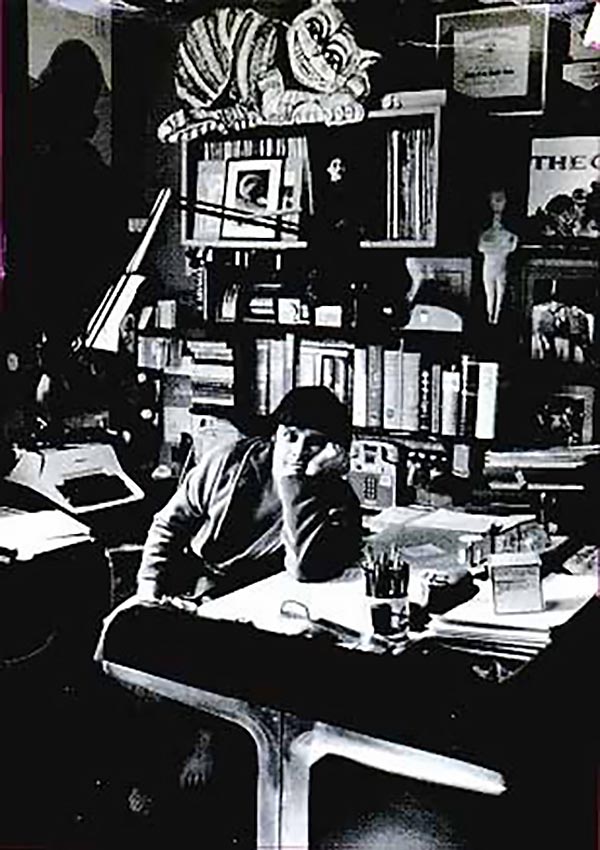
Harlan Ellison, his Olympia SG3, and other stuff - photo credit to MAX KATZ and KAREN FRIEDRICH
Harlan Ellison and his typewriter.  According to Richard Polt, the machine pictured is probably the Olympia SG3. Photo credit to Max Katz and Karen Friedrich.

Writers and their tools, in their workspaces.  We could probably date this photo by the stuff in Ellison’s office — the Cheshire Cat cutout?  Wasn’t that from an Edward Gorey-illustrated version of the Alice in Wonderland story?  What year was that?  The telephone on the wall, the desk scissors design . . . none of those fall into any expertise I have.  Someone else will have to date it.  My TinEye search didn’t shed any useful light.

I found the photo at Richard Polt’s fun site at Xavier University, The Classic Typewriter Page.  Polt is clearly working toward a MacArthur Foundation genius grant with this material.  Well, he would be, were I a judge.  (Who should get credit for the photo?  I don’t know — can you help identify who gets credit? See comment from Mr. Ellison:  ” . . .  image was captured for my 1974 STORY collection, APPROACHING OBLIVION, by MAX KATZ and KAREN FRIEDRICH.”  Credit for the photo gleefully acknowledged here.)

Oh, by the way, stay tuned:  Ellison is trying to sell his first typewriter.  That is a topic worthy of its own post.

Tip of the old scrub brush to the unfortunately moribund The Wit of the Staircase.


Whiskey and Cigar Day, 2010: Mark Twain and Winston Churchill

November 30, 2010

Mark Twain, afloat

November 30 is the birthday of Mark Twain (1835), and Winston Churchill (1874).

Twain had a comment on the Texas Education Agency and State Board of Education:

In the first place God made idiots. This was for practice. Then He made School Boards.

– Following the Equator; Pudd’nhead Wilson’s New Calendar

The Nobel literature committees were slow; Twain did not win a Nobel in Literature; he died in 1910. Churchill did win, in 1953.

Both men were aficionados of good whiskey and good cigars. Both men suffered from depression in old age.

Both men made a living writing, early in their careers as newspaper correspondents. One waged wars of a kind the other campaigned against. Both were sustained by their hope for the human race, against overwhelming evidence that such hope was sadly misplaced.

churchill-time-cover-man-of-the-year-1941.jpg

Both endured fantastic failures that would have killed other people, and both rebounded.

Each possessed a great facility with words, and wit, and frequently said or wrote things that people like to remember and repeat again.

Both of them rank near the top of the list of people to whom almost any quote will be attributed if the quote is witty and the speaker can’t remember, or doesn’t know, who actually said it.

Both men are worth study.  And wouldn’t you really love to have had them over to dinner?

Twain, on prisons versus education:

Every time you stop a school, you will have to build a jail. What you gain at one end you lose at the other. It’s like feeding a dog on his own tail. It won’t fatten the dog.” – Speech, November 23, 1900

Churchill on the evil men and nations do:

“No One Would Do Such Things”

“So now the Admiralty wireless whispers through the ether to the tall masts of ships, and captains pace their decks absorbed in thought. It is nothing. It is less than nothing. It is too foolish, too fantastic to be thought of in the twentieth century. Or is it fire and murder leaping out of the darkness at our throats, torpedoes ripping the bellies of half-awakened ships, a sunrise on a vanished naval supremacy, and an island well-guarded hitherto, at last defenceless? No, it is nothing. No one would do such things. Civilization has climbed above such perils. The interdependence of nations in trade and traffic, the sense of public law, the Hague Convention, Liberal principles, the Labour Party, high finance, Christian charity, common sense have rendered such nightmares impossible. Are you quite sure? It would be a pity to be wrong. Such a mistake could only be made once—once for all.”

—1923, recalling the possibility of war between France and Germany after the Agadir Crisis of 1911, in The World Crisis,vol. 1, 1911-1914, pp. 48-49.

Image of Twain aboard ship – origin unknown. Image of Winston S. Churchill, Time Magazine’s Man of the Year for 1941, copyright 1941 by Time Magazine.

More on Mark Twain

More on Winston Churchill

Orson Welles, with Dick Cavett, on Churchill, his wit, humor and grace (tip of the old scrub brush to the Churchill Centre):

Yeah, mostly this is an encore post from past years.


Happy Origin Day!

November 24, 2010

On November 24, 1859, Charles Darwin’s book was published, On the Origin of Species.

Title page, 1859 edition of Darwin's Origin of Species - University of Sydney/Wikimedia image

Title page, 1859 edition of Darwin's Origin of Species - image from the University of Sydney via Wikimedia image

How to celebrate?  You could read a summary of Ernst Mayr’s shorthand version of Darwin’s theory, and understand it really for the first time  (I hope not the first time, but there are a lot of people who really don’t understand what Darwin said — especially among critics of evolution):

Darwin’s theory of evolution is based on key facts and the inferences drawn from them, which biologist Ernst Mayr summarised as follows:[3]

  • Every species is fertile enough that if all offspring survived to reproduce the population would grow (fact).
  • Despite periodic fluctuations, populations remain roughly the same size (fact).
  • Resources such as food are limited and are relatively stable over time (fact).
  • A struggle for survival ensues (inference).
  • Individuals in a population vary significantly from one another (fact).
  • Much of this variation is inheritable (fact).
  • Individuals less suited to the environment are less likely to survive and less likely to reproduce; individuals more suited to the environment are more likely to survive and more likely to reproduce and leave their inheritable traits to future generations, which produces the process of natural selection (inference).
  • This slowly effected process results in populations changing to adapt to their environments, and ultimately, these variations accumulate over time to form new species (inference).

Darwin's original sketch of a "tree of life," from Darwin's journals

Charles Darwin's 1837 sketch, his first diagram of an evolutionary tree from his First Notebook on Transmutation of Species (1837) on view at the the Museum of Natural History in Manhattan. Interpretation of handwriting: "I think case must be that one generation should have as many living as now. To do this and to have as many species in same genus (as is) requires extinction . Thus between A + B the immense gap of relation. C + B the finest gradation. B+D rather greater distinction. Thus genera would be formed. Bearing relation" (next page begins) "to ancient types with several extinct forms." Wikimedia image


DDT: Zombie ideas of the right-winged and ill-informed

November 7, 2010

John Quiggin’s done with his book, Zombie Economics:  How Dead Ideas Still Walk Among Us.

Cover of John Quiggin's Zombie Economics

Cover of John Quiggin's Zombie Economics

Go buy a copy.  You will be happy you did.

Today, at Crooked Timber he’s looking at zombie ideas he was sure would eventually go away — like the bizarre, false idea that a lot more DDT should be used to fight malaria.

Is Quiggin ever wrong?


Washington, by Ron Chernow – great scholarship, a good read, significant light

October 28, 2010

Welcome, Book Tourists!  This is the last stop on a virtual book tour for Ron Chernow’s biography, Washington.

Virtual cocktails afterward, I hope.  Then sit down and read the book.

In a piece of great fortune for me, six years ago I spent a week at Mount Vernon, George Washington’s home in Virginia, through the good graces of the Bill of Rights Institute and the National Endowment for the Humanities, studying George Washington’s role in the creation of the U.S. Constitution.

Cover of Ron Chernow's book, Washington

Washington, by Ron Chernow. Penguin Press, 2010; 906 pages, $40.00

My academic interest leaned more toward James Madison’s role.  I thought then, and I still think, that Madison deserves a good, popular biography to complement the great recent work of others on the American Revolution and post-revolutionary organization of the nation.  We’ve had recent books by Edmund Morris, Ron Chernow, David McCullough, Joseph Ellis, Walter Isaacs  and others on Franklin, Jefferson, Adams, the “founding brothers,” Hamilton and Washington.   But for Garry Wills’ short and crabby assessment of Madison’s presidency, I am unaware of a good, popularly-readable Madison book.    As a professional journalist, as a civil libertarian, as a lawyer and occasional investigator, my studies of the era favored Franklin, Jefferson and Madison.  George Washington took the center stage, in my conception of events, while those working around him and in the wings frantically worked to put on the production that made America and allowed Washington to play the role of a hero, the face of the “Father of His Country” role — while the truth was that such success really did have many fathers.

For most history purposes in elementary and secondary schools, for most of the past 200 years, Washington is the easy center of attention, and I suspected a different story.  Jefferson wrote better, and more thoughtfully, did he not?  Madison’s legislative work in Virginia alone shone above Washington’s.  Washington had military experience, and he managed to cling on through the revolution — but his role as president was often more as a referee between the great creative forces driven by Hamilton, Madison and Jefferson.

What I hoped to find at the Mount Vernon meetings were sources to reveal the true role of James Madison — maybe I could get the story together and write it myself.

Simply put, I was not prepared to confront the genius of Washington, nor did I appreciate the depth of his involvement in so many areas where our common understanding of history simply gave Washington the title of hero, but without telling much of the backstory.

I looked for the evidence of Madison’s genius.  What I found was the overwhelming evidence of Washington’s genius, too.

Washington’s economic genius now displays proudly at Mount Vernon, with the reconstruction of his 16-sided barn for wheat thrashing, and with the reconstruction of the distillery which made the man who put down the Whiskey Rebellion, ironically, the leading distiller of whiskey in America shortly before his death.  I learned that Washington got out of tobacco a decade before the revolution, because he didn’t like the economics of sending a crop to agents he did not fully trust in London, for sales in markets whose prices he could not track, for sales to purchasers he could not see.  Instead, he took his business into wheat, a commodity much in demand since most other farmers locally grew tobacco.  Washington became a leading wheat producer, and grew richer as a result of that and other similar decisions of clear-thinking economics.  By the end of his life, he was producing a surplus of wheat — which excited his Scotland-born farm foreman, who had a recipe for whiskey.

Washington was not merely the frontman for the convention in Philadelphia in 1787.  It became clear to me that he was a driving force, introducing Madison to Hamilton, and mentoring both in their work to get the convention approved, and then to get the Constitution written and ratified.   Washington had financial interests in seeing a great, united nation out of the 13 colonies:  He had land in the Ohio River Valley to sell, to get rich, if only there were an authority to made transportation into the valley hospitable to settlers, and transportation out to let those settler farmers get rich from their produce.   Washington’s vision, I learned, was much greater than I had understood.

Ron Chernow’s thick biography of Alexander Hamilton excited historians in 2004.  As studies of Jefferson lead to studies of Madison, and vice-versa, so do studies of Hamilton inevitably lead to studies of Washington.  We are fortunate that Chernow wrote the thick biography of Washington, the first great study of the man for the 21st century.

Chernow’s Washington, A Life (2010, Penguin Press, 906 pages) is every bit the great study of Washington we need and can use.  My bias as a teacher of high school students leans toward usefulness in the classroom — a higher standard than most imagine, since, for a high school classroom, a book must be eminently readable as well as accurate and clear.

Chernow had me at the Prelude.  In a brisk five pages he tells the story of Gilbert Stuart, an often-economically-bereft artist who saw fortune in Washington’s election.  Stuart arranged to get the great man to sit for a portrait — Washington did not like it — but Stuart never finished Washington’s commission in Washington’s life.  Instead, Stuart used the portrait to copy, for others.    Stuart’s fortune came not from Washington, but from the vast throng of Washington admirers who would pay handsomely for an image of the man.  It’s a well-told story, and a great introduction to the lionizing of Washington and his image, the reality of the man who sat for the portrait, and the way history has treated the man and the myth.  [Courtesy of the New York Times, you may read the Prelude, here.]

Readers of McCullough’s 1776 know of some of Washington’s genius at war, and some of his attention to details of making things work right — whether it be the way latrines were dug so an army could relieve itself and avoid disease, or the the exact tints of the color of green paint applied to the massive dining room he had added to the house at Mount Vernon.  McCullough’s book is a taste, a sampling of the work Chernow has.  One may compare Chernow’s story-telling ability to McCullough’s, and Chernow may suffer a bit.  For Washington, the drama is so often in the details, however — and details we have, galore.

Is it too much detail?  For the life of another, it may be.  Not for Washington.  Chernow is able to make readable even the details.  One may open this book at any page, start with a paragraph, and learn something about Washington — most often, learning something one did not know precisely before.  Chernow relied on the massive project at the University of Virginia to publish all the papers of Washington, collected from various sources.  Washington had not been quite so assiduous as Jefferson in making copies of everything he wrote for posterity, though much he was an assiduous diarist and taker of notes.  No biographer before had the advantage of the catalogueing done at Virginia, nor perhaps of the scope of the material there.

For this reason alone, this book should be read.

Chernow’s portrait is painstaking.  What emerges in the end is a George Washington whose vanity would be quirky and irksome in others, but necessary to the building of the image history graces to him, as the standard-bearer for the founders of the nation, truly the Father of His Country.  The vanities quickly become clear as careful consideration by a man who understood, especially as president, that each move he made would be a precedent for those who would follow, he hoped.   One example:  Washington’s work on the bank bill of 1791, made possible as we know by the dinner at Jefferson’s where Hamilton and Madison struck the bargain that sited the District of Columbia on the Potomac, and set up the finances that would make the nation successful in business and international relations over the next 200 years.

Though he had sat through every session of the Constitutional Convention, Washington did not pretend to expertise in constitutional nuances — he nce wrote that he had ‘had as little to do with lawyers as any man of my age” — and engaged in much hand-wringing over the bank bill.  He would be forced to issue a black and white opinion that would alienate some, gratify others, and irrevocably shape the future government.  He called in Madison, supremely well versed in the Constitution, for a series of quiet, confidential talks.  “The constitutionality of the nation bank was a question on which his mind was greatly perplexed,” Madison would recall, noting that Washington was already biased in favor of a national bank and “a liberal construction of the national powers.”  On the other hand, Washington was shaken by uncompromising verdicts from Randolph and Jefferson and asked Madison, as a precaution, to draft a veto message for the bank bill.

When Washington turned to Hamilton, he made plain that, unless he could vanquish the arguments of Randolph and Jefferson, he planned to veto the bank bill, telling him that he wished to “be fully possessed of the arguments for and against the measure before I express any opinion of my own.”  By this point Washington knew the vigor of Hamilton’s mind and his extraordinary knack for legal argument.  In little more than a week, Hamilton, in a superhuman burst of energy, produced more than thirteen thousand words that buried his opponents beneath an avalanche of arguments.  His exegesis of the “necessary and proper” clause not only made way for a central bank but would enable the federal government to respond to emergencies throughout American history.  Hamilton interpreted the “necessary and proper” clause to mean that “every power vested in a government is in its nature sovereign and includes, by force of the term, a right to employ all the means requisite and fairly applicable to the ends of such power.”  In other words, the Constitution gave the federal government not only the powers explicitly enumerated but also a series of unstated or “implied powers” indispensable to attain those ends.  (circa page 649)

Two paragraphs, easily read without seriously taxing the vocabulary of an SAT-studying high school junior.  They clearly detail Washington’s care in analyzing all sides of an issue.  They reveal Washington’s ability to harness the good work of men of greatly differing viewpoints, to the enlightenment of Washington and benefit of the nation — which benefit likely would not have occurred had another man been in Washington’s place (can you imagine anyone else mediating Madison and Hamilton — and keeping them both as friends?).  Chernow gracefully slips from telling a good story to providing scholarly details (I have omitted footnotes here), but not in an eye-glazing fashion — weaving the scholarship into a story fantastic enough that it would not sell for fiction, as Twain warned because it does not stick to the probabilities.

A few years ago a student offered what I considered a great insight.  We were comparing the American Revolution to the French Revolution; naturally, considering the Reign of Terror and the rise of the dictatorial Emperor Napoleon, students wondered where the French went wrong, and where the Americans got luck and went right.  Israel Pena summed it up neatly:  “The French didn’t have George Washington.  Americans came out of their revolution with George Washington; France came out of their revolution with Napoleon.”

Napoleon would have done well to have studied George Washington.

It is reported that when King George III learned that Gen. George Washington had, at the end of the American Revolution and the peace treaty negotiations, resigned his commission to the Continental Congress, the news was met with disbelief.  Washington improbably held together a ragamuffin mob of an army, disciplined them into a fighting force, and through evasion tactics, inspiration and sheer luck, and great aid from the King of France and the French Navy, defeated Great Britain in a war where no one, probably  including Washington had thought it possible to do so.  Many Europeans expected Washington would assume the crown of America and have himself declared king.

Instead, following the story of his Roman hero, Cincinnatus, Washington declined the power, deferring to civilian and more democratic rule, sublimating military might and prowess to the greater powers of reason.  (Washington, following Cincinnatus again, bowed out after two terms in the presidency — the power of story and early education over the fate of a nation.)

King George said he didn’t believe the news.  “But if it is true, [Washington] is the greatest man who ever lived.”

Without unnecessary shine, Ron Chernow has written more than 800 pages of the brief for the case proving King George’s judgment.  In these times, when people claim to wish to follow Washington and the Constitution, we would do well to study what Washington said, wrote and did, and how he came to create the Constitution and the nation it frames.

Note: My review copy did not include an index. The book, Washington covers the man as an encyclopedia.  For the sake of high school teachers and researchers, I hope an index comes with the published text.

More, and resources; other reviews:

Other stops on the virtual book tour:


Quote of the moment: Lewis Carroll on Republican politics, climate skeptics, DDT advocates and creationism

October 26, 2010

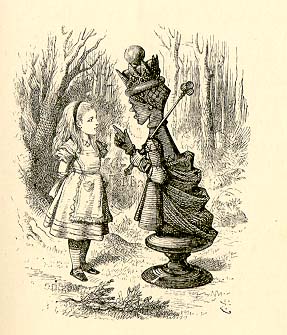
Alice and the Red Queen

Alice and the Red Queen – illustration by Sir John Tenniel

Alice laughed: “There’s no use trying,” she said; “one can’t believe impossible things.”

“I daresay you haven’t had much practice,” said the Queen. “When I was younger, I always did it for half an hour a day. Why, sometimes I’ve believed as many as six impossible things before breakfast.”

Charles Lutwidge Dodgson, writing under the name Lewis Carroll,
Alice in Wonderland, 1866

[Yes, the illustration is from Through the Looking Glass, 1871]