Annals of Global Warming: It didn’t start with the hockey stick . . .

December 12, 2011

Peter Sinclair comes through with a good explanation of the history of concern about global warming — how the warming trend was discovered.

It wasn’t scientists trying to get government grants.  It was the U.S. Air Force, trying to beat the commies and keep America safe for democracy and, ironically, safe for dissent from such applications of science.


9,996

Real history couldn’t be published as fiction, which is one way we can tell real history from the stuff that gets made up.  In the story told in this video, note carefully the serendipity of figuring out the CO2 issues:  Who could invent a story about warfare leading to the discovery of global warming?  As with the coincidence of John Adams and Thomas Jefferson both dying on the 50th anniversary of the Declaration of Independence, no editor of fiction would accept it as believable.

More:

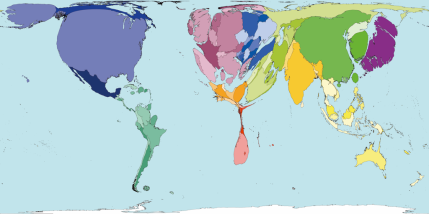
Why we worry, why policy makers are involved:  Carbon Emissions, 2000 – from WorldMapper, with a serendipitous tip of the old scrub brush to Petra Tschakert at Penn State.

Carbon emissions 2000, from worldmapper.org - creative commons license

Carbon Emissions 2000, from worldmapper.org - creative commons license

Carbon Emissions 2000 © Copyright 2006 SASI Group (University of Sheffield) and Mark Newman (University of Michigan). “We welcome use of our maps under the Creative Commons conditions by educational, charitable and other non-profit organisations.”

Stupid-Boy-Cries- “Wolf” Department: Thieves release more e-mails stolen from climate scientists

November 23, 2011

In his clear style, Tim Lambert at Deltoid lays out the basic facts:

Some more of the emails stolen from the Climate Research Centre in 2009 have been released. This time they are accompanied by a readme with out-of-context quotes that asserts the purpose of the release is information transparency, but that’s an obvious lie, since they’ve sat on them for two years and released them just before Durban conference. The timing suggests that the people behind the theft and release have a financial interest in preventing mitigation of greenhouse gas emissions. It is most unlikely that there is anything incriminating in these emails — if there was, it would have been released two years ago.

Gavin Schmidt is providing context for the emails, Brendan DeMelle has an extensive roundup and Stephan Lewandowsky writes about the real scandal.

I remind readers that the last round revealed wrong-doing only by accomplices and friends of the thieves, and revealed no wrong-doing on the part of climate scientists.

Especially, the last round revealed no data to show warming is not happening, nor any data to show anything but righteous and noble concern to mitigate or stop the human contribution to the pollution that causes unnatural global warming.  This round of releases will do the same, I predict.

Joe Romm illustrated his post on the issue (which you will want to read) with this cartoon from Drew Sheneman of the Newark Star-Ledger:

Drew Sheneman, Newark Star-Ledger, on politics around findings of global warming

Drew Sheneman, Newark Star-Ledger, on politics around findings of global warming; polar bears won't read the stolen e-mails, refuse to be convinced findings of warming comprise a hoax

(Does anyone have the date on that cartoon?  Is it, like this one from Tom Toles, so old it indicates denialists do nothing new under the sun?)

In the two years since the last release of stolen e-mails, a few hundred studies on global warming have been published confirming the fact that warming occurs, and confirming the links to human activity as a cause of unnatural warming.  Even Anthony Watts’s work was published, but when analyzed, it also showed global warming and not miscalculations of data or misreadings of data  (Watts denies the results from his data).

So, in two years, climate change denialists have been unable to find any significant chunk of data to support any of their claims, while the planet continues to warm at an increasingly alarming rate. 

How many times do we allow the miscreant to call “wolf” falsely?  Why would we believe him on any other issue?

More, Resources: 


What were scientists saying about global warming in 1971?

November 3, 2011

What did scientists know and say about climate change and global warming in the 1970s?  I keep running into claims by modern climate change denialists that scientists in the 1970s firmly predicted a pending ice age.  This is usually posited to establish that scientists are fools, and that concerns about warming now are probably displaced because the same scientists were in error 40  years ago.

I worked in air pollution studies way back then.  That’s not how I remember it at all.  I remember great, good-natured debates between Ph.Ds in the Department of Biology at the University of Utah, and other scientists from other institutions passing through and working in the field with us.  Greenhouse effect was very well understood even back then, and the discussions were on the nature of just how much human pollution would affect climate, and in which way.

Savvy scientists then well understood that there were two competing trends in air pollution:  Greenhouse gases and particulates and aerosols.  Greenhouse gases would warm the climate, but they were offset by particulates and aerosols that reflect solar radiation back into space before warming can occur.  At least, back then, the particulates and aerosols counteracted the greenhouse gases.

Manhattan skyline enveloped in heavy smog, May 1973: Chester Higgins/NARA. via Mother Jones

EPA collection, Manhattan skyline enveloped in heavy smog, May 1973: Chester Higgins/NARA. via Mother Jones

Looking for something else, I took off my shelf a book we used as a text in air pollution courses at the University of Utah in the 1970s, Whatever Happened to Fresh Air? by Michael Treshow.  Treshow taught at Utah.  He was deeply involved in several research projects on air pollution.  He was also a great conversationalist and competitive tennis player.  His book was a good text, but he intended it to be read by lay people, especially policy makers, also.  It’s easy to fathom, intentionally so.

Here, below, is what Treshow wrote in the early pages about carbon dioxide as an air pollutant, in sketching the global problems of air pollution.  Notice that, while he makes note of the predictions of what would happen with uncontrolled particulate and aerosol pollution, he gives the science straight up, telling what pollution can do, depending on local circumstances and global circumstances.  Treshow notes the research that the denialists cite now, but he explains enough of the science so that any reasonable person should be able to see that, if one form of pollution is controlled and another is not, the effects might be different.

Michael Treshow:

Over the past several million years, the earth’s animal and plant life have reached a workable equilibrium in sharing this atmosphere and keeping the oxygen and carbon dioxide concentrations in balance.  But man, by burning fossil fuels (particularly coal) at an accelerated rate and by removing vegetation at the prodigious rate of 11 acres per second in the U.S., may be upsetting this equilibrium.  Many scientists believe this carbon dioxide build-up is one of the major threats to man’s environment.

Carbon dioxide (CO2) is occasionally regarded as an air pollutant for this reason, even though it is a natural and essential component of the atmosphere.  Certainly the present concentrations are not dangerous; but what would happen if the amount of carbon dioxide in the atmosphere should increase appreciably?  What hazards would be imposed?

An increase in carbon dioxide would benefit the green plants since they need it for photosynthesis.  But what effect would it have on man and animals?  Or on the physical environment?  The main hazard lies in the effect that carbon dioxide has in absorbing the infrared radiation which normally radiates from the earth back to the atmosphere.  If the carbon dioxide content of the lower atmosphere were to increase, it would prevent the infrared heat absorbed by the earth from the sun from reradiating into the atmosphere.  Heat energy would accumulate and cause a general increase in the earth’s temperature.  Such an increase in temperature, often called the “greenhouse effect,” could cause the ice caps to melt, raising the level of the oceans and flooding most of the world’s major cities.

It is awesome to realize that sea level is actually rising.  It is now 300 feet above what it was 18,000 years ago, and is reportedly rising nearly nine inches higher each century.  Beaches are being wasted away and tides lap ever closer to the steps of coastal homes.  But is the displacement of our beaches more closely related to increasing carbon dioxide concentrations or to the normal warming process between ice ages?

Not everyone agrees that carbon dioxide is to blame.  Concentrations vary greatly around the world.  Near urban areas, where fossil fuels are burned, concentrations are high; over forested areas, where plants are rapidly removing the gas, they are low.  Concentrations also vary with the height above the ground, the latitude, whether over the ocean or land and even with the time of day and season of the year.  All of these variables make it difficult to agree on a reasonable average carbon dioxide concentration.

Despite some disagreement, it is generally conceded that carbon dioxide has been added to the atmosphere at an alarming rate during the past century.  Actual measurements show that between 1857 and 1956, carbon dioxide concentrations increased from an average of 0.0293 to 0.0319 percent; 360 X [10 to the 9th] tons of carbon dioxide have been added to the atmosphere by man during this period.  Upwards of a trillion tons will be added by the year 2000.  Such  a tremendous release of carbon dioxide would increase the atmospheric concentrations appreciably unless some mechanism is available to absorb the surplus and to maintain equilibrium.

Extensive measurements suggest that carbon dioxide concentrations near the earth’s surface have increased about 10 percent since 1900.  During this same time, fossil fuel consumption increased about 15 percent.  This is a remarkably, close, meaningful relationship.  The 5 percent difference is readily accounted for, since this much would be absorbed by the ocean or by rocks and living organisms, particularly plants, which absorb much of the surplus carbon dioxide.  In fact, green plants probably have the capacity to absorb and utilize far more carbon dioxide than man is likely to release.

Calculations presented by Gordon MacDonald of the University of California at Santa Barbara show that a 10 percent increase in the total carbon dioxide content theoretically should cause an increase of 0.4° F in the average temperature of the earth.  Although the carbon dioxide content is being increased about 0.06 percent each year by the combustion of fossil fuels, no temperature increase has been demonstrated.  Rather, the average temperature appears to be decreasing.  During the past 25 years, when the addition of carbon dioxide has been most rapid, the average temperature has dropped half a degree.

This temperature drop has been thought to result from the increase in the amount of submicron sized particulates which remain suspended in the atmosphere. These aerosols obstruct the entrance of the sun’s heat and light rays, thereby disrupting the earth’s energy balance.  The effect is one of less heat and lower temperatures.  Dr. William E. Cobb of the National Oceanic and Atmospheric Agency predicts the possibility of another ice age.

Whatever Happened to Fresh Air, Michael Treshow, University of Utah Press, 1971, pp. 3-6.

What changed since then?  The Clean Air Act provided the legal drive to clean particulates and aerosols out of the air.  Alas, we did not then have good controls for greenhouse gases.  The success of the Clean Air Act, and similar laws worldwide, rather left the pollution field open for greenhouse gases.  Without pollution to offset the effects of GHG, warming became the stronger trend.

I think Treshow was quite prescient back then.  His work is still accurate, when we adjust for the events of history that came after he wrote the book.

Time Magazine cover for January 27, 1967, photo by Larry Lee. The photo shows a typical Los Angeles day at 3:30 p.m., with photochemical smog restricting visibility dramatically. Particulate pollution, and sulfates, added to the visibility problems, and made air pollution a greater health hazard. An accompanying story was titled,

Time Magazine cover for January 27, 1967, photo by Larry Lee. The photo shows a typical Los Angeles day at 3:30 p.m., with photochemical smog restricting visibility dramatically. Particulate pollution and sulfates added to the visibility problems, and made air pollution a greater health hazard. An accompanying story was titled, “Ecology: The Menace in the Skies.”

It’s popular among those opposed to the science of climate change to claim scientists don’t know what they’re talking about, because ‘back in the 1970s they predicted a new ice age, and they were wrong.’

Dr. Treshow’s book presents the state of the science of air pollution in the early 1970s. He didn’t “predict” an ice age. He noted that particulate pollution was a major problem, and that particulates and other pollution created a cooling effect that could offset and perhaps overpower the warming effects of CO2, as he discusses in the passage above. In lay terms, in a few brief passages, Treshow notes the conflicting results of different types of pollution.

CO2’s warming effects were well known, and acknowledged. If particulates and other aerosols won the battle to pollute the skies, the Earth would cool. If GHGs won the battle, the Earth would warm.

Claiming scientists “predicted” an ice age tells only half the story, and thereby becomes a grossly misleading, whole lie.

More:


Annals of Global Warming: Arctic ice at second lowest level ever measured

October 12, 2011

Two years ago warming denialists claimed the Earth is actually cooling, and they predicted dramatic cooling by late 2010.

Instead, warming continues, overcoming the temporary mediation caused by increased particulate and sulfate emissions from coal burned in uncontrolled fashion in China, as evidence by things like the continued shrinking of Arctic ice below 20th century averages.  See this press release from NASA:

RELEASE : 11-337 – October 4, 2011

 Arctic Sea Ice Continues Decline, Hits Second-Lowest Level

WASHINGTON — Last month the extent of sea ice covering the Arctic Ocean declined to the second-lowest extent on record. Satellite data from NASA and the NASA-supported National Snow and Ice Data Center (NSIDC) at the University of Colorado in Boulder showed that the summertime sea ice cover narrowly avoided a new record low.

The Arctic ice cap grows each winter as the sun sets for several months and shrinks each summer as the sun rises higher in the northern sky. Each year the Arctic sea ice reaches its annual minimum extent in September. It hit a record low in 2007.

The near-record ice-melt followed higher-than-average summer temperatures, but without the unusual weather conditions that contributed to the extreme melt of 2007. “Atmospheric and oceanic conditions were not as conducive to ice loss this year, but the melt still neared 2007 levels,” said NSIDC scientist Walt Meier. “This probably reflects loss of multiyear ice in the Beaufort and Chukchi seas as well as other factors that are making the ice more vulnerable.”

Joey Comiso, senior scientist at NASA’s Goddard Space Flight Center in Greenbelt, Md., said the continued low minimum sea ice levels fits into the large-scale decline pattern that scientists have watched unfold over the past three decades.

“The sea ice is not only declining, the pace of the decline is becoming more drastic,” Comiso said. “The older, thicker ice is declining faster than the rest, making for a more vulnerable perennial ice cover.”

While the sea ice extent did not dip below the 2007 record, the sea ice area as measured by the microwave radiometer on NASA’s Aqua satellite did drop slightly lower than 2007 levels for about 10 days in early September, Comiso said. Sea ice “area” differs from extent in that it equals the actual surface area covered by ice, while extent includes any area where ice covers at least 15 percent of the ocean.

Arctic sea ice extent on Sept. 9, the lowest point this year, was 4.33 million square kilometers (1.67 million square miles). Averaged over the month of September, ice extent was 4.61 million square kilometers (1.78 million square miles). This places 2011 as the second lowest ice extent both for the daily minimum extent and the monthly average. Ice extent was 2.43 million square kilometers (938,000 square miles) below the 1979 to 2000 average.

This summer’s low ice extent continued the downward trend seen over the last 30 years, which scientists attribute largely to warming temperatures caused by climate change. Data show that Arctic sea ice has been declining both in extent and thickness. Since 1979, September Arctic sea ice extent has declined by 12 percent per decade.

“The oldest and thickest ice in the Arctic continues to decline, especially in the Beaufort Sea and the Canada Basin,” NSIDC scientist Julienne Stroeve said. “This appears to be an important driver for the low sea ice conditions over the past few summers.”

Climate models have suggested that the Arctic could lose almost all of its summer ice cover by 2100, but in recent years, ice extent has declined faster than the models predicted.

NASA monitors and studies changing sea ice conditions in both the Arctic and Antarctic with a variety of spaceborne and airborne research capabilities. This month NASA resumes Operation IceBridge, a multi-year series of flights over sea ice and ice sheets at both poles. This fall’s campaign will be based out of Punta Arenas, Chile, and make flights over Antarctica.  NASA also continues work toward launching ICESat-2 in 2016, which will continue its predecessor’s crucial laser altimetry observations of ice cover from space.

To see a NASA data visualization of the 2011 Arctic sea ice minimum as measured by the Advanced Microwave Scanning Radiometer – Earth Observing System (AMSR-E) on Aqua, visit:

http://www.nasa.gov/topics/earth/features/2011-ice-min.html  [I have changed the link to one that works for me.]

Here is that visualization, presented by Cryosphere Program Manager, Tom Wagner:

On Sept. 9th, 2011, Arctic sea ice most likely hit its minimum extent for the year. On Sept. 20th, NASA’s Cryosphere Program Manager, Tom Wagner, shared his perspectives on the ice with television audiences across the country.

On the top of the world, a pulsing, shifting body of ice has profound effects on the weather and climate of the rest of the planet. Every winter as temperatures dip, sea ice freezes out of cold Arctic Ocean waters, and every summer the extent of that ice shrinks as warm ocean temperatures eat it away. Ice cover throughout the year can affect polar ecosystems, world-wide ocean currents, and even the heat budget of the Earth.

During the last 30 years we’ve been monitoring the ice with satellites, there has been a consistent downward trend, with less and less ice making it through the summer. The thickness of that ice has also diminished. In 2011 Arctic sea ice extent was its second smallest on record, opening up the fabled Northwest Passages and setting the stage for more years like this in the future. In this video, NASA’s Cryosphere Program Manager, Tom Wagner, shares his perspectives on the 2011 sea ice minimum.

More data and animation versions here, at Goddard Multimedia.


Blame global warming for wild weather? NASA says, “Blame La Nada”

June 27, 2011

Here’s what NASA said:

What’s to Blame for Wild Weather? “La Nada”

Such sheets of fire, such bursts of horrid thunder,
Such groans of roaring wind and rain, I never
Remember to have heard; man’s nature cannot carry
The affliction nor the fear
… from Shakespeare’s Tragedy of King Lear

June 21, 2011: Record snowfall, killer tornadoes, devastating floods: There’s no doubt about it. Since Dec. 2010, the weather in the USA has been positively wild. But why?

Some recent news reports have attributed the phenomenon to an extreme “La Niña,” a band of cold water stretching across the Pacific Ocean with global repercussions for climate and weather. But NASA climatologist Bill Patzert names a different suspect: “La Nada.”

“La Niña was strong in December,” he says. “But back in January it pulled a disappearing act and left us with nothing – La Nada – to constrain the jet stream. Like an unruly teenager, the jet stream took advantage of the newfound freedom–and the results were disastrous.”

Wild Weather (La Nina, 558px)

The blue and purple band in this satellite image of the Pacific Ocean traces the cool waters of the La Niña phenomenon in December 2010. (from Ocean Surface Topography Mission (OSTM)/Jason-2 satellite, Credit: NASA JPL)

La Niña and El Niño are opposite extremes of a great Pacific oscillation. Every 2 to 7 years, surface waters across the equatorial Pacific warm up (El Niño) and then they cool down again (La Niña). Each condition has its own distinct effects on weather.

The winter of 2010 began with La Niña conditions taking hold. A “normal” La Niña would have pushed the jet stream northward, pushing cold arctic air (one of the ingredients of severe weather) away from the lower US. But this La Niña petered out quickly, and no El Niño rose up to replace it. The jet stream was free to misbehave.

“By mid-January 2011, La Niña weakened rapidly and by mid-February it was ‘adios La Niña,’ allowing the jet stream to meander wildly around the US. Consequently the weather pattern became dominated by strong outbreaks of frigid polar air, producing blizzards across the West, Upper Midwest, and northeast US.”1

The situation lingered into spring — and things got ugly. Russell Schneider, Director of the NOAA-NWS Storm Prediction Center, explains:

“First, very strong winds out of the south carrying warm, moist air from the Gulf of Mexico met cold jet stream winds racing in from the west. Stacking these two air masses on top of each other created the degree of instability that fuels intense thunderstorms.”

Extreme contrasts in wind speeds and directions of the upper and lower atmosphere transformed ordinary thunderstorms into long-lived rotating supercells capable of producing violent tornadoes.2

Wild Weather (La Nada, 558px)

This satellite image, taken in April 2011, reveals La Niña’s rapid exit from the equator near the US coast. The cool (false-color blue) water was gone by early spring. (from Ocean Surface Topography Mission (OSTM)/Jason-2 satellite, Credit: NASA JPL)

In Patzert’s words, “The jet stream — on steroids — acted as an atmospheric mix master, causing tornadoes to explode across Dixie and Tornado Alleys, and even into Massachusetts.”

All this because of a flaky La Niña?

“La Niña and El Niño affect the atmosphere’s energy balance because they determine the location of warm water in the Pacific, and that in turn determines where huge clusters of tropical thunderstorms form,” explains Schneider. “These storms are the main energy source from the tropics influencing the large scale pattern of the jet stream that flows through the US.”

In agreement with Patzert, he notes that the very strong and active jet stream across the lower US in April “may have been related to the weakening La Niña conditions observed over the tropical Pacific.”

And of course there’s this million dollar question: “Does any research point to climate change as a cause of this wild weather?”

“Global warming is certainly happening,” asserts Patzert, “but we can’t discount global warming or blame it for the 2011 tornado season. We just don’t know … Yet.”3

What will happen next? And please don’t say, “La Nada.”

Author: Dauna Coulter | Editor: Dr. Tony Phillips | Credit: Science@NASA

End Notes

(1) Other atmospheric factors also contributed to the inflow of frigid polar air, says Patzert. One of the most significant was a weakening in the whirlpool motion of the air around the North Pole. As a result of this weakening, more cold air flowed away from the pole and down toward the states. Climatologists call this an “arctic oscillation.”

(2) Imagine a paddle wheel oriented like a Ferris wheel and placed in winds that that are much stronger at the top than at the bottom. The wheel will spin in the direction of the strong winds above. This spring, these strong, turning winds led to ongoing rotation of the supercells themselves. So we ended up with intense rotation and updraft close to Earth’s surface — conditions ripe for strong tornadoes.

(3) On May 26, 2011, Patzert posted a comment about this topic on Andrew Revkin’s The New York Times’ DOT EARTH Blog, “Demography, Design, Atom Bombs and Tornado Deaths.” See comment 6 at this URL.

Looks to me as if the people at NASA are saying we should go slow, and not rush to blame our weather woes on climate change. Climate change “skeptics” should be so skeptical.


Annals of global warming: Al Gore didn’t invent it, Isaac Asimov explained in 1989

June 8, 2011

Amber Jenkins wrote over at NASA’s site:

I stumbled upon this video earlier today. It’s Isaac Asimov, famous science fiction writer and biochemist, talking about global warming — back in January 1989. If you change the coloring of the video, the facial hair style, and switch out Asimov for someone else, the video could pretty much have been made today.

Asimov was giving the keynote address at the first annual meeting of The Humanist Institute. “They wanted me to pick out the most important scientific event of 1988. And I really thought that the most important scientific event of 1988 will only be recognized sometime in the future when you get a little perspective.”

What he was talking about was the greenhouse effect, which, he goes on to explain, is “the story everyone started talking about [in 1988], just because there was a hot summer and a drought.” (Sound familiar, letting individual weather events drive talk of whether the Earth’s long-term climate is heating up or cooling down??)

The greenhouse effect explains how certain heat-trapping (a.k.a. “greenhouse”) gases in our atmosphere keep our planet warm, by trapping infrared rays that Earth would otherwise reflect back out into space. The natural greenhouse effect makes Earth habitable — without our atmosphere acting like an electric blanket, the surface of the earth would be about 30 degrees Celsius cooler than it is now.

The problem comes in when humans tinker with this natural state of affairs. Our burning of fossil fuels (coal, oil and gas) constantly pumps out carbon dioxide — a heat-trapping gas — into the atmosphere. Our cutting down of forests reduces the number of trees there are to soak up some of this extra carbon dioxide. All in all, our atmosphere and planet heats up, (by about 0.6 degrees Celsius since the Industrial Revolution) with the electric blanket getting gradually thicker around us.

“I have been talking about the greenhouse effect for 20 years at least,” says Asimov in the video. “And there are other people who have talked about it before I did. I didn’t invent it.” As we’ve stressed here recently, global warming, and the idea that humans can change the climate, is not new.

As one blogger notes, Asimov’s words are as relevant today as they were in 1989. “It’s almost like nothing has happened in all this time.” Except that Isaac Asimov has come and gone, and the climate change he spoke of is continuing.

Asimov’s full speech can be seen here.

Scientists have been on the job that long, yes.  Al Gore didn’t invent global warming or climate change, contrary to the working beliefs of much of the “no human warming” crowd.

One of the commenters at Jenkins’ blog put things in perspective:

Jim
January 8, 2011 – 10:22 PST

Interestingly, 1988 was
• the last year that we were not in ecological overshoot
• the last year we were at 350 Parts per million CO2
• the publication date of Joseph Tainter’s he Collapse of Complex Societies http://intersci.ss.uci.edu/wiki/index.php/The_Collapse_of_Complex_Societies


Annals of global warming: Records from Mauna Loa show continuing rise in atmospheric CO2

March 26, 2011

NOAA's Mauna Loa Observatory, NOAA photo, 1982, Cmdr. John Bortniak

NOAA's Mauna Loa Observatory, from NOAA At the Ends of the Earth Collection, 1982 NOAA photo by Commander John Bortniak

John Adams observed, and Ronald Reagan was fond of quoting, “Facts are stubborn things . . .”

Here are the facts on atmospheric carbon dioxide (CO2):


Monthly CO2 levels since 1960, Mauna Loa Observatory (Scripps Inst of Oceanography)

Mauna Loa Observatory, Scripps Institution of Oceanography, UCSD (University of Calfornia-San Diego); CO2 concentrations in parts per million (ppm)

As described at the Scripps Institution of Oceanography site:

Description:
Monthly average atmospheric carbon dioxide concentration versus time at Mauna Loa Observatory, Hawaii (20°N, 156°W) where CO2 concentration is in parts per million in the mole fraction (p.p.m.). The curve is a fit to the data based on a stiff spline plus a 4 harmonic fit to the seasonal cycle with a linear gain factor.

Data from Scripps CO2 Program.

For perspective, here’s a chart from Scripps that shows why there is concern over current levels of CO2:

CO2 over the past 420,000 years - Scripps Institution of Oceanography

CO2 over the past 420,000 years - Scripps Institution of Oceanography

Resources, More:


Is global warming/climate change a problem? Get the facts

March 15, 2011

Want solid information on climate change (global warming) and the problems it poses?

Several opportunities present themselves, from the National Academies of Science, America’s premiere science advisory group:

America’s Climate Choices Final Report in Review

The final report of the America’s Climate Choices suite of studies is in the final stages of peer review and will be released this Spring.  An official release date will be announced as soon as possible.  The report is authored by the Committee on America’s Climate Choices, which was responsible for providing overall direction, coordination, and integration of the America’s Climate Choices activities.

Related Activities at The National Academies

warming_world_cover
Warming World, a publication from the National Academies of Science

“Warming World: Impacts by Degree” Explains Findings of NRC Report

Emissions of carbon dioxide from the burning of fossil fuels have ushered in a new epoch, beginning to be called the Anthropocene, during which human activities will largely determine the evolution of Earth’s climate. That’s one of the main conclusions from Climate Stabilization Targets: Emissions, Concentrations, and Impacts over Decades to Millennia (NRC, 2011) an expert consensus report released last July and published this year.  Now a new 36-page booklet based on the report, “Warming World: Impacts by Degree” is available to help policymakers, students, and the general public better understand the report’s important conclusions.

The report concludes that, because carbon dioxide is so long-lived in the atmosphere, increases in this gas can effectively lock the Earth and many future generations in a range of impacts, some of which could be severe. Therefore, emission reduction choices made today matter in determining impacts that will be experienced not just over the next few decades, but also into the coming centuries and millennia.  Policy choices can be informed by recent advances in climate science that show the relationships among increasing carbon dioxide, global warming, related physical changes, and resulting impacts. The report identifies (and quantifies when possible) expected impacts per degree of warming, including those on streamflow, wildfires, crop productivity, the frequency of very hot summers, and sea-level rise and its associated risks and vulnerabilities.

Order free copies of the booklet at http://dels.nas.edu/materials/booklets/warming-world.


Report Sets Research Agenda to Study Earth’s Past Climate

Without a reduction in emissions, by the end of this century atmospheric carbon dioxide could reach levels that Earth has not experienced for more than 30 million years. Critical insights into how Earth’s atmosphere, oceans, and ecosystems would function in this high carbon dioxide environment are contained in the records of Earth’s geological past, concludes Understanding Earth’s Deep Past: Lessons for Our Climate Future, a National Research Council report from the Board on Earth Sciences that was released on March 1, 2011.

“Ancient rocks and sediments hold the only records of major, and at times rapid, transitions across climate states and offer the potential for a much better understanding of the long-term impact of climate change,” said Isabel Montañez, chair of the committee that wrote the report and a professor in the department of geology at the University of California, Davis. The research could also yield information on the tipping points for climate change–the threshold of greenhouse gas accumulation in the atmosphere at which abrupt climate change will occur.

The report sets out a research agenda for an improved understanding of Earth system processes during the transition to a warmer world. High-priority research initiatives include gaining a better understanding of the sensitivity of climate to increased atmospheric carbon dioxide, the amount of sea-level rise as the ice sheets melt, and the resilience of ecosystems to climate change.


Webinar on Transportation and Climate Change

On Thursday, March 24 from 2:00-3:00 p.m., the National Academies Transportation Research Board will host the first of a 2-part webinar series that looks the threats of climate change to transportation facilities and operations and at resources for adapting. The cost of the webinar is $109 (the webinars are free to employees of TRB sponsors). To sign up and/or to learn more, please visit http://www.trb.org/ElectronicSessions/Blurbs/164935.aspx.

Also, you can always check out the website for the Board on Atmospheric Sciences and Climate (BASC), a joint project of the National Academy of Sciences, National Academy of Engineering, Institute of Medicine, and National Research Council.


Green Hell? Milloy slanders Ruckelshaus as “mass murderer”

March 10, 2011

This week, EPA bashing took front and center on the performance stage that passes as Congress these days.  There is a school of thought that thinks EPA should be eviscerated because EPA is carrying out the mandate an earlier Congress gave it, to clean up the air.  Especially, the recent assailants claim, EPA should not try to reduce carbon emissions, because clean air might cost something.

Steven Milloy, making stuff up and passing it as fact

Steven Milloy, who makes crude and false claims against William Ruckelshaus, a great lawyer and the hero of the Saturday Night Massacre. Why does Milloy carry such a pathetic grudge?

Wholly apart from the merits, or great lack of merits to those arguments, the anti-EPA crowd is just ugly.

78-year-old William Ruckelshaus, the Hero of the Saturday Night Massacre, a distinguished lawyer and businessman, and the founding Director of EPA who was called back to clean it up after the Reagan administration scandals, granted an interview on EPA bashing to Remapping Debate, an ambitious, independent blog from the Columbia School of Journalism designed to provide information essential to policy debates that too-often gets overlooked or buried.  [Remapping Debate sent a note that they are not affiliated with CSJ; my apologies for the error.]

Ruckelshaus, as always, gave gentlemanly answers to questions about playing politics with science, and bashing good, honest and diligent government workers as a method of political discourse.

Steven Milloy, one of the great carbuncles on the face of climate debate or any science issue, assaulted Ruckelshaus at Milloy’s angry, bitter blog, Green Hell.  Milloy calls Ruckelshaus “a mass-murderer,” a clear invitation for someone to attack the man. Milloy wrote, cravenly:

He’s the 20th century’s only mass murderer to survive and thrive (as a venture capitalist) in the 21st century.

Milloy owes Ruckelshaus an apology and a complete retraction.  I rather hope Ruckelshaus sues — while Milloy will claim the standards under New York Times vs. Sullivan as a defense, because Ruckelshaus is a public figure, I think the only question a jury would have to deal with is how much malice aforethought Milloy exhibits.  Malice is obvious.  Heck, there might not even be a question for a jury — Milloy loses on the law (nothing he claims against Ruckelshaus is accurate or true in any way).

This is much more damning than what got two NPR officials to lose their jobs.

Who will stand up for justice here?  Rep. Upton?  Rep. Boehner?  Anthony Watts?

I tried to offer a correction, and since then have written Milloy demanding an apology and retraction — neither comment has surfaced yet on Milloy’s blog.  Here’s the truth Milloy hasn’t printed:

No, Sweeney did not rule that DDT is not a threat to the environment. He said quite the opposite. Sweeney wrote, in his ruling:

20. DDT can have a deleterious effect on freshwater fish and estuarine organisms when directly applied to the water.

21. DDT is used as a rodenticide. [DDT was used to kill bats in homes and office buildings; this was so effective that, coupled with accidental dosing of bats from their eating insects carrying DDT, it actually threatened to wipe out some species of bat in the southwest U.S.]

22. DDT can have an adverse effect on beneficial animals.

23. DDT is concentrated in organisms and can be transferred through food chains.

On that basis, two federal courts ruled that DDT must be taken off the market completely. Sweeney agreed with the findings of the courts precisely, but he determined that the law did not give him the power to order DDT off the market since the newly-proposed labels of the DDT manufacturers restricted use to emergency health-related tasks. With the benefit of rereading the two federal courts’ decisions, Ruckelshaus noted that the courts said the power was already in the old law, and definitely in the new law. [See, for example, EDF v. Ruckelshaus, 439 F. 2d 584 (1971)]

DDT was banned from use on crops in the U.S. as an ecosystem killer. It still is an ecosystem killer, and it still deserves to be banned.

Ruckelshaus’s order never traveled outside the U.S. DDT has never been banned in most nations of the world, and even though DDT has earned a place on the list of Dirty Dozen most dangerous pollutants, even under the Persistent Organic Pollutants Treaty of 2001, DDT is available for use to any country who wishes to use it.

Please get your facts straight.

Would you, Dear Reader,  help spread the word on Facebook, Reddit, Twitter, or any other service you have, that the Brown Lobby has gone too far in it’s error-based propaganda against clean air and those who urge a better environment?  Please?


EPA posts greenhouse gas reporting requirements

June 29, 2010

What’s that racket, that squealing, that ‘stuck’ pig noise?

Orbitals model of sulfur hexafluoride (SF6) - Wikimedia image

Space-filling model of sulfur hexafluoride (SF6) - Wikimedia image. Sulfur hexafluoride is one of the most powerful greenhouse gases known, with "global warming potential" 22,800 times that of CO2. EPA proposes to measure SF6 emissions as a first step toward reducing emissions. Warming deniers propose to stop the regulations.

EPA published regulations for measuring greenhouse gases as part of its CO2 emission regulatory program — and the noise is the reaction of the anti-warmists.

Here’s EPA’s press release — notice the links to longer explanations, and note especially that the regulations are not final yet, but are instead open for public comment.

FOR IMMEDIATE RELEASE
June 29, 2010

EPA Issues Greenhouse Gas Reporting Requirements for Four Emissions Sources

Agency also to consider data confidentiality

WASHINGTON The U.S. Environmental Protection Agency (EPA) is finalizing requirements under its national mandatory greenhouse gas (GHG) reporting program for underground coal mines, industrial wastewater treatment systems, industrial waste landfills and magnesium production facilities. The data from these sectors will provide a better understanding of GHG emissions and will help EPA and businesses develop effective policies and programs to reduce them.

Methane is the primary GHG emitted from coal mines, industrial wastewater treatment systems and industrial landfills and is more than 20 times as potent as carbon dioxide at warming the atmosphere.  The main fluorinated GHG emitted from magnesium production is sulfur hexafluoride, which has an even greater warming potential than methane, and can stay in the atmosphere for thousands of years.

These source categories will begin collecting emissions data on January 1, 2011, with the first annual reports submitted to EPA on March 31, 2012.

In a separate proposed rule, EPA is requesting public comment on which industry related GHG information would be made publicly available and which would be considered confidential. Under the Clean Air Act, all emission data are public. Some non-emission data, however, may be considered confidential, because it relates to specific information which, if made public, could harm a business’s competitiveness. Examples of data considered confidential under this proposal include certain information reported by fossil fuel and industrial gas suppliers related to production quantities and raw materials. EPA is committed to providing the public with as much information as possible while following the law.

The GHG reporting program requires suppliers of fossil fuels or industrial GHGs and large direct emitters of greenhouse gases to report to EPA.  Collecting this data will allow businesses to track emissions and identify cost effective ways to reduce emissions.  EPA is preparing to provide data to the public after the first annual GHG reports are submitted in March 2011.

There will be a 60-day public comment period on the proposed rules that will begin upon publication in the federal register.

More information on the final rule to add reporting requirements for four source categories:

http://www.epa.gov/climatechange/emissions/remaining-source-categories.html

More information on the proposal on data confidentiality:

http://www.epa.gov/climatechange/emissions/CBI.html

R227

These regulations are those complained about and proposed to be stopped by critics of the campaign to stop global warming.  Alaska’s pro-warming Sen. Lisa Murkowski introduced a resolution to stop these regulations, with the support of junk science lobbyists including the National Center for Policy Research.  Fortunately, on June 10 the Senate voted 47-53 to reject a motion to consider the resolution, S. J. Res. 26, “A joint resolution disapproving a rule submitted by the Environmental Protection Agency relating to the endangerment finding and the cause or contribute findings for greenhouse gases under section 202(a) of the Clean Air Act.”

Both of Texas’s senators were suckered by the junk science.  Sen. John Cornyn and Sen. Kay Bailey Hutchison both co-sponsored the losing resolution.  Texas Gov. Rick Perry and Attorney General Greg Abbott filed suit to stop the regulations.  Abbott’s opponent in the 2010 elections, Barbara Ann Radnofsky, probably the only one of these Texans who might understand sulfur hexafluoride’s role as a pollutant, criticized the suit and urged Abbott to spend his time protecting Texas oil fields from oil company sabotage.

Help control emissions from climate “skeptics,” and spread the good word:

Add to FacebookAdd to NewsvineAdd to DiggAdd to Del.icio.usAdd to StumbleuponAdd to RedditAdd to BlinklistAdd to TwitterAdd to TechnoratiAdd to Furl


The unbearable lightness of climate denialist thought

December 28, 2009

Maybe “emptiness” would be a better description.

Carbon dioxide’s greenhouse gas functions were discovered in the 19th century.  The physics are beyond dispute by rational people.

But that doesn’t stop the hard-core denialists from searching for a way to deny the undeniable.  Anthony Watts hosts a guest post from a guy who says that because the atmosphere is complex, the physics of global warming do not apply.

The guest poster is Willis Eschenbach.  His argument?  Well, rivers don’t run straight to the sea; they meander.  Ergo, water doesn’t run downhill in a complex system.   Consequently, no global warming.  In another place he argues that humans are not metal, therefore, no global warming.

I mean — sweet Mother of Pearl! —  this guy even denies the existence of the Army Corps of Engineers, and river straightening:

The results of changes in such a flow system are often counterintuitive. For example, suppose we want to shorten the river. Simple physics says it should be easy. So we cut through an oxbow bend, and it makes the river shorter … but only for a little while. Soon the river readjusts, and some other part of the river becomes longer. The length of the river is actively maintained by the system. Contrary to our simplistic assumptions, the length of the river is not changed by our actions.

No wonder they place all their bets on stealing e-mails from scientists.  Somebody show that man the South Platte River through Denver, Colorado, or the Los Angeles River through Los Angeles, or the Mississippi from Arkansas to the Gulf.  Somebody give that man a paddle!

Here are a couple of clues:  First, water always runs downhill — capillary action being the exception.  Eschenbach doesn’t propose capillary action as a driver of river meandering.  Any hydrologist will tell  you, however, that even a meandering river runs downhill.  Second, human beings don’t conduct heat like metal blocks.  Even a dead human won’t conduct heat like a copper block, but especially a living human will radiate heat away through several different paths, so that heating the feet of a human will not cause a concomitant rise in temperature of the head.  But, heck, if you soak the human’s head in hot water, it won’t warm like a block of steel, either.  The examples offered in this piece get pushed past the brink of absurdity.  It’s impossible for me to believe that Eschenbach — or Watts — fails to understand the physics so greatly.  I can only imagine that they are driven by a fanatic devotion to an idea of the result they hope to see, and that blinds them to the errors they make.

Finally, water’s flow, downhill or up with capillary action, doesn’t negate global warming.  Human conductivity affects warming not at all, also.

(No, “constructal theory” doesn’t have much to do with itConstructal theory generally doesn’t apply to atmospheric conditions, since the air is, technically, not alive, but a dynamic fluid system already highly evolved for these purposes.  Even for those cases in which contructal ideas apply to non-living systems, constructal theory does not claim that laws of physics are suspended or held in abeyance, as Eschenbach claims at Watts’s blog.  The idea of constructal theory is that systems not in equilibrium, will, over time, figure out (evolve) more efficient means to get into equilibrium.  This has nothing to do with the fact of CO2 acting as a greenhouse gas.  Constructal theory would only suggest that, over time, the atmosphere would develop systems to get heat distributed better despite CO2, which means that warming would not be held in abeyance at all, but spread out further and farther.)

Watts is already hot that I posted science links at his place on another post.  Go see what other commenters can get away with.  Can the camel’s nose of real science push into the WUWT tent?

Share the lightness:


Add to FacebookAdd to NewsvineAdd to DiggAdd to Del.icio.usAdd to StumbleuponAdd to RedditAdd to BlinklistAdd to TwitterAdd to TechnoratiAdd to Furl


Killer CO2 cloud – the story climate change “skeptics” hope you won’t read

October 14, 2009

From Neat-o-rama: Grazing cattle killed in the 1986 Lake Nyos disaster (Image Credit: Water Encyclopedia)

From Neat-o-rama: Grazing cattle killed in the 1986 Lake Nyos disaster (Image Credit: Water Encyclopedia)

It’s not even secret.  But those propagandists who run advertising claiming that carbon dioxide is natural and, therefore, harmless, hope against hope that you don’t know the true history, that you’ve never heard of Cameroon, that you don’t know about volcanic emissions, and that you forgot the story of the killer CO2 cloud of 1986.

Read it here, “Cameroon:  The Lake of Death.”

More information:

Lake Nyos, in Cameroon, shortly after the 1986 killer CO2 cloud. Image from Neat-o-rama.

Lake Nyos, in Cameroon, shortly after the 1986 killer CO2 cloud. Image from Neat-o-rama.

Help make a cloud of witnesses:

Add to FacebookAdd to NewsvineAdd to DiggAdd to Del.icio.usAdd to StumbleuponAdd to RedditAdd to BlinklistAdd to TwitterAdd to TechnoratiAdd to Furl

Save


Global warming? First, get the facts

February 28, 2009

In a move that is likely to panic climate change denialists (and others who claim not to be denialists, but oppose acting because they claim to be “skeptical”), federal agencies working under the new Obama budget might actually do some of the necessary research.  Bob Parks told the story in his weekly missive.

3.  NASA: THINGS HAVE NOT GONE WELL IN CLIMATE OBSERVATIONS.
First there was the Bush Administration’s shameful cancellation of the Deep Space Climate Observatory (DSCOVR) launch in 2000.  The only fingerprints on the cancellation belong to Dick Cheney.  It would by now have settled the critical issue of the role of solar variation in global warming.  Then, on Tuesday, the $278 million Orbital Carbon Observatory, designed to measure greenhouse gas emissions, crashed shortly after launch.  The good news is that the Omnibus Appropriations Bill that passed on Wednesday provides $9 million for NASA to refurbish DSCOVR, which has been shut up in a Greenbelt, MD warehouse for 9 years.