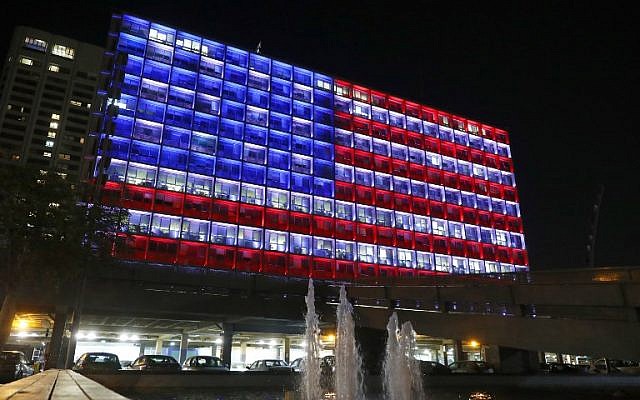
Especially poignant in 2023, after attacks in Israel — Solidarity with the United States: “Tel Aviv city hall, lit up in the colors of the American flag to honor the victims of the mass shooting in Las Vegas, on October 2, 2017. (AFP Photo/Jack Guez)” – From the Times of Israel
October is not a big month for dates to fly the U.S. flag. Only one state joined the union in October, and only two other dates received Congress’s designation for flag-flying.
Here are October’s flag-flying days, in chronological order:
Columbus Day, October 9 — tradition puts Columbus Day on October 12, but in law it is designated as the second Monday in October (to make a three-day weekend for workers who get a holiday); in 2023, October 9 is the second Monday of the month.
Nevada Statehood Day, October 31; Nevada joined the union during the Civil War, in 1864, the 36th state.
Federal law also designates October 9 as Leif Erickson Day, a concession to Scandanavian-descended Americans who argue Erickson beat Columbus to the Americas by a few hundred years. Congress’s recognition does not include an urging to fly the flag, though the President may issue such a proclamation.
Several states honor American indigenous groups on the same day as Columbus Day, with Indigenous Americans Day, or a similar title.
October 27 is also the birth date of Theodore Roosevelt (1858), the Secretary of the Navy who led the dramatic updating of the fleet that preceded the U.S. push to become a major international power. Navy Day was set on October 27 partly to honor Teddy’s work, and Teddy himself — the “birth” date of the U.S. Navy is considered to be October 7. Here’s a brief history of TR before his presidency, at the Miller Center, written by Sidney Milkis.
Fans of Roosevelt may get an little extra kick flying the flag on his birthday.
National Fallen Firefighters Memorial Weekend, originally held in October and a flag-flying event, has been moved to May in 2022 through 2024. The public law designating the weekend does not specify a date, leaving the foundation that governs the memorial free to move it as desired.
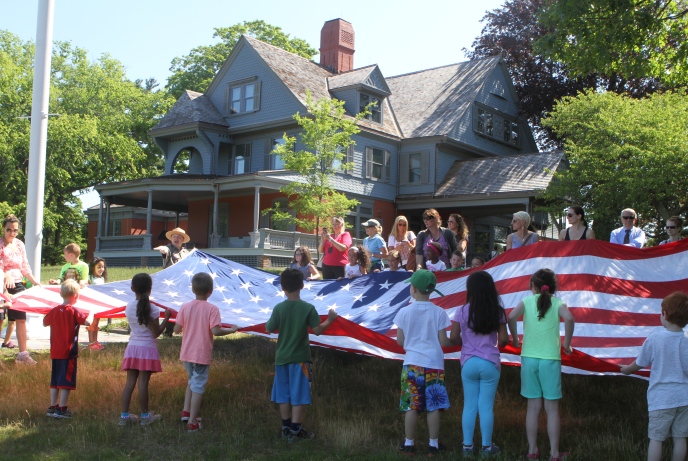
Fourth grade students practice U.S. flag etiquette with the help of National Park Service Rangers at Sagamore Hill National Historic Site in New York. Sagamore Hill, at Oyster Bay, was the home of Theodore Roosevelt and his family. National Park Service Photo
Yes, this is mostly an encore post. Defeating ignorance takes patience and perseverance.
Solidarity with the United States: “Tel Aviv city hall, lit up in the colors of the American flag to honor the victims of the mass shooting in Las Vegas, on October 2, 2017. (AFP Photo/Jack Guez)” – From the Times of Israel
October is not a big month for dates to fly the U.S. flag. Only one state joined the union in October, and only two other dates received Congress’s designation for flag-flying.
Here are October’s three flag-flying days, in chronological order:
Columbus Day, October 10 — tradition puts Columbus Day on October 12, but in law it is designated as the second Monday in October (to make a three-day weekend for workers who get a holiday); in 2022, October 10 is the second Monday of the month.
Nevada Statehood Day, October 31; Nevada joined the union during the Civil War, in 1864, the 36th state.
Federal law also designates October 9 as Leif Erickson Day, a concession to Scandanavian-descended Americans who argue Erickson beat Columbus to the Americas by a few hundred years. Congress’s recognition does not include an urging to fly the flag, though the President may issue such a proclamation.
October 27 is also the birth date of Theodore Roosevelt (1858), the Secretary of the Navy who led the dramatic updating of the fleet that preceded the U.S. push to become a major international power. Navy Day was set on October 27 partly to honor Teddy’s work, and Teddy himself — the “birth” date of the U.S. Navy is considered to be October 7. Here’s a brief history of TR before his presidency, at the Miller Center, written by Sidney Milkis.
Fans of Roosevelt may get an little extra kick flying the flag on his birthday.
Fourth grade students practice U.S. flag etiquette with the help of National Park Service Rangers at Sagamore Hill National Historic Site in New York. Sagamore Hill, at Oyster Bay, was the home of Theodore Roosevelt and his family. National Park Service Photo
Yes, this is an encore post. Defeating ignorance takes patience and perseverance.
Solidarity with the United States: “Tel Aviv city hall, lit up in the colors of the American flag to honor the victims of the mass shooting in Las Vegas, on October 2, 2017. (AFP Photo/Jack Guez)” – From the Times of Israel
October is not a big month for dates to fly the U.S. flag. Only one state joined the union in October, and only two other dates received Congress’s designation for flag-flying.
Here are October’s three flag-flying days, in chronological order:
Columbus Day, October 8 — tradition puts Columbus Day on October 12, but in law it is designated as the second Monday in October (to make a three-day weekend for workers who get a holiday); in 2017, October 8 is the second Monday of the month.
Nevada Statehood Day, October 31; Nevada joined the union during the Civil War, in 1864, the 36th state.
(Yes, I’m getting to this late this year; it’s an election year, you know.)
Federal law also designates October 9 as Leif Erickson Day, a concession to Scandanavian-descended Americans who argue Erickson beat Columbus to the Americas by a few hundred years. Congress’s recognition does not include an urging to fly the flag, though the President may issue such a proclamation.
October 27 is also the birth date of Theodore Roosevelt (1858), the Secretary of the Navy who led the dramatic updating of the fleet that preceded the U.S. push to become a major international power. Navy Day was set on October 27 partly to honor Teddy’s work, and Teddy himself — the “birth” date of the U.S. Navy is considered to be October 7. Here’s a brief history of TR before his presidency, at the Miller Center, written by Sidney Milkis.
Fans of Roosevelt may get an little extra kick flying the flag on his birthday.
Fourth grade students practice U.S. flag etiquette with the help of National Park Service Rangers at Sagamore Hill National Historic Site in New York. Sagamore Hill, at Oyster Bay, was the home of Theodore Roosevelt and his family. National Park Service Photo
Yes, this is an encore post. Defeating ignorance takes patience and perseverance.
Save
Save
Save
Save
Save
Spread the word; friends don't allow friends to repeat history.
It’s another controversy over flying flags, but the flag itself isn’t involved.
U.S. Flag Code specifies that we fly the flag for Columbus Day, but on the rather-new legal day, the second Monday in October. For about a hundred years before that, tradition and law put it on October 12.
So my flag is flying. Many others fly, too. I hope you remembered to post yours.
Parade in Westerly, Rhode Island/Pawcatuck, Connecticut, for Columbus Day 2018. “Several youngsters enjoy the tractors entered in the 71st annual Westerly-Pawcatuck Columbus Day Parade on Sunday. Jackie Turner, Special to The Sun.” Westerly Sun photo.
Columbus Day history tells us the celebration is intended, in part, to offset ugly bias against Italian immigrants in America. Good for that.
But we remember and acknowledge a lot more about history than a century ago. Today, in many quarters Columbus is viewed as a villainous conqueror, an explorer who brought slavery and misery to indigenous Americans.
And there are protests against Columbus in some places. In other places, officials celebrate Indigenous Americans Day, instead of Columbus Day. South Dakota, Columbus, Ohio, and Berkeley and Los Angeles California celebrate indigenous Americans.
There is no doubt that Columbus’s explorations set off several centuries of intense culture clash, resource exploitation and genocide. Probably no one could have foreseen the results. It is also true that in the Americas today modern cultures contribute and lead the world in many fields.
Maybe we should rename it “Celebrate History (and be very sure you know what the history is!) Day.”
Fly your flag, welcome the opportunity to discuss history.
Do you agree?
More:
Navy Day is October 27, the next date listed in the Flag Code to fly the flag.
Spread the word; friends don't allow friends to repeat history.
October is not a big month for dates to fly the U.S. flag. Only one state joined the union in October, and only two other dates received Congress’s designation for flag-flying.
Here are October’s three flag-flying days, in chronological order:
Columbus Day, October 8 — tradition puts Columbus Day on October 12, but in law it is designated as the second Monday in October (to make a three-day weekend for workers who get a holiday); in 2017, October 8 is the second Monday of the month.
Nevada Statehood Day, October 31; Nevada joined the union during the Civil War, in 1864, the 36th state.
Federal law also designates October 9 as Leif Erickson Day, a concession to Scandanavian-descended Americans who argue Erickson beat Columbus to the Americas by a few hundred years. Congress’s recognition does not include an urging to fly the flag, though the President may issue such a proclamation.
The photograph by Senior Airman Dennis Sloan, above, may suggest a suitably spooky theme for flying Old Glory on Halloween. While you are free to fly your flag on any day, Halloween, a religious or holy day for Christians, Celts and perhaps a few others, is not designated by Congress as a day to fly the flag. If you fly it at night, it must be lighted, as is the flag in the photograph.
Roosevelt look-alike Pietro Casini, an Italian merchant. Casini stands outside his Magazzino Roosevelt shop in Florence, Italy, holding a U.S. flag and a photo of Roosevelt. Oct. 26, 1915. George Grantham Bain Collection, Library of Congress Prints and Photographs Division. via Pinterest
October is not a big month for dates to fly the U.S. flag. Only one state joined the union in October, and only two other dates have merited Congress’s designation for flag-flying.
Here are October’s three flag-flying days, in chronological order:
Columbus Day, October 12 — tradition puts Columbus Day on October 12, but in law it is designated as the second Monday in October (to make a three-day weekend for workers who get a holiday); in 2016, October 10 is the second Monday of the month.
Nevada Statehood Day, October 31; Nevada joined the union during the Civil War, in 1864, the 36th state.
Federal law also designates October 9 as Leif Erickson Day, a concession to Scandanavian-descended Americans who argue Erickson beat Columbus to the Americas by a few hundred years. Congress’s recognition does not include an urging to fly the flag, though the President may issue such a proclamation.
A color guard will lead off most Columbus Day parades, as this one in New York City, in 2013. Latinospost.com image
Feel free to put your political brickbats in comments.
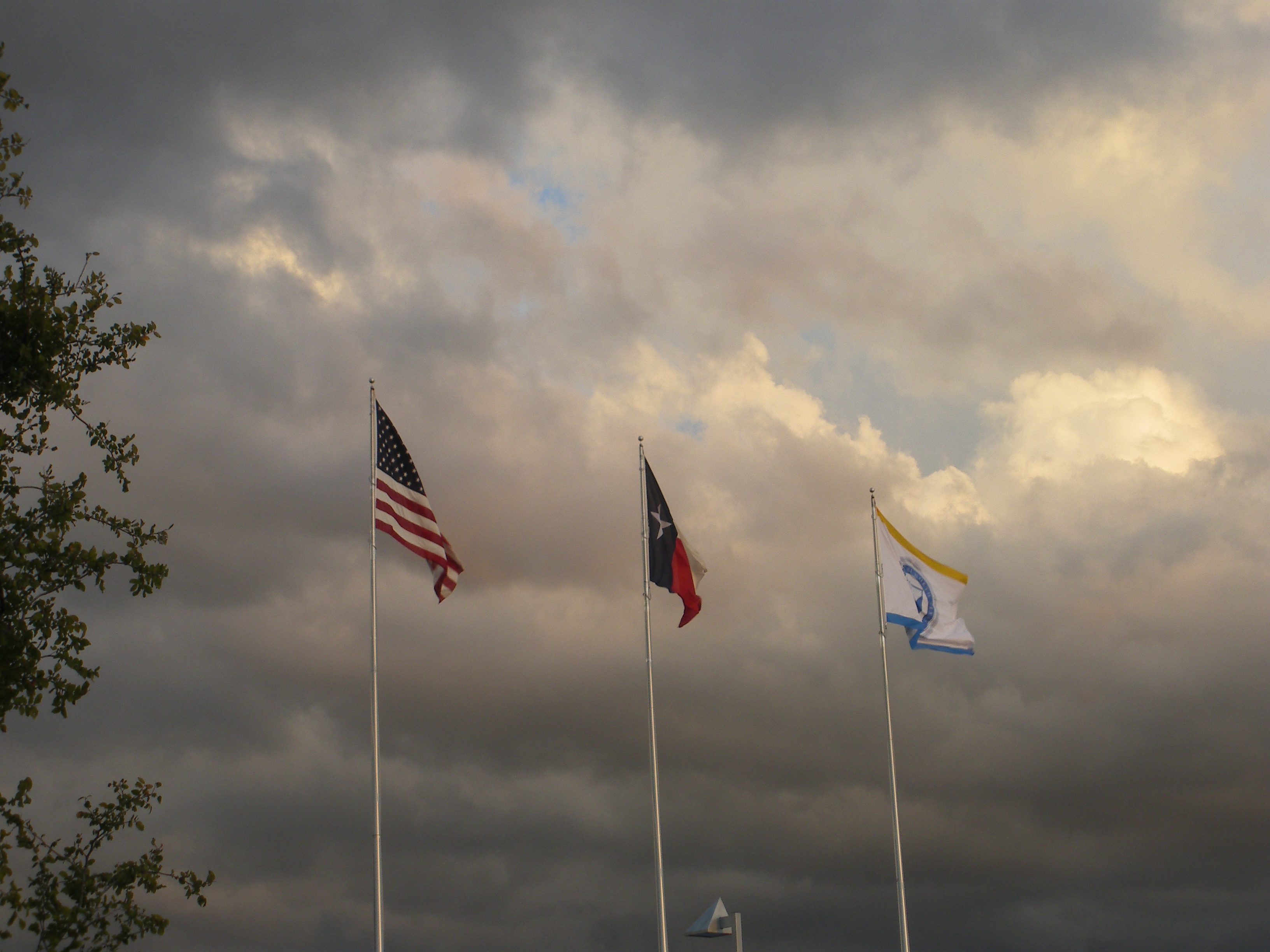
U.S., Texas and University of North Texas at Dallas flags flying on campus, with storm clouds to the South. Photo by Ed Darrell; use encouraged with attribution.
October 12 is the traditional, old calendar date upon which Columbus’s journals show he “discovered” land west of the Atlantic, after sailing from Spain. (Surely there is an explanation for why the date was not altered to conform with the new calendar, but I digress.) In the finite wisdom of Congress, the holiday is designated on the “second Monday of October,” in order to promote three-day weekends and avoid holidays in the middle of the week.
Happily for traditionalists, the second Monday of October 2015 falls on October 12.
The U.S. Flag Code urges Americans to fly their U.S. flags in honor of certain days. Columbus Day is a traditional (since the 19th century) holiday (especially for descendants of Italian immigrants), and one of the score of dates denoted in the Flag Code.
Fly your flag today.
At some parades on Columbus Day the Italian colors outnumber the U.S. colors. New York Daily News photo.
Knights of Columbus of New Haven, Connecticut, present the U.S. flag at the start of New Haven’s Columbus Day Parade, 2006. 28 flags demonstrated the history of the U.S. flag. KofC photo
October is not a big month for dates to fly the U.S. flag. Only one state joined the union in October, and only two other dates have merited Congress’s designation for flag-flying.
Here are October’s three flag-flying days, in chronological order:
Columbus Day, October 12 — tradition puts Columbus Day on October 12, but in law it is designated as the second Monday in October (to make a three-day weekend for workers who get a holiday); in 2015, October 12 is the second Monday of the month.
Nevada Statehood Day, October 31; Nevada joined the union during the Civil War, in 1864, the 36th state.
Federal law also designates October 9 as Leif Erickson Day, a concession to Scandanavian-descended Americans who argue Erickson beat Columbus to the Americas by a few hundred years. Congress’s recognition does not include an urging to fly the flag, though the President may issue such a proclamation.
Feel free to put your political brickbats in comments.
U.S., Texas and University of North Texas at Dallas flags flying on campus, with storm clouds to the South. Photo by Ed Darrell; use encouraged with attribution.
October 12 is the traditional, old calendar date upon which Columbus’s journals show he “discovered” land west of the Atlantic, after sailing from Spain. (Surely there is an explanation for why the date was not altered to conform with the new calendar, but I digress.) In the finite wisdom of Congress, the holiday is designated on the “second Monday of October,” in order to promote three-day weekends and avoid holidays in the middle of the week.
The U.S. Flag Code urges Americans to fly their U.S. flags in honor of certain days. Columbus Day is a traditional (since the 19th century) holiday (especially for descendants of Italian immigrants), and one of the score of dates denoted in the Flag Code.
Falling down on the job here as arbiter of your flag-flying habits. How could I forget that some of America celebrates this day as Columbus Day? (No one in this household gets the day off.)
Fly your U.S. flag today. Fly it to honor Columbus’s discovery of the Americas. Or, fly your flag to honor exploration and explorers, and to remember the people who suffered so greatly as a result of the collision of European cultures in search of money, and American cultures lacking gunpowder and steel.
The second Monday in October is celebrated as Columbus Day, a federal holiday (though not widely honored in private enterprise). Columbus made landfall in the Americas for the first time on October 12, 1492, 520 years ago.
John Vanderlyn, Oil on canvas, 12′ x 18′ – Commissioned 1836/1837; placed 1847 in the Rotunda of the Capitol. Christopher Columbus is shown landing in the West Indies, on an island that the natives called Guanahani and he named San Salvador, on October 12, 1492. He raises the royal banner, claiming the land for his Spanish patrons, and stands bareheaded, with his hat at his feet, in honor of the sacredness of the event. The captains of the Niña and Pinta follow, carrying the banner of Ferdinand and Isabella. The crew displays a range of emotions, some searching for gold in the sand. Natives watch from behind a tree. John Vanderlyn (1775-1852) had studied with Gilbert Stuart and was the first American painter to be trained in Paris, where he worked on this canvas for ten years with the help of assistants.
Did you notice? In the painting in the U.S. Capitol, Columbus isn’t flying the U.S. flag. Acccuracy over political correctness winds, eh?
Below the fold: A description of the painting in the Capitol Rotunda, from the Architect of the U.S. Capitol (the “official” version.)
The distinguished commentator Pat Carrithers, on Facebook: “Today is a special day. It’s Columbus Day. That’s the day on which illegal immigration is called Discovery.”
Fly your U.S. flag today. Fly it to honor Columbus’s discovery of the Americas.
The second Monday in October is celebrated as Columbus Day, a federal holiday (though not widely honored in private enterprise). Columbus made landfall in the Americas for the first time on October 12, 1492, 516 years ago.
John Vanderlyn, Oil on canvas, 12′ x 18′ – Commissioned 1836/1837; placed 1847 in the Rotunda of the Capitol. Christopher Columbus is shown landing in the West Indies, on an island that the natives called Guanahani and he named San Salvador, on October 12, 1492. He raises the royal banner, claiming the land for his Spanish patrons, and stands bareheaded, with his hat at his feet, in honor of the sacredness of the event. The captains of the Niña and Pinta follow, carrying the banner of Ferdinand and Isabella. The crew displays a range of emotions, some searching for gold in the sand. Natives watch from behind a tree. John Vanderlyn (1775-1852) had studied with Gilbert Stuart and was the first American painter to be trained in Paris, where he worked on this canvas for ten years with the help of assistants.
Spread the word; friends don't allow friends to repeat history.
Or, until that account is unsuspended by the forces supporting Donald Trump: Follow @FillmoreWhite, the account of the Millard Fillmore White House Library
We've been soaking in the Bathtub for several months, long enough that some of the links we've used have gone to the Great Internet in the Sky.
If you find a dead link, please leave a comment to that post, and tell us what link has expired.
Thanks!
Retired teacher of law, economics, history, AP government, psychology and science. Former speechwriter, press guy and legislative aide in U.S. Senate. Former Department of Education. Former airline real estate, telecom towers, Big 6 (that old!) consultant. Lab and field research in air pollution control.
My blog, Millard Fillmore's Bathtub, is a continuing experiment to test how to use blogs to improve and speed up learning processes for students, perhaps by making some of the courses actually interesting. It is a blog for teachers, to see if we can use blogs. It is for people interested in social studies and social studies education, to see if we can learn to get it right. It's a blog for science fans, to promote good science and good science policy. It's a blog for people interested in good government and how to achieve it.
BS in Mass Communication, University of Utah
Graduate study in Rhetoric and Speech Communication, University of Arizona
JD from the National Law Center, George Washington University


 Posted by Ed Darrell







 Millard Fillmore's Bathtub
_Read_more,_http-www.dvidshub.net-image-675376-american-flag-lit-full-moon.UGyISa5jcdU%5Eixzz28GOdWQR5.jpg)