Encore quote of the moment: John F. Kennedy, “We choose to go to the Moon”

September 12, 2012

John F. Kennedy at Rice University, Houston, Texas, Sept 12, 1962 - photo from NASA

John F. Kennedy at Rice University, Houston, Texas, Sept 12, 1962 – photo from NASA

There is no strife, no prejudice, no national conflict in outer space as yet. Its hazards are hostile to us all. Its conquest deserves the best of all mankind, and its opportunity for peaceful cooperation many never come again. But why, some say, the moon? Why choose this as our goal? And they may well ask why climb the highest mountain? Why, 35 years ago, fly the Atlantic? Why does Rice play Texas?

We choose to go to the moon. We choose to go to the moon in this decade and do the other things, not because they are easy, but because they are hard, because that goal will serve to organize and measure the best of our energies and skills, because that challenge is one that we are willing to accept, one we are unwilling to postpone, and one which we intend to win, and the others, too.

President John F. Kennedy, September 12, 1962, at Rice University, Houston, Texas

This is an encore post, on the 50th anniversary of the speech.

Why this speech in Houston?  There’s more here than just a speech in a football stadium.  Kennedy was working to save the space initiative, and to make America more secure.

In this quest, Kennedy lays out the reasons we need strong science research programs funded by our federal government, and strong science educational achievement in all of our schools.

From the White House History Association:

Race to the Moon

President John F. Kennedy (1961-1963) awoke on April 12, 1961, to the news that the Soviet Union had won the race to put a man into space. Kennedy immediately met with Vice President Lyndon Johnson in the White House to discuss the embarrassment of the Soviets beating America again. “Can we put a man on the moon before them?” Kennedy asked. A few weeks later, Kennedy challenged the nation to “commit itself to achieving the goal, before this decade is out, of landing a man on the moon and returning him safely to earth.”

Kennedy challenged Congress and the imaginations of all Americans a few weeks later, when on May 25, in a special Joint Session of Congress, he proposed a Moon exploration program.  In a speech outlining defense and foreign policy needs to make the U.S. secure and safe against threats from Soviet communism, or any other nation or faction, Kennedy spoke openly about the space race that had been waged since October 4, 1957, when the Soviet Union became the first nation on Earth to orbit an artificial satellite, Sputnik.

Kennedy told Congress in that part of the speech:

Finally, if we are to win the battle that is now going on around the world between freedom and tyranny, the dramatic achievements in space which occurred in recent weeks should have made clear to us all, as did the Sputnik in 1957, the impact of this adventure on the minds of men everywhere, who are attempting to make a determination of which road they should take. Since early in my term, our efforts in space have been under review. With the advice of the Vice President, who is Chairman of the National Space Council, we have examined where we are strong and where we are not, where we may succeed and where we may not. Now it is time to take longer strides–time for a great new American enterprise–time for this nation to take a clearly leading role in space achievement, which in many ways may hold the key to our future on earth.

I believe we possess all the resources and talents necessary. But the facts of the matter are that we have never made the national decisions or marshalled the national resources required for such leadership. We have never specified long-range goals on an urgent time schedule, or managed our resources and our time so as to insure their fulfillment.

Recognizing the head start obtained by the Soviets with their large rocket engines, which gives them many months of leadtime, and recognizing the likelihood that they will exploit this lead for some time to come in still more impressive successes, we nevertheless are required to make new efforts on our own. For while we cannot guarantee that we shall one day be first, we can guarantee that any failure to make this effort will make us last. We take an additional risk by making it in full view of the world, but as shown by the feat of astronaut Shepard, this very risk enhances our stature when we are successful. But this is not merely a race. Space is open to us now; and our eagerness to share its meaning is not governed by the efforts of others. We go into space because whatever mankind must undertake, free men must fully share.

I therefore ask the Congress, above and beyond the increases I have earlier requested for space activities, to provide the funds which are needed to meet the following national goals:

First, I believe that this nation should commit itself to achieving the goal, before this decade is out, of landing a man on the moon and returning him safely to the earth. No single space project in this period will be more impressive to mankind, or more important for the long-range exploration of space; and none will be so difficult or expensive to accomplish. We propose to accelerate the development of the appropriate lunar space craft. We propose to develop alternate liquid and solid fuel boosters, much larger than any now being developed, until certain which is superior. We propose additional funds for other engine development and for unmanned explorations–explorations which are particularly important for one purpose which this nation will never overlook: the survival of the man who first makes this daring flight. But in a very real sense, it will not be one man going to the moon–if we make this judgment affirmatively, it will be an entire nation. For all of us must work to put him there.

(Here’s a link to an audio excerpt of that speech, from the Kennedy Library.)

The race was on.  The Soviet Union’s massive rocket engines gave them a decided advantage.  Kennedy’s challenge captured the imagination of Americans and America.  Necessary money flowed from Congress, but not in a completely free flow.  Some opposed the nation’s efforts in space exploration because they thought spending on space exploration detracted from the nation’s defense efforts.  Kennedy continued to stress the connection between space exploration and defense.  He was backed by successes — Navy Commander Alan Shepard, Jr., had successfully launched into space and returned safely; and on February 20, 1962, pilot Marine Capt. John Glenn orbited the Earth three times, catching the U.S. up almost to where the Soviet Union was in manned space exploration.

Kennedy understood that constant attention, constant selling of the space program would be necessary.  So in September 1962 he found himself in Houston, the newly-designated home of the manned space program, and he took the opportunity to cast the American goals in the space race as peaceful, good for all mankind, and definitely worth the massive costs.

Notice in how he casts putting a human on the Moon in league with other great achievements of civilization.  Kennedy was truly shooting for the stars.

Notice also how he relates space exploration to practical applications then in existence, such as communication, navigation of ships at sea, and weather forecasting.  This was years before geosynchronus satellites were used for everyday telephone conversations, years before quantum theory was harnessed for Global Positioning Systems (GPS) and digital personal, handheld telephones, and before the newly-invented printed circuits were miniaturized to make computer calculating a possibility in space — the Moon landing was done with slide rules and hand calculations.

Just over 14 months later Kennedy would die in Texas, in Dallas, on November 22, 1963.  On July 20, 1969, Neil Armstrong and Buzz Aldrin landed the Eagle Lunar Module on the Moon, at the Sea of Tranquility.  A few hours later, on July 21, they stepped out on the Moon.  From Kennedy’s speech to Congress, the task had taken 8 years, one month and 26 days.

More resources:

Tip of the old scrub brush for inspiration to “Anything You Ever Wanted to Know” at KERA-FM 90.1 in Dallas, on July 24, 2009.

Buzz Aldrin on the Moon, with Neil Armstrong, the U.S. flag, and the Eagle Lunar Module reflected in his helmet visor, July 21, 1969 - NASA photo via Wikimedia

Buzz Aldrin on the Moon, with Neil Armstrong, the U.S. flag, and the Eagle Lunar Module reflected in his helmet visor, July 21, 1969 – NASA photo via Wikimedia

Please share.

Add to FacebookAdd to NewsvineAdd to DiggAdd to Del.icio.usAdd to StumbleuponAdd to RedditAdd to BlinklistAdd to TwitterAdd to TechnoratiAdd to Furl


Quote of the moment: President asks the Senate Majority Leader for help on the debt ceiling issue, in 1983

July 7, 2011

In a letter to the Majority Leader of the U.S. Senate, the President wrote:

This letter is to ask for your help and support, and that of your colleagues, in the passage of an increase in the limit on the public debt.

As [the Treasury Secretary] has told you, the Treasury’s cash balances have reached a dangerously low point.  Henceforth the Treasury Department cannot guarantee that the Federal Government will have sufficient cash on any one day to meet all of its mandated expenses, and thus the United States could be forced to default on its obligations for the first time in history.

This country now possesses the strongest credit in the world.  The full consequences of a default — or even the serious prospect of default — by the United States are impossible to predict and awesome to contemplate.  Denigration of the full faith and credit of the United States would have substantial effects on the domestic financial markets and on the value of the dollar in exchange markets.  The Nation can ill afford to allow such a result.  The risks, the costs, the disruptions, and the incalculable damage lead me to but one conclusion:  the Senate must pass this legislation before the Congress adjourns.

I want to thank you for your immediate attention to this urgent problem, and for your assistance in passing an extenstion of the debt ceiling.

Sincerely,

         Ronald Reagan

True then.  Still true now.

Letter from President Ronald Reagan to Senate Majority Leader Sen. Howard Baker, R-Tennessee, November 16, 1983.  The Treasury Secretary at the time was Donald Regan.

Tip of the old scrub brush to mainstream media pillar, The Washington Post, where a .pdf of the letter is available.


Battle of Bunker Hill, June 17, 1775

June 17, 2011

Barely two months after the Battle of Lexington and the Battle of Concord (April 19, 1775), British regulars attacked American colonists holding high ground near Boston, at Bunker and Breed’s Hills.  The Library of Congress carries a suitable-for-the-classroom description of the events, with links to resources:

Battle of Bunker Hill
Battle of Bunker Hill,
E. Percy Moran, artist,
copyright 1909.
Prints & Photographs Online Catalog

On June 17, 1775, American troops displayed their mettle in the Battle of Bunker Hill during the siege of Boston, inflicting casualties on nearly half of the British troops dispatched to secure Breed’s Hill (where most of the fighting occurred).

Map showing the action at Bunkers-Hill
A plan of the action at Bunkers-Hill, on the 17th. of June, 1775…,
By Sir Thomas Hyde-Page, 1775.
Map Collections

Approximately 2,100 British troops under the command of General Thomas Gage stormed Breed’s Hill, where colonial soldiers were encamped. In their fourth charge up the hillside, the British took the hill from the rebels, who had run out of ammunition. After suffering more than 1,000 casualties during their attacks on Breed’s Hill, the British halted their assaults on rebel strongholds in Boston. The last rebels left on the hill evaded capture by the British thanks to the heroic efforts of Peter Salem, an African-American soldier who mortally wounded the British commanding officer who led the last charge.

When George Washington assumed command of colonial forces two weeks later, he garnered ammunition for Boston troops and secured Dorchester Heights and Bunker Hill.

Several speeches in the American Memory collection African American Perspectives: Pamphlets from the Daniel A. P. Murray Collection, 1818-1907, contain references to Peter Salem, the former slave and hero of the Battle of Bunker Hill:

Mr. Everett has described Peter Salem, a black man, and once a slave, as having been among the most prominent and meritorious characters at the battle of Bunker’s Hill. Indeed, the historical painting of that scene, by Col. Trumbull, an eyewitness, done in 1785, gives Peter Salem , with other black patriots, a conspicuous place. One of the latter is thus commemorated:

“To the Honorable General Court of the Massachusetts Bay: The subscribers beg leave to report to your Honorable House (which we do in justice to the character of so brave a man), that, under our own observation, we declare that a negro man, called Salem Poor, of Col. Frye’s regiment, Capt. Ames’ company, in the late battle at Charlestown, behaved like an experienced officer, as well as an excellent soldier. To set forth particulars of his conduct would be tedious. We would beg leave to say, in the person of this said negro, centres a brave and gallant soldier. The reward due to so great and distinguished a character, we submit to the Congress.”
Cambridge, Dec. 5, 1755.

“A Reading on Slavery, from the Early Presidents.”
Opinions of the Early Presidents, and of the Fathers of the Republic, upon Slavery and upon Negroes as Men and Soldiers.
Prepared for the Celebration of Washington’s Birthday at Lyceum Hall, Salem, February 22, 1863.
African American Perspectives: Pamphlets from the Daniel A. P. Murray Collection, 1818-1907

Learn more about the Battle of Bunker Hill in American Memory:

Spirit of '76
Spirit of ’76, American Mutoscope and Biograph Company, 1905.
The American Variety Stage: Vaudeville and Popular Entertainment, 1870-1920


Then and now: Capitalism vs. Labor 1883, and today

April 2, 2011

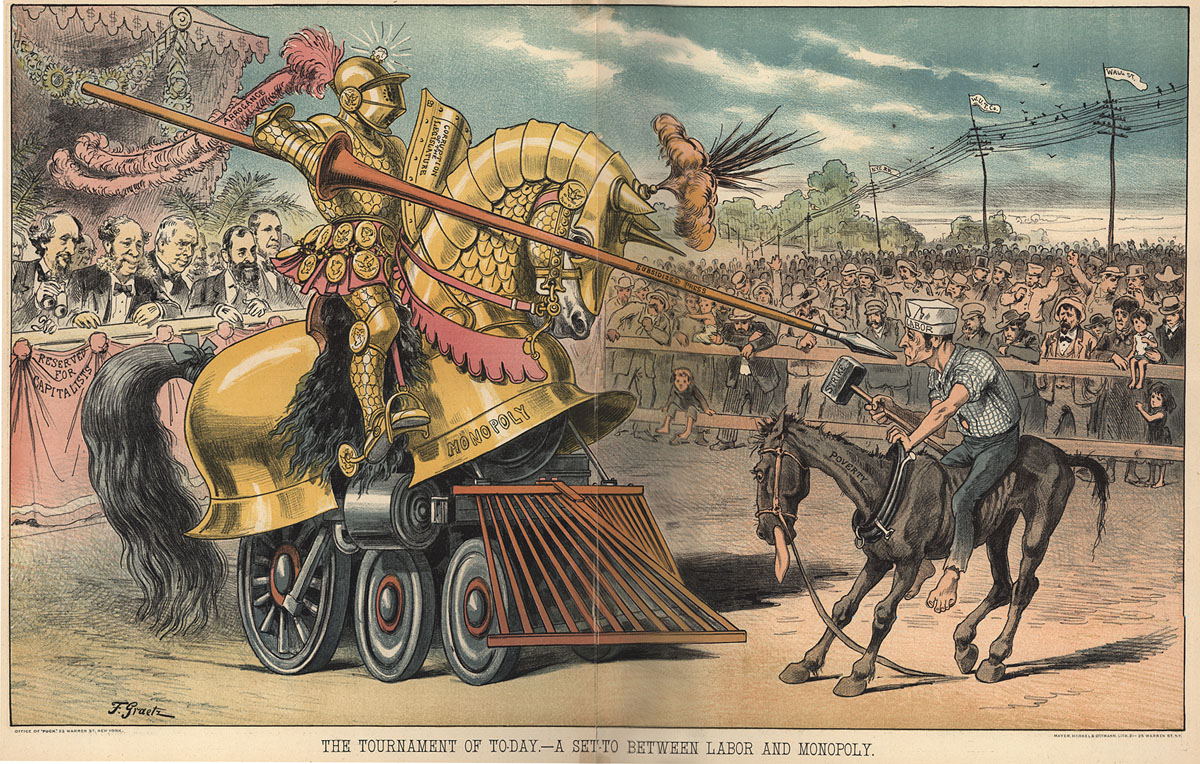
Alas, it’s almost exactly the same now as then:

"Tournament of Today:  A set-to between Labor and Monopoly," Cartoon by Frederick Graetz, Puck Magazine, August 1, 1883 (from files of Georgia State University); click image for a larger view at Georgia State

“Tournament of Today: A set-to between Labor and Monopoly,” Cartoon by Frederick Graetz, Puck Magazine, August 1, 1883 (from files of Georgia State University); click image for a larger view at Georgia State

Information on the cartoon, from SuperITCH: Frederick Graetz, a chromolithograph that was the center spread for Puck Magazine‘s issue of August 1, 1883.  Monopolists portrayed are, from left to right, “businessman, financier and telecommunications pioneer Cyrus Field; railroad tycoon William Vanderbilt; shipbuilding magnate John Roach; financier, railroad mogul, and speculator Jay Gould; and an unknown monopolist.”  Some might say that the “unknown monopolist” bears a striking resemblance to one of the Koch brothers, but that’s fanciful thinking.

Cartoon - Labor vs Monopoly, Graetz, Puck 8-1-1883 (GSU image)

Labor vs Monopoly – click on this image for a larger version of this historic Puck Magazine cartoon

Tip of the old scrub brush to One Penny Sheet’s “condemned to repeat” feature.

More:


1943 conflict: Flag, First Amendment’s Establishment Clause

June 14, 2010

Historic irony: On Flag Day in 1943, the U.S. Supreme Court issued its decision in the case of West Virginia vs. Barnette.

Billy Gobitis explained why he would not salute the U.S. flag, November 5, 1935 - Library of Congress collection

Image 1 - Billy Gobitas explained why he would not salute the U.S. flag, November 5, 1935 - Library of Congress collection

The case started earlier, in 1935, when a 10-year-old student in West Virginia, sticking to his Jehovah’s Witness principles, refused to salute the U.S. flag in a state-required pledge of allegiance. From the Library of Congress:

“I do not salute the flag because I have promised to do the will of God,” wrote ten-year-old Billy Gobitas (1925-1989) to the Minersville, Pennsylvania, school board in 1935. His refusal, and that of his sister Lillian (age twelve), touched off one of several constitutional legal cases delineating the tension between the state’s authority to require respect for national symbols and an individual’s right to freedom of speech and religion.

The Gobitas children attended a public school which, as did most public schools at that time, required all students to salute and pledge allegiance to the flag of the United States. The Gobitas children were members of the Jehovah’s Witnesses, a church that in 1935 believed that the ceremonial saluting of a national flag was a form of idolatry, a violation of the commandment in Exodus 20:4-6 that “thou shalt not make unto thee any graven image, nor bow down to them. . . .” and forbidden as well by John 5:21 and Matthew 22:21. On 22 October 1935, Billy Gobitas acted on this belief and refused to participate in the daily flag and pledge ceremony. The next day Lillian Gobitas did the same. In this letter Billy Gobitas in his own hand explained his reasons to the school board, but on 6 November 1935, the directors of the Minersville School District voted to expel the two children for insubordination.

The Watch Tower Society of the Jehovah’s Witnesses sued on behalf of the children. The decisions of both the United States district court and court of appeals was in favor of the right of the children to refuse to salute. But in 1940 the United States Supreme Court by an eight-to-one vote reversed these lower court decisions and ruled that the government had the authority to compel respect for the flag as a key symbol of national unity. Minersville v. Gobitis [a printer’s error has enshrined a misspelling of the Gobitas name in legal records] was not, however, the last legal word on the subject. In 1943 the Supreme Court by a six-to-three vote in West Virginia State Board of Education v. Barnette, another case involving the Jehovah’s Witnesses, reconsidered its decision in Gobitis and held that the right of free speech guaranteed in the First Amendment to the Constitution denies the government the authority to compel the saluting of the American flag or the recitation of the pledge of allegiance.

There had been strong public reaction against the Gobitis decision, which had been written by Justice Felix Frankfurter (1882-1965). In the court term immediately following the decision, Frankfurter noted in his scrapbook that Justice William O. Douglas (1898-1980) told him that Justice Hugo LaFayette Black (1886-1971) had changed his mind about the Gobitis case. Frankfurter asked, “Has Hugo been re-reading the Constitution during the summer?” Douglas replied, “No–he has been reading the papers.”1 The Library’s William Gobitas Papers showcase the perspective of a litigant, whereas the abstract legal considerations raised by Gobitis and other cases are represented in the papers of numerous Supreme Court justices held by the Manuscript Division.

1. Quoted in H. N. Hirsch, The Enigma of Felix Frankfurter (New York: Basic Books, 1981), 152.

John E. Haynes and David Wigdor, Manuscript Division

Second page, Billy Gobitiss explanation of why he will not salute the U.S. flag - Library of Congress

Second page, Billy Gobitas's explanation of why he will not salute the U.S. flag: "I do not salute the flag not because I do not love my country but I love my country and I love God more and I must obey His commandments." - Library of Congress

Supreme Court justices do not often get a chance to reconsider their decisions. For example, overturning Plessy vs. Ferguson from 1896 took until 1954 in Brown v. Topeka Board of Education. In the flag salute/pledge of allegiance cases Justice Hugo Black had a change of mind, and when a similar case from West Virginia fell on the Court’s doorstep in 1943, the earlier Gobitis decision was reversed.

Writing for the majority, Justice Robert H. Jackson said:

If there is any fixed star in our constitutional constellation, it is that no official, high or petty, can prescribe what shall be orthodox in politics, nationalism, religion, or other matters of opinion, or force citizens to confess by word or act their faith therein. If there are any circumstances which permit an exception, they do not now occur to us.

Jehovah’s Witnesses, and all other Americans, thereby have the right to refuse to say what they and their faith consider to be a vain oath.

And that, boys and girls, is what the First Amendment means.

Resources:


Who invented Santa Claus? Who really wrote the “Night Before Christmas?”

December 7, 2009

An encore post from 2007

Thomas Nast invented Santa Claus? Clement C. Moore didn’t write the famous poem that starts out, “‘Twas the night before Christmas, and all through the house . . . ?”

The murky waters of history from Millard Fillmore’s Bathtub soak even our most cherished ideas and traditions.

But isn’t that part of the fun of history?

Santa Claus delivers to Union soldiers, "Santa Claus in Camp" - Thomas Nast, Harper's Weekly, Jan 3, 1863
Thomas Nast’s first published drawing featuring Santa Claus; for Harper’s Weekly, “A Journal of Civilization,” January 3, 1863 Nast portrayed the elf distributing packages to Union troops: “Santa Claus in camp.” Nast (1840-1904) was 23 when he drew this image.

Yes, Virginia (and California, too)! Thomas Nast created the image of Santa Claus most of us in the U.S. know today. Perhaps even more significant than his campaign against the graft of Boss Tweed, Nast’s popularization of a fat, jolly elf who delivers good things to people for Christmas makes one of the great stories in commercial illustration. Nast’s cartoons, mostly for the popular news publication Harper’s Weekly, created many of the conventions of modern political cartooning and modeled the way in which an illustrator could campaign for good, with his campaign against the graft of Tammany Hall and Tweed. But Nast’s popular vision of Santa Claus can be said to be the foundation for the modern mercantile flurry around Christmas.

Nast is probably ensconced in a cartoonists’ hall of fame. Perhaps he should be in a business or sales hall of fame, too.  [See also Bill Casselman’s page, “The Man Who Designed Santa Claus.]

Nast’s drawings probably drew some inspiration from the poem, “Account of a Visit from St. Nicholas,” traditionally attributed to Clement C. Moore, a New York City lawyer, published in 1822. The poem is among the earliest to describe the elf dressed in fur, and magically coming down a chimney to leave toys for children; the poem invented the reindeer-pulled sleigh.

Modern analysis suggests the poem was not the work of Moore, and many critics and historians now attribute it to Major Henry Livingston, Jr. (1748-1828) following sleuthing by Vassar College Prof. Don Foster in 2000. Fortunately for us, we do not need to be partisans in such a query to enjoy the poem (a complete copy of which is below the fold).

The Library of Congress still gives Moore the credit. When disputes arise over who wrote about the night before Christmas, is it any wonder more controversial topics produce bigger and louder disputes among historians?

Moore was not known for being a poet. The popular story is that he wrote it on the spur of the moment:

Moore is thought to have composed the tale, now popularly known as “The Night Before Christmas,” on December 24, 1822, while traveling home from Greenwich Village, where he had bought a turkey for his family’s Christmas dinner.

Inspired by the plump, bearded Dutchman who took him by sleigh on his errand through the snow-covered streets of New York City, Moore penned A Visit from St. Nicholas for the amusement of his six children, with whom he shared the poem that evening. His vision of St. Nicholas draws upon Dutch-American and Norwegian traditions of a magical, gift-giving figure who appears at Christmas time, as well as the German legend of a visitor who enters homes through chimneys.

Again from the Library of Congress, we get information that suggests that Moore was a minor celebrity from a well-known family with historical ties that would make a good “connections” exercise in a high school history class, perhaps (”the link from Aaron Burr’s treason to Santa Claus?”): (read more, below the fold)

Clement Moore was born in 1779 into a prominent New York family. His father, Benjamin Moore, president of Columbia University, in his role as Episcopal Bishop of New York participated in the inauguration of George Washington as the nation’s first president. The elder Moore also administered last rites to Alexander Hamilton after he was mortally wounded in a tragic duel with Aaron Burr.

A graduate of Columbia, Clement Moore was a scholar of Hebrew and a professor of Oriental and Greek literature at the General Theological Seminary in Manhattan. [See comment from Pam Bumsted below for more on Moore.] He is said to have been embarrassed by the light-hearted verse, which was made public without his knowledge in December 1823. Moore did not publish it under his name until 1844.

Tonight, American children will be tucked in under their blankets and quilts and read this beloved poem as a last “sugarplum” before slipping into dreamland. Before they drift off, treat them to a message from Santa, recorded by the Thomas Edison Company in 1922.

Santa Claus Hides in Your Phonograph
By Arthur A. Penn, Performed by Harry E. Humphrey.
Edison, 1922.
Coupling date: 6/20/1922. Cutout date: 10/31/1929.
Inventing Entertainment: The Motion Pictures and Sound Recordings of the Edison Companies

Listen to this recording (RealAudio Format)

Listen to this recording (wav Format, 8,471 Kb)

But Henry Livingston was no less noble or historic. He hailed from the Livingtons of the Hudson Valley (one of whose farms is now occupied by Camp Rising Sun of the Louis August Jonas Foundation, a place where I spent four amazing summers teaching swimming and lifesaving). Livingston’s biography at the University of Toronto site offers another path for a connections exercise (”What connects the Declaration of Independence, the American invasion of Canada, the famous poem about a visit from St. Nick, and George W. Bush?”):

Henry Livingston Jr. was born in Poughkeepsie, New York, on Oct. 13, 1748. The Livingston family was one of the important colonial and revolutionary families of New York. The Poughkeepsie branch, descended from Gilbert, the youngest son of Robert Livingston, 1st Lord of Livingston Manor, was not as well off as the more well-known branches, descended from sons Robert and Philip. Two other descendants of Gilbert Livingston, President George Walker Herbert Bush and his son, President-Elect George W. Bush, though, have done their share to bring attention to this line. Henry’s brother, Rev. John Henry Livingston, entered Yale at the age of 12, and was able to unite the Dutch and American branches of the Dutch Reformed Church. At the time of his death, Rev. Livingston was president of Rutgers University. Henry’s father and brother Gilbert were involved in New York politics, and Henry’s granduncle was New York’s first Lt. Governor. But the law was the natural home for many of Henry’s family. His brother-in-law, Judge Jonas Platt, was an unsuccessful candidate for governor, as was his daughter Elizabeth’s husband, U.S. Supreme Court Justice Smith Thompson. Henry’s grandson, Sidney Breese, was Chief Justice of the Illinois Supreme Court.

Known for his encyclopedic knowledge and his love of literature, Henry Livingston was a farmer, surveyor and Justice of the Peace, a judicial position dealing with financially limited criminal and civil cases. One of the first New Yorkers to enlist in the Revolutionary Army in 1775, Major Henry Livingston accompanied his cousin’s husband, General Montgomery, in his campaign up the Hudson River to invade Canada, leaving behind his new wife, Sarah Welles, and their week-old baby, on his Poughkeepsie property, Locust Grove. Baby Catherine was the subject of the first poem currently known by Major Livingston. Following this campaign, Livingston was involved in the War as a Commissioner of Sequestration, appropriating lands owned by British loyalists and selling them for the revolutionary cause. It was in the period following Sarah’s early death in 1783, that Major Livingston published most of his poems and prose, anonymously or under the pseudonym of R. Ten years after the death of Sarah, Henry married Jane Patterson, the daughter of a Dutchess County politician and sister of his next-door neighbor. Between both wives, Henry fathered twelve children. He published his good-natured, often occasional verse from 1787 in many journals, including Political Barometer, Poughkeepsie Journal, and New-York Magazine. His most famous poem, “Account of a Visit from St. Nicholas,” was until 2000 thought to have been the work of Clement Clarke Moore (1779-1863), who published it with his collected poems in 1844. Livingston died Feb. 29, 1828.

More on Henry Livingston and his authorship of the Christmas poem here.

Thomas Nast, Merry Old Santa Claus, Harper's Weekly, Jan 1, 1881

Our views of Santa Claus owe a great deal also to the Coca-Cola advertising campaign. Coca-Cola first noted Santa’s use of the drink in a 1922 campaign to suggest Coke was a year-round drink (100 years after the publication of Livingston’s poem). The company’s on-line archives gives details:

In 1930, artist Fred Mizen painted a department store Santa in a crowd drinking a bottle of Coke. The ad featured the world’s largest soda fountain, which was located in the department store of Famous Barr Co. in St. Louis, Mo. Mizen’s painting was used in print ads that Christmas season, appearing in The Saturday Evening Post in December 1930.

1936 Coca-Cola Santa cardboard store display

  • 1936 Coca-Cola Santa cardboard store display

Archie Lee, the D’Arcy Advertising Agency executive working with The Coca-Cola Company, wanted the next campaign to show a wholesome Santa as both realistic and symbolic. In 1931, The Coca-Cola Company commissioned Michigan-born illustrator Haddon Sundblom to develop advertising images using Santa Claus — showing Santa himself, not a man dressed as Santa, as Mizen’s work had portrayed him.
1942 original oil painting - 'They Remembered Me'

  • 1942 original oil painting – ‘They Remembered Me’

For inspiration, Sundblom turned to Clement Clark Moore’s 1822 poem “A Visit From St. Nicholas” (commonly called “‘Twas the Night Before Christmas”). Moore’s description of St. Nick led to an image of Santa that was warm, friendly, pleasantly plump and human. For the next 33 years, Sundblom painted portraits of Santa that helped to create the modern image of Santa — an interpretation that today lives on in the minds of people of all ages, all over the world.

Santa Claus is a controversial figure. Debates still rage among parents about the wisdom of allowing the elf into the family’s home, and under what conditions. Theologians worry that the celebration of Christmas is diluted by the imagery. Other faiths worry that the secular, cultural impact of Santa Claus damages their own faiths (few other faiths have such a popular figure, and even atheists generally give gifts and participate in Christmas rituals such as putting up a decorated tree).

For over 100 years, Santa Claus has been a popular part of commercial, cultural and religious life in America. Has any other icon endured so long, or so well?

________________________
Below:
From the University of Toronto Library’s Representative Poetry Online

Major Henry Livingston, Jr. (1748-1828)

Account of a Visit from St. Nicholas

1 ‘Twas the night before Christmas, when all thro’ the house,
2 Not a creature was stirring, not even a mouse;
3 The stockings were hung by the chimney with care,
4 In hopes that St. Nicholas soon would be there;
5 The children were nestled all snug in their beds,
6 While visions of sugar plums danc’d in their heads,
7 And Mama in her ‘kerchief, and I in my cap,
8 Had just settled our brains for a long winter’s nap –
9 When out on the lawn there arose such a clatter,
10 I sprang from the bed to see what was the matter.
11 Away to the window I flew like a flash,
12 Tore open the shutters, and threw up the sash.
13 The moon on the breast of the new fallen snow,
14 Gave the lustre of mid-day to objects below;
15 When, what to my wondering eyes should appear,
16 But a miniature sleigh, and eight tiny rein-deer,
17 With a little old driver, so lively and quick,
18 I knew in a moment it must be St. Nick.
19 More rapid than eagles his coursers they came,
20 And he whistled, and shouted, and call’d them by name:
21 “Now! Dasher, now! Dancer, now! Prancer, and Vixen,
22 “On! Comet, on! Cupid, on! Dunder and Blixem;
23 “To the top of the porch! to the top of the wall!
24 “Now dash away! dash away! dash away all!”
25 As dry leaves before the wild hurricane fly,
26 When they meet with an obstacle, mount to the sky;
27 So up to the house-top the coursers they flew,
28 With the sleigh full of Toys — and St. Nicholas too:
29 And then in a twinkling, I heard on the roof
30 The prancing and pawing of each little hoof.
31 As I drew in my head, and was turning around,
32 Down the chimney St. Nicholas came with a bound:
33 He was dress’d all in fur, from his head to his foot,
34 And his clothes were all tarnish’d with ashes and soot;
35 A bundle of toys was flung on his back,
36 And he look’d like a peddler just opening his pack:
37 His eyes — how they twinkled! his dimples how merry,
38 His cheeks were like roses, his nose like a cherry;
39 His droll little mouth was drawn up like a bow.
40 And the beard of his chin was as white as the snow;
41 The stump of a pipe he held tight in his teeth,
42 And the smoke it encircled his head like a wreath.
43 He had a broad face, and a little round belly
44 That shook when he laugh’d, like a bowl full of jelly:
45 He was chubby and plump, a right jolly old elf,
46 And I laugh’d when I saw him in spite of myself;
47 A wink of his eye and a twist of his head
48 Soon gave me to know I had nothing to dread.
49 He spoke not a word, but went straight to his work,
50 And fill’d all the stockings; then turn’d with a jerk,
51 And laying his finger aside of his nose
52 And giving a nod, up the chimney he rose.
53 He sprung to his sleigh, to his team gave a whistle,
54 And away they all flew, like the down of a thistle:
55 But I heard him exclaim, ere he drove out of sight –
56 Happy Christmas to all, and to all a good night.

Online text copyright © 2005, Ian Lancashire for the Department of English, University of Toronto. Published by the Web Development Group, Information Technology Services, University of Toronto Libraries. Be sure to visit this site for more information on this poem, on Maj. Livingston, and on poetry in general.


Indoctrinate yourself! Obama’s education speech, full text

September 8, 2009

Unedited, direct from the White House website:

Prepared Remarks of President Barack Obama
Back to School Event

Arlington, Virginia
September 8, 2009

The President: Hello everyone – how’s everybody doing today? I’m here with students at Wakefield High School in Arlington, Virginia. And we’ve got students tuning in from all across America, kindergarten through twelfth grade. I’m glad you all could join us today.
I know that for many of you, today is the first day of school. And for those of you in kindergarten, or starting middle or high school, it’s your first day in a new school, so it’s understandable if you’re a little nervous. I imagine there are some seniors out there who are feeling pretty good right now, with just one more year to go. And no matter what grade you’re in, some of you are probably wishing it were still summer, and you could’ve stayed in bed just a little longer this morning.
I know that feeling. When I was young, my family lived in Indonesia for a few years, and my mother didn’t have the money to send me where all the American kids went to school. So she decided to teach me extra lessons herself, Monday through Friday – at 4:30 in the morning.
Now I wasn’t too happy about getting up that early. A lot of times, I’d fall asleep right there at the kitchen table. But whenever I’d complain, my mother would just give me one of those looks and say, “This is no picnic for me either, buster.”
So I know some of you are still adjusting to being back at school. But I’m here today because I have something important to discuss with you. I’m here because I want to talk with you about your education and what’s expected of all of you in this new school year.
Now I’ve given a lot of speeches about education. And I’ve talked a lot about responsibility.
I’ve talked about your teachers’ responsibility for inspiring you, and pushing you to learn.
I’ve talked about your parents’ responsibility for making sure you stay on track, and get your homework done, and don’t spend every waking hour in front of the TV or with that Xbox.
I’ve talked a lot about your government’s responsibility for setting high standards, supporting teachers and principals, and turning around schools that aren’t working where students aren’t getting the opportunities they deserve.
But at the end of the day, we can have the most dedicated teachers, the most supportive parents, and the best schools in the world – and none of it will matter unless all of you fulfill your responsibilities. Unless you show up to those schools; pay attention to those teachers; listen to your parents, grandparents and other adults; and put in the hard work it takes to succeed.
And that’s what I want to focus on today: the responsibility each of you has for your education. I want to start with the responsibility you have to yourself.
Every single one of you has something you’re good at. Every single one of you has something to offer. And you have a responsibility to yourself to discover what that is. That’s the opportunity an education can provide.
Maybe you could be a good writer – maybe even good enough to write a book or articles in a newspaper – but you might not know it until you write a paper for your English class. Maybe you could be an innovator or an inventor – maybe even good enough to come up with the next iPhone or a new medicine or vaccine – but you might not know it until you do a project for your science class. Maybe you could be a mayor or a Senator or a Supreme Court Justice, but you might not know that until you join student government or the debate team.
And no matter what you want to do with your life – I guarantee that you’ll need an education to do it. You want to be a doctor, or a teacher, or a police officer? You want to be a nurse or an architect, a lawyer or a member of our military? You’re going to need a good education for every single one of those careers. You can’t drop out of school and just drop into a good job. You’ve got to work for it and train for it and learn for it.
And this isn’t just important for your own life and your own future. What you make of your education will decide nothing less than the future of this country. What you’re learning in school today will determine whether we as a nation can meet our greatest challenges in the future.
You’ll need the knowledge and problem-solving skills you learn in science and math to cure diseases like cancer and AIDS, and to develop new energy technologies and protect our environment. You’ll need the insights and critical thinking skills you gain in history and social studies to fight poverty and homelessness, crime and discrimination, and make our nation more fair and more free. You’ll need the creativity and ingenuity you develop in all your classes to build new companies that will create new jobs and boost our economy.
We need every single one of you to develop your talents, skills and intellect so you can help solve our most difficult problems. If you don’t do that – if you quit on school – you’re not just quitting on yourself, you’re quitting on your country.
Now I know it’s not always easy to do well in school. I know a lot of you have challenges in your lives right now that can make it hard to focus on your schoolwork.
I get it. I know what that’s like. My father left my family when I was two years old, and I was raised by a single mother who struggled at times to pay the bills and wasn’t always able to give us things the other kids had. There were times when I missed having a father in my life. There were times when I was lonely and felt like I didn’t fit in.
So I wasn’t always as focused as I should have been. I did some things I’m not proud of, and got in more trouble than I should have. And my life could have easily taken a turn for the worse.
But I was fortunate. I got a lot of second chances and had the opportunity to go to college, and law school, and follow my dreams. My wife, our First Lady Michelle Obama, has a similar story. Neither of her parents had gone to college, and they didn’t have much. But they worked hard, and she worked hard, so that she could go to the best schools in this country.
Some of you might not have those advantages. Maybe you don’t have adults in your life who give you the support that you need. Maybe someone in your family has lost their job, and there’s not enough money to go around. Maybe you live in a neighborhood where you don’t feel safe, or have friends who are pressuring you to do things you know aren’t right.
But at the end of the day, the circumstances of your life – what you look like, where you come from, how much money you have, what you’ve got going on at home – that’s no excuse for neglecting your homework or having a bad attitude. That’s no excuse for talking back to your teacher, or cutting class, or dropping out of school. That’s no excuse for not trying.
Where you are right now doesn’t have to determine where you’ll end up. No one’s written your destiny for you. Here in America, you write your own destiny. You make your own future.
That’s what young people like you are doing every day, all across America.
Young people like Jazmin Perez, from Roma, Texas. Jazmin didn’t speak English when she first started school. Hardly anyone in her hometown went to college, and neither of her parents had gone either. But she worked hard, earned good grades, got a scholarship to Brown University, and is now in graduate school, studying public health, on her way to being Dr. Jazmin Perez.
I’m thinking about Andoni Schultz, from Los Altos, California, who’s fought brain cancer since he was three. He’s endured all sorts of treatments and surgeries, one of which affected his memory, so it took him much longer – hundreds of extra hours – to do his schoolwork. But he never fell behind, and he’s headed to college this fall.
And then there’s Shantell Steve, from my hometown of Chicago, Illinois. Even when bouncing from foster home to foster home in the toughest neighborhoods, she managed to get a job at a local health center; start a program to keep young people out of gangs; and she’s on track to graduate high school with honors and go on to college.
Jazmin, Andoni and Shantell aren’t any different from any of you. They faced challenges in their lives just like you do. But they refused to give up. They chose to take responsibility for their education and set goals for themselves. And I expect all of you to do the same.
That’s why today, I’m calling on each of you to set your own goals for your education – and to do everything you can to meet them. Your goal can be something as simple as doing all your homework, paying attention in class, or spending time each day reading a book. Maybe you’ll decide to get involved in an extracurricular activity, or volunteer in your community. Maybe you’ll decide to stand up for kids who are being teased or bullied because of who they are or how they look, because you believe, like I do, that all kids deserve a safe environment to study and learn. Maybe you’ll decide to take better care of yourself so you can be more ready to learn. And along those lines, I hope you’ll all wash your hands a lot, and stay home from school when you don’t feel well, so we can keep people from getting the flu this fall and winter.
Whatever you resolve to do, I want you to commit to it. I want you to really work at it.
I know that sometimes, you get the sense from TV that you can be rich and successful without any hard work — that your ticket to success is through rapping or basketball or being a reality TV star, when chances are, you’re not going to be any of those things.
But the truth is, being successful is hard. You won’t love every subject you study. You won’t click with every teacher. Not every homework assignment will seem completely relevant to your life right this minute. And you won’t necessarily succeed at everything the first time you try.
That’s OK.  Some of the most successful people in the world are the ones who’ve had the most failures. JK Rowling’s first Harry Potter book was rejected twelve times before it was finally published. Michael Jordan was cut from his high school basketball team, and he lost hundreds of games and missed thousands of shots during his career. But he once said, “I have failed over and over and over again in my life. And that is why I succeed.”
These people succeeded because they understand that you can’t let your failures define you – you have to let them teach you. You have to let them show you what to do differently next time. If you get in trouble, that doesn’t mean you’re a troublemaker, it means you need to try harder to behave. If you get a bad grade, that doesn’t mean you’re stupid, it just means you need to spend more time studying.
No one’s born being good at things, you become good at things through hard work. You’re not a varsity athlete the first time you play a new sport. You don’t hit every note the first time you sing a song. You’ve got to practice. It’s the same with your schoolwork. You might have to do a math problem a few times before you get it right, or read something a few times before you understand it, or do a few drafts of a paper before it’s good enough to hand in.
Don’t be afraid to ask questions. Don’t be afraid to ask for help when you need it. I do that every day. Asking for help isn’t a sign of weakness, it’s a sign of strength. It shows you have the courage to admit when you don’t know something, and to learn something new. So find an adult you trust – a parent, grandparent or teacher; a coach or counselor – and ask them to help you stay on track to meet your goals.
And even when you’re struggling, even when you’re discouraged, and you feel like other people have given up on you – don’t ever give up on yourself. Because when you give up on yourself, you give up on your country.
The story of America isn’t about people who quit when things got tough. It’s about people who kept going, who tried harder, who loved their country too much to do anything less than their best.
It’s the story of students who sat where you sit 250 years ago, and went on to wage a revolution and found this nation. Students who sat where you sit 75 years ago who overcame a Depression and won a world war; who fought for civil rights and put a man on the moon. Students who sat where you sit 20 years ago who founded Google, Twitter and Facebook and changed the way we communicate with each other.
So today, I want to ask you, what’s your contribution going to be? What problems are you going to solve? What discoveries will you make? What will a president who comes here in twenty or fifty or one hundred years say about what all of you did for this country?
Your families, your teachers, and I are doing everything we can to make sure you have the education you need to answer these questions. I’m working hard to fix up your classrooms and get you the books, equipment and computers you need to learn. But you’ve got to do your part too. So I expect you to get serious this year. I expect you to put your best effort into everything you do. I expect great things from each of you. So don’t let us down – don’t let your family or your country or yourself down. Make us all proud. I know you can do it.
Thank you, God bless you, and God bless America.

Should you watch it?  Here are the trailers:
Resources:

THE PRESIDENT’S BACK-TO-SCHOOL MESSAGE TO AMERICA’S STUDENTS

Help get America’s students engaged! On Tuesday, September 8 — the first day of school for many students — the President will talk directly to students across the country on the importance of taking responsibility for their education, challenging them to set goals and do everything they can to succeed. We want to make sure that as many schools and classrooms nationwide can participate in this special opportunity, so we are making the President’s address and all the information that comes with it available as widely as possible. Whether you are a teacher, a school board member, or a member of the media, find information below to help you watch and be engaged with the President in welcoming our students back to school.

The President’s Message

When

  • Tuesday, September 8th, at 12:00 PM (EDT)

How to Watch

  • The President’s message will be streamed live on WhiteHouse.gov/live, and broadcast live on C-Span
  • Downloadable video of the speech will be made available on this page later that day as it becomes available
  • For school districts hoping to access the satellite feed, it will be available beginning at 11:00 AM (EDT) using the following coordinates:
    * Galaxy 28/Transponder 17, Slot C (9 MHz)
    * Uplink Frequency 14344.5 Horizontal
    * Downlink Frequency 12044.5 Vertical

Classroom Engagement Resources

Spread the knowledge:

Add to FacebookAdd to NewsvineAdd to DiggAdd to Del.icio.usAdd to RedditAdd to BlinklistAdd to TwitterAdd to StumbleuponAdd to TechnoratiAdd to Furl


Quote of the moment: John F. Kennedy, “We choose to go to the Moon”

July 24, 2009

John F. Kennedy at Rice University, Houston, Texas, Sept 12, 1962 - photo from NASA

John F. Kennedy at Rice University, Houston, Texas, Sept 12, 1962 – photo from NASA

There is no strife, no prejudice, no national conflict in outer space as yet. Its hazards are hostile to us all. Its conquest deserves the best of all mankind, and its opportunity for peaceful cooperation many never come again. But why, some say, the moon? Why choose this as our goal? And they may well ask why climb the highest mountain? Why, 35 years ago, fly the Atlantic? Why does Rice play Texas?

We choose to go to the moon. We choose to go to the moon in this decade and do the other things, not because they are easy, but because they are hard, because that goal will serve to organize and measure the best of our energies and skills, because that challenge is one that we are willing to accept, one we are unwilling to postpone, and one which we intend to win, and the others, too.

President John F. Kennedy, September 12, 1962, at Rice University, Houston, Texas

Why this speech in Houston?  There’s more here than just a speech in a football stadium.  Kennedy was working to save the space initiative, and to make America more secure.

In this quest, Kennedy lays out the reasons we need strong science research programs funded by our federal government, and strong science educational achievement in all of our schools.

From the White House History Association:

Race to the Moon

President John F. Kennedy (1961-1963) awoke on April 12, 1961, to the news that the Soviet Union had won the race to put a man into space. Kennedy immediately met with Vice President Lyndon Johnson in the White House to discuss the embarrassment of the Soviets beating America again. “Can we put a man on the moon before them?” Kennedy asked. A few weeks later, Kennedy challenged the nation to “commit itself to achieving the goal, before this decade is out, of landing a man on the moon and returning him safely to earth.”

Kennedy challenged Congress and the imaginations of all Americans a few weeks later, when on May 25, in a special Joint Session of Congress, he proposed a Moon exploration program.  In a speech outlining defense and foreign policy needs to make the U.S. secure and safe against threats from Soviet communism, or any other nation or faction, Kennedy spoke openly about the space race that had been waged since October 4, 1957, when the Soviet Union became the first nation on Earth to orbit an artificial satellite, Sputnik.

Kennedy told Congress in that part of the speech:

Finally, if we are to win the battle that is now going on around the world between freedom and tyranny, the dramatic achievements in space which occurred in recent weeks should have made clear to us all, as did the Sputnik in 1957, the impact of this adventure on the minds of men everywhere, who are attempting to make a determination of which road they should take. Since early in my term, our efforts in space have been under review. With the advice of the Vice President, who is Chairman of the National Space Council, we have examined where we are strong and where we are not, where we may succeed and where we may not. Now it is time to take longer strides–time for a great new American enterprise–time for this nation to take a clearly leading role in space achievement, which in many ways may hold the key to our future on earth.

I believe we possess all the resources and talents necessary. But the facts of the matter are that we have never made the national decisions or marshalled the national resources required for such leadership. We have never specified long-range goals on an urgent time schedule, or managed our resources and our time so as to insure their fulfillment.

Recognizing the head start obtained by the Soviets with their large rocket engines, which gives them many months of leadtime, and recognizing the likelihood that they will exploit this lead for some time to come in still more impressive successes, we nevertheless are required to make new efforts on our own. For while we cannot guarantee that we shall one day be first, we can guarantee that any failure to make this effort will make us last. We take an additional risk by making it in full view of the world, but as shown by the feat of astronaut Shepard, this very risk enhances our stature when we are successful. But this is not merely a race. Space is open to us now; and our eagerness to share its meaning is not governed by the efforts of others. We go into space because whatever mankind must undertake, free men must fully share.

I therefore ask the Congress, above and beyond the increases I have earlier requested for space activities, to provide the funds which are needed to meet the following national goals:

First, I believe that this nation should commit itself to achieving the goal, before this decade is out, of landing a man on the moon and returning him safely to the earth. No single space project in this period will be more impressive to mankind, or more important for the long-range exploration of space; and none will be so difficult or expensive to accomplish. We propose to accelerate the development of the appropriate lunar space craft. We propose to develop alternate liquid and solid fuel boosters, much larger than any now being developed, until certain which is superior. We propose additional funds for other engine development and for unmanned explorations–explorations which are particularly important for one purpose which this nation will never overlook: the survival of the man who first makes this daring flight. But in a very real sense, it will not be one man going to the moon–if we make this judgment affirmatively, it will be an entire nation. For all of us must work to put him there.

(Here’s a link to an audio excerpt of that speech, from the Kennedy Library.)

The race was on.  The Soviet Union’s massive rocket engines gave them a decided advantage.  Kennedy’s challenge captured the imagination of Americans and America.  Necessary money flowed from Congress, but not in a completely free flow.  Some opposed the nation’s efforts in space exploration because they thought spending on space exploration detracted from the nation’s defense efforts.  Kennedy continued to stress the connection between space exploration and defense.  He was backed by successes — Navy Commander Alan Shepard, Jr., had successfully launched into space and returned safely; and on February 20, 1962, pilot Marine Capt. John Glenn orbited the Earth three times, catching the U.S. up almost to where the Soviet Union was in manned space exploration.

Kennedy understood that constant attention, constant selling of the space program would be necessary.  So in September 1962 he found himself in Houston, the newly-designated home of the manned space program, and he took the opportunity to cast the American goals in the space race as peaceful, good for all mankind, and definitely worth the massive costs.

Notice in how he casts putting a human on the Moon in league with other great achievements of civilization.  Kennedy was truly shooting for the stars.

Notice also how he relates space exploration to practical applications then in existence, such as communication, navigation of ships at sea, and weather forecasting.  This was years before geosynchronus satellites were used for everyday telephone conversations, years before quantum theory was harnessed for Global Positioning Systems (GPS) and digital personal, handheld telephones, and before the newly-invented printed circuits were miniaturized to make computer calculating a possibility in space — the Moon landing was done with slide rules and hand calculations.

Just over 14 months later Kennedy would die in Texas, in Dallas, on November 22, 1963.  On July 20, 1969, Neil Armstrong and Buzz Aldrin landed the Eagle Lunar Module on the Moon, at the Sea of Tranquility.  A few hours later, on July 21, they stepped out on the Moon.  From Kennedy’s speech to Congress, the task had taken 8 years, one month and 26 days.

More resources:

Tip of the old scrub brush for inspiration to “Anything You Ever Wanted to Know” at KERA-FM 90.1 in Dallas, on July 24, 2009.

Buzz Aldrin on the Moon, with Neil Armstrong, the U.S. flag, and the Eagle Lunar Module reflected in his helmet visor, July 21, 1969 - NASA photo via Wikimedia

Buzz Aldrin on the Moon, with Neil Armstrong, the U.S. flag, and the Eagle Lunar Module reflected in his helmet visor, July 21, 1969 – NASA photo via Wikimedia

Please share.

Add to FacebookAdd to NewsvineAdd to DiggAdd to Del.icio.usAdd to StumbleuponAdd to RedditAdd to BlinklistAdd to TwitterAdd to TechnoratiAdd to Furl


Typewriter of the moment: Alistair Cooke for the BBC

June 19, 2009

Alistair Cookes typewriter, displayed at BBC headquarters, Bush House, in London - Photo by Jeff Zycinski

Alistair Cooke's typewriter, displayed at BBC headquarters, Bush House, in London - Photo by Jeff Zycinski

Alas, our students now are too young to remember Alistair Cooke’s hosting of “Masterpiece Theater” on PBS, and of course, back then the BBC America service — if it existed — was available only to shortwave fanatics or people  who traveled a lot to the British Isles.

Perhaps more than anyone else other than Winston Churchill, and maybe the Beatles, Alistair Cooke tied England and America together tightly in the 20th century.  BBC’s other writers are good to brilliant, but even their obituary for Cooke (March 30, 2004) doesn’t quite do him justice:

For more than half a century, Alistair Cooke’s weekly broadcasts of Letter from America for BBC radio monitored the pulse of life in the United States and relayed its strengths and weaknesses to 50 countries.

His retirement from the show earlier this month after 58 years, due to ill health, brought a flood of tributes for his huge contributing to broadcasting.

Perhaps for Cooke, from Cooke’s broadcasts, we could develop a new variation of the Advanced Placement document-based question:  Broadcast-based questions. Heaven knows his Letter From America provided profound material on American history:

BBCs famous broadcaster Alistair Cooke, painted by June Mendoza (copyright Mendoza - www.junemendoza.co.uk)

BBC's famous broadcaster Alistair Cooke, painted by June Mendoza (copyright Mendoza - http://www.junemendoza.co.uk)


1943 – What the First Amendment means when saluting the flag conflicts with religion

June 14, 2009

Historic irony: On Flag Day in 1943, the U.S. Supreme Court issued its decision in the case of West Virginia vs. Barnette.

Billy Gobitis explained why he would not salute the U.S. flag, November 5, 1935 - Library of Congress collection

Image 1 - Billy Gobitas explained why he would not salute the U.S. flag, November 5, 1935 - Library of Congress collection

The case started earlier, in 1935, when a 10-year-old student in West Virginia, sticking to his Jehovah’s Witness principles, refused to salute the U.S. flag in a state-required pledge of allegiance.  From the Library of Congress:

“I do not salute the flag because I have promised to do the will of God,” wrote ten-year-old Billy Gobitas (1925-1989) to the Minersville, Pennsylvania, school board in 1935. His refusal, and that of his sister Lillian (age twelve), touched off one of several constitutional legal cases delineating the tension between the state’s authority to require respect for national symbols and an individual’s right to freedom of speech and religion.

The Gobitas children attended a public school which, as did most public schools at that time, required all students to salute and pledge allegiance to the flag of the United States. The Gobitas children were members of the Jehovah’s Witnesses, a church that in 1935 believed that the ceremonial saluting of a national flag was a form of idolatry, a violation of the commandment in Exodus 20:4-6 that “thou shalt not make unto thee any graven image, nor bow down to them. . . .” and forbidden as well by John 5:21 and Matthew 22:21. On 22 October 1935, Billy Gobitas acted on this belief and refused to participate in the daily flag and pledge ceremony. The next day Lillian Gobitas did the same. In this letter Billy Gobitas in his own hand explained his reasons to the school board, but on 6 November 1935, the directors of the Minersville School District voted to expel the two children for insubordination.

The Watch Tower Society of the Jehovah’s Witnesses sued on behalf of the children. The decisions of both the United States district court and court of appeals was in favor of the right of the children to refuse to salute. But in 1940 the United States Supreme Court by an eight-to-one vote reversed these lower court decisions and ruled that the government had the authority to compel respect for the flag as a key symbol of national unity. Minersville v. Gobitis [a printer’s error has enshrined a misspelling of the Gobitas name in legal records] was not, however, the last legal word on the subject. In 1943 the Supreme Court by a six-to-three vote in West Virginia State Board of Education v. Barnette, another case involving the Jehovah’s Witnesses, reconsidered its decision in Gobitis and held that the right of free speech guaranteed in the First Amendment to the Constitution denies the government the authority to compel the saluting of the American flag or the recitation of the pledge of allegiance.

There had been strong public reaction against the Gobitis decision, which had been written by Justice Felix Frankfurter (1882-1965). In the court term immediately following the decision, Frankfurter noted in his scrapbook that Justice William O. Douglas (1898-1980) told him that Justice Hugo LaFayette Black (1886-1971) had changed his mind about the Gobitis case. Frankfurter asked, “Has Hugo been re-reading the Constitution during the summer?” Douglas replied, “No–he has been reading the papers.”1 The Library’s William Gobitas Papers showcase the perspective of a litigant, whereas the abstract legal considerations raised by Gobitis and other cases are represented in the papers of numerous Supreme Court justices held by the Manuscript Division.

1. Quoted in H. N. Hirsch, The Enigma of Felix Frankfurter (New York: Basic Books, 1981), 152.

John E. Haynes and David Wigdor, Manuscript Division

Second page, Billy Gobitiss explanation of why he will not salute the U.S. flag - Library of Congress

Second page, Billy Gobitas's explanation of why he will not salute the U.S. flag: "I do not salute the flag not because I do not love my country but I love my country and I love God more and I must obey His commandments." - Library of Congress

Supreme Court justices do not often get a chance to reconsider their decisions.  For example, overturning Plessy vs. Ferguson from 1896 took until 1954 in Brown v. Topeka Board of Education. In the flag salute/pledge of allegiance cases Justice Hugo Black had a change of mind, and when a similar case from West Virginia fell on the Court’s doorstep in 1943, the earlier Gobitis decision was reversed.

Writing for the majority, Justice Robert H. Jackson said:

If there is any fixed star in our constitutional constellation, it is that no official, high or petty, can prescribe what shall be orthodox in politics, nationalism, religion, or other matters of opinion, or force citizens to confess by word or act their faith therein. If there are any circumstances which permit an exception, they do not now occur to us.

Jehovah’s Witnesses, and all other Americans, thereby have the right to refuse to say what they and their faith consider to be a vain oath.

And that, boys and girls, is what the First Amendment means.

Resources:


Arc of history under the St. Louis Arch

November 7, 2008

This is just so, so, so delicious.

Look at this photo.  It’s a shot of the crowd gathered in St. Louis on October 19 to see and hear Barack Obama — about 100,000 people.  Study the buildings in the photo.

Supporters of Barack Obama rally in St. Louis, Missouri, on October 19, 2008

Supporters of Barack Obama rally in St. Louis, Missouri, on October 19, 2008

See the building with the green dome?  Recognize it?

Elizabeth Kaeton wrote at Telling Secrets:

If you look in the distance there, you can see a building with a greenish-copper dome. That’s the Old St. Louis Courthouse. For years and years, slaves were auctioned on the steps of that courthouse.

The Old Courthouse used to be called the St. Louis State and Federal Courthouse.

Back in 1850, two escaped slaves named Dred and Harriett Scott had their petition for freedom overturned in a case there. Montgomery Blair took the case to the US Supreme Court on Scott’s behalf and had Chief Justice Roger Taney throw it out because, as he wrote, the Scotts were ‘beings of an inferior order, and altogether unfit to associate with the white race, either in social or political relations, and so far inferior that they had no rights which the white man was bound to respect.’

Hard to imagine, isn’t it?

What is rather uplifting is that, 158 years later, the man who will most likely be the first black US President was able to stand outside this very same courthouse and gather that crowd. Today, America looked back on one of the darkest moments in its history, and resoundingly told Judge Taney to go to hell.

That case is the first one I thought of when Sarah Palin got caught by Katie Couric unable to explain Supreme Court decisions with which she might have disagreed.  In re Dred Scott is right at the top of my list, and generally on the tip of my tongue.  We fought a great and bloody war to overturn that decision, amended the Constitution, bore another 100 years of atrocities, then passed the Civil Rights Act of 1964 and the Voting Rights Act of 1965, all to blot out the dreadful decision those conservative, activist judges wrought on the nation.

Kaeton posted the photo and comments last Saturday, before Freedom Tuesday when we voted as nation to clean up even more of the mess of the Dred Scott case.

History teachers:  I’ll wager that’s a photo you can get cheap, to blow up to poster size for your classrooms.  You ought to do it.  Students should not only understand history, they ought also be able to take delight in watching it unfold, especially when justice comes out of the unfolding.

Found the photo and post, with a tip of the old scrub brush to Blue Oregon, while looking at the astounding number of literary and history allusions in Obama’s unique victory speech, in which he talked about Americans trying to “bend the arc of history.”  I knew I’d heard that line before.  It’s from Martin Luther King, who saidm “The arc of history is long, but it bends toward justice.”  (Where did he say that?  When?)

Those allusions, and the speech, may be a topic for another post.

Resources:


Rape: A weapon of war

July 28, 2008

With very little fanfare U.S. Secretary of State Condoleeza Rice used her time at the UN recently to get a resolution through the Security Council that recognizes rape as an instrument of war (report from Global Sociology Blog).

UN Security Council (UN photo)

UN Security Council (UN photo)

Unfortunately the act got very little coverage in the U.S. press, so far as I can tell. (Please feel free to post links to articles you know about in comments.)

Mark this carefully, you’ll not read it often here: Kudos and thank you to Rice and the Bush Administration.

The UN News Centre reported:

In a resolution adopted unanimously after a day-long debate on women, peace and security, Council members said women and girls are consistently targeted during conflicts “as a tactic of war to humiliate, dominate, instil fear in, disperse and/or forcibly relocate civilian members of a community or ethnic group.”

The effect is to also prolong or deepen conflicts and to exacerbate already dire security and humanitarian conditions, particularly when the perpetrators of violent crimes against women go unpunished for their actions.

The resolution demands that all parties immediate stop sexual violence against civilians and begin taking measures, from the training of troops and upholding of military discipline procedures, to protect women and girls.

Sexual violence crimes should be excluded from amnesties reached at the end of conflicts, the 15-member Council added, calling on States to also strengthen their judicial and health-care systems to provide better assistance to victims of violence.

The resolution was adopted after dozens of speakers told the Council about the appalling effects of sexual violence during armed conflicts, with Secretary-General Ban Ki-moon saying the problem had reached “unspeakable and pandemic proportions” in some countries.

Mr. Ban announced he will soon appoint a UN envoy tasked entirely with advocating for an end to violence against women.

Opening today’s meeting, United States Secretary of State Condoleezza Rice said the truest test of the will of the international community was the protection it gave to the most vulnerable.

“When women and girls are raped, we cannot be silent… we must be their advocates,” Ms. Rice said.

See a second report here. Security Council report and resolution text here. The text of Resolution 1820 (2008) is listed below the fold.

International law develops quickly, but often out of sight of most people. This action is another in a long string of international agreements that build on the laws of war, and the laws of human rights. As part of the string of treaties including the Geneva Conventions on war, this offers a 21st century turn on the laws that gave rise to the International Red Cross, the rules of war, the war crimes trials following World War II, the drive for NATO and the UN to intervene in Bosnia, and it provides commentary on events and genocides in Turkey, World War II China and Europe, Cambodia, Guatemala, San Salvador, Rwanda, Congo and Darfur — and other places we don’t even know about yet. Each class will differ; these materials suggest topics for in-class debates about current issues seen through a lens of the experience of history.

The resolution and debates offer opportunities for Document Based Questions for AP and pre-AP course practice.

A look at some of the events in a reverse chronology of the issue, from the archives of the New York Times, reveals both the difficulty of getting this simple acknowledgement made, and the horrors of rape as a tactic or weapon.

Other Resources:

Read the rest of this entry »


Henry F. Phillips — when do we celebrate?

August 10, 2007

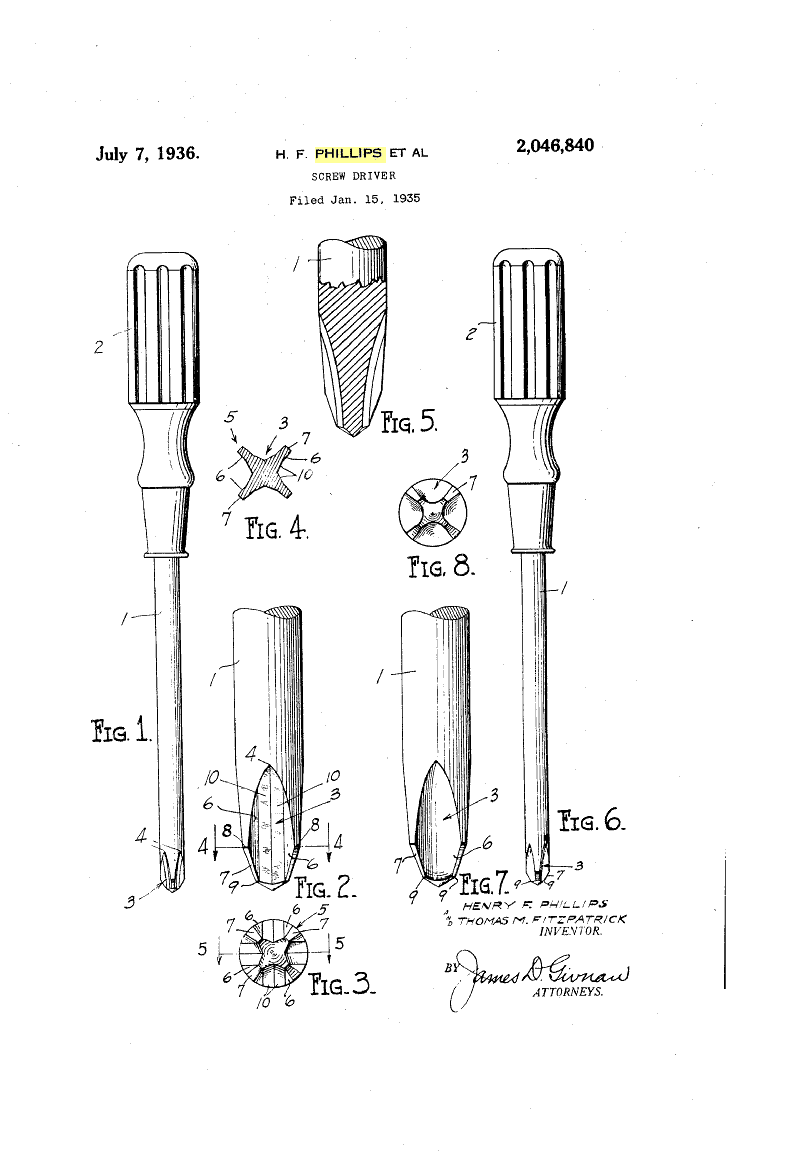
Herny Phillips' patent for the Phillips screw and screwdriver (Google Patents)

Patent drawings for the Phillips screw and screwdriver, 1936

Only Crook in Town was alerted to the work of Henry F. Phillips by an alert and helpful librarian (well — aren’t they all?). She worries –January 15 is Martin Luther King, Jr., Day, and July 7 is the middle of the summer — what day would be appropriate to celebrate the invention and patenting of the Phillips Screwdriver? (If image above does not display, click the thumbnail picture at the end of the post.)

Ah, history teachers, you noticed that the drawing comes from Google’s files of patent applications. And now you wonder: What other wonderful illustrations can we legally rip off to use in class? Wonderful question — what do you find?

The Phillips screwdriver came along in time for World War II and the mass assembly of aircraft, and aircraft instrument panels. The Phillips screw head helped aircraft assemblers keep from scratching the black metal of the rest of the panel while securing instruments into the forms.

Read the rest of this entry »