Bush/Romney-onomics: Disaster redux?

July 2, 2012

BushRomney-onomics.  It worked so well in 2008, didn’t it?

Mike Peters in the Dayton Daily News - King Features Syndicate, "Miss me yet"

Mike Peters in the Dayton Daily News, and King Features Syndicate, May 25, 2012. Did your local newspaper carry this cartoon? Why not? Call them and ask.  More editorial cartoons, click the cartoon.

Peters’s editorial cartoons in the Dayton Daily News is one feature that distinguishes the newspaper, still, as one of America’s great daily papers.  Here’s to the editors who keep doing it right.


Romney’s record on improving employment, holding taxes down

June 16, 2012

George Santayana warned people “who cannot remember the past are condemned to repeat it.”

Don’t forget this history.  Forward to those you care about.


Mitt Romney: ‘Cut teachers, fire cops, layoff firefighters . . .’

June 8, 2012

I don’t remember asking for this, but Romney says you did:  Cut jobs for teachers, cops and firefighters?

It’s not that the majority is silent, it is that the Republican Party is completely deaf.

That whirring noise is Milton Friedman, Friedrich von Hayek, and Ludwig von Mises, all spinning in their graves.


Tom Toles cartoon pegs ecoRomics

May 20, 2012

Tom Toles Cartoon

Tom Toles, for the Washington Post, May 18, 2012


Two presidents, 26 years: The Reagan/Obama plan

April 15, 2012

MoveOn.org wonders whether Warren Buffett is a time traveler.  I wonder about that old adage about an idea whose time has come.

I still think we need to pay more attention to making good jobs, and making jobs we have, pay better.   More taxpayers in the middle class reduces everyone’s tax burden and balances budgets.


Did taxpayers finance Romney’s wealth?

April 14, 2012

Mitt Romney’s fortune comes mostly from his work at Bain Capital Management.

Capital management?  What is capital management, exactly, you ask?

Prof. Robert Reich explained how private equity firms like Bain make their money, and fortunately MoveOn.org had a camera running when he did, “How exactly did Mitt Romney Get So Obscenely Rich? Robert Reich explains The Magic of Private Equity in 8 Easy Steps”:

Any questions?

Oh, I have one:  Prof. Reich, can you explain how Warren Buffett got so obscenely rich, and tell us the differences in the methods Buffett used, from those Romney used?

I have another question, too, but I’m not sure where to direct it:  Romney says he wants to “help out” the U.S. with his budgeting expertise; to whom does he expect to sell the U.S. government once he’s wrung out all the savings?

More, and Related articles:


More good news about the Affordable Care Act (Obamacare): CBO says it will save money

March 22, 2012

President Barack Obama's signature on the heal...

President Barack Obama's signature on the health insurance reform bill at the White House, March 23, 2010. The President signed the bill with 22 different pens. CBO projections in March 2012 indicate savings under the bill will increase beyond earlier projections, offsetting increased costs from continuing economics woes. (Photo credit: Wikipedia)

Remember, without the Affordable Care Act, the U.S. was experiencing health care cost inflation of about 15%annually.

You might not know it if you read conservative blogs, watch Fox News, or listen to the Republican candidates for president — all of whom seem to have their fact panties on wrong — but the Congressional Budget Office (CBO) projects the bill will reduce federal spending, still, even after accounting for recent changes in law and changes in the economy that will increase costs of the bill’s provisions.

Yeah, Obamacare saves money.

The new law will  not eliminate the problem of people not having insurance coverage to guarantee access to health care, a sad result of Republican efforts to cut the bill’s effectiveness.  But it’s a great first step to making America better, healthier, and economically more sound.  Here’s the blog post from the CBO discussing the bill, and CBO’s continuing studies of the effects of the law:

CBO Releases Updated Estimates for the Insurance Coverage Provisions of the Affordable Care Act

March 13, 2012

In preparing the March 2012 baseline budget projections, CBO and the staff of the Joint Committee on Taxation (JCT) have updated estimates of the budgetary effects of the health insurance coverage provisions of the Affordable Care Act (ACA)—the health care legislation enacted in March 2010. Those provisions:

  • Establish a mandate for most legal residents of the United States to obtain health insurance;
  • Create insurance “exchanges” through which certain individuals and families may receive federal subsidies to substantially reduce the cost of purchasing health insurance;
  • Significantly expand eligibility for Medicaid;
  • Impose an excise tax on certain health insurance plans with relatively high premiums;
  • Establish penalties on certain employers who do not provide minimum health benefits to their employees; and
  • Make other changes to prior law.

The most recent previous estimate of those effects was prepared in March 2011. For more details on the insurance coverage provisions of the ACA, you can see CBO’s cost estimate for the health care legislation, which was issued in March 2010.

The Estimated Net Cost of the Insurance Coverage Provisions Is Smaller Than Estimated in March 2011

CBO and JCT now estimate that the insurance coverage provisions of the ACA will have a net cost of just under $1.1 trillion over the 2012-2021 period-about $50 billion less than the agencies’ March 2011 estimate for that 10-year period. (For comparison with previous estimates, these numbers cover the 2012-2021 period; estimates including 2022 can be found below.)

The net costs–specifically the combined effects on federal revenues and mandatory spending–reflect:

  • Gross additional costs of $1.5 trillion for Medicaid, the Children’s Health Insurance Program (CHIP), tax credits and other subsidies for the purchase of health insurance through the newly established exchanges and related costs, and tax credits for small employers,
  • Offset in part by about $0.4 trillion in receipts from penalty payments, the new excise tax on high-premium insurance plans, and other budgetary effects (mostly increases in tax revenues).

Those amounts do not encompass all of the budgetary impacts of the ACA. They do not include federal administrative costs, which will be subject to future appropriation action. Also, they do not include the effects of the many other provisions of the law, including some that will cause significant reductions in Medicare spending relative to that under prior law and others that will generate added tax revenues relative those under prior law.

CBO and JCT have previously estimated that the ACA will, on net, reduce budget deficits over the 2012-2021 period; that estimate of the overall budgetary impact of the ACA has not been updated.

Gross Costs Are Higher, but Offsetting Budgetary Effects Are Also Higher

The current estimate of the gross costs of the coverage provisions—$1,496 billion through 2021—is about $50 billion higher than last year’s projection; however, the other budgetary effects of those provisions, which partially offset those gross costs, also have increased in CBO’s and JCT’s estimates—to $413 billion—leading to the small decrease in the net 10-year tally.

Over the 10-year period from 2012 through 2021, enactment of the coverage provisions of the ACA was projected last March to increase federal deficits by $1,131 billion, whereas the March 2012 estimate indicates that those provisions will increase deficits by $1,083 billion.

The net cost was boosted by:

  • An additional $168 billion in estimated costs for Medicaid and CHIP, and
  • $8 billion less in estimated revenues from the excise tax on certain high-premium health insurance plans.

But those increases were more than offset by a reduction of:

  • $97 billion in the projected costs for the tax credits and other subsidies for health insurance provided through the exchanges and related spending
  • $20 billion in the projected costs for tax credits for small employers, and
  • $107 billion in deficits from the projected revenue effects of changes in taxable compensation and penalty payments and from other small changes in estimated spending.

The Revisions in Estimates Reflect Legislative, Economic, and Technical Changes

The major sources for the differences between the March 2011 and March 2012 projections are the following:

  • New Legislation. Several laws were enacted during the past year that changed the estimated budgetary effects of the insurance coverage provisions of the ACA.
  • Changes in the Economic Outlook. The March 2012 baseline incorporates CBO’s macroeconomic forecast published in January 2012, which reflects a slower recovery when compared with the forecast published in January 2011 (which was used in producing the March 2011 baseline).
  • Technical Changes. The March 2012 baseline incorporates updated projections of the growth in private health insurance premiums, reflecting slower growth than the previous projections. In addition, CBO and JCT made a number of other technical changes in their estimating procedures.

The Number of the Nonelderly Uninsured Is Higher Than Previously Estimated

CBO and JCT’s projections of health insurance coverage have changed since last March. Fewer people are now expected to obtain health insurance coverage from their employer or in insurance exchanges; more are now expected to obtain coverage from Medicaid or CHIP or from nongroup or other sources. More are expected to be uninsured. The extent of the change in insurance coverage varies from year to year.

Compared with prior law, the ACA is now estimated by CBO and JCT to reduce the number of nonelderly people without health insurance coverage by 30 million to 33 million in 2016 and subsequent years, leaving 26 million to 27 million nonelderly residents uninsured in those years (see Table 3 at the end of the report). The share of legal nonelderly residents with insurance is projected to rise from 82 percent in 2012 to 93 percent in 2016 and subsequent years. That share rose to 95 percent in CBO and JCT’s previous estimate.

According to the current estimates, from 2016 on, between 20 million and 23 million people will receive coverage through the new insurance exchanges, and 16 million to 17 million additional people will be enrolled in Medicaid and CHIP as a result of ACA. Also, 3 million to 5 million fewer people will have coverage through an employer compared with the number under prior law

Estimates Through Fiscal Year 2022

This report also presents estimates through fiscal year 2022, because the baseline projection period now extends through that additional year. The ACA’s provisions related to insurance coverage are now projected to have a net cost of $1,252 billion over the 2012-2022 period; that amount represents a gross cost to the federal government of $1,762 billion, offset in part by $510 billion in receipts and other budgetary effects (primarily revenues from penalties and other sources).

The addition of 2022 to the projection period has the effect of increasing the costs of the coverage provisions of the ACA relative to those projected in March 2011 for the 2012-2021 period because that change adds a year in which the expansion of eligibility for Medicaid and subsidies for health insurance purchased through the exchanges will be in effect. CBO and JCT have not estimated the budgetary effects in 2022 of the other provisions of the ACA; over the 2012-2021 period, those other provisions were previously estimated to reduce budget deficits.

If we could get another stimulus program to goose the economy into quicker recovery, the cost savings would likely grow much faster.  What conservative budget chopper wouldn’t prefer that solution?

Barack Obama signing the Patient Protection an...

Barack Obama signing the Patient Protection and Affordable Care Act at the White House Español: Barack Obama firmando la Ley de Protección al Paciente y Cuidado de Salud Asequible en la Casa Blanca (Photo credit: Wikipedia)

How did your favorite media outlets report the CBO cost projections?

More, Resources (with help from Zemanta and WordPress):


Stimulus spending: Texans remember how the CCC helped save the nation

January 20, 2012

New video history piece from the Texas Parks & Wildlife people:

63

Uploaded by on Jan 17, 2012

The Civilian Conservation Corps provided jobs for over 3 million young men during the Great Depression and helped establish the foundation of our nation’s park system. 70 years after the creation of the CCC, Conservation Corps veterans reunite in one of the parks they helped build, sharing stories and rekindling old memories.

A pictorial map showing Texas State Parks with significant work performed by the CCC:

Map of Civilian Conservation Corps Legacy Parks in Texas - TPWD image

Map of Civilian Conservation Corps Legacy Parks in Texas - TPWD image - Click on map for original, larger version


Quote of the moment: Gold standard a “barbarous relic” – Keynes

January 18, 2012

Portrait of John Maynard Keynes as a younger man

Portrait of John Maynard Keynes as a younger man (who is the artist? where does it hang?)

  • In truth, the gold standard is already a barbarous relic.
    • John Maynard Keynes, Monetary Reform (1924), p. 172

    Did Keynes foresee the rise of Ron Paul, even in 1924?

    Gold Key, weighing one kilogram is used to acc...

More, resources:


Happy 254th birthday, Alexander Hamilton!

January 11, 2012

Today, January 11,  is Alexander Hamilton’s birthday — had he lived so long, he’d be 254 years old today!

Alexander Hamilton on the U.S. ten dollar note - Guardian image

Alexander Hamilton on the U.S. ten dollar note - Guardian image

But of course, the bullet from Aaron Burr’s gun cut Hamilton’s life short, after the duel in Weehawken, New Jersey. Hamilton died of the wound on July 12, 1804. He was 47 years old.

Had Hamilton survived the duel, would he have been elected president? Some people think so. In any case, Hamilton’s wise management of the new nation’s finances, and his establishment of the idea that government should have a working bank, and that good government is a key to economic success of a nation, leave a great legacy for the nation, and the world.

Hamilton’s portrait adorns the U.S. $10 bill.
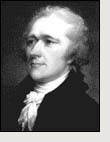
Read Hamilton’s biography from the U.S. National Archives’ feature on “America’s Founding Fathers/Charters of Freedom” exhibit:

Alexander Hamilton

Alexander Hamilton

Hamilton was born in 1757 on the island of Nevis, in the Leeward group, British West Indies. He was the illegitimate son of a common-law marriage between a poor itinerant Scottish merchant of aristocratic descent and an English-French Huguenot mother who was a planter’s daughter. In 1766, after the father had moved his family elsewhere in the Leewards to St. Croix in the Danish (now United States) Virgin Islands, he returned to St. Kitts while his wife and two sons remained on St. Croix.

The mother, who opened a small store to make ends meet, and a Presbyterian clergyman provided Hamilton with a basic education, and he learned to speak fluent French. About the time of his mother’s death in 1768, he became an apprentice clerk at Christiansted in a mercantile establishment, whose proprietor became one of his benefactors. Recognizing his ambition and superior intelligence, they raised a fund for his education.

In 1772, bearing letters of introduction, Hamilton traveled to New York City. Patrons he met there arranged for him to attend Barber’s Academy at Elizabethtown (present Elizabeth), NJ. During this time, he met and stayed for a while at the home of William Livingston, who would one day be a fellow signer of the Constitution. Late the next year, 1773, Hamilton entered King’s College (later Columbia College and University) in New York City, but the Revolution interrupted his studies.

Although not yet 20 years of age, in 1774-75 Hamilton wrote several widely read pro-Whig pamphlets. Right after the war broke out, he accepted an artillery captaincy and fought in the principal campaigns of 1776-77. In the latter year, winning the rank of lieutenant colonel, he joined the staff of General Washington as secretary and aide-de-camp and soon became his close confidant as well.

In 1780 Hamilton wed New Yorker Elizabeth Schuyler, whose family was rich and politically powerful; they were to have eight children. In 1781, after some disagreements with Washington, he took a command position under Lafayette in the Yorktown, VA, campaign (1781). He resigned his commission that November.

Hamilton then read law at Albany and quickly entered practice, but public service soon attracted him. He was elected to the Continental Congress in 1782-83. In the latter year, he established a law office in New York City. Because of his interest in strengthening the central government, he represented his state at the Annapolis Convention in 1786, where he urged the calling of the Constitutional Convention.

In 1787 Hamilton served in the legislature, which appointed him as a delegate to the convention. He played a surprisingly small part in the debates, apparently because he was frequently absent on legal business, his extreme nationalism put him at odds with most of the delegates, and he was frustrated by the conservative views of his two fellow delegates from New York. He did, however, sit on the Committee of Style, and he was the only one of the three delegates from his state who signed the finished document. Hamilton’s part in New York’s ratification the next year was substantial, though he felt the Constitution was deficient in many respects. Against determined opposition, he waged a strenuous and successful campaign, including collaboration with John Jay and James Madison in writing The Federalist. In 1787 Hamilton was again elected to the Continental Congress.

When the new government got under way in 1789, Hamilton won the position of Secretary of the Treasury. He began at once to place the nation’s disorganized finances on a sound footing. In a series of reports (1790-91), he presented a program not only to stabilize national finances but also to shape the future of the country as a powerful, industrial nation. He proposed establishment of a national bank, funding of the national debt, assumption of state war debts, and the encouragement of manufacturing.

Hamilton’s policies soon brought him into conflict with Jefferson and Madison. Their disputes with him over his pro-business economic program, sympathies for Great Britain, disdain for the common man, and opposition to the principles and excesses of the French revolution contributed to the formation of the first U.S. party system. It pitted Hamilton and the Federalists against Jefferson and Madison and the Democratic-Republicans.

During most of the Washington administration, Hamilton’s views usually prevailed with the President, especially after 1793 when Jefferson left the government. In 1795 family and financial needs forced Hamilton to resign from the Treasury Department and resume his law practice in New York City. Except for a stint as inspector-general of the Army (1798-1800) during the undeclared war with France, he never again held public office.

While gaining stature in the law, Hamilton continued to exert a powerful impact on New York and national politics. Always an opponent of fellow-Federalist John Adams, he sought to prevent his election to the presidency in 1796. When that failed, he continued to use his influence secretly within Adams’ cabinet. The bitterness between the two men became public knowledge in 1800 when Hamilton denounced Adams in a letter that was published through the efforts of the Democratic-Republicans.

In 1802 Hamilton and his family moved into The Grange, a country home he had built in a rural part of Manhattan not far north of New York City. But the expenses involved and investments in northern land speculations seriously strained his finances.

Meanwhile, when Jefferson and Aaron Burr tied in Presidential electoral votes in 1800, Hamilton threw valuable support to Jefferson. In 1804, when Burr sought the governorship of New York, Hamilton again managed to defeat him. That same year, Burr, taking offense at remarks he believed to have originated with Hamilton, challenged him to a duel, which took place at present Weehawken, NJ, on July 11. Mortally wounded, Hamilton died the next day. He was in his late forties at death. He was buried in Trinity Churchyard in New York City.

Image: Courtesy of The National Portrait Gallery, Smithsonian Institution

Post mostly borrowed, with express permission, from Mr. Darrell’s Wayback Machine.

Remember to watch for progress on “The Alexander Hamilton Mixtape,” a hip-hop version of Alexander Hamilton’s life by Lin-Manuel Miranda, seen here performing Aaron Burr’s soliloquey, at the White House.


Oh, say, can Republicans see?

December 18, 2011

Old Jules was referring to something else, a serious enough issue on its own, and not necessarily the lack of vision among Republican presidential candidates.

But it fits from time to time:

Zero Visibility, a warning sign - photo by Old Jules, perhaps

Zero Visibility, a warning sign - photo by Old Jules, perhaps

Bill Cosby once asked if anyone else had the same chill of fear he gets when the lights start to go down at the theater:  Are the lights getting dim, or are you going blind?

Is there zero visibility, or are our eyes shut tightly?  Can the candidates see what it takes to get us out of this olio, this olla podrida of messes, or is there too much fog, or are they just not looking?  Worse, is it dark AND they are not looking?

What say you?


Encore quote of the moment: Robert Kennedy on what really matters

December 18, 2011

This is borrowed from Harry Clarke (with a few minor corrections in the text):

Robert F. Kennedy speech at the University of Kansas, Lawrence, March 18, 1968

Robert F. Kennedy speech at the University of Kansas, Lawrence, March 18, 1968 - Photo by George Silk, Time-Life Pictures/Getty Images

RFK said this in 1968. In a speech I heard today it was quoted and it stirred me.

Too much and for too long, we seem to have surrendered personal excellence and community value in the mere accumulation of material things. Our Gross National Product, now, is over eight hundred billion dollars a year, but that GNP — if we judge the United States of America by that — that GNP counts air pollution and cigarette advertising and ambulances to clear our highways of carnage. It counts special locks for our doors and the jails for the people who break them. It counts the destruction of the redwoods and the loss of our natural wonder in chaotic sprawl. It counts napalm and it counts nuclear warheads, and armored cars for the police to fight the riots in our cities. It counts Whitman’s rifle and Speck’s knife, and the television programs which glorify violence in order to sell toys to our children.

Yet the Gross National Product does not allow for the health of our children, the quality of their education, or the joy of their play. It does not include the beauty of our poetry or the strength of our marriages, the intelligence of our public debate or the integrity of our public officials. It measures neither our wit nor our courage, neither our wisdom nor our learning, neither our compassion nor our devotion to our country; it measures everything, in short, except that which makes life worthwhile. And it can tell us everything about America except why we are proud that we are Americans.

Kennedy delivered these words in an address at the University of Kansas, Lawrence, Kansas, on March 18, 1968.

Here’s a video production from the Glaser Progress Foundation which includes an audio recording of the speech:

More resources:

Most of this post appeared originally here in 2009.  We need the reminder.


Bigger ditch + higher speed = (Greece X Russia)

December 17, 2011

What to do about the economic ditch the Republicans have driven the economy into?

Campaign aides to Ron Paul, Gary Johnson and Mitt Romney advocate finding a bigger ditch and hitting the gas pedal sooner and harder.

No, seriously:  Jon Huntsman’s economics advisor, a woman with years of experience working for a balanced budget, suggested that Paul’s proposal of cutting $1 trillion from spending in 2013 lacks a great connection to reality.  Aides to the other three, after taking another toke of godknowswhat, said they could do even more cutting.

It’s as if General Washington’s physicians, interviewed December 15, 1799, claimed they could have saved Washington’s life had they bled him two or three more times — but unfortunately, he was out of blood.

At a Wednesday panel discussion hosted by the America’s Future Foundation, a club of young libertarians and conservatives in Washington who meet regularly over beer to network and debate about politics, Jennifer Pollom, Huntsman’s economic director, joined campaign aides for Gary Johnson, Ron Paul and a former Mitt Romney staffer to discuss why their candidate would best represent conservatives as the presidential nominee of the Republican Party. The real fun (by D.C. standards) started when Jack Hunter, a blogger for Paul’s presidential campaign, touted his boss’s promise to slash $1 trillion from the federal budget.

“Having been on the Budget Committee and having worked in the federal government and in the Senate for quite a while, I think a trillion dollars is kind of ludicrous,” said Pollom, who formerly served as the counsel for the Senate Republican Policy Committee. “That’s my personal opinion, that is not the stance of Governor Huntsman. We’re more concerned about tax policy right now. We’re deeply concerned about the deficit and the debt, but we’re more concerned about jobs and freezing spending where it is right now.”

That didn’t play well with the representatives for Johnson and Paul, two of the most libertarian-leaning candidates in the race. (Johnson’s plan goes further than Paul’s. He has vowed to balance the budget in his first year, which would require cutting even more than $1 trillion.)

“To call that ludicrous is actually a little surprising because this idea that we can year after year continue to spend more money than we’re taking in, to me that actually seems to be the pretty ludicrous idea from a fiscally conservative perspective,” said panelist Jonathan Bydlak, the finance director for Johnson’s campaign.

“I personally think that cutting a trillion dollars in one year off the budget–I use ‘ludicrous’ sort of loosely–but I don’t think it’s practical,” Pollom said later during the panel. “It may be an excellent aspirational dream but speaking in the real world, I don’t know that it’s actually practically going to happen.”

That’s when Derek Khanna, a panelist who worked for Mitt Romney’s finance team in 2008, jumped in.

“The idea of one trillion is not ludicrous,” Khanna said, which prompted Pollom to put her finger to her head like she was pulling the trigger of a gun. “I think that the idea of saying that being able to balance the budget is ‘ludicrous’ is kind of disturbing. We’re all here saying we support the balanced-budget amendment, but in the end we won’t support cutting a trillion dollars. It seems to be a bit disingenuous.”

What in the world could these stooges be referring to in cutting?  I can see it now:  ‘What do we need Homeland Security for, anyway?  FAA doesn’t fly any airplanes — what could possibly happen if we just shut the agency down tomorrow?  Surely we don’t need more than one aircraft carrier, one for the Pacific, and one for the Atlantic — we don’t have any territory in the Southern, Indian, or Arctic Oceans.’

You can almost hear Ron Paul, wide-eyed, explaining:  ‘President Obama is hurting the energy industry.  BP found a way to quickly get millions of barrels of oil out of ground under the Gulf of Mexico, oil we need to run industry — but Obama made them stop!’

In other news, perhaps, The Onion is considering closing down — they can’t parody this stuff any more.


Obama’s right: Saving the nation is not “class warfare”

December 17, 2011

Ross Eisenbrey laid it out at the blog of the Economics Policy Institute:

The most important part of [President Obama’s] speech in Kansas was probably his attack on the “collective amnesia” that allows some people to continue advocating the Bush administration’s tax cuts for the rich, despite their clear history of failure as a spur to job creation. Obama said:

“Remember in those years, in 2001 and 2003, Congress passed two of the most expensive tax cuts for the wealthy in history. And what did it get us? The slowest job growth in half a century. Massive deficits that have made it much harder to pay for the investments that built this country and provided the basic security that helped millions of Americans reach and stay in the middle class — things like education and infrastructure, science and technology, Medicare and Social Security.”

The president pointed out the folly of pursuing the same kinds of failed “you’re on your own” economic policies that got us into the worst recession in 75 years. Weak regulation helped cause the Great Recession. Why would anyone expect the same policies to get us out?

“Remember that in those same years, thanks to some of the same folks who are now running Congress, we had weak regulation, we had little oversight, and what did it get us? Insurance companies that jacked up people’s premiums with impunity and denied care to patients who were sick, mortgage lenders that tricked families into buying homes they couldn’t afford, a financial sector where irresponsibility and lack of basic oversight nearly destroyed our entire economy.

We simply cannot return to this brand of ‘you’re on your own’ economics if we’re serious about rebuilding the middle class in this country.”

Unsurprisingly, the right wing media, led by Fox News, wants to take us right back to the kind of Bushonomics that crashed the economy in 2007. Progressive taxation doesn’t sit well with Fox’s high-income anchors, let alone its billionaire owner, Rupert Murdoch. As our friends at Media Matters document nicely, Fox immediately launched a broadside against the president and the notion of tax fairness, misquoting him when it was convenient, and accusing him of class warfare and socialism.

One might almost lament that Obama lacks opposition in the primaries; debates featuring Republicans drive sane thought off of the news pages.  None of the Republican candidates appears to subscribe to the free enterprise economics of Milton Friedman and/or Paul Samuelson, for example.  The radical right wing, experimental economics bandied about in the debates stands perpendicular to free market economics as practiced successfully in the U.S. and other places over the past 40 years — but with every Republican candidate so far out on the radical economic scale, it might appear to a non-careful reader that they speak Mainstream.

Wholly apart from the disastrous economics of “off-budget” warfare given to us by Republicans, the policies of Republicans gave us an economic disaster in 2008.  As a nation we have not moved far enough to correct those errors, and now Republicans block the action of the consumer protection agency designed to prevent another housing bubble to burst America’s economic dreams.

Polls show Americans don’t think Obama deserves a second term.  I find it hard to believe that a majority of voters will choose to go back to the disaster that Obama hasn’t been able to fix, however.  Americans are not quite that stupid, I hope.


Bill Keller, on shouting down the economists with the life-saving answers

November 30, 2011

Economists know how to fix the U.S. economy.  But according to Bill Keller at the New York Times, they’re being shouted down.

So for the past several weeks my airplane and bedside reading has consisted of sexy documents like “A Roadmap for America’s Future” and “The Way Forward” and “The Moment of Truth” and “Restoring America’s Future” and “Living Within Our Means and Investing in the Future.” I’ve also reached out to a few economists respected for the integrity of their science and their patience with economic illiterates.

The first thing I gleaned from this little tutorial will probably not surprise you: There really is a textbook way to fix our current mess. Short-term stimulus works to help an economy recover from a recession. Some kinds of stimulus pay off more quickly than others. Once the economic heart is pumping again, we need to get our deficits under control. The way to do that is a balance of spending cuts, increased tax revenues and entitlement reforms. There is room to argue about the proportions and the timing, and small differences can produce large consequences, but the basic formula is not only common sense, it is mainstream economic science, tested many times in the real world.

So what’s the problem? Why is our system so fundamentally stuck? Partly it’s a colossal, bipartisan lack of the political courage required to tell people what they sort of know but don’t want to hear. Partly it’s a Republican Party that, for its own cynical reasons, wants no deal with this president. Partly it’s moneyed, focused lobbies that swarm in defense of specific advantages written into the law; there is no comparable lobby for compromise, let alone sacrifice.

Is reasoned discourse such that much a lost art in America today?  Keller extends his point to cover several areas of discussion — President Obama’s birthplace, global warming and what to do about it, vaccines, etc.  He could as easily have added whether Rachel Carson murdered more people than Mao Zedong, cures for our education woes, and the designated hitter rule.

In the land of the blind, the one-eyed man has value; but in the land of the knee-walking turkeys the one-eyed man is just one more roost to crap on.

What is a rational person to do?
