No, race isn’t the cause of our economic and education woes

March 11, 2011

Just when you think the conservatives can’t possibly sound any more like fascists of the 1930s . . . I mean, can we just repeal Godwin’s law and call a racist fascist argument, a racist fascist argument?

Paul Krugman, whose Nobel Memorial Prize for economics galls conservatives more than left turns bothered J. Edgar Hoover, noted the other day that Texas is in a series of fixes.  This is important because Texas is what Wisconsin’s governor claims Wisconsin should be:  Shorn of union interference in almost all things, especially in public service sectors including education.  Krugman wrote in his column, “Leaving Children Behind”:

Texas likes to portray itself as a model of small government, and indeed it is. Taxes are low, at least if you’re in the upper part of the income distribution (taxes on the bottom 40 percent of the population are actually above the national average). Government spending is also low. And to be fair, low taxes may be one reason for the state’s rapid population growth, although low housing prices are surely much more important.

But here’s the thing: While low spending may sound good in the abstract, what it amounts to in practice is low spending on children, who account directly or indirectly for a large part of government outlays at the state and local level.

And in low-tax, low-spending Texas, the kids are not all right. The high school graduation rate, at just 61.3 percent, puts Texas 43rd out of 50 in state rankings. Nationally, the state ranks fifth in child poverty; it leads in the percentage of children without health insurance. And only 78 percent of Texas children are in excellent or very good health, significantly below the national average.

But wait — how can graduation rates be so low when Texas had that education miracle back when former President Bush was governor? Well, a couple of years into his presidency the truth about that miracle came out: Texas school administrators achieved low reported dropout rates the old-fashioned way — they, ahem, got the numbers wrong.

It’s not a pretty picture; compassion aside, you have to wonder — and many business people in Texas do — how the state can prosper in the long run with a future work force blighted by childhood poverty, poor health and lack of education.

But things are about to get much worse.

A few months ago another Texas miracle went the way of that education miracle of the 1990s. For months, Gov. Rick Perry had boasted that his “tough conservative decisions” had kept the budget in surplus while allowing the state to weather the recession unscathed. But after Mr. Perry’s re-election, reality intruded — funny how that happens — and the state is now scrambling to close a huge budget gap. (By the way, given the current efforts to blame public-sector unions for state fiscal problems, it’s worth noting that the mess in Texas was achieved with an overwhelmingly nonunion work force.)

Krugman was too easy on Perry.  In his campaign last year, Perry claimed that Texas had plenty of money, a surplus, even.  In debates with Democratic candidate Bill White, Perry pooh-poohed the notion that Texas had a sizable deficit, certainly not the $18 billion deficit White named.

No, the Texas deficit actually is north of $25 billion.  (Linda Chavez-Thompson, the defeated Democratic candidate for Lieutenant Governor, addressed Perry’s denial in a line that very few reporters bothered to report (or report accurately):  “Do you know how many zeroes there are in 18 billion?” Chavez-Thompson said. “11, when you count Perry and Dewhurst.”)

But blogger Iowahawk would hear none of that — no, the issue isn’t bad government and poor fiscal management.  Texas loses out in education because its got more racial minorities, he wrote at some length.

Other bloggers who should know better, or at least should be struck by the repugnance of the claim that race is the problem, spread the claim, including Paul E. Peterson at EducationNext and Mark at Pseudo-Polymath.

Krugman’s original point was untouched by any of these guys.  Texas is in deep trouble, on many, many fronts.  One of the more common comments on Texas education is, “Thank God for Mississippi!”  Mississippi’s having closed down its education system rather than integrate, and continued underfunding and mismanagement since the federal government forced the reopening, keeps Mississippi at the bottom of almost all state rankings regarding children.  That means Texas isn’t dead last.  Texas’s very real problems will affect racial disparities in achievement, but they are in no way caused by racial disparity, or race of the students.

Notice, too, how Iowahawk changed the comparison.  Krugman noted dropout rates.  Unable to muster a direct rebuttal to Krugman’s point, Iowahawk switched to comparing scores in NAEP.  It’s not the same thing by any stretch.

No Texas teacher would say Texas performs better than any other state in stopping dropouts.  While we might brag a bit on how we’ve increased scores on the ACT and SAT, it’s not across the board, and it’s not enough.  (It’s a miracle with the stingy funding, and it will likely stop with the proposed budget cuts — but we’re proud of our ability to make improvement despite obstacles carefully placed by state policy makers.)

Notice, too, that dropouts tend to perform more poorly on standardized tests.  If one wishes to screw around with the statistics for spin, one might note that by forcing students to drop out, Texas raises its scores on NAEP.  I seriously doubt any Texas educator conducts a campaign to get dropouts to boost NAEP scores, but let’s be realistic.  (Which is not to say that there is not a lot of action to mask the dropout problem; a Texas high school is responsible for the academic achievement of kids who drop out, or more accurately, the lack of academic achievement.  Dropouts count against a school’s performance rating, and count hard.  Every school on the cusp of “Exemplary,” or “Recognized,” or “Unacceptable,” has a campaign to track down dropouts to find that they have enrolled in another school to whom blame can be passed, or that they have left the state or the nation, and so don’t count in Texas at all.  One wishes one could school administrators and legislators in Deming’s Red Bead Experiment.)

It’s impossible to claim Wisconsin union teachers are to blame for any Wisconsin woe, when Texas, with it’s strong anti-union stands and ban on unionizing among teachers, performs worse, on average.

Will busting the unions put Wisconsin in the black?  It didn’t work for Texas.

Will busting the unions help Wisconsin schools?  You can’t make that case based on the information from Texas.  In fact, Angus Johnson conducted a more serious analysis of statistics that may provide a better view into the issue, and they tend to show that unionized teachers improve education performance.

Surely these guys understand where their argument ends up.  It is absolutely untrue that Texas’s minorities dragged the state into deficits.

We know where Texas deficits came from.  Several years ago Texas cut property taxes, a key source of education and other funding for the state, promising to make up the difference with corporate tax reforms.  But the corporations blocked significant reform.  Texas has been running on empty for six years, and now the deficits are simply too big to hide.

Unwise tax cuts, made for political gains, that put Texas in the dumper.

It wasn’t unions, and it sure wasn’t the large population of hard-working, tax-paying, union-needing Hispanics and blacks and Native Americans who got Texas in trouble.  They didn’t get the tax cut benefits, for the most part.

Race is not the cause of our education and budget woes, except in this way:  Racists, especially the latent, passive-aggressive sort, will not hesitate to cut programs that they see benefiting minorities.  Those education programs that have done the most to reduce the achievement gaps between the races, boosting minority achievement, are the first to go under the Republican budget meat cleavers.  The proposed cuts are not surgical in any way, to preserve education gains.


Can’t fire the bums to make a quality school: Principals division

February 8, 2011

Be sure to see the story in the New York Times today. Obama administration “Race to the Top” money went to states who proposed to replace principals in failing schools. A problem in the strategy threatens the program:  Not enough qualified people exist to replace all the “bad” ones.

Wrong-headed education “reformers” keep talking about “firing the bad ones,” teachers, administrators, or janitors.  Without significantly raising the pay for teachers, without greatly increasing the number of teachers and administrators in the pipeline from teaching colleges or any other source, reformers can’t attract anyone better qualified than the people they wish to replace.

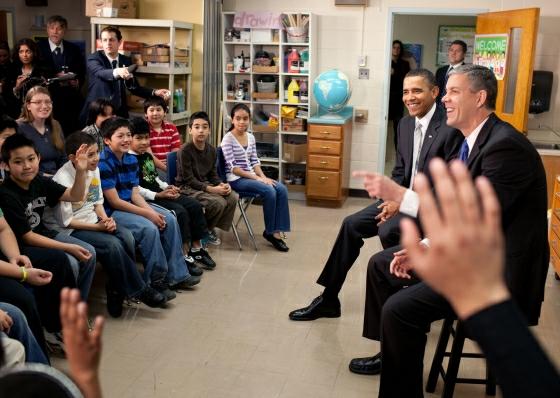
Pres. Obama and Sec. Duncan and the 6th grade at Graham Road Elementary, Falls Church, Virginia

President Barack Obama and Education Secretary Arne Duncan took questions from a 6th grade class at Graham Road Elementary School in Falls Church, Virginia, January 18, 2010 – photo credit unknown

Maybe, just maybe, it’s time these reformers took a step back and did some study, perhaps from the quality gurus, Deming and Juran and Crosby, or from the heights of championship performance, in basketball, football, soccer, sailing (try the America Cup), horse racing or politics:  No one can use firing as a chief tool to turn an organization around, nor to lead any organization to a championship.  Threatening people’s jobs does not motivate them, nor make the jobs attractive to others.

How can we tell the fire-the-teachers-and-principals group is on the wrong track?  See the article:

“To think that the same leader with a bit more money is going to accomplish tremendous change is misguided,” said Tim Cawley, a managing director at the Academy for Urban School Leadership, a nonprofit group that began leading turnaround efforts in Chicago when Mr. Duncan was the superintendent there.

“This idea of a light-touch turnaround is going to sully the whole effort,” Mr. Cawley added.

Tell that to Steve Jobs, who turned Apple around.  Tell it to Jack Welch, the tough-guy boss from GE (who had his own peccadilloes about firing, but who emphasized hiring and pay, at least, as the way to create a succession plan for the vacancies).  Tell it to any CEO who turned around his organization without falling on his own sword.

Any competent quality consultant would have foreseen this problem:  Nobody wants to train for a job with little future, less money to do the job right, little authority to get the job done, and the sole promise that the exit door is always open.

Secretary of Education Arne Duncan should know better, intuitively.  He used to play basketball, professionally.  Surely he knows something about team building and team turnarounds.  What caused his astounding, expensive amnesia?

Part of the issue identified in the article is training:

Because leading schools out of chronic failure is harder than managing a successful school — often requiring more creative problem-solving abilities and stronger leadership, among other skills — the supply of principals capable of doing the work is tiny.

Most of the nation’s 1,200 schools, colleges and departments of education do offer school leadership training. “But only a tiny percentage really prepare leaders for school turnaround,” said Arthur Levine, a former president of Teachers College who wrote a 2005 study of principal training.

That only contributes to the larger problem, that people in the positions are, often, the best ones for the job already; firing them damages turnaround efforts.

In Chicago, federal money is financing an overhaul of Phillips Academy High School. Mr. Cawley’s nonprofit trained Phillips’s new principal, Terrance Little, by having him work alongside mentor principals experienced at school makeovers.

“If we’re talking about turning around 700 schools, I don’t think you can find 700 principals who are capable of taking on the challenge of this work,” Mr. Little said. “If you could, why would we have this many failing schools?”

Education’s problems are many.  Few of the problems are the result of the person at the chalkboard in the classroom.  Firing teachers won’t help.  W. Edwards Deming claimed that 85% of the problems that plague front-line employees, like teachers, are management-caused.  Firing their bosses won’t solve those problems, either, but will just push the problems around.   (What?  “Deck chairs?”  “Titanic?”  What are you talking about?)

Did you hear?  Texas plans to cut state funding to all education by at least 25% for next year, due to Gov. Rick Perry’s $25 billion deficit, which he worked so hard to conceal during last year’s election campaign.

Santayana’s Ghost just dropped by to remind us, suitably the day after Ronald Reagan’s 100th birthday anniversary, of the Report of the Commission on Excellence in Education, the report that saved Reagan’s presidency and got him a second term:

Our nation is at risk. The educational foundations of our society are presently being eroded by a rising tide of mediocrity. If an unfriendly foreign power had attempted to impose on America the mediocre educational performance that exists today, we might well have viewed it as an act of war. We have, in effect, been committing an act of unthinking, unilateral educational disarmament. History is not kind to idlers.

When do we get political leaders who will swim against that tide instead of trying to surf it?


Dan Wasserman cartoon, Boston.com

Dan Wasserman, Boston Globe

See a small collection of  Dan Wasserman’s cartoons on Race to the Top, here.


Is Bill Gates the Superman education needs?

February 3, 2011

At Almost Diamonds, a clear explication of why Bill Gates alone cannot save education:

If you want to improve education in the U.S., fund it properly. Fund the education and salaries of teachers. Fund the building and maintenance of schools. Fund supplies. Fund libraries. Fund good textbooks and other materials. Fund early education. Fund student nutrition and health. Fund community social services that keep parents rooted in one place longer.

In short, fund those things it takes to produce small classes of students undistracted by other problems, taught by experienced teachers who aren’t constantly overworked. Is it a sexy solution? Does it put somebody’s name in lights? No, but it works.

Putting your name on some education initiative somewhere is grand. Nifty, even. The problem is that it really isn’t all that innovative when it comes right down to it. There is plenty of history of experimentation in education. Much of it even produced promising results.

Then it fell by the wayside because the implementation cost money. All the promise in the world can’t produce results if no one is willing to pay the cost. No, if someone really wants to do something new and different in the field of education, they need to implement those solutions that have already been proven.

More good stuff there at Almost Diamonds, keying off an article in The Atlantic by Chrystia Freeland on the “new elite.”

Tip of the old scrub brush to Rational Rant.


“WTF?” Palin completely misunderstands what “Sputnik Moment” means

January 28, 2011

Vodpod videos no longer available.

“WTF?” Palin completely misunderstands what “S…, posted with vodpod

Some bloggers have sworn off comments on Sarah Palin. Good on them.

This fruit is too low-hanging.

Palin doesn’t appear to have a clue about what the phrase “Sputnik moment” refers to — and mistakes it with the much later financial difficulties of the Soviet Union.  You’d think, since she was so close to the U.S.S.R. in Alaska, she’d know something about Sputnik.

And what’s with the “WTF” on television?  Has she no composure, no decency?

Here, Sarah; a primer:

Sputnik was the first artificial satellite launched from Earth, in October 1957.  (Palin wasn’t born for another seven years . . . arguments about teaching history, anyone?)

Please note that the launch of the satellite scared the bejeebers out of Americans.  Most people thought — without knowing anything about how heavy a nuclear device might be, nor how hard it might be to target one — that if the Russians could orbit a satellite the size of a beach ball, they could certainly launch missiles with nuclear warheads to rain down on America.  Maybe, some thought, Russians had already orbited such nukes, which could just fall from space without warning.

That was the spooky, red scary part.  Then there was the kick-American-science-in-the-pants part.  A lot of policy makers asked how the Russians could surpass the U.S. in the race for space (wholly apart from the imported German rocket scientists used by both the U.S. and the U.S.S.R.).  Looking around, they found science and technology education in America sadly lacking.  Congress passed a law that called science education necessary for our defense, and appropriated money to help boost science education — the National Defense Education Act.

The Cold War stimulated the first example of comprehensive Federal education legislation, when in 1958 Congress passed the National Defense Education Act (NDEA) in response to the Soviet launch of Sputnik. To help ensure that highly trained individuals would be available to help America compete with the Soviet Union in scientific and technical fields, the NDEA included support for loans to college students, the improvement of science, mathematics, and foreign language instruction in elementary and secondary schools, graduate fellowships, foreign language and area studies, and vocational-technical training.

(See the Wikipedia entry on NDEA, too.)

The National Science Foundation (NSF) history points to the genuine advances in science the Soviets had made, and the need for the U.S. to quickly catch up:

Sputnik once again elevated the word “competition” in the language of government officials and the American public. Sputnik threatened the American national interest even more than the Soviet Union’s breaking of America’s atomic monopoly in 1949; indeed it rocked the very defense of the United States because Russia’s ability to place a satellite into orbit meant that it could build rockets powerful enough to propel hydrogen bomb warheads atop intercontinental ballistic missiles.  Perhaps more importantly, however, Sputnik forced a national self-appraisal that questioned American education, scientific, technical and industrial strength, and even the moral fiber of the nation. What had gone wrong, questioned the pundits as well as the man in the street. They saw the nation’s tradition of being “Number One” facing its toughest competition, particularly in the areas of science and technology and in science education.

With its ties to the nation’s research universities, the Foundation of course became a key player in the unfolding events during this trying time. An indication is shown by the large increase in Foundation monies for programs already in place and for new programs. In fiscal year 1958, the year before Sputnik, the Foundation’s appropriation had leveled at $40 million. In fiscal 1959, it more than tripled at $134 million, and by 1968 the Foundation budget stood at nearly $500 million. Highlights of this phase of the agency’s history cannot be told in a vacuum, however, but must be placed within the broad context of American political happenings.

The Congress reacted to Sputnik with important pieces of legislation and an internal reorganization of its own committees. Taken together, the action announced that America would meet the Soviet competition.  The National Aeronautics and Space Act, more than any other post-Sputnik law, had great impact on increasing federal funding of scientific research and development. Signed by the president in July 1958, the law created the National Aeronautics and Space Administration (NASA) and gave it responsibility for the technological advancement of the space program. NASA became a major contracting agency and boosted tremendously the extra mural research support of the federal government. NASA not only symbolized America’s response to the Soviet challenge, but also dramatized the federal role in support of science and technology.

Among other things, the National Science Foundation looked at science textbooks used in elementary and secondary schools, and found them badly outdated.  NSF and other organizations spurred the development of new, up-to-date books, and tougher academic curricula in all sciences.

So, when President Obama refers to a “Sputnik moment,” he isn’t referring to a foolish expenditure of money for space junk that bankrupts the nation.  He’s referring to that time in 1957 when America woke up to the fact that education is important to defense, and to preparing for the future, and did a lot about improving education.  Between the G.I. Bill’s education benefits and the NDEA, the U.S. became the world’s leader in science and technology for the latter half of the 20th century.

But we’ve coasted on that 1958 law for too long.  Now we are being lapped by others — India, China, France, Japan, and others — and it’s time to spur progress in education again, to spur progress and great leaps in science.

One gets the impression Palin does not think much of science, nor education, nor especially science education.  She could use some lessons in history, too.  Sputnik didn’t bankrupt the Soviet Union.  Ignoring Sputnik might have bankrupted the U.S.

Santayana’s Ghost is shaking his head in sad disbelief.  And he has a question for Sarah Palin:  Santayana’s Ghost wants to know from Ms. Palin, can the U.S. compete with the Russians?

Tip of the old scrub brush to P. Z. Myers and Pharyngula, and another shake to DailyKos.

More, resources:


Texas ranks ahead of Indiana in higher level math proficiency!

December 26, 2010

That’s not really great news — Texas loses to Lithuania.

But without changing the captions on this great cartoon from McLeod Cartoons, it’s about the best we can say.

McLeod Cartoons on U.S. math achievement

Bragging with little to brag about -- your child left behind

McLeod’s inspiration came from The Atlantic’s report, “Your Child left Behind.”


New paradigm for education

October 31, 2010

Not sure where this guy, Sir Ken Robinson,  is going — nor especially how it would relate to education in the U.S. (this group is from Britian — hear the accent?).

The animation is great — I’d love to have someone who could do this for quick history lessons to correspond with what we’re supposed to be doing on the curriculum calendar.

Plus, of course, he’s right.  We need less standardization, and more personalization.  Firing teachers frustrates both ends of that equation. He’s right — the schools are headed in the wrong direction.

I’ll wager Arne Duncan has never seen this.  Any of our old friends at Education know?  I’ll wager this speech and film drop into the abyss, regardless the credentials of Sir Ken Robinson and the good intentions of RSA.

RSA is the acronym for the clumsily-named Royal Society for the encouragement of Arts, Manufactures and Commerce.  “RSA” is a deft recovery from such a nomenclaturical handicap.

This RSA Animate thing has some potential — a lot like some of the animation schemes used by network news.

Resources:


Education Department crowdsourcing for innovation

June 25, 2010

But, will it get my classroom thermostat under control?  Will it fix the copy machine?

Story at Federal News Rado’s Dorobek Insider:

The Department of Education is trying to foster innovation in a new and unique way.

They’ve created an innovation portal and are crowdsourcing ideas to try and improve education across the country.

Jim Shelton is Assistant Deputy Secretary for Innovation and Improvement at the Department of Education.

He says the idea for the portal came about after they held a competition with funds from the American Recovery and Reinvestment Act (ARRA).

The Education Department held a contest, funded by ARRA, to highlight good work being done by educators across the country.

They soon realized that there would be an even greater benefit if people weren’t simply competing with each other, but sharing ideas.

“In the run up to the competition and afterward [we realized] that there would be great benefit to all of the education community being able to hear about and see these ideas, for people to share information, find opportunities for partnership, [and] . . . for teachers and entrepreneurs to be seen by people who have funding and might be interested in supporting their work.”

Thus, the Open Innovation Portal was created.

More, there.

Well I remember when Information Services at OERI had most the department’s automation innovation, and it was in an unlocked room with a 386 computer running a toll-free telephone bulletin board.  Have we come a long way?

The true innovation was how Ned Chalker beat OPM at put a lock on the door to keep the computers from walking away.


Ravitch calls the issue: Will public education survive?

May 1, 2010

Diane Ravitch in Dallas, April 28, 2010 - IMGP3872  Copyright 2010 Ed Darrell

Diane Ravitch in Dallas, April 28, 2010 – Copyright 2010 Ed Darrell (you may use freely, with attribution)

Bill McKenzie, editorial board member and writer for the Dallas Morning News, wrote briefly about the rekindled controversy over standards a year ago — but did he listen to Diane Ravitch on Wednesday night?

He should have.

I first met Ravitch a couple of decades ago when I worked for Checker Finn at the Office of Educational Research and Improvement.   Ted Bell’s idea of a commission to look at education quality, and it’s 1983 report, saved the Reagan administration and assured Reagan’s reelection in 1984.  She was one of the most prodigious and serious thinkers behind education reform efforts, then a close friend of Finn (who was Assistant Secretary of  Education for Research) — a position that Ravitch herself held in the administration of George H. W. Bush.

Ravitch now criticizes the end result of all that turmoil and hard work, the No Child Left Behind Act, and the way it has distorted education to keep us in the crisis we were warned of in 1983.  Then, the “rising tide of mediocrity” came in part because we didn’t have a good way to compare student achievement, state to state.  Today, the mediocrity is driven by the tests that resulted from legislative efforts to solve the problem.

Conditions in education in America have changed.  We still have a crisis after 27 years of education reform (how long do we have a crisis before it becomes the norm), but for the first time, Ravitch said, “There is a real question about whether public education will survive.”  The past consensus on the value of public education and need for public schools, as I would put it, now is challenged by people who want to kill it.

“The new issue today:  Will we have a public education system bound by law to accept all children.”

Ironic, no?  The No Child Left Behind Act has instead created a system where many children could be forced to the rear.

I took an evening in the middle of a week of TAKS testing — the Texas Assessment of Knowledge and Skills.  With ninth through twelfth grades, we had four days of testing which essentially requires the shutdown of the education for the week (we had Monday to review for the test).  It was a week to reflect on just how far we have strayed from the good intentions of public education advocates who pushed the Excellence in Education Commission’s report in 1983.

Ravitch spoke for over an hour.  I’ll have more to report as I get caught up, after a month of meetings, test prep, testing, and little sleep.

Background, more:


Sour grapes of wrath at the Texas State Board of Education

March 10, 2010

A couple of months can make a big difference.  Can.

A difference which way?

Two months ago the Texas State Board of Education suspended its revamping of social studies standards — the efforts to grind the standards into a right-wing crutch were so controversial that hearings, discussion and amending proposed standards took up more time than allotted.  SBOE delayed final votes until March 10.

Today.

Last week Texas voted in primary elections.  Several board members’ terms are up.  Two incumbents lost primary challenges, Don McLeroy, the Boss Tweed of the right wing cultural war ring, and Geraldine Miller, a long-term veteran from Dallas, whose very conservative views cast her as a moderate among SBOE members.  Both are Republicans.

How will those primary losses affect them and their work on the board?

In addition, other members of the culture war ring are retiring, including Cynthia Dunbar. Will the lame ducks be content to vote up the changes urged by history and economic professionals and professional educators, or will they do as McLeroy suggested they need to do earlier, and fight against the recommendations of experts?

How will the lame ducks walk and quack?

Stakes are high.  New York Times Magazine featured the culture wars on the cover on Valentine’s Day (you should read the article)Texas Monthly weighed in against the culture wars, too — a surprise to many Texans.

Cynicism is difficult to swim against.  I expect McLeroy to try as best he can to make social studies standards a monument to right wing bigotry and craziness.  We’ve already seen SBOE vote to delete a wonderful children’s book from even being mentioned because the text author shares a name with a guy who wrote a book on socialism earlier.

Most of us watching from outside of Austin (somebody has to stay back and grade the papers and teach to the test . . .) expect embarrassments.  On English and science standards before, the culture war ring tactics were to make a flurry of last-minute, unprinted and undiscussed, unannounced amendments apparently conspired to gut the standards of accuracy (which would not make the right wing political statements they want) and, too often, rigor.  Moderates on the board have not had the support mechanisms to combat these tactics successfully — secret e-mail and telephone-available friends standing by to lend advice and language on amendments.  In at least two votes opponents of the culture war voted with the ring, not knowing that innocent-sounding amendments came loaded.

In a test of the No True Scotsman argument, religious people will be praying for Texas kids and Texas education.  Meanwhile, culture warriors at SBOE will work to frustrate those prayers.

Oy.

Thomas Jefferson toyed with the idea of amendment the U.S. Constitution to provide a formal role for the federal government in guaranteeing education, which he regarded as the cornerstone of freedom and a free, democratic-style republic.  Instead, American primary and secondary education are governed by more than 15,000 locally-elected school boards with no guidance from the national government on what should be taught.  Alone among the industrial and free nations of  the world, the U.S. has no mechanism for rigorous national standards on what should be taught.

For well over a century a combined commitment to educating kids better than their parents helped keep standards high and achievement rising.  Public education got the nation through two world wars, and created a workforce that could perform without peer on Earth in producing a vibrant and strong economy.

That shared commitment to quality education now appears lost.  Instead we have culture warriors hammering teachers and administrators, insisting that inaccurate views of Jefferson and history be taught to children, perhaps to prevent them from ever understanding what the drive for education meant to freedom, but surely to end Jeffersonian-style influences in the future.

Texas’s SBOE may make the case today that states cannot be trusted with our children’s future, and that we need a national body to create academic rigor to preserve our freedom.  Or they will do the right thing.

Voters last week expressed their views that SBOE can’t be trusted to do the right thing.  We’re only waiting to see how hard McLeroy is willing to work to put his thumb in the eye of Big Tex.

More:


Diane Ravitch’s “U-turn”: The teachers were right

March 4, 2010

Were I to advise Diane Ravitch right now, I’d tell her to change all her computer passwords and redouble the security on her servers.  Why?  After what happened to the scientists who study global warming, I expect many of the same wackoes are working right now to get her e-mails, knowing that the mere act of stealing them will be enough to indict her change of heart on education in America.

It’s much the same mob crowd in both cases.  [I’m hopeful it’s not a mob.]

Dr. Ravitch thinks big thoughts about education.  She stands in the vanguard of those people who are both academically astute in education, and who can make a case that appeals to policy makers.  Working under Checker Finn at the old Office of Educational Research and Improvement, we quickly got familiar with Ravitch’s works and views.  Finn and Ravitch, good friends and like-minded in education issues, were the running backs and sticky-handed receivers for any conservative education quarterback, back in the Day.

Finn was Assistant Secretary of Education for Research under Bill Bennett.  Ravitch succeeded Finn, under Lamar Alexander.  While Bennett and Alexander took troubling turns to the right, and Finn stayed much where he was, Ravitch has been looking hard at what’s working in schools today.

Ravitch doesn’t like the conservative revolution’s results in education.  She’s changed her views.  Says one of the better stories about her changing views, in The New York Times:

Once outspoken about the power of standardized testing, charter schools and free markets to improve schools, Dr. Ravitch is now caustically critical. She underwent an intellectual crisis, she says, discovering that these strategies, which she now calls faddish trends, were undermining public education. She resigned last year from the boards of two conservative research groups.

“School reform today is like a freight train, and I’m out on the tracks saying, ‘You’re going the wrong way!’ ” Dr. Ravitch said in an interview.

This is big stuff, and good news to teachers who, since I was at Education in 1987, have been telling policy makers the same things Ravitch is saying now.

David Gardner and Milton Goldberg wrote in the report of the Excellence in Education Commission in 1983 that America faces a “rising tide of mediocrity” because of bad decisions.  That’s true of much education reform today, too.

Gardner and Goldberg also said that, had a foreign nation done that damage to us, we’d regard it as an act of war.

Maybe Ravitch’s turn can help mediate an end to the Right’s War on Education and pogroms against teachers.

Here in Texas the conservatives on the Texas State Board of Education didn’t like Ravitch’s views when she was in the conservative camp, so Texas has started, finally, to vote out commissioners who don’t get it, who prefer a state of war on Texas’s children to promoting public education

Let’s hope more people listen to Ravitch now.

More:

Be sure to listen to the NPR interview from Morning Edition, yesterday (you can read it, too).

And, in next Sunday’s New York Times Magazine, a story about how to build a better teacher; do you know the difference between testing and teaching?


Texas social studies standards: Beware the ides of January

January 15, 2010

News reports in Texas this morning said that several of the right-wing, gut-education-standards changes proposed to social studies standards had failed in voting on Thursday, January 14.  But, much more was to be done, and the SBOE adjourned early last night to continue voting today.

In a pattern familiar to education advocates in Texas, board member Don McLeroy (R-Pluto) today proposed a long series of amendments, apparently off-the-cuff, but probably written up in earlier strategy sessions.  These last-minute amendments tend to pass having missed any serious scrutiny.

Will he be able to ruin Texas education for the next decade?  I cannot follow the live webcasts; Steve Schafersman is working to stop the amendments, rather than merely blog about them.  We probably won’t know the extent of the damage for weeks.  McLeroy cherishes his role as a Port-au-Prince-style earthquake to Texas education. (Pure coincidence, I’m sure — Ed Brayton summarizes McLeroy’s politics today.)

Watch that space, and other news sources.  I may provide updates here, as I can get information.


Stand up for good history in Texas

December 17, 2009

Here’s an education and Texas issue I’ve not done justice to:  The Texas State Board of Education is working to gut social studies curricula in Texas, with a special vent on history, which they appear to think is not fundamentalist Christian enough, and economics, where they think “capitalism” is, somehow, a dirty word.

Do I exaggerate?   Very little, if at all.  Really.

There’s a lot to say.  I may have another post on it this week.  In the meantime, the indefatigable Texas Freedom Network works to organize for the hearing on the issue in January.  SBOE hopes it will be a quiet, non-confrontational meeting, and they will do whatever they can to prevent Texans from telling them to have good history standards that make great students.  So it’s important that you speak up — especially if you’re a Texan.  Here’s what TFN said in an e-mail alert:

Make Your Voice Heard at January Public Hearing

The process of revising social studies curriculum standards for Texas public schools is moving into a critical stage. And a public hearing the board has scheduled for January may be the only opportunity for you to speak out against the far right’s efforts to corrupt standards for history, government and other social studies classes.

The final drafts of the proposed standards prepared by writing teams made up of teachers, academics and other community members are reflective of mainstream academic scholarship in the various subject areas. It is clear that members of these writing teams largely resisted intense political pressure from far right, rejecting attempts to remove key civil rights figures and make other politically motivated revisions. (See the Background section at the bottom of this e-mail for a more detailed account of the politicization of this curriculum process.)

But as with science and language arts, far-right SBOE members are already plotting to undo the work of the writing teams of social studies.

Take Action

The State Board of Education so far has scheduled only one public hearing on the proposed standards. That hearing is likely to occur either on January 13 or January 14 in Austin.

If you are interested in speaking at the hearing, please click here. TFN will help you register to speak before the board and be an effective voice against efforts to politicize our children’s classrooms.

This may be the only opportunity the board provides for Texans to speak out on the proposed standards. If we are to prevent far-right SBOE members from turning social studies classrooms into tools for promoting political agendas, then it’s critical that the board hears from people like you! Click here to sign up for more information on how to testify in January.

___________________________________________________

Background on Social Studies Review Process to Date

Earlier this year, TFN exposed and derailed several attempts by the far right to hijack the social studies curriculum revision process. Members of the state board – or their appointees to review panels and writing teams – tried at various times to:

  • Remove civil rights champions like César Chávez and Thurgood Marshall from the standards, calling them poor examples of citizenship
  • Turn Joseph McCarthy – who discredited himself and dishonored Congress with his infamous Red-baiting smear campaign in the 1950s – into an American hero
  • Rewrite history and portray America’s Founders as intending to establish a Christian nation with laws based on a fundamentalist reading of the Bible

Members of the writing teams largely rejected these fringe ideas in the final drafts of the standards they submitted to the board. Chávez and Marshall remain in the curriculum. The American history standards do not whitewash the damaging history of McCarthyism. And under the proposed standards students would still learn that the Founders created a nation in which all people are free to worship – or not – as they choose without coercion or interference by government.

We must ensure that the board adopts curriculum standards that reflect mainstream academic scholarship in social studies. This is vitally important because the results of this decision will be reflected in the next generation of social studies textbooks around the country.

Click here to let TFN know you are willing to testify at the state board.

Spread the word even farther — help save history, in Texas:

Add to FacebookAdd to NewsvineAdd to DiggAdd to Del.icio.usAdd to StumbleuponAdd to RedditAdd to BlinklistAdd to TwitterAdd to TechnoratiAdd to Furl


46 states agree to work for common education standards — Texas left out

June 17, 2009

(This issue has moved a bit since I first drafted this post — watch for updates.)

Ain’t it the way?

46 of the 50 states agreed to work for common education standards through a project of the National Governors Association (NGA) and the Council of Chief State School Officers.  Texas is one of four states not agreeing.  News comes from a report in the venerable Education Week (and to me directly via e-mail from Steve Schafersman at Texas Citizens for Science).

National standards for education are prohibited in the U.S. by law and tradition.  Education standards traditionally have been set by each of the more than 15,000 local school districts.  After the 1957 Sputnik education cleanup, and after the 1983 report of the Excellence in Education Commission, the nation has seen a drive to get at least state-wide standards, though a jealous regard for federalism still prevents national standards.

Almost all other industrialized nations have a set of national standards set by the national government, against which progress may be measured.  All the industrialized nations who score higher than U.S. students in international education comparisons, have standards mandated by a national group.

So if it’s an internationally recognized way of improving education, as part of their continuing war on education, and their war on science and evolution theory, the Texas State Board of Education takes the Neanderthal stance, avoiding cooperation with the 92% of the states working to improve American education.

You couldn’t make up villains like this.

Article below the fold.

Read the rest of this entry »

Man the ramparts: Texans, call your legislators!

May 22, 2009

Texans, the information on finding your state representative and state senator are below — call them, today.

In a surprise move, the Senate has moved the nomination of Don McLeroy to the floor for an up-and-down vote.

McLeroy has ushered in a new era of bitter, partisan and divisive politics to the State Board of Education.  In the past year he has insulted English teachers, citizens of Hispanic descent, unnecessarily gutted a good mathematics text from the approved list (just to show he can do it), and done his best to butcher science education standards for Texas.  He suspended work on new social studies curricula because, in part, he doesn’t like the term “capitalism,” insisting on “free enterprise” instead, contrary to almost all scholarly writing on the topic.

The man is a menace to education.  He uses wedge political issues to divide educators from parents, parents from schools, schools from the community, students from teachers, and education from propaganda.

I quote the entirety of the post from Texas Freedom Network’s Insider blog, below, to explain:

UPDATE: Click here to see video of the committee vote.

In a surprise meeting on the Senate floor, the Senate Nominations Committee in Austin has just approved the appointment of Don McLeroy as chairman of the Texas State Board of Education. It appears that McLeroy’s supporters plan to bring his confirmation to the full Senate early next week. Confirmation will require a two-thirds vote.

Committee Chairman Mike Jackson, R-La Porte, had said he would not bring up McLeroy’s confirmation for a vote in committee unless he thought there were enough votes to get it in the full Senate. We don’t know at this point whether opposition from nearly all Democrats and some Republicans has softened, but the signs are alarming.

If you haven’t done so already, it’s critical that you contact your senator and tell him or her that you oppose McLeroy’s confirmation. You can find the name and contact information for your senator here.

Texas Freedom Network President Kathy Miller has released the following statement:

“If the Texas Senate genuinely cares about quality public education, they will reject as state board chairman a man who apparently agrees that parents who want to teach their kids about evolution are monsters. And we’ll see whether senators really want a chairman who presides over a board that is so focused on ‘culture war’ battles that it has made Texas look like an educational backwater to the rest of the country.”

Gov. Perry appointed McLeroy board chairman in July 2007. Since then, the board has turned debates over language arts and science curriculum standards in “culture war” battlegrounds. Chairman McLeroy has also endorsed a book that says parents who want to teach children about evolution are “monsters” and calls clergy who see no conflict between faith and science “morons.” This spring McLeroy led other creationists on the state board in adopting new science curriculum standards that call the scientific consensus on evolution into question and no longer include references to scientific estimates of the age of the universe.


Joel Klein, Michelle Rhee, Michael Hinojosa, Arne Duncan: Are you listening?

March 17, 2009

NYC Educator spells out the difficulties.  It’s not the teachers’ fault when the major systems needed to run a school don’t work — like the lights, heat, phones, furniture, plumbing, etc.

But these guys who tell us the teachers need to be fired — do you think they ever feel the pain?

When was the last time one of these school superintendents had to run a copy machine, let alone repair it before it would run, or bring their own paper to have something to make copies on?

We’re coming up on National Poetry Month; I’d like to find who was the author of this poem:

MY JOB

It’s not my job to run the train, the whistle I can’t blow.

It’s not for me to say how far the train’s allowed to go.

I’m not allowed to blow off steam, nor even clang the bell.

But let the damn thing jump the tracks, and see who catches hell!

Another version here.